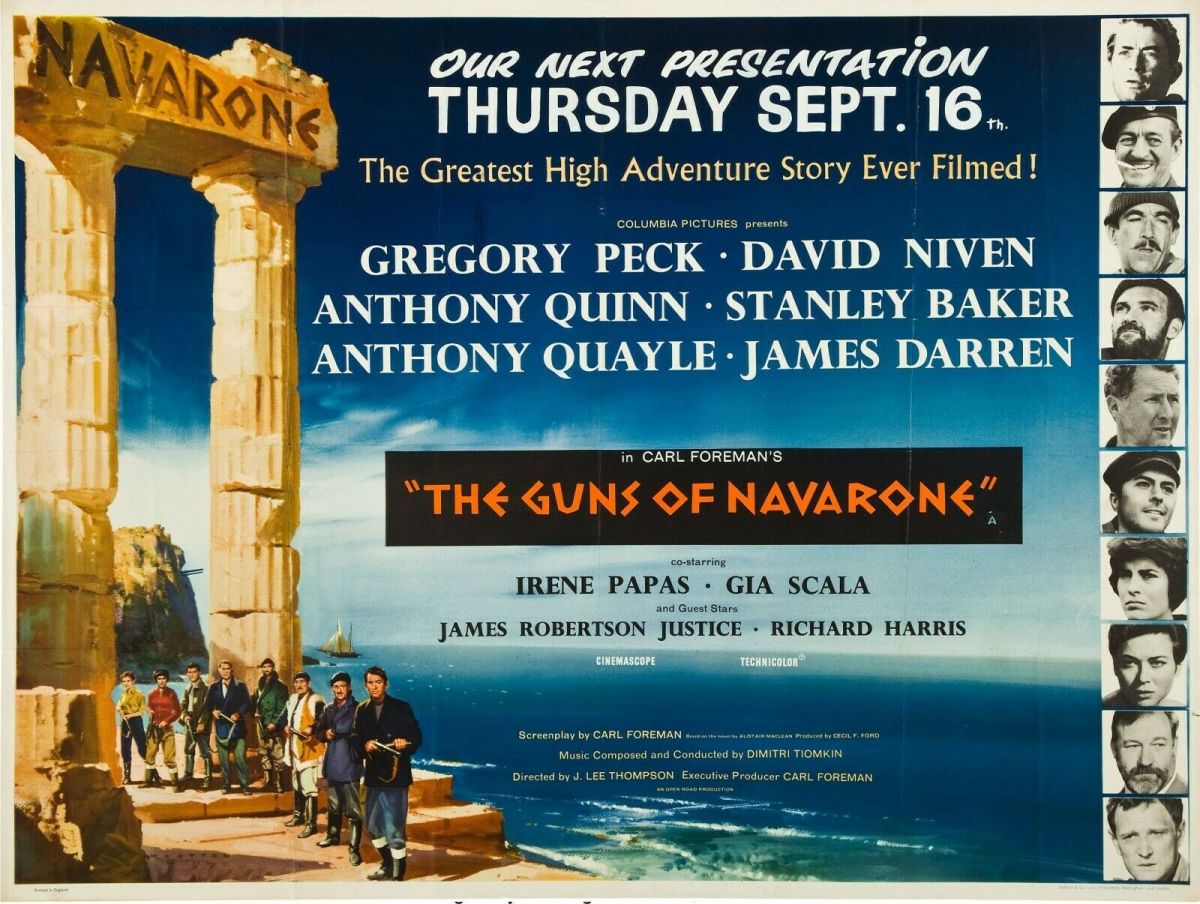
The Guns of Navarone (1961) *****

To celebrate this film now streaming on Netflix I thought i’d re-run a previous review.

Stone-cold action classic that blazed a trail for the big-budget men-on-a-mission war picture like The Dirty Dozen (1967) and Where Eagles Dare (1968). Brilliantly structured, written and directed,  and featuring a sea battle, storm, shipwreck, mountaineering, chase, interrogation scenes, infiltration of an impregnable fortress, a pair of romances, two traitors, and an awe-inspiring climax make this a candidate for one of the greatest war pictures ever made.

The set-up is simple. Knock out the gigantic guns at Navarone or two thousand men will perish. It’s mission impossible and the clock is ticking. You don’t know who to trust and the enemy is ruthless.

In the early days of the all-star-cast, producer Carl Foreman rounded up an astonishing line-up, bulking out the bestseller by Scottish thriller maestro Alistair Maclean (The Secret Ways, 1961) with three top stars in five-time Oscar nominee Gregory Peck (The Big Country, 1958), double Oscar-winner Anthony Quinn (Heller in Pink Tights, 1960) and Oscar-winner David Niven (Please Don’t Eat the Daisies, 1960). Add in British household names Anthony Quayle (Ice Cold in Alex, 1958), Stanley Baker (The Concrete Jungle, 1960) and James Robertson Justice (Doctor in Love, 1960), a sprinkling of rising stars in James Darren (Let No Man Write My Epitaph, 1960), Gia Scala (I Aim at the Stars, 1960) and Richard Harris (The Night Fighters, 1960) and renowned Greek actress Irene Papas (Antigone, 1961).
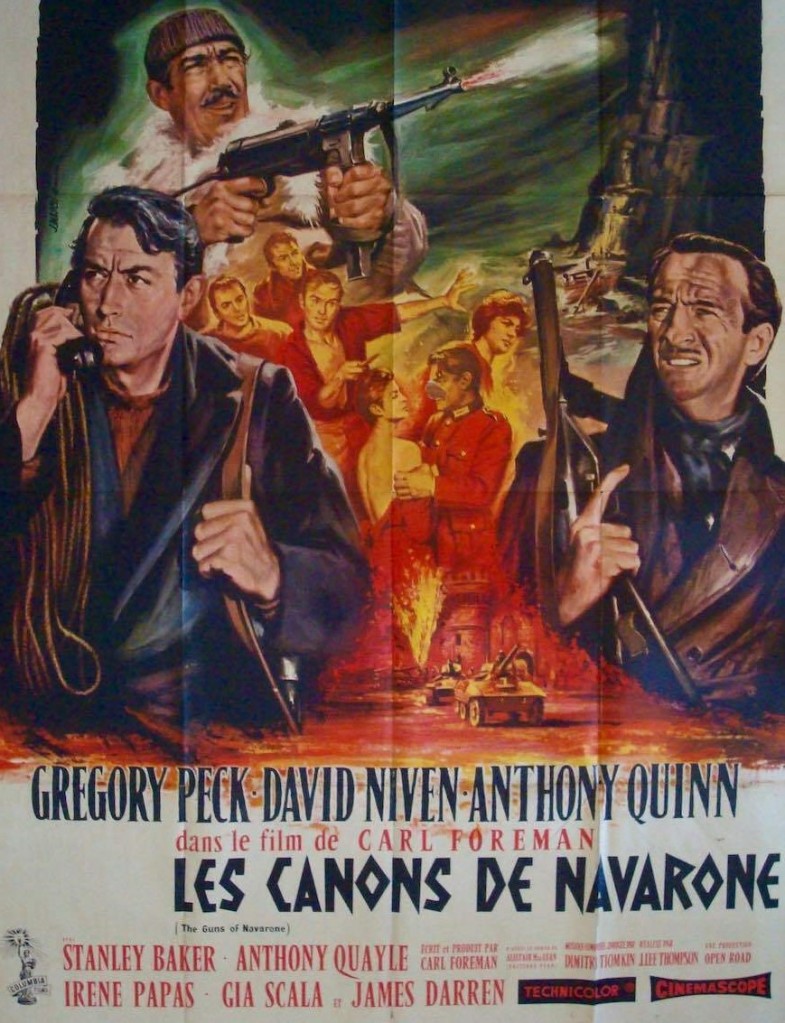
Each man is a specialist. Capt. Mallory (Gregory Peck) the mountaineer whose climbing skills are essential to completing the fist part of the mission, explosives expert Corporal Miller (David Niven), mechanic ‘Butcher’ Brown (Stanley Baker), Greek patriot Stavrou (Anthony Quinn) and the ruthless killer Pappadimos (James Darren) who has the contact with the Greek resistance. The stakes are ramped up when we learn both Mallory and Stavrou have bounties on their heads, not to mention the fact they are sworn enemies, and that before the mission even gets under way, spies are discovered in the camp. The ostensible leader of the group Major Franklin (Anthony Quayle) is wounded early on, turning him into a liability and making Mallory the de facto leader.

The stakes are ramped up further – this time through relationships. Their Greek contact turns out to be a woman, Maria (Irene Papas), brother of Pappadimos. She brings with her a mute girl Anna (Gia Scala) for whom Mallory develops romantic feelings while Stavrou has eyes for Maria. Mallory is also torn about Franklin, his best friend.

And from there it pitches into one disaster after another. They are too easily hunted by the Germans. They are shelled with mortars and attacked by dive bombers as they race across open mountains and through caves to reach their destination. They have to shoot their way out of traps and finagle their way into the fortress. There are twists and turns all the way, the clock ticking in almost James-Bond-style as the deadline for the destruction of the troops approaches.

And although this is clearly a war picture it is also as obviously an anti-war one, no end to the killing in sight, people dying pointlessly.

Although the acting was ignored come Oscar time, each of the stars delivers and it is a communal tour de force. Director J. Lee Thompson (Ice Cold in Alex) ensures that in visual terms none of the stars dominates, each given equal screen time while the strong supporting cast each has their own narrative arc. With over two-and-half-hours’ running time, Thompson has both the bonus of time to allow each element to be fully played out and the problem of keeping the picture taut and he succeeds brilliantly in both aims. It is a masterpiece of suspense. And it looked fabulous, the guns themselves, by which the picture might succeed or fail, were awesome.

Thompson was Oscar-nominated as was producer Carl Foreman for both Best Picture and the screenplay, Dmitri Tiomkin for the score (one of the longest-ever), John Cox for sound, Alan Osbiston for editing. Bill Warrington who did the visual special effects and Chris Greenham who did the sound effects were the only winners on the night.

It was a commercial smash, top picture of the year in the U.S., the biggest  picture of all time at the British box office and breaking records all over the world.
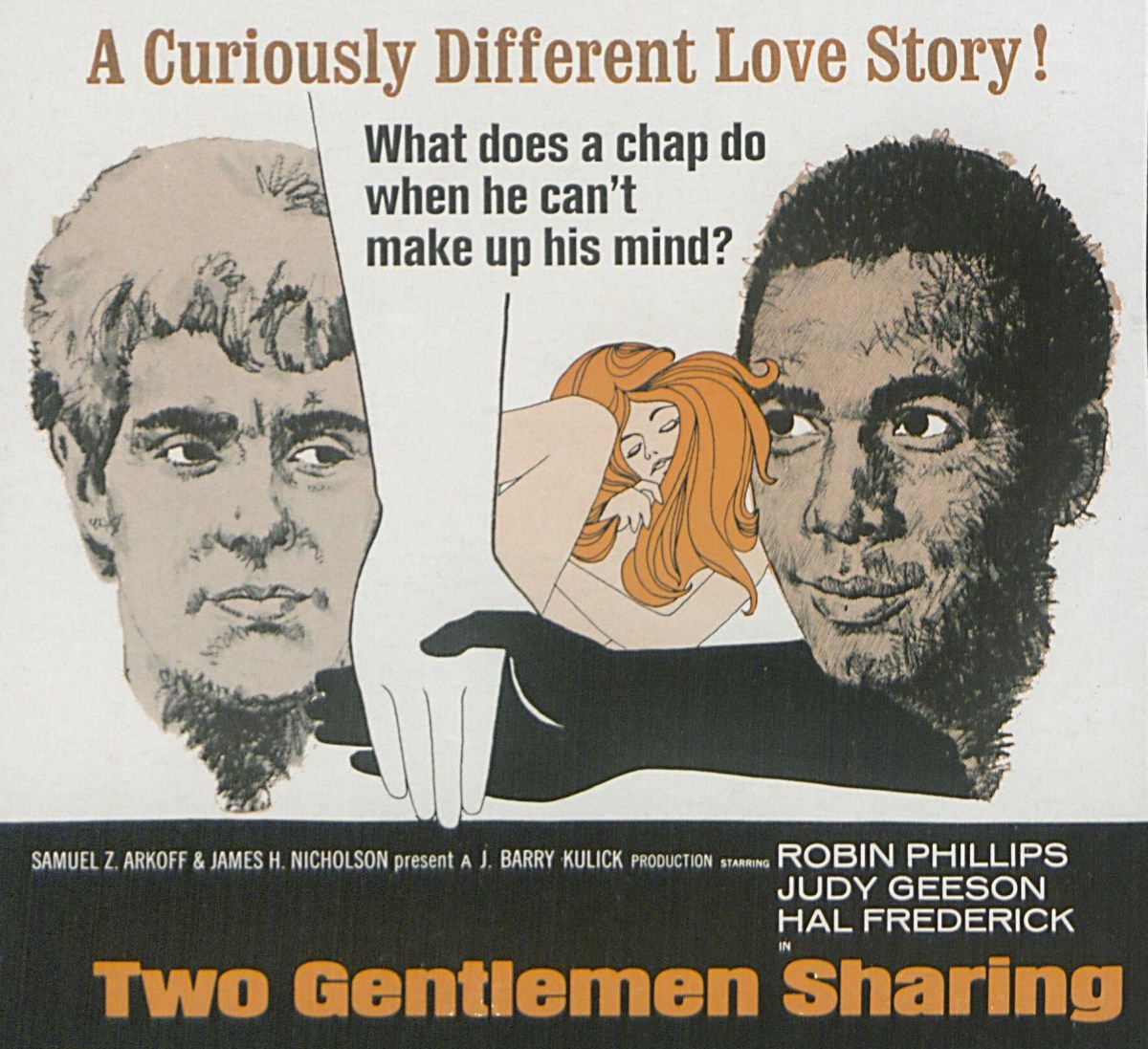
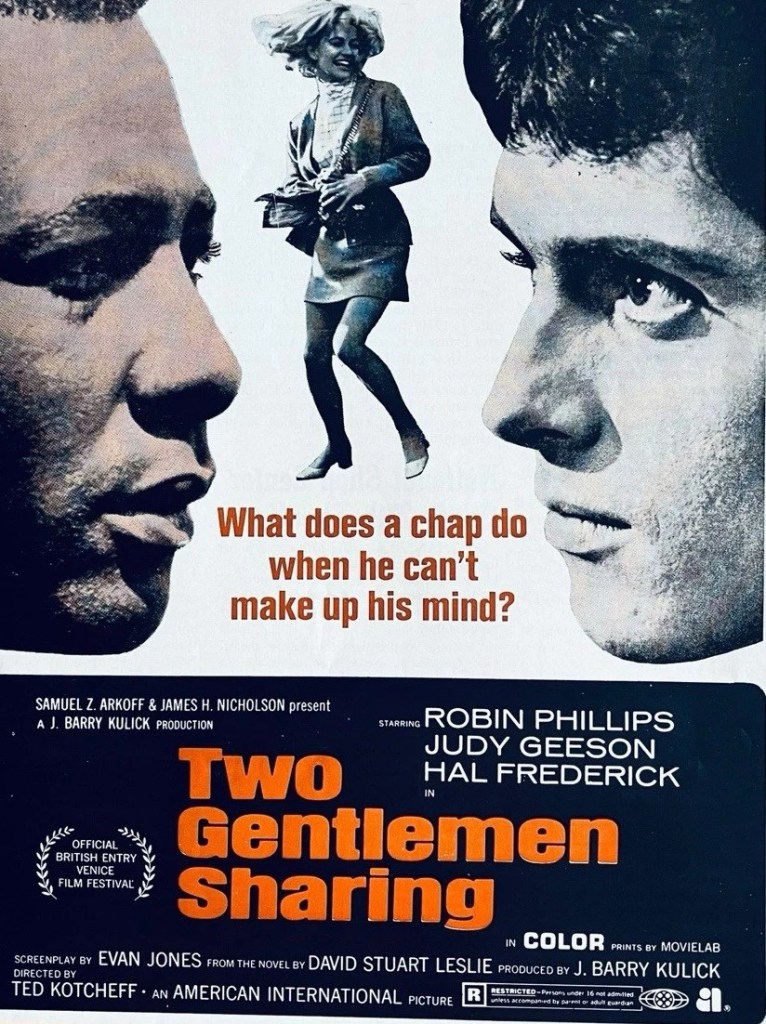
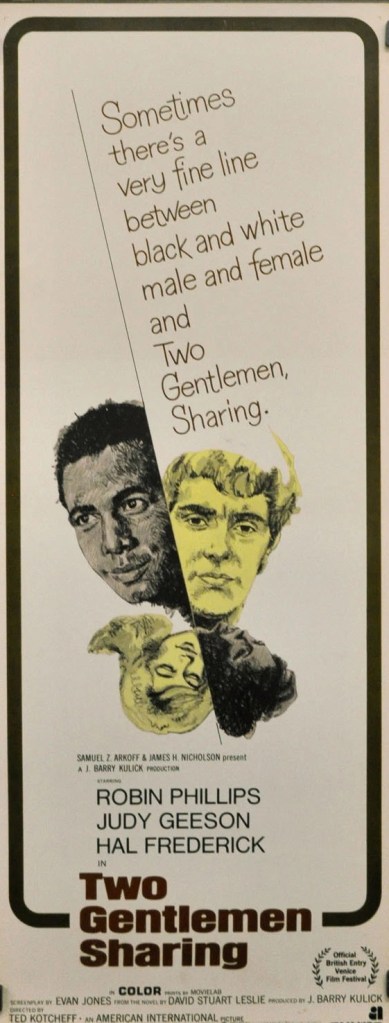
Two Gentlemen Sharing (1969) ***

Shelved was a polite term for what happened to this picture. It was funded by Paramount but they didn’t like the look of the finished article. It could have gone straight into the bin, but it was reprieved, sold onto AIP which was looking to shift away from horror and biker movies into mainstream productions. But though it was made in Britain and therefore would qualify for both the Levy tax credit and the quota system, AIP couldn’t find a British distributor to take it on, not even after being selected as the official UK entry to the Venice Film Festival and impressing New York critics. It wasn’t shown on a British screen until 2017.

So what the heck was wrong with it? I had wrongly assumed that the title was a hint that the two gentlemen were gay, but that isn’t the case.

We open with a fellow with a plummy voice called Andrew Mackenzie (Hal Frederick) calling round London landlords looking for digs. He’s a solicitor, wears a bowler hat, was educated at Oxford University, even famously scored a century in a cricket match – and you can’t fit in any more than being a top-class cricketer. But doors which would open for anyone else with such a pedigree are closed to him.

Problem is – he’s Black. He’s of Jamaican descent. He’s not homeless, he’s got digs in Brixton, a noted Black community. Eventually, he finds accommodation in very posh Knightsbridge with ad man Roddy (Robin Philips).

Racism had been tackled in the movie world primarily through the aegis of Sidney Poitier. His three 1967 films – To Sir, With Love, In the Heat of the Night and Guess Who’s Coming to Dinner, had all concluded on the upbeat. The Black man was accorded acceptance and respect.

That doesn’t happen here. The N-word is in common use. Andrew ends up being tossed out of the apartment by his landlady for essentially conforming to the cliché of being a “sexual degenerate,” i.e. for making too much noise while having sex. Eventually, he decides he’ll never fit in in Britain and returns to Jamaica.

But while the film deals bluntly with issues of endemic racism in British culture, it also tackles the problems facing the more socially aware, who tie themselves in knots trying to prove they are not racists. Although on the face of it accepting his flatmate’s color, Roddy has problems with his own beliefs. He’s certainly jealous of Andrew’s supposed sexual prowess, to the point of clearly believing he will enjoy more sexual freedom should he hitch up with a Black woman, and at various points exhibits inappropriate behavior towards them.

He also can’t come to terms with the fact that his girlfriend Jane (Judy Geeson) is not only very popular with Black men but has been brought up by a Black man after her own White father died when she was very young. To prove his liberal credentials once and for all, Andrew hosts a massive party in the apartment, inviting a crowd of Blacks, but when his drunken overtures to Black women are rejected, the party ends in disaster.

The characters are well drawn. Andrew is no saint. He’s misogynistic for a start, determining that his girlfriend Caroline (Esther Anderson) should do all the cooking and household chores. He’s arrogant and selfish, often grumpy. In other words, as human as the next guy.

Roddy is insecure. His job has none of the glamor we associate with advertising. His biggest decisions concern how many chips to have on a plate being photographed for an advertisement. Although coming from a wealthy background, his parents are now so impoverished they live in the squalid basement of a stately home. He has no understanding of women, tending to make too many of the wrong assumptions. So, just another young fella having problems growing up.

You’d think – and Roddy certainly thinks – that in the ad world he’d have a bevy of young women at his beck and call as does his colleague Phil (Norman Rossington) who, despite clearly taking advantage of his position in terms of seduction opportunities, is more enlightened – he has a Black girlfriend.

The movie’s very fair in determining when characters feel out of place. While Andrew struggles in the White world, Roddy and to a certain extent Phil struggle in the Black social world, bounding about awkwardly at a “jump-up”, the name given to a dance featuring Black music.

Given the actors are all primarily newcomers, showing promise is the extent of the acting. Reportedly Hal Frederick’s (Sandokan, 1964) plummy British accent was dubbed, but it is adequate for the task in hand which is to explore the minefield of the often unexplored aspects of British racism at a time when large-scale immigration was limited to certain cities and when the country still believed in “fair play” or convinced itself it did.

Robin Phillips (Decline and Fall…of a Birdwatcher, 1968) has a more complex part, needy, weak, his unformed unappealing character turning up at the edges. Judy Geeson (Three into Two Won’t Go, 1969) is better and Norman Rossington (Tobruk, 1967) throws himself into a peach of a part. Esther Anderson (The Touchables, 1968) is appreciated.

Canadian director Ted Kotcheff (Life at the Top, 1965) pulls no punches and certainly there is no sign of sentimentality or that, somehow, everything will all come good in the end. Screenplay by debutant David Stuart Leslie from the bestseller by Evan Jones.

Worth seeing if only to ask why we were kept from seeing it for so long. You can catch it on Amazon Prime at the moment.

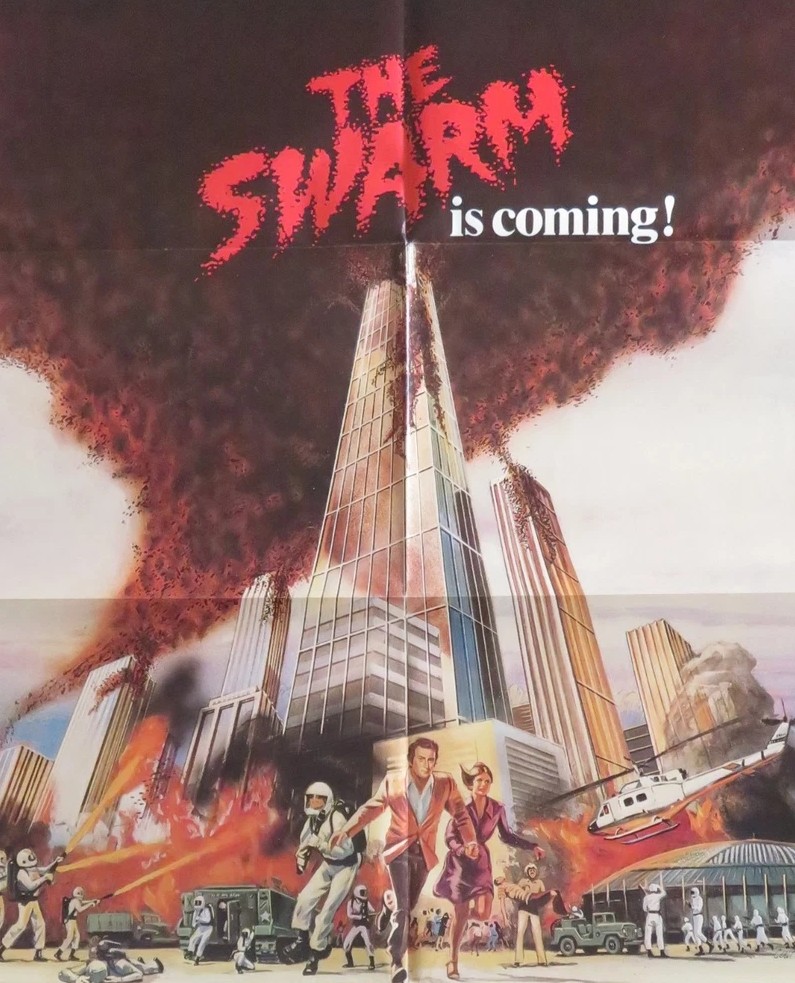
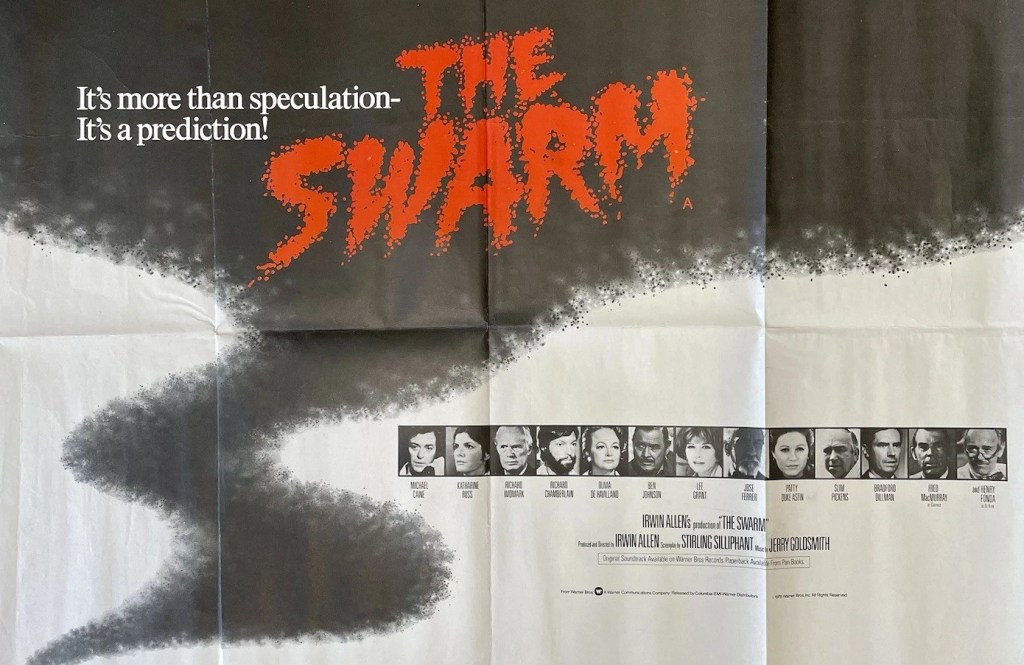
The Swarm (1978) *

I’m delighted to inform you that there was only disappointment this time around, no provisos to save the day, no reassessment to make me change my original views. This truly is a terrible picture. Possibly the worst to involve Michael Caine, who was no slouch when it came to making inadvisable choices. Just as with The Island (1980) which on paper appeared a slam-dunk hit coming as it did in the wake of Jaws (1975) and The Deep (1977), based on Peter Benchley bestsellers, this looked like a no-brainer, another Irwin Allen disaster picture following on from mega-hits The Towering Inferno (1974) and Earthquake (1975).

It’s tempting to blame it on the bees. The special effects creating the sky-borne swarm makes them look like nothing more than a strange smudge on the screen. And the bodies or cars or helicopters smothered in millions of static bees score pretty low, actually, on the scare-o-meter, nothing like a giant shark on the loose. Anyone caught in the swarm has to go into some kind of slow-motion dance that fails to shake them off.

Sure we’ve got a runaway train coming off the tracks and sliding down a hill, but the action quotient is surprisingly pretty low. The opportunity, a la The Birds (1963), to lay low a town is ignored and after a few peremptory shots of bees causing havoc we’re stuck with TV reports. Even giant bees, caused by hallucination, might cause an audience to vaguely squirm but it doesn’t replicate the gut-wrenching terror of a killer shark or the tension of a burning skyscraper.

The cast spend most of their time in exposition mode, or arguing with each other as to whose exposition is better. We know a heck of a lot more about the bees, and why they’re on the rampage, some nonsense about alarm horns replicating the sound of bees mating, than we do about any of the characters.

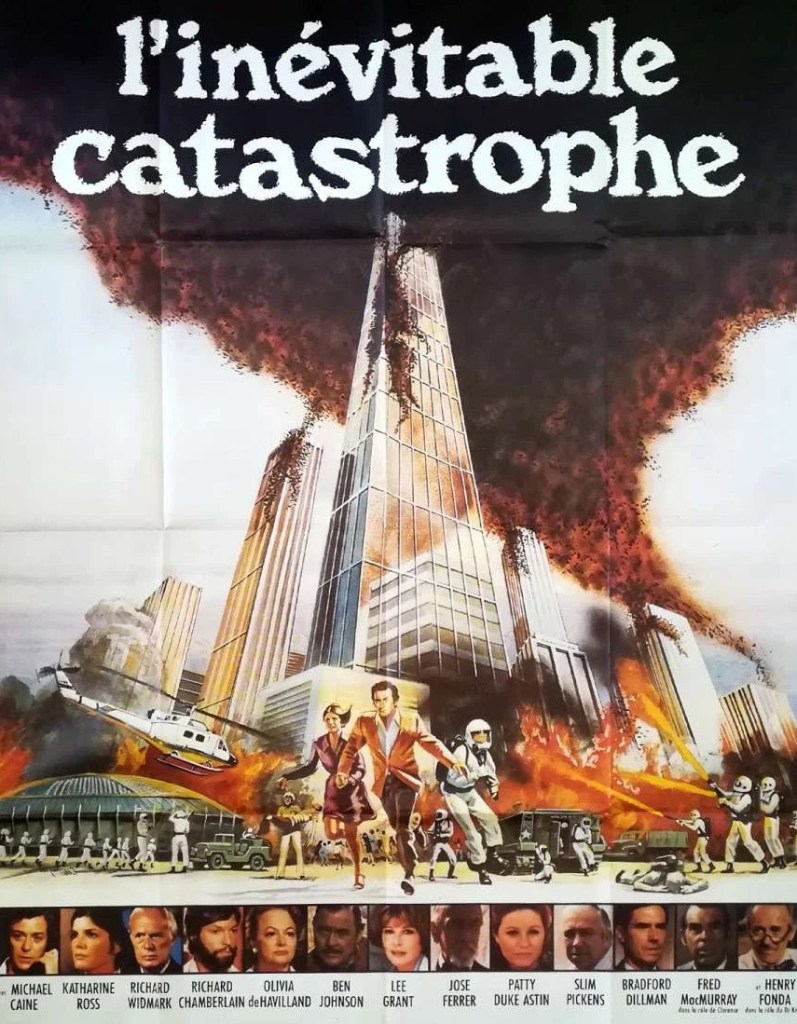
There’s a smidgeon of romance between Dr Bradford Crane (Michael Caine) and Capt Dr Helena Anderson (Katharine Ross) but it doesn’t get beyond the teenage (“am I walking too fast for you?). And there’s a truly terrible attempt at romantic comedy as old codgers Felix (Ben Johnson) and Clarence (Fred MacMurray) fight over school marm Maureen (Olivia De Havilland) who looks as if she’d like to crack their heads together.

A young boy is caught up in the melee and a pregnant woman, and I was looking out for the statutory nun, a strange omission is a disaster narrative.

The only effective bit of the movie is the opening when a squad of soldiers all Hazchem-med up descend on a deserted missile base and find the entire garrison – apart from a half-dozen – lying dead on the floor. That Dr Crane happens to be passing by leads to a stupid subplot where Major General Slater (Richard Widmark) and sidekick Major Baker (Bradford Dillman) take  the suspicion option and look for an excuse to bang up the academic.

This initially went on general release in a curtailed version running just short of two hours rather than the original 155-minute cut which you can now catch, as I did, on YouTube.

You can’t blame Michael Caine (The Island, 1980) for this mess and he would have acquitted himself well if there had been any actual acting to be done outside of the exposition and arguing with the major general. His best scene is when he gently carries crippled mentor Dr Krim (Henry Fonda) into his wheelchair. Katharine Ross (Hellfighters, 1968) has such a restrained screen persona half the time you think she’s going to burst into tears.

Uber-producer Irwin Allen (The Towering Inferno) had decided by this point that he could dispense with a name director and take on that chore himself. But I doubt if anyone could have made a better job given they were stuck with bees and a terrible script by Stirling Silliphant (In the Heat of the Night, 1967).

A true stinker.

The Island (1980) ***

By common consent one of Michael Caine’s worst films – on a par with The Swarm (1978), The Hand (1981), Jaws, The Revenge (1987), and, for sheer embarrassment, Blame It On Rio (1984) – so naturally I had steered clear of it for four decades. But in the grip of reassessment fever and given how big a fan I am of pirate films, I wondered if I might come to a different conclusion after another vewing.

This was being touted as another blockbuster from the author of Jaws (1975) and The Deep (1977) so it’s entirely possible the actor was not necessarily its biggest drawing card.

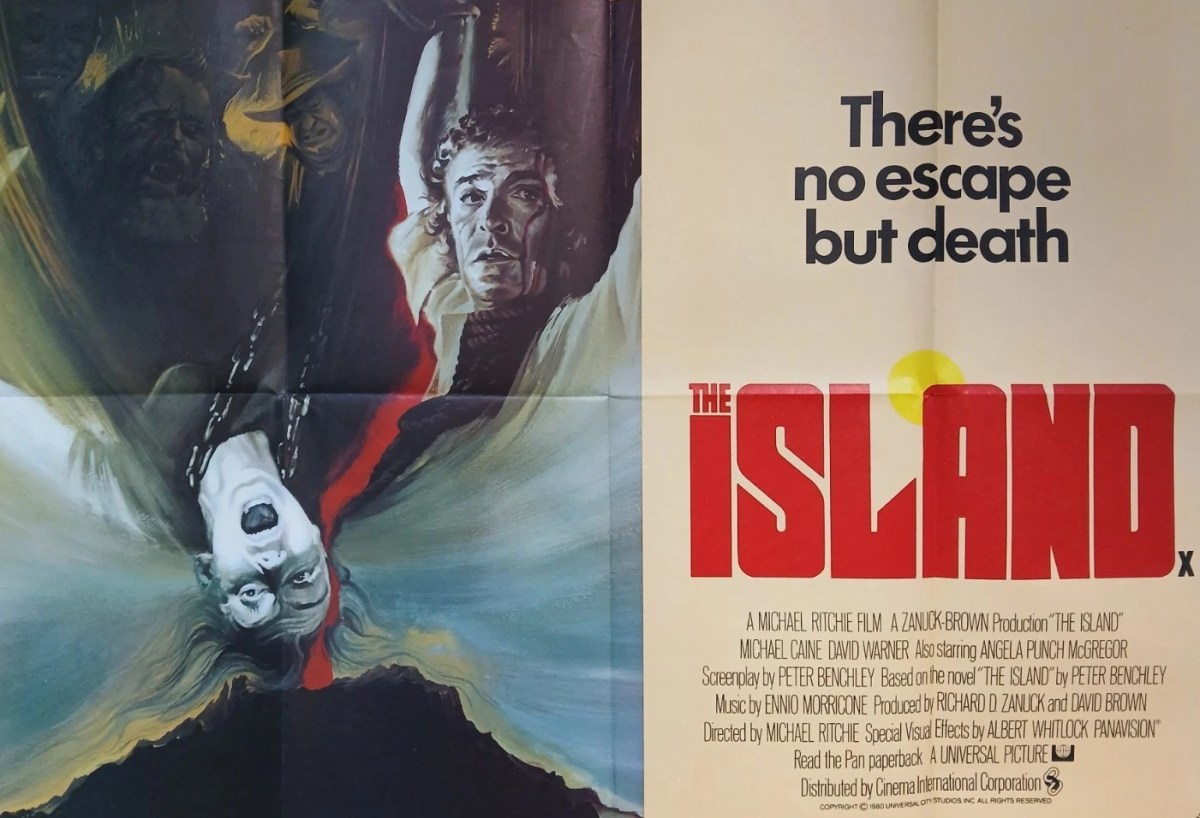
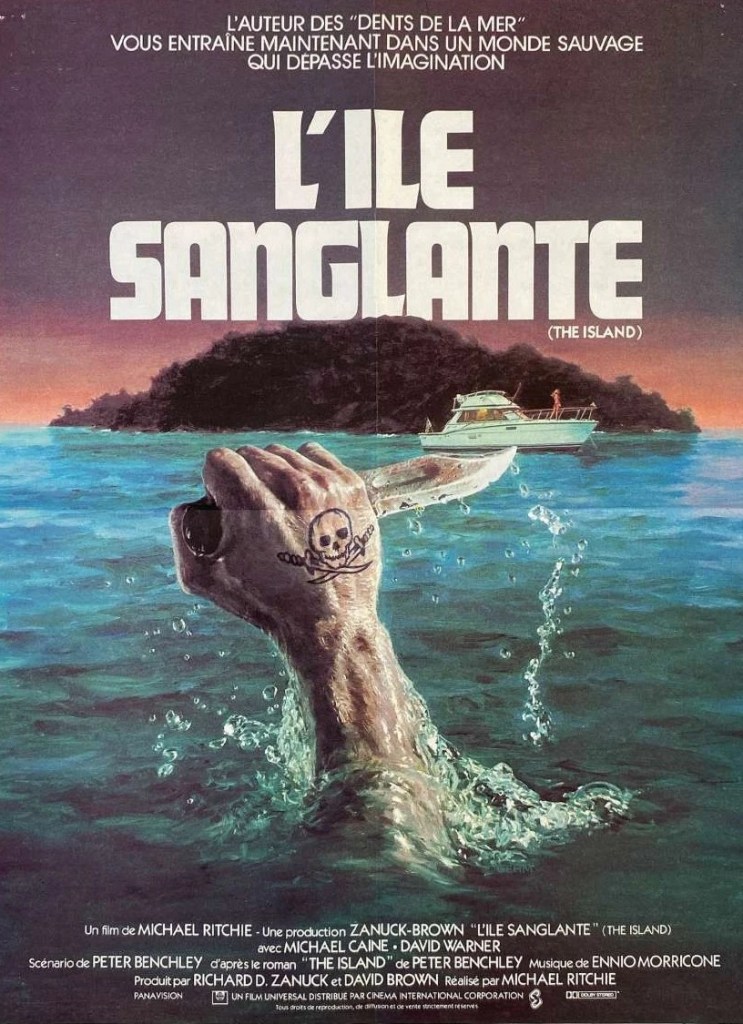
The odd thing is that – terrible though it is – it has some aspects very much in its favor. And if it had the courage of its convictions would have taken The Wicker Man route and not permitted journalist Blair Maynard (Michael Caine) to escape from the titular island where he is being held captive by a primitive tribe of pirates. Once he had fulfilled his purpose, which was to impregnate a female pirate, he could as easily have had his throat cut.

There is also some power reversal. He’s raped by said female, Beth (Angela Punch McGregor), and she keeps him chained by the neck, dragging him along behind her like a pet. And there’s an exploration of the gun-love fantasy, expressed by Blair’s  12-year-old son Justin (Jeffrey Frank), given the chance to wield a pistol like his hero Dirty Harry, enjoy the feeling of pulling the trigger, and in an extreme version of early teenage revolt, embracing the opportunity to put one over on his father.

And you might also go for the islanders, untouched and therefore uncorrupted by civilization, who still negotiate the seas in small sailing craft, and, except for their murderous instincts, could easily come across as innocents, living the same life – the “good life” in the eyes of many these days – as they would have done 300 years ago.

What counts against the movie is, for a start, the set-up. Had Blair been just on a sailing trip with his son and been captured by pirates that would have been fine. Instead, he’s a journalist managing to convince his editor to send him to investigate that hoary old chestnut, the Bermuda Triangle.

While the pirates are a gift to anthropological studies, sometimes they speak in perfect English, sometimes they speak pidgin English, sometimes they’re speaking in some form of Olde English complete with naff ritual and rules. Although they’re desperate to find a way of prolonging their species – which is where Blair comes in – they tend to kill any other males or females who could help them achieve this aim.

And although they steal plenty of modern supplies in the way of food and clothing from the ships they pirate, they still wear scraps and live off scraps.

When Blair attempts his first escape the presence of a giant jellyfish cuts that short. But, miraculously, the next two times he’s in the water, no jellyfish. Not much of this is discreet, but there is one relationship that gets by with looks. A young island boy, jealous of the attention given to Justin by Nau (David Warner), the pirate chief,  appears to be helping Blair escape in a tiny craft until, far out at sea, the journalist notices that the boat has been sabotaged and is sinking fast. Even so, it’s a bit complicated. I couldn’t work out the young fellow’s motives. Getting rid of Blair wouldn’t get rid of his rival for the chief’s affections.

The ending is a complete mess. Luckily, we’ve been informed that Blair fought in the Korean War so when he finds a deck-mounted machine gun on the U.S. Coastguard vessel the pirates have just taken over, he can open fire like Rambo and slaughter near enough the entire contingent of his enemies. The only survivors are his son and Nau, so we can have one last hand-to-hand skirmish, and the boy and father can enjoy a sentimental reunion.

So, yes, this is a hidden civilization, a lost tribe, that might be treasured for living the simple life, but Blair, despite being a journalist, is hardly salivating at the prospect of his scoop. Too much time is spent on trying to establish the pirates’ way of life via their rituals and oddities.

But this was certainly a bold move on Caine’s part, to take on a role that was akin to Charlton Heston in Planet of the Apes (1968), to be treated as not just an inferior but only useful for his semen. The reversal of the power balance between himself and Beth, who, as in Planet of the Apes, begins to care for her captive, would certainly chime with the contemporary audience.

There’s very little that’s noble about the savages, all are unkempt and few have a full set of teeth.

But Caine does put in a good acting shift. Angela Punch McGregor (The Chant of Jimmie Blacksmith, 1978) is the pick of the rest. David Warner (Morgan!/Morgan, A Suitable Case for Treatment, 1966) excels in this kind of oddball part. Jeffrey Frank didn’t make another movie.

Disappointing choice, though, for director Michael Ritchie, who had built up a solid reputation through Downhill Racer (1969), Prime Cut (1972), The Candidate (1972) and Smile (1975). Written by Peter Benchley.

To be honest, I’m a bit disappointed to find so much to admire in what I had expected to be an ideal candidate for the So Bad It’s Good category.

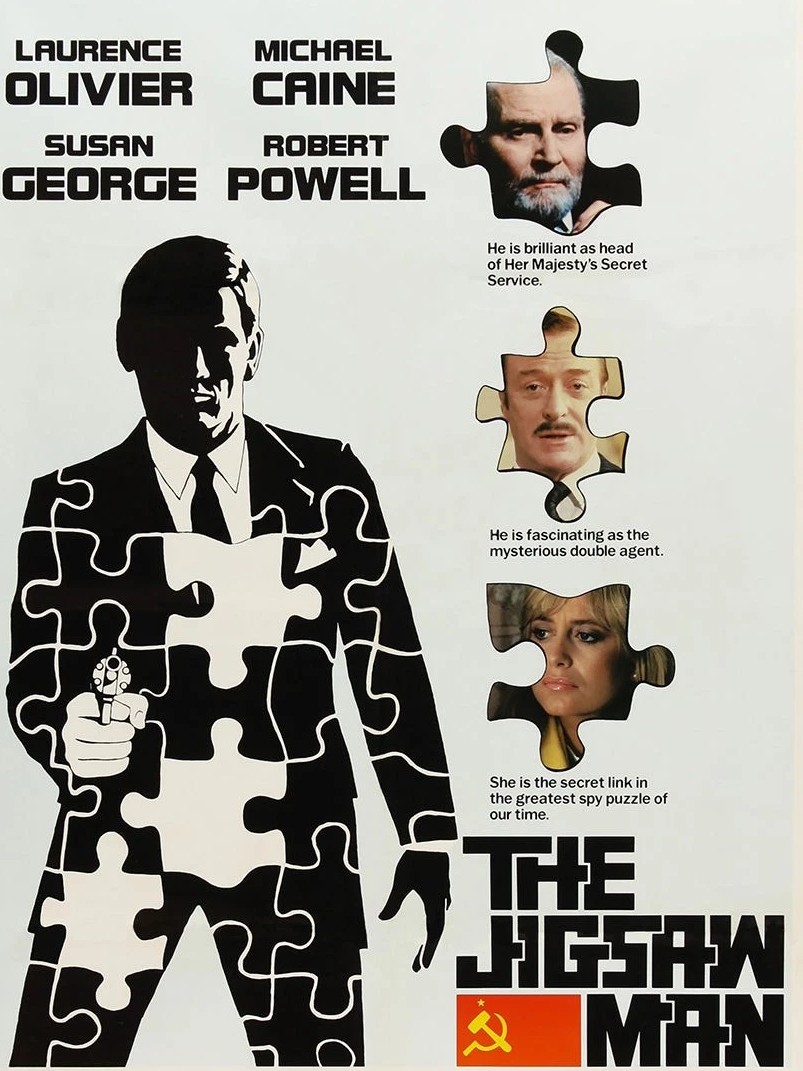
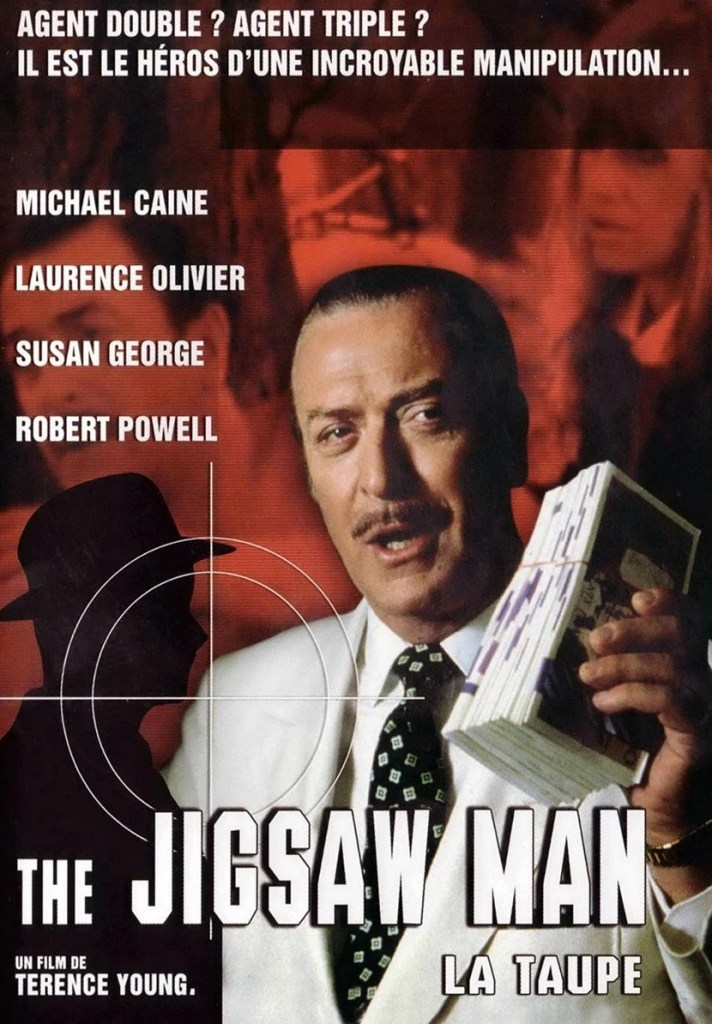
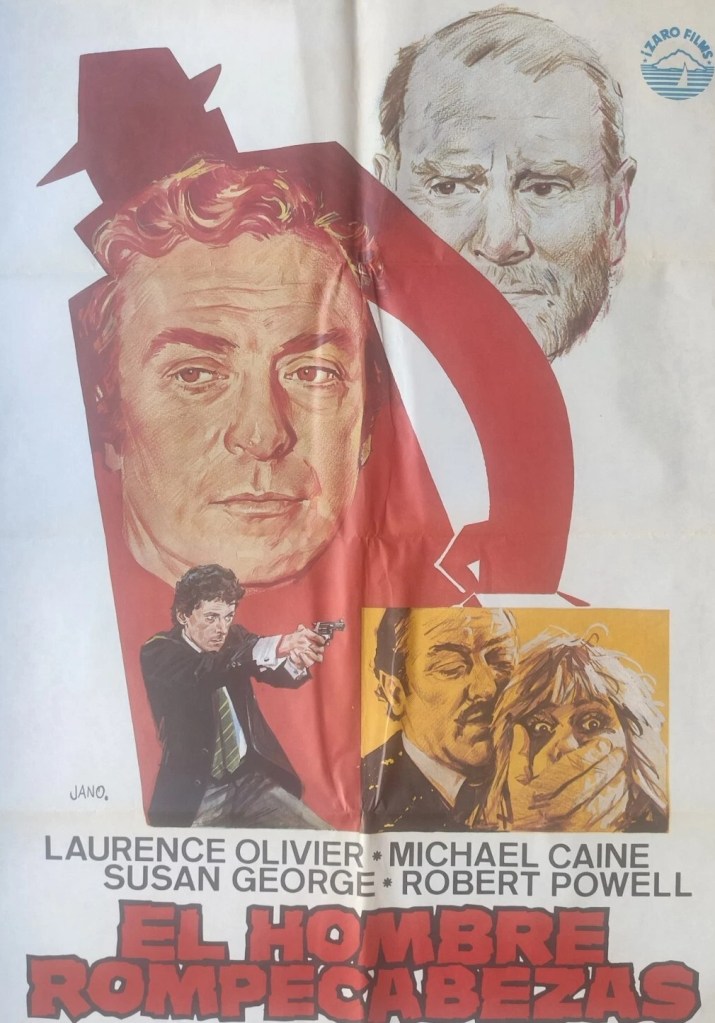
The Jigsaw Man (1983) ***

If you watched Michael Caine movies non-stop for 24 hours a day, it would take you two weeks to complete the haul. That’s how many pictures he made. So it would be no surprise if they were: a) not all top-notch and b) included a good few stinkers. But every now and then he had the habit of pulling out a plum, a critically-acclaimed number and/or a box office hit. His marquee attraction continued long after, by any other standards, his career as a top-billed star was over. And once he accepted that he was no longer the main reason audiences would come to see his pictures, he found himself in huge demand as a supporting actor (two Oscars in that department to his name), often second-billed and in late career some kind of lucky charm for Christopher Nolan who pegged him for distinguished parts.

This isn’t by any means a stinker and it’s somewhat lifted by the very human frailties of those involved. One character is vain about wearing a wig, another is more concerned about recovering his Cup Final tickets than a defector on the lam, there’s a golf-obsessed vicar, predatory males moving in on the wife and daughter the defector left behind, a car chase in a safari-style zoo (elephants looking on in bewilderment) and Laurence Olivier playing the debilitation of age extremely well.

The Russians send defector Philip Kimberley (Michael Caine), former head of the British secret service, back to Blighty with a new face and the plan to recover a secret film that he has stashed away somewhere, presumably as a bargaining tool. Since the microfilm contains the names of all KGB agents including moles in Britain, it sets him up as a target for said double agents fearing discovery. The Burgess-Philby-MacLean defections that sent British espionage into a spin would still have been of huge public interest at the time the movie was made, especially as “The Fourth Man,” Sir Anthony Blunt, who also moved in royal circles, had been denounced in 1979. But for anyone watching with scant knowledge of the espionage scandal, the movie gives a brief reminder using news footage.

However, Kimberley has a different agenda when he lands in Britain, giving his Russian handlers and the Brits the slip and sets out to sell the microfilm to the highest bidder to fund retirement in Switzerland. His wife, with whom current spy chief Admiral Sir Gerald Scath (Laurence Olivier) was in love, is now dead but his daughter Penelope  (Susan George), now grown-up, has changed her name to avoid media attention. Her beau Jamie Fraser (Robert Powell) is in reality a secret service agent charged with keeping tabs on her.

Although Kimberley has been trained in the martial arts, he’s long lost his tradecraft skills and though he puts a cop out of action he forgets to dispose of the policeman’s walkie-talkie which gives away his position.

Most of this is a chess game rather than a jigsaw, it’s not that difficult for the espionage experts to put the pieces together, especially after Kimberley is reunited with his daughter, who appears to happily set aside the deaths of two innocents caught up in the affair, blame for which is attributed to her father’s presence or his too heavy-handed karate chop.

Action is limited, a chase on foot, some clambering over rooftops, the aforementioned car chase, a couple of firearm exchanges, but mostly it’s Kimberley putting all the pieces in place until he gets what he wants.

There’s a clever trick at the start when Michael Caine’s voice emanates from clearly another man’s mouth before he goes under the scalpel for the face change.

Michael Caine (The Ipcress File, 1965), essentially plays three roles – the original surly alcoholic Englishman in Moscow, liable to embarrassing displays in public, the Russian character he adopts for the purposes of appearing an ordinary defector before anyone susses out his real identity, and the better-behaved Englishman trying to woo back his daughter and con the likes of the Admiral. You’ll guess one of the twists at the end but not the other.

Laurence Olivier (Khartoum, 1966) steals the show as the ageing bureaucrat. I know he was ill at the time of filming but, still, his decision to play his part without the normal Olivier vocal tics and sense of immediate screen authority, and play up his physical weakness and waning powers,ensures you keep your eyes on him during any scene he’s in.

Charles Gray (The Devil Rides Out, 1968) provides another of his languid effete portrayals characters with a steely interior. Susan George (The Straw Dogs, 1971) and Robert Powell (The 39 Steps, 1978) bring up the rear.

Director Terence Young (Mayerling, 1968), in his second last movie, shows some classy touches.  Written by Jo Eisenger (They Came to Rob Las Vegas, 1968) from the bestseller by Dorothea Bennett.

This is as good an example as any of Michael Caine’s wayward career. This fell into the flop category. His previous film Beyond the Limit/The Honorary Consul (1983) had also been a financial dud, though his acting won favor with Bafta (a nomination for Best Actor). But the one before that, Educating Rita (1983), had not only been a commercial success but won Caine an Oscar nomination. Deathtrap (1982) had been a so-so performer. But while Escape to Victory/Victory (1981) and The Hand (1981) had been clinkers, Dressed to Kill (1980) had been a huge success.

After The Jigsaw Man came three more duds before a return to form – and an Oscar win – for Hannah and Her Sisters (1986) and Mona Lisa (1986).

You can catch this on British streamer Talking Pictures TV.

Standard spy fare lifted by the acting

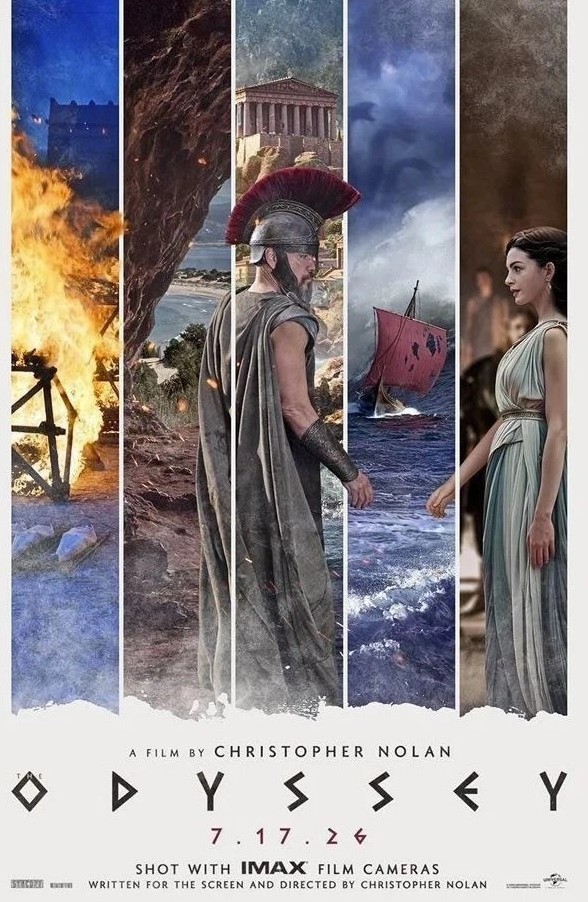
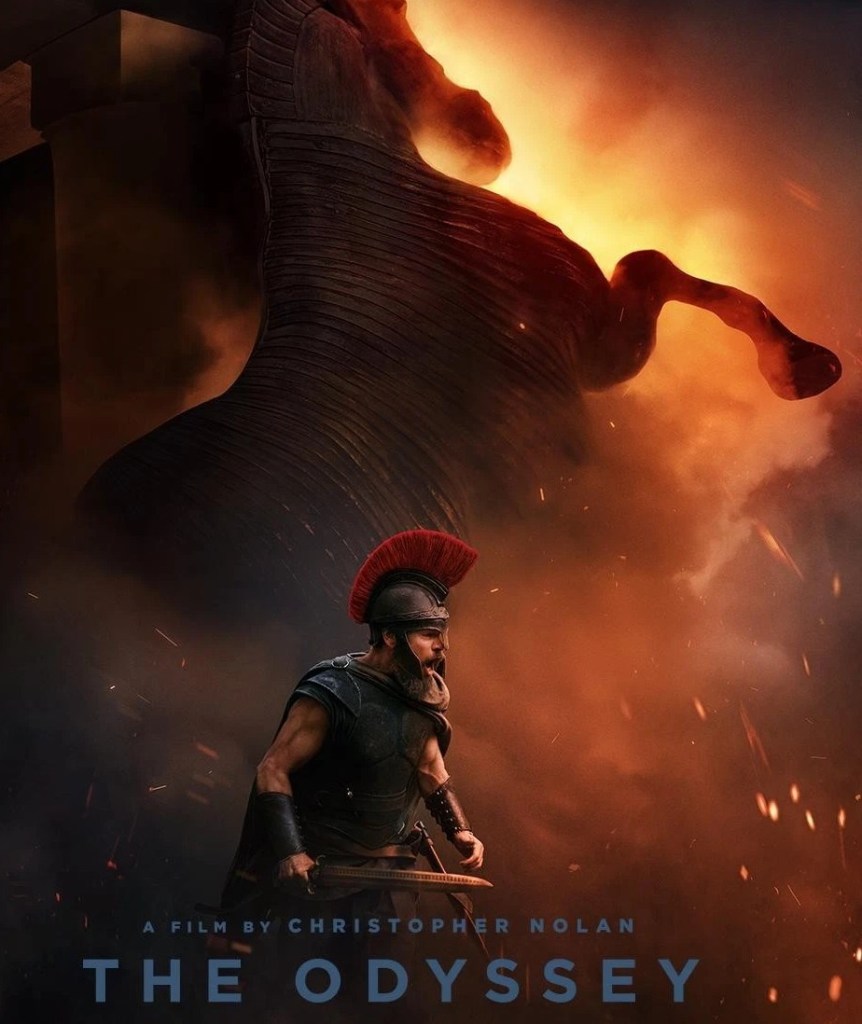
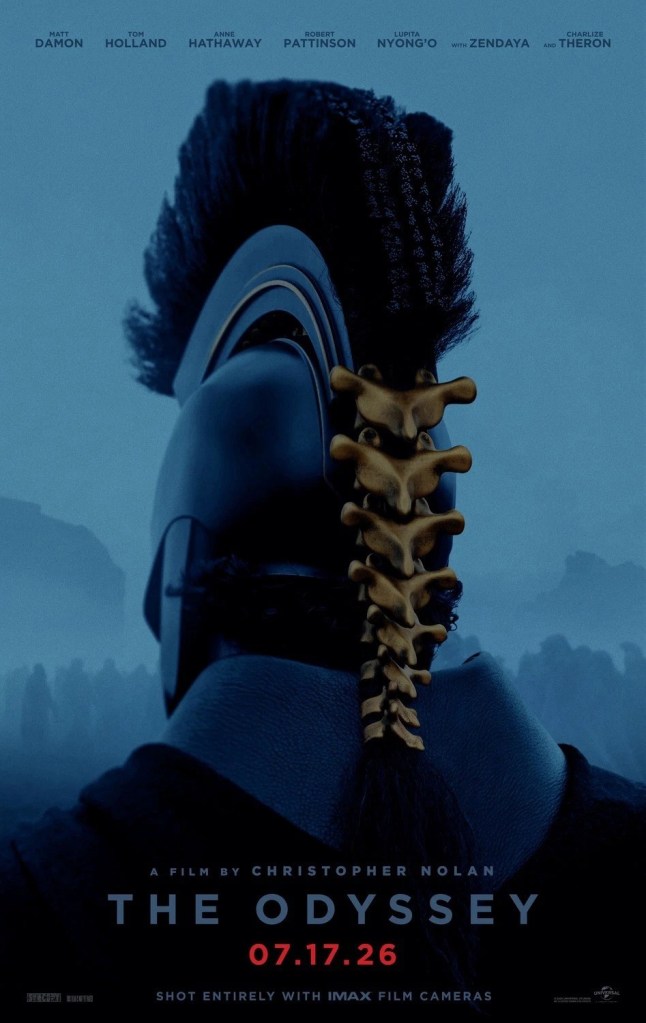
The Odyssey (2026) ***** – Seen at the Cinema, Twice in the One Day

What sets Christopher Nolan aside is not the visual dexterity, imagination or the confidence of his reach, it’s his intelligence. Once you come to the tortuous end, having perhaps shifted time or point of view several times, and wondered at all the amazing stunts or worlds he has opened up, you are left with something utterly human. Emotion that leaves characters bereft. Here, he turns on its head the greatest deception ever practised in war – the Wooden Horse of Troy. Instead of, as since time immemorial everyone has done, praising the trick and Odysseus the ultimate trickster, he chooses another route in his ruthless examination of the artifice. In sneaking the horse into the besieged city, Odysseus has broken the most basic rule of Civilization. A stranger must be given hospitality. And the visitor must leave his weapons at the door. In this picture it’s known as The Code of Zeus, but it’s what held ancient Greek Civilization together, that trust in one another. Strangers were welcomed and once inside a foreign abode they did not seek to carry out violence.

On top of that, the hero realizes what a hero actually is. Once the warrior in him is let loose, the havoc is unjustified. That PTSD and war guilt would probably be enough for any contemporary audience, yet the confession of Odysseus turns out to be the re-wooing of his wife Penelope, telling her he is not at all, after two decades apart, the man that he once was.

There are few directors who can genuinely claim to be auteurs. Usually, they are not screenwriters so are stealing someone else’s original invention. While Nolan relies heavily on the writings of the legendary Homer, he not only Nolanesques everything, the screenwriter in him takes care to ensure that the groundwork is quietly laid for what will spark emotional tumult later on.

There are four exceptionally clever examples of this. Odysseus’s old dog is on the point of death. When Odysseus strokes him, in recognition the dog wags his tail. At this point Odysseus is in disguise – two decades separating him from an infant son now grown up – and it’s how his heir Telemachus recognizes him. Emotional beat no 1. The younger Odysseus has been gored in the ankle by a boar. When he returns, still in disguise, his nurse recognizes him from the scar. Emotional beat no 2. Odysseus has a bow that only he is strong enough to use. Once it’s ready, he’s in the habit of pulling on the bowstring so it gives a distinctive twang. It’s that twang that makes wife Penelope, in a state of desperation, realize that her husband has come home. Emotional beat no 3.

But the best is the mystery sewn into the lining of the script. Everyone lives in a state of fear. They are preparing for invasion by the unknown. “People from the sea” are reputed to be on their way, who knows from where, nobody knows who they are. When the solution is found it’s an overriding emotional beat no 4 – Odysseus himself is one of the people from the sea, the Greeks who landed on the shores of Troy and set siege to the city and eventually burned and pillaged it.

For all the monsters and witches and slaughter, there is incredible restraint. There’s no nudity. There’s no rape shown or even visually implied. But when Odysseus speaks of the horror of war, we know to include that element.. While it’s certainly stated on several occasions that women, either killed as innocent bystanders or left behind and prey to any passing male predator, they have ways of defending themselves. The witch Circe can turn men into pigs. The sorceress Calypso uses lotus leaves to keep her lover sedated. Penelope keeps her suitors at bay with a clever ruse. Agammemnon’s wife can’t be bothered with any of that, she simply cuts her husband’s throat on his triumphant return.

I’m not so familiar with the Greek myths. I’ve not read Henry Treece since childhood. So I can’t tell you what Nolan has adapted, eliminated or added. But I can tell you it all adds up. All the legends I expected are here – the one-eyed Cyclops, the whirlpool Scylla, Charybdis, Circe, the lotus eaters, the underworld, Troy. I don’t recall the giant soldiers so they may or may not be figments of the director’s imagination. For heroes, the Odysseus gang do a lot of running away as they head for home. And for all that he is hailed as the cleverest of the Greek generals, Odysseus is a mite dumb at time, incapable of reading the room on the boat, unwisely irritating monsters.

Matt Damon (The Martian, 2025) is terrific as Odysseus, and while redoubtable in action, is tasked with carrying the emotional thrust, the fatigue and guilt of war, the knowledge that his actions could bring down Civilization. Anne Hathaway (The Devil Wears Prada 2, 2026) is surprisingly good as his wife, the totem for the women left to suffer. Of the rest, Robert Pattinson (The Batman, 2022) is easily the pick as the glowering surly cowardly suitor. Samantha Morton (Minority Report, 2022) is gleefully venomous as Circe. I’m not entirely sure what Zendaya (Challengers, 2024), as ghostly goddess Athena, is doing in the mix and Charlize Theron (The Old Guard, 2020) as Calypso is mostly there for the exposition and it sometimes feels as if that’s the sole purpose of Tom Holland (Spiderman: No Way Home, 2021) as Telemachus.

Jon Bernthal (The Accountant 2, 2025) and John Leguizamo (Tin Soldier, 2025) stand out for the wrong reasons. They sound as if they’ve strayed in from a Martin Scorsese gangster picture.

Back in the days before VHS, DVD and streaming, you couldn’t watch a picture over and over. But occasionally, I’d be so taken with a movie that, in the days of continuous performance (you might not know what that is but when you go to the movies these days it’s for a separate performance, everyone kicked out after the showing) I would stay on and watch it again.

First time I did that it was for Terence Malick’s hypnotic Badlands (1973) – Martin Sheen, Sissy Spacek, Erik Satie – when it turned up in the UK as the support to It’s Alive and there have been countless other examples. So, on my weekly Monday outing to the cinema, I decided I’d take in this picture again rather than grumble at whatever The Evil Dead Burns brought to the table.

When you watch a movie a second time, you’re not held in your seat by the narrative. You know what’s going to happen. You can marvel at all the rest, the writing, the camera movement, the special effects, the acting. I’ll probably go back next week.

Truly awesome.

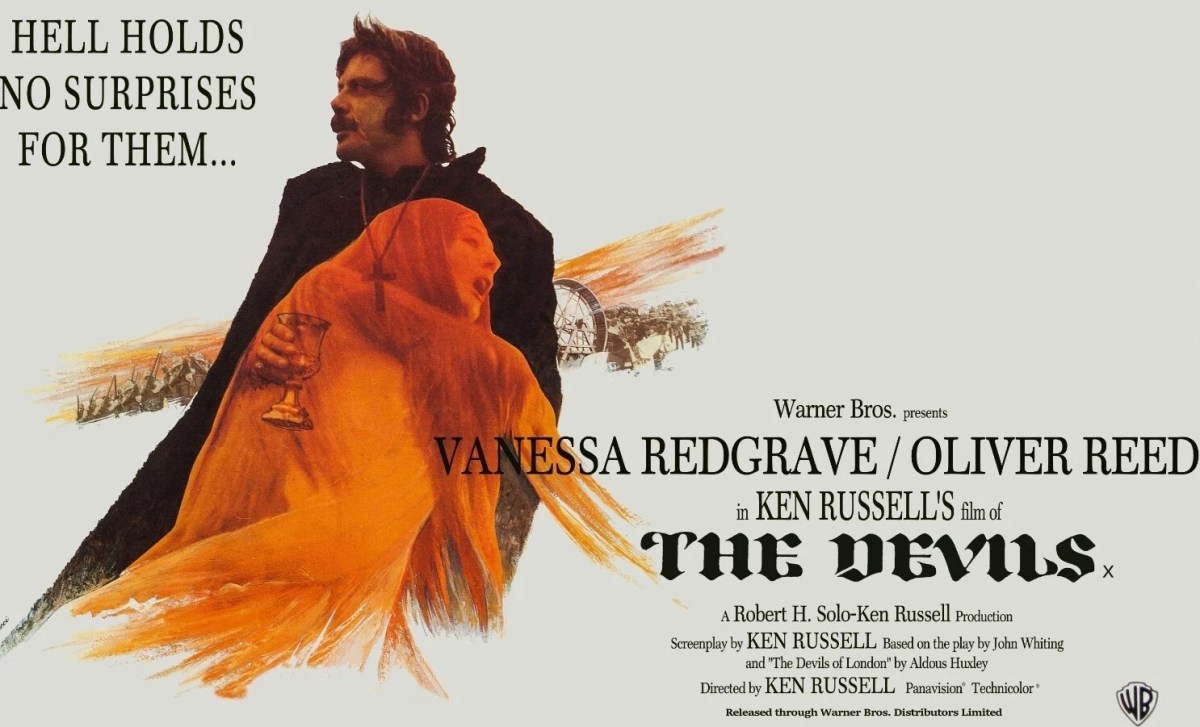
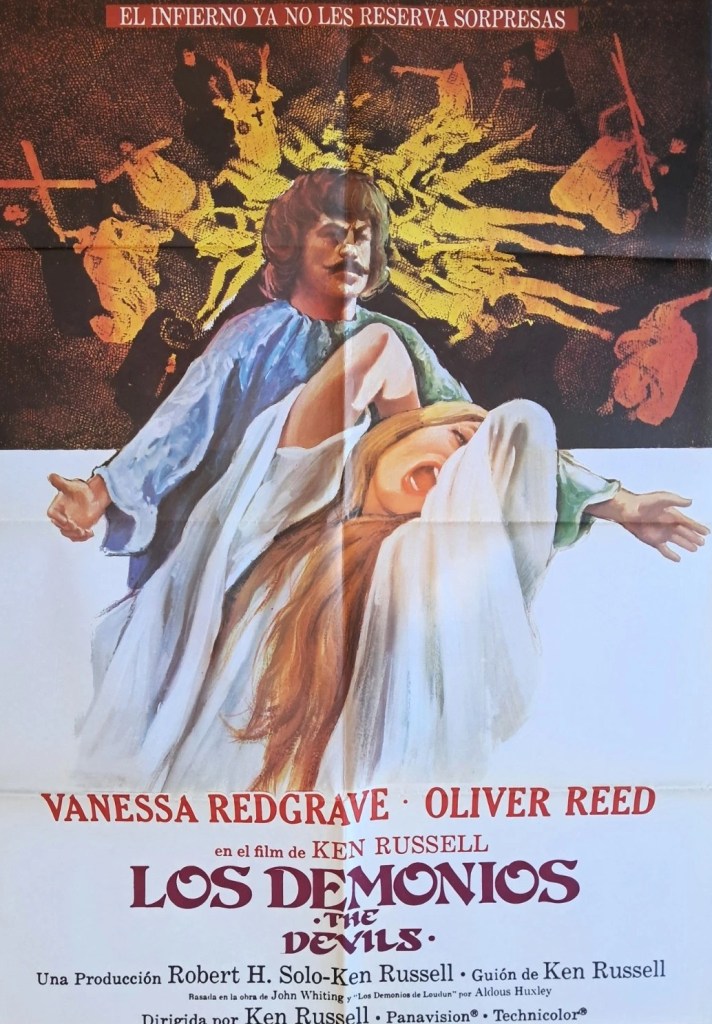
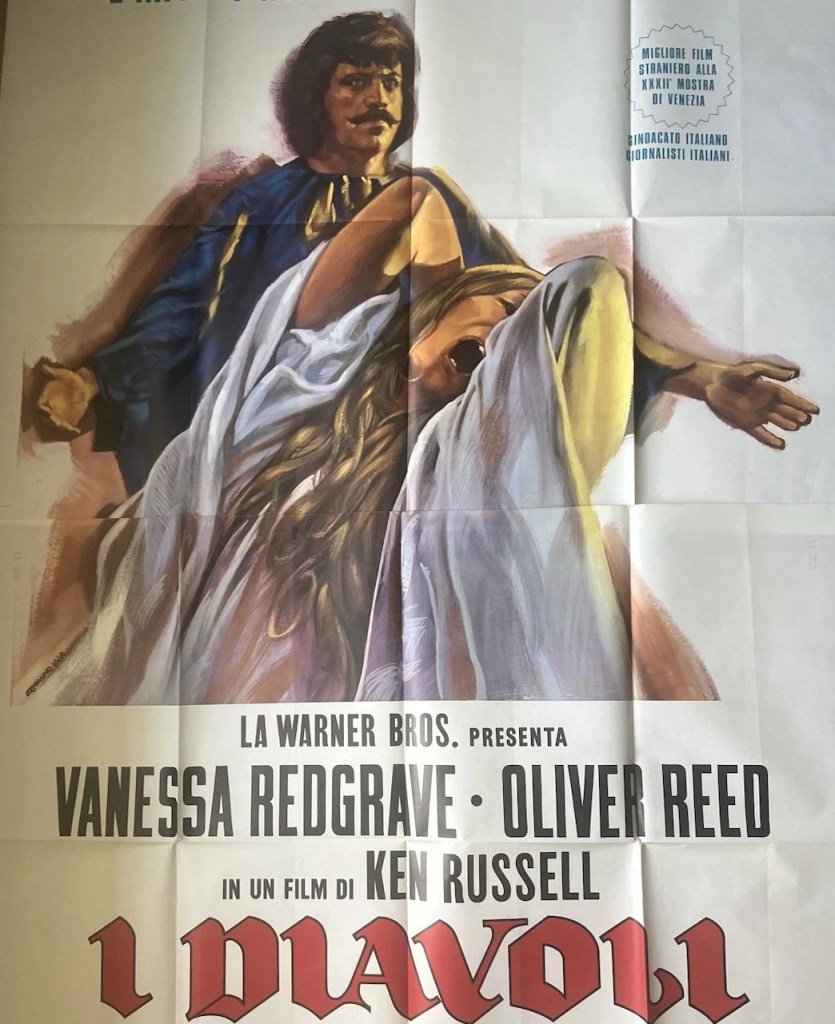
The Devils (1971) *

It’s a conspiracy! The British Film Institute and critic Mark Kermode are on a mission to force the public to reconsider this epic travesty. They have managed to convince Warner Brothers to reissue the film in cinemas in October 2026. The only problem is – this is the second time they’ve tried this maneuver. And it was no more successful last time round – two decades ago in a limited release in arthouses – and despite a lavish follow-up DVD packed full of extras and an expensive illustrated brochure.

Knowing this was the second attempt to regenerate interest in this shambolic enterprise from Ken Russell (Billion Dollar Brain, 1967) – who will no doubt be tabbed a “visionary” director this time round – I thought I’d dig out the DVD featuring the original 1971 release cut in the genuine hope that I might be able to add a little spark to the promotional hoopla for the forthcoming cinematic reissue.

The problem is – it’s still awful. And not in healthy cult fashion or as a slam-dunk for the So Bad It’s Good category. It’s just awful every which way but loose. And it commits the worst error of the awful picture – it’s plain boring. And that’s a shame because the tale is an interesting one. How the French church and state connived to get rid of an irritant challenging their authority by placing false charges of satanic possession against the nuns of the small town of Loudon.

It would certainly have helped had not every single person in a position of power not just looked like an idiot and if Russell had cast the parts with actors of authority, say rising star John Hurt in the role of the exorcist or John Gielgud as the conspiratorial Cardinal Richeliu, a character who as we know from The Three Musketeers was always up to no good. Instead, we’ve got actors way out of even their modest league who make an unintentional mockery of their parts.

Anyone complaining about the modern vernacular of Christopher Nolan’s The Odyssey (2026) would have a field day here with a cornucopia of accents so it sounds more like a  Carry On picture. In fact, Carry On Ken would have been a more apt title.

Vanessa Redgrave (Blow-Up, 1966) had, unfortunately, gone down the Oscar-bait route of hoping that exaggerations of physical affliction will inform her acting. Instead, with her head twisted at ninety degrees, it looks like she’s intent on comedy. And when that only leaves Oliver Reed (Hannibal Brooks, 1968) to hold your picture together you are in dire straits.

Had the director concentrated on the obvious points, that the clergy was corrupt and liable to indulge in sex with any willing participant in the usual male power-abuse scenario, and that nobody went into a nunnery by choice but were sent there by families who could not provide a dowry or who were incapable of themselves finding a husband to support them, then you might have had the beginnings of a good picture.

But Russell is just intent on indulgence. So the nuns behave as if they were being directed by Jess Franco in a Women-in-Prison movie and strip off their clothes and consort with each other. Chief nun Sister Jeanne (Vanessa Redgrave) doesn’t need to wait for a fake exorcist to pass by, she’s already knee-deep in sexual fantasies about Father Grandier (Oliver Reed) who is trying to impregnate as many women as possible.

The American censor had the good sense to cut out the worst sexual extravagances, the British censor was much more lenient though oddly enough David Lean owed the liberal censor a debt of gratitude for when Glasgow City Council, exerting their right as did many other local authorities, banned this atrocity it left roadshow venue ABC2 short of a program so it decided to keep running Ryan’s Daughter.

“Based on  true story” has never been more abused. Back in the day it would certainly have challenged a moral order where the Church of any denomination was not yet known for hiding a flock of pedophiles. But any student of history – and in those days, like it or not, that would be all of us given how important that subject was to the school curriculum – would not have been surprised to discover that kings and cardinals were not above unethical maneuver.

I’m not saying this movie required a Hollywood-style heroic figure, but it certainly didn’t deserve these cartoon cut-outs. The campness of the presentation, the excess and overload, only serves to stultify what would otherwise be an examination of how easy it was back in the 17th century for the authorities to bring down any challenger – but, heck, we knew that.

I saw the original version on my DVD. Theoretically,  it was welcomed at Cannes this year, but although it certainly made the kind of controversial splash often associated with the Festival, it didn’t seem to me that critics were united in their praise.

If you are familiar with the Russell oeuvre this has more in keeping with The Lair of the White Worm (1988) rather than a genuine cinematic – and restrained – achievement like Altered States (1980).

If Warner Bros has any sense, they will pitch this as a Halloween picture for the cinematic reissue.

There will be hype, so you have been warned.

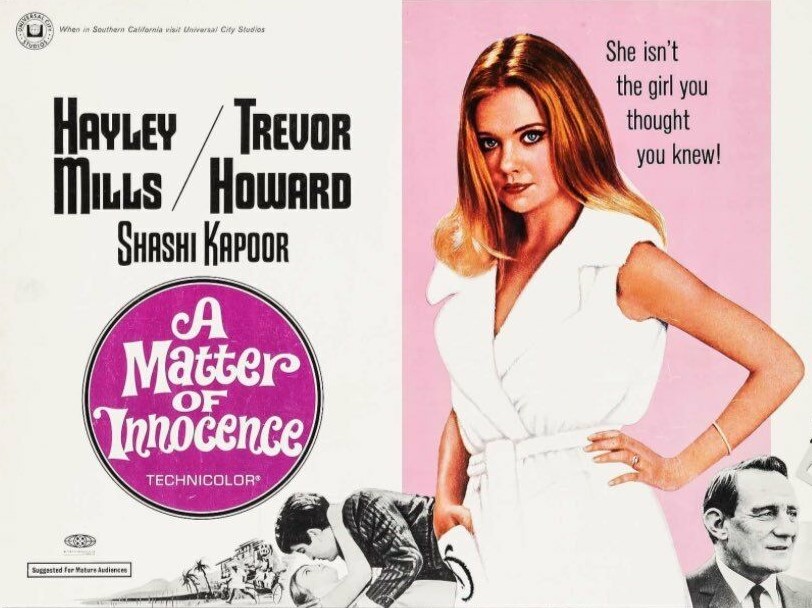
A Matter of Innocence / Pretty Polly (1967) ***

Dramatically undernourished coming-of-age tale over-reliant on “authentic” travelogue and continuing the transformation of Hayley Mills from child to adult star, although that change had been clearly wrought by her previous outing in  The Family Way (1966) which had contained her first nude scene. While there’s definitely way more sex here it’s all off-screen.

In Singapore, family black sheep Robert (Trevor Howard) tries to stifle romance blossoming between his ugly duckling niece Polly (Hayley Mill) and local king of the fixers Amaz (Shashi Kapoor), to quote from list of the clichés the screenplay happily summons up. Polly is the bespectacled, dowdy, shy travelling companion to snippy aunt (Brenda de Banzie) – Robert’s sister not wife – who resides in a magnificent suite in Raffles Hotel, consigning her niece to a hovel of a room. When said aunt drops dead in the swimming pool, Polly, wasting no time on mourning, is free to turn butterfly, channeling her inner Brigitte Bardot with bouffant hairstyle and tight red dress.

The genial Amaz is on hand as a guide, in sexual matters as well as tourist, until huffing-and-puffing plantation manager Robert threatens to intervene and smarmy American Critch (Peter Bayliss) attempts to sweep her off her feet. And that’s about it, plot-wise. The meandering story provides insights into different aspects of local culture –  Whicker’s World was the only globe-trotting television series available at the time so all this would probably have entranced moviegoers rather than, as now, bored them to death.

Perhaps what’s most interesting is what’s left unsaid or never dwelt upon, of the posh English girl having sex with a native of Singapore. In previous movies – Bhowani Junction et al – miscegenation would have been the sole plot point with Brits up in arms at the suggestion of it. Here, the only objection to Amaz is that he’s a bit of a Casanova, practised seducer in the main of older women. While Amaz falls in love, Polly is considerably more objective, viewing their relationship in terms of rite-of-passage, rather an un-British approach, more in keeping with the attitudes those bold females exhibited in pictures like The Group (1966).

Polly is a pretty cool-headed kid, with a good head for booze, not staggering in gutters or throwing up after imbibing too much, alert to the intentions of Critch and more than capable of putting her uncle in his place. Despite her delight at enjoying sex Polly is more independent than you might imagine and the film’s actually a character study of a woman refusing to be defined – or trapped – by love and its obvious consequence marriage and viewing this new freedom as merely the starting point of her life.

For Hayley Mills fans, of course, her career divides sharply into Disney and post-Disney. Few child stars ever manage to take the first steps to an adult career never mind sustain one, but the actress made a good stab at throwing off her previous precocious screen persona by taking on challenging roles that perhaps upset her core followers. But the film would have benefitted from a better storyline and minus the distracting tourist elements been a lot tighter.   

The career of Trevor Howard, long-time second male lead, was on a bit of an upswing after sterling roles in Von Ryan’s Express (1965) and The Long Duel (1967) and although he remained the scowler supreme he brings more vulnerability to this role. Bollywood heartthrob Shashi Kapoor had come to prominence as far as the English-speaking countries were concerned through arthouse director James Ivory’s The Householder (1963) and Shakespeare-Wallah (1966) but this was his mainstream debut. He certainly has a screen presence and enjoys the best character arc, going from the cynicism of sex to the innocence of love. I’m sure the title is intended to refer to Polly but she is innocent, in screen shorthand terms, for about two seconds. Pretty Polly, the title of the short story on which the film is based, was not usable in certain countries because the name was the trademark of a popular brand of hosiery.

This was the final film of Brenda de Banzie (The Man Who Knew Too Much, 1956) and the second for British television stalwart Patricia Routledge (Keeping Up Appearances, 1990-1995), while for Chinese star Kalen Liu (Welcome to Hard Times, 1967) it was both her second and last picture.

This was perhaps an odd choice for director Guy Green (A Patch of Blue, 1965) but he was mired in the on-again off-again saga of proposed MGM roadshow epic Forty Days of Musa Dagh and compared to those travails this may have been welcome light relief. Keith Waterhouse and Willis Hall (Lock Up Your Daughters, 1969) developed the screenplay from Noel Coward’s short story.

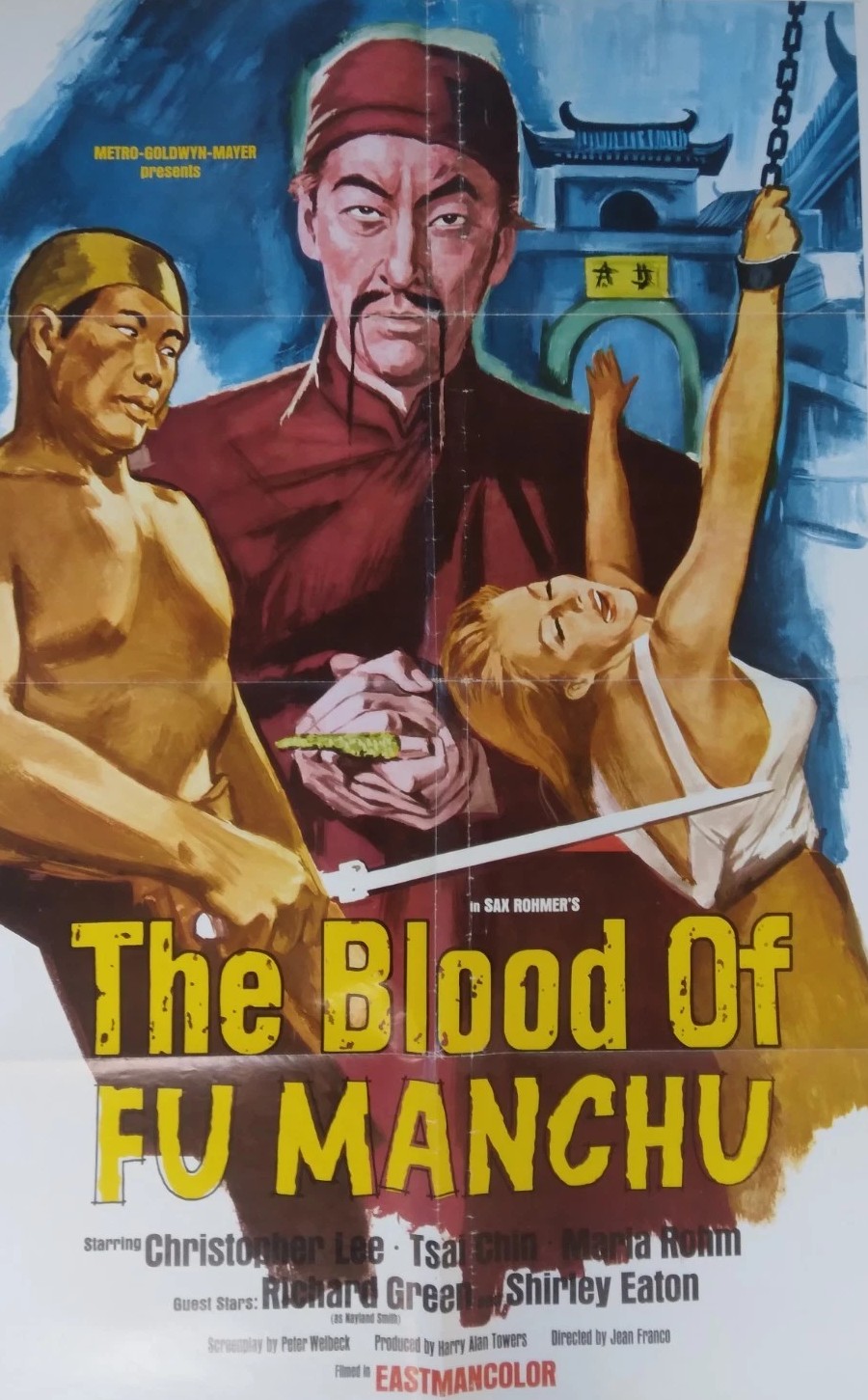
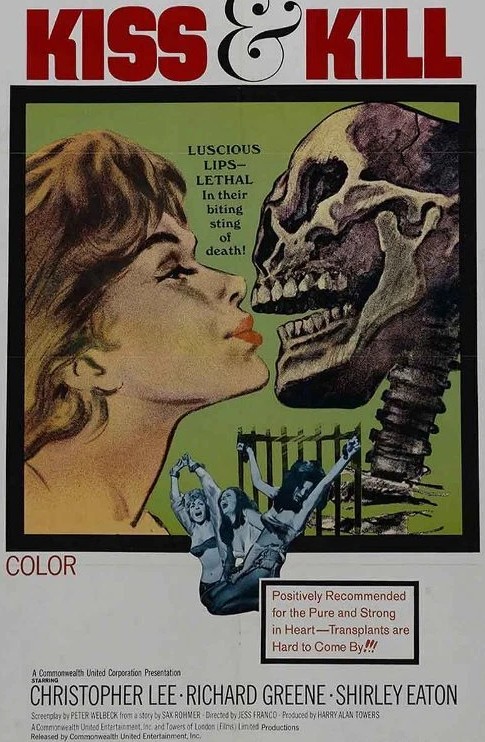
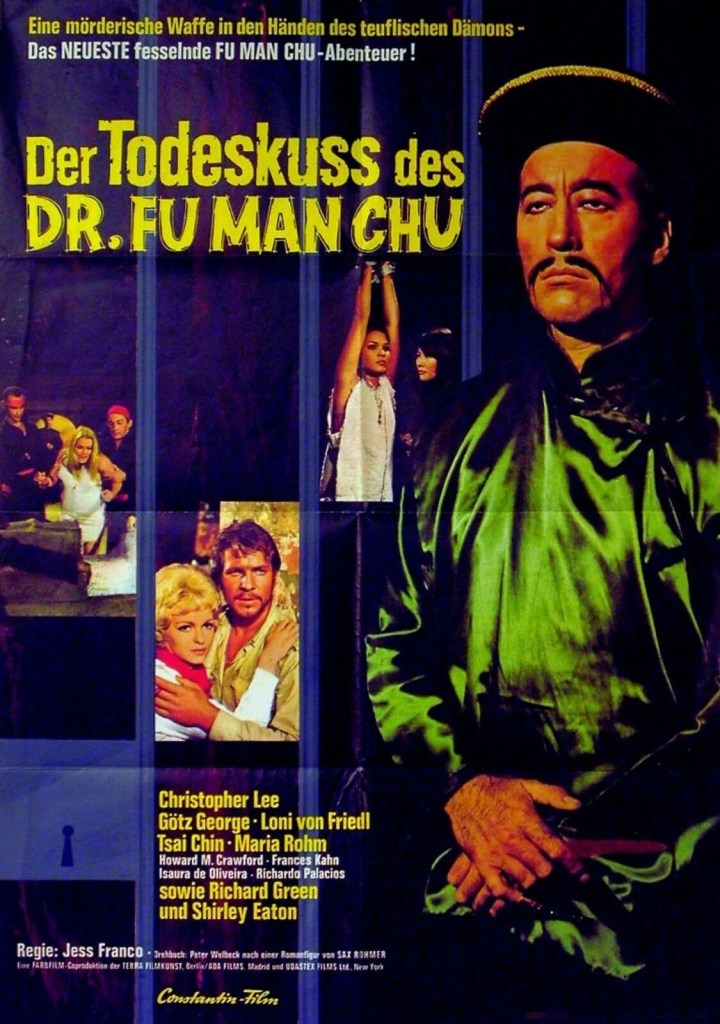
The Blood of Fu Manchu / Kiss & Kill (1968) **

Three stories in one, except only one tale remotely holds our interest. So what compelled producer Harry Alan Towers and director Jess Franco to sideline the titular character and devote more time to a young explorer Carl Janseon (Gotz George) and bandit Sancho Lopez (Ricardo Palacios). You could probably guess that the physical involvement of Fu Manchu (Christopher Lee) would be in any case limited once you grasped the crux of the narrative which saw ten girls sent out into the big wide world to kill his ten most hated enemies. You’ll probably be surprised to learn that he had only ten major enemies, but since one of them is his old nemesis Nayland Smith (Richard Greene), then you can be sure that that aspect is going to suck up a good deal of what time remains after the subplots concerning the explorer and the bandit.

 Which is a shame because neither explorer not bandit employ the kid of evil little grey cells that would allow them to come up with a plot that any of the James Bond villains would be proud of in their bids for global domination. Fu Manchu has located an ancient poison which is transmitted by women in the form of a kiss. It originates in certain snakes and although the women are “kissed” by the snakes, they are apparently impervious to its venom, so the first gender-specific poison in history.

And that’s about it. As usual Towers has rounded up a bevy of young beauties, no doubt sold on the idea that he’s going to turn them into the next big female star, as carriers of the deadly poison. Not all are so keen on the idea, but since he’s got them chained by the neck in a Brazilian cave that passes for his stronghold and with his daughter Lin Tang (Tsai Chin) to threaten them with torture, it’s not surprising they are complicit.

In any case the female assassins are one-trick ponies. The minute they accomplish their deed, they are bumped off. Smith is the first victim (apart from a prisoner selected to demonstrate the efficacy of the poison) but he doesn’t die immediately. Instead he is struck blind, although he is aware he hasn’t got long to live unless an antidote can be found.

Naturally, that puts him on the track of Fu Manchu and, of course, into sudden danger. The Fu Manchu-Nayland Smith had proved a decent cinematic tug-of-war for three previous episodes beginning with  The Face of Fu Manchu (1965), so it was somewhat surprising that tension was diminished by spending so much time playing up explorer and bandit, especially as the latter is determined to play out all the cliches, including laughing like a hyena.

There is some occasional visual humor such as when the bandits go on the rampage and the crew emerge from bandits bearing such prizes as a bishop’s mitre and when a governor, having imprisoned Jansen, suggests they while away their time with a game of chess.

It’s odd that part of the disappointment for certain viewers in this opus is the lack of trademark Jess Franco sleaze. There’s barely any nudity and although the girls are kept in prison (until released to wreak havoc) there’s none of the tawdriness of WIP epics such as his 99 Women (1969) which is replete with brutality and sex.

Despite the cultural appropriation, Christopher Lee (The Devil Rides Out, 1968) is, as ever, solid as Fu Manchu, speaking in clipped tones and towering over everyone else, though his main role appears to be to deliver exposition, explain the foul plot and its consequences and so on. It’s left up to Tsai Chin (You Only Live Twice, 1967) to carry the sadism.

Richard Greene (Sword of Sherwood Forest, 1960) does his best in a role of declining returns. You might spot among the cast Towers’ wife Maria Rohm (Five Golden Dragons, 1967) and Shirley Eaton (The Girl from Rio, 1969).

Of the women expecting a major career break, Loni von Friedl had scores of parts including Doppelganger/Journey to the Far Side of the Sun (1969). But Frances Khan only enjoyed three more roles and or Isaura de Olivera this was the beginning and end of her movie career.

Written as usual by Peter Welbeck (Five Golden Dragons) – aka Harry Alan Towers – and Franco based on the novels of Sax Rohmer.

Promising idea ruined.

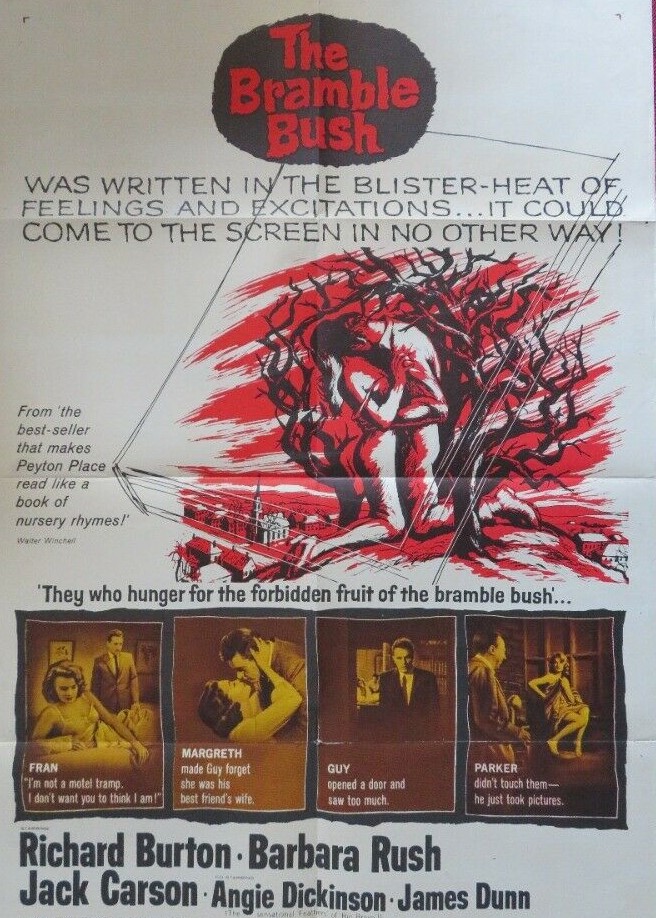
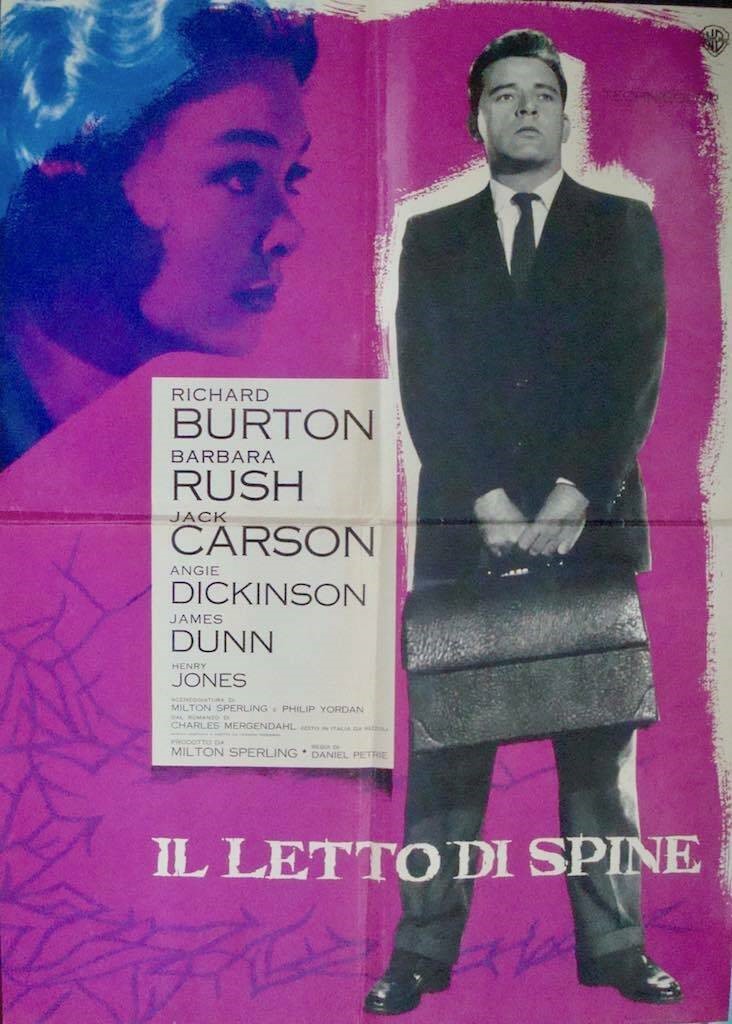
The Bramble Bush (1960) ***

The secrecy business was working overtime in small-town America according to the Peyton Place template. And that wouldn’t be so bad here except returning big city doctor Guy (Richard Burton) has a few of his own in the locker but more importantly the unfolding of so many secrets detracts from the time available for the main dramatic premise which is an absolute corker.

We might as well account straight-off with the secret Guy drags around behind him like a two-ton weight thus explaining his general surliness, tight-lipped demeanor and occasional flashes of temper. As a twelve-year-old he told his father he had caught his mother in bed lover with Stew (James Dunn) which prompted his dad to chuck himself off a cliff.

The other big secret, dealt with fairly promptly, is that local nurse Fran (Angie Dickinson), who held a torch for Guy, now makes do with district attorney Bert (Jack Carson), that clandestine affair coming to light not so much in flagrante but in full beam when the illicit couple require treatment following a fire in a hotel bedroom.

The unravelling of both secrets impacts on Guy’s emotional state. The fire leads to Fran admitting her feelings to Guy, happy to have him use her for sex if love is not possible, “I love you so much I have no shame,” she proclaims, to no avail, but the hotel business also makes her fall prey to blackmail by local newshound Parker (Henry Jones), a budding amateur photographer of the unsavoury kind. Recounting his personal tragedy results in a Guy having a one-night stand with the married wannabe artist Margaret McFie (Barbara Rush).

But here’s the brilliant twist. Margaret’s husband Larry (Tom Drake) wants her to end up with Guy – but after his death. Larry, Guy’s best friend from childhood, is dying, the doctor scuttling back to a town that harbours too many bad memories in order to act as his personal physician. Larry’s never going to recover, he has the incurable illness Hodgkin’s Disease. His dying wish is that Guy marry Margaret.

Margaret is revolted by the idea, “I don’t want to be beautiful for anyone but Larry,” but unable to cope with his with illness is living on a cocktail of drink and drugs. And although Guy, who distrusts any woman, is similarly ill-inclined, Margaret becomes dependent on his medical ability, treating both husband and wife. Larry turns out to have another crazy idea – he wants Guy to kill him, medically speaking of course, some extra, illegal, doses of morphine would do the trick.

This incredible bucket list provides Guy with a huge dilemma, never mind what to do with Fran throwing herself at him and having to put up with the hypocritical Bert, and Stew, now the town drunk, begging for forgiveness, and Larry’s father Sam (Carl Benton Reid), who, for reasons unspecified, hates the doctor.  

There’s more twists to come, just in case you thought you had everything worked out. But you can see the problem over-complication creates. The euthanasia-please-have-sex-with-my-beautiful wife combination would have set the movie up nicely from the get-go. Guy wouldn’t need to have a deep secret to find himself in very deep waters. How he would react to either or both outcomes, how Margaret would equally react to the possibility of ending her husband’s suffering in a quick and painless manner, would be more than enough to provide the dynamic the picture required. The movie then pivots on Guy being charged with murder.

It’s certainly interesting enough but Guy is too buttoned-down to incur sympathy and his revelation, devastating though it is, doesn’t suddenly make him an instantly more attractive screen character. In fact, it’s Fran who elicits the greater sympathy, the woman bedding someone who views her only  as a sex object, yet willing to become a sex object for someone she does love if that’s all she can have. Eventually, the two key issues are put in the spotlight, which certainly puts a spark in the picture. But the poster promises a passion that just doesn’t exist.

Richard Burton (The Spy Who Came in from the Cold, 1965) plays this character in a lower register than his screen persona, the sonorous voice toned down, and although the look of someone who doesn’t want to be back rings true the performance lacks variety and there are only occasional glimpses of the fiery actor. Barbara Rush (Robin and the 7 Hoods, 1964) has her own legitimate reasons for being dispassionate and the vibrant character her husband married never really gets an airing. Angie Dickinson (Jessica, 1962) comes across as a more human character with, in emotional terms, a greater flaw, and a more tragic figure, even though there is nothing life-or-death about her circumstances. Two veterans are showcased: Jack Carson (Mildred Pierce, 1945) and James Dunn (Bad Girl, 1931).

Television director Daniel Petrie (A Raisin in the Sun, 1961) was making his movie debut. The screenwriting team of Milton Sperling and Philip Yordan (Battle of the Bulge, 1965) drew on the bestselling novel by Charles Mergendahl.

Hard to find DVD so Ebay is the best source.

Discover WordPress

A daily selection of the best content published on WordPress, collected for you by humans who love to read.

The Atavist Magazine

by Brian Hannan

WordPress.com Blog

News, Tips & Website Tutorials