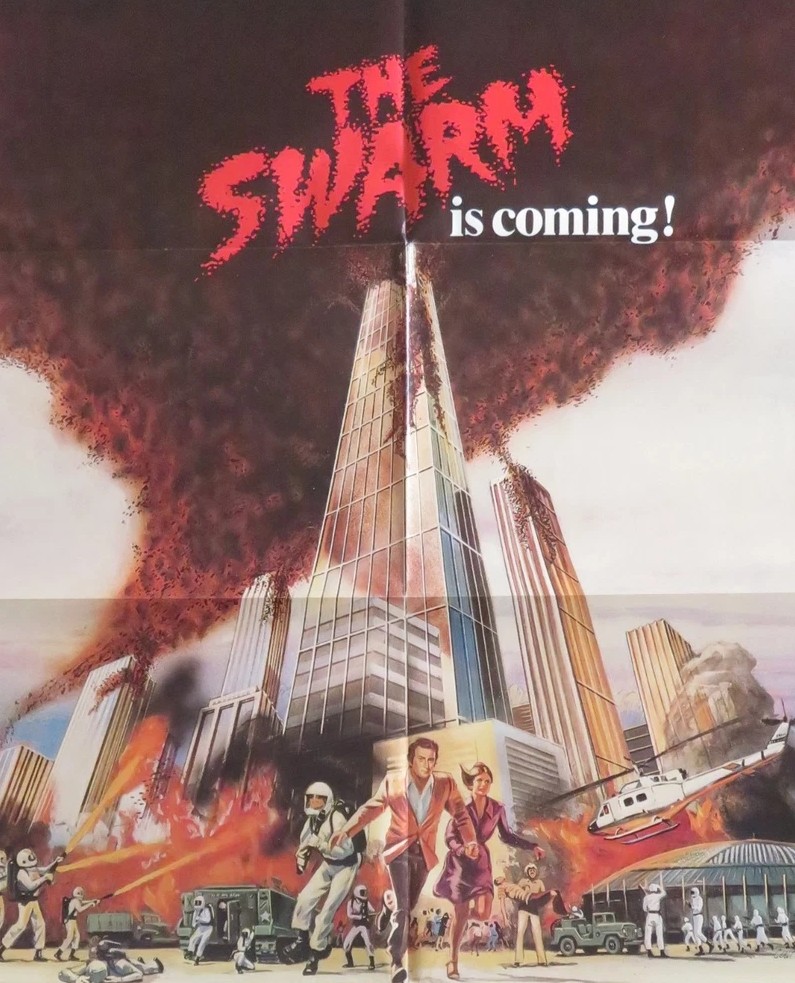
The Swarm (1978) *

I’m delighted to inform you that there was only disappointment this time around, no provisos to save the day, no reassessment to make me change my original views. This truly is a terrible picture. Possibly the worst to involve Michael Caine, who was no slouch when it came to making inadvisable choices. Just as with The Island (1980) which on paper appeared a slam-dunk hit coming as it did in the wake of Jaws (1975) and The Deep (1977), based on Peter Benchley bestsellers, this looked like a no-brainer, another Irwin Allen disaster picture following on from mega-hits The Towering Inferno (1974) and Earthquake (1975).

It’s tempting to blame it on the bees. The special effects creating the sky-borne swarm makes them look like nothing more than a strange smudge on the screen. And the bodies or cars or helicopters smothered in millions of static bees score pretty low, actually, on the scare-o-meter, nothing like a giant shark on the loose. Anyone caught in the swarm has to go into some kind of slow-motion dance that fails to shake them off.
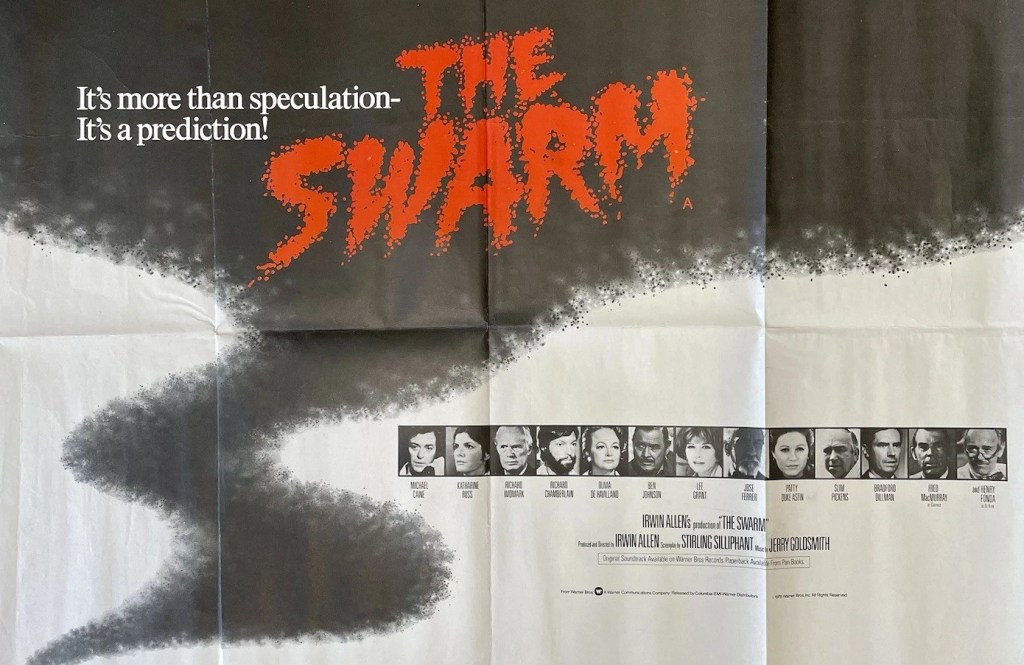
Sure we’ve got a runaway train coming off the tracks and sliding down a hill, but the action quotient is surprisingly pretty low. The opportunity, a la The Birds (1963), to lay low a town is ignored and after a few peremptory shots of bees causing havoc we’re stuck with TV reports. Even giant bees, caused by hallucination, might cause an audience to vaguely squirm but it doesn’t replicate the gut-wrenching terror of a killer shark or the tension of a burning skyscraper.

The cast spend most of their time in exposition mode, or arguing with each other as to whose exposition is better. We know a heck of a lot more about the bees, and why they’re on the rampage, some nonsense about alarm horns replicating the sound of bees mating, than we do about any of the characters.

There’s a smidgeon of romance between Dr Bradford Crane (Michael Caine) and Capt Dr Helena Anderson (Katharine Ross) but it doesn’t get beyond the teenage (“am I walking too fast for you?). And there’s a truly terrible attempt at romantic comedy as old codgers Felix (Ben Johnson) and Clarence (Fred MacMurray) fight over school marm Maureen (Olivia De Havilland) who looks as if she’d like to crack their heads together.
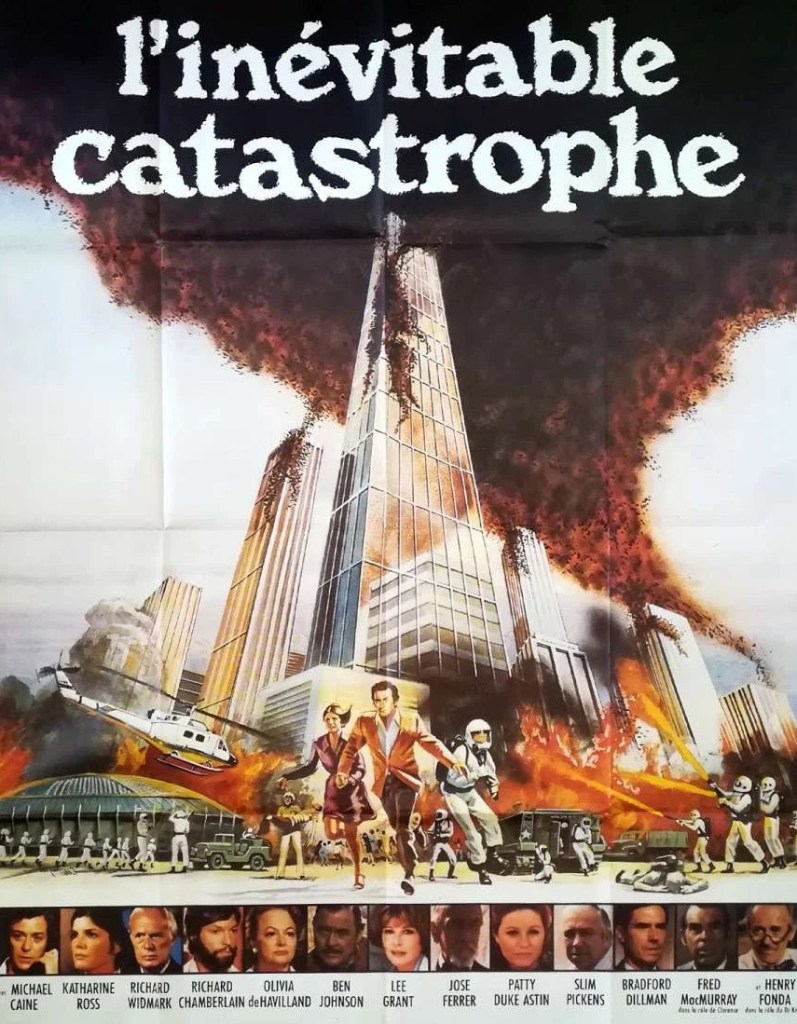
A young boy is caught up in the melee and a pregnant woman, and I was looking out for the statutory nun, a strange omission is a disaster narrative.

The only effective bit of the movie is the opening when a squad of soldiers all Hazchem-med up descend on a deserted missile base and find the entire garrison – apart from a half-dozen – lying dead on the floor. That Dr Crane happens to be passing by leads to a stupid subplot where Major General Slater (Richard Widmark) and sidekick Major Baker (Bradford Dillman) take  the suspicion option and look for an excuse to bang up the academic.

This initially went on general release in a curtailed version running just short of two hours rather than the original 155-minute cut which you can now catch, as I did, on YouTube.

You can’t blame Michael Caine (The Island, 1980) for this mess and he would have acquitted himself well if there had been any actual acting to be done outside of the exposition and arguing with the major general. His best scene is when he gently carries crippled mentor Dr Krim (Henry Fonda) into his wheelchair. Katharine Ross (Hellfighters, 1968) has such a restrained screen persona half the time you think she’s going to burst into tears.

Uber-producer Irwin Allen (The Towering Inferno) had decided by this point that he could dispense with a name director and take on that chore himself. But I doubt if anyone could have made a better job given they were stuck with bees and a terrible script by Stirling Silliphant (In the Heat of the Night, 1967).

A true stinker.
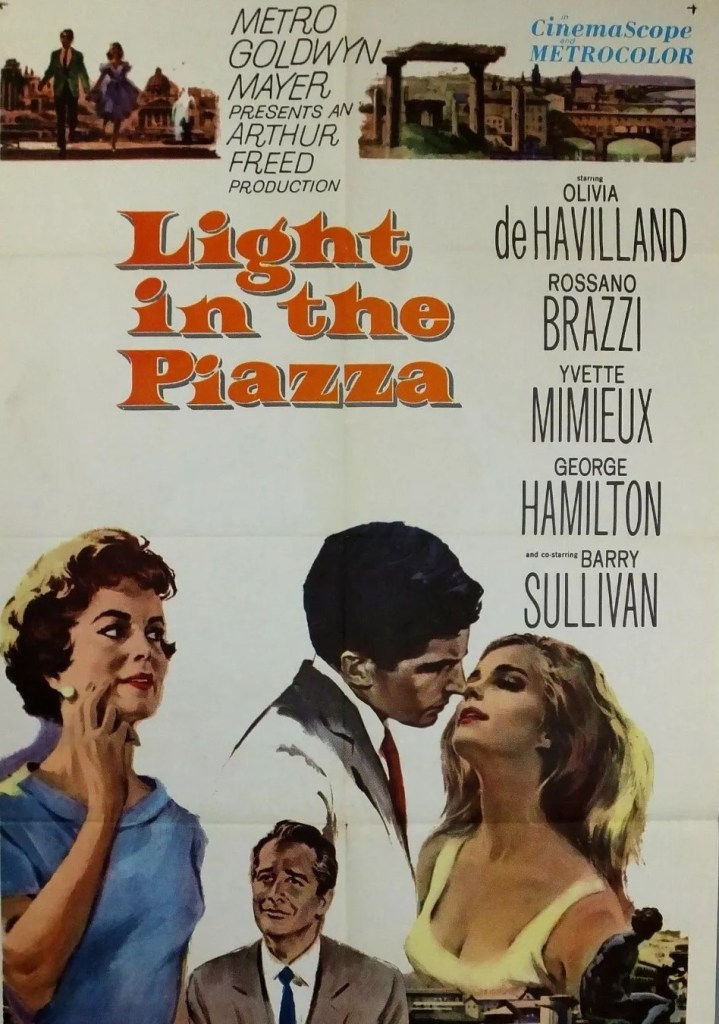
Light in the Piazza (1962) ****

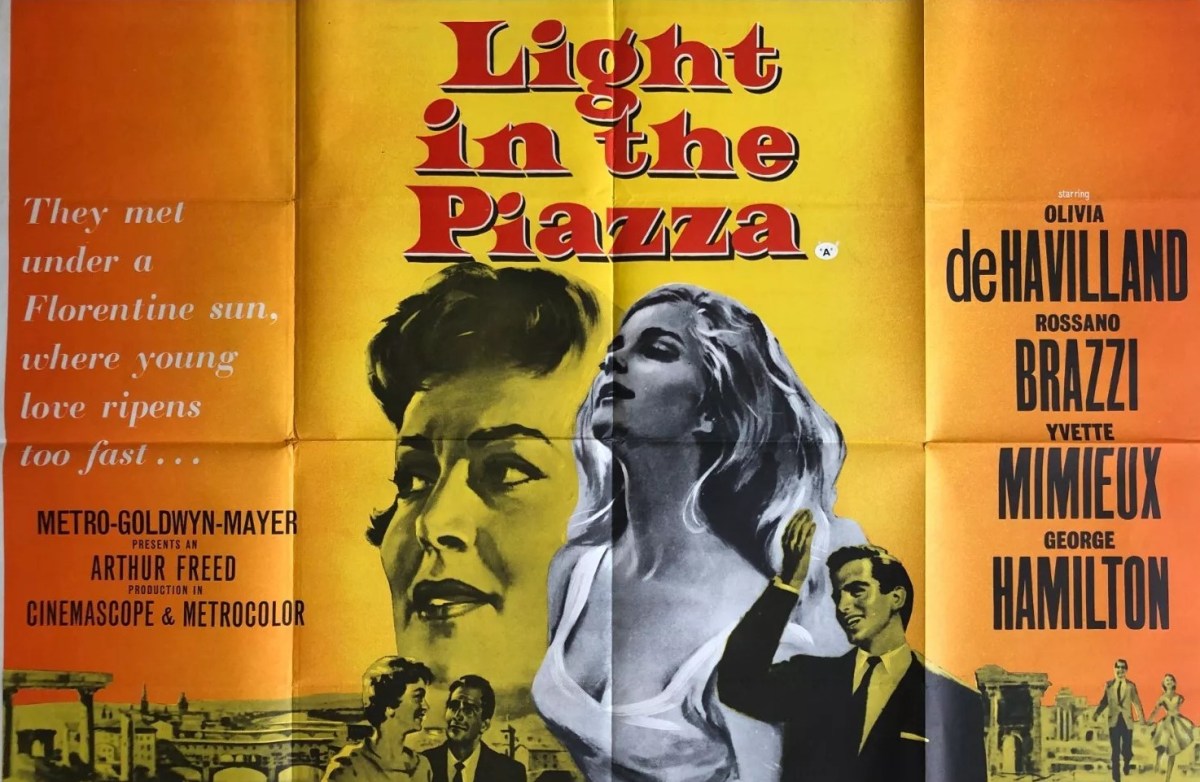
Will resonate more strongly today. Never intended as a light-hearted confection, despite the obvious premise of young love catching fire in Italy, this was a bold picture in its day and a more subtle examination of the wider impact of mental illness than those later movies set in institutions such as Lilith (1962) or Shock Treatment (1964). Bold, too, of Olivia de Havilland to take on a role that is so transparently maternal. Instead of her middle-aged character succumbing to romantic opportunity as the billing might suggest, to a holiday affair with a rich handsome Italian, she is first and foremost a mother.

Initially, standard romance meet-cute as young Italian Fabrizio (an unlikely George Hamilton) catches the runaway hat of young blonde Clara (Yvette Mimieux) in a piazza in Florence. His ardent pursuit is thwarted at every turn by Clara’s mother Meg (Olivia de Havilland). At first this appears to be for the most obvious of reasons. Who wants their naïve daughter to be swept away by a passionate Italian with heartbreak and possibly worse consequence (what mother does not immediately conjure up pregnancy?) to come.

Sure, Clara seems flighty and a tad over-exuberant and perhaps prone to tantrums but then back in the day this was possibly just an expression of entitlement by rich indulged young women. Turns out there’s a more worrying cause of her sometimes-infantile behavior. She was kicked in the head by a pony and has the mental age of a child of ten. If she is not protected, she might end up as prey to any charming young man.

Clara needs tucked up in bed with a stuffed toy, and her mother to check the room for ghosts and read her a bedtime story before she can go to sleep. Even when Fabrizio’s credentials check out – his father Signor Naccarelli (Rossano Brazzi) vouches for his good intentions, but, in the way of the passionate Italians, would not want to stand in the path of true love.

Clara’s father Noel (Barry Sullivan) is the one who spells out the reality. That pony didn’t just kick his daughter in the head it “kicked the life out of” his marriage. His wife lives in a dreamland, hoping for a miracle, and if that is not forthcoming quite happy to live with a daughter who never grows up. He wants to send her to “a school,” convincing himself it’s “more like a country club.”

Meg fights her own feelings that she knows better than her daughter and that love will not provide the cure, at the same time as batting away the affections of the elder Naccarelli. When she finally gives in to her daughter’s desire, wedding plans fall apart at the last minute when Naccarelli Snr discovers that his 20-year-old son is marrying not, as he imagined, a woman of roughly the same age or slightly younger, but actually someone six years older. Eventually, the wedding goes ahead. Meg convinces herself she did the right thing in permitting the marriage to go ahead.

But this is one of those happy ever afters that don’t quite wash and you might find yourself wondering exactly how it played out when the husband discovered exactly what kind of wife she had. Her instability isn’t genetic so no danger of a subsequent child encountering the same issue. And having to care for someone other than herself might well bring out the same level of maternity as her mother shows, but equally clearly Fabrizio is unaware of exactly what he’s taking on. How will he feel when asked to read her a bedtime story or scour the cupboards for imaginary monsters.

The movie didn’t do well enough to warrant a sequel – audiences expecting romantic confection were disappointed – and just hope Clara didn’t turn into the kind of inmate seen in Lilith and Shock Treatment.

Still, takes a very realistic approach to the problems of someone with such problems maturing into adulthood.

The Oscar-garlanded Olivia de Havilland  (two times winner, three times nominee), in her first picture in three years, clearly didn’t want to see out her maturity in those May-December roles that others of her age fell prey to. She is excellent here, no attempt to dress herself up as a sex bomb, and refreshing to see her approach. Yvette Mimieux (Diamond Head, 1962) is excellent as the confused youngster. George Hamilton  (The Power, 1968) lets the side down with his speaka-da-Italian Italian but Rossano Brazzi (The Battle of the Villa Fiorita, 1965), who is Italian, has no trouble with the lingo or with being a smooth seducer.

Director Guy Green (Diamond Head, 1962) adds in some unusual Florentine tourist color, but doesn’t shirk the difficult storyline. Julius J. Epstein (Casablanca, 1942) wrote the script.

Worth a look

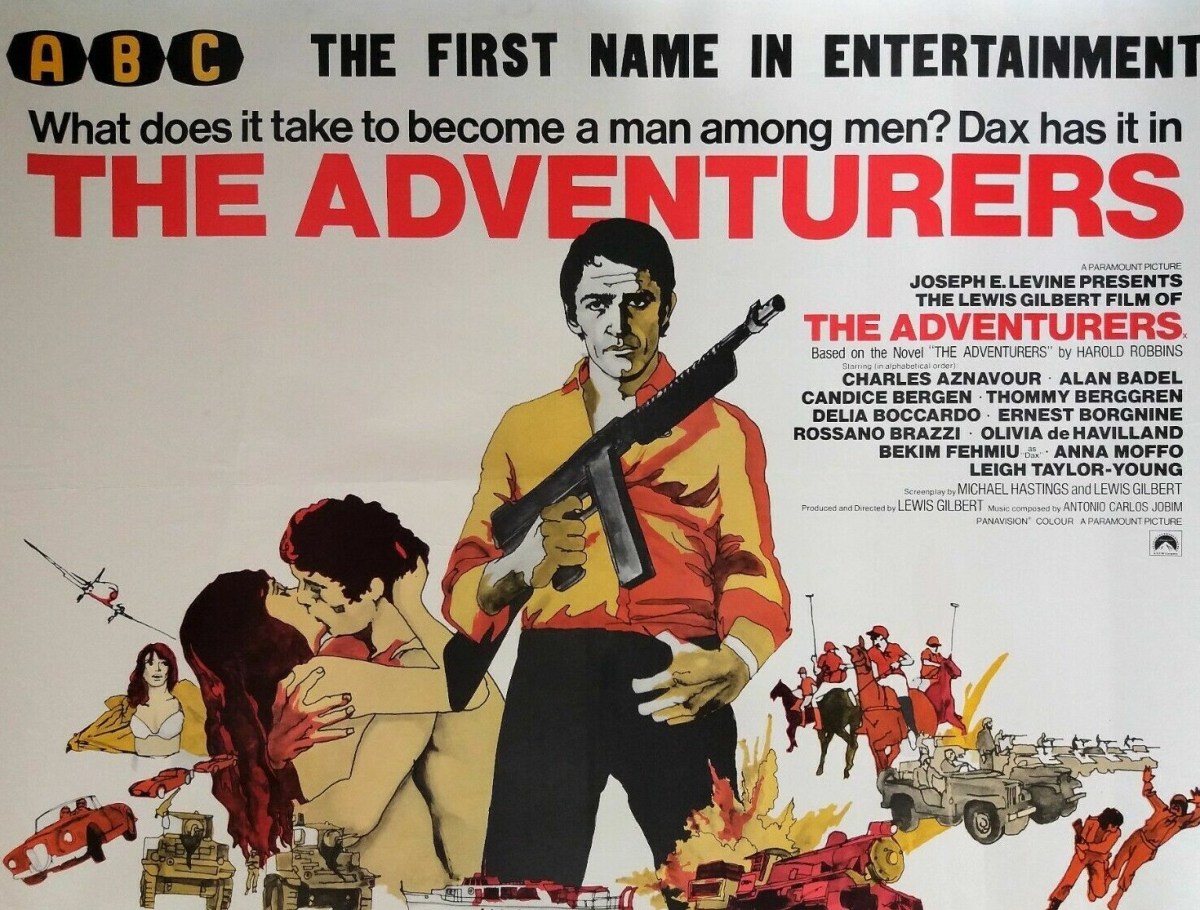
The Adventurers (1970) ***

Class A Trash. Adaptation of Harold Robbins (Nevada Smith, 1966) bestseller goes straight to the top of the heap in the So-Bad- It’s-Good category. Only Alan Badel (Arabesque, 1966) as a double-dealing revolutionary comes out of this with any honors.

The likes of Candice Bergen (Soldier Blue, 1970), Rossano Brazzi (Rome Adventure/Lovers Must Learn, 1962), double Oscar-winner Olivia de Havilland (Hush, Hush, Sweet Charlotte, 1964), Leigh Taylor-Young (The Big Bounce, 1969)  and Ernest Borgnine (The Wild Bunch, 1969) must have wondered how they were talked into this.

And director Lewis Gilbert (Loss of Innocence/The Greengage Summer, 1961) must have wondered how he talked himself into recruiting unknown Yugoslavian Bekim Fehmiu (The Deserter/The Devil’s Backbone, 1970), nobody’s idea of a suave lothario,  for the lead.

One of the taglines was “Nothing has been left out” and that’s to the movie’s detriment because it’s overloaded with sex, violence, more sex, more violence, in among a narrative that races from South American revolution (in the fictional  country of Corteguay) through the European jet set, fashion, polo, fast cars, orgies, and back again with revenge always high on the agenda. At close on three hours, it piles melodrama on top of melodrama with characters who infuriatingly fail to come to life.

Sensitivity is hardly going to be in order for Dax (Bekin Fehmiu) who, as a child after watching his family slaughtered and mother raped, makes his bones as a one-man firing squad, machine-gunning down the murderers. From there it’s a hop-skip-and-jump to life as the son of ambassador Jaime (Fernando Rey) in Rome where he belongs to an indulgent aristocracy who play polo, race cars along hairpin bends, swap girlfriends and, given the opportunity, make love at midnight beside the swimming pool.

His fortunes take a turn for the worse when his father backs the wrong horse, the rebel El Condor (Jorge Martinez de Hoyos)  in Corteguay, and is killed by the dictator Rojo (Alan Badel). In between an affair with childhood sweetheart Amparo (Leigh Taylor Young), life as a gigolo and cynical marriage to millionairess Sue Ann (Candice Bergen), Dax takes up the rebel cause, initially foolish enough to fall for Rojo’s promises which results in the death of El Condor, and then to join the rebels.

But mostly it’s blood, sex, betrayal and revenge. Anyone Dax befriends is liable to face a death sentence. He only has to look at a woman and they are stripping off. It’s a heady mess. It might have worked if the audience could rustle up some sympathy for Dax, especially as he was entitled to feel vulnerable after his childhood experiences. But he just comes across as arrogant and the film-makers as even more arrogant in assuming that because women fall at his feet that must mean he had bucketloads of charm rather than that was what it said in the script. He’s fine as the thug but not convincing as a lover.

Excepting Badel, the best performances  in a male-centric sexist movie come from women, those left in Dax’s wake, particularly Candice Bergen as the lovelorn wife and Olivia De Havilland as the wealthy older woman who funds his lifestyle, aware that at any moment he will leave her for a younger, richer, model. Lewis Gilbert is at his best when he lets female emotion take over, not necessarily wordy intense scenes, because Bergen and De Havilland can accomplish a great deal in a look.

The rest of it looks like someone has thrown millions at a B-picture and positioned every character so that they have nowhere else to go but the cliché.

By this point, Hollywood had played canny with Harold Robbins, toning down the writer’s worst excesses and employing name directors to turn dire material into solid entertainment. Edward Dmytryk (Mirage, 1965) had worked wonders with The Carpetbaggers (1964),  whose inherent salaciousness was held in check by the censor and made believable by characters played by George Peppard (Pendulum, 1969), Alan Ladd (Shane, 1953) and Caroll Baker (Station Six Sahara, 1963). Bette Davis and Susan Hayward contrived to turn Where Love Has Gone (1964) into a decent drama. Even Stiletto (1969), in low-budget fashion, managed to toe the line between action and drama.

But here it feels as if all Harold Robbins hell has been let loose. Rather than reining in the writer, it’s as if exploitation was the only perspective. Blame Lewis Gilbert, director,  and along with Michael Hastings (The Nightcomers, 1971) in his movie debut, also the screenwriter for the end result.

On the other hand, if you can leave your critical faculties at the door, you might well enjoy how utterly bad a glossy picture can be.

The Woman Who Beat Hollywood

Outside of her brace of Oscars, Olivia de Havilland’s biggest achievement was in forcing studios to pay actors who did not want to work. She wasn’t the first person to take on the studios as I discovered when researching my book When Women Ruled Hollywood. Bette Davis, Myrna Loy and Hedy Lamarr preceded her.

De Havilland owed the studio several months on her contract since she had failed to fulfill its terms by refusing to work and was put on suspension. She took the view that the suspension should form part of her contract. The law agreed.

De Havilland was without doubt a great actress – her Oscars for To Each His Own (1946) and The Heiress (1949) plus nominations for Gone with the Wind (1939), Hold Back the Dawn (1941) and my favorite The Snake Pit (1948) attest to that.

But without Errol Flynn at her side she was never a big star. Her only big hit once she left the Warner Brothers comfort zone was medical drama Not as a Stranger (1955) which had strong co-stars in Frank Sinatra and Robert Mitchum. Once she won her freedom she was only seen 15 pictures in 20 years. Both Joan Crawford and Bette Davis made 50 per cent more.

She enjoyed one of the great screen partnerships with Errol Flynn in swashbucklers like Captain Blood (1935) and The Adventures of Robin Hood (1938) and westerns Dodge City (1939) and They Died with their Boots On (1941). Despite her protestations to the contrary, Warner Brothers looked after their ingenue and developed her talent. Versatility was key to remaining a star – the public soon grew tired of a star confined to single genre – and she appeared in westerns, drama, comedies.

Her main problem was her age. She was only 19 when Captain Blood appeared. She was competing with the more mature Bette Davis and Joan Crawford, eight and twelve years older, respectively, for the best parts the studio had to offer. Warner Brothers was also willing to let her go out on loan, her first two nominations were for work at other studios, MGM and Paramount. Since most of the top male actors were much older, it would be hard for her to be accepted by audiences as their equal in a romance or drama.

That she won her case against the studio was as much to do with politics as anything else. The idea that an actor should enjoy more freedom in the workplace than a miner or a nurse was patently preposterous. However, the government was involved in aggressive action against Hollywood that would result in the break-up of the studio system and make hundreds of actors, who depended on contracts, freelancers whether they liked it or not.

However, she certainly made great use of her freedom, as the unwed mother in To Each His Own, confined to a mental asylum in The Snake Pit and forced to choose between money and happiness in William Wyler’s The Heiress.

After a three-year hiatus, she returned with another strong performance in the adaptation of Daphne du Maurier’s My Cousin Rachel (1952). But by the end of the decade she had lost her star status, demoted to leading lady, below Alan Ladd in the billing for in The Proud Rebel (1958) and Dirk Bogarde in Libel (1959). After the reissue of Gone with the Wind in 1961, her career briefly revived – with romantic drama Light in the Piazza (1962) and powerful performances as the woman terrorized by thugs in Lady in a Cage (1964) and Hush, Hush, Sweet Charlotte (1964).   

Thereafter, there were occasional supporting roles and television parts. Her last movie was The Fifth Musketeer (1979).

Discover WordPress

A daily selection of the best content published on WordPress, collected for you by humans who love to read.

The Atavist Magazine

by Brian Hannan

WordPress.com Blog

News, Tips & Website Tutorials