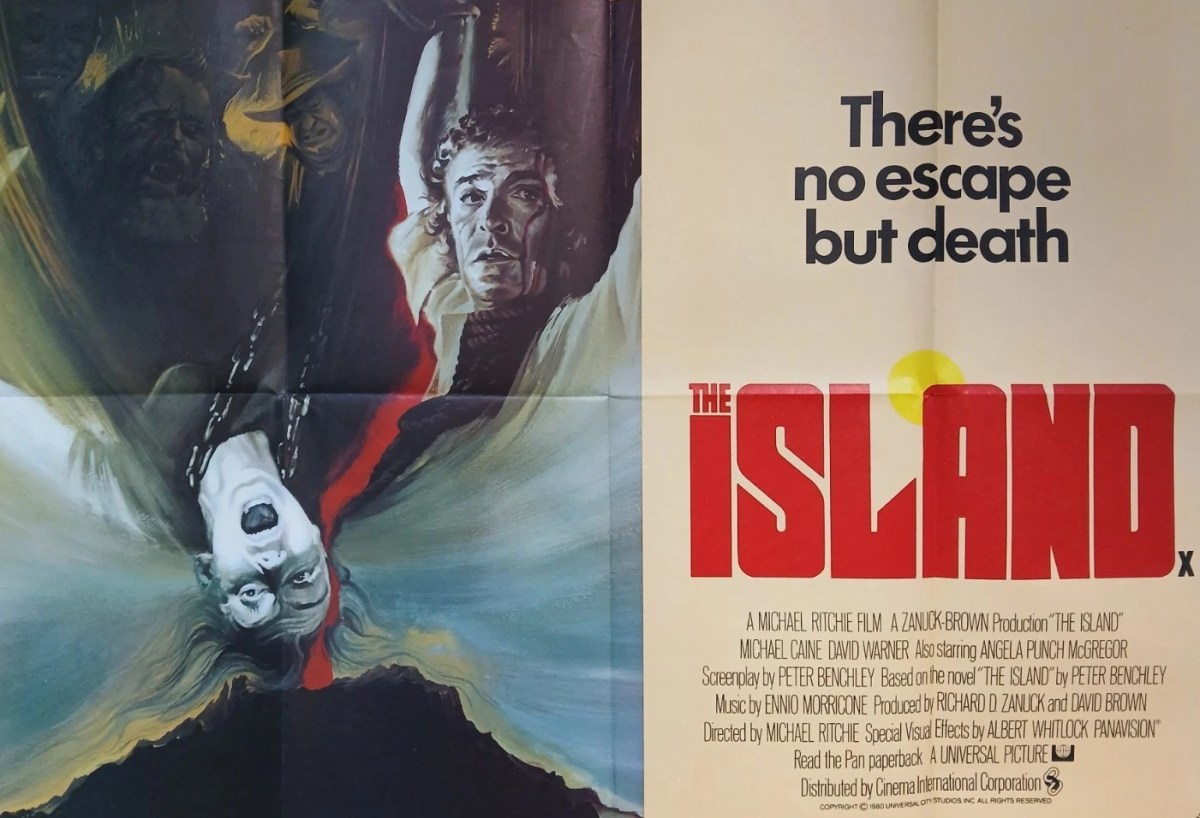
By common consent one of Michael Caine’s worst films – on a par with The Swarm (1978), The Hand (1981), Jaws, The Revenge (1987), and, for sheer embarrassment, Blame It On Rio (1984) – so naturally I had steered clear of it for four decades. But in the grip of reassessment fever and given how big a fan I am of pirate films, I wondered if I might come to a different conclusion after another vewing.
This was being touted as another blockbuster from the author of Jaws (1975) and The Deep (1977) so it’s entirely possible the actor was not necessarily its biggest drawing card.
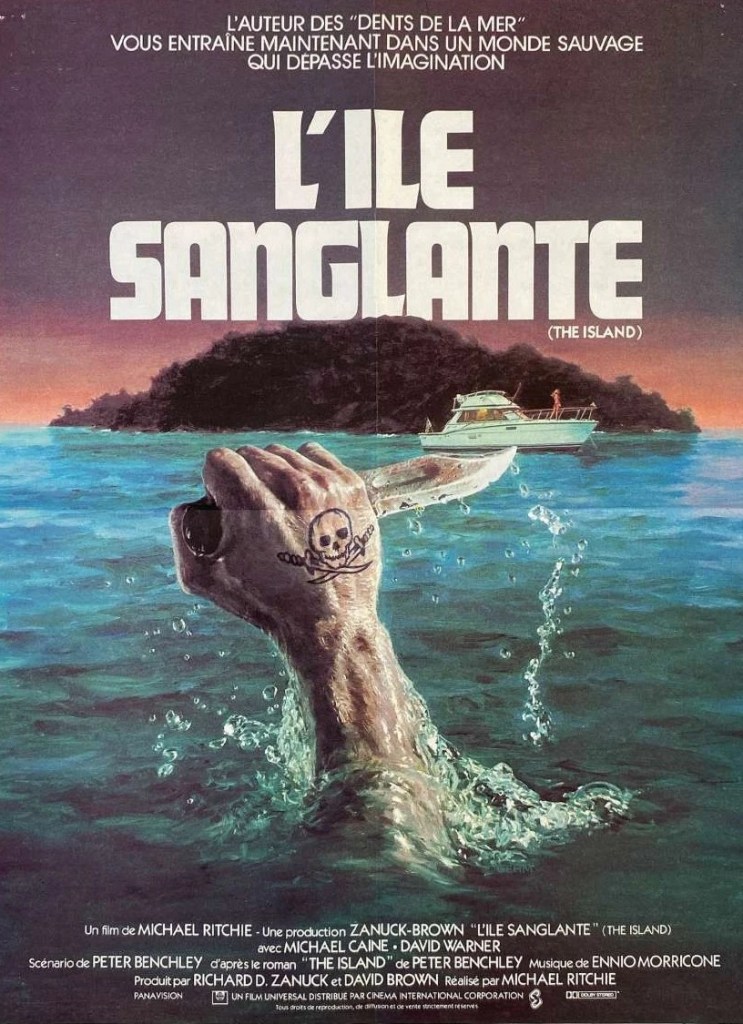
The odd thing is that – terrible though it is – it has some aspects very much in its favor. And if it had the courage of its convictions would have taken The Wicker Man route and not permitted journalist Blair Maynard (Michael Caine) to escape from the titular island where he is being held captive by a primitive tribe of pirates. Once he had fulfilled his purpose, which was to impregnate a female pirate, he could as easily have had his throat cut.
There is also some power reversal. He’s raped by said female, Beth (Angela Punch McGregor), and she keeps him chained by the neck, dragging him along behind her like a pet. And there’s an exploration of the gun-love fantasy, expressed by Blair’s 12-year-old son Justin (Jeffrey Frank), given the chance to wield a pistol like his hero Dirty Harry, enjoy the feeling of pulling the trigger, and in an extreme version of early teenage revolt, embracing the opportunity to put one over on his father.
And you might also go for the islanders, untouched and therefore uncorrupted by civilization, who still negotiate the seas in small sailing craft, and, except for their murderous instincts, could easily come across as innocents, living the same life – the “good life” in the eyes of many these days – as they would have done 300 years ago.
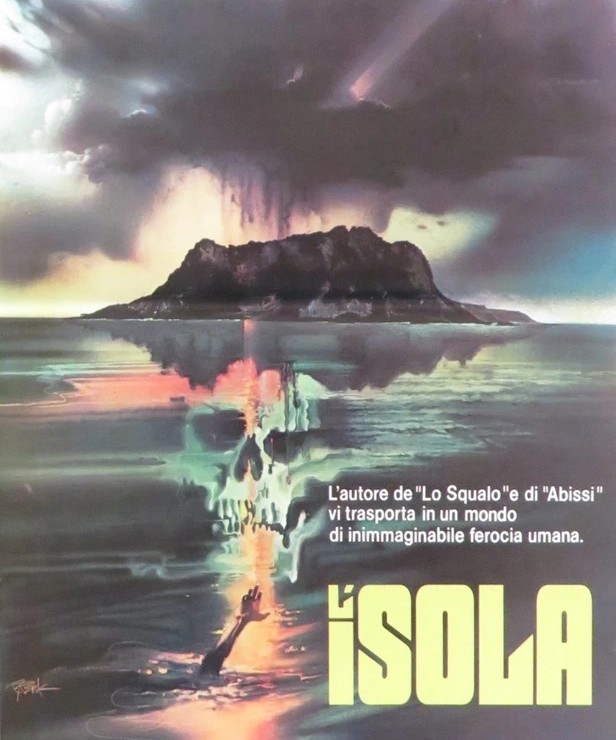
What counts against the movie is, for a start, the set-up. Had Blair been just on a sailing trip with his son and been captured by pirates that would have been fine. Instead, he’s a journalist managing to convince his editor to send him to investigate that hoary old chestnut, the Bermuda Triangle.
While the pirates are a gift to anthropological studies, sometimes they speak in perfect English, sometimes they speak pidgin English, sometimes they’re speaking in some form of Olde English complete with naff ritual and rules. Although they’re desperate to find a way of prolonging their species – which is where Blair comes in – they tend to kill any other males or females who could help them achieve this aim.
And although they steal plenty of modern supplies in the way of food and clothing from the ships they pirate, they still wear scraps and live off scraps.
When Blair attempts his first escape the presence of a giant jellyfish cuts that short. But, miraculously, the next two times he’s in the water, no jellyfish. Not much of this is discreet, but there is one relationship that gets by with looks. A young island boy, jealous of the attention given to Justin by Nau (David Warner), the pirate chief, appears to be helping Blair escape in a tiny craft until, far out at sea, the journalist notices that the boat has been sabotaged and is sinking fast. Even so, it’s a bit complicated. I couldn’t work out the young fellow’s motives. Getting rid of Blair wouldn’t get rid of his rival for the chief’s affections.
The ending is a complete mess. Luckily, we’ve been informed that Blair fought in the Korean War so when he finds a deck-mounted machine gun on the U.S. Coastguard vessel the pirates have just taken over, he can open fire like Rambo and slaughter near enough the entire contingent of his enemies. The only survivors are his son and Nau, so we can have one last hand-to-hand skirmish, and the boy and father can enjoy a sentimental reunion.
So, yes, this is a hidden civilization, a lost tribe, that might be treasured for living the simple life, but Blair, despite being a journalist, is hardly salivating at the prospect of his scoop. Too much time is spent on trying to establish the pirates’ way of life via their rituals and oddities.
But this was certainly a bold move on Caine’s part, to take on a role that was akin to Charlton Heston in Planet of the Apes (1968), to be treated as not just an inferior but only useful for his semen. The reversal of the power balance between himself and Beth, who, as in Planet of the Apes, begins to care for her captive, would certainly chime with the contemporary audience.
There’s very little that’s noble about the savages, all are unkempt and few have a full set of teeth.
But Caine does put in a good acting shift. Angela Punch McGregor (The Chant of Jimmie Blacksmith, 1978) is the pick of the rest. David Warner (Morgan!/Morgan, A Suitable Case for Treatment, 1966) excels in this kind of oddball part. Jeffrey Frank didn’t make another movie.
Disappointing choice, though, for director Michael Ritchie, who had built up a solid reputation through Downhill Racer (1969), Prime Cut (1972), The Candidate (1972) and Smile (1975). Written by Peter Benchley.
To be honest, I’m a bit disappointed to find so much to admire in what I had expected to be an ideal candidate for the So Bad It’s Good category.


