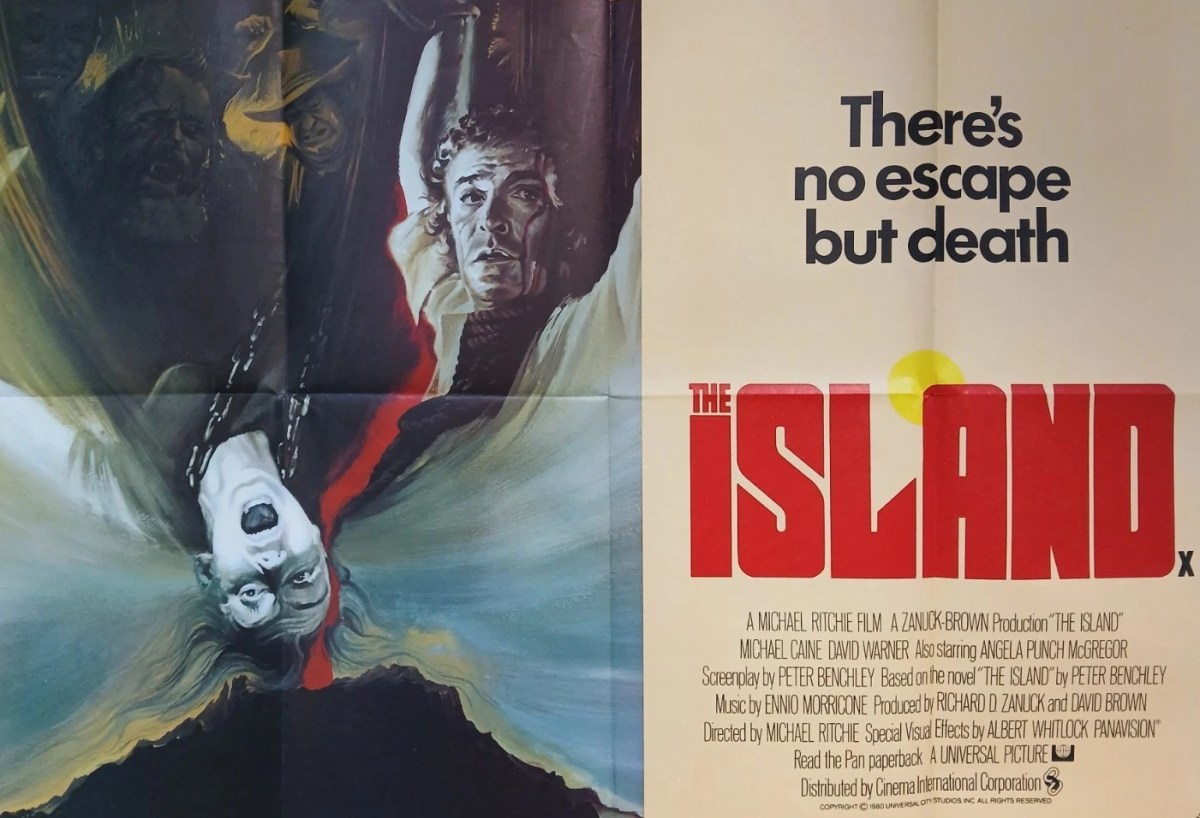
The Island (1980) ***

By common consent one of Michael Caine’s worst films – on a par with The Swarm (1978), The Hand (1981), Jaws, The Revenge (1987), and, for sheer embarrassment, Blame It On Rio (1984) – so naturally I had steered clear of it for four decades. But in the grip of reassessment fever and given how big a fan I am of pirate films, I wondered if I might come to a different conclusion after another vewing.

This was being touted as another blockbuster from the author of Jaws (1975) and The Deep (1977) so it’s entirely possible the actor was not necessarily its biggest drawing card.
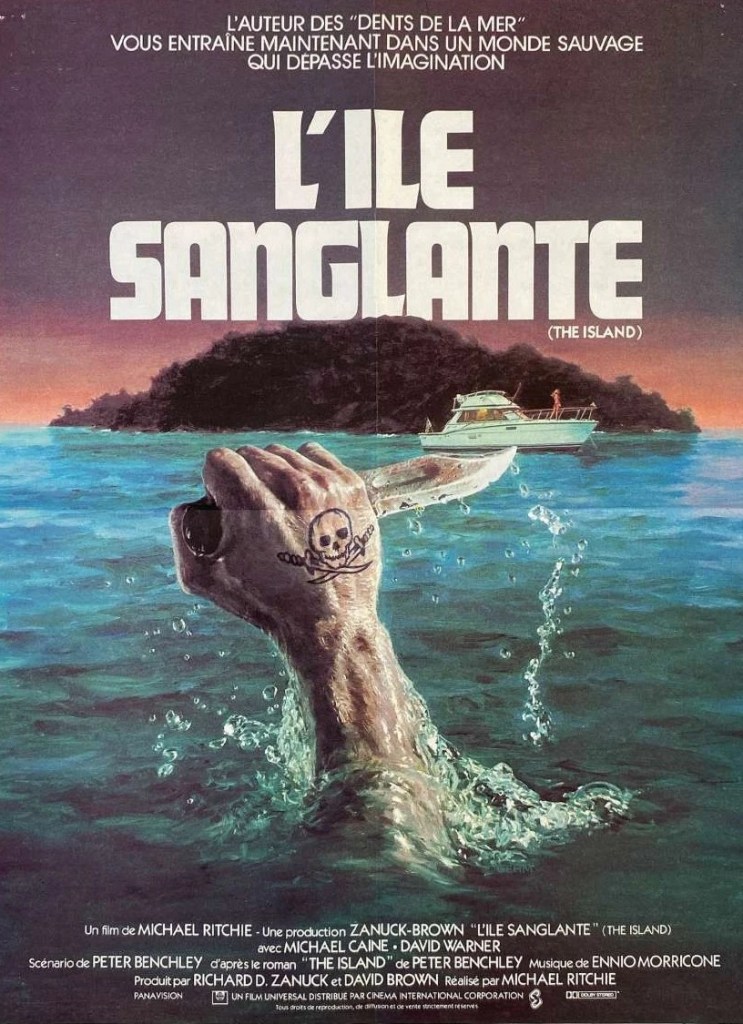
The odd thing is that – terrible though it is – it has some aspects very much in its favor. And if it had the courage of its convictions would have taken The Wicker Man route and not permitted journalist Blair Maynard (Michael Caine) to escape from the titular island where he is being held captive by a primitive tribe of pirates. Once he had fulfilled his purpose, which was to impregnate a female pirate, he could as easily have had his throat cut.

There is also some power reversal. He’s raped by said female, Beth (Angela Punch McGregor), and she keeps him chained by the neck, dragging him along behind her like a pet. And there’s an exploration of the gun-love fantasy, expressed by Blair’s  12-year-old son Justin (Jeffrey Frank), given the chance to wield a pistol like his hero Dirty Harry, enjoy the feeling of pulling the trigger, and in an extreme version of early teenage revolt, embracing the opportunity to put one over on his father.

And you might also go for the islanders, untouched and therefore uncorrupted by civilization, who still negotiate the seas in small sailing craft, and, except for their murderous instincts, could easily come across as innocents, living the same life – the “good life” in the eyes of many these days – as they would have done 300 years ago.
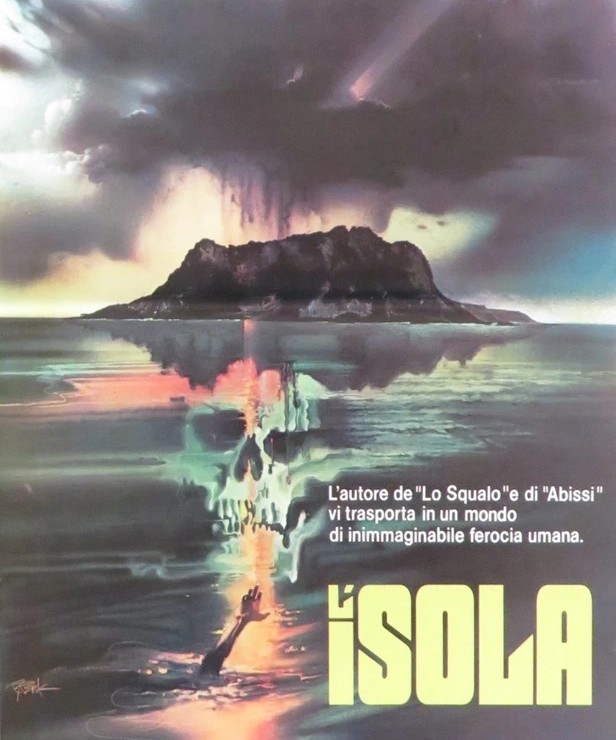
What counts against the movie is, for a start, the set-up. Had Blair been just on a sailing trip with his son and been captured by pirates that would have been fine. Instead, he’s a journalist managing to convince his editor to send him to investigate that hoary old chestnut, the Bermuda Triangle.

While the pirates are a gift to anthropological studies, sometimes they speak in perfect English, sometimes they speak pidgin English, sometimes they’re speaking in some form of Olde English complete with naff ritual and rules. Although they’re desperate to find a way of prolonging their species – which is where Blair comes in – they tend to kill any other males or females who could help them achieve this aim.

And although they steal plenty of modern supplies in the way of food and clothing from the ships they pirate, they still wear scraps and live off scraps.

When Blair attempts his first escape the presence of a giant jellyfish cuts that short. But, miraculously, the next two times he’s in the water, no jellyfish. Not much of this is discreet, but there is one relationship that gets by with looks. A young island boy, jealous of the attention given to Justin by Nau (David Warner), the pirate chief,  appears to be helping Blair escape in a tiny craft until, far out at sea, the journalist notices that the boat has been sabotaged and is sinking fast. Even so, it’s a bit complicated. I couldn’t work out the young fellow’s motives. Getting rid of Blair wouldn’t get rid of his rival for the chief’s affections.

The ending is a complete mess. Luckily, we’ve been informed that Blair fought in the Korean War so when he finds a deck-mounted machine gun on the U.S. Coastguard vessel the pirates have just taken over, he can open fire like Rambo and slaughter near enough the entire contingent of his enemies. The only survivors are his son and Nau, so we can have one last hand-to-hand skirmish, and the boy and father can enjoy a sentimental reunion.

So, yes, this is a hidden civilization, a lost tribe, that might be treasured for living the simple life, but Blair, despite being a journalist, is hardly salivating at the prospect of his scoop. Too much time is spent on trying to establish the pirates’ way of life via their rituals and oddities.

But this was certainly a bold move on Caine’s part, to take on a role that was akin to Charlton Heston in Planet of the Apes (1968), to be treated as not just an inferior but only useful for his semen. The reversal of the power balance between himself and Beth, who, as in Planet of the Apes, begins to care for her captive, would certainly chime with the contemporary audience.

There’s very little that’s noble about the savages, all are unkempt and few have a full set of teeth.

But Caine does put in a good acting shift. Angela Punch McGregor (The Chant of Jimmie Blacksmith, 1978) is the pick of the rest. David Warner (Morgan!/Morgan, A Suitable Case for Treatment, 1966) excels in this kind of oddball part. Jeffrey Frank didn’t make another movie.

Disappointing choice, though, for director Michael Ritchie, who had built up a solid reputation through Downhill Racer (1969), Prime Cut (1972), The Candidate (1972) and Smile (1975). Written by Peter Benchley.

To be honest, I’m a bit disappointed to find so much to admire in what I had expected to be an ideal candidate for the So Bad It’s Good category.
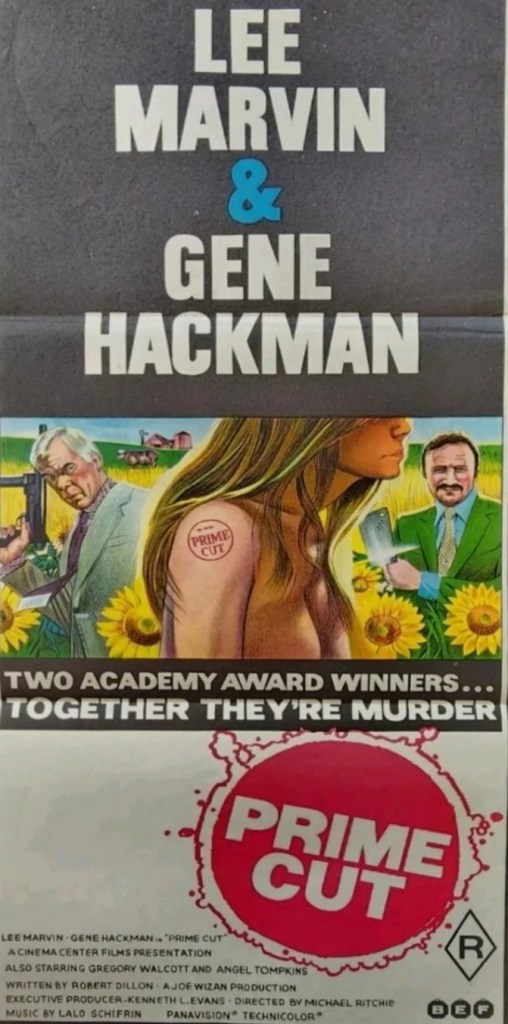
Prime Cut (1972) ****

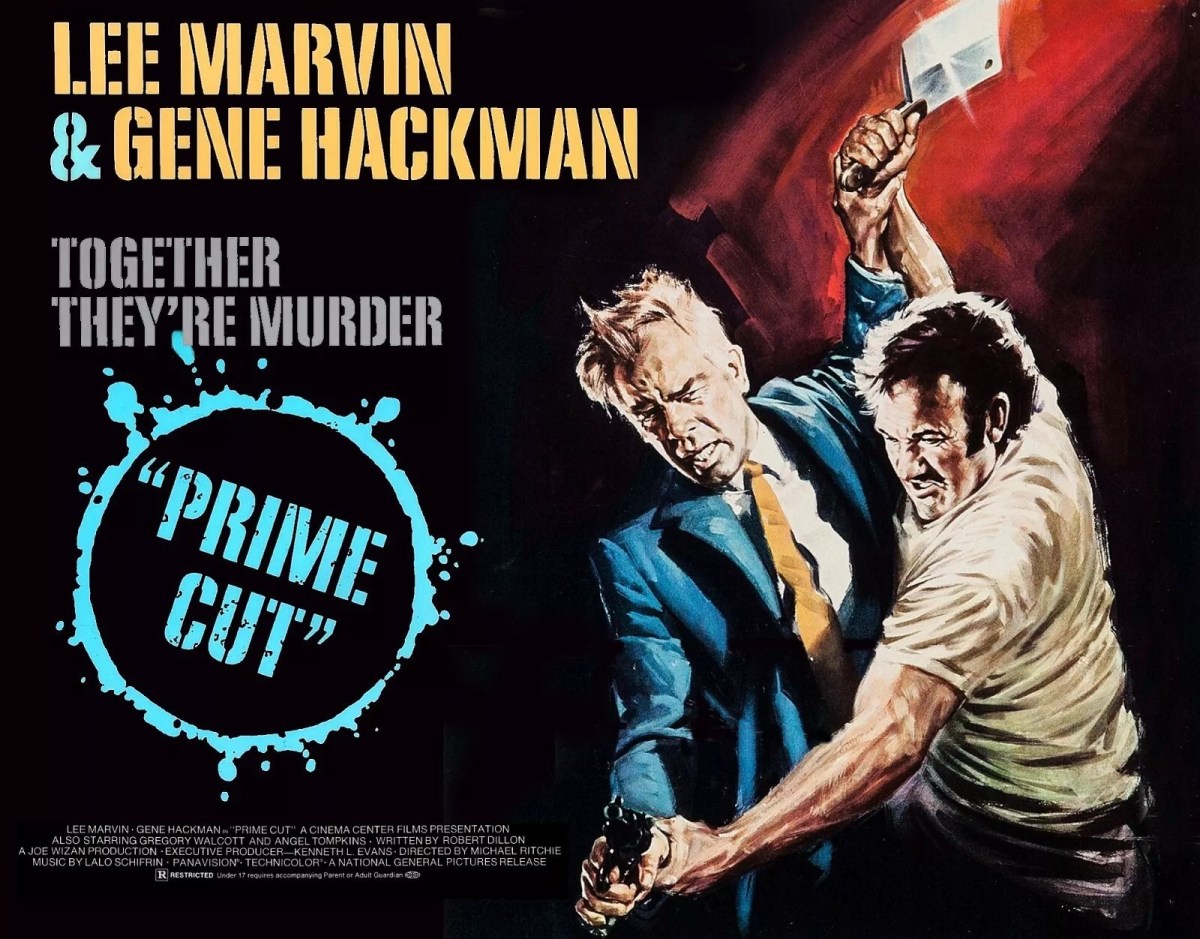
Unusually nuanced thriller. Unusually lean, too, barely passing the 90-minute mark. There’s a Hitchcockian appreciation of the danger lurking in wide open spaces. And the background is the Middle America of annual fairs, marching bands, pie-eating competitions, rural pride in farming and marksmanship.

But there’s an undercurrent that will strike a contemporary audience. The contempt of big business for its customers. The sex trafficking, too, will sound an all-too-common note especially as the young women come from an orphanage set in the heart of homespun America in what appears to be a streamlined service.

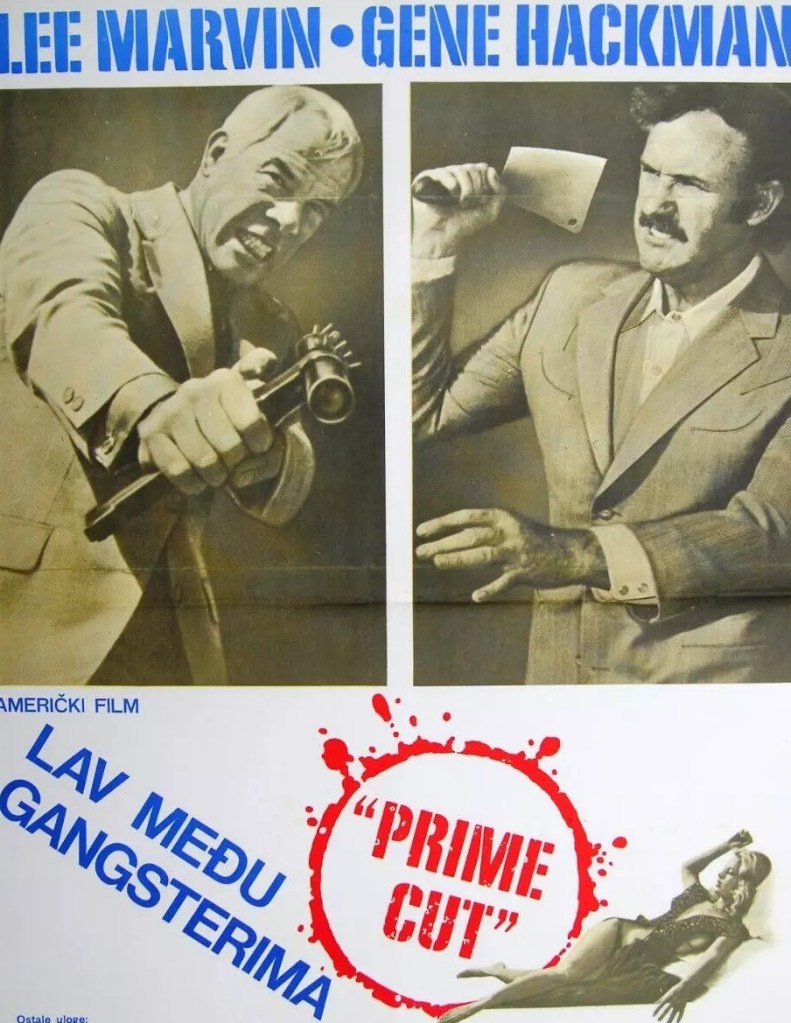
In the actual screen credits, Hackman was not above the title.

We shouldn’t at all take to hitman Nick (Lee Marvin) except that he’s got a code of honor and sparing with words. He’s been sent from Chicago to Kansas to sort out with what would later be termed “extreme prejudice” Mafia boss and meat-packer Mary Ann (Gene Hackman) who’s been skimming off the top. As back-up Nick is handed a trio of young gunslingers anxious to prove themselves while his faithful chauffeur owes Nick his life.

Mary Ann doesn’t just have a factory, he has a fort, a posse of shotgun-wielding henchman standing guard. So Nick has to plunge right in and confront the miscreant. As well as dealing with animal flesh, Mary Ann has a side hustle in sex trafficking, displaying naked women in the same straw-covered pens as his beef.

Responding to a whispered “help me” by Poppy (Sissy Spacek) Nick buys her freedom, but Mary Ann isn’t for knuckling down to the high-ups in Chicago and since he’s already despatched a handful of other hoods sent on a similar mission as Nick he’s intent on turning the tables.

The action, when it comes, is remarkably low-key and all the more effective for it. Swap a crop duster for a combine harvester and the head-high prairie corn for the usual city back streets and you realize someone has dreamed up a quite original twist on the standard thriller. No need for a car chase here to elevate tension, it’s already a quite efficient slow burn.

By the time this came out Hackman had won an Oscar for “The French Connection” (1971), Marvin already in that exalted league thanks to “Cat Ballou” (1965)

This could be an ode to machinery. The entire credit sequence is devoted to the way machines chew up cow flesh and turn it into strings of sausages and the like. The combine harvester chews up and spits out an entire automobile, grinding the metal through its maw. And then there’s the machinery of business, the ability, at whatever cost, to give the public what it wants, in whatever kind of flesh takes its fancy.

You’ll remember the combine harvester sequence and the shootout in the cornfields, but you will come away with much more than that. Remember I mentioned nuance. Sure Mary Ann is an arrogant gangster and you’d think with hardly an ounce of humanity, but that’s until you witness his relationship with his simple-minded brother Weenie (Gregory Walcott). That could as easily have fallen into the trap of cliché sentimentality. Instead, there’s roughhouse play between the pair and it’s all the more touching for being realistic.

There’s a tiny scene where one of the young hoods asks Nick to meet his mother, in the way of a young employee wanting to show off that he was working for a top man. And Nick also goes out of his way to praise what’s on offer at the fair from a couple of women anxious for praise.

One of the tests of a good actor is what they do when they enter an unfamiliar room. Your instinct and mine, like ordinary people, would be to look around not just lock eyes on the person you’ve come to meet. So when Poppy wakes up in a luxurious hotel room she doesn’t go into all that eye-rubbing nonsense, but instead marvels at her surroundings. And although she hangs on his every word – and his arm – Nick isn’t in the seduction business, instead spoiling the young woman with expensive clothes.

There are several other scenes elevated just by touches. The credit sequence ends with a shoe appearing among the meat being processed – Mary Ann’s victims don’t sleep with the fishes but with the sausages. Poppy recalls a childhood spent in a rural wonderland, squirrels, rabbits, the splendors of nature, and reveals a lesbian relationship with another orphan Violet that is the most innocent description of love and sexual exploration you’ll ever hear.

Violet is the victim of multiple rapists. Weenie has passed her onto a bunch of down-and-outs for the price of a nickel. When Nick unclenches her clenched fist you’ll be horrified to see how many nickels tumble out.

Lee Marvin (Point Blank, 1967) is at his laconic best and Sissy Spacek (Carrie, 1976) makes a notable debut but Gene Hackman (Downhill Racer, 1969) overplays his hand.

Director Michael Ritchie (Downhill Racer) was on a roll, following this with The Candidate (1972), Smile (1975), The Bad News Bears (1976) and Semi-Tough (1977) before the execrable The Island (1980) badly damaged his career.

Written by Robert Dillon (The French Connection II, 1975).

Well worth a look.

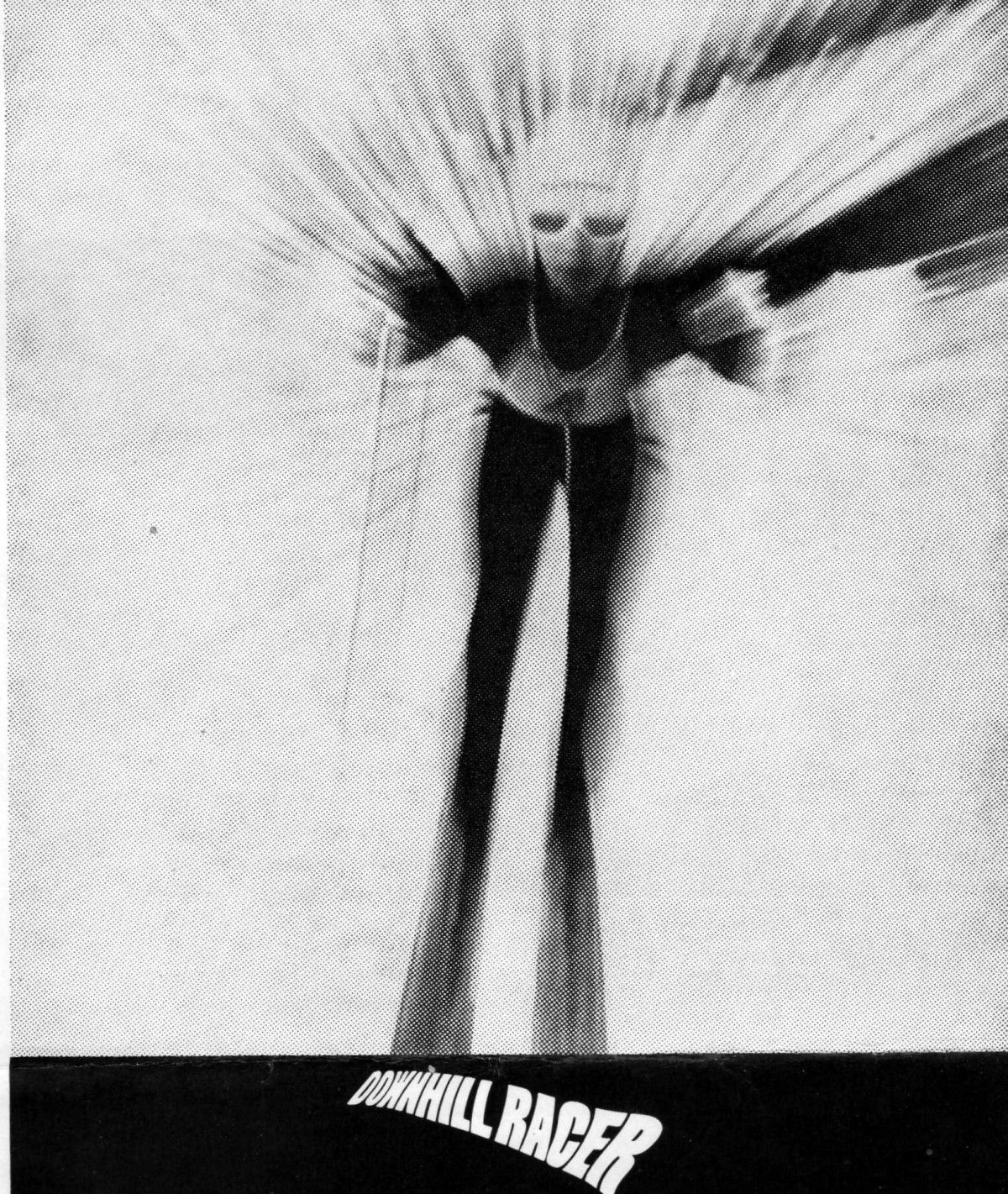
Downhill Racer (1969) ***

Idealising heroes is endemic. Most films which portray sport stars with feet of clay generally start off with an attractive personality who presses the self-destruct button through alcohol, sex or drugs (or all three) such as Number One (1969) with Charlton Heston. The general consensus is that this approach to the sports movie was not rescinded until the brutal boxer exposed in Scorsese’s The Raging Bull (1980). But it turns out Scorsese was not the first.

Downhill Racer is a character study of a loner who cares for no-one but himself. Alienated from his father, his girlfriend at home treated as little more than a sex object, a constant source of friction for his national team manager (a pre-chuckle Gene Hackman) and not above the kind of dirty tricks as typified in Slap Shot (1977) he sees nothing wrong with making no bones about the fact that he is in the game for fame. He has no illusions, he’s a farm boy and few steps up from being illiterate.

That Paramount had little faith in the project was shown by the Pressbook. It was a mere eight pages long when 16-plus pages were devoted to other pictures. There was no mention of the startling success of “Butch Cassidy and the Sundance Kid” released a few months before. Its limited appeal was shown by the fact there were only two adverts, both very artistic, whereas most movies had at least half a dozen different variations to help cinemas market the movie to their specific audiences. And there was but a single tag-line “how far must a man go to get from where he’s at.” Studio marketeers had managed to drum up just two promotions, both fashion-led, a six-page section in “Glamour” magazine and five pages in “Ski” magazine. A better bet was the accompanying two-page advertising supplement showing the movie had scored excellent reviews from “Time”, “Life”, “Newsweek” and the “New York Times.”

His only attractive feature is that he is played by Robert Redford, and the film plays upon the conceit that as handsome a man as this will at some point turn into a good guy.  There’s an interesting debate – and one that would last decades – about whether Redford’s looks got in the way of the characters he portrayed. Imagine Robert Duvall in the part, for instance, and relentless determination would not be called into question. This leaves the film with only pity as a way to give the character any sympathy, which duly occurs when his hopes of genuine romance with a top-notch blonde (Camilla Sparv) are dashed. 

Michael Ritchie, making his directing debut, opts for a documentary-style approach, so minimalist it’s almost perfunctory. This is a decent option given there’s very little going on beyond lonely hotel rooms, and an endless round of competitions and an occasional outburst from Hackman. Less welcome is his decision to fall back on television commentators to fill us in on exactly where we are geographically and specifically regarding individual competitions.

The film’s biggest drawback is that the skiing scenes, sensational at the time, offer little on the small screen. But at least they were competently done. Ritchie drew on a number of experts in that department: German racer Heini Schuler, Swiss team members Peter Rohr and Arnold Alpigger and ski instructors Marco Valli and Rudi Gertsch. Former U.S. Olympic team member Rip McManus turns up as an on-camera commentator. Although it gained good reviews, audiences failed to respond although Redford was on a career high after Butch Cassidy and the Sundance Kid (1969). But it was a brave choice for the actor.

And it was the start of his producing career. The film had been a stop-start project at Paramount and when the studio continued to dither Redford set up Wildwood with Richard Gregson, husband of Natalie Wood with whom Redford had appeared in Inside Daisy Clover (1965) and This Property Is Condemned (1966).

Discover WordPress

A daily selection of the best content published on WordPress, collected for you by humans who love to read.

The Atavist Magazine

by Brian Hannan

WordPress.com Blog

News, Tips & Website Tutorials