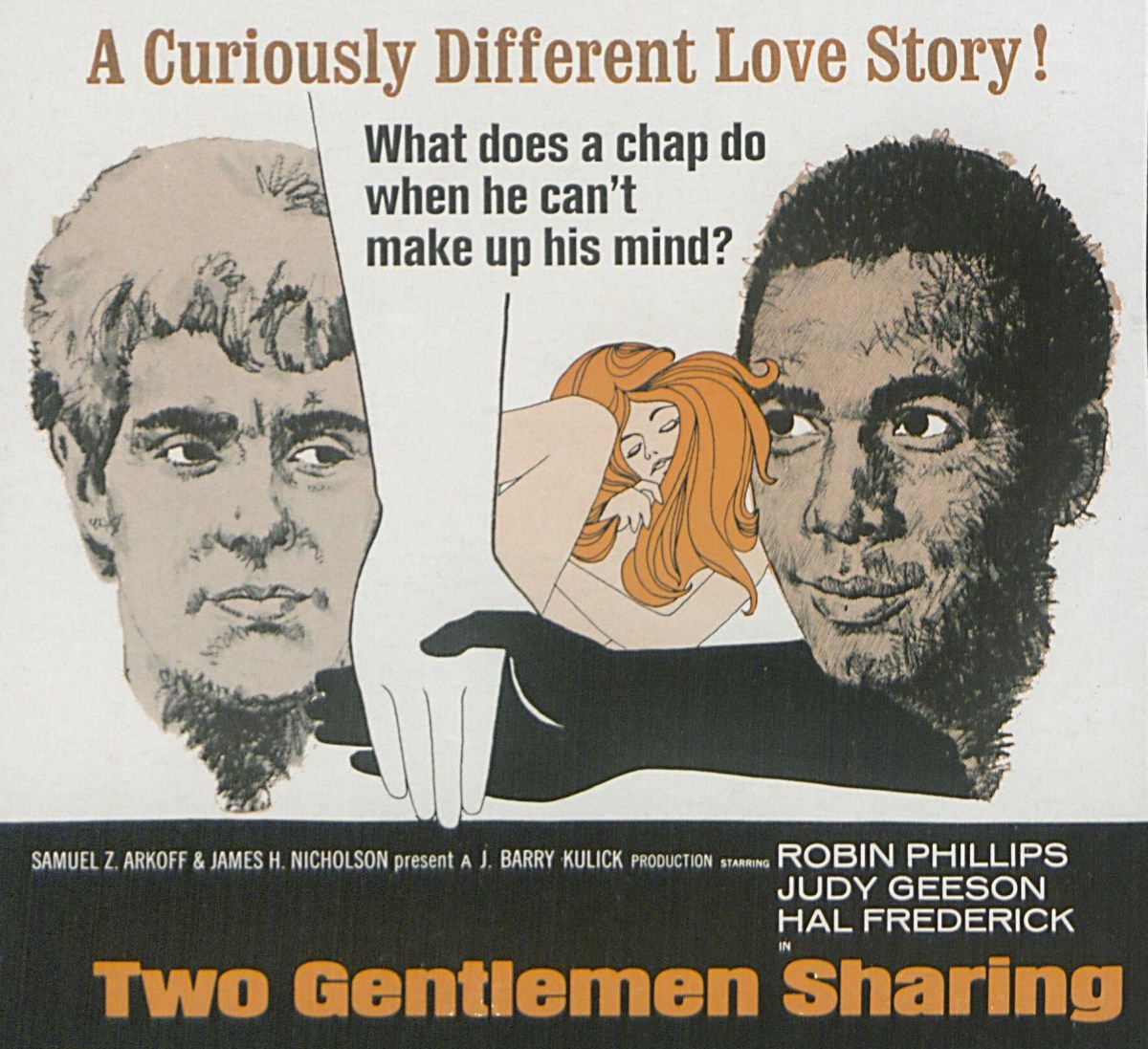
Two Gentlemen Sharing (1969) ***

Shelved was a polite term for what happened to this picture. It was funded by Paramount but they didn’t like the look of the finished article. It could have gone straight into the bin, but it was reprieved, sold onto AIP which was looking to shift away from horror and biker movies into mainstream productions. But though it was made in Britain and therefore would qualify for both the Levy tax credit and the quota system, AIP couldn’t find a British distributor to take it on, not even after being selected as the official UK entry to the Venice Film Festival and impressing New York critics. It wasn’t shown on a British screen until 2017.

So what the heck was wrong with it? I had wrongly assumed that the title was a hint that the two gentlemen were gay, but that isn’t the case.
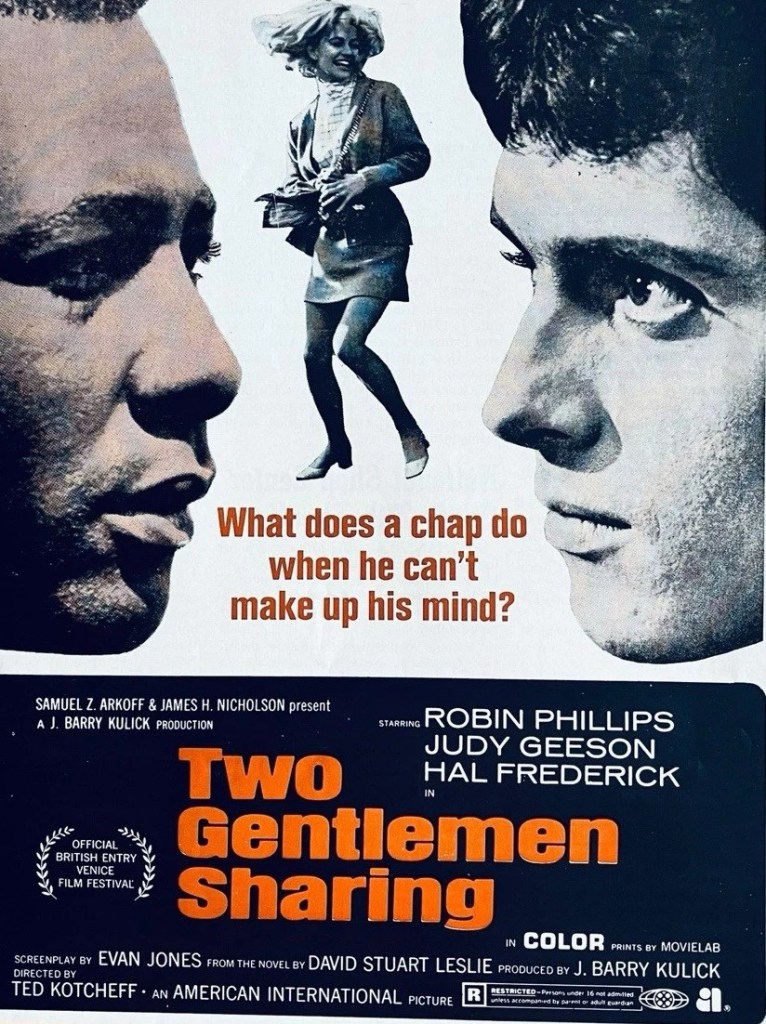
We open with a fellow with a plummy voice called Andrew Mackenzie (Hal Frederick) calling round London landlords looking for digs. He’s a solicitor, wears a bowler hat, was educated at Oxford University, even famously scored a century in a cricket match – and you can’t fit in any more than being a top-class cricketer. But doors which would open for anyone else with such a pedigree are closed to him.

Problem is – he’s Black. He’s of Jamaican descent. He’s not homeless, he’s got digs in Brixton, a noted Black community. Eventually, he finds accommodation in very posh Knightsbridge with ad man Roddy (Robin Philips).

Racism had been tackled in the movie world primarily through the aegis of Sidney Poitier. His three 1967 films – To Sir, With Love, In the Heat of the Night and Guess Who’s Coming to Dinner, had all concluded on the upbeat. The Black man was accorded acceptance and respect.

That doesn’t happen here. The N-word is in common use. Andrew ends up being tossed out of the apartment by his landlady for essentially conforming to the cliché of being a “sexual degenerate,” i.e. for making too much noise while having sex. Eventually, he decides he’ll never fit in in Britain and returns to Jamaica.
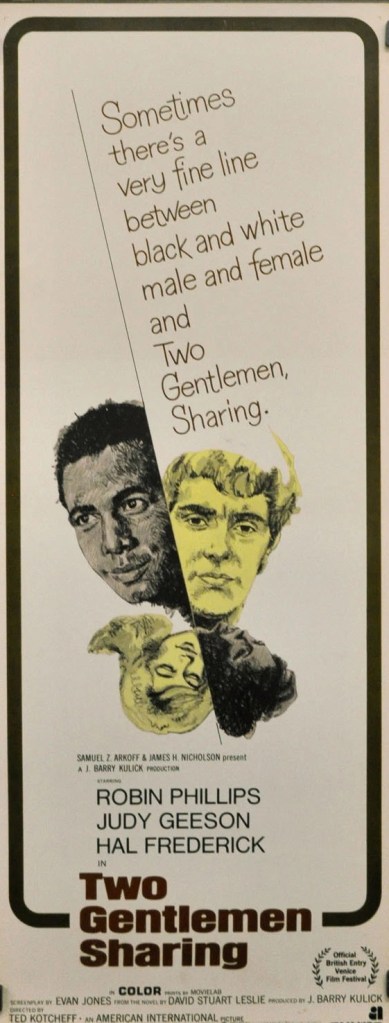
But while the film deals bluntly with issues of endemic racism in British culture, it also tackles the problems facing the more socially aware, who tie themselves in knots trying to prove they are not racists. Although on the face of it accepting his flatmate’s color, Roddy has problems with his own beliefs. He’s certainly jealous of Andrew’s supposed sexual prowess, to the point of clearly believing he will enjoy more sexual freedom should he hitch up with a Black woman, and at various points exhibits inappropriate behavior towards them.

He also can’t come to terms with the fact that his girlfriend Jane (Judy Geeson) is not only very popular with Black men but has been brought up by a Black man after her own White father died when she was very young. To prove his liberal credentials once and for all, Andrew hosts a massive party in the apartment, inviting a crowd of Blacks, but when his drunken overtures to Black women are rejected, the party ends in disaster.

The characters are well drawn. Andrew is no saint. He’s misogynistic for a start, determining that his girlfriend Caroline (Esther Anderson) should do all the cooking and household chores. He’s arrogant and selfish, often grumpy. In other words, as human as the next guy.

Roddy is insecure. His job has none of the glamor we associate with advertising. His biggest decisions concern how many chips to have on a plate being photographed for an advertisement. Although coming from a wealthy background, his parents are now so impoverished they live in the squalid basement of a stately home. He has no understanding of women, tending to make too many of the wrong assumptions. So, just another young fella having problems growing up.

You’d think – and Roddy certainly thinks – that in the ad world he’d have a bevy of young women at his beck and call as does his colleague Phil (Norman Rossington) who, despite clearly taking advantage of his position in terms of seduction opportunities, is more enlightened – he has a Black girlfriend.

The movie’s very fair in determining when characters feel out of place. While Andrew struggles in the White world, Roddy and to a certain extent Phil struggle in the Black social world, bounding about awkwardly at a “jump-up”, the name given to a dance featuring Black music.

Given the actors are all primarily newcomers, showing promise is the extent of the acting. Reportedly Hal Frederick’s (Sandokan, 1964) plummy British accent was dubbed, but it is adequate for the task in hand which is to explore the minefield of the often unexplored aspects of British racism at a time when large-scale immigration was limited to certain cities and when the country still believed in “fair play” or convinced itself it did.

Robin Phillips (Decline and Fall…of a Birdwatcher, 1968) has a more complex part, needy, weak, his unformed unappealing character turning up at the edges. Judy Geeson (Three into Two Won’t Go, 1969) is better and Norman Rossington (Tobruk, 1967) throws himself into a peach of a part. Esther Anderson (The Touchables, 1968) is appreciated.

Canadian director Ted Kotcheff (Life at the Top, 1965) pulls no punches and certainly there is no sign of sentimentality or that, somehow, everything will all come good in the end. Screenplay by debutant David Stuart Leslie from the bestseller by Evan Jones.

Worth seeing if only to ask why we were kept from seeing it for so long. You can catch it on Amazon Prime at the moment.
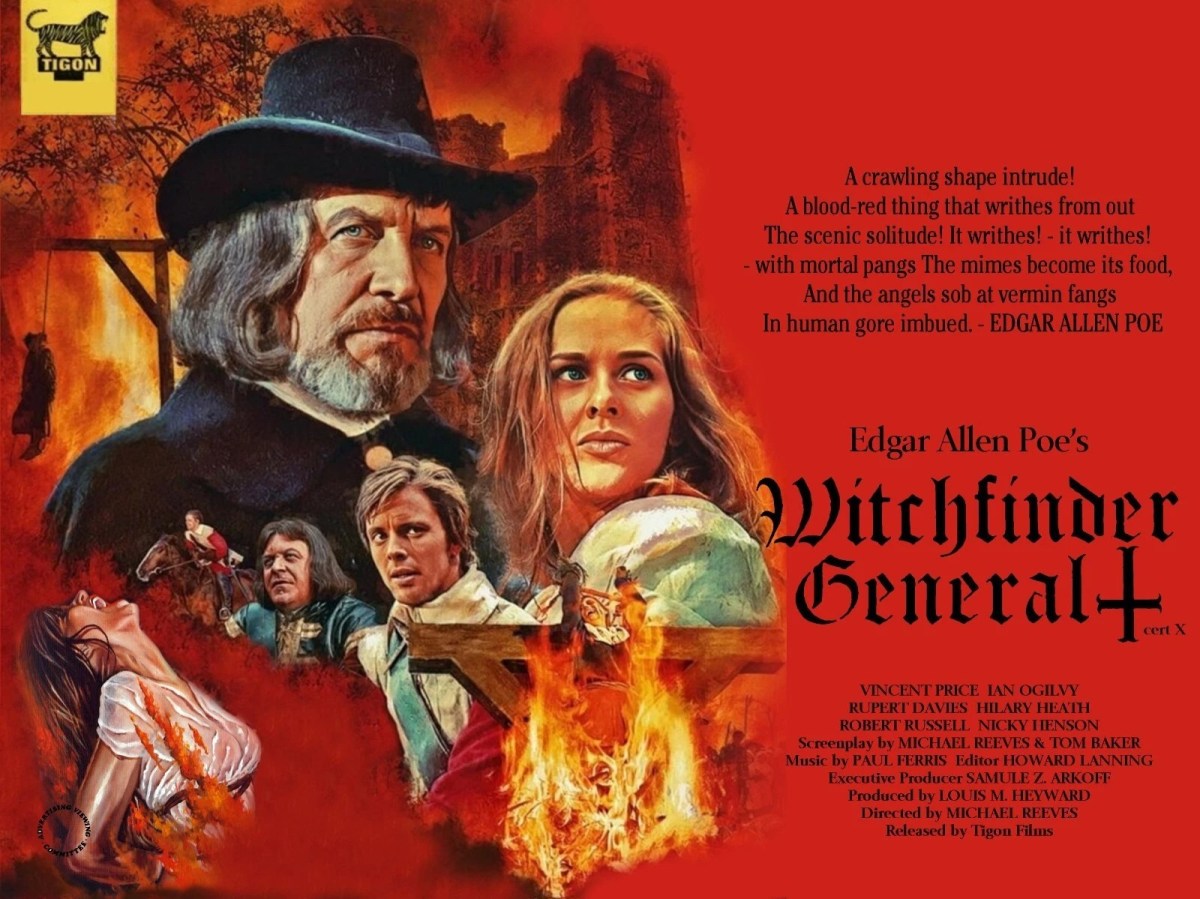
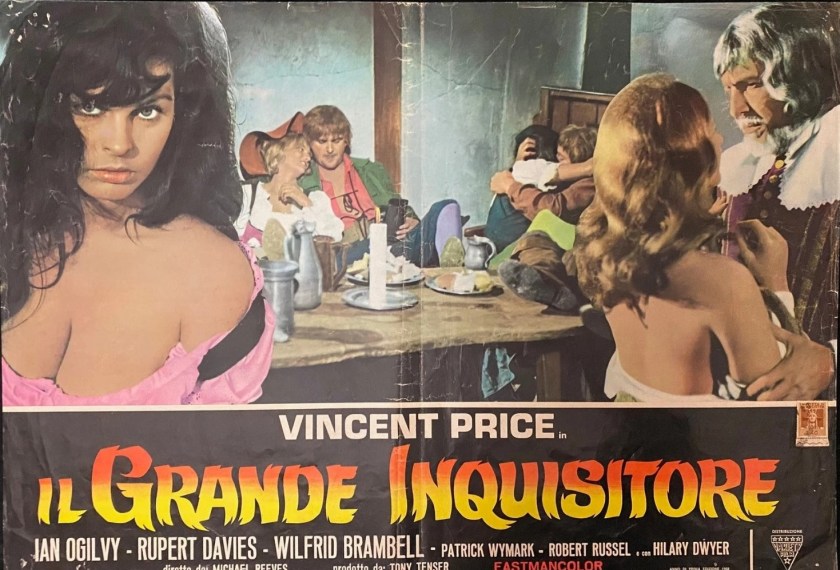
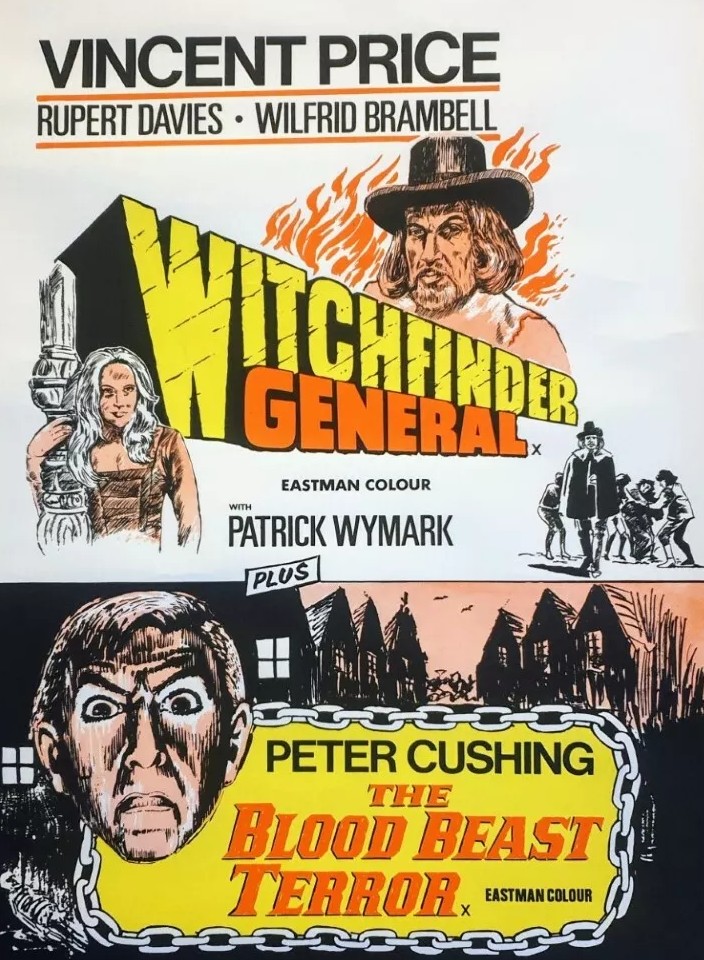
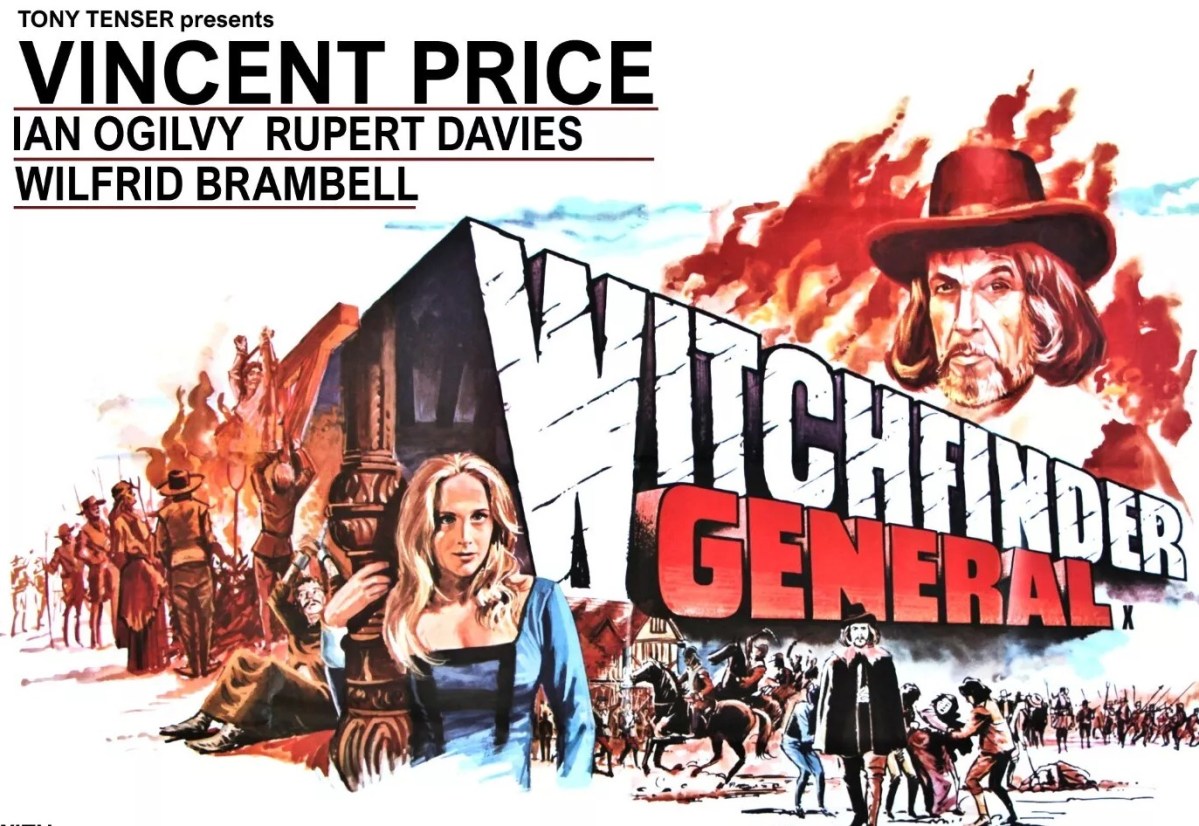
Behind the Scenes: “Witchfinder General” / “The Conqueror Worm” (1968)

Truth was the first casualty. Matthew Hopkins, the character played in the film by Vincent Price, was 27 when he died in 1647. He had been hunting witches for three years. Price was 57 when the movie appeared. Co-star Ian Ogilvy, aged 25, would have been a better fit, though he lacked the menace. Oliver Reed, who had the swagger and the scowl, would have been the ideal candidate, age-wise, since he was just turning 30. And the movie might well have benefitted from presenting Hopkins as a young grifter who through force of personality and cunning held a country to ransom.

Price wasn’t director Michael Reeves’ (The Sorcerers, 1967) first choice. In fact, he originally wanted buddy Ogilvy, who had played opposite Boris Karloff in The Sorcerers. When that idea failed to float with Tony Tenser – previously head of Compton Films – now boss of British horror outfit Tigon, a challenger to the Hammer crown, Reeves pivoted to Donald Pleasance who, although better known as a supporting actor in the likes of The Great Escape (1963), had headlined Roman Polanski’s chiller Cul de Sac (1966). But when Tenser did a deal with American International Pictures, the U.S. mini-studio insisted on contract player Vincent Price, the mainstay of their Edgar Allan Poe output, with 16 previous films (out of 74) for the company.

Twenty-one-year-old Hilary Dwyer (The Oblong Box, 1969), under contract to Tigon, made her movie debut. Rupert Davies (The Oblong Box) was a seasoned veteran while Nicky Henson (Here We Go Round the Mulberry Bush, 1967) was a potential breakout star.

Tigon was a relatively new entrant to the horror scene, founded in 1966 by Tenser. Its second picture was The Sorcerers; this would be its fourth. Tenser has bought, pre-publication, the rights to Ronald Bassett’s novel Witchfinder General, published in 1966. Director Reeves faced something of a deadline once Tenser finalized the £83,000 budget. AIP chipped in £32,000 which included a £12,000 fee for Price. While it was Tigon’s biggest film to date, it was pin money for AIP.

The film needed to begin shooting by September 1967 at the latest to avoid the worst of the British cold weather. But the screenplay proved too unpleasant for the taste of the British censor. Reeves had already begun the screenplay with Tom Baker (The Sorcerers) with Donald Pleasance in mind portraying “a ridiculous authority figure” and had to quickly revamp it for Price. The laws of the period required a green light for the script from the British Board of Film Censors, who were repulsed by a “study in sadism” which dwelt too lovingly on “every detail of cruelty and suffering.”

That draft was submitted on August 4, 1967. The second draft, submitted on August 15, proved no more appealing. A third, substantially toned-down version, was approved. This resulted in the elimination of gruesome details of the Battle of Naseby and a change to the ending.

Production began on September 18, 1967. Star and director clashed. Reeves refused to go and meet Price on arrival at Heathrow Airport and told him, “I didn’t want you, and I still don’t want you, but I’m stuck with you.” The star was riled by the director’s inexperience. When told to fire a blank pistol while on horseback, Price was thrown from his horse after the animal reared up in shock at the sound. Price, in real-life a very cultured person, was surprised at Reeves’ attitude because in general he got on with directors.

Price turned up drunk on the last day of shooting, the filming of his character’s death scene. Reeves was planning revenge and told Ogilvy to really lay into the star. But the producer, anticipating trouble, ensured Price was well padded.

Reeves was better known for his technical rather than personal skills. Ogilvy commented: “Mike never directed the actors. He said he knew nothing about acting and preferred to leave it up to us.” That wouldn’t square with him falling out with Price over his interpretation of the character. And Hilary Dwyer saw another side of Reeves. “He was really inspiring to work with,” she said, “And because it was my first film, I didn’t know how lucky I was.” She would work with Price again on The Oblong Box and Cry of the Banshee (1970).

Tony Tenser, egged on by AIP’s head of European Productions, shot additional nude scenes in the pub sequence for the German version, A continuity error was responsible for the freeze-frame ending. There was a short strike when the production fell foul of union rules. Producer Philip Waddilove and his wife Susi were occasionally called upon to act.

Two aircraft hangars near Bury St Edmunds in Suffolk were converted for the interiors while a wide variety of locations were utilized for exteriors including Lavenham Square in Suffolk, the coast at Dunwich, also in Suffolk, Black Park in Buckinghamshire, Orford Castle in East Anglia, St John The Evangelist Church in Rushford, Norfolk, and Kentwell Hall in Long Melford on the Essex-Suffolk border. When the operation could not afford a camera crane, the crew improvised with a cherry picker.

Despite the tension on set, Price was pleased with his performance and the overall film. He praised the film in a 10-page letter. Price remarked, “I realized what he wanted was a low-key, very laid-back, menacing performance. He did get it but I was fighting him every inch of the way. Had I known what he wanted I would have cooperated.”

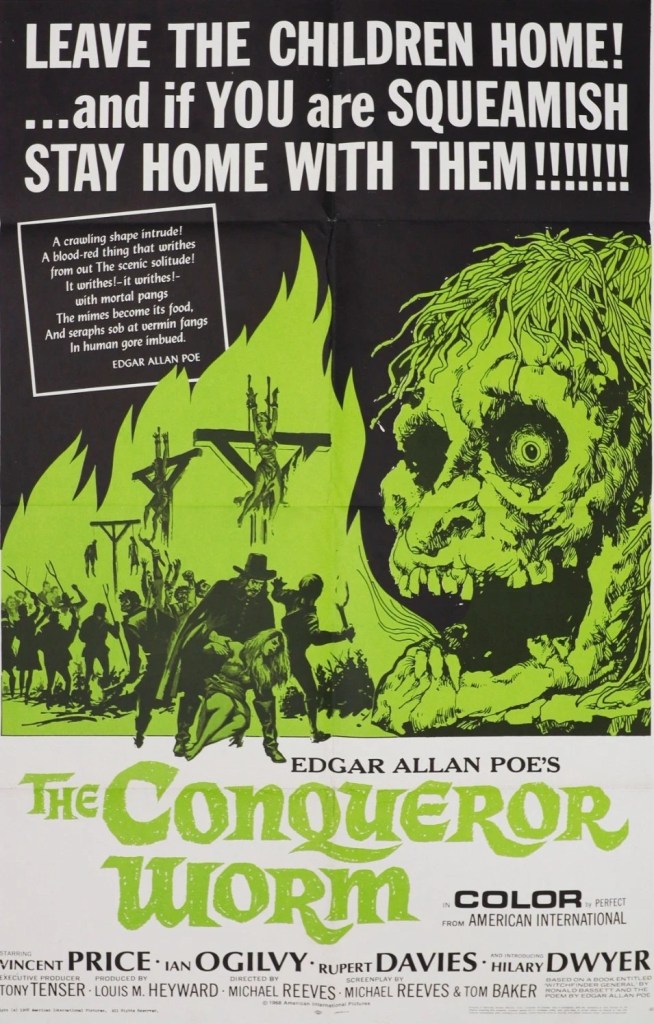
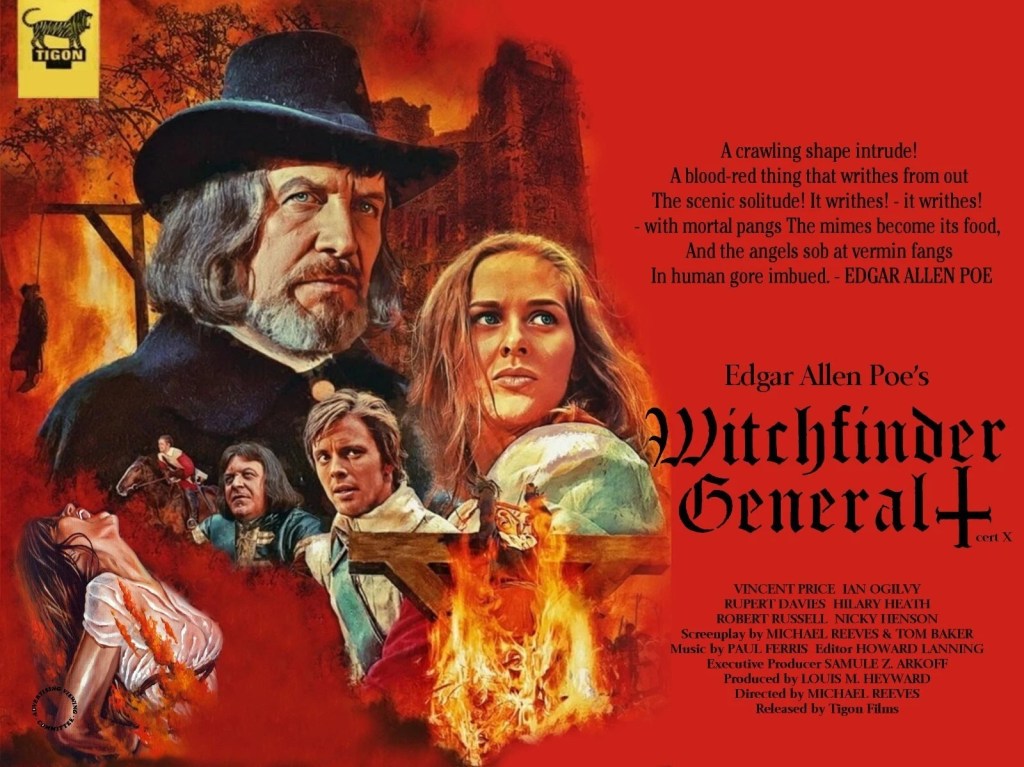
AIP retitled it The Conqueror Worm for U.S. release, hoping to snooker fans into thinking this fell into the Edgar Allan Poe canon, since the title referred to one of the author’s poems, part of which was recited over the credits.

The movie was generally lambasted by critics for its perceived sadistic approach, but is now considered cult. It was a big box office hit, especially considering the paltry budget, gaining a circuit release in the UK – “very good run beating par by a wide margin” – and despite being saddled with the tag of “unlikely box office prospects” by Variety did better than expected business in New York ($159,000 from 28 houses), Los Angeles (a “lusty” $97,000 from 16) and Detroit ($35,000 from one). The final U.S. rental tally was $1.5 million placing it ahead in the annual box office charts of such bigger-budgeted efforts as Villa Rides starring Yul Brynner and Robert Mitchum, Anzio with Mitchum again, James Stewart and Henry Fonda in Firecreek and Sean Connery and Brigitte Bardot in Shalako.

SOURCES: Benjamin Halligan, Michael Reeves (Manchester University Press) 2003; Lucy Chase Williams, The Complete Films of Vincent Price (Citadel Press, 1995); “Big Rental Films of 1968,” Variety, January 8, 1969, p15; Steve Biodrowski and David Del Valle, “Vincent Price, Horror’s Crown Prince,” Cinefantastique, Vol 19;  Bill Kelley, “Filming Reeves Masterpiece Witchfinder General,” Cinefantastique, Vol 22; “Box Office Business,” Kine Weekly, June 1, 1968, p8; “Review,” Variety, May 15, 1968, p6. Box office figures – Variety, May-August 1968.

Witchfinder General / The Conqueror Worm (1968) ****

For 250 years Europe and America was in the grip of a man-made plague. Ever since Pope Innocent VIII declared war on supposed witches in 1584, tens of thousands were arrested, tortured and hung or burned to death. Although Arthur Miller’s play The Crucible is considered the last word on the subject, in fact it treats very lightly the physical degradation visited upon victims and the corruption that was at the heart of the disaster. And sure, cinema has poked its nose into the area of possession, most recently with the supposed final act of the The Conjuring series, and while items like The Immaculate (2024) and The Handmaid’s Tale series focus on female subjugation, none of these exposes the full horror of witchcraft accusation.

The British censor bristled at the violence depicted in this film, and the picture was censored to a degree, while movie critics howled at the film’s “sadism.” Yet though the film is a raw depiction of the terrors inflicted on the innocent – male and female – by a corrupt male hierarchy, it scarcely touches the surface of the tsunami of wanton killing and terror.

So this serves as a welcome reminder of that awful age. While romantic leads Richard (Ian Ogilvy) and Sarah (Hilary Dwyer) are insipid, Matthew Hopkins (Vincent Price), the self-appointed Witchfinder General, and his gang of thugs led by John Stearne (Robert Russell) are not, and the enormous delight they take in torturing the innocent is what drives the picture. Set in an England in 1645 riven by civil war, where the forces of law and order are in disarray, Hopkins takes delight in profiting from the lack of opposition to his reign of terror.

While Vincent Price (The Oblong Box, 1969) manages to resist the temptation to be overblown and his subdued performance carries ominous weight, it’s the unusual approach of  director Matthew Reeves (The Sorcerers, 1967) that makes this a standout. He’s not making a horror picture, but a historical one. Not just are their nods to a specific time period, he bypasses the Gothic, the movie taking place mostly in daylight rather than nighttime, and his visual composition stands comparison with the best of the 1960s roadshows rather than standard Hammer or AIP offerings.

Hopkins delegates the actual torture to his underlings, retaining for himself the more subtle pleasure of blackmailing women into providing him with sex and walking off with a fat purse from local dignitaries for his troubles.

When he descends on any town or village, there will be a price to pay in human ruin. He picks on the village of  Brandstone in Sussex and begins to torture local priest John Lowes (Rupert Davies), driving him to exhaustion by endlessly racing him up and down a room before his accomplices can get down to the serious business of plunging long needles into his naked body. Virtually all the weapons in the witch hunter’s armory are of the Catch 22 category. Nothing you do will present as innocent and then you are headed for the gallows or lowered alive into a bonfire.

Luckily for Lowes, his niece Sarah is sweet on Roundhead officer Richard, applauded for his courage in battle, and he attempts to come to her rescue. Unfortunately for her, he is called back to duty before he can save anybody and it’s only by sacrificing herself to Hopkins that Sarah believes she can save her uncle. That turns out to be the worst of the calumnies Hopkins visits upon the innocent, as once he has had his fun he just condemns the old man anyway, and the daughter to boot. And although audiences might wince at the torture it was only fraction of the pain inflicted on the victims who might well end up confessing to witchcraft just to get the agony over with. In my hometown of Paisley, seven witches were executed a few years after Salem on the accusations of an 11-year-old girl – The Renfrewshire Witch Trials has just been published on Amazon should you be interested – which shows the absolute contrivance of the authorities in ruthlessly hunting out victims on the slightest pretense.

It’s a shame that neither Ian Ogilvy (The Sorcerers) nor Hilary Dwyer (The Oblong Box) are equipped to show the depths of despair of their characters, but in some sense this is not their story, except as examples of victims, and the tale really belongs to the venal butchers who took advantage of a climate of fear. These days, it shows up almost as a quasi-documentary and that’s to its benefit.

Written by the director and Tom Baker (The Sorcerers) based on the bestseller by Ronald Bassett. For its U.S. release, AIP snuck in a poem by Edgar Allan Poe which explains the U.S. title The Conqueror Worm.

Interest in this movie is unfairly attributed to the cult status it acquired after the premature death of the director – this was the last of his three films – but in fact it sits easily in the well-wrought historical movies of the period, handsomely mounted and unflinching.

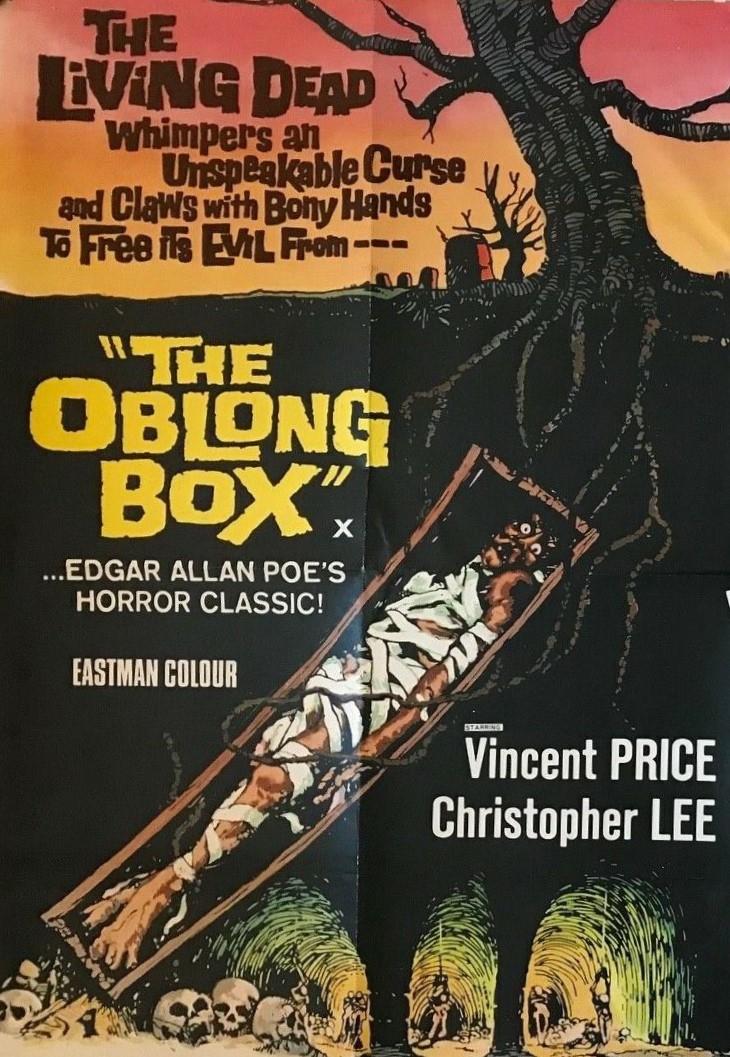
The Oblong Box (1969) ***

Vincent Price and Christopher Lee – two scions of 1960s horror – together, yet anyone expecting a clash of the giants would be sorely disappointed as they only share one short scene. This is a typical American International Pictures venture, based even more typically on an Edgar Allan Poe story, with some stylistic direction – the extreme close-up never more effectively utilized – from Gordon Hessler in his third feature.

Given that German-born Hessler (Catacombs/The Woman Who Wouldn’t Die, 1965) was a last-minute substitute for English director Michael Reeves (Witchfinder General, 1968), he made an exceptionally good job of a complicated plot. The production was even more complicated than that since it was originally intended as a Spanish co-production to be shot in Spain. And at one point writer Lawrence Huntingdon (The Vulture, 1966), who did have form as a director (Death Drums Along the River, 1963), was reportedly also carrying out producer-director duties.

What seems like a mishmash of different stories – African sorcery, grave-robbing, disfigurement, forgery, blackmail, lifetime imprisonment, medical experiment, buried alive, a monster in a scarlet mask – soon comes together in a tense tale of retribution and revenge.

Nineteenth century English aristocrat Julain Markham (Vincent Price) has withdrawn to his country manor, for unknown reasons distancing himself from his fiancée Elizabeth (Hilary Dwyer), but in reality to conceal from the world the fact that he has locked up his own brother, Sir Edward (Alister Williamson). When the brother, a disfigured monster, escapes he embarks on a murder spree.

The various storylines keep the narrative sufficiently entangled to sustain tension. Despite what may appear to a modern audience as primitive special effects, several scenes are bone-chilling largely through directorial manipulation. The Gothic look – graveyards, castles, the village – adds to the atmosphere. The violence was trimmed in America to avoid an “R” rating, but led to the film being banned in Australia.

There is more overt sexuality than normal, a scheming whore Heidi (Uta Levka) tempting a man with her bare breasts, and maid Sally (Sally Geeson) entranced by the monster.

The various plot strands appeared to confuse critics at the time and even now the film receives comments that it is “vague” but at a time when Hammer’s output usually comprised a straightforward – and somewhat limited narrative – I found AIP’s approach to this picture a welcome development. The slowly emerging story set the film up as much as a thriller as a horror.

It’s a bit of a reversal for Vincent Price (Witchfinder General, 1968) to be playing the good guy but that works to the movie’s advantage because you spent most of the time thinking this is just a scam and at some point he will show his true colors. Hilary Dwyer (Witchfinder General) is excellent and Sally Geeson (What’s Good for the Goose, 1969) is an example of the type of woman attracted to rather than revulsed by a killer.

Well worth a look if only to enjoy the distinctive Hessler style.

Discover WordPress

A daily selection of the best content published on WordPress, collected for you by humans who love to read.

The Atavist Magazine

by Brian Hannan

WordPress.com News

The latest news on WordPress.com and the WordPress community.