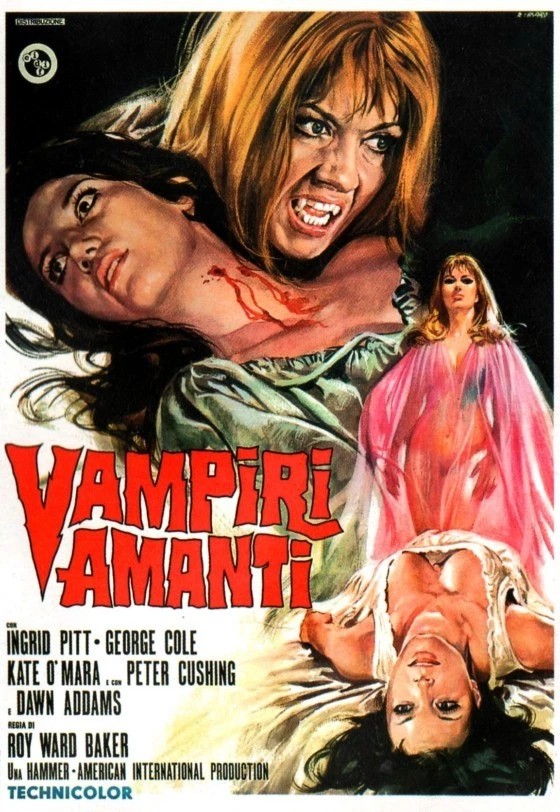
The Vampire Lovers (1970) ***

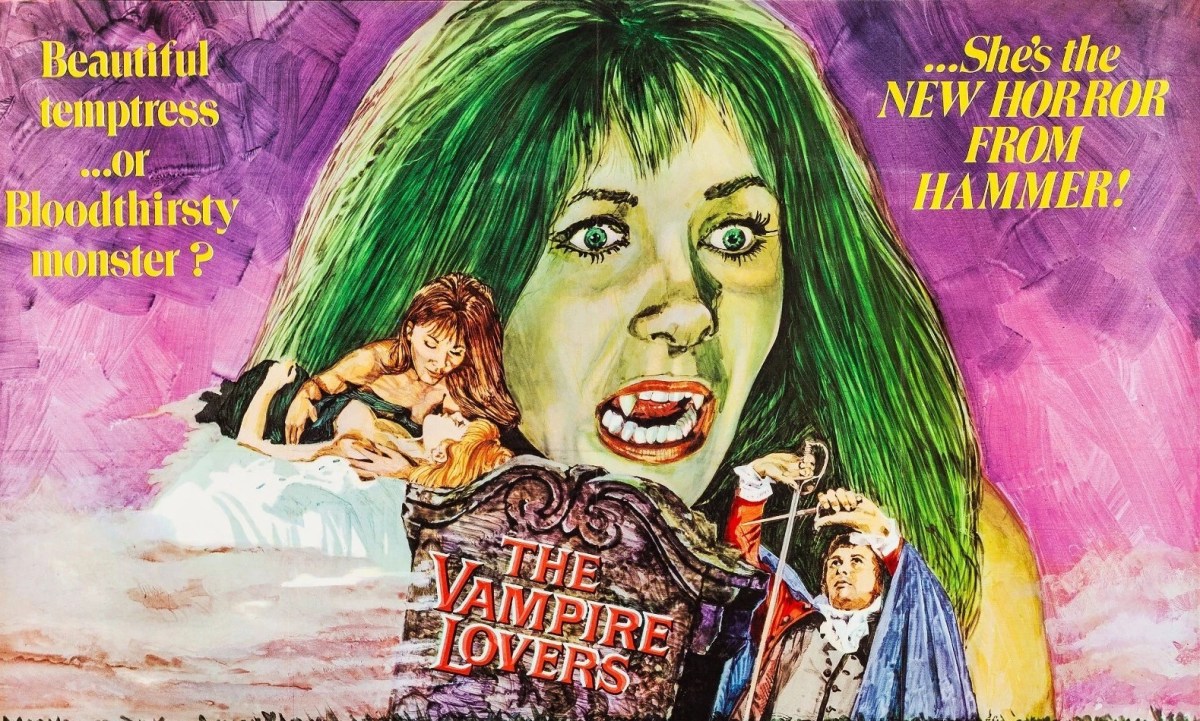
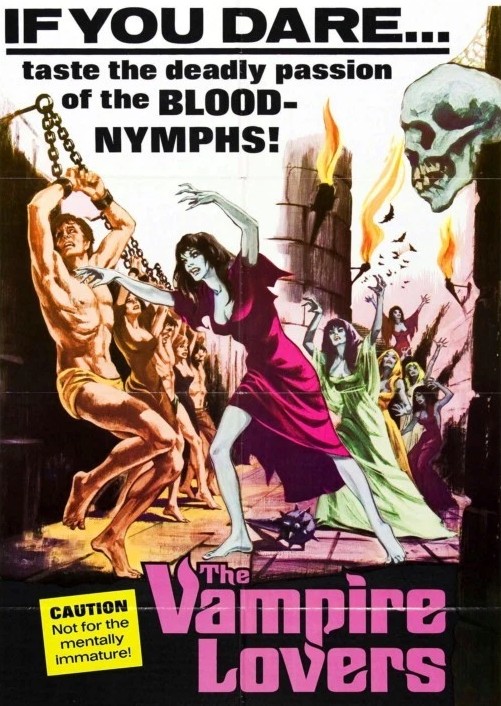
Should have a lot more going for it. Female empowerment for a start. This would also, in today’s terms, be called a reboot of the Dracula legend, though it does originate from a different source than Bram Stoker. Or you could look at the bold exploration of lesbianism, none of the angst of The Killing of Sister George (1968) or the lyricism of The Fox (1967). Or you could fall back on that old chestnut – a camp reinterpretation of the vampire world, where female breasts rather than necks are the prime target. At the very least, it should have set up Ingrid Pitt (Where Eagles Dare, 1968) for stardom.

And while all these hold true, it lacks the key ingredient of the horror picture, any kind of tension or imminent threat. Nor does it carry the emotional weight of Countess Dracula (1971) – also starring Pitt –  a twist on Dorian Gray, of a woman trying to hold age at bay with infusions of virgin blood.

So, in the end, it comes off as little more than a commercial decision to revive a fading genre with lashings of nudity, sex and lesbianism. Director Roy Ward Baker (Moon Zero Two, 1969) brings significant style to the proceedings even though the backdrops look as if they’ve been picked from a cast-off bin.

The tale is based on a story Carmilla by Sheridan Le Fanu, that predated Bram Stoker. On the production side, Hammer and its American rival AIP teamed up, with the latter blamed for insisting on the sexual overdose. Although on that score you could as easily point the finger at the British censor known for his liberal approach to such shenanigans.

While it’s true that Dracula, especially as interpreted by Christopher Lee in Hammer offerings, carried a sexual frisson, there was never anything more than that, allowing the audience to determine whether the vampire was ever interested in a woman except for the purpose of sucking blood from her neck. Previously, diaphanous gowns and cleavage had been the extent of the sexual element. To switch the target from the neck to the breasts is a determined commercial move.

So, basically, with a gender twist, we’re following the old story – vampire stalks victims, finds acolytes, and falls victim to a vampire hunter. In the 19th century, the beautiful Carmilla (Ingrid Pitt), traveling with her mother, a countess (Dawn Adams), is adept at inveigling herself into high-class households where she seduces the daughters and staff of the rich. Her first victim Laura is niece to General Spielsdorf (Peter Cushing) who subsequently enlists the help of vampire hunter Baron Hartog (David Wilmer), who mistakenly believes he had rid the world of the female vampire clan.

Next for the bloody breast treatment is a Mademoiselle Perrodot (Kate O’Mara), governess to Emma (Madeleine Smith). Perrodot becomes her lover and accomplice. Carmilla is an inclusive kind of vampire and if need be will seduce any male obstacle such as Morton’s suspicious butler Renton (Harvey Hall) while sucking the blood out of any passing male of more modest means.

Carmilla has the same get-out-of-jail-free as any male of the species and can take refuge in her grave until the heat passes. However, this time she’s intent on taking Emma with her. By now Baron Hartog has filled the general in on the threat, explaining that the Karnstein clan go back to the sixteenth century, and that he has dispatched many of the breed in traditional fashion, decapitation or stake through the heart, but he had been unable to find the night-time resting place of Carmilla.

So when Carmilla heads off to Karnstein Castle with Emma, she’s not expecting vampire hunters lying in wait. This time it’s the general who does the killing, making doubly sure by both cutting off her head and driving a stake through her heart. Emma recovers.

Given that any version of Dracula was essentially a franchise, Hammer/AIP managed to keep the Karnsteins going for another two episodes, Lust for a Vampire (1971) – which gave Yutte Stensgaard a shot a stardom – and Twins of Evil (1972) starring Playboy Playmates the Collinson twins.

While The Vampire Lovers was a launching pad for Ingrid Pitt as a new top-billed femme fatale, her marquee attraction didn’t last beyond the superior Countess Dracula. However, Pitt certainly brings gusto to the part and there’s an argument that the contemporary world deserved more explicit expression of that previously restrained sexual frisson. The counter-argument is that it’s blatant sexploitation.

Kate O’Mara (The Horror of Frankenstein, 1970), a future Scream Queen, would have been an obvious contender for the main role rather than a supporting one except that she refused to take off her clothes. Madeleine Smith (Taste the Blood of Dracula, 1970) became another future Scream Queen.

With Ingrid Pitt’s physical allure to the fore that limited the involvement of Peter Cushing (Frankenstein Created Woman, 1967). The more prominent of the wannabes was Jon Finch (Macbeth, 1971).

Written by Tudor Gates (Danger: Diabolik, 1968).

Still the argument continues – groundbreaking approach to the genre or mere sexploitation.

You decide – Amazon Prime currently has this.

The Blood Beast Terror (1968) ***

As the title suggests there’s a vampiric element, and there’s not a great deal unusual in that, Hammer having successfully revived interest in bloodsuckers. What is unusual, however, and a couple of years before that studio’s The Vampire Lovers (1970) is the idea of female empowerment. Previously, the sole purpose of a damsel in a horror picture was to lay bare a convenient bosom for a passing thirsty creature, or, have their clothing disarrayed and let out a scream when a monster pounced.

The twist here is that the vampire is a woman, Clare (Wanda Ventham), and men who are the victims except on the occasions when her father Dr Mallinger (Robert Flemyng) hypnotizes young women in order to give the creature a blood transplant. The beast exists as a creature and then morphs into Clare. For a time it looks as if Clare is merely possessed, but in reality appears much more as if she is enjoying being the beast, abandoning the enforced respectability of the times, luring men into the forest to have her rapacious way with them, the men naturally thinking they are in for a romantic tryst rather than being targeted by a predator.

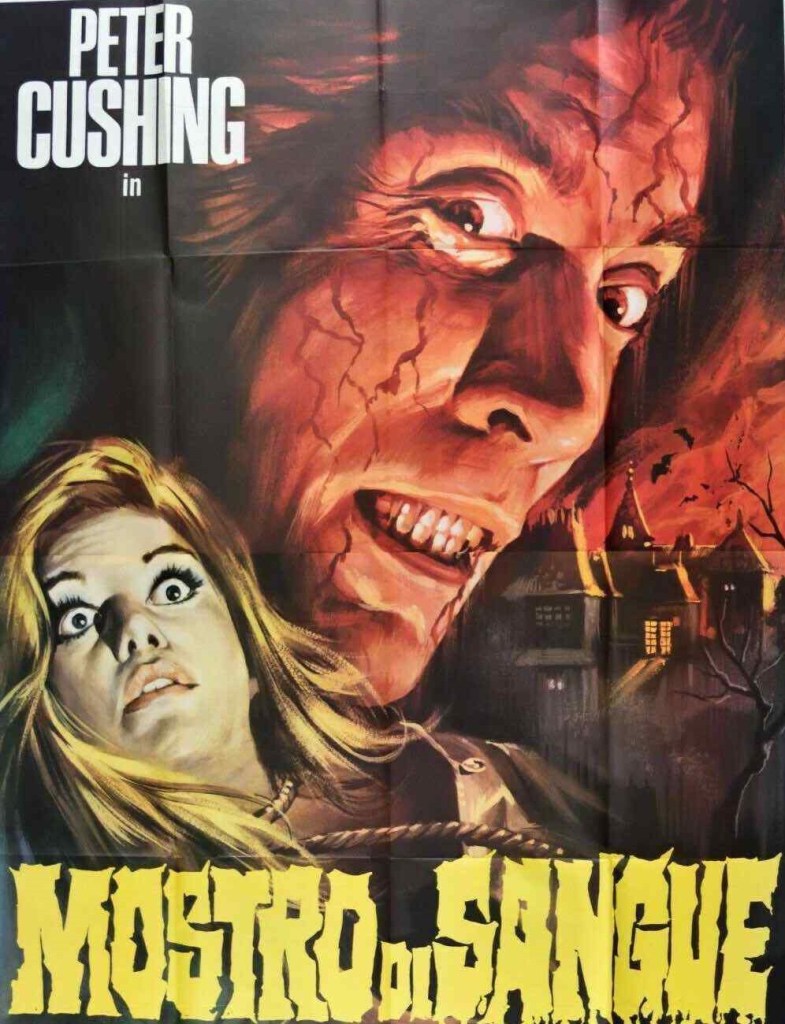
Continuing the theme of misleading the audience, this poster cleverly suggests that it’s a man who is the beast and the woman who are the victims.

There’s a wonderful scene that gives an insight into her mindset. Her friends put on a little play. Her role is the monster, a part she seizes with relish.

It’s one of those films you have to work out backward. In standard horror fashion it leaves the twist till close to the end and it would have been far more interesting if we had discovered at the outset that Clare was the beast, leading the men for the most part a merry dance, outwitting Inspector Quennell (Peter Cushing) and her adoring father Dr. Mallinger (Robert Flemyng).  

The inspector, faced with a growing pile of corpses drained of blood, is baffled throughout, no Sherlock Holmes clever deductions here, and it naturally would not occur to any of the males, beyond Dr Mallinger who is in on the secret, to imagine a woman capable of not just committing such crimes but of exerting such power over a man. The story glosses over the genetics, it’s a version of Frankenstein obviously, but the background to it is missing, and I can see why. There has to be some mystery.

Hitchcock could not have done a better job of misleading the audience. For a start the story is told entirely through the male perspective. And it’s set up as a murder mystery, Quennell our lead as he dances from one corpse to the other, helped along in his information accumulation by lugubrious mortuary attendant  (Roy Hudd), who is, ironically, as hungry as the beast, but for normal food rather than blood, always seen devouring something. Mallinger is not a mad professor either, but a distinguished one, celebrated in his field, giving lectures and attracting proteges like Britewell (William Wilde).

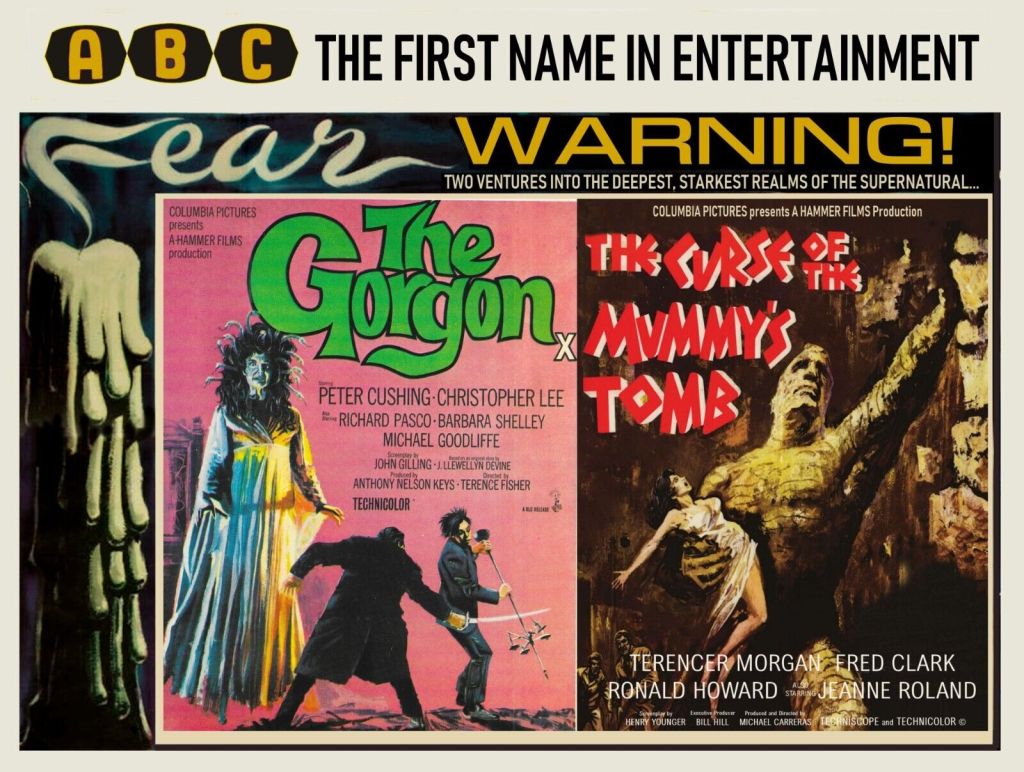
Initial British release double bill cleverly bringing together Peter Cushing and Christopher Lee –
though in separate pictures.

Although his daughter acts as laboratory assistant, Mallinger is hardly aware that his daughter is sizing up every male visitor as a potential victim.

The posters give away that the creature is a giant moth, and by and large the special effects (no CGI available of course) pull this off, the creature usually just glimpsed or seen from the distance, and the possibility that Mallinger is aware of what he is harbouring apparent when he enters a cellar wearing a leather hood and carrying a whip.

Tony Tenser’s production company Tygon has acquired cult status, in part for having the temerity to take on British horror giant Hammer at the height of its powers in the 1960s, and in part from the distinction of its output, making such films as The Sorcerers (1967) with Boris Karloff, Peter Cushing as Witchfinder General (1968) and Karloff, Christopher Lee and Barbara Steele in The Crimson Cult/ The Curse of the Crimson Altar (1968). Tenser ploughed a different furrow to Hammer at a time when that studio was also expanding into bigger-budgeted movies such as One Million Years B.C. (1966).

Capably not to say cleverly director by veteran Vernon Sewell (The Crimson Cult) it is miles ahead of its time and generally delivers the goods. Peter Cushing (The Skull, 1965) is excellent as usual, Robert Flemyng (The Deadly Affair, 1967) proves a more interesting scientist than usual, steering clear of any craziness.

Wanda Ventham in her first leading role provides a fascinating character study, but you have to work backwards as I said, to realize just how good she is, the way she has, for Victorian times, her father under her thumb, and the seductive glances she casts at men, not to mention the ease with which she assists her father in his diabolical experiments without him realizing why she is so enamored. Female monsters had evolved from creatures before – in Cat People (1942), Snake Woman (1961) and Hammer’s The Reptile (1966) – but this was a more rapacious example of the species. Vanessa Howard (Some Girls Do, 1969) has a small role and you can spot Scottish character actor Glynn Edwards (Zulu, 1963) and television comedian Roy Hudd in his movie debut.

Screenwriter Peter Bryan (The Brides of Dracula, 1960), something of an expert in the horror field, turns the whole genre on its head with the gender politics examined here.

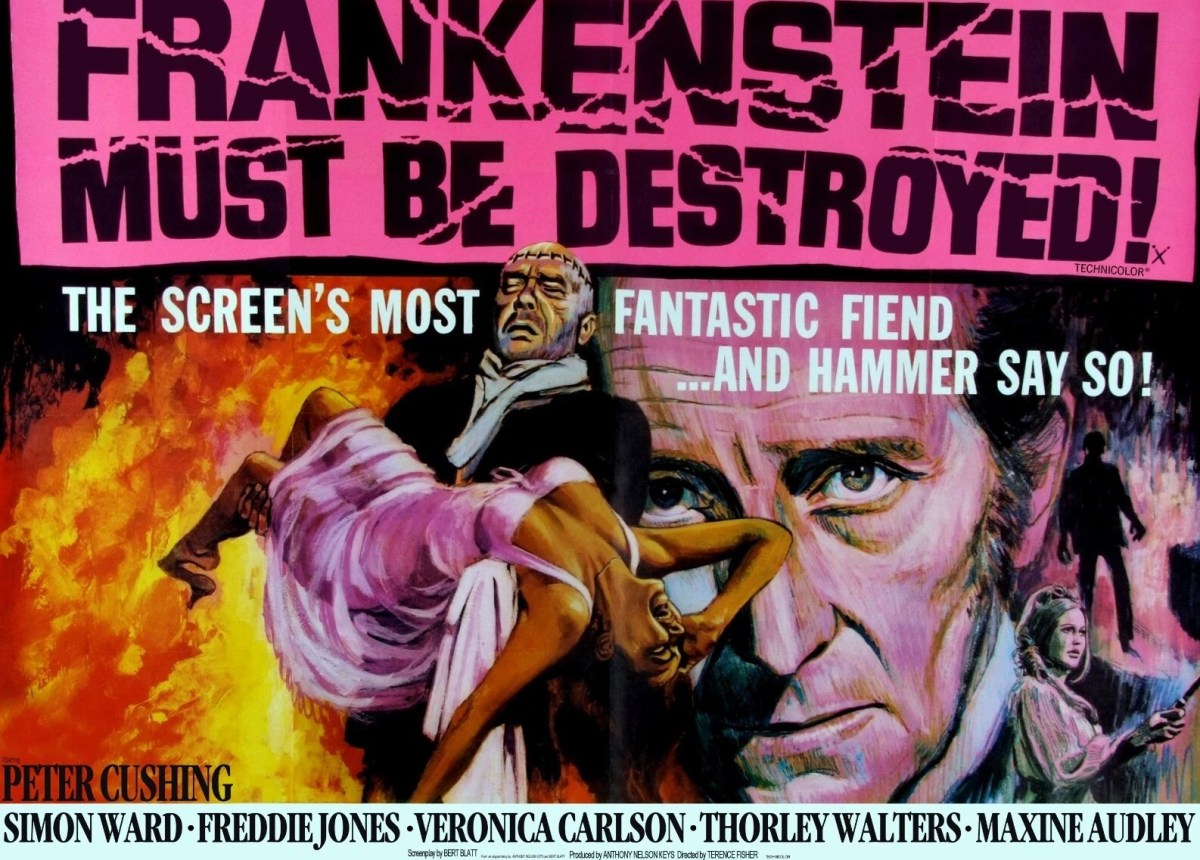
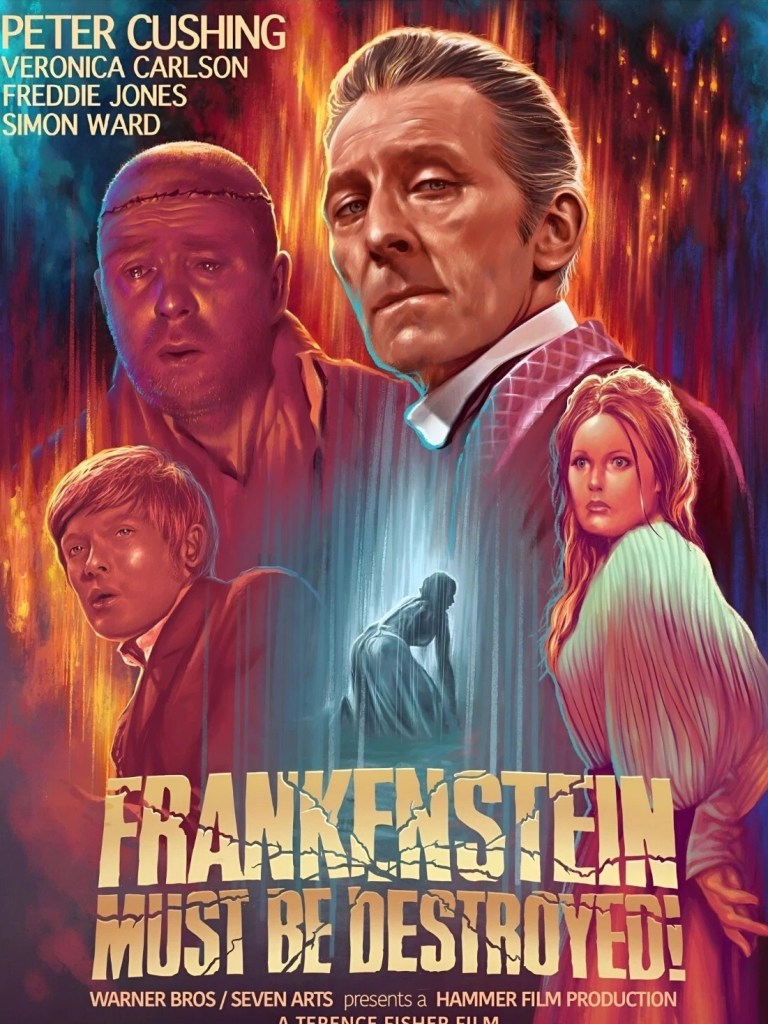
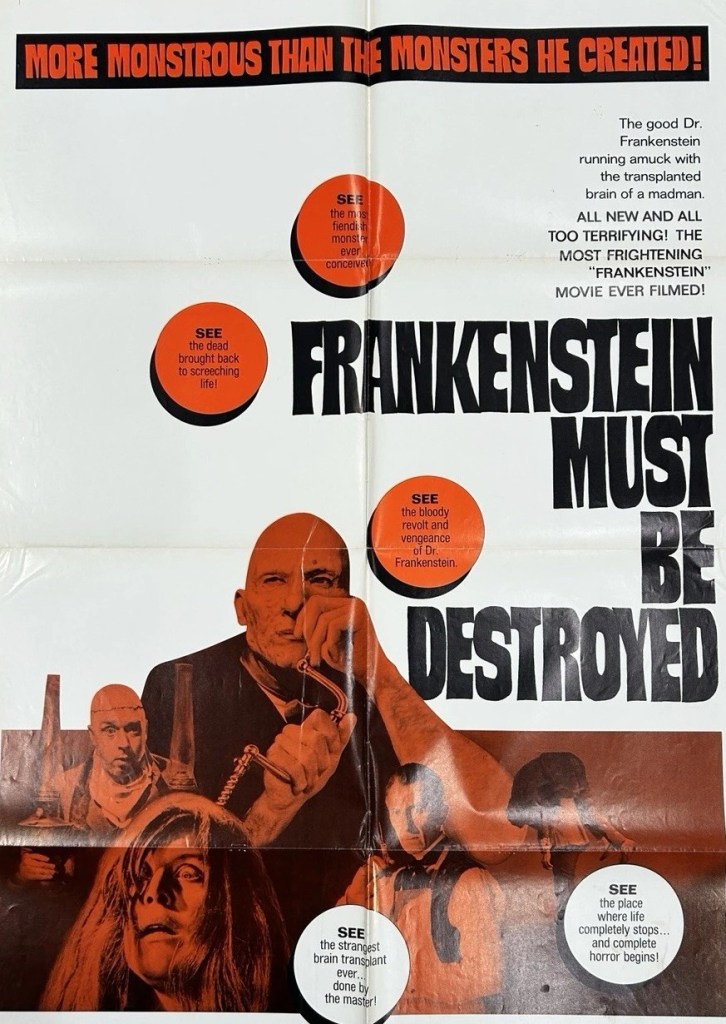
Frankenstein Must Be Destroyed (1969) ****

Hugely enjoyable, mainly because it throws away the standard template for this kind of horror picture. Long before Hollywood got into the habit or remaking or reimagining hit films, Hammer was constantly finding a reason to revive a character who in his previous iteration had met a sticky end. Even though Baron Frankenstein was not one of those villains who always managed to escape at the end of every episode, audiences had no trouble accepting him in whatever guise, era or location he turned up in.

But this is a considerable reinvention of the accepted characterization. Usually, Frankenstein is represented as somewhat academic arrogant scientist, not suffering fools gladly, but rarely has he been given such a wealth of finely tuned insults to offer. Nor has he ever exhibited what you might term passion. You’d never wonder, for example, who he fancied. But that’s all changed here. When he takes a woman here, it’s an extension of his power as much as his passion, and although the sex takes the form of rape, it does reveal him (if that’s not too awful to contemplate) as more human than before.

And the young couple in love, dragged into his web, are far from the usual innocents. On top of that, there are scenes of tremendous pathos when a wife cannot accept the husband brought back from the dead. And there’s quite a brilliant, if ironic, climax that you would not see coming.

In addition, at times the direction by Terence Fisher exhibits tremendous confidence, not just following a structure that brings out far more emotion than is generally accorded the genre, but surprises with flashes of humor and the kind of editing that would generate acclaim had it been in anything other than this.

This time round Baron Frankenstein (Peter Cushing) is in London, haunting the streets with a scythe to lop off the heads of passing pedestrians on dark nights. While he’s employed in this endeavor a burglar discovers the secrets of the baron’s cellar and inadvertently destroys the monster undergoing creation. Frankenstein hides out in a boarding house run by Anna (Veronica Carlson), whose fiancé Dr Holst (Simon Ward) is stealing drugs from the mental asylum where he works, thus making him easy prey for blackmail. The baron wants to kidnap asylum inmate and former colleague Dr Brandt (George Pravda) to find the secret formula for their previous work together.

With Holst soon knee-deep in murder, Anna an accessory to the drug theft, the “innocent” pair are dragged further into the baron’s web. When Holst pleads with Frankenstein, “Let her go, you don’t need here,” the baron replies in deliciously supercilious tones, “I need her to make coffee.”

During the escape from the asylum, Brandt has a heart attack so Frankenstein arranges to transplant his brain into the body of Professor Richter (Freddie Jones). Brandt’s wife Ella (Maxine Audley), initially delighted to find her husband not just alive but cured of insanity, nonetheless is later repulsed by this “creature”, even though in appearance he is not awful, just not the husband she knew.

The plot quickly turns. Frankenstein rapes Anna. In turn, she wounds the creature. And the baron murders Anna, meanwhile realizing that Holst cannot be trusted. The creature, turned away by Ella, and now determined to gain revenge, sets a fiery trap for Frankenstein and in a superb ending hauls the baron into a burning house.

As I said, the structure takes a considerable detour from the standard Frankenstein picture, in particular taking time out from the main plot of the “innocents” escaping and/or thwarting the baron in order to focus on the relationship between Ella and the creature. Her rejection of him, his disgust with his new appearance, and the emotional loss of his wife moves into territory you wouldn’t normally associate with the genre, much closer to the more contemporary reading of the original tale.

Every now and then we dip into a subplot of a police investigation aided by the thief and Ella as witnesses. At first the pompous Inspector Frisch (Thorley Walters) seems little more than a comedic diversion, but actually he’s more switched-on than you’d expect and his detective work adds more tension.

Making Frankenstein more human – even if it’s just him giving into evil impulse – works to the movie’s advantage, as it allows him to pepper his lines with rapier wit. Peter Cushing (The Skull, 1965) has never been better but Freddie Jones (Otley, 1969) as the victim steals the show with a performance of tremendous pathos.

Simon Ward should count himself lucky that Richard Attenborough overlooked his performance and saw something in him that made him the ideal candidate to play Young Winston (1972). Veronica Carlson (Hammerhead, 1968) became the latest Hammer Scream Queen.

Occasionally inspired direction from Terence Fisher (The Devil Rides Out, 1968) in allowing the characters to develop and relationships to foster. Screenplay by Bert Batt, in his debut, and producer Anthony Nelson Keys (Pirates of Blood River, 1962) and based, somehow, on the original by Mary Frankenstein.

Surprised how much I appreciated it.

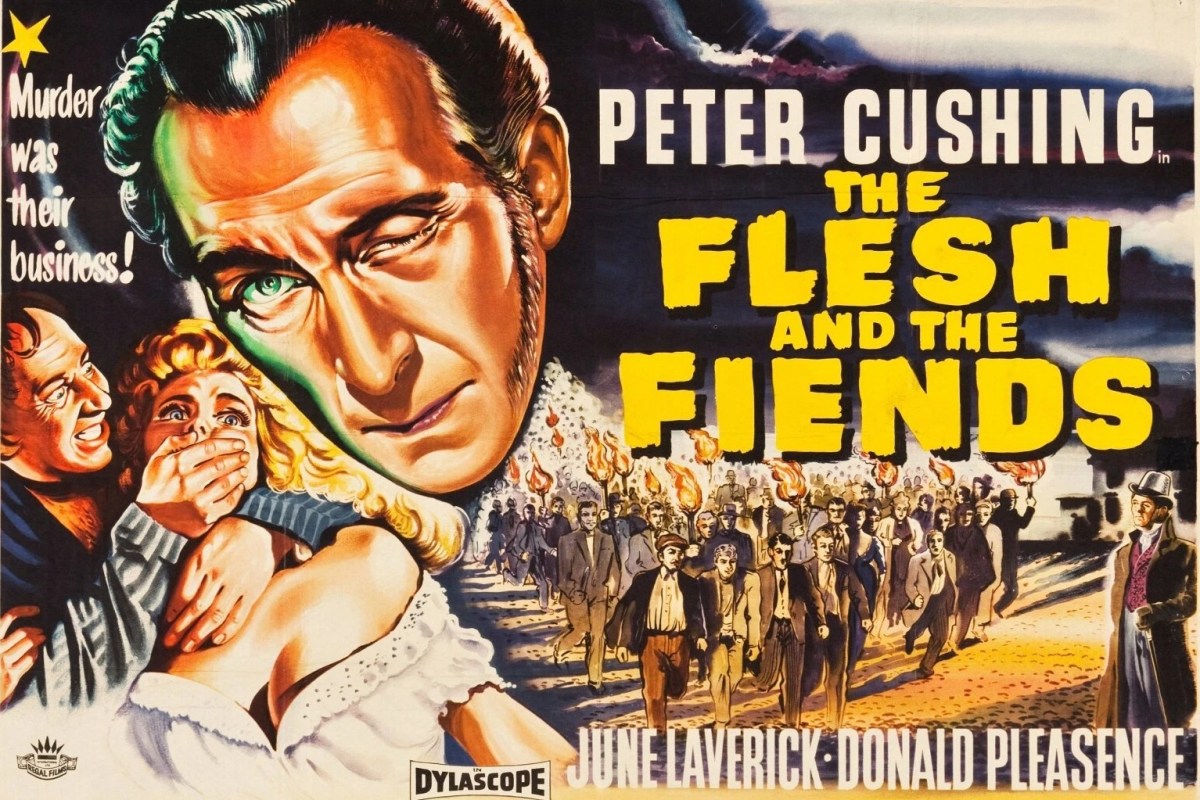
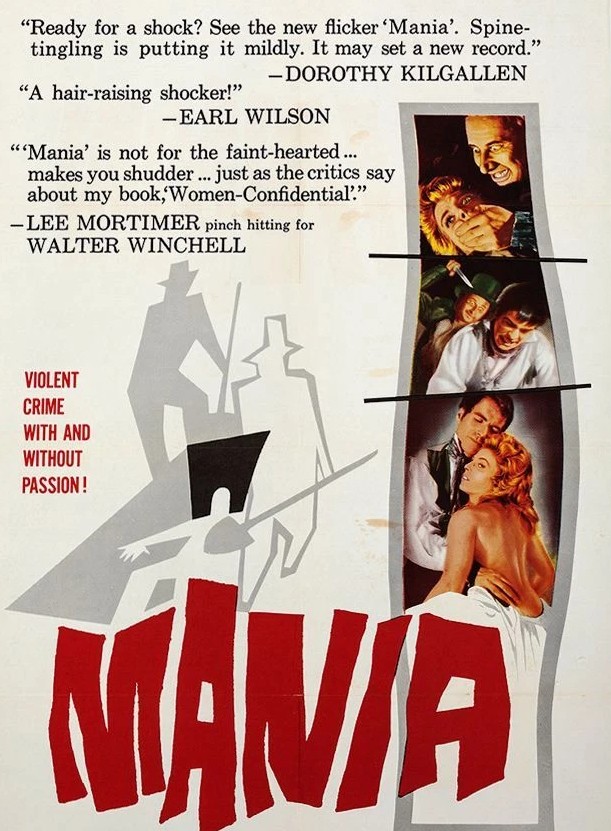
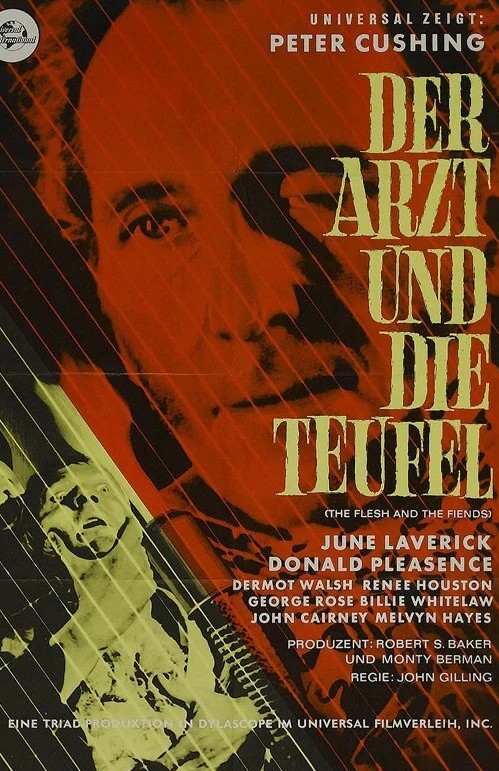
The Flesh and the Fiends / Mania / The Fiendish Ghouls (1960) ***

Hypocrisy runs rampant as an entitled medical hierarchy effectively condones vile practice. Of course it wouldn’t do to have Peter Cushing, who generally hounded demonic fiends like Dracula, to be tabbed a villain so with a little bit of jiggery-pokery he gets off scot-free and, in fact, is considered so much above other mortals that he receives a standing ovation at the end.

The self-justification, or deification if you like, of Edinburgh surgeon Dr Knox (Peter Cushing) is promoted on the back of primitive medicine, whereby, through sheer ignorance and laziness surgeons were more apt to kill than to cure.

Dr Knox is an advocate of using recently interred corpses to teach his students the real fundamentals of anatomy. However, his colleagues feel that the use of fresh corpses goes against the grain and there was no such thing in the early 19th century of donating your body to medical science. Grave-robbing was a crime.

Enterprising duo Burke (George Rose) and Hare (Donald Pleasance) get round that problem by skipping the burial aspect, murdering assorted drunks and vagabonds and delivering fresh meat to the good doctor, who turns a blind eye to their actions, determined as he is to improve teaching standards. He’s not the only one who believes that a streetwalker, killed in this fashion, has achieved more in death than life.

The good doctor has a conscience in the shape of Dr Mitchell (Dermot Walsh) who is wooing his daughter Martha (June Laverick), but he eventually comes round Knox’s way of thinking. The hierarchy in the shape of the Medical Council would get their claws into Knox were it not for the fact that in their incompetence they inflict more damage than good.

As a sub-plot, and as a way of weaselling into the lower classes who provide the bulk of Burke and Hare’s supply chain, earnest medical student Chris Jackson (John Cairney) falls for drunken goodtime girl Mary (Billie Whitelaw) who spends as much time making fun of him as she does sharing his bed.

You would have thought the high mortality rate of the period would not have made the local populace suspicious of a few extra deaths, but when Burke and Hare kill too close to home – Mary, Jackson and Daft Jamie – townspeople like a regular Transylvanian village mob light their torches and head off in pursuit.

The question of whether Knox was in collusion with Burke and Hare becomes the crux. But given the medical profession does not want to bring itself into disrepute, he is given a free pass and declared not guilty.

The high-mindedness which Peter Cushing (The Skull, 1965) usually brings to a role works in his favor here and, until the death rate mushrooms, audiences may be inclined to go along with his thesis that fresher corpses should be made available as a matter of course to doctors. His pinpoint arrogance brooks no quarter. He’s in entitlement heaven. And that his superiors back off informs you that hierarchies were as good at closing ranks and defending themselves then as now.

This was the first venture of Donald Pleasance (Soldier Blue, 1970) into the sleazy characterizations which would become a trademark. The nervous tics were a later addition. Here’s he’s mostly sweaty. 

I should profess an interest. John Cairney was a relative of our family but acknowledging his work in our household was limited to such less contentious material as Jason and the Argonauts (1963). Along with Billie Whitelaw (The Comedy Man, 1964), he was in the rising star category. Both deliver solid performances. You might also spot Melvyn Hayes of the It Ain’t Half Hot, Mum series (1974-1981).

Dodgy accents abound, Pleasance and Rose affect Irish accents and Whitelaw makes a stab at a Scottish one. I was surprised, given the date, to see a deal of nudity, but it transpires I was watching the “continental version.”

Directed by John Gilling (The Reptile, 1966) from a screenplay by himself and Leon Griffiths (The Hellfire Club, 1961).

You catch this on YouTube

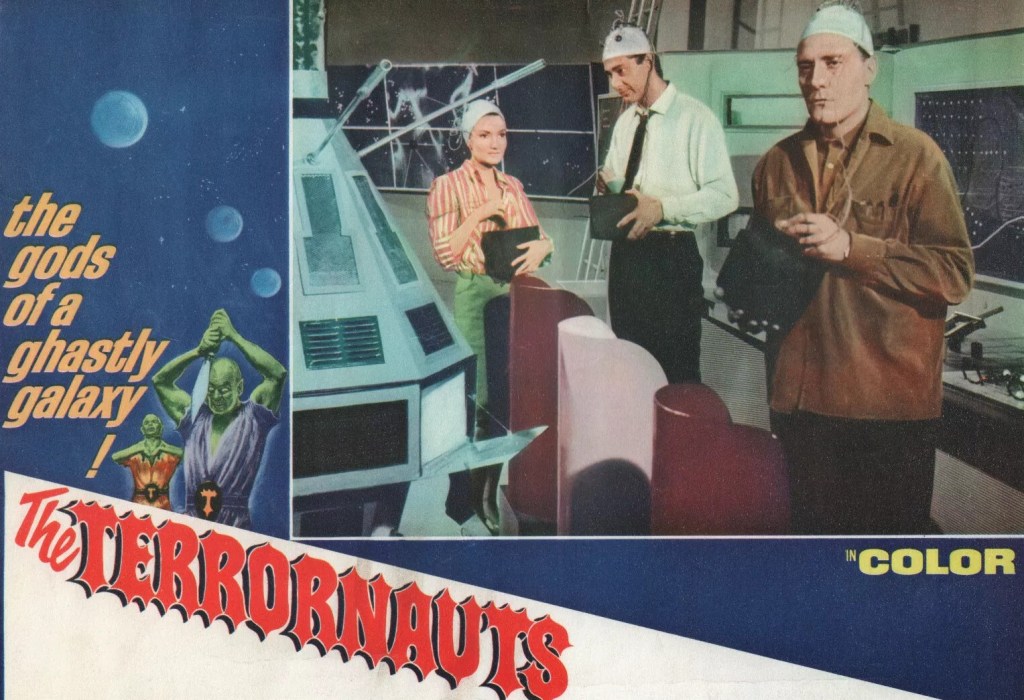
Behind the Scenes: “The Terrornauts” (1967)

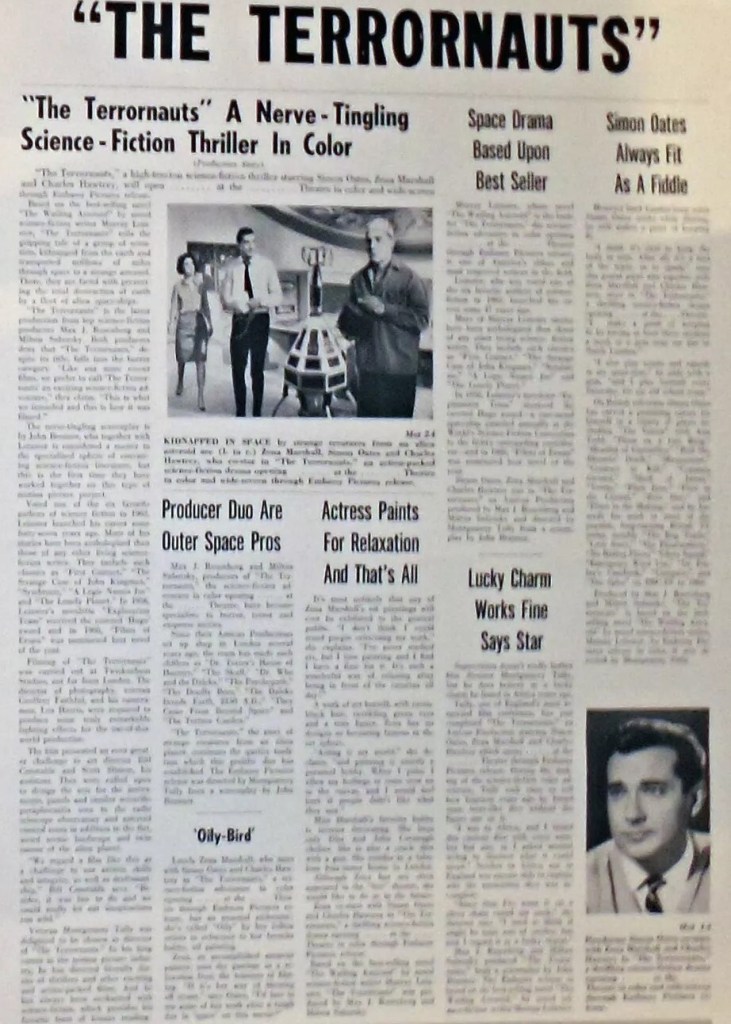
Unless you’re a sci-fi buff of a certain vintage, you probably haven’t heard of Murray Leinster who wrote The Wailing Asteroid on which The Terrornauts is based. Which is a shame because he was one of the giants of science fiction of the golden age. Time magazine called him The Dean of Science Fiction.

For a contemporary audience his name is of considerable significance because he invented the concept of the multiverse. In those days it was called a parallel universe or an alternate history but it amounted to the same thing. And he did so nearly a century ago – in 1934 in fact.

He was second only to H.G. Wells in originating science fiction concepts. He was the first, for example, to imagine meeting an alien culture that was as advanced as our own. He explored themes of mutual distrust, mutual assured destruction, and aliens as superior beings. He also invented the idea of the Internet and man-eating plants.

In The Wailing Asteroid, Leinster draws upon many of the ideas he was first to promulgate.

We have alien encounter. We have the fear that as a consequence terror might be brought back to Earth. We have a species that has evolved far beyond human experience.

We have the same kind of instant absorption of knowledge that occurs through the Internet. The little blocks that our hero finds might as well be called Miniature Googles.

You could also argue that what the space explorers discover is akin to The Sentinel that features in 2001: A Space Odyssey, released in 1968. And you could also view the asteroid as a life-affirming alternative to the hovering destructive Death Star of Star Wars filmed a decade later.

The Terrornauts is a rarity because only a handful of Leinster books were ever filmed. But he was very important to the movies in another way, at the forefront of an invention – front projection – that changed the way movies were made in the 1960s.

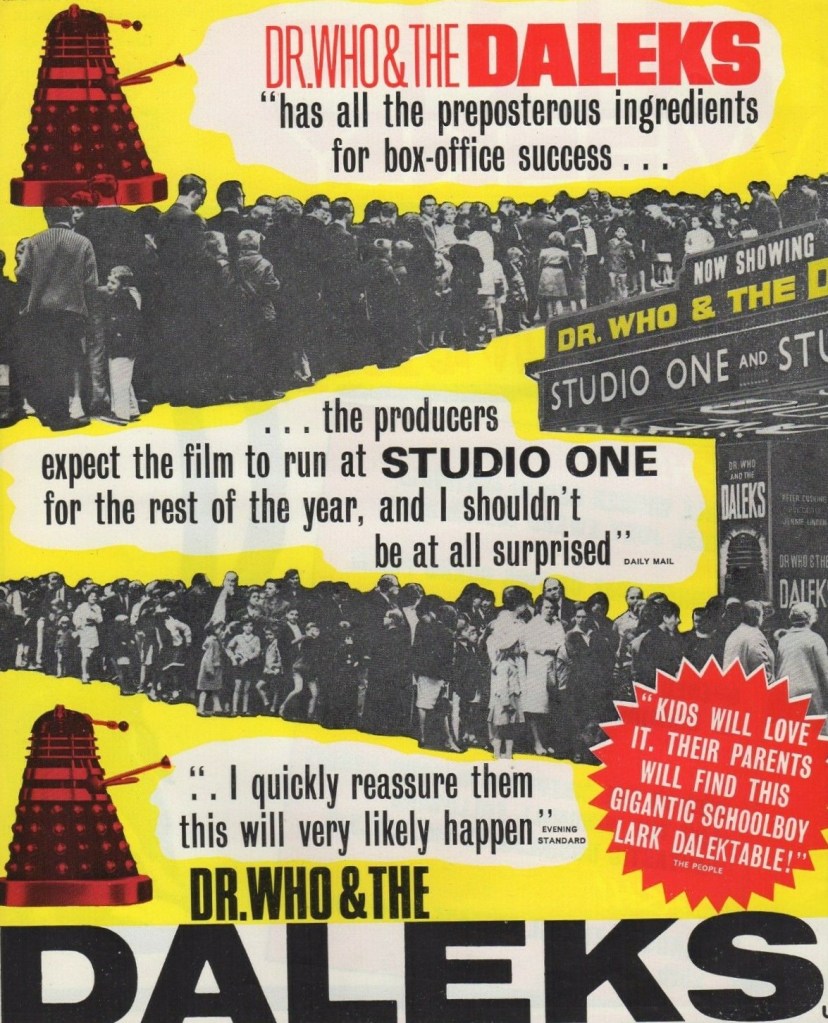
At this point, production entity Amicus was as well known for its sci fi output as its horror thanks to Dr Who and the Daleks (1965) and Daleks Invasion Earth 2015 A.D (1966).

So when Embassy Pictures knocked on the door and offered a flat fee of around half a million dollars for a science fiction double bill, Amicus was delighted. Hammer sold its horror pictures as double bills, a complete program more attractive to an exhibitor and more lucrative for a producer than  half a program.  

Amicus contracted to make The Terronauts and They Came from Beyond Space. They weren’t big enough to have stars under contract, nor the first port of call should a director or star have a pet project that required funding.

Their modus operandi was to trawl through the hundreds of novels published every year, either in pre-publication galley form, or when printed. Max Rosenberg claimed to read 500 books a year. “The basic job of a producer,” explained his partner Milton Subotsky, “is to find properties.”  That was how they came across The Wailing Asteroid.

It was occasionally part of the deal in Hollywood that when a studio bought a best-seller, the author was given the opportunity to write the screenplay. But that wasn’t the case here.

Instead, Amicus turned to another science fiction author. John Brunner was as prolific as Leinster. Brunner got the gig because he mixed in the same social circles as Subotsky. Mostly, he wrote conventional space opera and it was only after his experience on The Terrornauts that he acquired a bigger name in science fiction, after winning a Hugo Award in 1969.

The first casualty was the title. The Wailing Asteroid was not as catchy as The Terrornauts. And Brunner had no qualms about scrapping most of the original narrative. He telescoped the time frame. The action in the book takes place over several months, not a couple of days. The book involves multiple countries. Leinster’s novel was set in the United States, but Brunner made the characters British and added the comedy – no tea lady or accountant in the original.  And there’s no humor either. He changed the hero’s occupation from design engineer to scientist, and dumped the incipient hesitant romance between Joe and Sandy. But he brings in the notion of scientists hunting for intelligent life in space.

Nor does Leinster’s book involve little green men, robots or human sacrifice. That’s all Brunner’s doing. He turns what was really a concept novel, an exploration of ideas more akin to 2001: A space Odyssey and Planet of the Apes. Brunner shifts it from what if to alien abduction.

Budget shaped the picture. The first four reels are slow and full of dialog because dialog can be shot much quicker and more cheaply than action. Low budgets didn’t bother Amicus. “I defy any other picture making company,” proclaimed Rosenberg, “to turn out that sort of picture with the budget we are under.” He added, “We make pictures for a price and I think we’re better at it than anybody else.” 

Amicus had something of a stock company, Freddie Francis, for example, the in-house director, had helmed four pictures, the same number as Peter Cushing headlined. Christopher Lee starred in two, Robert Bloch contributed four scripts and Elizabeth Lutyens scored two pictures. But only Lutyens was retained here.

Amicus handed The Terrornauts to veterans, the majority involved were over 50 years of age. Cinematographer Geoffrey Faithful was 74, author Murray Leinster 71,  supporting actor Max Adrian 64, special effects guru Les Bowie 64, director Montgomery Tully 63, composer Elizabeth Lutyens 61.

It would prove the last hurrah for female lead Zena Marshall, Montgomery Tully would bow out later that year after Battle Beneath the Earth and Geoffrey Faithful would only make another two pictures.

The Terrornauts and They Came from Beyond Space were not filmed in October-December 1966 as has been widely reported. Instead, production took place earlier in the year. According to British trade magazine Kine Weekly’s Shooting Now section, The Terrornauts was first to go before the cameras at Twickenham Studios, on June 13 1966 and still featured on its production chart on August 3. Filming on They Came from Beyond Space in the second last week of September continued also at Twickenham until the week of November 3.  

Though to some observers the amount spent on The Terrornauts was very little, in fact the £87,000  budget was nearly double the amount spent on City of the Dead and slightly more than The Skull. Admittedly, there were special effects to consider but to offset that the stars came cheaper than the likes of Peter Cushing and Christopher Lee.

For a time it looked as if Embassy expected The Terrornauts to prove the more popular picture. It ran a one-page advertisement in trade newspaper Variety for The Terrornauts in April 1967 claiming it would be available to rent the following month. The image of Zena Marshall being held down by aliens was accompanied by the tagline – “the virgin sacrifice to the gods of a ghastly galaxy” They didn’t run any adverts for They Came from Beyond Space.

I’m sorry to have to tell you this is a condensed version of the audio commentary by me that accompanies the spanking new DVD released by Vinegar Syndrome – I’m sure you’ll forgive me another small plug – and it’s on special offer.

Dr Who and the Daleks (1965) ***

The maiden voyage of the time-travelling Tardis is triggered by some unexpected pratfall comedy. On board are the venerable doctor (Peter Cushing), his intrepid great-granddaughter Susan (Roberta Tovey) and a fearful pair, granddaughter Barbara (Jennie Linden) and accident-prone Ian (Roy Castle). They land on a petrified planet ruled by the robotic Daleks with menacing electronic voices.

The malfunctioning Tardis forces them to investigate an abandoned city but they are quickly imprisoned, the steel robots determined to discover why the earthlings should be immune to the radiation that has consumed this planet after nuclear war. Meanwhile, the planet’s remaining inhabitants, the Thals, are planning an uprising.

Budget restrictions ensure that menace is limited, even as the characters endure a heap of traditional obstacles such as swamp and rocky outcrop. Adults who did not grow up in the 1960s when the BBC television series took Britain by storm and apt to come at this without the benefit of nostalgia will certainly look askance at the sets and costumes. And it doesn’t possess the so-bad-it’s-good quality of some 1950s sci-fi pictures. But since it was primarily made for children, then perhaps it’s better to watch it with a younger person and gauge their response – of course, that may be equally harsh from someone brought up on the modern version of the series or already immersed in superheroes.

On the plus side, it does move along at a clip. Roberta Tovey (A High Wind in Jamaica, 1965) charms rather than annoys as the plucky grand-daughter even if her grandfather has mutated from the sterner figure of the television series into an eccentric inventor. Peter Cushing (The Skull, 1965) is only required to ground the production which he does adequately. The innate comic timing of comedian Roy Castle, in his leading man debut, brings a light touch to proceedings as the bumbling boyfriend and generates some decent laughs. Jennie Linden (Women in Love, 1969) has little to do except look scared.

Oddly enough, it was American Milton Subotsky who, in opportunistic fashion, brought the project to the big screen, although the BBC had a track record of providing product that might make such a leap, The Quatermass Experiment in the 1950s the leading example. He wrote the screenplay and acted as producer and had previously worked with Cushing on Dr Terror’s House of Horrors (1965) and was about to embark on horror masterpiece The Skull the same year. He has approached the material with some reverence and the fact that the budget allowed for hordes of Daleks rather than being seen one or two at a time as on the television probably made some child’s day.

Scottish director Gordon Flemyng (The Split, 1968) would make the leap to Hollywood on the back of this picture and its sequel the following year and you can see what made studios have faith in his ability – he deals with multiple characters, works quickly on a low budget and delivers an attractive picture that was a box office hit.

I suspect that audiences will divide into those who watch the film with nostalgia-colored spectacles, those who think it only as good as a bad episode of Star Trek and those who adore any low-budget sci-fi movie.

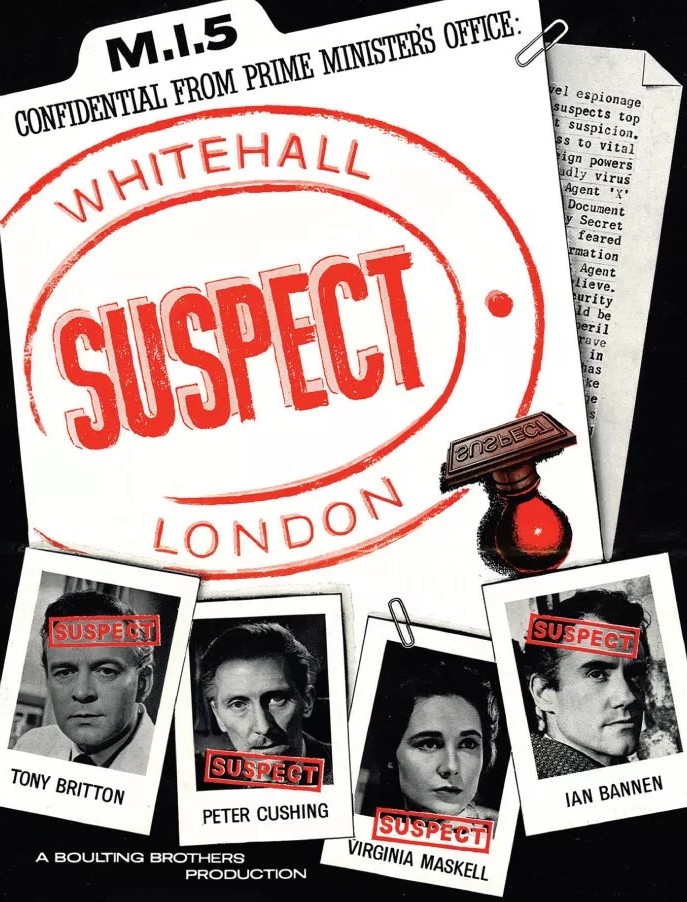
Suspect / The Risk (1960) ****

Marvellous long-forgotten character-driven espionage drama exploring the twin themes of guilt and duty. It would appear to be stolen by two supporting actors, Ian Bannen and Thorley Walters, but in fact both play roles that have significant bearing not only on the narrative but on our understanding of the most important characters. Not only do we have the main plot, but we also have two well-worked sub-plots, one concerning disability and the other of more sinister relevance – a 1984 Big Brother theme.

Basic tale concerns a laboratory that has discovered a bacteria that can cure plague. Hopes of  a celebratory drink all-round and academic kudos on publishing his paper for top boffin Professor Sewell (Peter Cushing) are dashed when the Government in the shape of the pompous Sir George Gatling (Raymond Huntly) steps in, steals the discovery and makes the staff sign the Official Secrets Act.

Romance No 1 – Virginia Maskell and Tony Britton in the lab.

While the revered professor takes it on the chin, colleague Bob Marriott (Tony Britton) is outraged so vocally in public that he attracts the attention of the shady Brown (Donald Pleasance) who suggests to the dupe that there is a way of getting the information out to the wider scientific community, especially to plague-ridden countries.

However, don’t let Sir George’s pomposity fool you. He doesn’t trust this bunch an inch and puts the Secret Service on their tail to assess “the risk” and we dip into the dark kind of web (not that kind of dark web) and the mundane business of deception and betrayal shortly to be explored by the likes of John Le Carre (The Spy Who Came in from the Cold, published in 1963) and Len Deighton (The Ipcress File, published a year earlier).

Rather than this outfit being headed by a version of the prim George Smiley, Mr Prince (Thorley Waters) has a lot more in common with the unkempt Jackson Lamb of the Slow Horses series. His incompetence is an act to make visitors to his shambles of an office under-estimate him.  But he’s got that Columbo knack of asking the most important question just when an interviewee thinks the interview is over.

Also in the background, coming more increasingly into the foreground, is an unusual love triangle between colleagues Bob and Lucy Byrne (Virginia Maskell), who kiss and hold hands in the cinema, and Lucy’s flatmate, the disabled war vet Alan Andrews (Ian Bannen). The fact that Lucy and Alan live together at a time when such a relationship was frowned upon and would be career death in certain circles and that they were once engaged to be married gives it an edge. That Alan has lost an arm and a hand so needs to be cared for – fed (as in food spooned into his mouth),  washed (you can guess that aspect), cigarette lit and removed between puffs, dressed – suggests significant intimacy for an adult.

Obviously, she’s the kind of lass who couldn’t abandon him to the welfare system, and he’s the kind of man who broke off their engagement so she wouldn’t feel tied to him for the rest of her life. But he also hates what he’s become, his desperate reliance on her, what he’s lost, and that’s turned him into not just a bitter individual but a particularly cunning one, who has developed the trick of torpedoing any nascent romance. “You can’t compete,” he gloats to Bob, “because you can’t make her feel good.”

Romance No 2 – Ian Bannen and Virginia Maskell.

But when that doesn’t work, he befriends Bob and surreptitiously eggs him on to betray his country and in so doing, hopefully, kill off the romance.

Mr Prince is a delight. Accorded the best lines, he makes great use of them. When his subordinate Slater (Sam Kydd) abrasively brings Dr Shole (Kenneth Griffith) in for questioning, he reprimands him with the rather coy, “Oh, you haven’t been rough again.” To Dr Shole (Kenneth Griffith), the most susceptible of the professor’s acolytes, he warns, “Tell him (Sewell) not to be a fool or you’ll smack him on the backside.”  Though Dr Shole has a superb retort, “We’re not exactly on those terms.”

Professor Sewell appears mostly on the back foot. While quietly seething at being denied his professional day in the sun, he accepts duty. Even so, he’s smart enough to outwit Prince when the traitor is caught.

The background of the wheels-within-wheels of Government, the silent overseeing of ordinary lives, the authorized level of spying, comes as something of a shock, since despite George Orwell’s best efforts Big Brother was seen as a clever fiction that could not occur in this most democratic and upright of countries where “fair play” was the rule. Visually, this is well done, we see eavesdroppers in mirrors in pubs and, as I said, Prince seems the least effective of operatives but with the kind of personality that you could easily have built a series around.

Disability from war was a constant of post-war British pictures, most often demonstrated by a character with a limp, as with general dogsbody Arthur (Spike Milligan) here. The Oscar-winning The Best Years of Our Lives (1946) was the most effective at dealing with the physical after-effects of the Second World War. But there, the worst-affected soldier, had prosthetic hands. Here, Alan does not, so the scenes of him being tended to by Lucy are emotionally more powerful.

She tends to his emotions, too, and will embrace him and kiss him on the mouth though he’s not dumb enough to read true romantic commitment into those demonstrations of affection. Clearly, there is emotional residue from their engagement, from which you guess she will ultimately be unable to entangle herself, unless he can find a more brutal way of helping her out of the dilemma.

The lab aspect is surprisingly well done. We don’t get any real information on the scientific breakthrough. Mostly, what we view is the grunt work, the laborious checking of thousands of samples for another experiment. At one point Bob thrusts his arm into a contraption packed with buzzing flies as if he was a competitor in I’m a Celebrity, Get Me Out of Here.

Ian Bannen (The Flight of the Phoenix, 1965) is the standout but character actor Thorley Waters (Sherlock Holmes and the Deadly Necklace, 1962) runs him close. Tony Britton (better known later for television comedy) has the least interesting role, but Virginia Maskell (Interlude, 1968) has too much to do without dialog to demonstrate her dilemma. Peter Cushing (The Skull, 1965) is solid as always and Spike Milligan provides light relief.

Joint direction by the Boulting Brothers (The Family Way, 1967), Roy and John. Screenplay by Nigel Balchin (Circle of Deception, 1960) based on his own novel.  

Exceptionally solid stuff. I was very much taken by the unusual approach, the themes and the acting.

Worth a look.

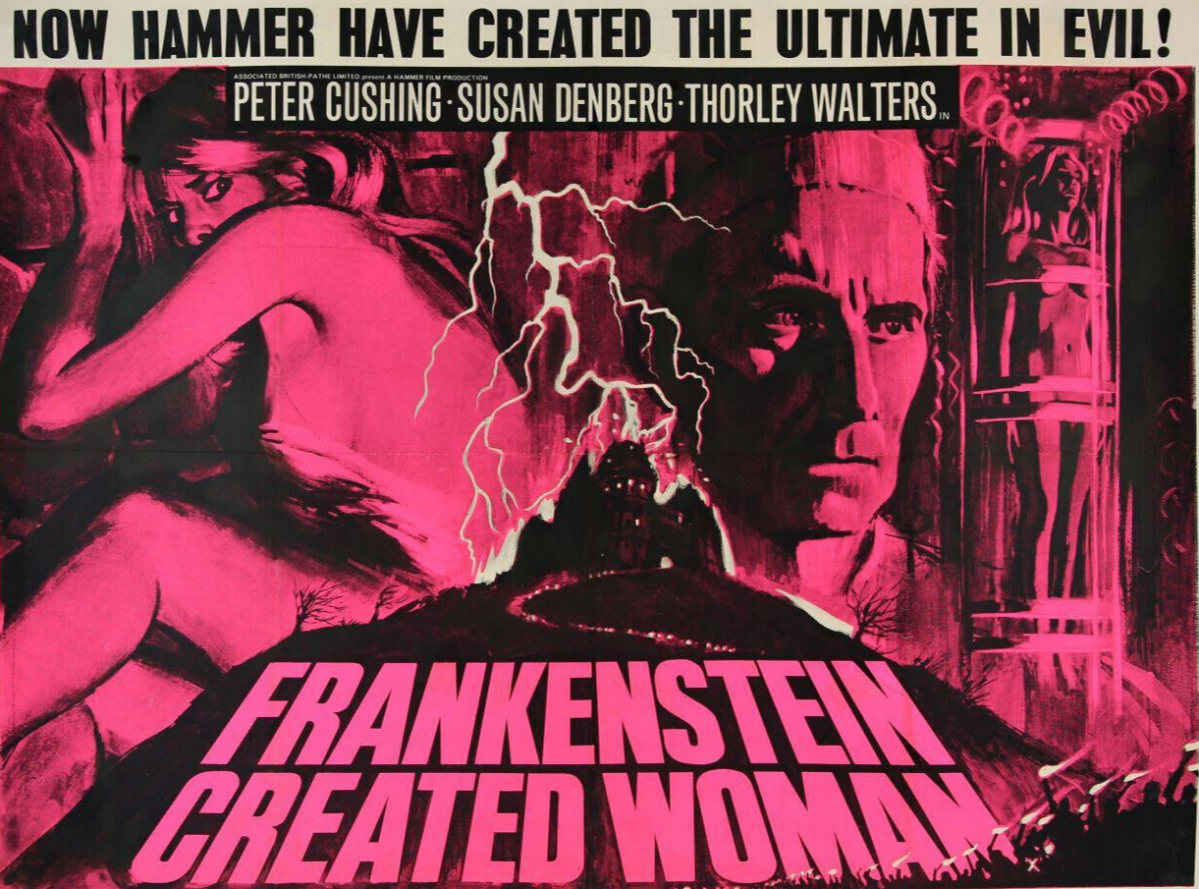
Frankenstein Created Woman (1967) ***

Custom-made for a contemporary audience. How can you fail with a tale about a male brain taking over a female body. Male soul if you want to be strictly correct and metaphysical about it or if you are Martin Scorsese for whom discussion about whether the soul leaves the body after death and exists on some other plane was of the greatest interest. But, yes, so although our hero/villain Baron Frankenstein (Peter Cushing) does create a female instead of a male, and not just with the misogynistic purpose of supplying a monster with a mate, unfortunately in the act of creation the poor woman is saddled with the soul/brain of a man, and, even worse, one with  bloody revenge on his mind.

These days for sure audiences would not have any trouble with female stars carving a swathe through any populace and nobody would require transplanting of  male hormones-soul-brain-whatever to take off on a rampage. But, back in the day, before Hammer went full-tilt-boogie down the lesbian vampire route, it was rare, outside of film noir and exploitationer pictures, for a woman to be so savage. So her actions are viewed with regret rather than roars of approval. But, for once, nobody is taking a torch or axe to the good old Baron.

That’s not all that takes the audience by surprise. The use of a guillotine, ideal for a post-task  dripping of blood, turns out to be widely used in central Europe in the 19th century, hardly surprising since it was a German invention. The movie opens with a young boy, Hans, witnessing his father’s execution on such a device, a point that seems arbitrary but proves pivotal.

The grown-up Hans (Robert Morris) assists Dr Hertz (Thorley Walters) assisting the Baron in some kind of resurrection experiment, the guinea pig being Frankenstein himself. Naturally, for purely metaphysical purposes you understand, the Baron would like to experiment on as barely-dead a cadaver as possible to prove his theories. That this takes a good while to materialize is largely because the narrative has to go all around the houses.

Hans’s lover, disfigured and lame innkeeper’s daughter Christina (Susan Denberg), is taunted by a trio of young swells that results in Hans attacking them. Later, for no particular good reason, the toffs kill the innkeeper, but Hans gets the blame and is sentenced to death. After he is  guillotined, Christina commits suicide by drowning. Both bodies turn up in Frankenstein’s lab at roughly the same time. Complication of course being that a guillotine doesn’t deliver a body intact. Quite how Frankenstein achieves his soul-body transplant is left up to your imagination – the scene promised in the poster is a marketing fiction.

And there’s a touch of Poor Things about the result as Christina wakes up minus scars and disfigurement but with no recollection of her past and needs to be taught who she is. Not that she requires much education in the feminine wiles department and is soon stalking the three young toffs, seducing them with hints of sexual promise before taking savage revenge.

There also a Curse of the Undead element when villagers discover her grave is empty. In fairness to the Baron, he soon realizes what fate had befallen her and tries to ensure that, once her revenge is complete, she can live a different life, although in the way of horror films a happy ending is rarely an option. And in fairness to the Baron the villagers aren’t queueing up to set him alight.

With various subplots to get through, this leaves the Baron out of the picture for considerable periods of time. From a contemporary perspective, there’s a freshness here that will appeal, especially the creation’s desire to discover her purpose in life, her not being bred to fulfil a romantic purpose, and the battle of the male-female will.

Peter Cushing (The Skull, 1965) is as usual splendid, Thorley Walters (Sherlock Holmes and the Deadly Necklace, 1962) presents as an inebriated and impecunious assistant while Austrian Susan Denberg (An American Dream, 1966) does well in the dual role.

Fourth outing in the Hammer series, directed with occasional verve by the reliable Terence Fisher (The Devil Rides Out, 1968) from a screenplay by Anthony Hinds (The Mummy’s Shroud, 1967).

Contemporary appeal and can never go wrong given that it is purportedly one of Martin Scorsese’s favorite films.

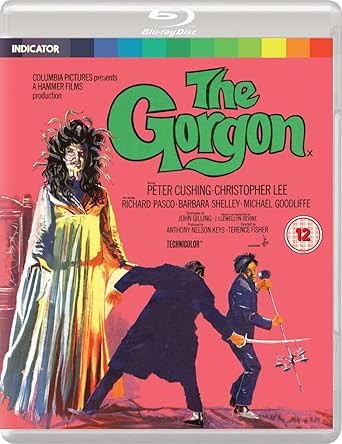
The Gorgon (1964) ***

This impressive Hammer conspiracy-of-silence slow-burner, more thriller than horror, features the triumvirate of Christopher Lee (The Devil Ship Pirates, 1964), Peter Cushing (The Sword of Sherwood Forest, 1960) and Barbara Steele (Dracula, Prince of Darkness, 1966) in untypical roles. Lee and Cushing, of course, had locked horns before, namely in Hammer’s reimagining of the classic Dracula, with the former the charismatic fiend and the latter his nemesis.

Dr Namaroff (Peter Cushing) is a  doctor in an unnamed European turn-of-the-twentieth-century police state who knows more than he is letting on about seven inexplicable deaths in five years and the possibility of a 2,000-year-old myth coming to life and taking on a human form. And with quite a human side, jealous when his assistant Carla (Barbara Shelley) falls for a younger man, Paul (Richard Pascoe). Professor Karl Meister (Christopher Lee) appears late in the day to investigate.

Director Terence Fisher, who had shepherded the studio’s Dracula, Frankenstein, the Mummy and Dr Jekyll franchises through the starting gate, builds up the atmosphere with full moons, haunting voices, fog, sudden sounds, drifting leaves and an abandoned castle forever in shadow. The camera is often a weapon of stealth. Shock is kept to a minimum, fleeting ghostly apparitions and a finger falling off a corpse. Given the limitations of special effects in this era, that was a smart move.

Far better to concentrate on fear of impending doom, a man knowing he is turning to stone, a woman living in terror of being taken over by the phantom. The title gives away the story somewhat – even if you didn’t know the Gorgon was a mythical monster with a headful of snakes and the ability to turn people to stone, that is soon explained. 

Death remains the trigger for action, the suicide of an artist after he has apparently murdered his pregnant girlfriend bringing his father onto the scene and then his brother accompanied by Lee. But all investigation hits a wall of silence after Inspector Kanof (Patrick Troughton) refuses to instigate detection.

The Hammer double bill was a common feature in British cinemas. It also meant Hammer didn’t need to share box office receipts with another company.

At the heart of all the relationships is betrayal. The artist leading his girlfriend on, Namaroff willing to endanger Carla, whom he professes to love, rather than revealing the truth. Even Carla spies on the brother, with whom she is falling in love, in order to gather information for Namaroff. 

Forgive the pun, but Shelley steals the picture. An amnesiac, a victim and finally the lure, she remains enigmatic, a whisper of a woman. It is a haunting portrayal far removed from Hammer’s traditional cleavage queens. This is a very human character who nonetheless must stand guard over herself. Shelleye, here a gentle beauty, initially introduced as merely the love interest, becomes central to the story but without sucking up all the available horror oxygen by over-acting.   

Cushing embroiders his character with little touches, smoking a cigarette in a holder, for example, but Shelley’s character, her distrust of herself, shows in every move she makes.

You would need a heart of stone to be unmoved.

https://amzn.to/41dZqD3

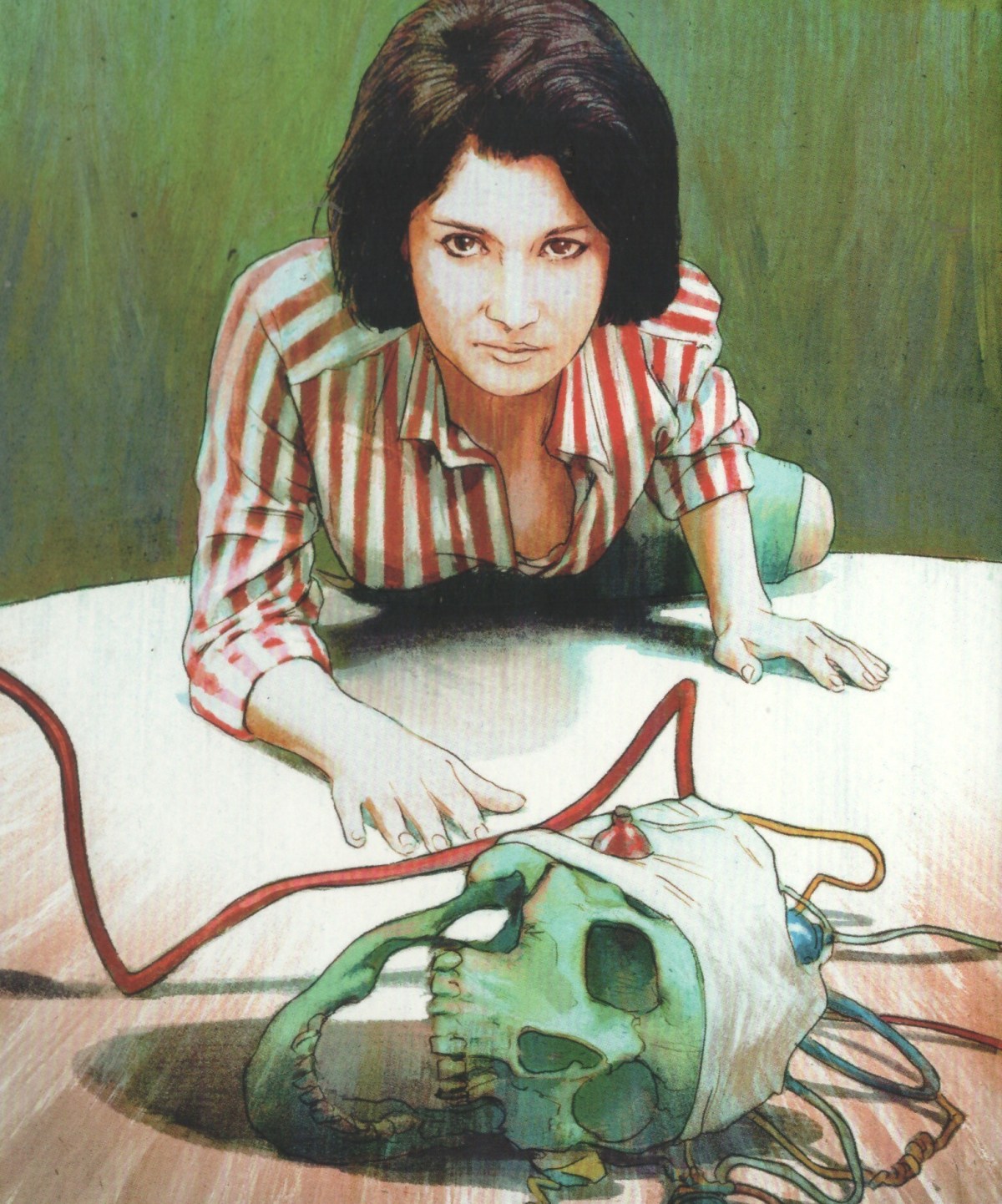
The Skull (1965) *****

I have no idea why this masterpiece has not been acclaimed. For virtually half the picture, there is no dialogue, the entire focus on camerawork and reaction. Even Stanley Kubrick in The Shining (1980) gave in to grand guignol and The Exorcist (1973) was filled with over-the-top scenes but here the psychological impact of possession remains confined.

Initially, it appears we are in familiar Hammer territory, a grave-robber detaching a skull from a corpse only to meet an untimely end. There is another flashback to the gothic where the presence of the skull drives an order man to murder. But this is an Amicus production and set in contemporary times where Christopher Lee and Peter Cushing are once again in opposition, but this time only in an auction house bidding for demonic artefacts.

Exposition is straightforward. Dealer Marco (Patrick Wymark) sells Maitland (Peter Cushing) a book about De Sade bound in human skin. Marco may be a con man. He claims to possess the skull of the Marquis de Sade but his attitude towards it, kissing its head, plucking its nose socket, and the fact that he willing to halve his asking price, suggest otherwise. Sir Matthew (Christopher Lee), who once owned the skull, warns Cushing against it.

The rest of the film covers Maitland’s possession of the skull and the skull’s possession of him. There is a notable Kafkaesque sequence where Maitland is arrested, taken before a judge and forced three times to play Russian roulette before ending up in the house of the dealer where he steals the skull. What is less often commented upon is that this nigh-on 15-minute sequence including a 90-second taxi ride is conducted in virtual silence, the camera mostly on Maitland’s face, that silence only broken by the feeding of bullets not the barrel of the gun and the barrel being rolled round. It is not long before Maitland commits his first murder.

There is a famous scene in the Last Tycoon (1976) in which Robert De Niro explains to a truculent word-obsessed British writer why dialogue is redundant in the movies. All you need is camera and reaction. That sets up The Skull’s greatest scene, a 17-minute dialogue-free climax, where Maitland is effectively preyed upon and consumed.

The skull itself appears to have a point-of-view, various shots of Maitland through the skull’s eyes. The actual special effects are limited to what is imminently achievable, the skulls glows, it moves through the air. The impact of its presence is shown on Maitland’s face and by his action. It is just hypnotic.

Various directors have been anointed for the way they move their camera – Antonioni’s 360-degree turn in The Passenger (1975) comes to mind, large chunks of 2001: A Space Odyssey (1968), the long wait for sunrise in Lawrence of Arabia (1962), the lengthy shots of James Stewart driving a car in Vertigo (1958). But I have never seen anything as innovative as the silent sequences in The Skull which would be a waste of innovation were the sequences not so effective, especially on the small screen. Freddie Francis (Nightmare, 1964) directed from a story by Robert Bloch (Psycho, 1960). Equally innovative is the jarring music by avant-garde composer Elizabeth Lutyens.

In the role of his career, Peter Cushing (Dr Who and the Daleks, 1965) turns on the style, his character virtually turning 360-degrees as he becomes enmeshed in diabolic terror.

A must-see.

Discover WordPress

A daily selection of the best content published on WordPress, collected for you by humans who love to read.

The Atavist Magazine

by Brian Hannan

WordPress.com Blog

News, Tips & Website Tutorials