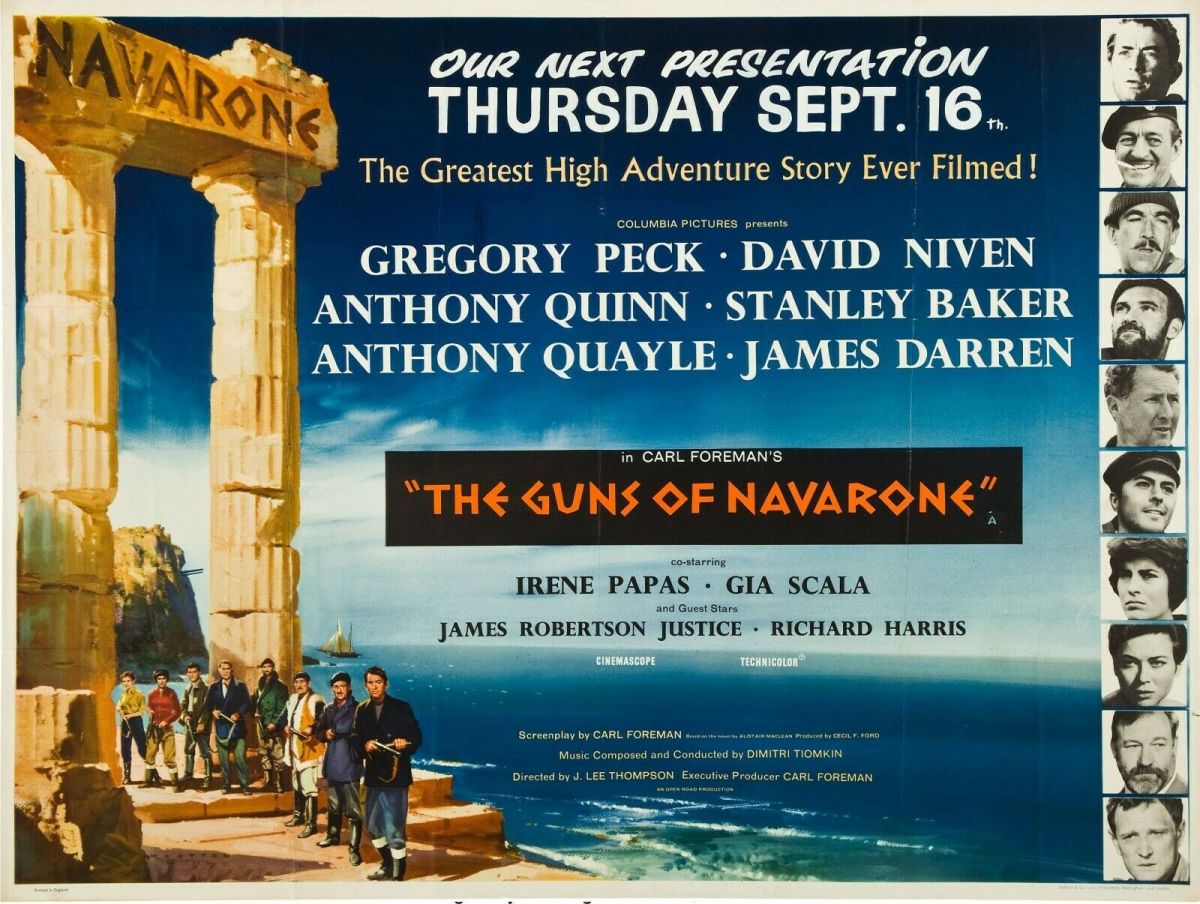
To celebrate this film now streaming on Netflix I thought i’d re-run a previous review.
Stone-cold action classic that blazed a trail for the big-budget men-on-a-mission war picture like The Dirty Dozen (1967) and Where Eagles Dare (1968). Brilliantly structured, written and directed, and featuring a sea battle, storm, shipwreck, mountaineering, chase, interrogation scenes, infiltration of an impregnable fortress, a pair of romances, two traitors, and an awe-inspiring climax make this a candidate for one of the greatest war pictures ever made.
The set-up is simple. Knock out the gigantic guns at Navarone or two thousand men will perish. It’s mission impossible and the clock is ticking. You don’t know who to trust and the enemy is ruthless.
In the early days of the all-star-cast, producer Carl Foreman rounded up an astonishing line-up, bulking out the bestseller by Scottish thriller maestro Alistair Maclean (The Secret Ways, 1961) with three top stars in five-time Oscar nominee Gregory Peck (The Big Country, 1958), double Oscar-winner Anthony Quinn (Heller in Pink Tights, 1960) and Oscar-winner David Niven (Please Don’t Eat the Daisies, 1960). Add in British household names Anthony Quayle (Ice Cold in Alex, 1958), Stanley Baker (The Concrete Jungle, 1960) and James Robertson Justice (Doctor in Love, 1960), a sprinkling of rising stars in James Darren (Let No Man Write My Epitaph, 1960), Gia Scala (I Aim at the Stars, 1960) and Richard Harris (The Night Fighters, 1960) and renowned Greek actress Irene Papas (Antigone, 1961).
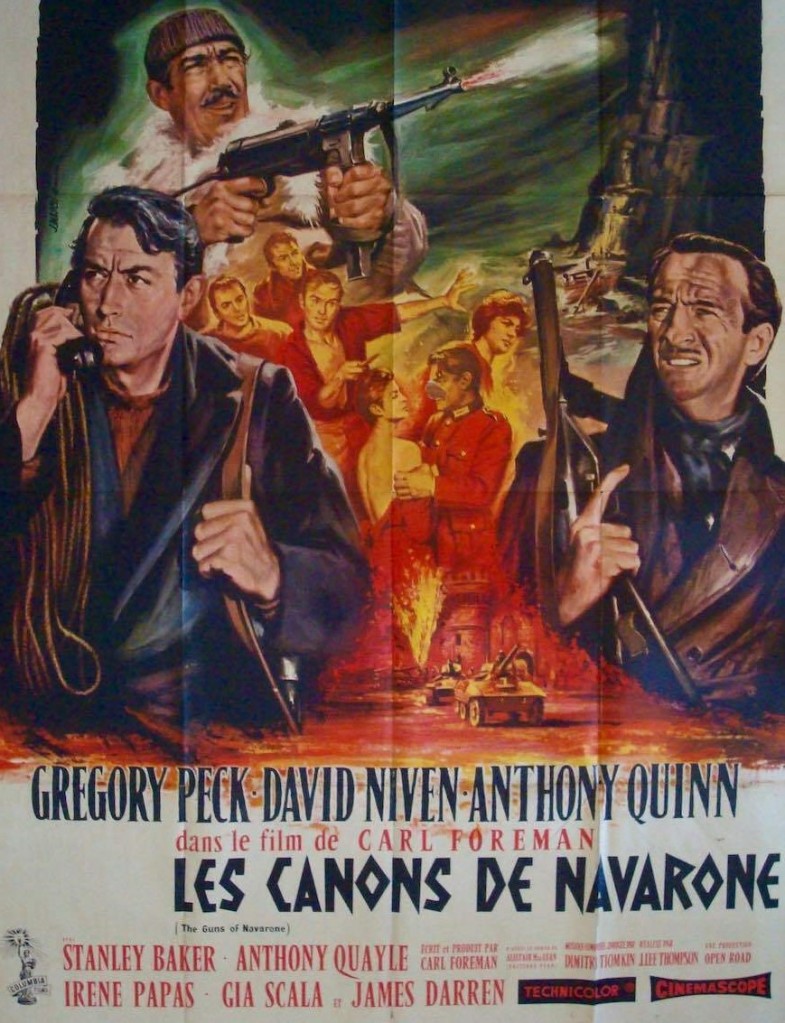
Each man is a specialist. Capt. Mallory (Gregory Peck) the mountaineer whose climbing skills are essential to completing the fist part of the mission, explosives expert Corporal Miller (David Niven), mechanic ‘Butcher’ Brown (Stanley Baker), Greek patriot Stavrou (Anthony Quinn) and the ruthless killer Pappadimos (James Darren) who has the contact with the Greek resistance. The stakes are ramped up when we learn both Mallory and Stavrou have bounties on their heads, not to mention the fact they are sworn enemies, and that before the mission even gets under way, spies are discovered in the camp. The ostensible leader of the group Major Franklin (Anthony Quayle) is wounded early on, turning him into a liability and making Mallory the de facto leader.
The stakes are ramped up further – this time through relationships. Their Greek contact turns out to be a woman, Maria (Irene Papas), brother of Pappadimos. She brings with her a mute girl Anna (Gia Scala) for whom Mallory develops romantic feelings while Stavrou has eyes for Maria. Mallory is also torn about Franklin, his best friend.
And from there it pitches into one disaster after another. They are too easily hunted by the Germans. They are shelled with mortars and attacked by dive bombers as they race across open mountains and through caves to reach their destination. They have to shoot their way out of traps and finagle their way into the fortress. There are twists and turns all the way, the clock ticking in almost James-Bond-style as the deadline for the destruction of the troops approaches.
And although this is clearly a war picture it is also as obviously an anti-war one, no end to the killing in sight, people dying pointlessly.
Although the acting was ignored come Oscar time, each of the stars delivers and it is a communal tour de force. Director J. Lee Thompson (Ice Cold in Alex) ensures that in visual terms none of the stars dominates, each given equal screen time while the strong supporting cast each has their own narrative arc. With over two-and-half-hours’ running time, Thompson has both the bonus of time to allow each element to be fully played out and the problem of keeping the picture taut and he succeeds brilliantly in both aims. It is a masterpiece of suspense. And it looked fabulous, the guns themselves, by which the picture might succeed or fail, were awesome.
Thompson was Oscar-nominated as was producer Carl Foreman for both Best Picture and the screenplay, Dmitri Tiomkin for the score (one of the longest-ever), John Cox for sound, Alan Osbiston for editing. Bill Warrington who did the visual special effects and Chris Greenham who did the sound effects were the only winners on the night.
It was a commercial smash, top picture of the year in the U.S., the biggest picture of all time at the British box office and breaking records all over the world.


It was the first big budget men in a mission war movie that started it all. Frankly I like it better than Where Eagles Dare and The Dirty Dozen is several notches below them. The former must be for the scrip, stars and J. Lee Thompson was in fine form. These three stand out among them.
LikeLike
It certainly was the one that kicked it all off. There was a lot more proper story in The Guns of Navarone than the other two and better character interaction. I see more in it every time I watch it.
LikeLike
Well I know all about this film, of course! Hopefully, I’ll be reviewing it relatively soon…
LikeLiked by 1 person
A must for all real movie fans as you know.
LikeLiked by 1 person
I remember discussing the action of this film in the primary school playground. War stories lend themselves to good cinema, but this is one of the best, the whole package absolutely sings. About to rewatch Ice Cold, bought a DVD but haven’t found the right moment. I do miss this kind of Hollywood heroism, it’s a lowly sub-genre these days…
LikeLiked by 1 person
When good guys were good guys…those were the days. Ice Cold is great, too.
LikeLike
Here you go:
“A news item in the 2 Mar 1957 NYT announced that Columbia Pictures had acquired film rights to Alistair MacLean’s recently published novel, The Guns of Navarone. Later that year, a 23 Dec 1957 DV brief noted that Carl Foreman Productions would likely produce.
According to the 8 Jan 1958 LAT, Alec Guinness was attached to star in the picture, to be shot in New Zealand. Later reports in the 12 Jun and 18 Sep 1958 DV, 22 Sep 1958 LAT, and 26 Oct 1958 NYT noted that writer-producer Carl Foreman, who was set to adapt the screenplay, was interested in casting Cary Grant, William Holden, Peter Finch, John Mills, and Jack Palance, in addition to Guinness. In a 12 Nov 1958 Var article, Foreman refuted such reports, stating that only one “top American star – not, as rumored Cary Grant,” had been cast, and other roles would not be filled until the script was finished. After an announcement that the project was set to be Columbia’s biggest release of 1959, Foreman was swarmed by talent agents hoping to cast their clients. In response, he sent out a form letter asking actors’ representatives not to contact him while the script was still in development, as he “wanted the artists to fit the roles and not vice versa.”
The 22 Sep 1958 LAT stated that promotional and distribution plans were already underway, although production was not expected to begin until spring 1959. The picture was said to have the highest budget of any Columbia picture, to date. While several contemporary sources, including the 24 Sep 1958 Var, listed a budget of $5 million, the 26 Oct 1958 NYT stated that the picture would cost $5.6 million. The 1 May 1961 DV review cited a final budget of $6 million.
In late Oct 1958, British producer Aubrey Baring was said to be scouting locations with Carl Foreman in Italy and Greece. While filmmakers originally planned to shoot in Cyprus, Foreman decided against the island due to political unrest, according to an 18 May 1960 Var article, and chose the island of Rhodes, instead.
On 22 Jan 1960, NYT announced that David Niven would co-star with Gregory Peck and Anthony Quinn, with principal photography set to begin on 8 Feb 1960 in Greece. Alexander Mackendrick was attached to direct at that time. Filming was delayed until 21 Mar 1960, however, and Mackendrick dropped out due to a “severe back ailment,” as reported in the 8 Mar 1960 NYT. An item in the 15 Mar 1960 DV listed Michael Anderson and J. Lee Thompson as the top contenders to take over for Mackendrick, and an NYT item published the following day confirmed that Thompson was hired.
According to items in the 17 Dec 1958 Var, 23 Dec 1958 DV, 8 Jul 1959 LAT, and 8 Sep 1959 DV, the following actors were under consideration for roles or cast in the picture: Hugh O’Brian; Annette Stroyberg; opera singer Maria Callas; and Richard Burton.
Animation company UPA Pictures was contracted to produce an expositional prologue, combining animation with color and black-and-white film. The 8 Apr 1959 Var noted that the prologue, written by Foreman, would visually employ “the style of the Greek frieze and Etruscan bas relief.”
An article in the 2 Mar 1960 Var noted that a special publicity unit would operate throughout filming, with support from the Greek Ministry of Information and National Tourist Organization. Olympic Airways acted as a sponsor by flying cast and crew to location, and the film received support from the Auto Club of Greece and the Greek Steamship Line. During production, in a ceremony held at the Rhodes City Hall, Foreman was named “an honorary citizen of Rhodes,” according to a 20 Apr 1960 Var brief.
Over 1,000 Greek soldiers appeared as background actors in battle scenes, the 8 May 1960 NYT reported, and Rhodes locations included the towns of Rhodes and Paradisi. The Maria, a fifty-five-foot caique powered by a one-cylinder engine, was used on location, and a full-scale replica was built at Shepperton Studios in London, England, where filming moved after shooting in Rhodes was completed. According to a 14 Aug 1961 LAT article, the scene showing the “guns of Navarone” being exploded required a full-size cave that was built outside at Shepperton, and three additional reproductions: one fifth-scale model (six stories high); a one tenth-scale model; and a one twentieth-scale model. Six cameras recorded the explosion of all three models.
A 31 Jul 1960 NYT article stated that filming, which was behind schedule, was expected to continue through Sep 1960. On 17 Oct 1960, DV stated that principal photography would finally be completed that day.
A royal world premiere was set to take place at London’s Leicester Square Theatre on 27 Apr 1961, according to a 5 Apr 1961 Var brief. Proceeds from the charity event were slated to go to the Edwina Mountbatten Trust, aiding the St. John Ambulance Brigade, the Advancement of World Nursing, and the Save the Children Fund. Soon after, a preview screening was held in Westchester, NY, on 3 May 1961, as noted in a DV item published that day. Theatrical release in New York City followed on 22 Jun 1961, at the Criterion Theatre, where the picture was poised to break an opening-week record with $80,000 in ticket sales in its first seven days, according to a 28 Jun 1961 Var article. The Guns of Navarone was set to open in Los Angeles, CA, on 29 Jun 1961, at the Stanley Warner Beverly Hills Theater, as noted in a 23 Jun 1961 LAT item. New York and Los Angeles screenings included a short film, Rooftops of New York, described in the 23 Jun 1961 NYT review as “a colorful short recording of the behavior of local sun-worshipers hereabouts in the summertime.”
The film was a critical and commercial success. It was chosen as the Best Picture of 1961 in FD’s annual poll of film critics, as noted in the 19 Mar 1962 NYT, and received an Academy Award for Best Special Effects, in addition to Academy Award nominations for Best Picture, Directing, Film Editing, Music (Music Score of a Dramatic or Comedy Picture), Sound, and Writing (Screenplay—based on material from another medium). Less than two months after its New York release, Foreman predicted it would reach a cumulative domestic gross of $12 million, as noted in the 14 Aug 1961 LAT. Overseas grosses were also high, particularly in the United Kingdom, where the film was poised to surpass The Bridge on the River Kwai (1957, see entry) as the highest-grossing theatrical release to that time, according to the 6 Dec 1961 Var.”
LikeLiked by 1 person
I wrote a book about the making of this, but thaks all the same.
LikeLike
I have that book. Good book.
LikeLiked by 1 person
Thanks.
LikeLike
Brian, I just remembered in 1980 Andrew Mclaglen directed another men on a mission war picture The Sea Wolves with limited success. Gregory Peck teamed up again with David Niven, both past their prime. Any chance of you reviewing this in the forseeable future?
LikeLiked by 1 person
Will do. Plus The Wild Geese I guess.
LikeLike