Shoot Out (1971) ***

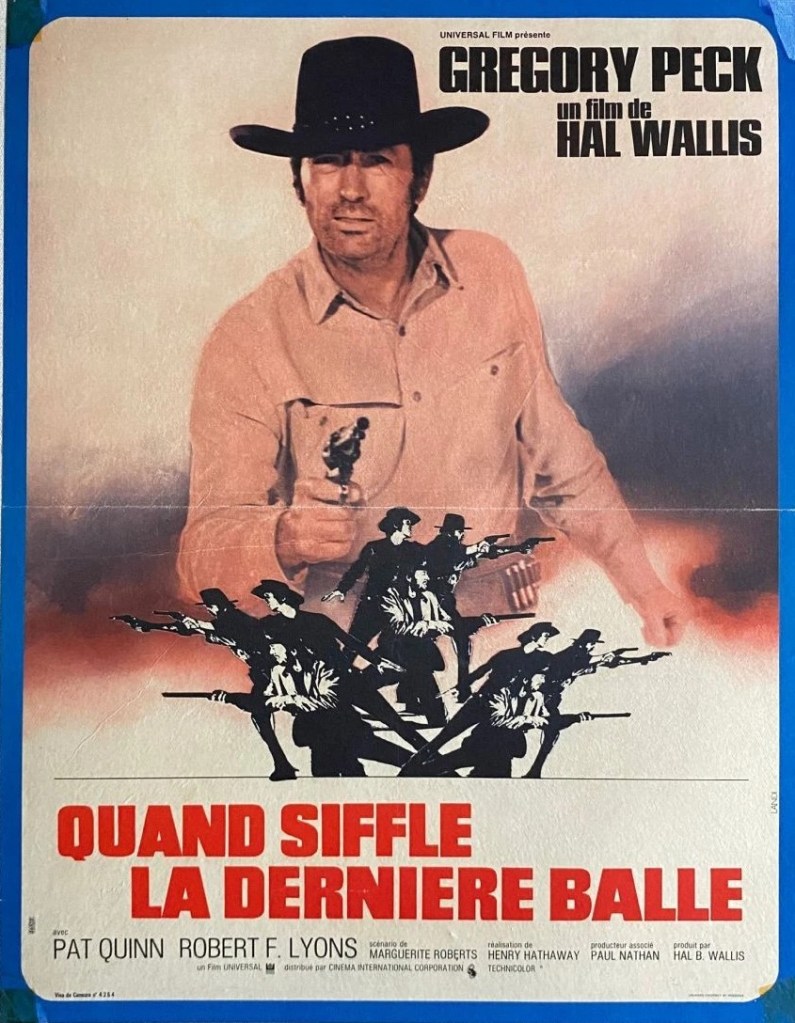
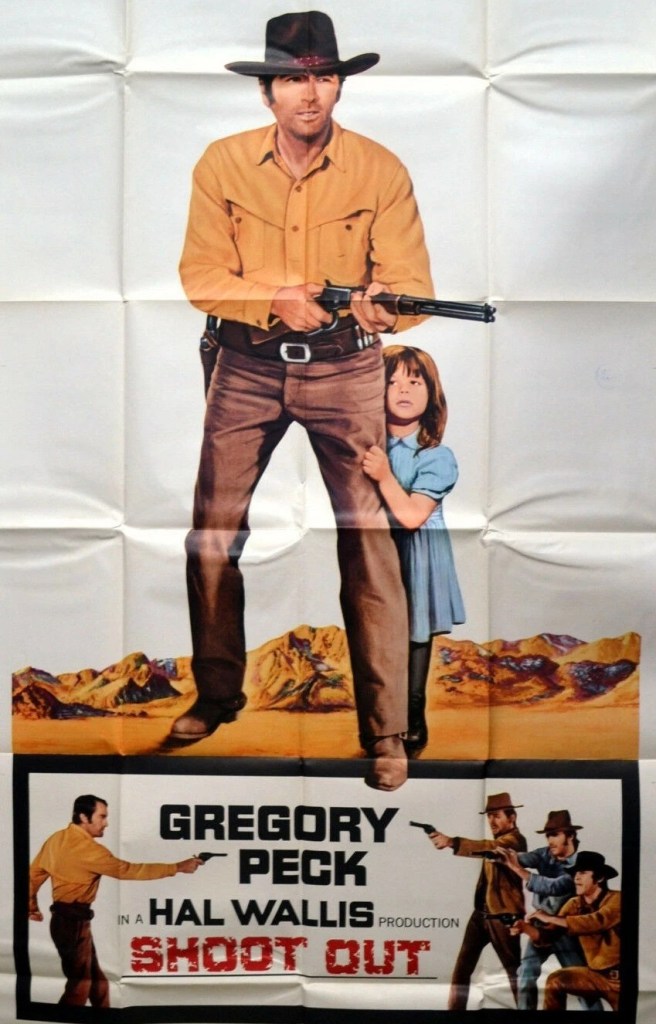
The team behind True Grit – producer Hal Wallis, director Henry Hathaway and screenwriter Marguerite Roberts – make the mistake of thinking that lightning will strike twice in a tale of an older fella, in this case a bank robber rather than a lawman, saddled with a younger woman, in this case a child rather than a sassy teenager. It’s not the only mistake. The title is a misnomer, for a start, and there’s a rather dumb use of shooting the apple off a child’s head a la the “Swizzer” William Tell. In reality, it’s a revenge tale, and a violent one at that, mixed in with a sentimentality that’s at odds with the story.

Like James Stewart and John Wayne, Gregory Peck was in something of a default position in terms of the movies he was now making. This trio, in particular, now specialized almost exclusively in the western. From 1966 of the nine movies made by Wayne seven had been   westerns. For Stewart, over the same period, it had been exclusively westerns – five of them. Now Peck was beginning to go down the same route – this would be his third western in three years.
The reason wasn’t hard to find. Of all the genres churned out by Hollywood, westerns were the most sellable abroad. So, at the global box office at least, this trio still held sway, justifying their hefty fees.  

Clay Lomax (Gregory Peck), just out of prison, seeks vengeance on ex-partner Sam Foley (James Gregory) who shot him in the back after a robbery, leaving him to carry the can, and made off with the loot, which he has used to build a ranching empire. Learning Lomax is out, Foley puts a sadistic trio – Pepe (Pepe Serna), Skeeter (John Chandler) and Bobby Jay Jones (Robert F. Lyons) – on his trail, with orders not to kill him, which is pure torture for the bloodthirsty thugs, but just to track him and report on his whereabouts. But thuggery will out, and instead the thugs kill Trooper (Jeff Corey) in heinous fashion.

Quite why the narrative dictates that the gunslingers are not to kill Lomax is anyone’s guess because it makes little sense, unless Foley is aware how unfair a fight it will be and that the veteran outlaw will be more than a match for his crew. And that’s how it turns out, Clay knocks them six ways to Sunday and that’s just for disturbing his peace in a hotel.

The narrative takes another odd twist with the arrival of the seven-year-old Becky (Dawn Lyn) who is put in Lomax’s charge. When he fails to offload her, he takes her with him, only stopping off to bushwhack the thugs and steal their weapons.
Quite why Lomax doesn’t just shoot the gunslingers and be done with it is also anyone’s guess but that leaves the trio able to jump Lomax when he’s taken refuge with the kind of widow drifters tend to come across in westerns. It gets quite unnecessarily confusing at this point but given Lomax is close to finding Foley something needs to create a delay.

And that’s done with an overlong unduly sadistic session by Bobby Jay as he attempts to emulate the Swizzer by shooting cups off Becky’s head. But the upshot of all this is Bobby Jay ends up killing his buddies and making off with the kid. Naturally, Lomax is soon in pursuit, but the promised “shoot out” doesn’t materialize, at least not in the traditional sense of gunmen facing each other in the main street.

What makes the movie work is what they should have concentrated on in the first place, Lomax taking a parental interest in the girl. That neither wants the other makes for decent enough tension and there are enough moments to flesh out their relationship, with Lomax unwilling to accept that he might well actually be her father.

Of course, a jailbird as a father doesn’t sit right with the filmmakers, even though Lomax is clearly capable of keeping the little one washed and fed and comfortable at night. So that’s where your lonely widow Juliana (Patricia Quinn) comes in. Interestingly, that’s the only scene that’s completely devoid of sentiment. She’s had long enough – five years – of loneliness and consoling herself with whisky at night to be happy to take the first half-decent fella who comes her way.

The action, when Lomax is sorting things out fist first, is acceptable enough, but whatever movie Hathaway and Co thought they were making just doesn’t come off. Certainly, it doesn’t come close to True Grit.

Pendulum (1969) ****

It’s better to come at this as a drama rather than the thriller it was marketed as. That the name of George Schaefer, the last to make a movie of the directors who shot to fame in television in the 1950s, is attached should be indication that this is character- and issue- rather than action-driven. It’s more about people being sucked into the system, about the vulnerable members of society, who, whether cop or criminal, have no recourse to some kind of higher power to sort their lives out. As such, it’s a satisfying drama.

A-list male stars playing emotionally vulnerable characters was a growing trend in the late 60s. Think of Burt Lancaster in The Swimmer (1968) and Kirk Douglas in The Arrangement (1969) – all reviewed in the Blog, incidentally. Here top Washington detective Frank Matthews (George Peppard) goes through the personal and professional wringer, suspecting wife Adele (Jean Seberg) of an affair then becoming a suspect himself in a murder case. Underlying these plot-driven aspects is an exploration of the political issue of civil liberties, in particular the constitutional rights of criminals, setting this up as one of the earliest law’n’order movies, a trope that would take center stage in films like Dirty Harry (1971).  

At a peak of professional success, having been awarded a medal and promoted to consultant on a subcommittee on Law and Order headed by Senator Augustus Cole (Paul McGrath), Matthews’ ethics come under scrutiny when alleged murder/rapist Paul Sanderson (Robert F. Lyons), whom Matthews had arrested, is freed on a technicality thanks to the efforts of civil liberties attorney Woodrow Wilson King (Richard Kiley).

Matthews appears distracted much of the time trying to keep track of his wife’s whereabouts.  After delivering a speech in Baltimore, he walks the streets in a fug of depression. Meanwhile, King is disturbed by the fact that a man he clearly believes guilty refuses to seek psychiatric help. The question in the audience’s mind is where he will strike next. There’s an excellent scene in King’s office where his secretary Liz (Marj Dusay), delighted at the lawyer’s success in overturning Sanderson’s case, instinctively pulls away from the freed man.

When Adele and lover are murdered in Matthews’ bed, he finds himself on the opposite side of the law, undergoing the kind of treatment he has meted out to so many criminals, quickly aware that circumstantial evidence could find him guilty. Front-page news himself now, suspended from his job by a quick-to-judge senator, emotionally isolated and a laughing stock, he retreats further inside himself. Naturally, he evades subsequent arrest, setting out to track down the killer himself, that leads him into the murkier depths of society from which emotionally-abused villains easily spring. 

Other issues are explored in passing, the independent woman for a start, whether it is wanting to have her own career and not play the stay-at-home wife or considering it fair game – as with Gwen (Faye Dunaway) in The Arrangement – to upturn accepted morality and take a lover.

But the focus remains squarely on Matthews struggling to cope with life running away from  him, falling deeper into despair and into the maw of the criminal justice system which has the knack of bending its own rules. He has never been the saintly cop and there are moments where violence seems the best option, although not the vicious kind later espoused by Inspector Harry Callaghan. It’s ironic that the only solid detection the cop does in the first part of the film is tracking down his wife’s whereabouts.

George Peppard (Tobruk, 1967), generally a much-maligned actor, excels in a part where he can neither charm his way into an audience’s heart, nor confide in someone else about his marital problems, nor resort to action to define his character. That his pain is all internalised shows the acting skills he brings to bear. Oddly enough Jean Seberg (Moment to Moment, 1966), a specialist in emotional pain, takes a different path, coming across as a devious minx, keeping Matthews on the hook while enjoying relations with an ex-lover, whose career, as it happens, has panned out a lot better than her husband.

I only knew Richard Kiley, an American theatrical giant and primarily in the 1960s a television performer, through that mention in Jurassic Park (1993), but he is solid as the attorney who has qualms about releasing a prisoner he knows is guilty. Robert F. Lyons, making his movie debut, brings jittery danger to the unbalanced criminal. Look out also for Charles McGraw (The Narrow Margin, 1952) as the cop determined to take Matthews down and Frank Marth (Madigan, 1968) as the subordinate who gives the suspect too much leeway – to his cost. Madeleine Sherwood (Hurry Sundown, 1967) is excellent as the disturbed, needy mother.

George Schaefer, at this point a four-time Emmy award-winner, specialized in thought-provoking drama such as Inherit the Wind (TV, 1965) and Elizabeth the Queen (TV, 1968).  This fits easily into that pattern. The title is a giveaway, too, referring to the pendulum swinging, “perhaps too far,” from all-powerful police to the rights of the accused taking prominence.

This was the only screenplay from Stanley Niss, who died shortly after the film’s release. He was also the producer. And better known as the writer-producer of television series like Jericho (1966-1967) and Hawaiian Eye (1959-1961).

Catch-Up: George Peppard pictures reviewed in the Blog are Breakfast at Tiffany’s (1961), Operation Crossbow (1965), The Blue Max (1966), Tobruk (1967), and P.J. / New Face in Hell (1968).

Pendulum is best sourced on Ebay.

Discover WordPress

A daily selection of the best content published on WordPress, collected for you by humans who love to read.

The Atavist Magazine

by Brian Hannan

WordPress.com Blog

News, Tips & Website Tutorials