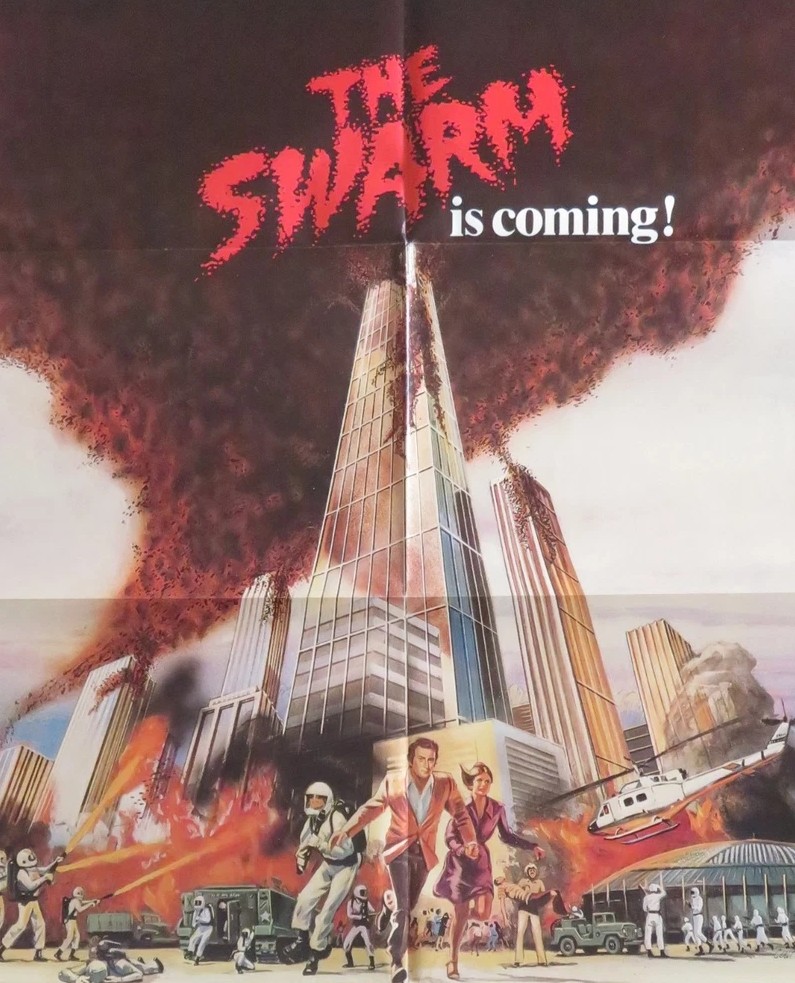
The Swarm (1978) *

I’m delighted to inform you that there was only disappointment this time around, no provisos to save the day, no reassessment to make me change my original views. This truly is a terrible picture. Possibly the worst to involve Michael Caine, who was no slouch when it came to making inadvisable choices. Just as with The Island (1980) which on paper appeared a slam-dunk hit coming as it did in the wake of Jaws (1975) and The Deep (1977), based on Peter Benchley bestsellers, this looked like a no-brainer, another Irwin Allen disaster picture following on from mega-hits The Towering Inferno (1974) and Earthquake (1975).

It’s tempting to blame it on the bees. The special effects creating the sky-borne swarm makes them look like nothing more than a strange smudge on the screen. And the bodies or cars or helicopters smothered in millions of static bees score pretty low, actually, on the scare-o-meter, nothing like a giant shark on the loose. Anyone caught in the swarm has to go into some kind of slow-motion dance that fails to shake them off.
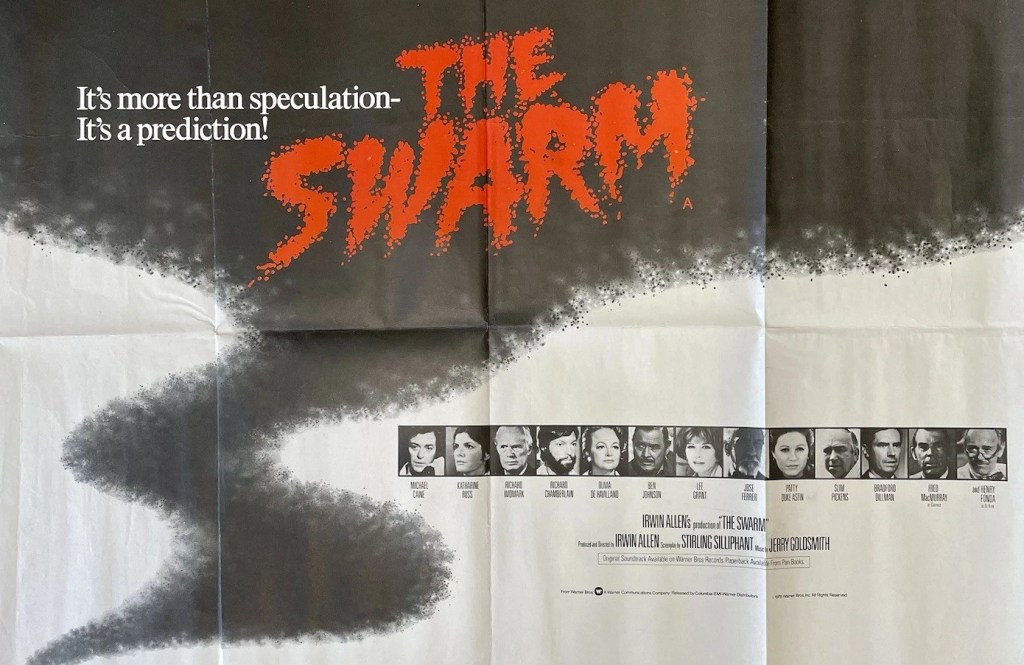
Sure we’ve got a runaway train coming off the tracks and sliding down a hill, but the action quotient is surprisingly pretty low. The opportunity, a la The Birds (1963), to lay low a town is ignored and after a few peremptory shots of bees causing havoc we’re stuck with TV reports. Even giant bees, caused by hallucination, might cause an audience to vaguely squirm but it doesn’t replicate the gut-wrenching terror of a killer shark or the tension of a burning skyscraper.

The cast spend most of their time in exposition mode, or arguing with each other as to whose exposition is better. We know a heck of a lot more about the bees, and why they’re on the rampage, some nonsense about alarm horns replicating the sound of bees mating, than we do about any of the characters.

There’s a smidgeon of romance between Dr Bradford Crane (Michael Caine) and Capt Dr Helena Anderson (Katharine Ross) but it doesn’t get beyond the teenage (“am I walking too fast for you?). And there’s a truly terrible attempt at romantic comedy as old codgers Felix (Ben Johnson) and Clarence (Fred MacMurray) fight over school marm Maureen (Olivia De Havilland) who looks as if she’d like to crack their heads together.
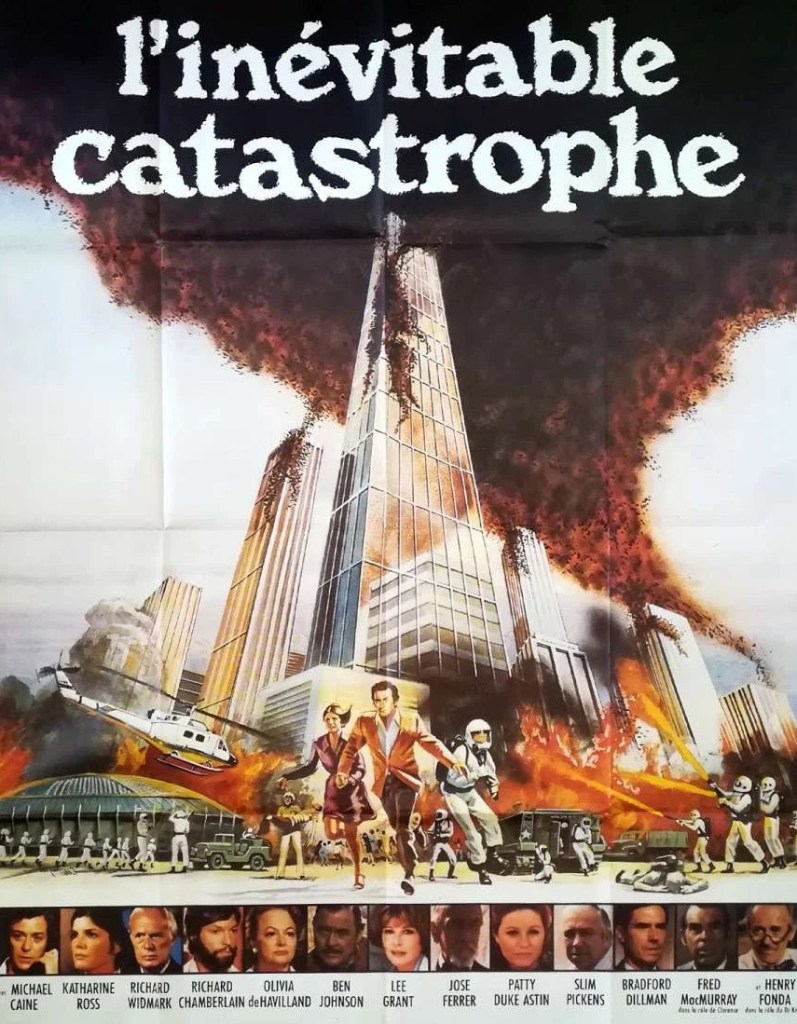
A young boy is caught up in the melee and a pregnant woman, and I was looking out for the statutory nun, a strange omission is a disaster narrative.

The only effective bit of the movie is the opening when a squad of soldiers all Hazchem-med up descend on a deserted missile base and find the entire garrison – apart from a half-dozen – lying dead on the floor. That Dr Crane happens to be passing by leads to a stupid subplot where Major General Slater (Richard Widmark) and sidekick Major Baker (Bradford Dillman) take  the suspicion option and look for an excuse to bang up the academic.

This initially went on general release in a curtailed version running just short of two hours rather than the original 155-minute cut which you can now catch, as I did, on YouTube.

You can’t blame Michael Caine (The Island, 1980) for this mess and he would have acquitted himself well if there had been any actual acting to be done outside of the exposition and arguing with the major general. His best scene is when he gently carries crippled mentor Dr Krim (Henry Fonda) into his wheelchair. Katharine Ross (Hellfighters, 1968) has such a restrained screen persona half the time you think she’s going to burst into tears.

Uber-producer Irwin Allen (The Towering Inferno) had decided by this point that he could dispense with a name director and take on that chore himself. But I doubt if anyone could have made a better job given they were stuck with bees and a terrible script by Stirling Silliphant (In the Heat of the Night, 1967).

A true stinker.
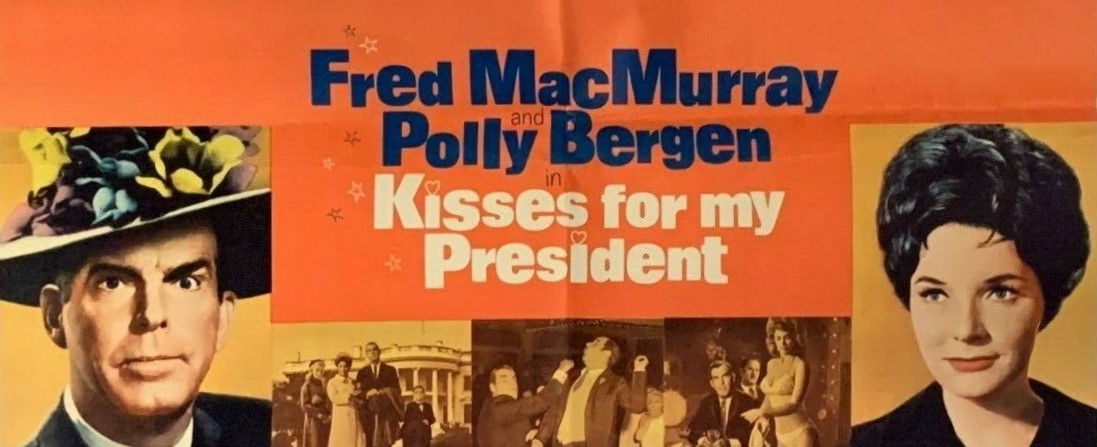
Kisses for My President (1964) ***

The concept of a female President was so alien to Hollywood that the only conceivable approach was to make it the story of the husband taking up the chores of the First Lady.

Having perfected his double takes and pratfalls on a string of Disney comedies Fred MacMurray plays Thad McCloud, straight man to incoming President Leslie McCloud (Polly Bergen) and after the screenwriters have exploited virtually every joke in the gender switch catalog it settles down to a more serious exploration of power.

Thad nurses a wounded ego after playing second fiddle to his more powerful wife, joining the anteroom queue to see her, any romantic notions interrupted by the telephone, and not enjoying his new role as chief menu selector and supporter of charities. So he’s a prime target for another powerful woman, Doris (Arlene Dahl), the head of a perfume company, an old flame who seduces him into taking charge of their male toiletries division. Meanwhile, Leslie challenges the foreign aid expectations of South American dictator supreme Valdez (Eli Wallach) while Thad gets into trouble escorting him to a night club.

Power is exploited not just by Valdez for whom financial aid means corruption but by the President’s children, the teenage Gloria (Anna Capri) who races round Washington in fast cars driven by louche boyfriends in the knowledge that she can’t be arrested,  and younger Peter (Ronnie Dapo) who attacks schoolmates knowing Secret Service agents will protect him from retaliation. The sexually frustrated Thad, excited at the prospect of developing a new masculine-oriented range of perfumes, does not realise that Doris, far from leading him into the sack, is merely leading him by the nose, having no intention of using his ideas, her sole interest being getting the presidential endorsement.

There are certainly some amusing sequences – Thad getting lost in the White House, discovering his bedroom is more luxuriously appointed, getting stoned on pills to make him relax for a television show, and his reactions to watching the dictator spend his country’s foreign aid on fast cars, speedboats and loose women (a stripper named Nana Peel). The children are not just entitled but vicious with it. And Leslie, the most powerful person in the country nonetheless impotent in the face of a rebellious brood.

There’s a welcome element of Yes, Minister (the British television comedy ridiculing political bureaucracy) as both wife and husband face up to the over-complications of White House life. And there are some good lines. Spouts Thad: “A man needs an office especially when he has nothing to do.” Without a hint of irony, Leslie tells him, “Nobody expects you to vegetate just because you’re married to the President.”

And at least the character of Leslie is treated with respect. There’s no falling back on stereotypes. She’s not out of her depth, or given to tantrums or bouts of tears, she’s not outmanoeuvred by more clever men and she doesn’t come running to Thad for help.

That said, you can’t help thinking of the picture they could have made if Leslie had been the complete focus, her battles with the political male hierarchy, the laws she would have attempted to enact, introducing a feminine perspective to the corridors of power. Even so, as written, she is strong-willed enough to strip the self-indulgent Vasquez of foreign aid and deal with the consequent political fall-out.

Generally under-estimated as an actor, and now in his third decade as a star, the high points being Double Indemnity (1945) and The Apartment (1960), he had reinvented himself as a slapstick comedian with The Shaggy Dog (1959). His work had largely remained in that vein ever since so he was adept at underplaying this kind of character. Polly Bergen (Move Over, Darling, 1963) is spared the comedy and could have been in a different movie entirely, her scenes primarily taken seriously. Eli Wallach (The Moon-Spinners, 1964) gives the game away, over-acting to his heart’s content. Arlene Dahl (Sangaree, 1953) conjures up her Hollywood glamor heyday. 

Hungarian blonde bombshell Anna Capri (Target: Harry, 1969) makes her movie debut. Variety’s Army Archerd had a cameo as did columnist Erskine Johnson. Beverly Powers (Jaws, 1975) plays the stripper.

This was the final picture in a 40-year career for German director Curtis Bernhardt (Possessed, 1947). Claude Binyon (North to Alaska, 1960) and Robert G. Kane (The Villain, 1979), in his movie debut, shared the screenplay credit.

Check out a Behind the Scenes for the Pressbook

Selling the Obvious: Pressbook for “Kisses for My President” (1964)

Fred MacMurray doesn’t actually wear a woman’s hat in this picture, he just imagines himself wearing one. But that image was all it took for the marketeers to do it to death. Warner Brothers clearly believed the picture was going to be a winner and produced a whopping 32-page A3 Pressbook (double the normal size) in a bid to persuade exhibitors of its potential. That included a blockbusting two dozen adverts. Although in the 1960s as this series on Pressbooks has shown, movies were not sold just on the basis of one core image, but even so a limit was generally called when the number of options reached eight or nine.

On top of that, the Pressbook writers provided interesting copy for editors who might file a snipper or two around the movie’s launch. Arlene Dahl, for instance, contended that a large proportion of the most prominent women in history – Salome, Cleopatra, Elizabeth I – had, like her, red hair. Writing a syndicated beauty column, Dahl also offered advice on wearing perfume.

Eli Wallach put forward a convincing argument for remaining a supporting actor. “Get your name above the title,” he opined, “and if you make a hit you have to play the same thing over and over – the actor gets sick of the monotony and sooner or later so does the public.” Polly Bergen, who based her screen wardrobe on Jackie Kennedy, argued that ordinary women were well turned out in America whereas abroad that was the preserve of the wealthy. Starting out in Wisconsin Fred MacMurray scraped paint off cars for $20 a week.

To get exhibitors in the mood to sell a political comedy, the Pressbook offered eight “punchy and funny” spoof campaign posters, suggesting they be positioned in door panels or along one wall in a straight line and on a voting booth in the lobby. Expanding on the concept in their local area, exhibitors were encourage to recruit an important woman “holding some office” who could be corralled into acting as a “president” embarking on an imitation tour backed up by supporters carrying placards.

Silent screen star Carmel Myers, who manufactured a fragrance line for men, was enrolled by Warner Brothers for a nationwide tour in part talking about the subject that is key to the movie’s subplot – “can a beautiful and glamorous woman be a successful business executive?” A high-flying vamp of the silent era, Myers starred in Ben-Hur: A  Tale of the Christ (1925) and later had her own short-lived television series before entering the beauty business.

Except twice, each of the other myriad adverts stuck with a photo of MacMurray wearing a hat. The taglines, running on the theme of what happened to the female President’s male consort, varied only slightly. “When a woman becomes President, what happens when her poor husband becomes First Lady?” / “President arrives in New York today, leaves First Lady home with knitting”/ “Women rise, men revolt, everybody cheer”

Inevitably, advertising focused on politics. “Republicans and Democrats agree this is the funniest picture you’ll ever see” / “First male First Lady takes Washington by storm” / “Is America prepared for the first woman president and her First Lady?

Some taglines took a different approach. “This year a woman will be elected President of U.S….and a man will be elected to the Comedy Hall of Fame” /”Vote the sdtraight ticket (the movie ticket, we mean” / “When you cast your next vote for President, be sure to do it at (this) theatre” / My father is the hostess with the moistest.” 

Discover WordPress

A daily selection of the best content published on WordPress, collected for you by humans who love to read.

The Atavist Magazine

by Brian Hannan

WordPress.com Blog

News, Tips & Website Tutorials