Apex (2026) ** – Seen on Netflix

Deliverance meets The Silence of the Lambs and that wouldn’t be an altogether bad elevator pitch except for constant interruptions from the Australian Tourist Board flogging adventure holidays. Takes forever to get going – and it’s only 95 minutes to begin with – and after a tight ten minutes somewhere around the one-hour work when it works up a bit of speed it then takes such a loopy turn that any narrative buoyancy gained suddenly evaporates.

Alternatively, it might work as Oscar-bait. You know, those kind of movies where the star goes through such physical trauma that the Academy voters seemed obliged to provide peer reward. And someone was given a drone for Xmas and every time you think the sensible approach is a close-up the camera goes flying back into the sky as if trying to set a record for the longest longshot.

What’s the story? Well you might ask. Bereft mountaineer Sasha (Charlize Theron), recovering from the death of boyfriend tommy (Eric Bana) on a Norwegian peak, heads for the Australian outback for a trip down the rapids. For whatever reason, she’s chosen a spot where dozens of people have gone missing – an event that appears to have received no media coverage whatsoever. For a moment you think we’re going to full-tilt-boogie into the Deliverance backwoods when in very mild fashion she beats back the overtures of a couple of rough Aussies. For about 20 minutes it’s nothing but travelog, Sasha racing through rapids, camping, walking.

Then she meets another Aussie, Ben (Taron Egerton), who seems straight out of Jeremiah Johnson, living off the land, finding some kind of liquid in trees, that kind of fella. However, he’s got the Deliverance bug and soon produces an archery device, this time a crossbow, and before long she’s on the run, pursued through even more scenic areas – of the adventure kind, but still distinctly tourist. Any time there’s any chance of tension, in comes Mr Drone to spoil things by pulling the camera back.

Eventually, as you might have guessed, she does get captured and is dragged into a hidden cave where Ben has hung up all his previous victims, tenderizing them before eating them with his perfectly sharpened teeth. There’s some nonsense about ritual that’s meant to add some meaning. Eventually, she escapes. Cue more scenic tourist stuff though you might just be wondering actually how long can people hold their breath underwater.

Eventually, she gets the upper hand. And then the plot goes loopy. She is handcuffed and tied to him by a long piece of rope. But he has a broken leg that in the heat is going to get infected as a bunch of flies starting dipping into the tasty morsels of bloodied flesh. So she does the obvious. She starts tugging on the rope – obviously he’d be hopping about in agony and toppling over every minutes – and drags him into the water and drowns him.

Nope, we’re barely past the hour mark, so a lot of time still to fill. She’s got a better idea. Why don’t we climb out of the canyon? She being the mountaineer would lead the way and she’d promise not to let him go halfway up. Apex predator that he is, he thinks, yes, why don’t I trust my enemy and put my life in her hands, the one I’ve been torturing and trying to kill all this while? But guess what? He’s the sucker. She drops him off the cliff.

This is advertised as running for 95 minutes but actually it’s closer to 88-89 minutes. It could have taken a swerve into proper horror what with all the cadavers strung up and Ben displaying his sharp teeth or if someone had applied a bit if elbow grease it could have turned into a decent thriller. Instead, it’s not much of anything.

Actually, this might have worked better in the cinema where the action sequences would have had more impact. But there’s just no tension.

Charlize Theron (Fast X, 2023) had six stunt doubles so she didn’t get as physical as I thought. Taron Egerton’s (Rocketman, 2019) teeth are presumably fake, too.

Directed by Baltasar Kormakur (Everest, 2015). Written by Jeremy Robbins (The Purge series, 2018-2019).

Netflix’s previous DTS (direct-to-streaming) offering Thrash at least had the compensation of accepting it was pure trash and making the most of it. This looks like someone thought there was something serious going on here.

Honestly, there isn’t.

The Magic Faraway Tree (2026) *** – Seen at the Cinema

Watching just one movie on my weekly jaunt to the cinema seems such a dereliction of duty that occasionally I’ll throw in a picture which was not at all high – or completely absent – from my must-see list. The presence of either Andrew Garfield (After the Hunt, 2025) or Claire Foy (H is for Hawk, 2025) would not have been enough to draw me in otherwise, especially as this was being sold as a children’s story and I knew from a trailer I’d seen ages ago that they weren’t popping up in the guise of fairies and elves, the usual inhabitants I had imagined of any magical world dreamed up by the likes of Enid Blyton.

I have to confess I was astonished to see Blyton’s name attached to this as I thought she had been cancelled a long time ago for having the temerity to set her stories in middle-class households. Though I had read The Famous Five and The Secret Seven as a child, I hadn’t been aware she had written a series set in the titular tree. Though I imagine her adult characters would not be inventing intelligent fridges nor determining to make a living by selling home-made pasta sauce, nor would social media play any part in the lives of the children. So whenever the original stories were set, they’ve undergone radical surgery.

I’m not sure how the target audience would take to the moralizing aspect i.e. that social media is bad, but that’s only if you assume that the target audience is children rather than the adults paying for the tickets who would most likely chime with those views. That’s notwithstanding the fact that mother-of-three Polly (Claire Foy) has been dabbling with intrusive technology, though she’s principled enough to quit when she realizes just how invasive.

So minus a job and with stay-at-home husband Tim (Andrew Garfield) not contributing to the family coffers they embark on what seems at first a disastrous foray into “The Good Life”, living in a barn with no electricity or central heating and the children in open revolt at the lack of Wi-Fi. Eventually, the titular tree puts in an appearance and all the magic of childhood comes rolling back as the children, led by Fran (Billie Gadsen), discover its unusual properties and investigate a world that’s half-Lord of the Rings and half-Avatar peopled by fairies and odd creatures and villains living in the sky. There’s a nod to Toy Story, the idea that children too quickly abandon the joys of childhood.

It’s not all magic, or to put it another way, the magic sometimes backfires as when the children get to make a wish and discover they can’t undo the wish. But the invention is good fun – Moonface (Nonso Anozie), the Know-It-Alls and schoolteacher-from-Hell Dame Snap (Rebeca Ferguson) complete with ominous snaggle tooth. There’s the innocent-leaning-towards-the-vulnerable Silky (Nicola Coughlin), stroppy eldest child Beth (Delilah Bennett-Cardy), an airplane that stops flying when it gets tired and up in the clouds the kind of performers you’d find on a talent show and the greatest array of candy/sweets you could ever create what with marshmallow trees and sherbet flying saucers that actually fly.

There’s not much to the story, except believing in magic, and the climax is too earthbound to interest kids. Occasionally, the contemporary intrudes – Beth attacking Silky for defining herself by her beauty. But it’s just as well Beth is the lippy one, as it’s her ability to challenge that gets them out of scrapes, although her snarkiness is responsible for the family’s biggest problem.

Given this is gentle stuff, there are surprisingly potent emotional moments, though most revolve around Beth. She discovers that electricity comes in the form of a bicycle ridden by her exhausted father, that her snippiness does wound and that she is capable of destroying dreams.

In fact Delilah Bennett-Cardy is the standout with her expressive face and sharp retorts. Rebecca Ferguson (Dune: Part Two, 2024) wins out among the adults. Andrew Garfield is a goofy dad in the vein of Lionel Jeffries, Claire Foy the practical one.

The roster of television refugees includes Nicola Coughlin from Bridgerton (2020-2026), Jennifer Saunders from Absolutely Fabulous (1992-2012), Mark Heap from Friday Night Dinner (2011-2020) and Jessica Gunning (Baby Reindeer, 2024).

Ben Gregor (Fatherhood, 2018) directs with Simon Farnaby taking the plaudits/brickbats for modernizing Enid Blyton much as he did for tweaking Roald Dahl for Wonka (2023).

Much more enjoyable than I expected. Opening in the U.S. in August, so worth looking out for as counter-programming to the chunk of animation sequels heading your way.

Zee & Co / X Y & Zee (1972) ****

I’ve seen Elizabeth Tayor glide along the floor, I’ve seen her stomp and stamp, I’ve seen her bellow and hiss, but, except at the outset of her career, I’ve never seen her indulge in anything vaguely athletic. So it’s a bold opening here to witness the actress playing table tennis with some venom, virtually dancing from one foot to the other, bouncing in triumph when she wins. Who the heck is this reincarnation?

The movie’s acquired a different dimension since original release, a pathos that emphasizes the actress’s vulnerability. In the 1960s she was considered the most beautiful woman in the world yet she married a man who had a wandering eye. She would accompany him to film sets so she could keep an eye on him and keep other women at a distance. Can you imagine the impact on her psychological make-up to know that she was not enough for handsome charismatic husband Richard Burton?

That’s much the same situation the childless Zee (Elizabeth Taylor) finds herself in, married to handsome wealthy architect Robert (Michael Caine) who acquires other women art the drop of a hat. He’s got three on the go here. When she arouses him, he still enjoys passionate sex with his wife, he has a thing going with his secretary and he home in on widowed mother-of-to Stella (Susannah York). He encourages the idea of an open marriage. Though it’s unclear how much she actually indulges, she’s capable of stimulating his jealousy through her imaginative tales of seduction.

While he’s sleek and slim, she’s showing the signs of wear, plastered in make-up and desperate to fit into dresses at least a size too small.

While this doesn’t enter the no-holds-barred marital hell of Who’s Afraid of Virginia Woolf, it’s mostly ugly. He’s a chauvinist pig, a bully, given to tantrums. While, verbally, she can give as good as him, she’s mostly kept dangling on a string, spending “his money” her only satisfaction, and although they live the good life of fancy house, parties and expensive restaurants, the only reason they are not divorced is it would be an inconvenience.

Clearly, his usual targets are “ladies of leisure” but Stella runs her own design business. Robert has the instincts of all predators, targeting the needy. However, Stella is different, appearing to offer the serenity missing from his life. Where he started looking for just another fling, he finds himself falling in love. It’s not entirely clear whether he intends to split form his wife or is merely setting up Stella in an apartment, but he buys and flat and they decorate it, though there’s no sign of her to boys living there.

Zee is accustomed to sabotaging his wanderings. She knows how to hit him where it hurts. She manages to trace him when he’s off enjoying a dirty weekend and fires him up by telling she’s crashed his beloved Rolls-Royce – whether she has or not is unclear, but it does the trick of spoiling his weekend.

And she’s got her own antenna, seeking out the weakness in the mistress whom she befriends well enough so that Stella confesses her dark secret. These days, that would take on a completely different complexion, and would be dealt with in a more sympathetic dramatic fashion. Stella was expelled for falling in love with a nun at her school, so clearly the victim of grooming. Zee exploits this, seducing the younger woman, ensuring Robert knows the secret, destroying his plans for a more idyllic future.

So on the one hand director Brian G. Hutton, moving away from his action comfort zone of Where Eagles Dare (1968) and Kelly’s Heroes (1970), has fashioned on of those crisp double-edged marital dramas where each partner strives for dominance but on the other has created a highly sympathetic portrait of men and women trying to offset their own frailties.

If you’ve only seen Michael Caine employ that steely-eyed mean street for a succession of tough good guys and villains as exemplified by The Italian Job (1969) and Get Carter (1971) you’re in for a treat. This is Caine’s fury in full force, though that is undercut by charm and vulnerability. But it’s Elizabeth Taylor (Butterfield 8, 1960) who has the more rounded character, seductive, mothering, calculating, equally vulnerable. Susannah York (The Killing of Sister George, 1969) has an equally challenging role, maintaining a calm and carefree exterior while seething underneath with desires she dare not admit.

In other hands, this could easily be handled in an exploitational manner, a love triangle, plenty sex with hints of domination, and lesbianism. But Hutton resists the temptation and it takes some time before we less in Who’s Afraid of Virginia Woolf territory than something like The Housemaid where the downtrodden individual turns out to hold the ace.

Written by Edna O’Brien (Three into Two Won’t Go, 1969) from her own novel, the screenplay is stagey at times, but the force of the screen personalities involved makes that irrelevant.  

I caught it on Talking Pictures TV and it’ll be repeated there soon.

Thoughtful, stylish, scabrous and intriguing.

Death Rides A Horse (1967/1969) ****

Although Once Upon a Time in the West (1969) is my all-time favorite western and although the first X-certificate movie I sneaked into as a teenager was The Good, the Bad and the Ugly (1966/1968), I never had much interest in spaghetti westerns. For a start, by the time I started my serious cinemagoing – bear in mind I grew up in towns without picture houses – the spaghetti western sub-genre was long gone.

So I was surprised to find how stylish and intriguing this little number was. People had odd ideas about style: they think it’s about capturing a vista at sunset or the way a director moves the camera or some effect gained from the cinematography. But there are other, as important, aspects. And two, perhaps the smallest of the effective ingredients, are on show here.

The first comes with the opening shot. Some cowboys are braving torrential rain. Now movie rain doesn’t behave the same way as real rain. It’s directed and its force depends on something else beyond nature. It’s too consistent in the way that real rain isn’t. So to convince us that these dudes are enduring a storm, director Giulio Petroni has set up on the very edge of the screen a lamp that moves, twisting one way and the other as the wind shifts direction, flaring up and flickering down depending on the position it holds. That little thing was what it took to convince me this was a storm.

The second thing was the editing. Again, critics intend to focus on some unusual aspect. Fast-cutting, for example, as in The Wild Bunch (1969) or cutting between a match and a sunrise (Lawrence of Arabia, 1962)) or from one pillow to another in separate households (Zee & Co, X Y & Zee, 1972). But actually the biggest benefit of good editing is to keep the story moving and not waste time

So here we cut from our blue-eyed anti-hero Bill (John Philip Law) being told to meet a bad guy in his office. Next thing, Bill is entering a darkened room. Automatically, you think this is a trap, that he’s going into villainous saloon owner Cavanaugh’s (Anthony Dawson) office. Instead, he confronts the other anti-hero, criminal Ryan (Lee Van Cleef), just released from prison after 15 years. And without any dialog to otherwise explain the situation, we understand immediately from previous interaction that Bill has been hired by the bad guy to kill Ryan.

There’s countless examples of this kind of editing where action sets the tone rather than dialog, although in the latter regard some of the lines are filled with edge.

Bill and Ryan really should be working as a team. They both want revenge on the same gang of outlaws, Bill because, as a child, he witnessed the gang murder his family and rape his mother and sister, and Ryan because he was fitted up for the robbery the gang committed. But both want the sole satisfaction of carrying out the revenge.

Ryan is something of a mentor to the greenhorn, a skilled gunslinger without the smarts necessary to hold his own. Ryan constantly shows Bill how much he still has to learn about looking after himself and the teaching comes with sharp consequence, Bill left horseless on two occasions and having to tramp miles into the nearest town.

So they get in each other’s way. Bill kills Cavanaugh without realizing that the only reason the businessman is still alive is that Ryan wants reparation from him of $15,000 – $1,000 for each of the years he spent in prison. And now he saddles Bill with that debt.

Ryan knows exactly who he’s hunting down but Bill has to do it the hard way, following a series of clues, personal elements of the masked guys who slaughtered his family, someone who wears distinctive spurs, another with a tattoo on his chest and so on.

This proves a particularly good twist on the older guy-younger guy narrative device so often used in Hollywood. The rivalry rarely cools, Bill taking simple revenge on Ryan at any opportunity.

Eventually, they do agree to work together after Bill works out that Ryan was one of the gang, except that the older man arrived too late to take part in the massacre but just in time to save Bill from being consumed by a raging fire.

The last twist is saved for the climax.

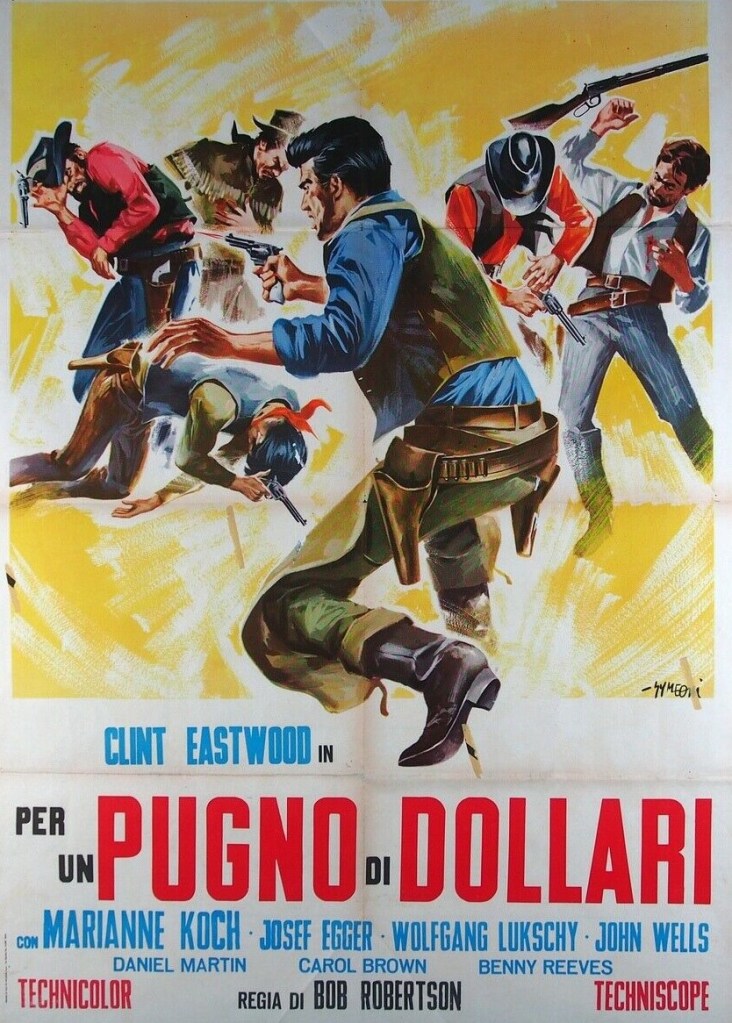
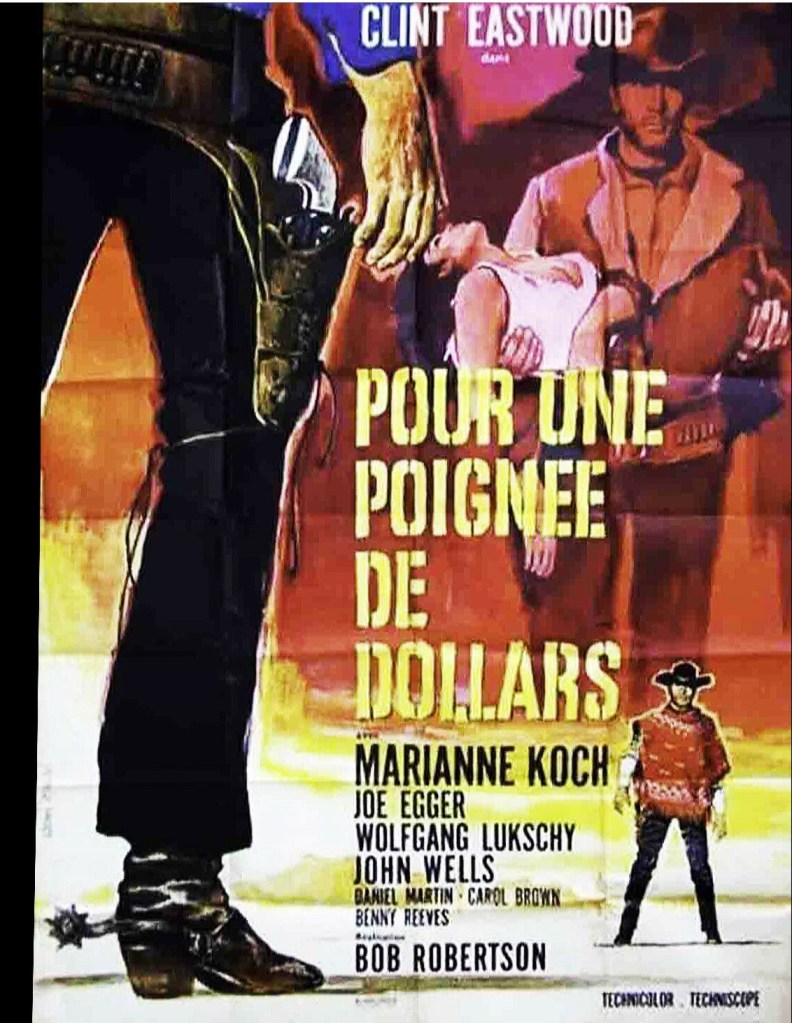
United Artists waited until Sergio Leone’s “Dollars” trilogy had opened the box office doors in America before pushing this out in 1969 (hence the odd dating). Lee Van Cleeef essays a more considered version of his Man in Black persona from For a few Dollars More (1965/1967). John Philip Law (Barbarella, 1969) would never work out, unlike George Peppard, say, that the intensity of his gaze and the blueness of his eyes distracted from his acting.

Put me in mind to check out some of the other spaghetti westerns directed by Guilio Petroni such as A Sky Full of Stars for a Roof (1968). Written by Luciano Vincenzoni (The Good, the Bad and the Ugly).

Well worth a look.

The List of Adrian Messenger (1963) ***

The gimmick of stars in disguise isn’t enough to spark this routine whodunit and the extended sequences of fox-hunting might deter the contemporary viewer but oddly enough something else of considerable interest is going on and enough to keep you hooked.

Given it’s an actor’s screen persona that tempts you to their movies, how are you going to respond when that’s gone AWOL? Actually, you get a more intriguing performance. Covered in slabs of make-up Kirk Douglas makes out like a latter-day Alec Guinness or Peter Sellers, essaying a number of quite different characters. So the jutting chin, the fierce eyes and the aggressive tone are all gone and in its place he shows he can act. His vicar is especially appealing.

But the same holds true of George C. Scott even though he’s not in disguise. Director John Huston, much as he did with his trio of star names in The Misfits (1961), gets Scott to tone down his screen idiosyncrasies. So the growl is tempered, the flaring eyebrows in cold storage for much of the time, and his jutting chin and aggression set to one side as he depicts a different character to his usual.

The Academy usually hands out Oscars to people who over-act or have some affliction to overcome, and they seem to wilfully ignore it when actors show how well they can act outside their comfort zone.

The story is the usual combination of clever deduction, red herrings and set pieces. Former spy Anthony Gethryn (George C. Scott) is hired by the titular character (John Merivale) to find out if a bunch of people on his list are still alive. Messenger himself is soon bumped off in a plane explosion but not before he leaves a garbled clue with sole survivor of the sabotage Raoul Le Borg (Jacques Roux). Gethryn soon discovers everyone on the list is dead. This may have something to do with the Second World War or it may be that the killer wants to cover up something now before potential scandal can ruin a promising future.

Meanwhile, the killer keeps bumping people off. And just to keep Gethryn from getting distracted by possible romance by Lady Bruttenholm (Dana Wynter) Le Borg pounces on her.

By this point the director was pursuing his dreams of becoming landed gentry with a stately home in Ireland and very keen on all the trimmings including fox-hunting which probably accounts for the length of time accorded the sport.

Kirk Douglas, who’s company produced the picture, thought – either to fire up public interest or to help along a fairly straightforward tale – he would ask a few of his movie star buddies to bury themselves in make-up and play bit parts. Whether audiences spent all their time when they should have been concentrating on Gethryn’s detection on carrying out their own sleuthing trying to detect which of the supporting characters might actually be Tony Curtis, Frank Sinatra, Robert Mitchum or Burt Lancaster is anybody’s guess. It does have to be pointed out that some of the make-up is unconvincing, some faces looking as though they’ve come out of a box.

Despite all this, I enjoyed seeing George C. Scott (Patton, 1970) and Kirk Douglas (Cast a Giant Shadow, 1966) playing decidedly against type and showing how easy it is to act if you’re not always having to adopt a screen persona.

John Huston looks as if he’s having a ball. Written by Anthony Veiller (Night of the Iguana, 1964) and Alec Coppel (Vertigo, 1958) from the book by Philip MacDonald.

A watchable curiosity.

The Longest Day (1962) *****

When critics applauded the inspired use of a reaction shot via Omar Sharif to convey the horror of a massacre on the Mocow streets in Doctor Zhivago (1965), they omitted to mention that the technique had been used to similar stunning effect – and twice – in The Longest Day. The first comes when the camera cuts to Red Buttons dangling from a parachute down a building witnessing a massacre in the square below. The second, oddly enough, in virtually the same locale, when John Wayne arrives and views the aftermath.

Emotion was generally not considered a requisite of this epic war picture about the D-Day landings. The general consensus these days is that at best it’s a docudrama or at worst a star-a-minute mess with a dozen storylines vying for supremacy. In fact, it’s neither, but a surefooted and even-handed depiction of a complex battle, concentrating as much on the backroom staff as the soldiers in the line of fire.

Except for German complacency, the Allied forces would have faced fiercer opposition. The German troops had no air cover except for two planes and the Panzers had been pulled back in reserve. High-ranking officers had high-tailed it out of German HQ to enjoy a night on the town. Yes, the Germans expected the invasion to come from Calais rather than Normandy, but once their mistake became obvious, they did little to counter the attack, spending too much time arguing with each other and being too frightened to wake Hitler from his beauty sleep to trigger the tanks and planes.

Producer Darryl F. Zanuck covered his back by enrolling 40 stars for his venture. While most had varying marquee appeal, he had drawn on leading actors and actresses from countries other than Britain and the USA. And there was clearly a calculated decision to make audiences wait for the two major stars, John Wayne and Robert Mitchum, to put in an appearance. It’s a good 15 minutes before we spot Wayne, that time spent setting up the event from British, French, German and American perspectives.

Unusually for major stars, Wayne and Mitchum are not averse to carrying exposition, something generally left to the supporting cast, Wayne in particular spelling out the pitfalls of his particular parachute drop situation. Incidentally, two of the best sequences took a good less time to show – as later explained in feature-length detail in A Bridge Too Far – the dangers inherent in parachuting into enemy territory and trying to capture and hold vital bridges.

The picture could easily have been titled A Gamble Too Far because Zanuck was betting the future of Twentieth Century Fox, facing a financial burnout, on its box office outcome.

While covering the planning for the landings in sweeping terms, the movie concentrates on three major actions – Omaha Beach and the scaling of the impenetrable Pointe du Hoc featuring the Americans headed up by Brig General Norman Cota (Robert Mitchum), a British commando raid led by Major John Howard (Richard Todd) on the Pegasus Bridge and the parachute drop led by Lt Col Benjamin Vandervoort (John Wayne).   

By today’s standards the bloodletting is non-existent but the brutality of combat hits hard. Flight Officer David Campbell (Richard Burton) heads up the victims, knowing he is going to die but trying to keep up his spirits. French peasant Janine (Irina Demick) distracts German soldiers with her beauty. Lord Lovat (Peter Lawford) goes into battle accompanied by bagpipes and beachmaster Capt Maud (Kenneth More) tries to keep troops moving on the beach.. Comic interludes are provided by Private Flanagan (Sean Connery) and his buddy and German Sgt Kaffekanne (Gert Frobe).

Many of the commanders that would feature in later World War Two pictures –  Lt Gene Omar Bradley (Patton, 1970) and Brig General James Gavin and General Sir Bernard Montgomery (A Bridge Too Far, 1977), played respectively by Arthur Hill, Robert Ryan, and Trevor Reid. German General Rommel had already had his shot at Hollywood fame through The Desert Fox (1951) and Desert Rats (1953) and was the American nemesis in Patton.

Given the amount of rubbernecking by the audience, it’s worth noting the number of actor in small parts who eventually made good including Sean Connery (Dr No had just appeared by the time The Longest Day opened in the U.K.), Christian Marquand (The Corrupt Ones/The Peking Medallion, 1967), George Segal (Bridge at Remagen, 1969), Tom Tryon (The Cardinal, 1964) and Robert Wagner (Banning, 1967).

You could do an entire review just listing who played who. But in spreading the field and covering French and German activities alike Zanuck brings a wider understanding of the proceedings.

Five directors were involved and unlike most anthology pictures where individual styles clash, here everyone follows the same playbook. Ken Annakin (Battle of the Bulge, 1965), Andrew Marton (Africa, Texas Style, 1967), Gerd Oswald (Agent for H.A.R.M, 1966), Bernhard Wicki (The Visit, 1964) and Darryl F. Zanuck all took a turn at the helm.

While author Cornelius Ryan (A Bridge Too Far) was credited with the screenplay he received help in the shape of Frenchman Romain Gary (Birds in Peru, 1968) , American novelist James Jones who wrote From Here to Eternity, and British screenwriters  David Seddon and Jack Pursall (The Blue Max, 1966). Remains an awesome experience, one I’d just love to see in 70mm

The Violent Enemy (1967) ****

Surprisingly even-handed and thoughtful with more twists than The Housemaid. Rising star Tom Bell makes a bid to fill the spot in the British movie hierarchy vacated by Michael Caine who had gone to greater things while Susan Hampshire is trying to escape the screen persona foisted upon her by Walt Disney in such innocuous fare as The Fighting Prince of Donegal (1967). Australian director Don Sharp was hoping to add some gravitas to a portfolio that included The Face of Fu Manchu (1965) and Our Man in Marrakesh (1966). To some extent, all three achieve their aims.

Irish terrorist Sean Rogan, learning he has been refused parole and has another seven years of a 15-year sentence to serve, breaks out of jail, assisted by Hannah (Susan Hampshire), scion of an IRA legend. Twist number one, back in Ireland, Sean tells his boss Colum O’More (Ed Begley) that he’s going to go straight. Ireland having no extradition treaty with the United Kingdom for political prisoners he’s safe. Twist number two, Colum threatens to dump him over the border to Northern Ireland where he could be arrested.

O’More wants Sean, an explosives specialist, to blow up an electronics plant that services British armament factories and in doing so restore pride in a fading political force. Sean agrees to plan the job but not carry it out, leaving it to underling Austin (Jon Laurimore). Sean also, surprisingly, has scruples, wanting to limit the charge so that it doesn’t affect people living in caravans below the factory. Meanwhile, Inspector Sullivan (Philip O’Flynn) turns up with a killer piece of information. He tells Hannah, who’s grown sweet on Sean, that the escapee was deliberately misled – his parole had been granted. Hannah refuses to pass this along, her loyalty to the cause greater than her feelings for Sean.

As the deadline approaches for the sabotage, it becomes apparent Austin has a different project in mind. Instead of blowing up the plant he’s going to use the blackout caused by the dynamite to rob the factory, forcing Sean to come along so he can be rendered unconscious and take the fall.

The final twist is that Sean foils the robbers.

Apart from the sabotage and the heist there’s a lot to savor here. Old hands are deserting the cause to enjoy prosperity. The idea of ruining local livelihoods by terminating the plant is anathema to some. Many are just tired of fighting a war that’s not been won. Others, like Sean, believe they have done their bit and are entitled to peace and quiet.

Die-hards like Colum are easily duped by the unscrupulous – one of the best scenes the shock on his face when he realizes he’s been took and he lacks the authority to stop what might be deemed organizational malpractice – while Austin takes advantage of the money-making opportunity that supposed fealty to the cause creates. Hannah, too, has to change her attitude. Sean’s spent enough time in prison to appreciate what he’s lost.

There’s little remorse but equally there’s little tub-thumping and the movie largely steers clear of the political issues and sentimentality. There’s nothing glamorous or romantic in this Ireland, no glorious scenery, just dreich wet streets, and the flag isn’t tied to the mast but  employed to package the loot. The heist is well done and there’s an unusual climax. Possibly the most imaginative section is the flight after the initial escape with Sean disguised as a chauffeur driving a Rolls-Royce. It’s probably a plus point that nobody attempts an Irish accent that they’d mess up anyway.

Possibly because of the subject matter, the movie flopped. Neither Tom Bell nor Susan Hampshire ascended to the higher echelons though Don Sharp returned to Ireland for Hennessey (1975) and went on to direct Bear Island (1978). Written by Edmund Ward (Goodbye Gemini, 1970) from an early novel by Jack Higgins (The Eagle Has Landed, 1976 ) who both revisited the Troubles for Mike Hodges A Prayer for the Dying (1987) with Mickey Rourke.

In between the action beats plenty to mull over.

Thrash (2026) ** or **** (depending) – Seen on Netflix

Those of you who thought Netflix would be better served by abandoning its overblown self-indulgent Oscar bait in favor of B-pictures have had their prayers answered. Both hilariously bad and hilariously good with plenty gore but not a scare in sight. Questions will be asked about how many CGI sharks were harmed in the making.

While there are plenty of opportunities to rack up the tension with a bundle of sequences calling out for the Steven Spielberg treatment, writer-director Tommy Wirkola doesn’t take up a single one. That’s not to say there aren’t moments of greatness if not pure genius. When teenager Dee (Alyla Browne) is called upon to act as midwife for heavily pregnant unnamed New Yorker (Phoebe Dynovor), the poor lass is instructed to look “down there” and work out by how many inches the older woman is dilated. Plus you can’t get more woke than the pregnant lady achieving a genuine water birth, although, as you can imagine, the bloody aftermath attracts a bunch of sharks.

Did I forget to mention the sharks racing ashore in the wake of a storm surge, homing in on  a meat wagon that has broken in two and spilled its cargo of blood. I suppose the newborn child is to make up for all the parentless kids. I counted four – Dee and three foster kids. While Dee just takes it out on the sharks, the fostered trio take revenge on their greedy foster dad by kicking him into the water as shark food.

Wirkola does adopt the Spielberg playbook to destroy some sharks through an explosion and kill another with a harpoon gun and employs the Jurassic World technique of one predator being gobbled up by an even bigger predator. And I guess shark hunter Dr Edwards (Djimon Hounsou) can easily top Robert Shaw’s U.S.S. Indianapolis speech – he became obsessed with sharks once he saw the fear they instilled in a hippo. Yep, you heard that right. Did I mention that the good doctor is on the trail of Nellie the pregnant Great White Shark. “Sharks don’t eat kids,” claims the bad dad.

None of the grown-ups, not even our pregnant New Yorker, is worth a button as adults. She’s foolish enough to get herself trapped in a car by driving into a fallen-down tree when told to go the other way. Then she thinks that a pregnant woman wins out every time over a teenager scared witless. It’s the teenager that in the middle of the flood has to slide down a car roof  and teeter along the top of a fence to rescue the New Yorker trapped in flood waters in her car by a tree branch. It’s quite a hairy moment for the teenager and you wonder just how the heck is the heavily pregnant woman going to get to safety what with the water six feet deep and the marauding sharks and all that teetering and climbing. Hey-ho, she gets a free pass. One minute she’s in the car, the next she’s climbing through a window.

And she’s as entitled as all-get-out. It’s Dee who has to clamber onto the storm-soaked roof and improvise the word “help” out of curtains. And it’s lucky that Dee, as pointed out in a flashback, is such an ace shot. Judging from the one time she took aim at her dad with a toy gun that was more than enough of a demonstration as to how lethal she would be pinpointing a shark from a range of 20 metres.

But I can’t help thinking what Spielberg would have made of the scene when thanks to the force of the water the  New Yorker’s bed starts rising to the ceiling or when the house collapses beneath her. My guess is both sequences would have last more than a minute.

Alyla Browne (Furiosa: A Mad Max Saga, 2024) steals the show, not least because she has the wits to look terrified rather than coolly heroic. Phoebe Dynovor (Anniversary, 2025) has a pretty thankless task trying to win sympathy from such an unsympathetic character. It looked to me that the ending hinted at a sequel, so you have been warned.

Tommy Wirkola (Violent Night, 2022) would have done better if he’d either taken it more seriously or gone down the opposite route.  

I’m probably not the only one either who thinks Netflix could have been more honest with the title and omitted the first letter “h”.

Either a cult in the making or pure rubbish.

Eye of the Cat (1969) ***

If I hadn’t watched The Woman Who Wouldn’t Die (1965) I wouldn’t have been so well up on the intrigue of the modern film noir so I guessed where this was going pretty quickly but that did not detract from the enjoyment of watching it reach its stylish denouement. A perfect antidote to the cute cats as personified by Disney in The Three Lives of Thomasina (1963) and That Darn Cat! (1965). 

Realizing that wealthy client Danny (Eleanor Parker), suffering from emphysema, might only need a nudge or two to hasten her death, hairdresser Kassia (Gayle Hunnicutt) enrolls the sick woman’s wayward nephew Wylie (Michael Sarrazin) in a plot to kill her off and inherit her money. There are two obstacles, possibly three.  Danny has a houseful of cats, close to a hundred at the last count, and Wylie, after a childhood feline encounter, is terrified of the four-legged creatures. Upset at his previous behavior, Wylie has been cut out of the old lady’s will and needs reinstated pronto. The last element is that Wylie has a younger brother, Luke (Tim Henry) who acts as Danny’s gofer, who may take exception to the scheme.

Needless to say, the otherwise imperious Danny is so delighted at the return of the prodigal nephew that she demands her lawyer Bendetto (Linden Chiles) amend the will immediately. She sleeps in an oxygen tent and simply switching off her supply will be enough. But, of course, it would be foolhardy to murder her before the will is signed, sealed and delivered. Unfortunately, Wylie is a high-spirited selfish young man and comes close to offing her unintentionally.

While Wylie takes up residence in Danny’s vast house, Kassia is kept in the cellar and there is a suspicion that he will blackmail her into having sex with him since she sees their relationship as strictly business. Wylie has a whole string of abandoned girlfriends and seems to have capacity for preying on the most vulnerable if “Poor Dear” (Jennifer Leak), the nickname he assigns one is anything to go by.

Meanwhile, Wylie’s childhood fears return. He doesn’t need to see a cat, or even smell it, just sensing its presence is enough. His terrified reaction makes him want to abandon the scheme, despite the amount he might inherit. Desperate to prevent him from leaving, Danny agrees to get rid of her army of cats. Unfortunately, Luke is not as assiduous as he ought to be and a couple escape the round-up.

As the deadline for her demise nears, the tension is ratched up, seeds of suspicion sown among the conspirators, complications with the will and of course the cats hidden from Wylie’s view – but not ours. A fabulous scene with a runaway wheelchair nearly puts paid to the entire endeavor.

The under-rated Michael Sarrazin (In Search of Gregory, 1969), given a more complex character than before, switches through the gears of terror, charm and predation. Gayle Hunnicutt  (P.J./New Face in Hell, 1968) is a less obvious femme fatale, relying far more on brain than obvious physical attributes. And what a delight to see 1950s box office queen Eleanor Parker (Warning Shot, 1967) handling a much larger role than was normal at this point in her career. Tim Henry made his movie debut. You might also spot Laurence Naismith (Jason and the Argonauts, 1963) and one of Judy Garland’s husbands Mark Herron (Girl in Gold Boots, 1968).

From the atmospheric credit sequence featuring silhouettes of cats through a rash of twists and turns director David Lowell Rich (A Lovely Way to Die, 1968) guides this unusual thriller with considerable expertise, knowing just when to add another layer to the suspense, and drawing excellent performances from the two principals. The original screenplay is by a master of the macabre Joseph Stefano of Psycho (1960) fame.

This chiller will keep you guessing.

The Spy with My Face (1965) ****

Far more enjoyable than I had expected and definitely benefitting from being seen on a small screen – I suspect the effects would show up the worse for wear on the big screen. Certainly, a decent enough plot and Napoleon Solo (Robert Vaughn) as the main Man from U.N.C.L.E. dominating proceedings.  Despite being an expanded version of an episode, The Double Affair from the television series, it doesn’t betray its origins. Female master spies were thin on the ground until Thunderball (1965) and Deadlier than the Male (1967) and here Serena (Senta Berger) masterminding a T.H.R.U.S.H operation to steal a nuclear weapon, steals a march on both. The action is counterpointed by some nice humor.  

While Solo and crew are busy attacking an Australian base of arch-nemesis T.H.R.U.S.H.,  Serena is putting the final plans together to infiltrate U.N.C.L.E. by using a doppelganger of Solo, cosmetic surgery creating an exact double. Solo’s sidekick Ilya Kuryakin (David MacCallum), portrayed as a cold fish – “I’ve got my computer to keep me warm” – is attacked leaving HQ by gas-spraying robots.  

Women here are a good bit more realistic than in Bond. Let down by Solo, his girlfriend Sandy (Sharon Farrell), an airline hostess, proceeds to get drunk. When they go out to dinner, a bandaged man (the double) is at the next booth and when Solo is called to the telephone Serena is there on his return, prompting the jealous Sandy to dump her dinner all over him. In best secret agent style, of course, Solo reckons he can have his cake an eat it, hoping to dupe Serena at the same time as seducing her. However, he is suspicious of her motives – “whenever I go to strange places with strange women I get hit over the head by strange men.”

In Serena’s apartment, suspicion continues, Solo takes his gun into the shower. However, when he answers the door, it’s to his double, and Solo is gassed. Sly sexual elements are brought into play – the double isn’t quite correct, failing the kiss test. While Solo is transported to the Alps where T.H.R.U.S.H plans to hijack a secret nuclear device, the double enters U.N.C.L.E. HQ where he will receive a new password relating to the weapon.

Meanwhile, it transpires the double’s disguise is convincing – the still jealous Sandy pours a pot of coffee over him and later kicks him. And not foolproof enough – nonetheless he wears the wrong aftershave. The real Solo is intrepid enough, finding a clever method of delaying a countdown, and a good bit more alert when captured than when not.

The set pieces are well-done, considerable tension built up at various points, the assault on the T.H.R.U.S.H. premises, while lower-grade than James Bond, considerably more realistic with Solo in Special Forces-type camouflage and hiding in the trunk. The climactic fist fight between the rival Solos is convincing and there is an excellent motorcycle chase. Fortunately, the movie steers clear of gadgets and gizmos, presumably for budgetary reasons, and the only let down is a vault which looks as if it is constructed of bits and pieces of leftovers.

I was particularly fond of a quip by Kitteridge (Donald Harron), U.N.C.L.E’s Australian associate. In response to a query from the big boss, Alexander Waverly (Leo G. Carroll), about whether his beard was real, Kitteridge answers “No, sir, it’s fake, I’ve got the real one in my pocket.”

The movie is surprisingly adept at treading a fine line between serious action and playfulness. The notion that the entire conspiracy can be undone by female jealousy or the wrong scent adds an interesting layer to the proceedings. And even the computer-loving Kuryakin finds time for romantic distraction. Serena is something of a secret weapon herself, far from an obvious espionage villainess, and keeps both Solo and the audience in the dark about her real intentions.

Director John Newland, more at home in television, steps up to the plate with a brisk tale that still has time for surprising subtlety. Robert Vaughn (The Venetian Affair, 1966) strides through the concoction effortlessly. The ever-alluring Senta Berger (Bang! Bang! You’re Dead, 1966) creates an intriguing character. Demands of the plot mean that David MacCallum (Sol Madrid, 1968) is somewhat underused. Sharon Farrell (A Lovely Way to Die, 1968) sparkles in a supporting role. Look out for Bardot lookalike Jennifer Billingsley (The Young Lovers, 1964), Harold Gould (The Sting, 1973) and Michele Carey (El Dorado, 1967). Joseph Calvelli (Death of a Gunfighter, 1969) and Clyde Ware (No Drums, No Bugles, 1972) devised the screenplay.

You can see why MGM went back to the U.N.C.L.E. well so often to plunder movies for foreig release.

Discover WordPress

A daily selection of the best content published on WordPress, collected for you by humans who love to read.

The Atavist Magazine

by Brian Hannan

WordPress.com News

The latest news on WordPress.com and the WordPress community.