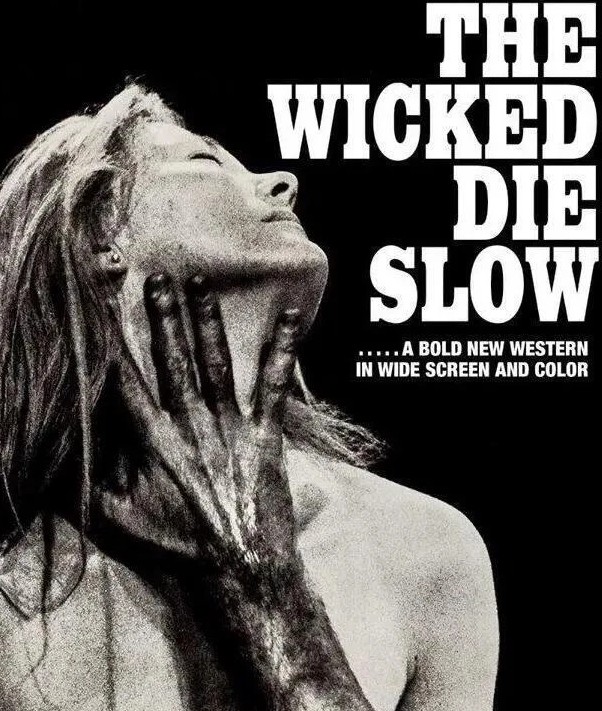
Companion piece to Hot Spur. Not excused fitting into same one-star sleaze western category as Hot Spur (1969) even with some elements that appear at odds with the tale, such as playing around with the time signatures. The best bit is the credits, or as they’re dubbed here the “visual effects,” a series of paintings that send a message of a woman clawing her face. Quite why the movie involves so many extreme close-ups and a heck of lot of birds tweeting in the background.
There’s an outrageously clever sequence involving a young woman brushing down her horse and an approaching rider. The way the man sneaks around hidden by trees and foliage makes you think he’s up to no good. The woman certainly thinks so, she whips out a shotgun. Then the fellow produces an apple. So you change your mind. He’s a good guy. He’s going to feed the horse. Except he tosses the apple into bushes some distance away and she shoots at it. He does the same with another apple. She gets off a shot at that, too.
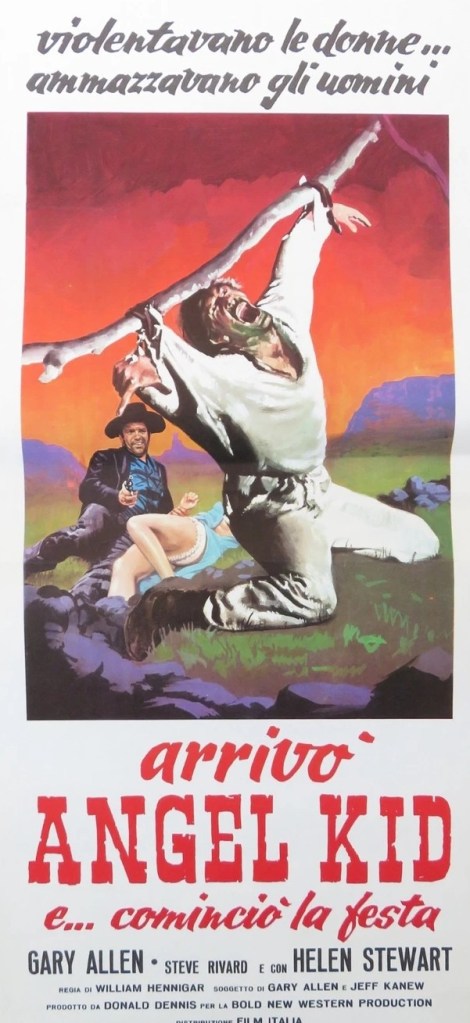
Then he steps out of the trees as most certainly a bad guy. She’s not reloaded her shotgun. She’s out of bullets. As he points out her predicament. While he’s a man with a pistol. Except he means her no harm. Which is just as well because she’s extremely vulnerable – she’s already been raped by her father.
It’s only now we actually get down to some narrative – the visitor, name of Steve (Bart Lenoir) is hunting for his brother Luke aka “The Kid” (Gary Allen) with whom this girl temporarily hooked up with.
Then we’ve got a preacher man, addicted to snuff, who saunters into a town and starts giving it hellfire and brimstone on the back of a wagon. He’s actually a bounty hunter and when he catches up with his prey teaches them – as in repeat after me – how to pray before he puts a bullet through their head.
But after this unusual start it’s quickly down to the lowest common denominator – rapes, nudity, violence, torture – the same elements as dominated Hot Spur. Sexploitation, or as it was known back in the day, apparently, a “roughie.”
So now we’re also ducking around with time. Four Native Americans have raped gunfighter The Kid’s girlfriend (Susannah Campbell) and he wants revenge. He’s not so vengeful that he doesn’t have time to stop off for a bit of consensual sex with a complaint women, cue naked breasts, while he has to avoid, for reasons unknown, some kind of lynch party. Naturally, when he’s not naked, he’s given to wearing a poncho.
This isn’t some torture yarn, as you might expect from the title (that’s a reference to the Biblical Hell) nor, as I expected, a spaghetti western, since Amazon Prime directed me to this as a reward for watching Django (1966). Nobody’s planning on giving the bad guys a lingering death. Just death.
And, given the opening section, that might well have provided sufficient ingredients for a decent revenge western and we’ve had plenty of those where extraneous sexuality has not been called for. But that’s not the case here. The story is just an excuse for rampant nudity and brutality directed at women.
In due course, The Kid teams up with Mexican bandit Armadillo (Jeff Kanew).
Then it really gets nasty in the Hot Spur vein.
There’s another curiosity here. The film is attributed to Cannon, the production outfit most association with Israeli double act Menahem Golan and Yoram Globus, but this was made long before the pair got into the Death Wish franchise business or ponying up $15 million to Sylvester Stallone for Over the Top (1987). And in fact, Golan-Globus had nothing to do with The Wicked Die Slow. They didn’t buy Cannon until much later. This was made by Cannon when it was owned by Christopher Dewey and Dennis Friedland while they were in the exploitation business.
Directed by William K. Henniger (See How They Come, 1968) and it’s generally assumed someone else did the first 30 minutes or so. Written by stars Gary Allen and Jeff Kanew.
Nobody comes out of this with any kudos except for Swede artist Maria Nordenson who created the credit sequence and whoever directed the first section.
Hot Spur fans should head for Amazon Prime.