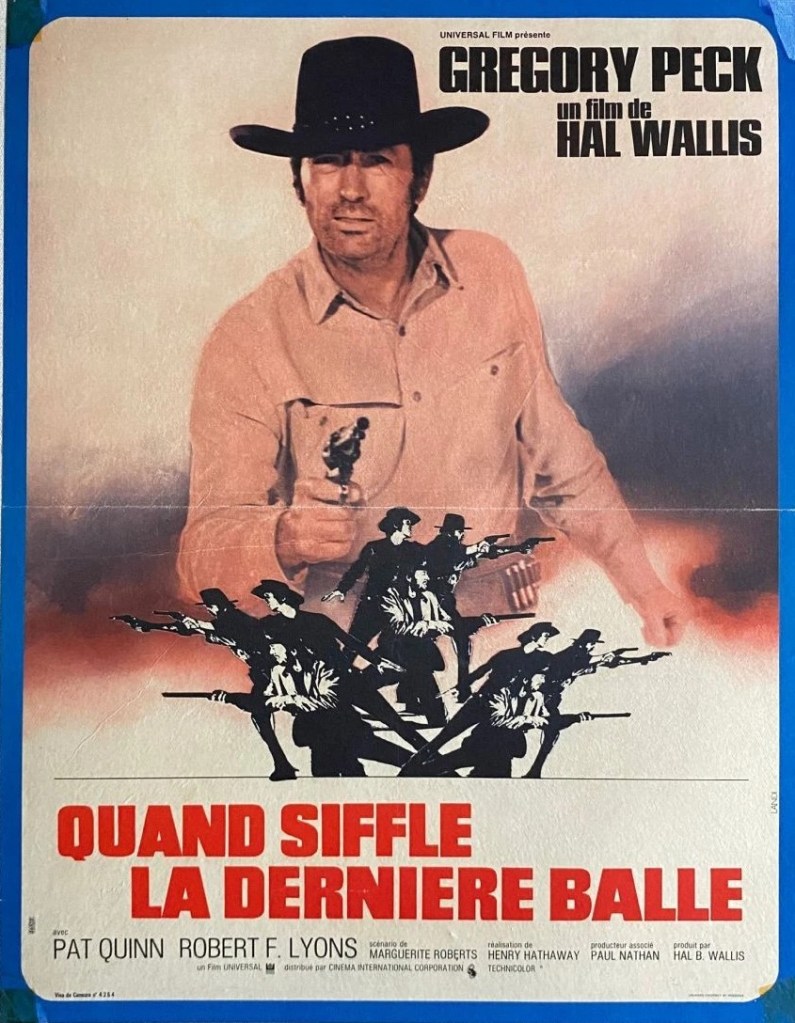
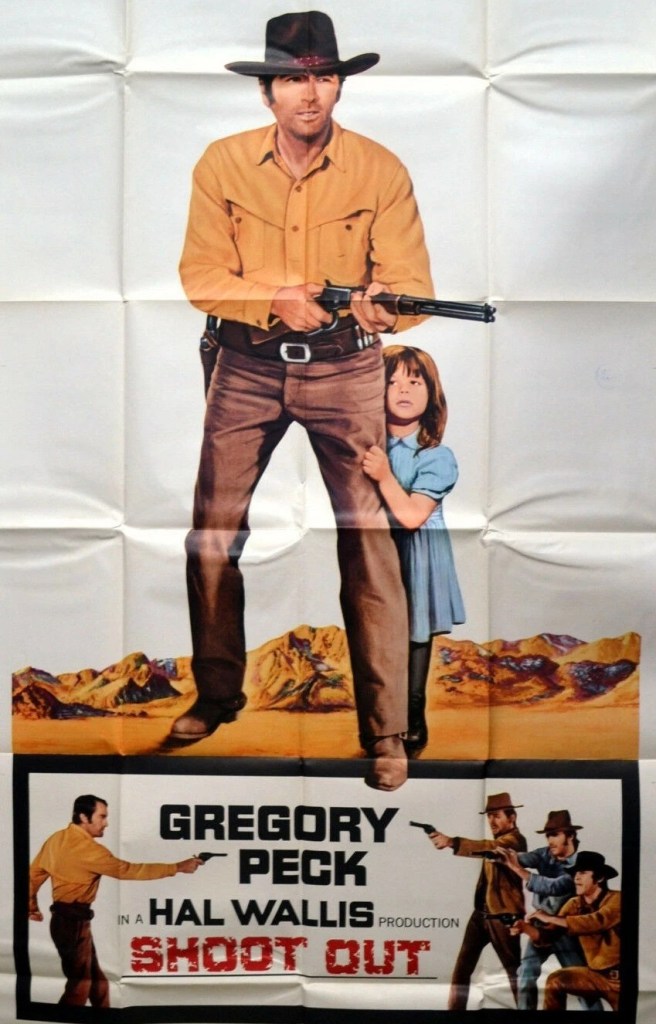
The team behind True Grit – producer Hal Wallis, director Henry Hathaway and screenwriter Marguerite Roberts – make the mistake of thinking that lightning will strike twice in a tale of an older fella, in this case a bank robber rather than a lawman, saddled with a younger woman, in this case a child rather than a sassy teenager. It’s not the only mistake. The title is a misnomer, for a start, and there’s a rather dumb use of shooting the apple off a child’s head a la the “Swizzer” William Tell. In reality, it’s a revenge tale, and a violent one at that, mixed in with a sentimentality that’s at odds with the story.
Like James Stewart and John Wayne, Gregory Peck was in something of a default position in terms of the movies he was now making. This trio, in particular, now specialized almost exclusively in the western. From 1966 of the nine movies made by Wayne seven had been westerns. For Stewart, over the same period, it had been exclusively westerns – five of them. Now Peck was beginning to go down the same route – this would be his third western in three years.
The reason wasn’t hard to find. Of all the genres churned out by Hollywood, westerns were the most sellable abroad. So, at the global box office at least, this trio still held sway, justifying their hefty fees.
Clay Lomax (Gregory Peck), just out of prison, seeks vengeance on ex-partner Sam Foley (James Gregory) who shot him in the back after a robbery, leaving him to carry the can, and made off with the loot, which he has used to build a ranching empire. Learning Lomax is out, Foley puts a sadistic trio – Pepe (Pepe Serna), Skeeter (John Chandler) and Bobby Jay Jones (Robert F. Lyons) – on his trail, with orders not to kill him, which is pure torture for the bloodthirsty thugs, but just to track him and report on his whereabouts. But thuggery will out, and instead the thugs kill Trooper (Jeff Corey) in heinous fashion.
Quite why the narrative dictates that the gunslingers are not to kill Lomax is anyone’s guess because it makes little sense, unless Foley is aware how unfair a fight it will be and that the veteran outlaw will be more than a match for his crew. And that’s how it turns out, Clay knocks them six ways to Sunday and that’s just for disturbing his peace in a hotel.
The narrative takes another odd twist with the arrival of the seven-year-old Becky (Dawn Lyn) who is put in Lomax’s charge. When he fails to offload her, he takes her with him, only stopping off to bushwhack the thugs and steal their weapons.
Quite why Lomax doesn’t just shoot the gunslingers and be done with it is also anyone’s guess but that leaves the trio able to jump Lomax when he’s taken refuge with the kind of widow drifters tend to come across in westerns. It gets quite unnecessarily confusing at this point but given Lomax is close to finding Foley something needs to create a delay.
And that’s done with an overlong unduly sadistic session by Bobby Jay as he attempts to emulate the Swizzer by shooting cups off Becky’s head. But the upshot of all this is Bobby Jay ends up killing his buddies and making off with the kid. Naturally, Lomax is soon in pursuit, but the promised “shoot out” doesn’t materialize, at least not in the traditional sense of gunmen facing each other in the main street.
What makes the movie work is what they should have concentrated on in the first place, Lomax taking a parental interest in the girl. That neither wants the other makes for decent enough tension and there are enough moments to flesh out their relationship, with Lomax unwilling to accept that he might well actually be her father.
Of course, a jailbird as a father doesn’t sit right with the filmmakers, even though Lomax is clearly capable of keeping the little one washed and fed and comfortable at night. So that’s where your lonely widow Juliana (Patricia Quinn) comes in. Interestingly, that’s the only scene that’s completely devoid of sentiment. She’s had long enough – five years – of loneliness and consoling herself with whisky at night to be happy to take the first half-decent fella who comes her way.
The action, when Lomax is sorting things out fist first, is acceptable enough, but whatever movie Hathaway and Co thought they were making just doesn’t come off. Certainly, it doesn’t come close to True Grit.
Not cut out for the musicals, comedies, historical adventures (let’s not count The Greatest Story Ever Told, 1965), thrillers, dramas, and spy pictures that dominated that 1960s the western was John Wayne’s default. After his initial battle with lung cancer, he enjoyed an extended period of success in Henry Hathaway’s The Sons of Katie Elder (1965), Howard Hawks’ El Dorado (1967) and Burt Kennedy’s The War Wagon (1967) before diversifying in Vietnam war picture The Green Berets (1968), which he directed and was also a hit, and Andrew V. McLaglen oil drama Hellfighters which did, however, fall short of his high box office standards. So when any big western picture was mooted, it was either Wayne or James Stewart to whom producers first came calling. But when the actor particularly wanted a part, he usually got it.
Charles Portis was a journalist with one modern novel, Norwood published in 1966, to his name when he wrote True Grit, published in 1968, which, unusually for a western, spent 22 weeks in the New York Times bestseller list. The main attraction for a reader was the equally unusual first-person narrator, Mattie Ross, towards the end of her life telling the tale of how as a 14-year-old in Arkansas she sought bloody revenge for the death of her father. The narrative voice was highly individual with colorful phrases, punchy dialogue, and a taut storyline.
Producer Hal Wallis snapped it up for $300,000, beating out Wayne’s Batjac operation. Wallis had been making his own pictures for over two decades, having originally overseen films as varied as swashbuckler Captain Blood (1935) and Casablanca (1942). He also had a western pedigree, having set up John Sturges’ Gunfight at the O.K. Corral (1957), The Sons of Katie Elder and Five Card Stud (1968) with Dean Martin and Robert Mitchum.
The movie went into speedy production, barely a year from the novel’s publication to the world premiere. From the start Wallis had Wayne in mind for Rooster Cogburn, with Robert Mitchum as back-up. Mia Farrow turned down the role of Mattie Ross when she found out the director was to be Henry Hathaway. Genevieve Bujold turned it down because she didn’t want to work with Wayne. Wayne favored Katharine Ross (The Hellfighters, 1968) or Michele Carey (El Dorado) or his daughter Aissa whom Hathaway ruled out. Sally Field from the television series The Flying Nun was also considered, but the part finally went to 21-year-old Kim Darby.
She had been in the movies since 1963 (an uncredited role in Bye, Bye, Birdie) and, excepting small roles in Bus Riley’s Back in Town (1965) starring Ann-Margret, fourth-billing in both the low-budget The Restless Ones (1965) and Arthur Penn television movie Flesh and Blood (1968), confined to guest roles in routine television series such as The Fugitive, Star Trek, Gunsmoke and Bonanza.
Elvis Presley was touted for the role of Le Boeuf but manager Col. Parker insisted his client receive top billing and the role went to another popular singer Glen Campbell, who had made his movie debut in The Cool Ones (1967). Robert Duvall, filling the boots of Lucky Ned Pepper, was also a refugee from television (The Outer Limits, The Fugitive, Combat) although he had delivered a memorable performance as Boo Radley in To Kill a Mockingbird (1962) and had risen to third-billing for Francis Ford Coppola’s The Rain People (1969).
Henry Hathaway, a former child actor, had directed 60 movies beginning in 1932. But he had learned about direction at the feet of Josef von Sternberg and Victor Fleming, both hard taskmasters, and only made the move into megging at the third attempt. First of all, he had spent nine months touring India with the idea of making a film in the style of silent documentaries Grass: A Nation’s Battle for Life (1925) or Chang: A Drama of the Wilderness (1927). He managed to attract the interest of Irving G. Thalberg but the producer died before funding materialized. Next, Paramount planned to hire him when the studio planned an early 1930s investment in color but got cold feet and the idea was dropped. Finally, when Paramount decided it was going to make its own westerns, rather than buying them in, he was hired to direct Heritage of the Desert (1932) starring Randolph Scott but after six more in that genre – being paid $100 a week for the first two and then $65 a week for the next two after the Depression bit – he hit pay dirt with adventure The Lives of a Bengal Lancer (1935) with Gary Cooper and comedy Go WestYoung Man (1936) with Mae West.
When Paramount finally embraced three-color Technicolor they chose Hathaway to direct adventure The Trail of the Lonesome Pine (1936) starring Sylvia Sidney and Fred MacMurray. “It cannot be merely accidental that he was selected,” commented historian Kingley Canham, arguing that Hathaway had “more than just an aptitude for freshening familiar material through technical resourcefulness.”
And like John Ford he was economical with the camera. “I only shoot what can be used so the producer has no choice…I always cut in the camera, the cutter just has to put the ends together,” he said. Determined to achieve verisimilitude, instead of using studio hand-made locusts for biopic Brigham Young (1940), he travelled to Nevada where had been a big invasion of the insects. Except for this film and The Shepherd of the Hills (1941), starring Wayne, he steered clear of westerns, preferring action and drama. However, he was instrumental in helping Wayne extend his acting style. For Shepherd of the Hills, Hathaway “added new subtleties to the already characteristic western hero persona – the roiling gait and economy of dialog were still very much in evidence but his acting was more mature, more sensitive, and more assured.”
He was called upon to demonstrate further technical mastery in the first of Twentieth Century Fox’s semi-documentary dramas The House on 92nd St (1945) followed by film noir Dark Corner (1946) and Kiss of Death (1947). He made his first western in a decade with Rawhide (1951) toplining Tyrone Power and Susan Hayward and only two other westerns in the 1950s – Garden of Evil (1954), teaming Cooper and Hayward, and Hell to Texas (1958) with Audie Murphy, the twist in this one being the hero rather than the villain subjected to a manhunt. Another technical innovation came with The Desert Fox (1951), where he “did the whole raid before the titles,” the first time any action had been shown prior to the rolling of the opening credits.
He was so impressed with the acting skills of Marilyn Monroe in Niagara (1953) that he purchased Somerset Maugham’s Of Human Bondage intending to team her with Montgomery Clift, but nothing came of the concept. He worked with Wayne again in Legend of the Lost (1957) co-starring Sophia Loren.
But, like Wayne, he returned in triumph to the western in the 1960s, all bar two of his movies in this decade in this genre, the first four of the decade starring Wayne – North to Alaska (1960), How the West Was Won (1962), Circus World (1964) and The Sons of Katie Elder. He had finished up on Five Card Stud when Hal Wallis invited him to direct True Grit. He had only received one Oscar nomination, four decades previously, for The Lives of a Bengal Lancer, and no avant garde French film critic was reassessing his work, but he was known to bring movies in on time, and had his own distinct style if anyone could be bothered looking for it.
Certain themes did reappear, revenge for one, which was central to The Trail of the Lonesome Pine, Kiss of Death, historical adventure The Black Rose (1950), Prince Valiant (1954) with James Mason, The Sons of Katie Elder and Nevada Smith (1966) starring Steve McQueen. He also focused on disruption within the family, and situations where an older man aids an impetuous youngster, both instrumental to True Grit. “He is the only director I know,” observed Kingsley Canham, “to have specialized in films about backwoods and mountains.”
Screenwriter Marguerite Roberts was also old-school, born in 1905, with over 30 screen credits. She sold her first script while working as a secretary at Fox, had her first screen credit in 1933 for Sailor’s Luck. By 1939 she was earning $2,500 a week at MGM and turned out Honky Tonk (1941) with Clark Gable and Lana Turner, Sea of Grass (1946) with Katharine Hepburn and Spencer Tracy, Gunga Din remake Soldiers Three (1951) and big-budget historical adventure Ivanhoe (1951) with Robert Taylor and Elizabeth Taylor.
Like Abraham Polonsky she fell out of favor with Hollywood for her left-wing sympathies and was blacklisted for nearly a decade until Daniel Petrie’s The Main Attraction (1962) with Pat Boone and Nancy Kwan, Guy Green’s Diamond Head (1962) with Charlton Heston and Rampage (1963) with Robert Mitchum. She, too, had been working for Hal Wallis on Five Card Stud before receiving the commission to adapt the Portis book.
Roberts was familiar with the Old West, since her father had been a lawman in Colorado. Screenwriter Wendell Mayes, who wrote From Hell to Texas, commented that “Henry Hathaway is very easy for a writer to work with.” “When a screenplay is finished,” said Hathaway, “I go through it and work on it. I worked on True Grit with Marguerite Roberts because there was a great deal of repetition in the book and I eliminated a lot of things.” John Wayne felt Hathaway “never got the creative credit I think is due him…He was sort of a story doctor…a fine, instinctive, creator.”
Her first problem was how to translate the book’s distinctive first-person style onto the screen without the entire movie sounding too archaic and although many speeches were lifted verbatim from the book it was Roberts who established Mattie Ross as an authority figure from the outset by introducer the teenager as her father’s “bookkeeper” and inventing the argument about the type of horses he intended to buy.
The result is an unusual composite of tight storyline, exuberant characterization and wonderful dialog. The movie was filmed mainly in Colorado – Ouray, Owl Creek Pass, Ridgway, Canon City, Montrose, Bishop, and Gunnison – as well as Durango in Mexico and Inyo National Park in California where Hot Creek was used for the outlaw’s cabin and also Sherwin Summit.
The critics, who had slaughtered The Green Berets the previous year, and been largely indifferent to many of his previous westerns during the 1960s, virtually gave him a standing ovation. Variety called it a “top adventure drama…Wayne towers over everything in the film – the actors, script and even the magnificent Colorado mountains.”
Vincent Canby of the New York Times called it “a triumph…one of the major movies of the year.” The New York Daily News claimed it was “John Wayne’s finest moment.” The New York Post came closest to defining its appeal: “Few westerns will come along this or any other year that can be as fully enjoyed by as many people of varying ages and sex.” Vernon Scott of United Press was not alone in predicting “Wayne should win the Oscar.”
Joyce Haber of the Los Angeles Times said, “come Oscar time Wayne will be a leading contender.” Norma Lee Browning of the Chicago Tribune informed readers that “there’s already talk that he may, at long last, get an Oscar nomination.” Charles McHarry of the New York Daily News held the same view. Time opined “a flawless portrait of a flawed man.” International Motion Picture Exhibitor found it “the perfect vehicle for Henry Hathaway’s directorial style. He approached the simple western story in the most straightforward manner…garnished it with a delightful humor that springs right out of the vagaries of the homespun characters…and giving it a rhythm that carries the viewer along despite its lengthy running time.”
Allen Eyles in Focus on Film summed up the film’s appeal: “That True Grit could end up being the best western of the year is a tribute to old Hollywood – to a producer, director, star, cameraman and others who’ve been at the top of the film business for more than three decades. Their solid, unpretentious professionalism enables them to meet the challenge of filming a first-rate novel with pleasing assurance and directness…it is far superior to…the poorly-shaped but occasionally striking The Wild Bunch from Peckinpah…(it) is not innovatory in style but the details are communicated with a freshness that is appealing.”
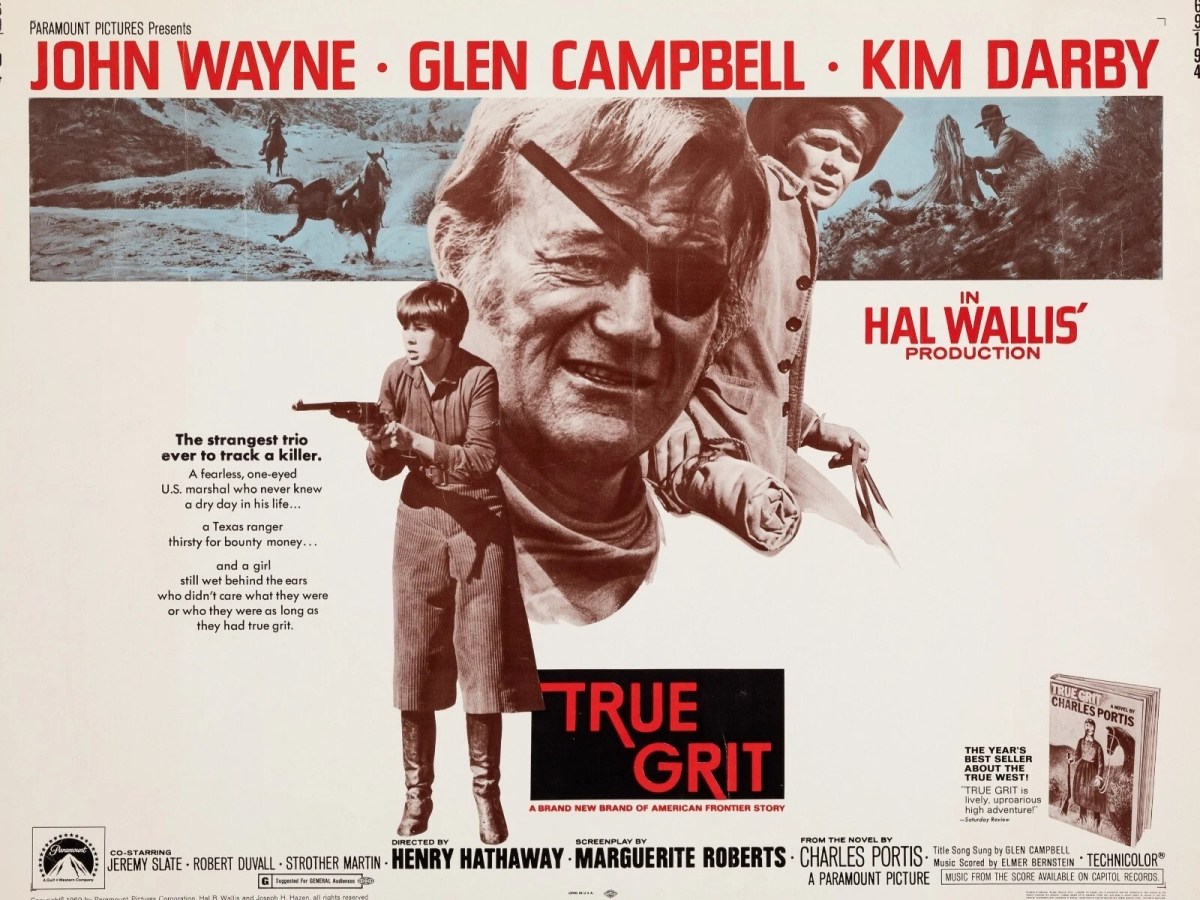
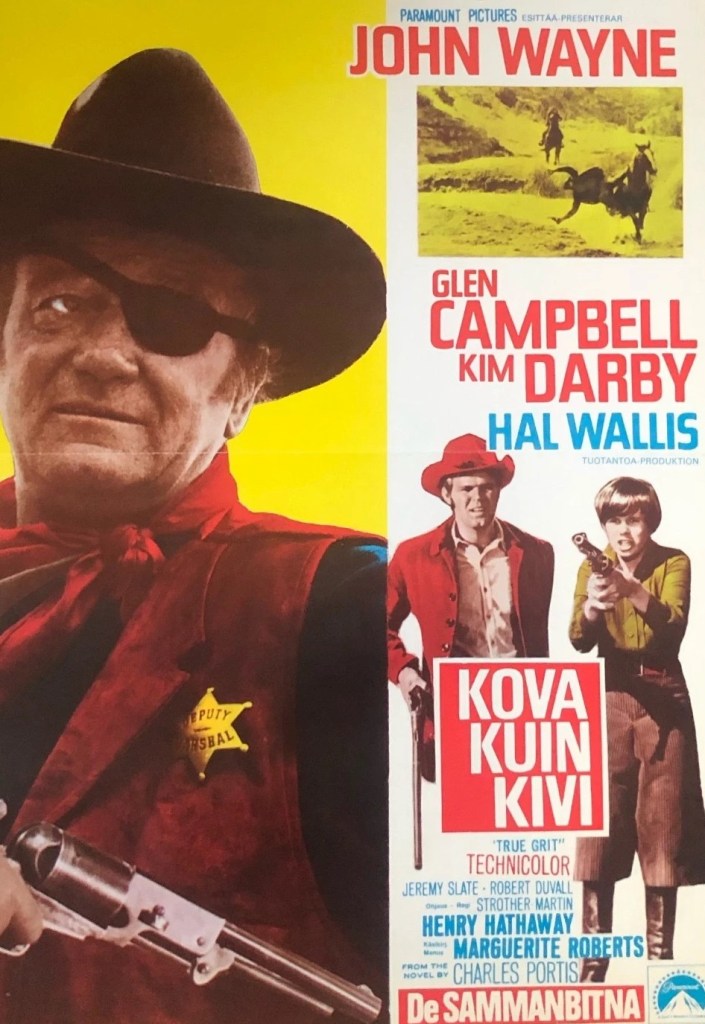
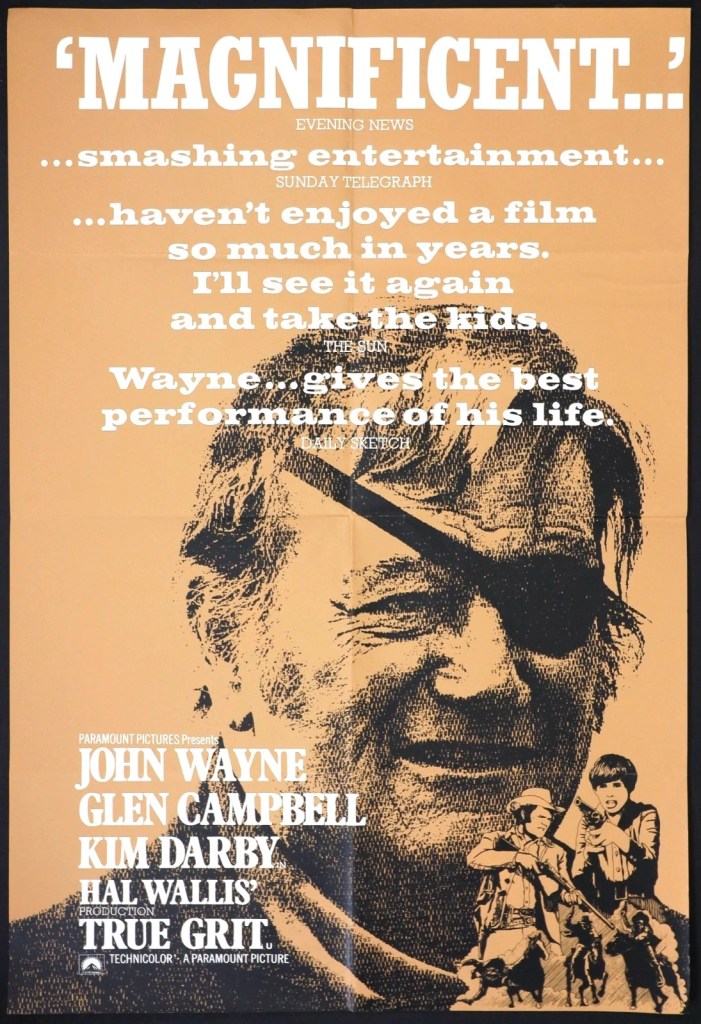
Unusually, for a film of the period, the movie repeated a single image in all of its advertising, Wayne’s face dominating the composition, with below him Mattie Ross standing gun in hand and Glen Campbell behind him. That Campbell sang the title song over the credits led to the release of a record, and there was a New American Library book tie-in. Ancillary promotional items included a t-shirt embellished with the words “This Man Has True Grit,” and buttons announcing “I Have True Grit” and, alternatively, “Give Me a Man with True Grit.” Stetson created a special hat called “The Duke,” with a special one costing $1,500 to be presented to Johnny Carson on his show, with an advertising campaign that included Playboy and Esquire while Aramis created a special line of “Grit Soap.”
Time magazine had raised expectations for the picture by putting John Wayne on the front cover, on August 8, although this was in part retaliation to Life’s joint cover story on Wayne and Dustin Hoffman which ran in the Jul 11 issue, and Paramount took a gamble opening it in New York at the Radio City Music Hall, partly a ploy to boost European revenues, the first western to be so honored, although the theater covered itself by claiming the movie was an “outdoor adventure” rather than a western per se. The picture broke all sorts of records there and went on to conquer America, shattering Dallas records, for example, and then helped along by the Time cover story. For a few months it looked set to become the best performing western of all time, but was soon overtaken by the release of Butch Cassidy and the Sundance Kid. Even so, it took $11.5 million in rentals to finish sixth in the annual chart. It was reissued after Wayne’s Oscar triumph the following year in an unlikely double bill with Oscar-nominated The Sterile Cuckoo and grossed $3.7 million in the twelve days. But Paramount, trying to offset calamitous losses, prematurely sold off the western to television so its reissue value was sharply curtailed.
SOURCE: Brian Hannan, The Gunslingers of ’69: Western Movies’ Greatest Year, (McFarland, 2019).
The property had been bouncing around Hollywood for over decade. It had its origins in the true-life tale of the five Marlow brothers involving murder, revenge, and jailbreak, the story making national headlines when the case was heard at the U.S. Supreme Court in 1892. Based on the book The Fighting Marlows by Glenn Shirley,William H. Wright (Assignment in Brittany, 1943) shopped around a screenplay, jointly written with Talbot Jennings (Northwest Passage, 1940), that was purchased by Paramount in 1955.
Alan Ladd (Shane, 1953), who owed the studio a movie, was cast in the lead and the script went through rewrites by Frank Burt (The Man from Laramie, 1955) and Noel Langley (Knights of the Round Table, 1953) with shooting scheduled for 1956. John Sturges (The Magnificent Seven, 1960) was set to direct until Ladd quit, having bought his way out of his contract. Burt Lancaster (The Train, 1966) was brought in as his replacement.
When Lancaster dropped out, producer Hal Wallis took over the movie in 1959 and considered replacing him with James Stewart (Shenandoah, 1965) or Charlton Heston (The Hawaiians, 1970) with Dean Martin (Rio Bravo, 1959) as the second lead. But still the movie stalled for another five years before Wallis settled on John Wayne who signed on for $600,000 plus a one-third share of the profits and one-third ownership of the negative (a bounty that would continue to pay off through reissues and leasing to television). Henry Hathaway was paid a flat $200,000.
Wayne and Hathaway had history dating back to The Shepherd of the Hills (1941) based on the million-copy bestseller by Harold Bell Wright, and groundbreaking in its use of Technicolor, then in its infancy. They didn’t work again until desert treasure hunt Legend of the Lost (1957) which teamed Wayne with Sophia Loren. A few years later came North to Alaska (1960) followed by Circus World / The Magnificent Showman (1964).
Despite this long-term relationship, the most the director could offer about his star was that “Wayne is more particular about the pants he wears than anything in the world…unless he gets the thinnest kind of material it drives him crazy.”
When the script was finally knocked into shape, the Marlow siblings had been trimmed from five to four, and that family had been replaced by the Elders, a nod to western aficionados who would recognize the name Katie Elder (“Big Nose Kate”), occasional companion of Doc Holliday whose story Wallis had previously filmed as Gunfight at the O.K. Corral (1957). Even though Elder wasn’t dead enough – she lived till 1940 – to conform to this picture, it seemed an odd decision to choose that name unless resonance was expected.
But it was still far from a done deal because Wayne’s cancer threatened to scupper the picture. Start of shooting scheduled for October 20, 1964, was shuttered when the disease was diagnosed on September 13 following the completion of Otto Preminger WW2 epic In Harm’s Way (1965). Aware surgery might jeopardize the picture, Wayne suggested Wallis replace him with Kirk Douglas (Cast a Giant Shadow, 1966).
Hathaway rejected the notion, but while neither star nor producer had any idea whether the operation would be successful, and whether Wayne would be even fit enough to work, or – God forbid, that the actor might already have made his last picture – Wallis took an optimistic approach and announced the picture would be delayed for a month and “even a little later.” Hathaway’s optimism was based on the fact that he had survived colon cancer a decade before.
At least the surgeon moved fast, operating four days after diagnosis, and again five days later. As well as fighting the damage surgery and pain had done to his body, Wayne found himself slipping into depression, convinced the operation would render him unemployable. “I’ll never work again if they find out how sick I am. If they think an actor is sick, they won’t hire him,” he said, a legitimate observation given the cost of shutting down a picture should the actor be unable to play his role.
Wallis’s business partner Joseph Hazen shared Wayne’s pessimism and urged the producer to recast with either William Holder (The 7th Dawn, 1964) or Robert Mitchum (The Way West, 1967). Paramount, too, fretted about insurance, the studio couldn’t risk hiring an uninsurable actor. Wallis refused to abandon Wayne and the studio finally agreed to tough conditions from the insurance company. So, on January 6, 1965, the principals gathered in Durango to commence the 46-day shoot on a production budgeted at $3.19 million.
The high elevations – 8,500 ft in places – were not conducive to someone recovering from a lung cancer operation and Wayne found it difficult to breathe. It didn’t help that on the fourth day of shooting Wayne was expected to jump into icy water for the sequence where the brothers were ambushed by the villains. It didn’t help, either, that Wayne was too big to wear a rubber suit to stave off the cold like his fellow actors.
Wayne never complained that Hathaway “worked me like a damn dog.” He realized that it “was the best thing ever happened to me. It meant I got no chance to walk around looking for sympathy.” The star put on a brave front, publicly acknowledging his battle with cancer as a way of giving hope to others while privately terrified not so much of dying but of being helpless. “I just couldn’t see myself lying in bed…no damn good to anybody.”
“He had to be the macho man,” commented Earl Holliman (The Power, 1968), a late substitute for original star Tommy Kirk (Swiss Family Robinson, 1960) who was sacked after being caught smoking marijuana, “he had to have more drinks than the next guy.” And despite the severity of his condition, and although publicly pretending he had given up tobacco, he continued smoking cigars.
Recalled Dean Martin (Rough Night in Jericho, 1967), “He’s two loud-speaking guys in one.” George Kennedy (Cool Hand Luke, 1967) asserted, “If you put him in a group with other movie stars, the eye went to him and that is the ultimate marker of respect. He was John Wayne. He was very real. It didn’t matter if he wasn’t Olivier; Olivier wasn’t John Wayne.”
But there were outward signs of the effect the illness had upon him. He was less sure of himself on a horse, riding with a shorter rein out of fear a horse would get away from under him, trying to minimize the chances of falling or being bucked from the animal. And as the film wore on, an oxygen inhaler was set up beside him on set.
Dennis Hopper (Easy Rider, 1969) was wary of working again with Hathaway after a difficult experience with him on From Hell to Texas (1958) starring Don Murray and Diane Varsi where the actor suffered the indignity of endless takes. Hopper quit three times and for good measure the director put the word around and virtually grounded the actor’s career. Hopper only made one movie in six years. In the interim he had married Brooke Hayward, daughter of actress Margaret Sullavan whom Hathaway respected, and peace was brokered.
Although on his best behavior on the shoot, Hopper was no less impressed. “He was a primitive director, he rarely moved his camera, the movement came from the actors.”
“Westerns are art,” declared Wayne. “They’ve got simplicity and simplicity is art…There’s simplicity of conflict you can’t beat…Westerns are our folklore and folklore is international…In Europe they understand that better than we do over here. “
Whether it was public sympathy for an ailing star and his resolve to fight cancer, or audience delight that he was back in a western after a gap of a few years, The Sons of Katie Elder was a huge hit with $5 million in initial rentals (what studios were left with after cinemas had taken their share). It earned more later in reissues but that initial sum was enough for thirteenth spot in the annual box office rankings though beaten by both Shenandoah and Cat Ballou. Its foreign earning would probably match domestic, to make it one of Wayne’s biggest earners for the decade.
SOURCES: Scott Eyman, John Wayne: His Life and Legend (Simon and Schuster Paperbacks, 2014) p111, p387-396 ; Ronald L. Davis, Duke: The Life and Image of John Wayne (University of Oklahoma Press, 1998) p266; Hal Wallis Collection, Margaret Herrick Library; Hedda Hopper, “Ladd To Star in Film of Pioneers’ Reunion,” Chicago Daily Tribune, November 9, 1955, p16; Thomas M. Pryor, “Hecht-Lancaster Obtains 2 Novels,” New York Times, January 12, 1956, p22; Oscar Godbout, “TV Movies Extras Get Salary Rises,” New York Times, July 3, 1956, p17; John Wayne, “Me? I Feel Fine,” Los Angeles Times, January 18, 1965; James Bacon, “Wayne’s Biggest Bout vs. Killer Cancer,” Los Angeles Herald Examiner, March 14, 1965; Roderick Mann, “John Wayne – A Natural as The Shootist, Los Angeles Times, March 7, 1976.
What wouldn’t Hollywood give now for a pair of personable players who could take as slight a piece of fluff as this and through sheer force of screen personality turn it into an enjoyable experience. Based entirely around misconception, misunderstanding, characters at cross purposes and mild business satire this would have been hailed as a classic had it appeared in the golden age of the screwball comedy.
Playboy Tony Ryder (Dean Martin) inherits a publishing empire from his uncle but discovers an unsavoury fact about his relative’s demise that could severely damage the business. A naked woman was seen running from his hotel room. When hotel house detective Lasker (Jack Weston) identifies her as Katie Robbins (Shirley MacLaine), a lowly employee in the company, the suspicious minds of big business surmise that she intends to blackmail them.
The plot, such as it is, concerns Ryder and Co’s attempts to avoid this, by bribing her to shut up and at the same discrediting her. Ryder is conflicted, in part because he fancies her rotten, in part because he doesn’t quite believe she could be so duplicitous, and in part because he can’t afford to risk believing her. For some reason, as a researcher, she is involved in union negotiations, giving him the opportunity to get to know her better, as part of a “sub-committee of two” established to examine union claims more thoroughly.
So it’s basically one set-piece after another. A flashback explains why Katie came to be in the uncle’s bedroom – to escape in the same hotel the lustful attentions of the elderly wealthy guest Kirby Hackett (Johnstone White) whom she saved from drowning. Her behaviour at the uncle’s funeral suggests she is stricken by his death. And unfortunately, she is the recipient from the grateful Hackett of a mink coat worth thousands of dollars which, on her meagre salary, she can’t explain.
Katie is dithering over her planned wedding to dull vet Warren Kingsley Jr. (Cliff Robertson) and, aiming to discredit her with him, Ryder plants the seed that actually she is a showgirl on the side, arranging for her to receive five star treatment at various nightclubs, inciting suspicion from her fiancé and his extremely conventional parents. In order to get to the bottom of everything, Ryder agrees to be bugged for a private meeting with Katie. You can imagine how that goes. But the outcome is never in doubt of course.
What the audience knows but the participants do not is that this couple is well-suited. Ryder is far from the playboy of his reputation, having started at the bottom of a rival publishing empire and worked his way up to the top, so he turns out to be a more astute businessman than the sycophants on the board anticipate – “you may not be much but you’re all we’ve got” typical of the welcome he receives. Far from being a good-time girl, Katie is a woman of principle, refusing to take the mink coat as a gift and determining to pay it off at the rate of $10 a week.
The humour derives almost entirely from the cross-purpose nature of the plot and the set-pieces work out well, especially when Ryder kidnaps a sheepdog as an excuse to visit the vet, and stumped for a reason comes up with the notion the animal is suffering from amnesia. “He gives me that ‘who are you’ look,” Ryder explains. As the tale unfolds Kingsley becomes more insufferable by the minute.
There’s a romantic subplot involving Katie’s outgoing office chum Marge (Norma Crane) and the shy detective and some satirising of big business but that all plays out in relation to the main story.
If you remember Dean Martin from heavyweight dramas like The Young Lions (1958), Some Came Running (1958), Rio Bravo (1959) or the breezy Rat Pack comedies and the equally breezy Matt Helm spy pictures will probably not be aware he started his career in comedy, as one half of the Dean Martin-Jerry Lewis combo, a box office sensation in the early to middle 1950s. So, although he was primarily the straight man to the more obviously comedic Lewis, he was still well versed in the nuances of the genre. Nothing is ostensibly played for laughs, but he gets the laughs nonetheless.
Martin was always badly under-rated, in part because of the perma-tan, in part down to the his television show, and in part because he just wasn’t Frank Sinatra. But he was an accomplished actor, as this proves. One of the aspects of his performance I liked was that he moves with purpose. In most movies, characters cross a room or change position simply because a director calls the shots. But here, every time Martin moves it’s for a designated reason, to touch something, admire something, maneuver himself closer to someone else.
Shirley MacLaine is also refreshing, considerably less conniving or lovelorn than in her breakthrough role in The Apartment (1960), and coming to believe in her screen presence. She inhabits this character’s innocence very well, is suitably baffled on occasion, and exhibits a screen persona that simply lights up the screen. Together they are a great screen couple and in the charisma-starved Hollywood of today would be very welcome.
Cliff Robertson (The Honey Pot, 1967), almost unrecognizable without that hefty hunk of hair and the grandstanding he often effected, plays his small role to perfection. Norma Crane (Penelope, 1966) and Jack Weston (The Cincinnati Kid, 1965) – minus the screen tics he later exhibited – are quietly effective. Veteran Charles Ruggles (The Parent Trap, 1961) puts in a decent shift.
Confident direction by Joseph Antony (The Rainmaker, 1956) in just his fourth film out of a grant total of five makes you forget this was based on a hit play by Margit Veszi and Owen Elford. The screen transition was down to Maurice Richlin (The Pink Panther, 1963), Edmund Beloin (Donovan’s Reef, 1963) and future bestselling author Sidney Sheldon (Billy Rose’s Jumbo, 1962).
The real beauty of this piece is how effortless it all looks. The characters are grounded and believable, viewed from varying perspectives the plot remains logical, and there is enough daft invention to tickle your fancy.