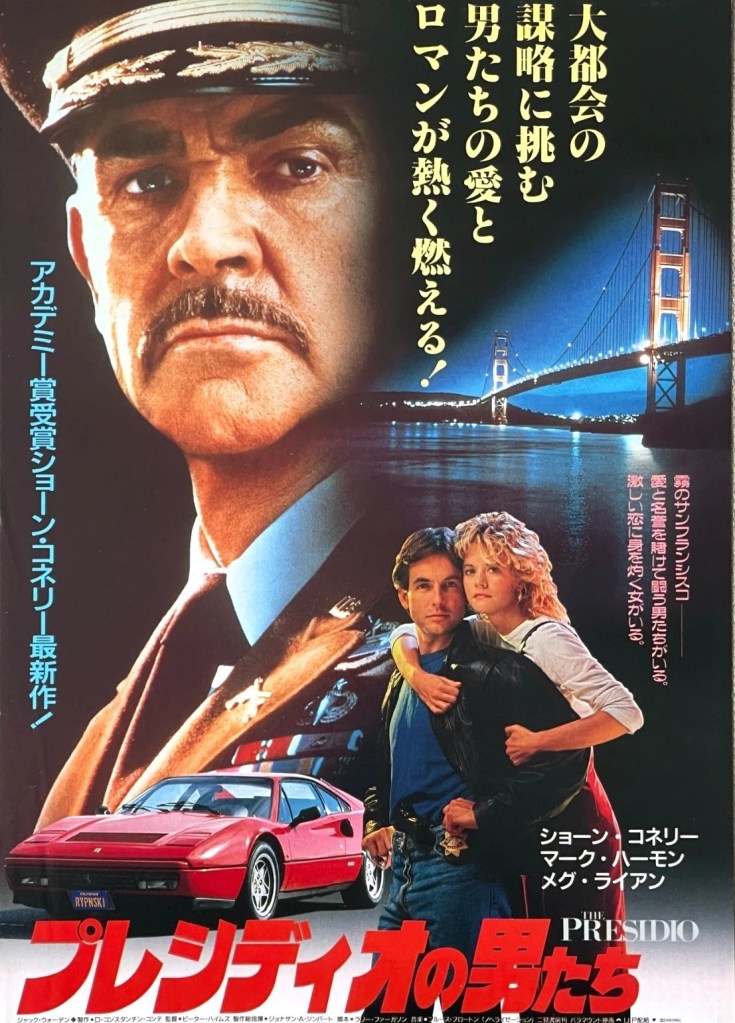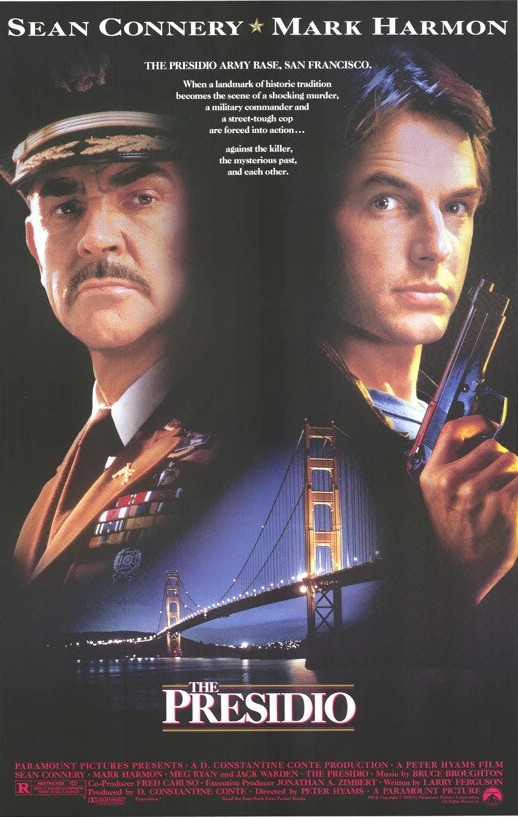
The Presidio (1988) ***

Blame the young whelp. Hollywood had form when it came to piggybacking a rising star on the back of an older established star. Go back to Montgomery Clift and John Wayne in Red River (1948) and you can see why it’s such a potent route to success. Young bucks like James Caan in another John Wayne number El Dorado (1967) fared less well. Tom Cruise got the hang of it, riding on the coattails of Paul Newman in The Color of Money (1986) and Dustin Hoffman for Rain Man (1988). Sean Connery was even known to help out – consider his mentoring of the characters played by Kevin Costner in The Untouchables (1987) or Wesley Snipes in Rising Sun (1993).

But sometimes it just doesn’t work. And that’s the main flaw here in an otherwise involving crime drama featuring unwilling partners that has the requisite car chases, a variety of smart moves, and a hefty load of emotional complication. Military cop Lt Col Alan Caldwell (Sean Connery) has daughter issues, daughter Donna (Meg Ryan) has daddy issues and commitment issues, while civilian cop Jay Austin (Mark Harmon) has authority issues.

Caldwell and Austin are forced to work together after a murder on San Francisco military base The Presidio.

Austin is altogether too volatile, too apt to go off at the mouth, and more important (in acting terms) hasn’t learned to rein it in, to reveal all through the eyes and bite off what snappy dialog comes his way rather than throwing stuff around and slamming doors and such. To complicate matters Austin and Caldwell have a past. To complicate matters even more – or to put it another way spice up proceedings – Austin and Donna get it together after a pretty neat meet-cute.

While in some ways Donna is cute, mostly she’s feisty, determined to put both dad and lover in their places. Both Caldwell and Austin have a top-class solo scene – the colonel when he turns the tables on a barroom bully, Harmon when he sweet-talks a secretary into providing vital information. The more experienced Caldwell tends to be one step ahead in terms of figuring out what’s going on. But in terms of the running, jumping and standing still stuff, it’s mostly Harmon who is dumped with the action, Caldwell the altogether cooler cat.

While Connery was coming off an Oscar for The Untouchables, I have to confess I’d never heard of Harmon. Turns out his rising stardom was on the back of a couple of television series –  Flamingo Road (1980-1982) and St Elsewhere (1983-1986) plus a turn as Ted Bundy in the mini series The Deliberate Stranger (1986). In terms of movies, he’d been top-billed in the lackluster thriller Let’s Get Harry (1986) and Carl Reiner surprise comedy hit Summer School (1987) which took in $15.7 million in rentals and placed 27th for the year, ahead of Kevin Costner in No Way Out and Bruce Willis in Blind Date.

Harmon was the replacement for Don Johnson who was on duty in Miami Vice. Whether Johnson would have been capable of taking on Connery is open to question. Harmon clearly struggled and Meg Ryan (Top Gun, 1986) ran away with what Connery left on the acting table.

This was an interesting role for Connery, not just coming to terms with his daughter but also with betrayal, and the climactic scene in a cemetery is a career highlight.

Back to the tale: under-rated director Peter Hyams (Capricorn One, 1978) keeps the action coming and in between ensures emotional tension holds sway. Apart from Harmon, what lets it down is the story – the real story I mean not the various personnel sorting out their private lives. It’s not that the conspiracy the pair uncover isn’t interesting, it’s just not interesting enough and I guessed from the minute he was introduced who the bad guy was.

But the dialog is meaty enough and Meg Ryan shows more promise and of course by this stage Connery is such an assured performer that he’s not going to put a foot wrong. I’m not sure that filming a car chase in the darkness on the city’s steep inclines was a good idea, apart from the white sparks zinging out of the darkness. A later Connery venture The Rock (1996) did it much better. Written by Larry Ferguson (The Highlander, 1986).

If you can ignore Harmon, a good evening’s watch.

NOTE: The movie didn’t do so well at the U.S. box office – just $10 million in rentals, but it took in nearly half as much again in Japan so my guess the Connery name in the global markets helped recouped the cost. But this was the beginning of the famous “long tail” when movies made a lot more after initial release and this was a case in point. Although it only placed 50th on Variety’s annual box office chart, it made the Top Ten for the year on video.

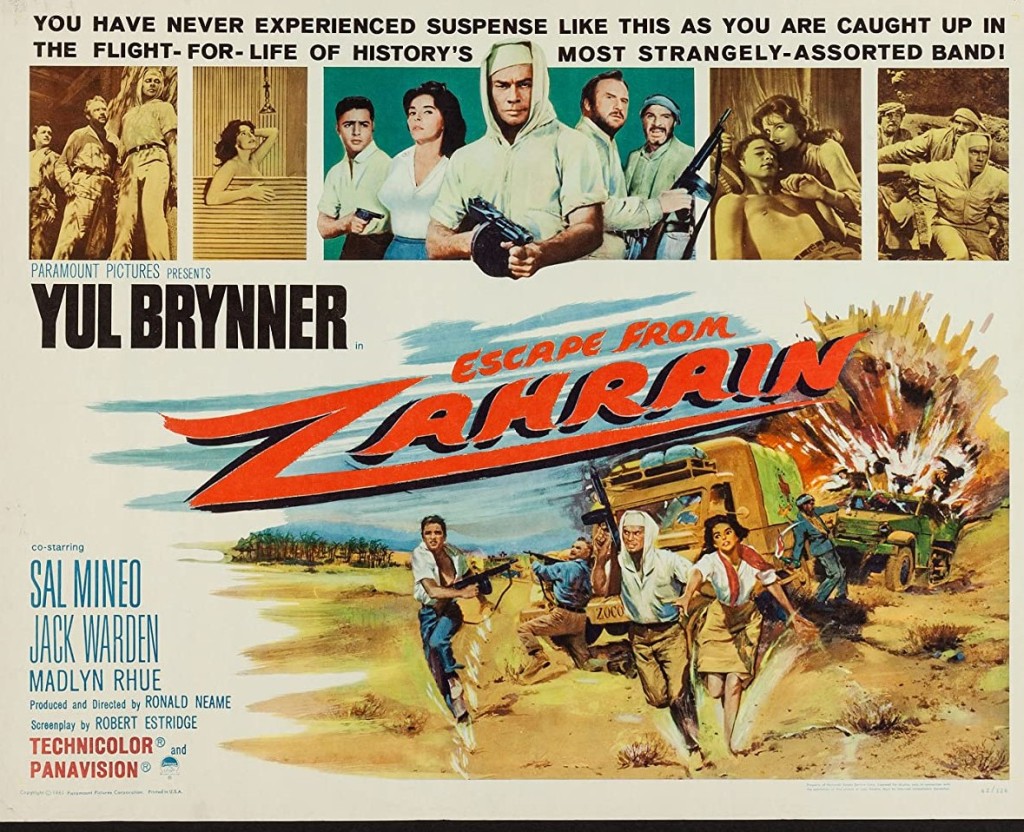
Escape from Zahrain (1962) ***

After being attacked by armored cars and strafed by airplanes, stranded in the desert, and overcome various tensions within the small group of escapees, there is still considerable life left in this picture at the end as Jack Warden, making his departure, comes up with a classic last line: “We must do this again sometime.”

In truth, the picture has far more going for it than a mere outline would suggest. In rescuing rebel leader Sharif (Yul Brynner) from a lorry bound for jail, the escapees led by Ahmed (Sal Mineo (Exodus, 1960) in a stolen ambulance also scoop up three convicts including American fraudster and loudmouth Huston (Jack Warden) and all-purpose thug Tahar (Anthony Caruso) plus nurse Laila (Madhlyn Rhue) as a hostage. Like most stranded-in-the-desert films, the storyline is on who will survive and how.

Action is one constant. The threat of failure is another. Supplies are rationed and, of course, someone steals more than their fair share. The members regularly switch allegiance. At various points someone is about to give up Sharif. Their gas tank is punctured so, thanks to Huston’s engineering skills, they just make it to a remote pumping station where they encounter maintenance man (James Mason in an uncredited cameo). Their numbers diminish and despite his recalcitrance Huston’s engineering skills save them again when they reach an oasis.

What makes the film different is that the characters all change. In a country where “half the wealth is stolen by Europeans and half by corruption,” Sharif is the altruistic leader whose ideals are shattered. Laila,  a Muslim, drinks alcohol and questions the number of deaths necessary for a revolution but declines to leave when the opportunity arises. Ahmed who thinks “women should be as free as men” reacts badly when Laila enjoys such freedom. Huston, who has embezzled $200,000, and has loyalty to no one stands by the shambolic crew.

I had always believed Brynner had enjoyed a rare case of beginner’s luck when he won the Oscar for his debut in The King and I (1956) and that once Hollywood became wise to his acting schtick he would never be nominated again – as proved the case. But after watching Brynner in The Magnificent Seven (1960) and its sequel and Invitation to a Gunfighter (1964) and Flight to Ashiya (1964) I have become convinced he is under-rated as an actor. He acts with his eyes and his delivery is far more varied than I had supposed. Here, clothed in Arab costume, there is no bald pate to distract. 

Sal Mineo (Exodus, 1960) can’t compete in the acting stakes with the canny Jack Warden (Blindfold, 1966). Anthony Caruso (a television regular) is lost in the mix but Madhlyn Rhue (A Majority of One, 1961) certainly looked a good prospect.

British director Ronald Neame (Tunes of Glory, 1960) holds the enterprise together, keeping to a tidy pace but allowing tension and character to emerge. Screenplay was courtesy of Robin Estridge (Eye of the Devil, 1966) based on the Michael Barrat novel and with an injection somewhere along the line by Dudley Nichols (Heller in Pink Tights, 1960).

Tight script, taut direction.

https://amzn.to/3Td6m1d

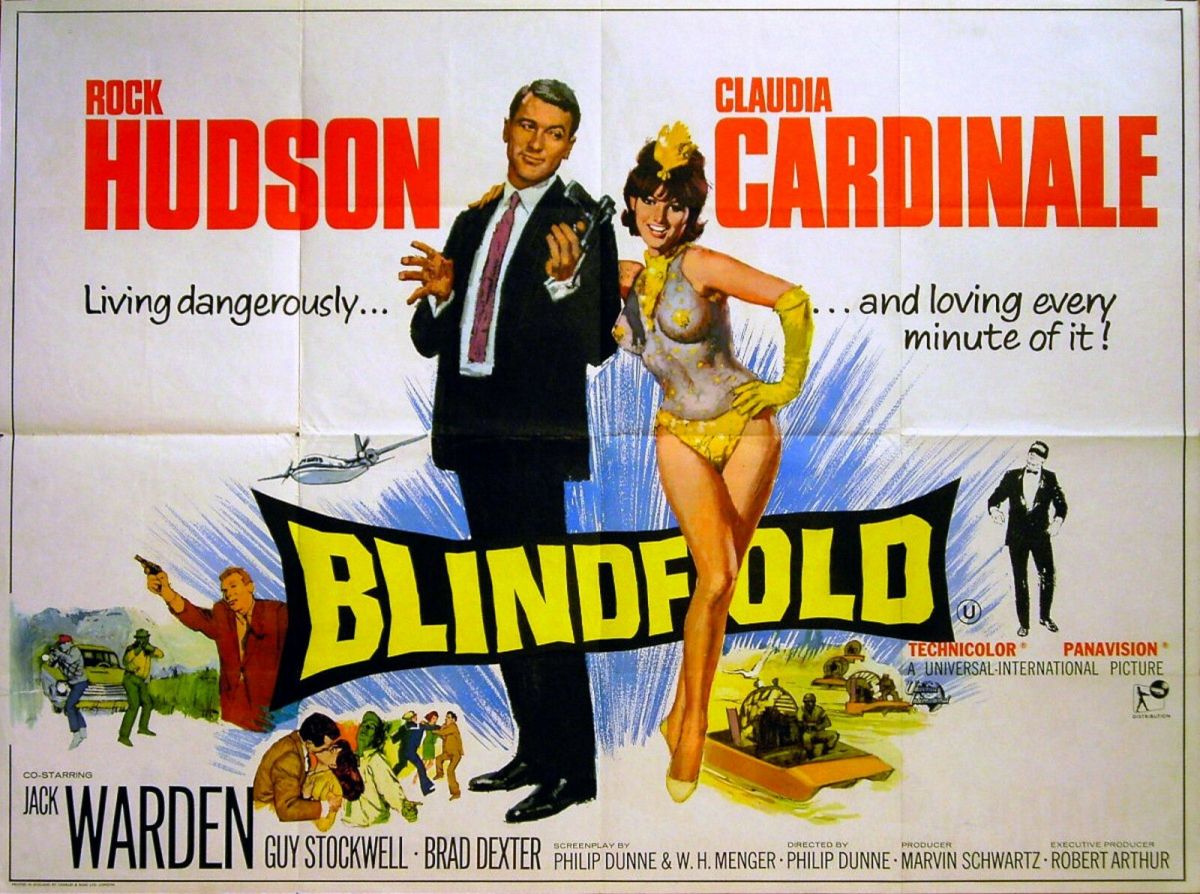
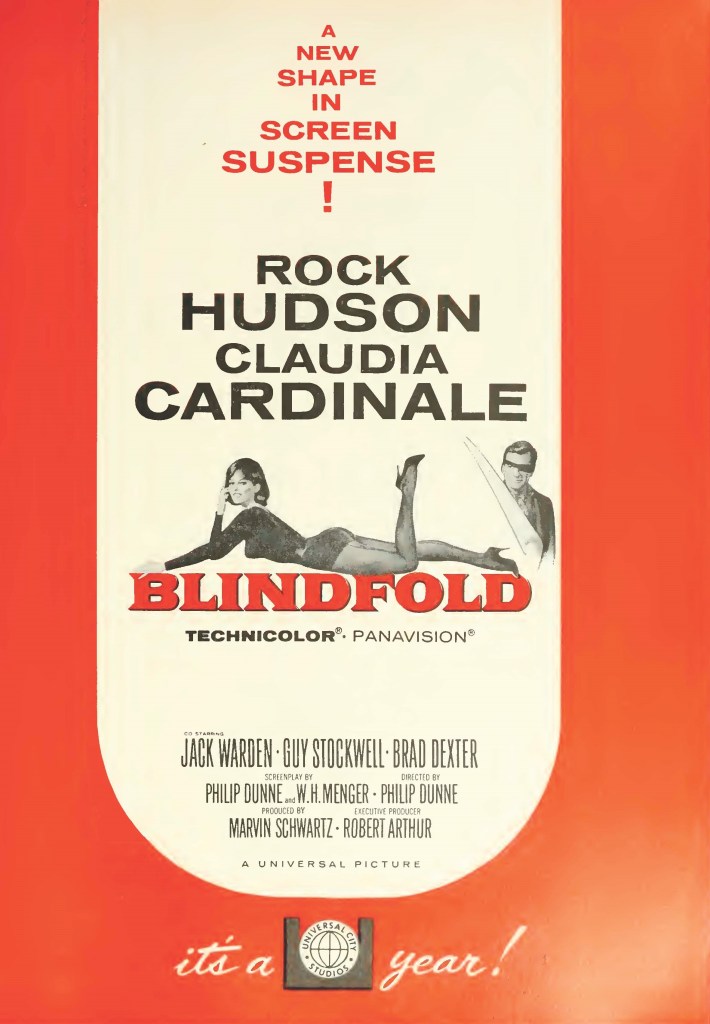
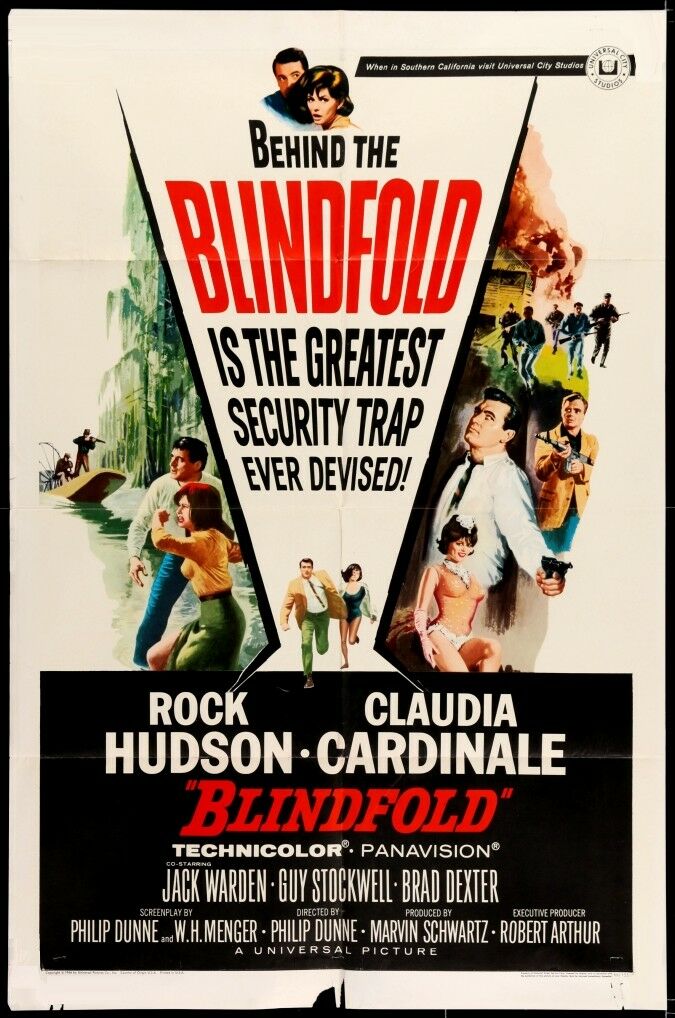
Blindfold (1965) *****

Hugely enjoyable superior addition to the romantic thriller genre with charismatic stars and a touch of screwball comedy. Dr Stone (Rock Hudson), a psychiatrist with such commitment issues he is dubbed “Bluebeard” by the media, is recruited by General Prat (Jack Warden) of the National Security Council to prevent former patient Arthur Vincenti (Alejandro Rey) falling victim to an international scientist-kidnapping ring. Getting to the patient, a plane and car ride away, requires the titular blindfold so Stone has no idea where he is. When Vincenti attacks Stone as a traitor, Prat explains the scientist has been brainwashed.

Ballet dancer Vicky (Claudia Cardinale) engineers an accidentally-on-purpose meet-cute in Central Park by running her bicycle into Stone’s horse but when, to nurse her injury, he carries her into his office she steals the scientist’s file. Turns out her artistic skills are somewhat lower than ballet, she is a go-go dancer, but she is the scientist’s brother whom she claims has been kidnapped. Stone is arrested and to get out of another sticky situation announces he is engaged to Vicky.

Complications are added when the C.I.A and F.B.I. enter the equation as well as a very suspicious cop Harrigan (Brad Dexter) with an inferiority complex, a couple of shady homburg-wearing hoods and new patient Fitzpatrick (Guy Stockwell), who, all, in one way or another, hound Stone and Vicky. The couple’s relationship is one of those on-again off-again romances which come with the territory. Soon, of course, Stone doesn’t know who to believe.

Bearing in mind we still have to get to the geese, the alligators and a mule called Henry, the witty, inventive script delivers on all fronts. Both Stone and Vicky are believable characters, and Stone’s psychiatric skills are not just window dressing – the kind of tony job associated with innocents thrust into peril. He uses his proficiency to get out of scrapes and eventually solve the mystery. Despite her glamor-girl persona, Vicky is the opposite of the sleek high-living characters often shoehorned into this kind of picture, a down-to-earth lass living in a brownstone with her mama and papa. Both leads turn out to be handy with their fists and in Vicky’s case her high-kicking feet.

And the comedy, rather than getting in the way or looking ridiculously out of place, aids and abets the storyline. It falls into three distinct camps. There is repartee not just between Stone and Vicky but Stone’s secretary (Anne Seymour) operates a sideline in dry quips. Slapstick comes mainly in the form of a fire extinguisher employed as a weapon and Stone nearly losing his trousers scaling a fence. Bureaucratic brick walls that hint of paranoia come close to classic black comedy. Not to mention some visual gags – “undie dummies” anyone – and some neat reversals.

This is Hudson at his very best and while often confused is never flustered, and without recourse to the double-takes that appeared so essential in any previous film with a comedic element. His character is assured, self-aware, thoughtful (he has to be to think things out), and very human. Cardinale is more than a match, a nice girl in the wrong line of work, passionate, determined and very warm. Director Philip Dunne find dramatic reasons to reveal her famous assets in body stocking, leotard and underwear, but in reality it is her smile that is the killer.

Dunne (Lisa, 1962) keeps up a cracking pace. He had a hand in the screenplay, adapted from the novel by Lucille Fletcher (Sorry, Wrong Number, 1948), one-time wife of composer Bernard Herrmann. Here, incidentally, the music is by Lalo Schifrin. Among the decade’s romantic thrillers this is out-ranked only by Charade (1963).

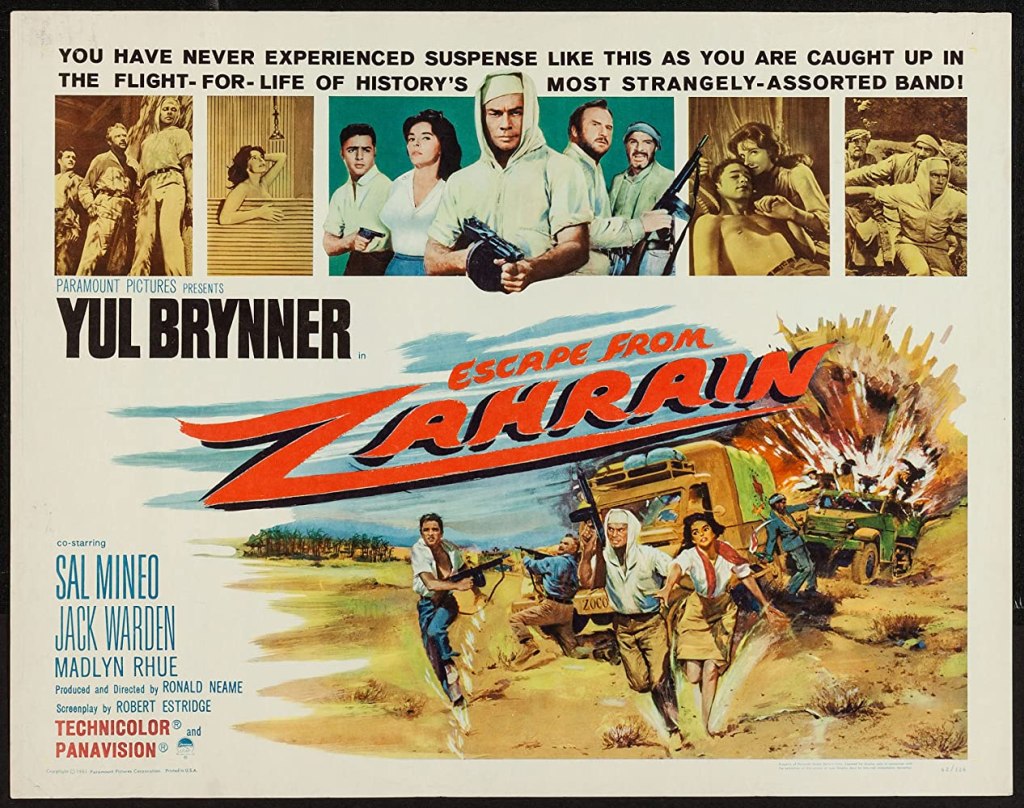
Escape from Zahrain (1962) ***

After being attacked by armored cars and strafed by airplanes, stranded in the desert, and overcome various tensions within the small group of escapees, there is still considerable life left in this picture at the end as Jack Warden, making his departure, comes up with a classic last line: “We must do this again sometime.”

In truth, the picture has far more going for it than a mere outline would suggest. In rescuing rebel leader Yul Brynner from a lorry bound for jail, the escapees led by Sal Mineo (Exodus, 1960) in a stolen ambulance also scoop up three convicts including American fraudster and loudmouth Jack Warden (That Kind of Woman, 1959) and all-purpose thug Anthony Caruso (a television regular) plus a nurse Madhlyn Rhue (A Majority of One, 1961) as a hostage. Like most desert films, the storyline is on who will survive and how.

Action is one constant. The threat of failure is another. Supplies are rationed and, of course, someone steals more than their fair share. The members regularly switch allegiance. At various points someone is about to give up Yul Brynner. Their gas tank is punctured so, thanks to Warden’s engineering skills, they just make it to a remote pumping station where James Mason pops up in a cameo as a maintenance man. Their numbers diminish and despite his recalcitrance Warden’s engineering skills save them again when they reach an oasis.

This was originally intended as a starring vehicle for Clark Gable with Edward Dmytryk in the director’s chair.

What makes the film different is that the characters all change. In a country where “half the wealth is stolen by Europeans and half by corruption,” Brynner is the altruistic leader whose ideals are shattered. Rhue, a Muslim, drinks alcohol and questions the number of deaths necessary for a revolution but declines to leave when the opportunity arises. Mineo who thinks “women should be as free as men” reacts badly when Rhue enjoys such freedom. Warden, who has embezzled $200,000, and has loyalty to no one stands by the shambolic crew.

I had always believed Brynner had enjoyed a rare case of beginner’s luck when he won the Oscar for his debut in The King and I (1956) and that once Hollywood became wise to his acting schtick he would never be nominated again – as proved the case. But after watching Brynner in The Magnificent Seven (1960) and its sequel and Invitation to a Gunfighter (1964) and Flight to Ashiya (1964) I have become convinced he is under-rated as an actor. He acts with his eyes and his delivery is far more varied than I had supposed. Here, clothed in Arab costume, there is no bald pate to distract.  

British director Ronald Neame (Tunes of Glory, 1960) holds the enterprise together, keeping to a tidy pace but allowing tension and character to emerge.

Many of the films from the 1960s are to be found free of charge on TCM and Sony Movies and the British Talking Pictures as well as mainstream television channels. Films tend to be licensed to any of the above for a specific period of time so you might find access has disappeared. But if this film is not available through these routes, then here is the link to the DVD and/or streaming service.

Discover WordPress

A daily selection of the best content published on WordPress, collected for you by humans who love to read.

The Atavist Magazine

by Brian Hannan

WordPress.com News

The latest news on WordPress.com and the WordPress community.