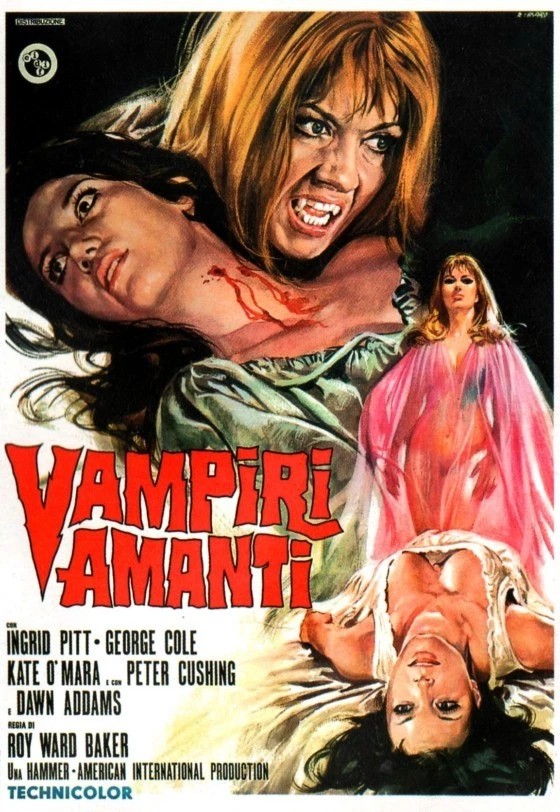
The Vampire Lovers (1970) ***

Should have a lot more going for it. Female empowerment for a start. This would also, in today’s terms, be called a reboot of the Dracula legend, though it does originate from a different source than Bram Stoker. Or you could look at the bold exploration of lesbianism, none of the angst of The Killing of Sister George (1968) or the lyricism of The Fox (1967). Or you could fall back on that old chestnut – a camp reinterpretation of the vampire world, where female breasts rather than necks are the prime target. At the very least, it should have set up Ingrid Pitt (Where Eagles Dare, 1968) for stardom.

And while all these hold true, it lacks the key ingredient of the horror picture, any kind of tension or imminent threat. Nor does it carry the emotional weight of Countess Dracula (1971) – also starring Pitt –  a twist on Dorian Gray, of a woman trying to hold age at bay with infusions of virgin blood.

So, in the end, it comes off as little more than a commercial decision to revive a fading genre with lashings of nudity, sex and lesbianism. Director Roy Ward Baker (Moon Zero Two, 1969) brings significant style to the proceedings even though the backdrops look as if they’ve been picked from a cast-off bin.

The tale is based on a story Carmilla by Sheridan Le Fanu, that predated Bram Stoker. On the production side, Hammer and its American rival AIP teamed up, with the latter blamed for insisting on the sexual overdose. Although on that score you could as easily point the finger at the British censor known for his liberal approach to such shenanigans.

While it’s true that Dracula, especially as interpreted by Christopher Lee in Hammer offerings, carried a sexual frisson, there was never anything more than that, allowing the audience to determine whether the vampire was ever interested in a woman except for the purpose of sucking blood from her neck. Previously, diaphanous gowns and cleavage had been the extent of the sexual element. To switch the target from the neck to the breasts is a determined commercial move.

So, basically, with a gender twist, we’re following the old story – vampire stalks victims, finds acolytes, and falls victim to a vampire hunter. In the 19th century, the beautiful Carmilla (Ingrid Pitt), traveling with her mother, a countess (Dawn Adams), is adept at inveigling herself into high-class households where she seduces the daughters and staff of the rich. Her first victim Laura is niece to General Spielsdorf (Peter Cushing) who subsequently enlists the help of vampire hunter Baron Hartog (David Wilmer), who mistakenly believes he had rid the world of the female vampire clan.

Next for the bloody breast treatment is a Mademoiselle Perrodot (Kate O’Mara), governess to Emma (Madeleine Smith). Perrodot becomes her lover and accomplice. Carmilla is an inclusive kind of vampire and if need be will seduce any male obstacle such as Morton’s suspicious butler Renton (Harvey Hall) while sucking the blood out of any passing male of more modest means.

Carmilla has the same get-out-of-jail-free as any male of the species and can take refuge in her grave until the heat passes. However, this time she’s intent on taking Emma with her. By now Baron Hartog has filled the general in on the threat, explaining that the Karnstein clan go back to the sixteenth century, and that he has dispatched many of the breed in traditional fashion, decapitation or stake through the heart, but he had been unable to find the night-time resting place of Carmilla.

So when Carmilla heads off to Karnstein Castle with Emma, she’s not expecting vampire hunters lying in wait. This time it’s the general who does the killing, making doubly sure by both cutting off her head and driving a stake through her heart. Emma recovers.

Given that any version of Dracula was essentially a franchise, Hammer/AIP managed to keep the Karnsteins going for another two episodes, Lust for a Vampire (1971) – which gave Yutte Stensgaard a shot a stardom – and Twins of Evil (1972) starring Playboy Playmates the Collinson twins.

While The Vampire Lovers was a launching pad for Ingrid Pitt as a new top-billed femme fatale, her marquee attraction didn’t last beyond the superior Countess Dracula. However, Pitt certainly brings gusto to the part and there’s an argument that the contemporary world deserved more explicit expression of that previously restrained sexual frisson. The counter-argument is that it’s blatant sexploitation.

Kate O’Mara (The Horror of Frankenstein, 1970), a future Scream Queen, would have been an obvious contender for the main role rather than a supporting one except that she refused to take off her clothes. Madeleine Smith (Taste the Blood of Dracula, 1970) became another future Scream Queen.

With Ingrid Pitt’s physical allure to the fore that limited the involvement of Peter Cushing (Frankenstein Created Woman, 1967). The more prominent of the wannabes was Jon Finch (Macbeth, 1971).

Written by Tudor Gates (Danger: Diabolik, 1968).

Still the argument continues – groundbreaking approach to the genre or mere sexploitation.

You decide – Amazon Prime currently has this.

Quatermass and the Pit / Five Million Miles to Earth (1967) ****

Five million dollars.  That’s roughly the budgetary difference between Hammer’s Quatermass and the Pit and Twentieth Century Fox’s Fantastic Voyage. Although the protagonists in the latter face the unexpected, the movie is (as would be 2001: A Space Odyssey, 1968) an exercise in awe, in controlled exploration of wonder, whereas Quatermass, lacking the money for special effects, concentrates more on story and human impact. The government funds the experiment in Fantastic Voyage while Professor Quatermass (Andrew Keir) finds nothing but obstruction from his superiors.

Quatermass and the Pit is a masterpiece of stealthy exposition. Virtually every minute brings another development, gradually building tension, stoking fear. The principals – Dr Roney (James Donald), Barbara Judd (Barbara Shelley) and the professor – are cleverly kept apart during the early stages. A human skull discovered on a building site for a London Underground station is followed by a skeleton. Palaeontologist Roney determines it is five million years old, older than any previous find.

A metallic object is found nearby. First guess is an unexploded bomb from the Second World War. But it’s not ticking. And a magnet won’t stick to it. Col Breen (Julian Glover) is called in along with hostile rocket expert Quatermass. They have been locking horns from the outset.

There’s a whole bunch of apparent red herrings, mostly of the demonic variety. The location, historically associated with weird occurrences, is a nickname for the Devil. A pentagram is detected. Touching the object can give you frostbite. Col Breen argues it’s a leftover German propaganda machine from World War Two. A hideous dwarf and other spectral images are sighted. Telekinesis is involved. And tremendous vibrations.

Some people, such as Barbara, have a more receptive brain and can play memories millions of years old that reveal the alien truth. But this is an alien race with genocidal tendencies and able to unleash psychic energy.

The genre requires the scientists to discover an improbable solution which of course they do. Given the miserly budget, the special effects are not remotely in the Fantastic Voyage league. But that hardly matters. The movie coasts home on ideas, marrying sci-fi, the demonic, dormant and institutionalized evil, the militarization of the Moon and the ancient infiltration of Earth by Martians, no mean achievement, and a vivid narrative.

Director Roy Ward Baker (aka Roy Baker) provides many fine cinematic moments as he chisels away at the story, finding clever methods of revealing as much of the aliens as the budget will permit, focusing on very grounded characters, concentrating on conflict, and human emotions, mainlining fear rather than awe, building to an excellent climactic battle between man and monster.

Barbara Shelley (The Gorgon, 1964) is the pick of the stars, in part because she is at such a remove from her normal Hammer scream-queen persona, but more importantly because she brings such screen dynamism to the role. It’s refreshing to see her step up, as she carries a significant element of the story. Oddlyenough, although she has as good a movie portfolio as Andrew Keir and is certainly superior to James Donald, the denoted star, in that department, she is only billed third.

While Andrew Keir (The Viking Queen, 1967), warm-hearted for an intellectual, and James Donald (The Great Escape, 1963), trying to keep a cool head in the middle of inclination to panic, are good, they don’t bring anything we haven’t seen before. Julian Glover (Alfred the Great, 1969) is never anything but imperious and/or irascible, so ideal casting here.

The innovative electronic music was down to Tristram Cary and the unsettling credit sequence deserves some recognition. Nigel Kneale, who originally explored similar ideas for the character on television, came up with the screenplay.
Discover WordPress

A daily selection of the best content published on WordPress, collected for you by humans who love to read.

The Atavist Magazine

by Brian Hannan

WordPress.com Blog

News, Tips & Website Tutorials