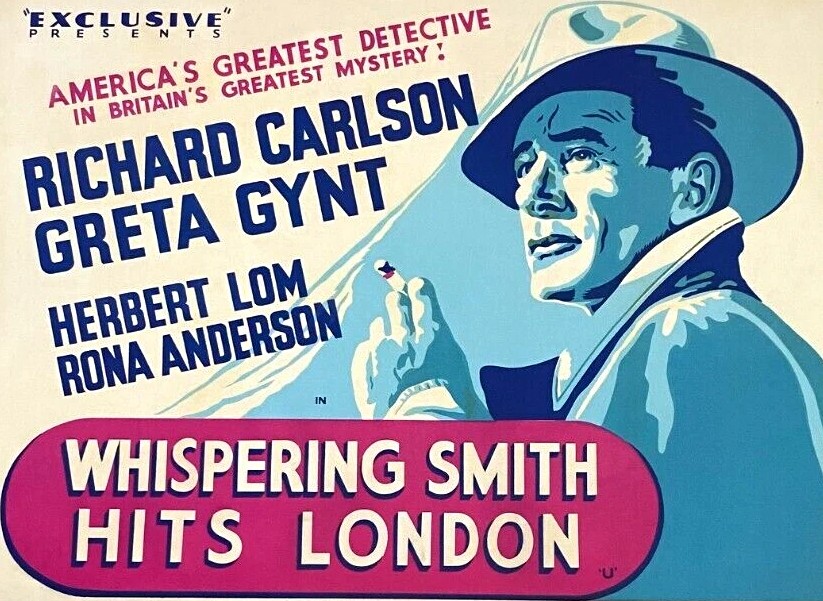
“In a change to the advertised program” is probably the best place to start, since in writing nearly 2,000 reviews I’ve only, from memory, dipped into the pre-1960 era a couple of times. So let me explain. First of all when I was diving through my trove of Pressbooks, deciding what to select for the new movie exhibition in the book shop I run – Abbey Books in Paisley, Scotland – I came across a Pressbook for this. I noted it was produced by Hammer which I had always associated with horror so I was intrigued to see what the company had been up to long before it made its name mainlining on Dracula, Frankenstein and The Mummy.
By coincidence, I spotted the title on the listings for British streamer Talking Pictures so decided to have a look.
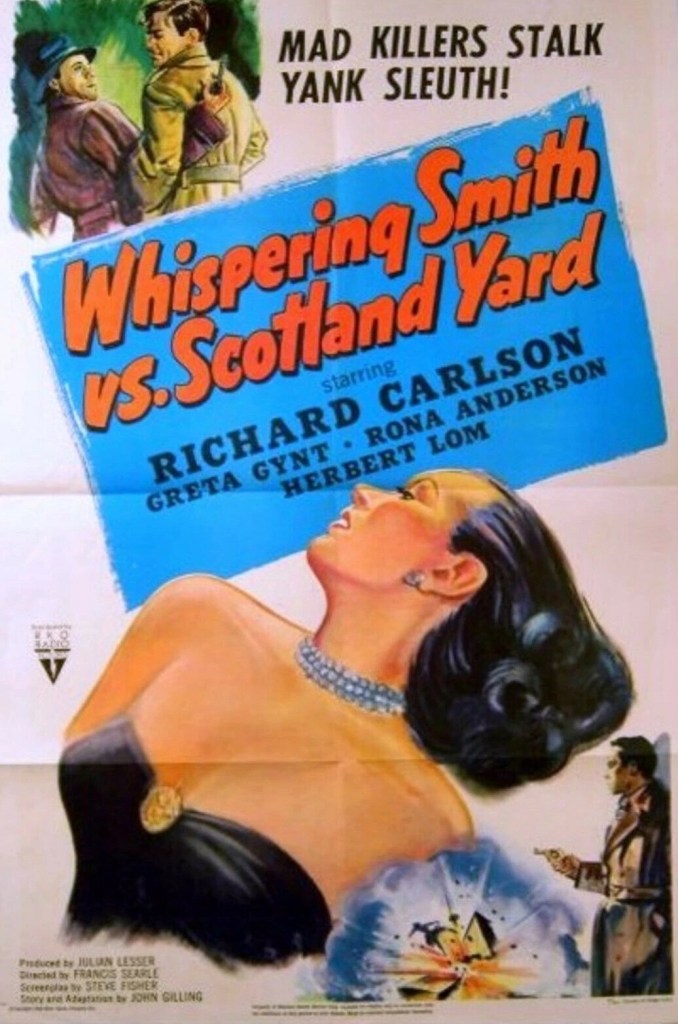
The first point of note, I guess, is the cast. It was par for the course in the 1960s for producers to trawl many countries in the world to make films with an international, sometimes all-star, cast, as they had worked out that it was easier to sell a movie outside the U.S. if you could pin your publicity efforts on big names from France, Italy, Scandinavia, Britain and Australia.
Here, Hammer, maybe in the vanguard of that policy, took this to the extreme. Among the three top-billed names, there isn’t a single Brit. We’ve got American Richard Carlson (The Creature from the Black Lagoon, 1954), Norwegian blonde bombshell Greta Gynt (Soldiers Three, 1951) and Czech Herbert Lom (A Shot in the Dark, 1964).
All this might have been grist to the trivia mill had the movie turned out not to be so damned entertaining, well above par for a B-movie. Not only, visually, does it take on aspects of film noir, slats of lights penetrating the darkness, but there are distressing overtones relating to the insanity business, where once an inmate enters a sanatorium unscrupulous staff can do anything they want, make them worse or kill them if that’s on the agenda.
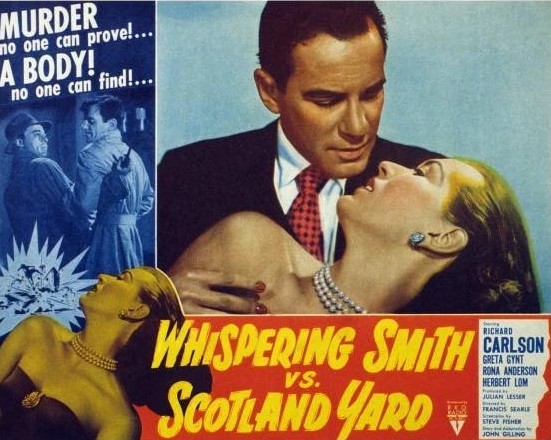
There are plenty twists and a cracker of a climax, but, as importantly, Yank sleuth Whispering Smith (Richard Carlsen) and his client Ann Carter (Rona Anderson), thanks to sparkling repartee, create genuine screen charisma.
When the celebrity cop arrives in London for a vacation he is door-stepped by publisher Ann tasked with investigating the apparent suicide of her American employer’s daughter Sylvia and the mysterious disappearance of her friend Louise. Although initially rejecting the case, he changes his mind when Ann is victim of an attempted hit-and-run.
Interviews with Sylvia’s fiancé Roger Ford (Herbert Lom), a part-time puppeteer, and her lawyer Hector Reith (Alan Wheatley) throw up impressions of the dead girl as wild, strange, jealous and a gambler. The missing Louise turns out to be rather glamorous, not easily fooled, and in the mood for a taste of seduction and with a nice line in put-downs, “I like a working man,” she tells Smith.
However, a creepy sanatorium run by goatee-bearded Dr Talen (Daniel Therry) appears to be a cover for a criminal organization and Smith soon uncovers a blackmail ring. But none of the victims is willing to talk and when they do are bumped off. Smith eludes various traps, including a showdown in a tunnel and a booby-trapped boat. When Sylvia’s corpse turns up it’s unrecognizable after spending too long in the Thames.
Ann and Smith make a great team, especially when she turns snappy. “You can keep your whispering for someone else,” is one of her better retorts. She’s a surprise in other ways, a dab hand at safe-breaking, for example. It’s not clear how far he is seduced by Louise, so the issue of romance remains inconclusive.
Three standout sequences: the chase in the tunnel: Dr Taren’s disquisition on how easy it is to trap the innocent through psychiatric gobbledygook; and a murder scene where the victim is forced to turn up the sound of a succession of wirelesses to disguise the noise of the imminent gunshot.
Whether it’s the introduction of the slick American or the Scandinavian beauty, or the general pacing and twists ladled out, this is a notch above the usual British B-movie.
I should point out the alternative title is misleading, suggesting Smith is some kind of maverick cop besting Scotland Yard when in fact they work in tandem. And, for the record, he doesn’t whisper either. You might catch a glimpse of Stanley Baker (Zulu, 1964) as a reporter.
Veteran director Francis Searle (The Marked One, 1963) makes the most of the cast, the narrative and the ambience. Written by John Gilling (The Pirates of Blood River, 1962) and Steve Fisher (Rogue’s Gallery, 1968) from the bestseller by Frank H. Spearman.
Worth a watch.

