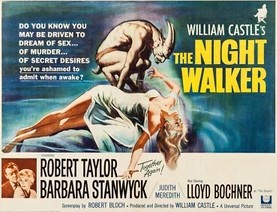
The Night Walker (1964) ****

Deserves its spot in the cult pantheon, hints of Spellbound (1945) and Vertigo (1958),  mesmeric atmosphere of dream/nightmare held together by a hypnotic performance by Barbara Stanwyck, tonsils in overdrive. But no point screaming at the unseen, at the unknown, when it invades reality, no point trying to escape a dream when you’re trapped inside.

Except that there’s no sign of the demonic figure haunting widow Irene Trent (Barbara Stanwyck) on the poster it delivers on all other fronts, driving you to question our heroine’s grip on reality as much as she questions herself. If there’s such a thing as self-gaslighting, she’s in the vanguard.
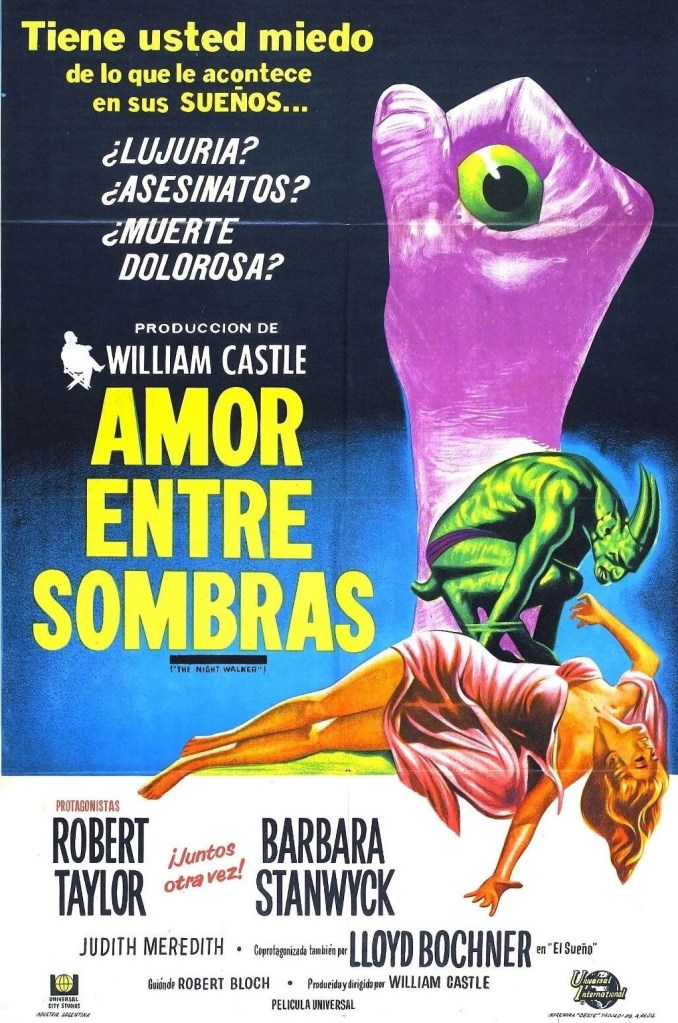
Creepy rich blind husband Howard (Hayden Rorke) is an emperor of surveillance, microphones everywhere catching her every word, including what she utters in her dreams, which convinces him that she’s having or has had an affair. When he dies in an explosion, body eviscerated in the inferno, she can’t come to terms with her freedom, holing up in the tiny apartment at the back of her beauty parlor, relying on assistant Joyce (Judi Meredith) and attorney Barry (Robert Taylor) for moral, and perhaps in relation to the solicitor, physical support.

When the unreal invades her daily life and she begins to believe in her dreams and when the handsome lover (Lloyd Bochner) of her night-time imagination takes shape, she begins to doubt her sanity. But so convinced, on the other hand, that she must be sane, she tries to convince Barry that her dreams have basis in fact. She tracks down the apartment (No 341) she visited in her dreams and the chapel where she imagined she was married to said lover.

You wish director William Castle (Straitjacket, 1964) had continued exploring the theme of dreams vs reality, and how to cope when the imagination takes over. But instead, it twists into thriller territory, the old set-up, the gaslighting that could send Irene over the edge and straight into a sanatorium while her husband’s substantial wealth ends up elsewhere.

Even so, once it heads down this particular path, it’s still mighty tricky. Who could be in on the act? All the people she trusts – Barry, Joyce, even Loverboy? And if she’s going to let her suspicions run riot, how is she going to come out the other side, for surely that will tip her over into madness?
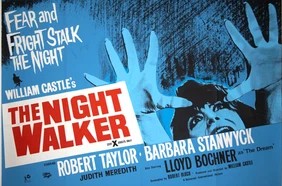
Exceptionally lean, barely 80 minutes once you exclude the treatise on dreams at the start that establishes the premise of the “Night Walker” – the person who lives through their dreams – and exceptionally clever. Irene is so given to screaming that you’d scarcely think there’s space left in her brain to to work out just what’s going on. And there’s no shortage of permutations.

Has her dead husband, half his face obliterated by burns, come back to haunt her? Is the Lover just a figment of her imagination? Why can’t she make do with someone as handsome as Barry?

We’ve got smoke issuing from under doors, recurrent bright flashes of explosion, mannequins that seem alive, all sorts of jiggery-pokery with guns, telephone wires cut, a blind man who can tell the color of your dress, eyeballs plucked from faces and squeezed until they pop, and the expectation all the time of a straight dive into madness. No escape in other words.

Even when it fast approaches a climax you might have guessed the outcome of, turns out you were wrong and there’s still a few more twists – and screams – to come.

The fact that it turns into a straightforward thriller at the time tended to diminish the emphasis on the demonic, but these will be more fully appreciated today when the line between reality and fiction is stretched ever thin.

Four-time Oscar nominee Barbara Stanwyck (A Walk on the Wild Side, 1962) might have been accused of slumming it in low-budget horror fare such as this, but, boy, in her final big screen appearance, (although she successfully switched to television as star of The Big Valley, 1965-1969) does she give it her best shot. If this was Stanwyck’s swansong, Robert Taylor (A House Is Not a Home, 1964) , a fellow relic from Hollywood’s Golden Age, wasn’t far behind, only a few movies left in him.

For all this relied on William Castle’s directorial dexterity,  the imagination behind it came from master of the macabre Robert Bloch (Psycho, 1960).

Cult doesn’t come much better.
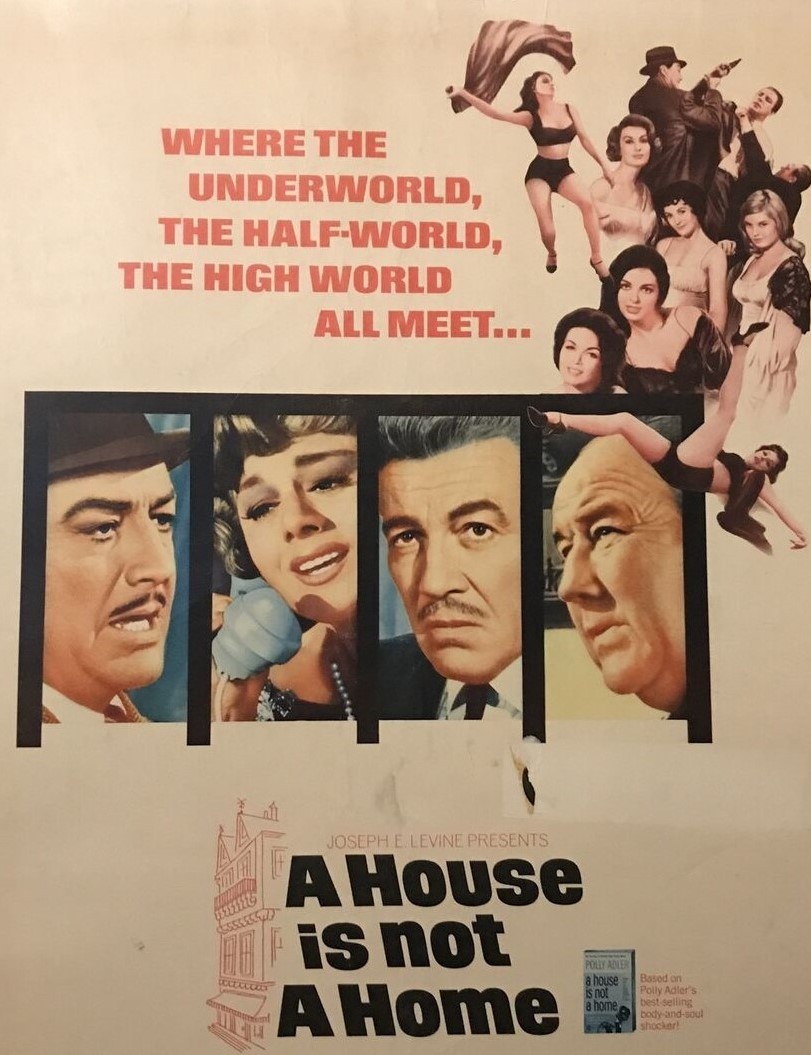
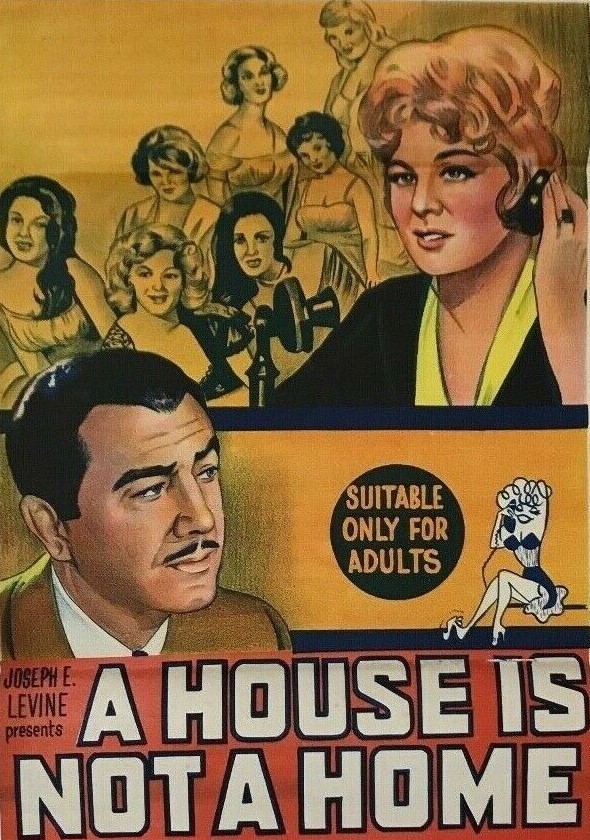
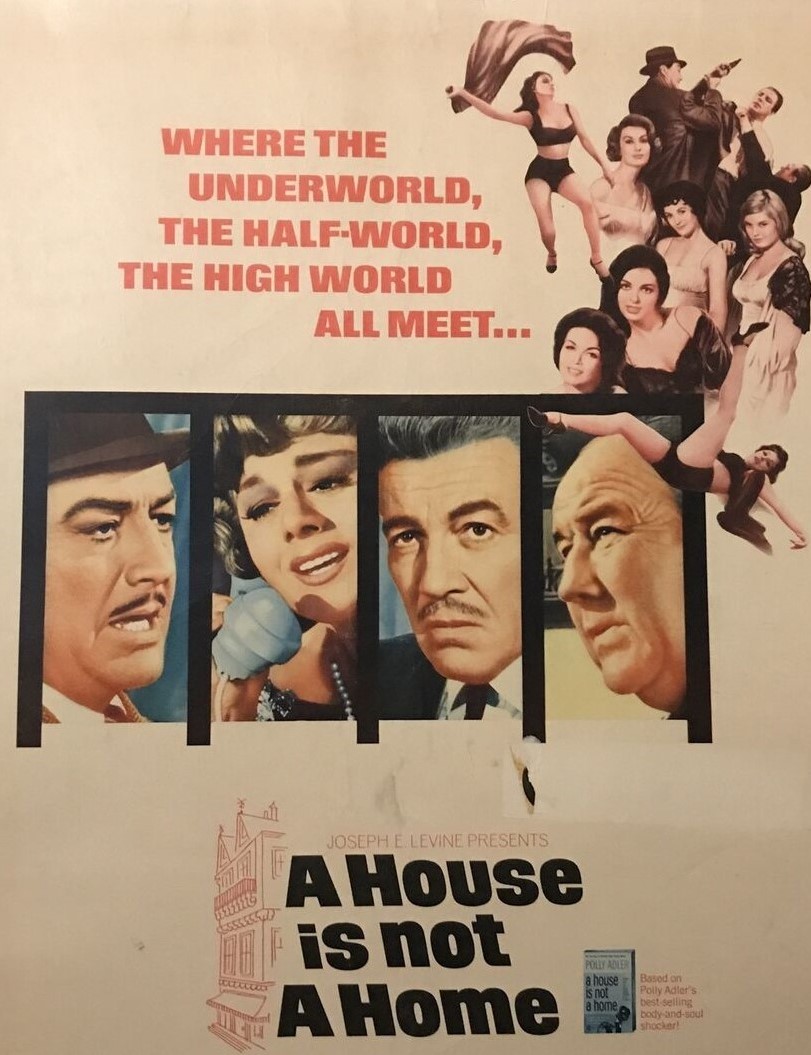
A House Is Not A Home (1964) ***

While perhaps best remembered these days as the debut film for Raquel Welch (One Million Years BC, 1966), the rest of the film is worth a look.

Hypocrisy had its heyday in The Roaring 20s when prohibition made bootleggers millionaires, helped bankroll other criminal activities like prostitution and encouraged cops and politicians to seek their share of the loot. The biography of real-life madam Polly Adler (Shelley Winters) covers all elements of corruption.  

Thrown out of her own home after being raped, she finds a knight in shining armor in the shape of bootlegger Frank Costigan (Robert Taylor) and is soon, at first apparently innocently, pimping out her friends. The reality of what becomes her profession is not ignored, the word “whore” bandied around, with one girl, Madge (Lisa Seagram), turning junkie as a result, another, Lorraine, committing suicide. Like Go Naked in the World (1961) Polly realizes that true love has no place in her world, a relationship with musician Casey (Ralph Taeger) unsustainable.

Adler, in her many voice-overs, explains why vulnerable women become sex workers – poverty, lack of family and lack of hope is her take on it – and she professes to view it as a business and preferable to working in a factory for pitiful wages, but the movie is at its best in linking the nether worlds of infamy and showing that the woman is always the loser.  

While any attempt to properly portray the period is hampered by lack of budget, it does provide an array of interesting and occasionally real-life characters, Lucky Luciano (Cesar Romero) for example. A brothel proves an ideal location meeting place for crooks and politicians, the latter easily bought by contributions to their campaign funds. Nor are cops   shy about asking for donations to their Xmas funds, or using the facility.

The Adler operation puts a glossy shine on the shady business since all her girls are glamorous. But still the movie pulls no punches except in the case of the madam herself, presented too often as an innocent and as a person who never sold her own body and who saw nothing wrong in taking as much advantage of the vulnerable girls in her employ as the  clients who paid for them.    

Oscar-winner Shelley Winters (The Chapman Report, 1962), more often a supporting player at this point in the 1960s than the star, grabs the role with both hands and although unconvincing as the younger girl delivers a rounded performance minus the blowsy affectations that marred much of later work. One-time MGM golden boy Robert Taylor, pretty much in the 1960s reduced to television (The Detectives, 1959-1962) and low-budget pictures, shows a glimpse of old form as the smooth bootlegger.

Cesar Romero (Oceans 11, 1960) and Oscar-winner Broderick Crawford (All the Kings Men, 1949) head up a checklist of old-timers filling out the supporting cast. Future director Lisa Seagram (Paradise Pictures, 1997) as the junkie hooker makes the biggest impact among the girls.

A flotilla of wannabes made up Polly’s girls. Apart from Raquel Welch, the only one to break into the big time was Edy Williams (Beyond the Valley of the Dolls, 1970). In the main they comprised beauty queens – Amede Chabot (Miss America), Danica d’Hondt (Miss Canada) and Leona Gage (Miss Universe) who had a small part in Tales of Terror (1962). Otherwise Sandra Grant became the most famous – for marrying singer Tony Bennett. Patricia Manning had the most screen experience, second-billed in The Hideous Sun Demon (1958), bit parts in television shows, and fourth-billed in The Grass Eater (1961). Inga Nielsen would later turn up as bikini fodder in The Silencers (1966), In Like Flint (1967) and The Ambushers (1967).

Director Russell Rouse (The Fastest Gun Alive, 1956) was better known for the screenplay of D.O.A. (1949) and had a story credit for Pillow Talk (1959). In fairness, although the film has no great depth, Rouse keeps it ticking along via multiple story strands although occasional lapses into comedy do not work. Written by Rouse and Clarence Greene (The Oscar, 1966) based on Adler’s autobiography.

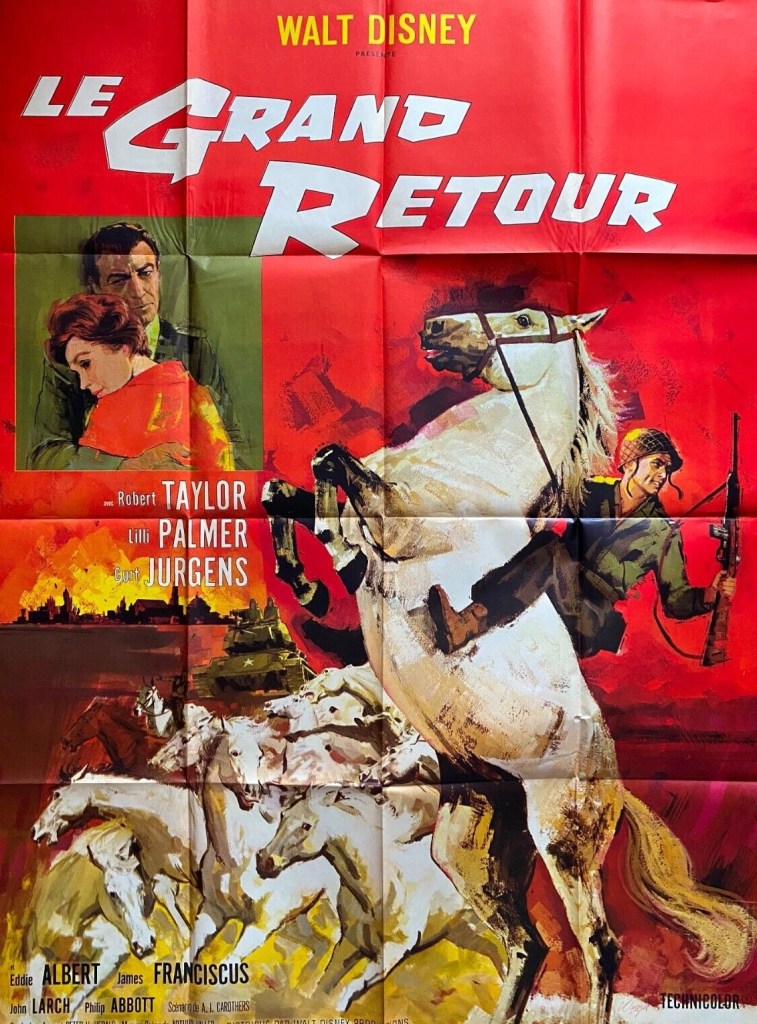
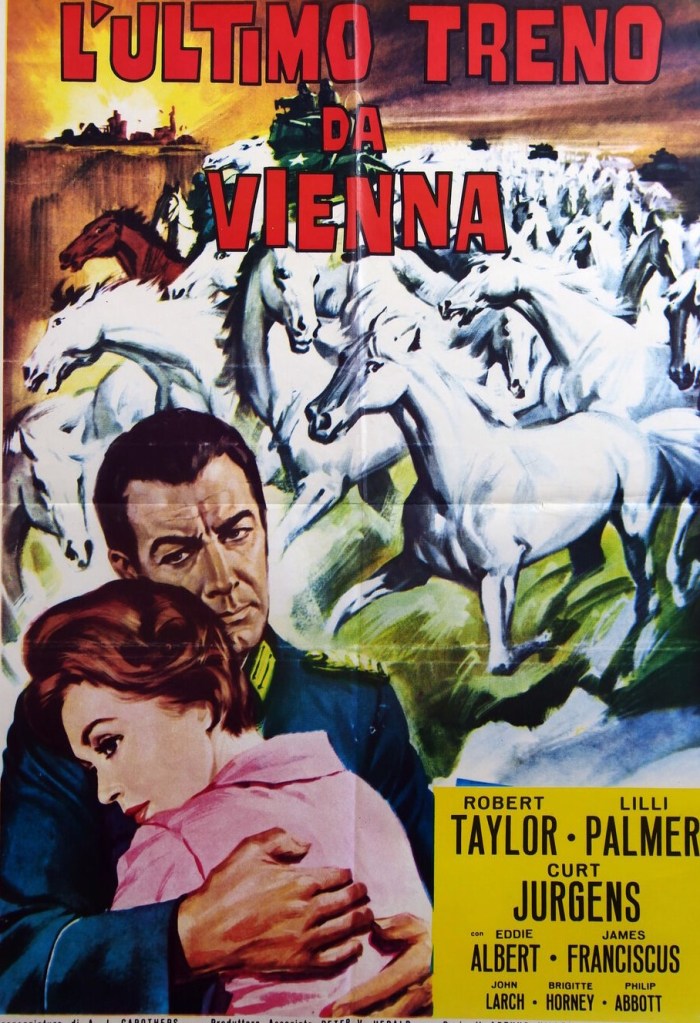
Miracle of the White Stallions (1963) ***

You wouldn’t look to Walt Disney in the 1960s to provide a tyro director with a calling card when so much of that studio’s output was saccharine. But this beautifully-mounted World War Two drama showed there was a new kid in town worth watching, name of Arthur Hiller. And if you always wondered why the later biopic of General Patton showed him in riding gear, that penchant is more clearly explained here.

You might balk, however, at the idea of a bunch of horses being considered in the same category as an art treasure worth protecting from the worst predations of war. And just as with the Von Trapp family, Austrians, despite welcoming the annexation of their country by Hitler in 1938, are given a free pass here.

In case you’re unfamiliar with the subject matter, the Spanish Riding School in Vienna was a celebrated nearly 200-year-old institution in which the famed Lipizzaner white “dancing” horses were put through their paces. With the Second World War coming to a close it was threatened on three fronts: the German Army poached its instructors to man the front line, the invading Russians wanted to appropriate the horses and starving refugees focused on the potential horse meat.

School chief Col Alois Podhajsky (Robert Taylor) and wife Pedena (Lili Palmer) organise an evacuation under the guise of using the horses to draw cartloads of legitimate art treasures. They hole up in the castle of Countess Arco-Valley (Brigitte Horney) but the mares are stolen by the Russians and hidden in Czechoslovakia. (Only the stallions perform, but without the females as breeding stock, the line would become extinct.)

The colonel ditches his German uniform on the arrival of American forces and puts on a performance in a makeshift arena in an attempt to convince Patton (John Larch) to mount a rescue of the captured horses. Patton, we learn here, is a renowned horseman, competed in the equestrian section of the 1912 Olympic Games, and if anyone considers a fabulous horse more valuable than a work of art it’s him. As it happens, there are prisoners to be freed in Czechoslovakia so the horses are included in that mission.

What’s unusual about this animal tale, given Disney’s predilection for anthropomorphising animals, is that it’s not told from the point-of-view of the horses. Nor, as you might have expected, given the studio’s plethora of young talent, turned into  the story of a young girl or boy attached to the horses. Instead, the focal point is the impact of the creatures on those around them.

Of course the colonel is bound to be obsessed. But for the ordinary soldiers, who might never appreciate a work of art, they represent a kind of majesty,  a grandeur, rising above the horror of war, something well worth the effort of rescue.

What’s even more unusual in saccharine-town is the script’s recognition of the effect of war on humanity. At one point Pedena laments that men are asked to possess “the strength and fury of giants…and then be again the men they were before.” And in some respects acknowledging the beauty of the horses is a step in the right direction. The Yanks are neither celebrated as brave nor foolhardy, in fact mostly they are just working grunts, cleaning out the castle, fixing up the arena, cracking jokes.

Hiller is the big find here. There’s a brilliant scene, all of 40 seconds long (I timed it) that would have been cut out of any other Disney picture. In a chiaroscuro of light, the colonel walks from one end of the deserted Vienna riding hall to the other and his wife, entering the frame, goes to join him. Nothing more is needed to indicate loss. Hiller clearly recognised opportunity and while the film itself is no masterpiece every single frame reveals a talented mind at work, his use of colors and costume, movement within the frame, employing Pedena and the Countess to comment on the action, allowing the inbuilt tension to carry the story without extraneous drama.

You’re mostly likely to remember the performing horses, the balletic choreographed movements, the “airs above the ground,” and indeed Hiller wisely devotes a good 15 minutes to this, but without his input this would either be overly sentimental, saccharine or little more than a documentary. This is a very grown-up picture for Disney.

Robert Taylor (A House Is Not A Home, 1964) was at the tag-end of his career, his first film in four years, but he still has the charisma to carry the film and the gravitas to see it over the line. Lili Palmer (The Counterfeit Traitor, 1962) is well cast as a voice of reason and offering commentary on humanity. Curt Jurgens (Pysche ’59, 1964) has an interesting role, lamenting, as he picks out a classical tune at the piano, how Hitler outlawed famous composers.

There’s a stronger supporting cast than you might expect: Eddie Albert (Captain Newman M.D., 1963) , James Franciscus (Valley of Gwangi, 1969) and German actress Brigitte Horney (The Trygon Factor, 1966).

Somebody certainly took notice of Hiller’s talent because his next films were The Wheeler Dealers (1963) with Lee Remick and James Garner and The Americanization of Emily (1964) with Julie Andrews and Garner.  A.J. Carothers (The Happiest Millionaire, 1967) based the screenplay on the book by Alois Podhajsky.

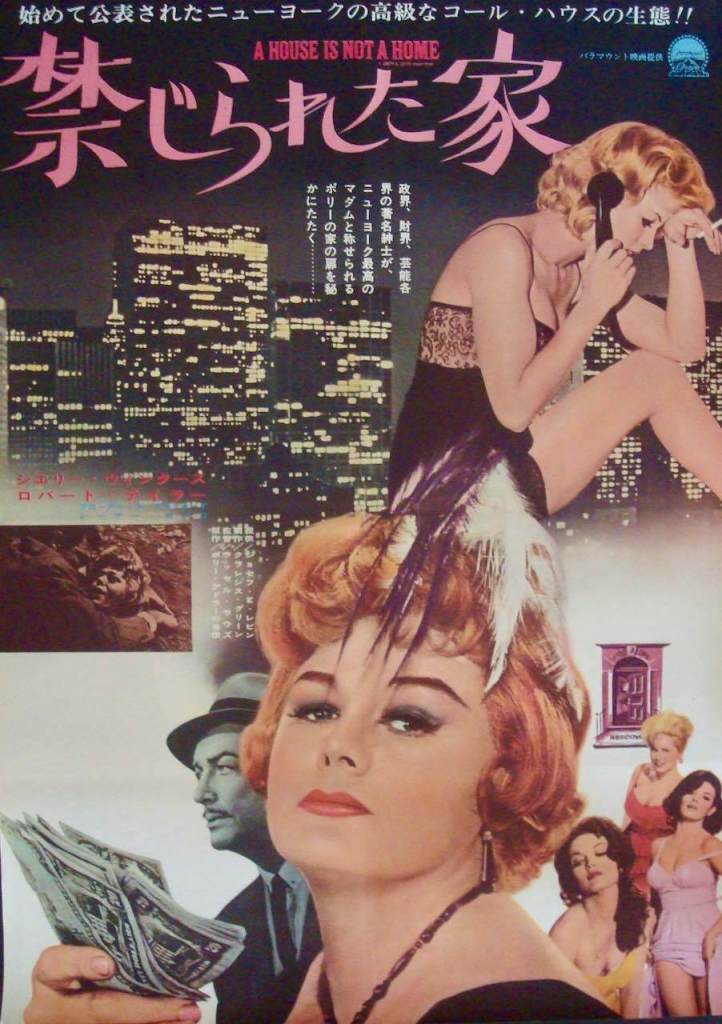
A House Is Not a Home (1964) ***

Best remembered these days as the debut film for Raquel Welch (One Million Years BC, 1966), the rest of the film is well worth a look.

Hypocrisy had its heyday in The Roaring 20s when prohibition made bootleggers millionaires, helped bankroll other criminal activities like prostitution and encouraged cops and politicians to seek their share of the loot. No surprise then that the biopic of real-life madam Polly Adler (Shelley Winters) is knee-deep in corruption.  

Thrown out of her own home after being raped, Adler finds a knight in shining armor in the shape of bootlegger Frank Costigan (Robert Taylor) and is soon, at first apparently innocently, pimping out her friends. The reality of what becomes her profession is not ignored, the word “whore” bandied around, one girl, Madge (Lisa Seagram), turning junkie as a result while Lorraine (Meri Welles) commits suicide. As in Go Naked in the World (1961) Polly realizes that true love has no place in her world, a relationship with musician Casey (Ralph Taeger) unsustainable.

Adler, in her many voice-overs, explains why vulnerable women become sex workers – poverty, lack of family and lack of hope is her take on it – and she professes to view it as a business and preferable to working in a factory for pitiful wages, but the movie is at its best in linking the nether worlds of infamy and showing that the woman is always the loser.  Morality got in the way of portraying Adler as a winner, a successful businesswoman who brought a certain amount of style to the oldest profession. Women profiting from illegal activity would not be deemed heroic (to use the word loosely) until Molly’s Game (2017) and like Jessica Chastain in that film Adler’s love life is in tatters because, like her male counterparts, she devotes so much time to her business.

While any attempt to properly portray the period is hampered by lack of budget, it does provide an array of interesting and occasionally real-life characters, Lucky Luciano (Cesar Romero) for example. A brothel proves an ideal meeting place for crooks and politicians, the latter easily bought by contributions to their campaign funds. Cops are not shy about asking for donations to their Xmas funds or using the facility.

The Adler operation puts a glossy shine on the shady business since all her girls are glamorous. But still the movie pulls no punches except in the case of the madam herself, presented too often as an innocent and who saw nothing wrong in taking as much advantage of the vulnerable girls in her employ as the  clients who paid for them. Nonetheless, while Adler attempts to justify her life the film’s moralistic tone undercuts this.


Oscar-winner Shelley Winters (The Chapman Report, 1962), more often a supporting player at this point in the 1960s than the star, grabs the role with both hands and although unconvincing as the younger girl delivers a rounded performance minus the blowsy affectations that marred much of later work. One-time MGM golden boy Robert Taylor, pretty much in the 1960s reduced to television (The Detectives, 1959-1962) and low-budget pictures, shows a glimpse of old form as the smooth bootlegger.

Cesar Romero (Oceans 11, 1960) and Oscar-winner Broderick Crawford (All the Kings Men, 1949) head up a checklist of old-timers filling out the supporting cast. Future director Lisa Seagram (Paradise Pictures, 1997) as the junkie hooker makes the biggest impact among the girls.

From the flotilla of wannabes playing Polly’s girls, apart from Raquel Welch the only one to break into the big time was Edy Williams (Beyond the Valley of the Dolls, 1970). In the main they comprised beauty queens – Amede Chabot (Miss America), Danica d’Hondt (Miss Canada) and Leona Gage (Miss Universe) who had a small part in Tales of Terror (1962). Otherwise Sandra Grant became the most famous – for marrying singer Tony Bennett. Patricia Manning had the most screen experience, second-billed in The Hideous Sun Demon (1958), bit parts in television shows, and fourth-billed in The Grass Eater (1961). Inga Nielsen would later turn up as bikini fodder in The Silencers (1966), In Like Flint (1967) and The Ambushers (1967).

Director Russell Rouse (The Fastest Gun Alive, 1956) was better known for the screenplay of D.O.A. (1949) and had a story credit for Pillow Talk (1959). In fairness, although the film has no great depth, Rouse keeps it ticking along via multiple story strands, although occasional lapses into comedy fail to work. Lovers of curiosities might like to note that Rouse was the producer on an abortive American attempt to remake the classic British television comedy Steptoe and Son for U.S. audiences with Lee Tracy in the role of Albert and Aldo Ray as his son Harold.

This is hard to get hold of. Ebay will be your best bet. Youtube has a print but it’s not in great condition.

Discover WordPress

A daily selection of the best content published on WordPress, collected for you by humans who love to read.

The Atavist Magazine

by Brian Hannan

WordPress.com News

The latest news on WordPress.com and the WordPress community.