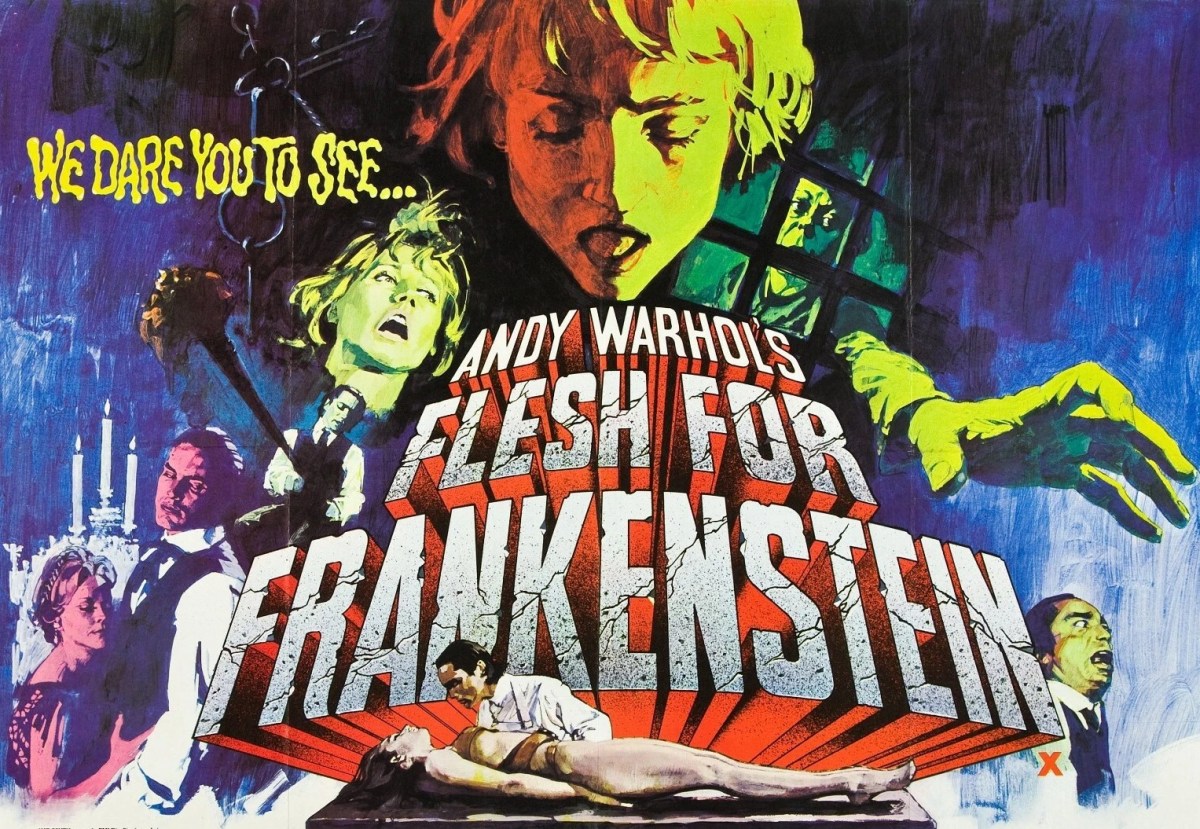
What with Jessie Buckley putting on her best Joker-style smile in Maggie Gyllenhaal’s Looney Tunes version of The Bride (2026) and Oscar Isaac going as high-tech as the 19th century would allow in Guillermo del Toro’s excellent Frankenstein (2025), Paul Morrissey’s Flesh for Frankenstein now appears tame in comparison though at the time its sexuality and gore came in for severe criticism. I’m guessing it’s the campiness that finds it rated so highly among the contemporary critics, but, apart from some poor acting, there’s little in this piece that would bring it down in your estimation or provide it with a free pass.
In terms of the thematic, there are connections to David Cronenberg’s Crash (1996), and in terms of trivia (although the version I saw lacked this) it was originally shot in 3D (though without, as was usually the way with such items, tons of things thrown into the viewer’s eyes) and included an early example of the imagination of SFX genius Carlo Rambaldi (Alien, 1979).
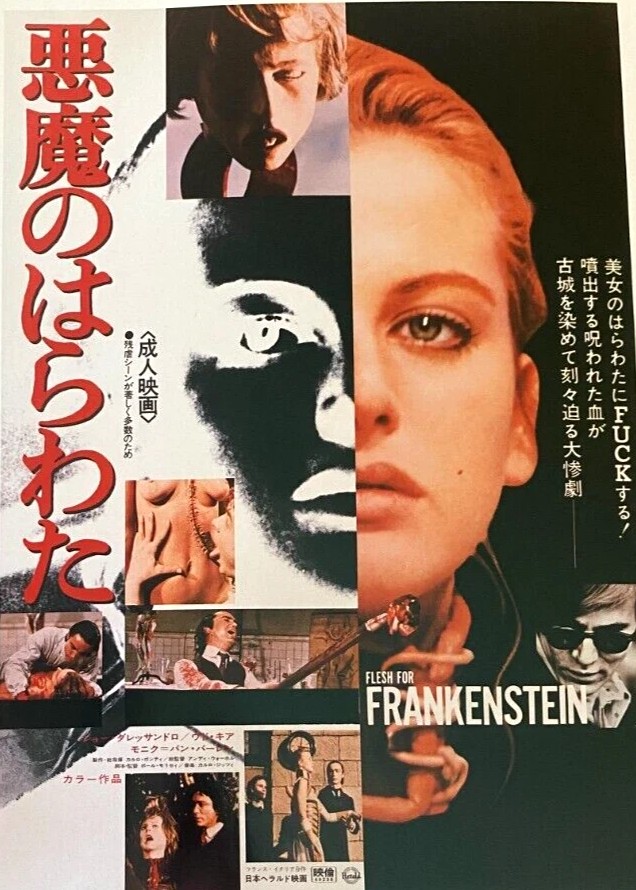
While you might recoil at the good doctor’s right-wing tendencies and his determination to bring to life a superior species, the rest of it is surprisingly good. There’s a determined stateliness to the camerawork and the score by Claudio Gizzi (he only did another two) is as far removed from the over-the-top menace that infected Hammer and AIP versions as you can get.
I wasn’t a card-carrying member of the avant-garde back in the day any more than I am now so didn’t rush out to see this on its first appearance and probably wouldn’t have been tempted to watch it at all except that the presence of Dalila di Lazzaro from Three Men to Kill (1980) piqued my interest. In truth, she has a small part as the female of the species in the monster department.
Here, Baron Frankenstein (Udo Kier) is aiming for the double whammy of not just creating male and female monsters but of getting them to procreate and provide him with a new master race. He’s handy with a set of garden shears, lopping off heads to suit his experiment, and stitching, molding cadavers to suit his purpose, and he clearly takes perverse delight in plunging his hands – and shades of David Cronenberg’s Crash (1996) – and other parts of his body into the innards for sexual satisfaction.
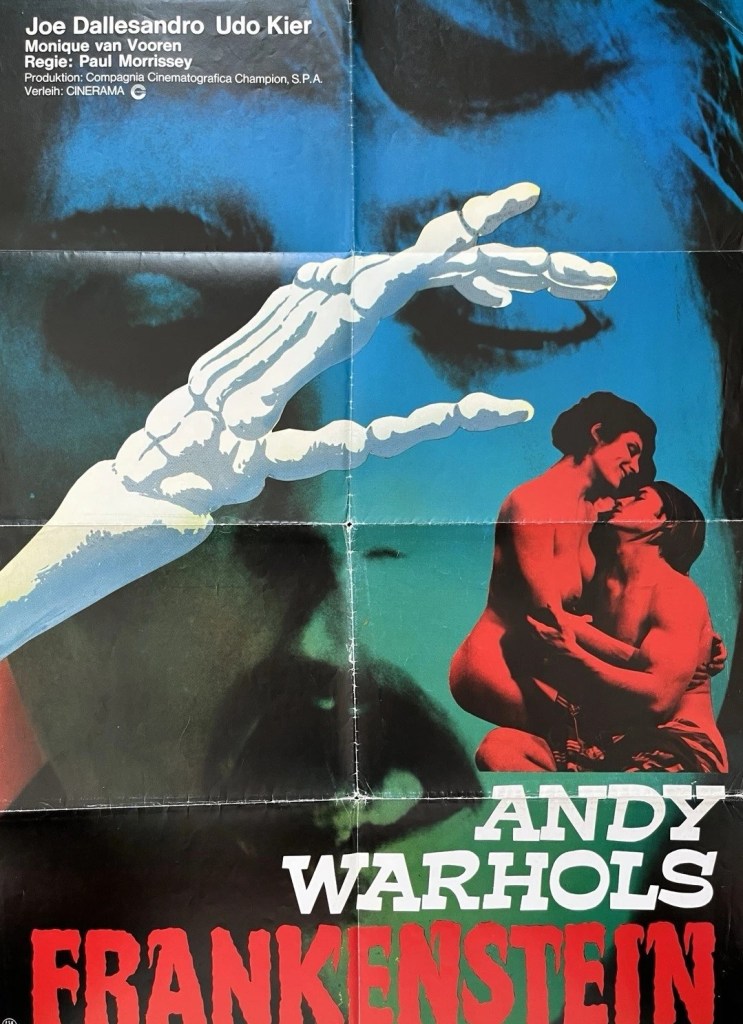
If I’ve read this correctly, we’re also in incest territory, his children the offspring of his sister. Or it may well be that she’s employed for her non-existent maternal skills rather than having played a part in their birth. It’s hard to see why he wants any more creations in his own image since the kids are as creepy as they come, voyeurs to the core, guillotining dolls, making off with any spare body parts, and with a malignancy that sets the tone for a stunning last scene.
His sister Katrin (Monique Van Vooren) has a degree in hypocrisy, taking a moral high tone with villagers she catches having sex while recruiting lusty local stud Nicholas (Joe D’Allesandro) for her own bed. The Baron’s assistant Otto (Arno Jurging) is from the Marty Feldman (Young Frankenstein, 1975) school of eye-popping. The only flaw in Frankenstein’s plan is he hasn’t taken into account sexual preference, since Nicholas’s buddy Sacha (Srdjan Zelenovic),selected to supply a head and brain for his male monster, is more interested in men than women, so despite the best efforts of the female monster (Dalila di Lazzaro) his experiment is doomed to failure.
Most movies in this subgenre exist in a moral vacuum, beyond someone taking vengeance on the horror-meister, but here Sacha not only has no interest in sex but he’s so appalled at what he has become thanks to Frankenstein that he wants to die and is so scandalized by the baroness’s attempts to seduce him that he suffocates her.
For the most part, this is restrained, although over-acting is endemic, and the science as convincing as in the Del Toro version. The gore and sex would scarcely trouble a contemporary audience.
The climax is just superb. With corpses littering the floor, including that of the Baron and his creations, and Nicholas hanging from the ceiling, the kids each pick up a scalpel and begin to lower the captive, leaving the audience to guess the rest.
Any inherent campiness passed me by and I suspect that impact has faded with time. What we’re left with is an intriguing well-directed entry into the canon.
Not sure why Joe Dallesandro (Lonesome Cowboys, 1968) takes top billing, aside from his beefcake potential and the central role he played in the Andy Warhol Factory, given he has a small part. Like Klaus Kinski, Udo Kier (The Salzburg Connection, 1972) has a cult following, and the freedom to overact as much as he likes.
Beside lending his name to the venture for publicity purposes, Andy Warhol played no part. The direction by Paul Morrissey (Heat, 1972) has, I thought, considerable distinction especially the camera movement and the music. He wrote the screenplay.
Surprisingly good.

 The Magnificent 60s
I saw this in 3D at a downtown Milwaukee grinder. Quite eye-openig it was.
“Working titles for the film included Flesh for Frankenstein, The Frankenstein Experiment, Up Frankenstein, and The Devil and Dr. Frankenstein.
According to a 2 Jan 1996 Village Voice article, director Paul Morrissey first joined Andy Warhol’s Factory in 1965, and served not only as a filmmaker, but as manager to the famous artist-turned-filmmaker, for almost ten years. In 1973, Morrissey directed both Andy Warhol’s Frankenstein and Andy Warhol’s Dracula (1974, see entry) consecutively; however, only Andy Warhol’s Frankenstein was filmed in 3D. The films were shot at Cinecittà studio in Rome, Italy, with financing provided by Carlo Ponti, as noted in a Jul 1974 Coast article. A 14 Jul 1974 NYT article stated that Ponti provided $700,000 for the “two-picture package.”
In a 3 May 1974 HR article, Morrissey stated that he used a crew of sixty people on the four-week shoot, and prioritized performance issues over the challenges presented by 3D technology. The film was Warhol’s first project to be shot in 35mm, as noted in a 14 Jul 1974 NYT article. According to the Jul 1974 Coast article, the filmmakers utilized Spacevision, a recently developed 3D process that required only a single camera and standard projector, in the place of two cameras and two projectors necessitated by older 3D techniques. In the 3 May 1974 HR article, Morrissey stated that his biggest obstacle on set was not the 3D technology but live sound recording, as Italian crew members were more accustomed to depending on ADR (automated dialogue replacement, or “looping”), and Morrissey intended to use “100% live sound.” Improvisation was not encouraged on set, as it had been on previous Morrissey films, because the horror genre necessitated a more substantial plot. In the HR article, Morrissey stated that the film was delivered within the expected budget and schedule.
An 11 Apr 1974 DV news item reported that rights to the film were first secured by Herbert Nitke, who formed an entity called Lodi Distributing specifically for the film, to avoid associations with Nitke’s other company which distributed the pornographic film The Devil in Miss Jones (1973). Though Lodi bowed out as the film’s distributor, Nitke “retain[ed] a 50% interest,” along with the new distributor, Bryanston Pictures. According to a 30 Apr 1974 DV news item, Bryanston would premiere Andy Warhol’s Frankenstein on 8 May 1974 in Westwood, CA. The film had previously screened twice as Flesh for Frankenstein at Los Angeles’ Filmex, to sold-out audiences. A 26 Apr 1974 HR news item stated that the film required “a special screen and optical equipment” at each of its engagements.
Andy Warhol’s Frankenstein was rated X by the MPAA. According to Coast, an MPAA member pointed to the scene in which Baron Frankenstein revives his female monster by having sex with her, and inserting one hand into an incision in her torso, as particularly offensive material that helped earn the X-rating. Though the film remained X-rated throughout its initial release, the MPAA later re-rated it R, as stated in a 14 Jul 1975 Box report.
The film opened to mixed reviews. The 5 Apr 1974 HR review praised Morrissey’s direction, stating that the 3D technology required to shoot the film helped create a more controlled look than Morrissey had achieved in earlier Warhol films. While the 8 May 1974 LAT review denounced the film’s ironic detachment as “chilling and forlorn,” the 20 May 1974 Newsweek review lauded the film’s intellectual send-up of mainstream audiences’ increasing desire for violence and sex. The film took in $1,003,932 in box office receipts in its first two months of release, as stated in a 14 Jul 1974 NYT article.
According to a 21 May 1974 HR news item, Bryanston Pictures condemned LAT when the newspaper refused to publish critics’ quotes on advertisements for Andy Warhol’s Frankenstein due to its X-rating. Bryanston vice-president and COO, Ted Zephro, accused LAT of “blatantly censoring public information,” and stated that LAT had defended their policy by explaining that some pornographic filmmakers had invented critics’ quotes to use in their advertisements. Zephro mentioned positive reviews from Playboy, Newsweek, and New York as some of the credible sources for quotes that he would like to see in the advertisements for Andy Warhol’s Frankenstein.
A 27 Aug 1976 HR news item reported that the film had grossed over $20 million, to that time. Hoping to make another $10 million from a re-issue, Monarch Releasing Corp. purchased the rights to the film with plans to distribute it after another 3D release, Fantastic Invasion of Planet Earth, aka The Bubble (1966, see entry).
A 10 Mar 1982 Var news item announced that Silverstein International Corp. would be selling all-media rights to both Andy Warhol’s Frankenstein and Andy Warhol’s Dracula to foreign distributors, with screenings scheduled at the American Film Market in Los Angeles, CA, 25 Mar—2 Apr 1982. Andy Warhol’s Frankenstein was available to foreign markets in 3D as well as “flat” versions. According to a 15 Apr 1982 DV news item, Landmark Films planned to reissue Andy Warhol’s Frankenstein in 30 Southern California movie theaters the following day. A 21 Apr 1982 HR report stated that Landmark bought the film from Bryanston Pictures, partly because of a wave in popularity of 3D films, and spent $75,000 to advertise the screenings. After a three-day opening weekend, the rerelease had taken in $300,000 in box office receipts, and Landmark planned to expand the release nationwide.
According to a 23 Jun 1993 HR article, the Museum of Modern Art in New York, NY, was restoring Andy Warhol’s feature-length and short films, including Andy Warhol’s Frankenstein. Following the restoration, domestic and foreign “theatrical, TV and home video outlets” would be offered the chance to license the films individually or, in some cases, as packages. HR noted that several stars of Warhol films, including Joe Dallesandro, were expected to promote the restored versions. Proceeds from the sales were to go to the Andy Warhol Foundation for the Visual Arts, specifically towards artists’ grants.”
LikeLiked by 2 people
that’s terrific. I knew nothing about this except the Warhol connection.
LikeLiked by 1 person