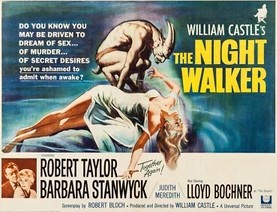
The Night Walker (1964) ****

Deserves its spot in the cult pantheon, hints of Spellbound (1945) and Vertigo (1958),  mesmeric atmosphere of dream/nightmare held together by a hypnotic performance by Barbara Stanwyck, tonsils in overdrive. But no point screaming at the unseen, at the unknown, when it invades reality, no point trying to escape a dream when you’re trapped inside.

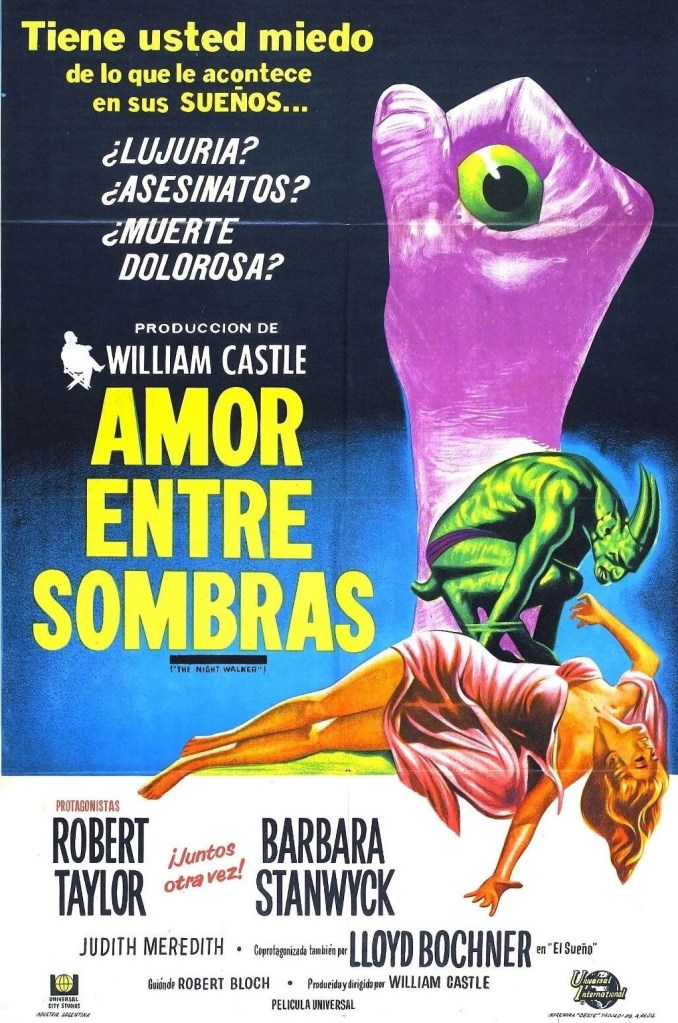
Except that there’s no sign of the demonic figure haunting widow Irene Trent (Barbara Stanwyck) on the poster it delivers on all other fronts, driving you to question our heroine’s grip on reality as much as she questions herself. If there’s such a thing as self-gaslighting, she’s in the vanguard.
Creepy rich blind husband Howard (Hayden Rorke) is an emperor of surveillance, microphones everywhere catching her every word, including what she utters in her dreams, which convinces him that she’s having or has had an affair. When he dies in an explosion, body eviscerated in the inferno, she can’t come to terms with her freedom, holing up in the tiny apartment at the back of her beauty parlor, relying on assistant Joyce (Judi Meredith) and attorney Barry (Robert Taylor) for moral, and perhaps in relation to the solicitor, physical support.

When the unreal invades her daily life and she begins to believe in her dreams and when the handsome lover (Lloyd Bochner) of her night-time imagination takes shape, she begins to doubt her sanity. But so convinced, on the other hand, that she must be sane, she tries to convince Barry that her dreams have basis in fact. She tracks down the apartment (No 341) she visited in her dreams and the chapel where she imagined she was married to said lover.

You wish director William Castle (Straitjacket, 1964) had continued exploring the theme of dreams vs reality, and how to cope when the imagination takes over. But instead, it twists into thriller territory, the old set-up, the gaslighting that could send Irene over the edge and straight into a sanatorium while her husband’s substantial wealth ends up elsewhere.

Even so, once it heads down this particular path, it’s still mighty tricky. Who could be in on the act? All the people she trusts – Barry, Joyce, even Loverboy? And if she’s going to let her suspicions run riot, how is she going to come out the other side, for surely that will tip her over into madness?
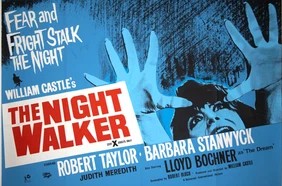
Exceptionally lean, barely 80 minutes once you exclude the treatise on dreams at the start that establishes the premise of the “Night Walker” – the person who lives through their dreams – and exceptionally clever. Irene is so given to screaming that you’d scarcely think there’s space left in her brain to to work out just what’s going on. And there’s no shortage of permutations.

Has her dead husband, half his face obliterated by burns, come back to haunt her? Is the Lover just a figment of her imagination? Why can’t she make do with someone as handsome as Barry?

We’ve got smoke issuing from under doors, recurrent bright flashes of explosion, mannequins that seem alive, all sorts of jiggery-pokery with guns, telephone wires cut, a blind man who can tell the color of your dress, eyeballs plucked from faces and squeezed until they pop, and the expectation all the time of a straight dive into madness. No escape in other words.

Even when it fast approaches a climax you might have guessed the outcome of, turns out you were wrong and there’s still a few more twists – and screams – to come.

The fact that it turns into a straightforward thriller at the time tended to diminish the emphasis on the demonic, but these will be more fully appreciated today when the line between reality and fiction is stretched ever thin.

Four-time Oscar nominee Barbara Stanwyck (A Walk on the Wild Side, 1962) might have been accused of slumming it in low-budget horror fare such as this, but, boy, in her final big screen appearance, (although she successfully switched to television as star of The Big Valley, 1965-1969) does she give it her best shot. If this was Stanwyck’s swansong, Robert Taylor (A House Is Not a Home, 1964) , a fellow relic from Hollywood’s Golden Age, wasn’t far behind, only a few movies left in him.

For all this relied on William Castle’s directorial dexterity,  the imagination behind it came from master of the macabre Robert Bloch (Psycho, 1960).

Cult doesn’t come much better.

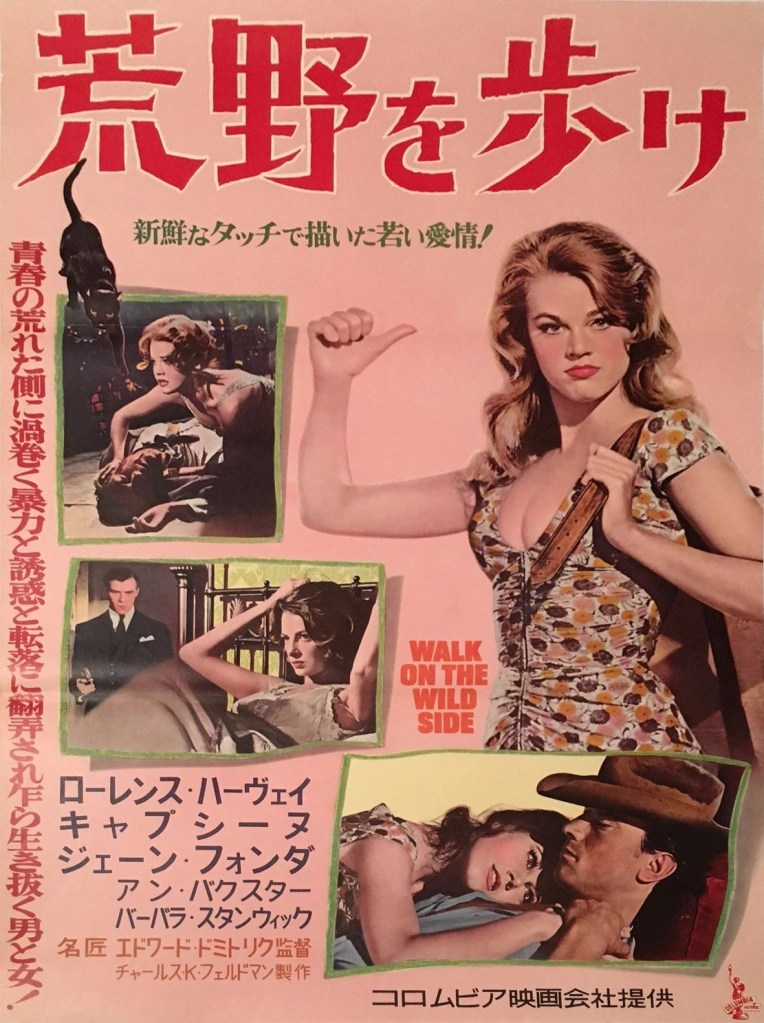
Walk on the Wild Side (1962) ***

As much as the censor would permit – would be the subtitle. While not as harsh as the Nelson Algren source novel, it’s still, wrapped up in a bitter romance, a more brutal than heretofore expose of the sex worker, far removed from the gloss of Butterfield 8 (1960) or the romantic comedy of Never on Sunday (1960) and Irma La Douce (1963).

The initial thwarted romance lacks the tragic element. It falls apart due to the mundane. After a four-month affair Dove (Laurence Harvey) can’t commit to artist Hallie (Capucine) because his father is too ill to leave. So she ups sticks and heads for New York, hooks up with buyer Jo (Barbara Stanwyck) who turns out to invest in more than art, and ends up in a New Orleans brothel where as well as servicing the clients she can continue making sculptures.

After his father dies three years later, Dove heads to New Orleans to find her, but with no idea where to look. He falls in with vagabond-cum-thief Kitty (Jane Fonda) and eventually having dumped her due to her thieving ways takes refuge in a café whose owner Teresina (Anne Baxter), a victim of Kitty, offers him employment. She suggests he puts an advert in a New Orleans newspaper and just when he’s giving up hope and Teresina is getting up her hopes that she can win him over romantically he gets a phone call.

He’s clearly unaware that Hallie is a sex worker and after romancing her sets them up in an apartment. Hallie abandons the reunion after a night or possibly just an idyllic afternoon. Hallie’s reluctance is twofold. She’s become accustomed to the relative laziness of her life, she’s a high-class lady and is not worked too hard, plus she’s got accommodation and a studio to work in and she knows her boss Jo is sweet on her. On the other hand, it would be difficult to quit, the brothel employs tough guy Oliver to keep the girls in line and nobody’s going to want her to be giving it away for free.

Kitty, now working in the establishment, annoyed that he previously rejected her advances, gives Dove a full run-down on his lover. And there’s a legal catch that Jo is quick to take advantage of. Since Kitty is now a sex worker and it was Dove who took her with him to New Orleans he could be prosecuted for sex trafficking of a minor. When that doesn’t work, Dove receives a beating.

Kitty now decides Dove isn’t so bad after all, feels remorse at her role in his downfall, and helps him get back to café where Teresina cares for him and gets her hopes up once again. Then she helps Hallie escape and then fesses up to Oliver where she is. It doesn’t end well – although the censor would be pleased since after the climactic fracas the brothel is closed down and Jo and Co jailed.

It’s got a Tennessee Williams feel, though everything set in the South appeared to come into his bailiwick, but most of the realism is understated, as it would have to be in those times. Jo’s a groomer of the vulnerable, and for all Hallie’s artistic ambition she’s every bit as easy pickings as Kitty who is grateful to be freed from prison where she was arrested as a vagrant and reckons being given money for fancy clothes and having a roof over her head is good enough reward for selling body and soul. Her role in the denouement is a mite too convenient from the narrative perspective but it will do as a means of tacking on a tragic ending.

It helps enormously that most of the performances are understated. Laurence Harvey (A Dandy in Aspic, 1967), more commonly a scene-stealer, is good value and Barbara Stanwyck (The Night Walker, 1964) only requires a stare to make her feelings known. Though Capucine (Song without End, 1960) was criticized at the time I felt her performance was measured. Jane Fonda (Barbarella, 1968) was more of a wild card and it didn’t seem believable that such a flighty piece was going to become principled.

You can thank director Edward Dymytryk (Shalako, 1968) for keeping the actors in line and maintaining an even tone without spilling over into the melodramatic. John Fante (My Six Loves, 1963) and Edmund Morris (The Savage Guns, 1961) adapted the book. Special nod of appreciation to Saul Bass for the credits.

Marketing: Black Stamps

You might be tempted to fork out for the range of James Bond Commemorative Stamps being brought out to celebrate No Time to Die when it eventually sees the light of day on movie screens.

But stamps either as collector’s items or for trading purposes have been around since the silent era.  A line of movie commemorative stamps issued in America in 1944 sold 1.1 million first day covers, the second highest-ever at the time, and in the late 1950s Movie Stamps Inc set up a business that worked in the same way as the Green Stamps given away in supermarkets and gas stations. In this system, if you collected enough you won a gift, usually, in regards to the movie business, a couple of free tickets.

So Columbia Pictures looking for a way to sell its Hammer double bill The Gorgon (1964) with Christopher Lee and Peter Cushing and The Curse of the Mummy’s Tomb (1964) starring the lesser-known Terence Morgan revived the idea.

Horror specialist Hammer was one of the British film studios going through a production boom – over 100 movies were being made in that country in that year – with The Secret of Blood Island (1965) in the works for Universal and She for MGM. But horror was still a difficult sell and Hammer had ignored the advice of Variety that The Gorgon would work best if teamed with “a lively comedy.”

American International had expanded the horror market away from the Frankenstein/Dracula axis by exploiting the Edgar Allan Poe back catalog and William Castle had achieved some success in modern tales of terror such as Dementia 13 (1963) and The Night Stalker (1964). But Castle could call upon the likes of Barbara Stanwyck and Robert Taylor, players with substantial marquee status despite their lately diminished careers, for radio and television interviews.

For Hammer the obvious exploitation options were limited to a spread in the quarterly Castle of Frankenstein magazine which could be purchased for 35 cents at newsstands.

So the marketing honchos dusted off the old movie stamps idea. In some advertisements, the studio offered free stamps to the first 10,000 ticket-buyers but in the advertisement shown above they appeared to be given away free to everyone. The faces of the various monsters and characters featured in both films were imprinted on the stamps. However, on the debit side, there was no sign of any redemption for the collected cards. You couldn’t, should you be so inclined, collect ten and get a guest ticket in return. You could probably trade them and build up a collection. I’m not sure they did much for the movie judging by the box office accounts that exist but if anyone remembers seeing them or collecting them let me know.

Sources: “Film Industry New 3c Stamps Sets Record,” Variety, Nov 15, 1944, 1; “Tease-In Kids with Movie Star Stamps,” Variety, Aug 21, 1957, 20; “Premium Stamp Set Up,” Variety, Aug 20, 1958, 7; Review of The Gorgon, Variety, Aug 26, 1964, 6;  advert, Box Office, Nov 16, 1964, 2; “Film Plugs and Pluggers,” Variety, December 30, 1964, 21; Mark Thomas McGee, Beyond Ballyhoo: Motion Picture Promotion and Gimmicks, p125-131.

Discover WordPress

A daily selection of the best content published on WordPress, collected for you by humans who love to read.

The Atavist Magazine

by Brian Hannan

WordPress.com News

The latest news on WordPress.com and the WordPress community.