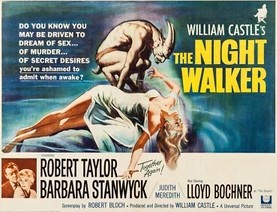
Deserves its spot in the cult pantheon, hints of Spellbound (1945) and Vertigo (1958), mesmeric atmosphere of dream/nightmare held together by a hypnotic performance by Barbara Stanwyck, tonsils in overdrive. But no point screaming at the unseen, at the unknown, when it invades reality, no point trying to escape a dream when you’re trapped inside.
Except that there’s no sign of the demonic figure haunting widow Irene Trent (Barbara Stanwyck) on the poster it delivers on all other fronts, driving you to question our heroine’s grip on reality as much as she questions herself. If there’s such a thing as self-gaslighting, she’s in the vanguard.
Creepy rich blind husband Howard (Hayden Rorke) is an emperor of surveillance, microphones everywhere catching her every word, including what she utters in her dreams, which convinces him that she’s having or has had an affair. When he dies in an explosion, body eviscerated in the inferno, she can’t come to terms with her freedom, holing up in the tiny apartment at the back of her beauty parlor, relying on assistant Joyce (Judi Meredith) and attorney Barry (Robert Taylor) for moral, and perhaps in relation to the solicitor, physical support.
When the unreal invades her daily life and she begins to believe in her dreams and when the handsome lover (Lloyd Bochner) of her night-time imagination takes shape, she begins to doubt her sanity. But so convinced, on the other hand, that she must be sane, she tries to convince Barry that her dreams have basis in fact. She tracks down the apartment (No 341) she visited in her dreams and the chapel where she imagined she was married to said lover.
You wish director William Castle (Straitjacket, 1964) had continued exploring the theme of dreams vs reality, and how to cope when the imagination takes over. But instead, it twists into thriller territory, the old set-up, the gaslighting that could send Irene over the edge and straight into a sanatorium while her husband’s substantial wealth ends up elsewhere.
Even so, once it heads down this particular path, it’s still mighty tricky. Who could be in on the act? All the people she trusts – Barry, Joyce, even Loverboy? And if she’s going to let her suspicions run riot, how is she going to come out the other side, for surely that will tip her over into madness?
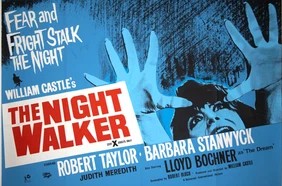
Exceptionally lean, barely 80 minutes once you exclude the treatise on dreams at the start that establishes the premise of the “Night Walker” – the person who lives through their dreams – and exceptionally clever. Irene is so given to screaming that you’d scarcely think there’s space left in her brain to to work out just what’s going on. And there’s no shortage of permutations.
Has her dead husband, half his face obliterated by burns, come back to haunt her? Is the Lover just a figment of her imagination? Why can’t she make do with someone as handsome as Barry?
We’ve got smoke issuing from under doors, recurrent bright flashes of explosion, mannequins that seem alive, all sorts of jiggery-pokery with guns, telephone wires cut, a blind man who can tell the color of your dress, eyeballs plucked from faces and squeezed until they pop, and the expectation all the time of a straight dive into madness. No escape in other words.
Even when it fast approaches a climax you might have guessed the outcome of, turns out you were wrong and there’s still a few more twists – and screams – to come.
The fact that it turns into a straightforward thriller at the time tended to diminish the emphasis on the demonic, but these will be more fully appreciated today when the line between reality and fiction is stretched ever thin.
Four-time Oscar nominee Barbara Stanwyck (A Walk on the Wild Side, 1962) might have been accused of slumming it in low-budget horror fare such as this, but, boy, in her final big screen appearance, (although she successfully switched to television as star of The Big Valley, 1965-1969) does she give it her best shot. If this was Stanwyck’s swansong, Robert Taylor (A House Is Not a Home, 1964) , a fellow relic from Hollywood’s Golden Age, wasn’t far behind, only a few movies left in him.
For all this relied on William Castle’s directorial dexterity, the imagination behind it came from master of the macabre Robert Bloch (Psycho, 1960).
Cult doesn’t come much better.


Here is something:
“The 3 February 1964 DV announced The Night Walker as filmmaker William Castle’s first project under his Universal Pictures contract. He claimed it would feature “a form of human destruction never before seen on the screen.” Castle dismissed criticisms of movie violence as “ridiculous,” adding that such pictures were earning considerable profits. He described his latest production in the 16 September 1964 Variety as his transition from “gore into pure shock and suspense.”
According to the 3 June 1964 Variety, Castle was interviewed several months earlier by Chicago, IL, journalist Shirley Eder. During the interview, Castle stated that he would like Barbara Stanwyck to star in his next production. After suggesting Stanwyck’s ex-husband, Robert Taylor, as co-star, Eder promised to share Castle’s request with the actress. Castle responded by promising Eder a trip to Hollywood, CA, if she could persuade Stanwyck and Taylor joined the cast. Both Castle and Eder kept their promises. The 15 April 1964 NYT noted that it was the first time in more than twenty years that Stanwyck and Taylor appeared on screen together.
The 4 May 1964 DV stated that Taylor was forbidden to show Stanwyck his assigned “horror mask” until the day he was to wear it. Ten days later, DV reported a cocktail party at Universal’s commissary to launch the production. The 15 May 1964 LAT included George Kennedy among the cast; his participation has not been determined. Other casting announcements included Paulle Clark and Kathleen Mulqueen (3 June 1964 DV) and Rochelle Hudson (20 May 1964 Variety).
The 24 December 1964 LAT noted that a replica telephone booth was placed on a Los Angeles, CA, street corner in the Wilshire District for use in an exterior scene. After the scene was completed and the studio retrieved the booth, eight dimes were discovered in the coin box.
An article in the 30 July 1964 DV indicated that photography had recently been completed. Editing was underway, according to the 5 August 1964 Variety. The 7 August 1964 DV reported that recording of Vic Mizzy’s score, conducted by music supervisor Joseph Gershenson, began that day.
A news brief in the 13 October 1964 DV announced that Castle began production that day on a six-minute promotional film, titled Experiment in Nightmares. The $25,000 short subject featured Pat Collins, known as “the Hip Hypnotist,” questioning six mesmerized subjects on their nightmares. The 16 December 1964 Varietynoted that Universal also planned a “‘dream’ contest” to be offered in the Jan and Feb 1965 issues of Modern Screen magazine. An item in the 30 December 1964 Variety reported that Castle, associate producer Dona Holloway, and cast members Stanwyck, Taylor, and Lloyd Bochner were scheduled to begin a series of promotional tours on 4 January 1965. Cities included New York City, Boston, MA, Philadelphia, PA, Detroit, MI, Chicago, IL, and the TX cities of Dallas, Fort Worth, Houston, Austin, and San Antonio.
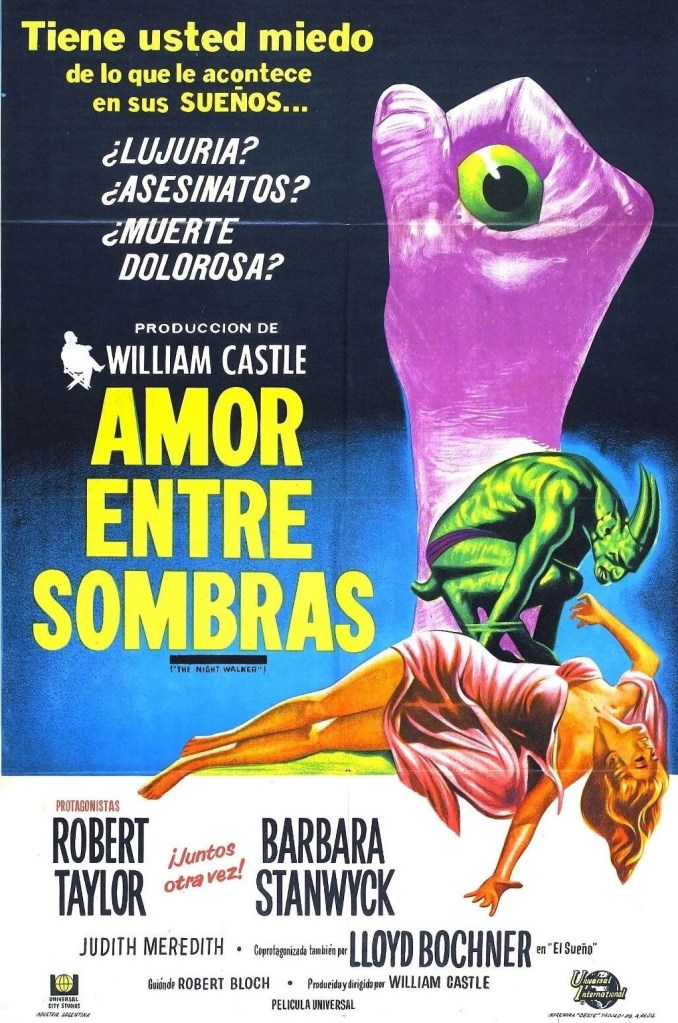
The Night Walker opened 30 December 1964 in Los Angeles, and 20 January 1965 in New York City. Reviews were mixed, with the 1 January 1965 LAT recommending the film as “one of the better horror efforts” currently in release, and the 21 January 1965 NYT calling it “eerie nonsense.” The 3 March 1965 Variety reported that the Dallas Citizens’ Committee for Decent Movies (CCDM) objected to advertising copy, which included the phrase, “Lust, murder and secret desires.” The picture was still in release as of 7 July 1965, according to that day’s DV.
A version of the title song was recorded by the Sammy Kaye Orchestra for Decca Reccords. A related album, titled The Night Walker’s Dead-Time Stories! was released on Vee-Jay.”
LikeLiked by 2 people
That was very interesting. I’d never been much interested in castle though to some he is true cult.
LikeLike