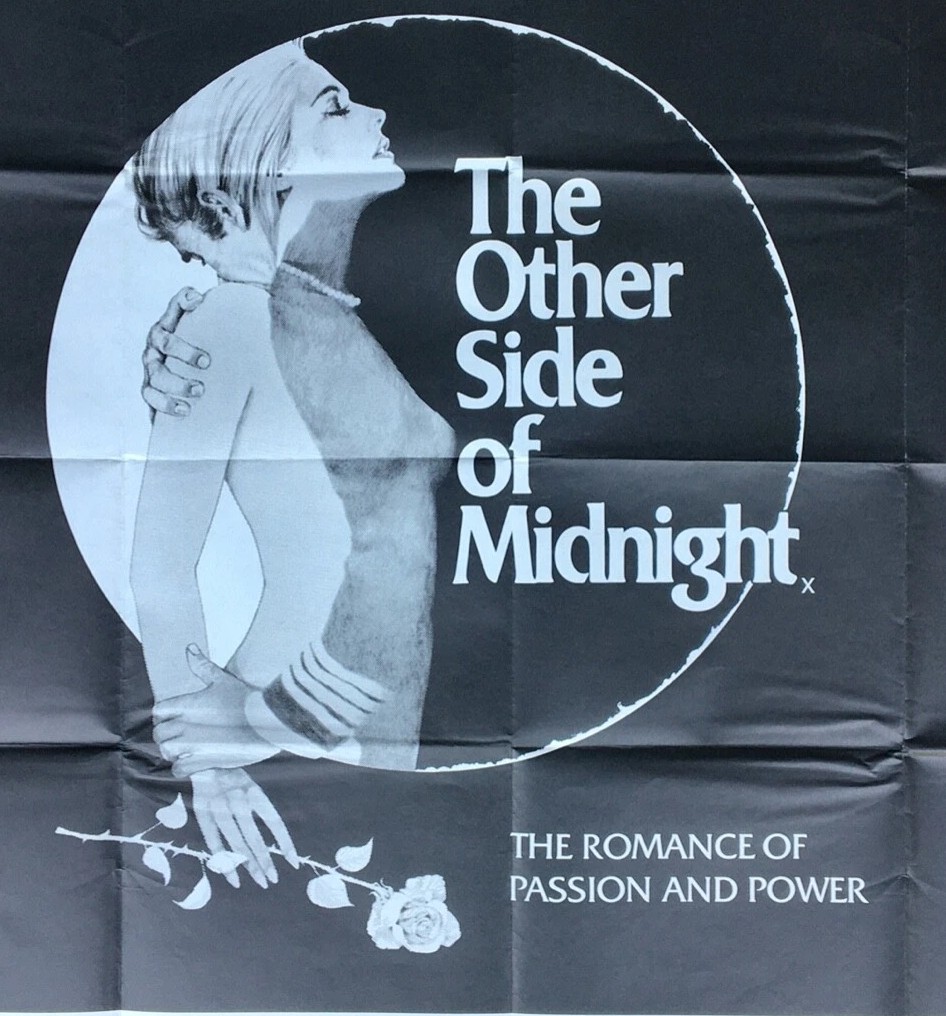
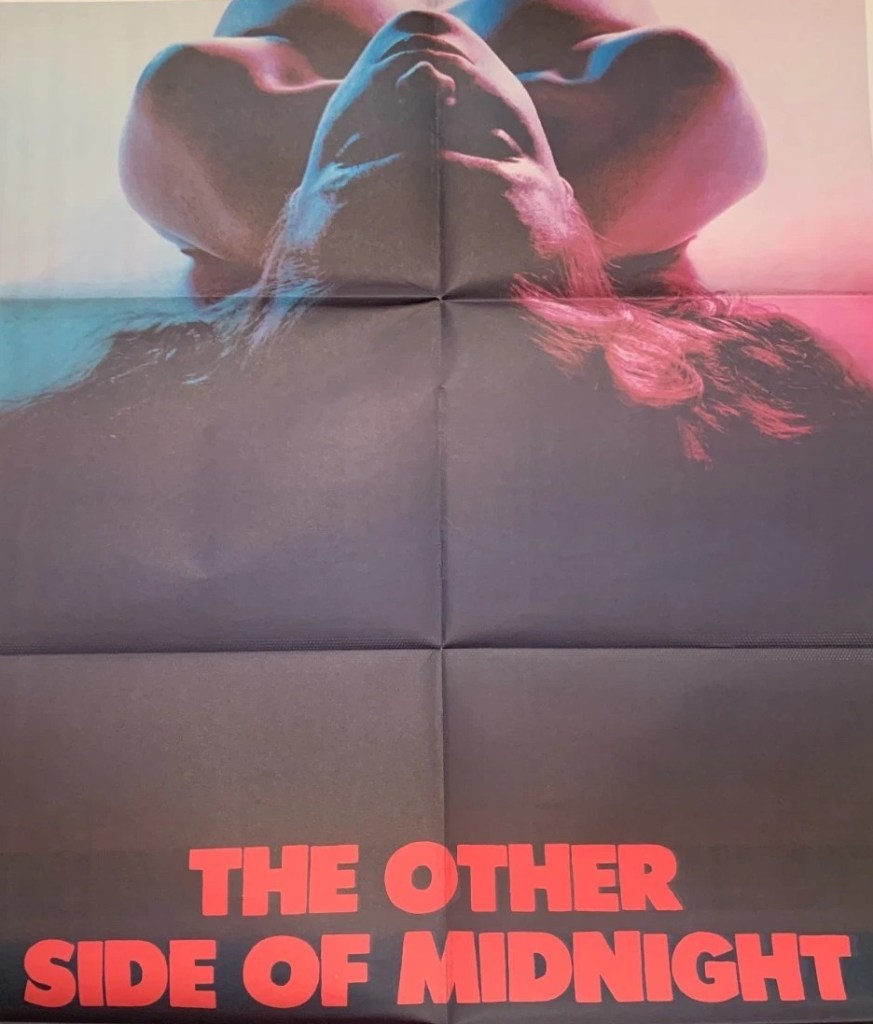
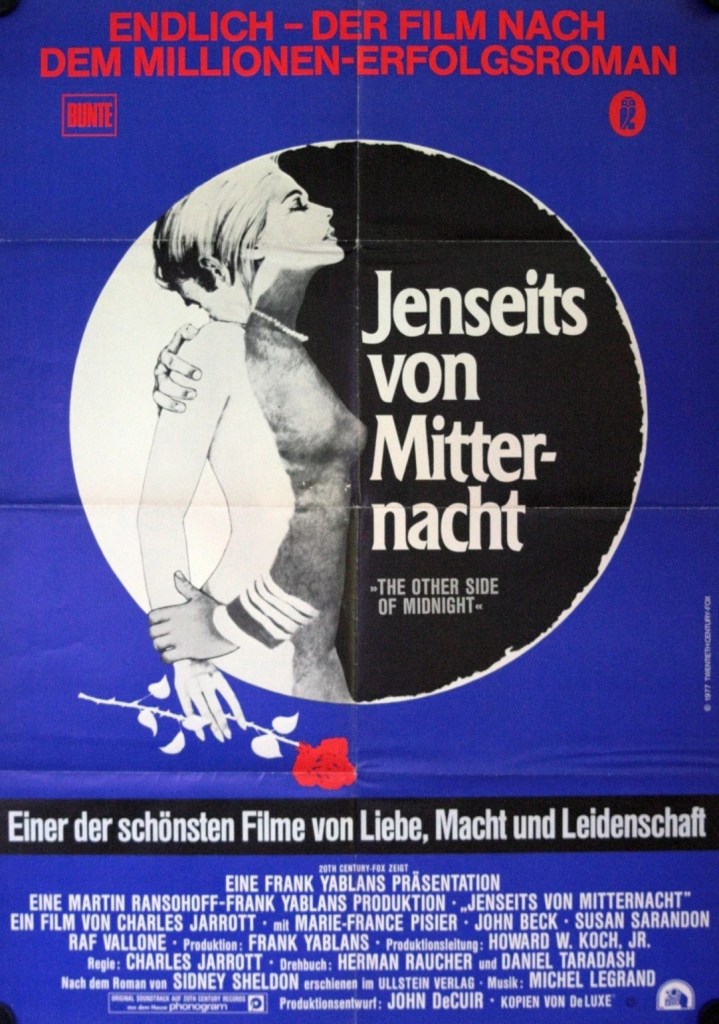
The Other Side of Midnight (1977) ****

I was settling in for what I thought was an evening of high-class trash when the unexpected occurred. This wasn’t a mushy World War Two romance but a tale of revenge on a par with that wreaked by the legendary Count of Monte Cristo or by the more recent The Housemaid (2026). Except for throwing a romantic spanner in the work, this has little to do with the Second World War and everything to do with how a Frenchwoman drags herself from the gutter by dint of personality and guile to reach, by way of movie stardom, the highest echelons of society and use her wealth and power to extract vengeance.

The two women, Noelle (Marie-France Pisier) and Catherine (Susan Sarandon) who end up competing for the affections of charming pilot Larry (John Beck) may well begin with innocence on their side but pretty soon they toughen up. Noelle is given a brutal lesson in reality, effectively trafficked by her father to a dressmaker, sex part of her apprenticeship.  Fleeing to Paris, her suitcase stolen by a taxi driver, she is rescued by the self-deprecating Larry, an American pilot stationed in France with the Royal Canadian Air Force on the eve of World War Two. He’s got a nice line in repartee. After he is recalled to Britain, he promises to return, telling her to have a wedding dress ready. But he doesn’t appear, and she aborts his baby. After a stint as a fashion model, having honed her seductive skills, she shifts into the movies.
Meanwhile, resourceful Catherine had made herself indispensable in the business sense to her PR boss  Bill (Clu Gulager), who (in a move that should be appreciated in view of  contemporary power politics) gently rebuffs her advances. Her meet-cute with Larry is well-managed but as the romance shifts towards seduction we realize that he’s using the same lines on her as he did with Noelle.

As I mentioned, the actual war doesn’t enter the equation and by its end Noelle is a huge star, but keeping tabs on Larry and delighted to discover that he hasn’t managed to translate being a war hero into a decent income, his wife Catherine the major breadwinner. Once Noelle has stepped up in society by hooking Greek millionaire Constantine Demeris (Raf Vallone) she sets her sights on humiliating Larry, using her lover’s cash to ensure he loses every job he has, even though he manages that well enough on his own account, given to abrasiveness towards any employer.

Slowly, Noelle brings Larry, literally, to heel, arranging for him to be employed as the pilot on her personal plane, humiliating him at every turn – he has to carry her luggage, not speak unless spoken to, and is hauled before Constantine. What with her transformation from almost a street urchin to one of the wealthiest most glamorous women in the world it takes him a while to make the connection.  

Of course, they fall for each other all over again. Wife Catherine being now an obstacle, he plans to get rid of her deep in ancient Greek caves. When that doesn’t work, she drowns trying to escape the pair in a storm.

However, suspicions lurk and the pair are brought to trial in a Greek court. Initially, it looks like they’ll get off scot-free but Noelle isn’t the only one obsessed with vengeance and they end up facing the firing squad. There can’t hardly have been a more downbeat ending to an epic picture (it clocks in at 165 minutes).
Male humiliation appears to be the theme. Larry’s meet-cute with Catherine spins on his humiliation and Noelle has no qualms about humiliating her rich husband in public. It’s not money that provides the leverage, it’s sex.

I’m assuming the title is a perverse twist on the Cinderella story. While Larry starts out Prince Charming, later on he’s revealed as an entitled brat.

You’ll maybe be wondering why I’ve selected this. Well, it was seeing John Beck in Blue (1968). I remembered that he’d become something of a leading man in the mid-1970s and could never work out why. He always seemed to be too stolid. But, in fact, he does great work here, humble, reticent, witty, and with a gentle touch in the seduction department.

In acting terms, of course Marie-France Pisier steals the show. A new name to American audiences she had a decent French track record, stretching from Trans-Europ Express (1966) to Cousin Cousine (1975). Not given to over-acting, except when making men feel good, it’s her quiet obsession that determines the movie.

Susan Saradon (The Rocky Horror Picture Show, 1975) makes good on her earlier promise, with a fine performance as a woman who grows in confidence but is still rattled by emotion. Clu Galager (McQ, 1974) and Raf Vallone (The Italian Job, 1969) provide interesting support.

While there’s lushness aplenty, it’s also lean in narrative terms, action speaking louder than words, almost as if silence and secrecy are a prerequisite of vengeance.

Directed with in parts considerable style by Charles Jarrott (Anne of the Thousand Days, 1969) from a script by Herman Raucher (Can Heironymus Merkin etc, 1969) and Daniel Taradash (Hawaii, 1966) based on the Sidney Sheldon bestseller.

This is the kind of movie on which critics and the public are sharply divided and it tends to be the former that gains the greater sway. Only eight critics saw fit to comment on Rotten Tomatoes and they ranked it an outright dud, with a rating of 25%. The public, on the other hand, have responded in droves, over 500 of them so far, and they take the opposite view in terms of rating – a more than healthy 73%. Go figure.

I’m in the general moviegoer camp and think it well worth a viewing.
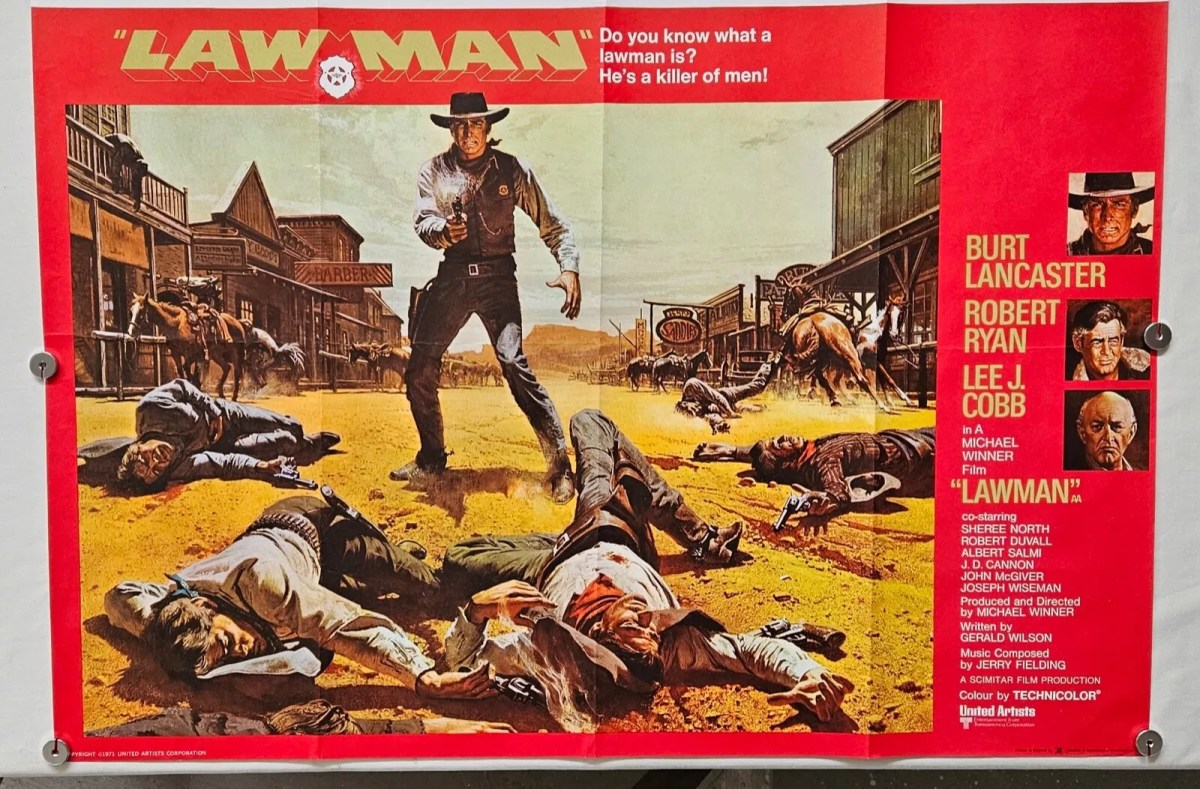
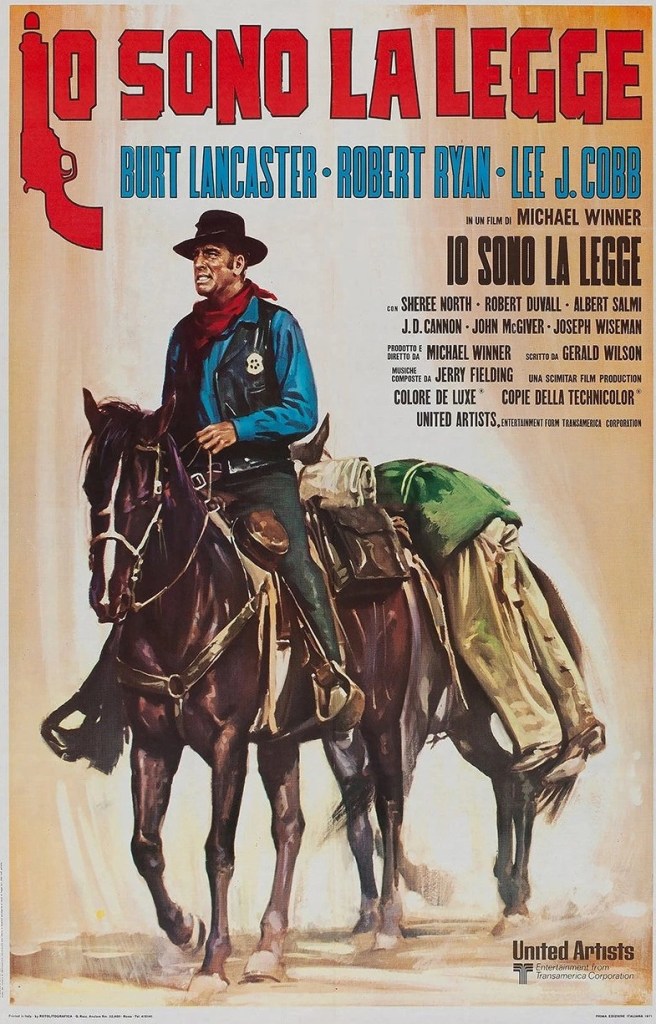
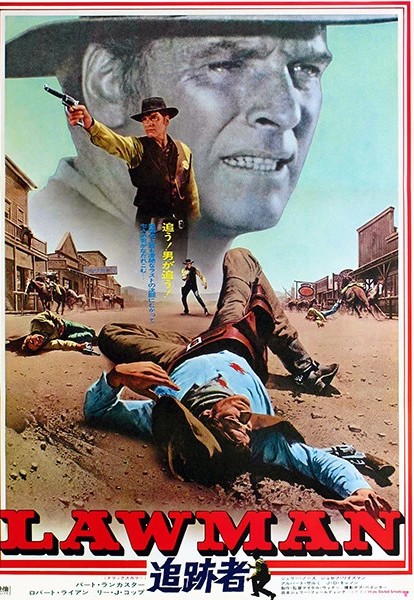
Lawman (1971) *****

Virtually every film by British director Michael Winner was either despised or under-rated. Sure, he appeared at the wrong time, when critics were in the thrall of such stylists as Francis Ford Coppola, Martin Scorsese, Arthur Penn and Steven Spielberg, guys who couldn’t tell a story without adding something distinctive and individual. It didn’t help that Winner came across as cocky and arrogant and chewed on cigars as if he was Orson Welles. His copybook was eternally blotted after Death Wish (1974) and possibly before then for consorting with the likes of Charles Bronson who did not fit the critical palette in terms of a western hero.

So I’ve come out swinging big-style for this extraordinary number for its moral complexity and revisionism. It doesn’t exactly turn the genre on its head but it’s the most honest and realistic western you’ll come across and with rasping dialogue where every word counts. Sheriff Cotton Ryan (Robert Ryan) is a coward, bought and sold by local rancher Vincent Bronson (Lee J. Cobb). Old flame Laura (Sheree North) is willing to jump into bed with the titular lawman Jared Maddox (Burt Lancaster) to save her partner Hurd Price (J.D. Cannon) and just as likely to bed Maddox anyway out of pure lust. But then she’s just as likely to feel sorry for one Maddox’s captives, Vernon (Robert Duvall), and sneak him out a gun and endanger her old lover.

Price and Laura had such a miserable spread and are such poor farmers, hooked by a dream that needs more than dreaming to turn it into a reality, that any crops they raise only feed the weevils. On the other hand Bronson, unlike the ranchers in other westerns, doesn’t want to posse up and hunt down the lawman. His skill set errs on the side of negotiation, bribery and blackmail. The young gunslinger Crowe (Richard Jordan) doesn’t end up, as usual for the genre, as easy meat.

Whenever John Wayne set off to right a wrong he generally had the audience on his side. The injustice committed against him, or that was walking into, was clear.

There’s nothing clear about who murdered an old man in Maddox’s home town of Bannock. It was an accident, or the kind of accident you get when a bunch of drunken outlaws shoot up a town. No idea who fired the fatal bullet. It could anyone out of seven visitors. We don’t even find out anything about the victim. He’s little more than a MacGuffin.

And Maddox isn’t vengeance on a horse. He’s not out to kill anyone. He doesn’t know who to blame for the murder, his job is just to round up the suspects. However, the wanted don’t take too kindly to being on his wanted list and a couple of them, namely Vernon and Bronson’s son Jason (John Beck) are itching to put a bullet through the lawman’s head, by fair means or foul, via the traditional shootout in main street or as conveniently the bullet in the back or the trail ambush.

Maddox is implacable. “A lawman is a killer of men. That’s what the job calls for.” Even though he agrees his task is a murky one, and little chance of divining the actual killer, and even the possibility that for lack of such clarity the judge hearing the case will simply let everyone off, he’s still obsessed with doing what needs done, rounding up the suspects, killing them if need be if they oppose the rule of law.

The townspeople aren’t much help, up in arms at the prospect of a widow-maker in their midst, and not keen on the law being enforced when their own lawman takes such a different view. Cotton Tyan, at one point, was a good and feared lawman. But those days are long past. “Everyone remembers Fort Bliss,” he mutters ruefully before reeling off the list of his failures.

As I mentioned the dialog is superb. No room for banter or repartee here. Every word comes with a hammer behind it.

“I ain’t afraid of him,” remonstrates wannabe gunslinger Crowe. “You would be,” retorts Ryan, “if you had brains enough to spit.”

To prevent Hurd from leaving Laura pleads, “But Maddox promised nothing would happen to you.” Hurd snaps, “But what did you promise him?”

Saloon owner Lucas (Joseph Wiseman), with whom Maddox has history, challenges his approach. “You’re wrong here.” “Not from where I stand,” says Maddox. “You can’t see from where you stand.”

Although Winner is too fond of a recent technological innovation, the zoom shot, the rest of the filming, like the tale itself, is somber. There are some nice touches. We are introduced to Maddox as he towers above the camera. And it’s only when the camera changes angle that we realize the load on his packhorse is actually a corpse.

I’ve never seen a western where anyone, despite riding through endless barren plains, is covered in dust. But here, Maddox’s eyes have a patina of dust. Ryan uses a horseshoe as a paperweight. His town is largely crime free because it lacks a railhead. Like a Henry Hathaway western, we get a good idea of the makeup of the town from signs on buildings.

The action scenes are terrific. Killing a man’s horse in the wilderness is as good as killing the man. The only time Ryan chips in is to help arrest someone committing crime in his own town, and in that section he and Maddox work as a team communication through nods and gestures.

The ending, had it gone to plan, would have turned the genre on its head, Maddox deciding he’s done enough killing and planning to leave without making any further arrests. But that’s not good enough for Jason, who has something to prove and dies because of it.

Bronson, who’s done his best to avoid outright conflict, also dies, by his own hand, unable to deal with the death of his only remaining son.

Michael Winner (The Nightcomers, 1972) knows he’s dealing with a western icon in Burt Lancaster (The Professionals, 1966) and allows the actor to add another iconic character to his portfolio and trigger the more thoughtful screen persona he would evince in the next two in his “western trilogy” Valdez Is Coming (1971) and Ulzana’s Raid (1972), each successively nudging closer and closer to outright revisionism.

Inveterate tough guy Robert Ryan (The Wild Bunch, 1969) plays mostly against type as the worn-outlawman seeking an easy life. Sheree North (The Gypsy Moths, 1969) makes the most of an unglamorous, conflicted, role. Based on this performance, you wouldn’t figure Robert Duvall on turning into a quiet gangster’s lawyer the following year in The Godfather.

Making his big screen debut is Richard Jordan (Valdez Is Coming, 1971) and on his sophomore appearance is John Beck (The Other Side of Midnight, 1977).

What a debut by screenwriter Gerald Wilson (Chato’s Land, 1972).

Coming to this in reverse order after watching Lancaster in Valdez is Coming and Ulzana’s Raid (1972) and after reappraising Winner following The Nightcomers, I had no idea what to expect. Least of all that I would be so impressed I’d watch it twice straight through.

Superb.

Discover WordPress

A daily selection of the best content published on WordPress, collected for you by humans who love to read.

The Atavist Magazine

by Brian Hannan

WordPress.com News

The latest news on WordPress.com and the WordPress community.