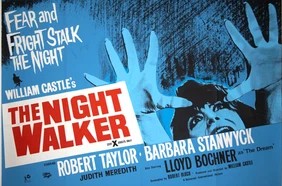
The Night Walker (1964) ****

Deserves its spot in the cult pantheon, hints of Spellbound (1945) and Vertigo (1958),  mesmeric atmosphere of dream/nightmare held together by a hypnotic performance by Barbara Stanwyck, tonsils in overdrive. But no point screaming at the unseen, at the unknown, when it invades reality, no point trying to escape a dream when you’re trapped inside.

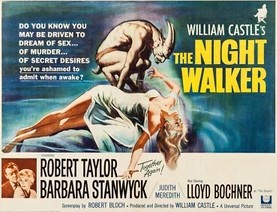
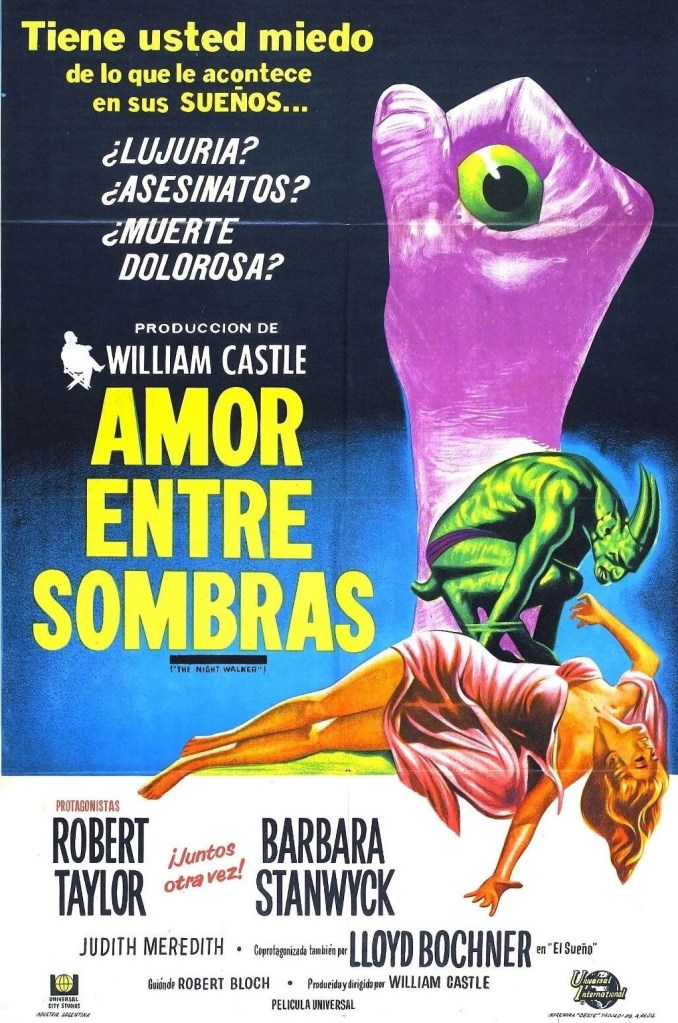
Except that there’s no sign of the demonic figure haunting widow Irene Trent (Barbara Stanwyck) on the poster it delivers on all other fronts, driving you to question our heroine’s grip on reality as much as she questions herself. If there’s such a thing as self-gaslighting, she’s in the vanguard.

Creepy rich blind husband Howard (Hayden Rorke) is an emperor of surveillance, microphones everywhere catching her every word, including what she utters in her dreams, which convinces him that she’s having or has had an affair. When he dies in an explosion, body eviscerated in the inferno, she can’t come to terms with her freedom, holing up in the tiny apartment at the back of her beauty parlor, relying on assistant Joyce (Judi Meredith) and attorney Barry (Robert Taylor) for moral, and perhaps in relation to the solicitor, physical support.

When the unreal invades her daily life and she begins to believe in her dreams and when the handsome lover (Lloyd Bochner) of her night-time imagination takes shape, she begins to doubt her sanity. But so convinced, on the other hand, that she must be sane, she tries to convince Barry that her dreams have basis in fact. She tracks down the apartment (No 341) she visited in her dreams and the chapel where she imagined she was married to said lover.

You wish director William Castle (Straitjacket, 1964) had continued exploring the theme of dreams vs reality, and how to cope when the imagination takes over. But instead, it twists into thriller territory, the old set-up, the gaslighting that could send Irene over the edge and straight into a sanatorium while her husband’s substantial wealth ends up elsewhere.

Even so, once it heads down this particular path, it’s still mighty tricky. Who could be in on the act? All the people she trusts – Barry, Joyce, even Loverboy? And if she’s going to let her suspicions run riot, how is she going to come out the other side, for surely that will tip her over into madness?

Exceptionally lean, barely 80 minutes once you exclude the treatise on dreams at the start that establishes the premise of the “Night Walker” – the person who lives through their dreams – and exceptionally clever. Irene is so given to screaming that you’d scarcely think there’s space left in her brain to to work out just what’s going on. And there’s no shortage of permutations.

Has her dead husband, half his face obliterated by burns, come back to haunt her? Is the Lover just a figment of her imagination? Why can’t she make do with someone as handsome as Barry?

We’ve got smoke issuing from under doors, recurrent bright flashes of explosion, mannequins that seem alive, all sorts of jiggery-pokery with guns, telephone wires cut, a blind man who can tell the color of your dress, eyeballs plucked from faces and squeezed until they pop, and the expectation all the time of a straight dive into madness. No escape in other words.

Even when it fast approaches a climax you might have guessed the outcome of, turns out you were wrong and there’s still a few more twists – and screams – to come.

The fact that it turns into a straightforward thriller at the time tended to diminish the emphasis on the demonic, but these will be more fully appreciated today when the line between reality and fiction is stretched ever thin.

Four-time Oscar nominee Barbara Stanwyck (A Walk on the Wild Side, 1962) might have been accused of slumming it in low-budget horror fare such as this, but, boy, in her final big screen appearance, (although she successfully switched to television as star of The Big Valley, 1965-1969) does she give it her best shot. If this was Stanwyck’s swansong, Robert Taylor (A House Is Not a Home, 1964) , a fellow relic from Hollywood’s Golden Age, wasn’t far behind, only a few movies left in him.

For all this relied on William Castle’s directorial dexterity,  the imagination behind it came from master of the macabre Robert Bloch (Psycho, 1960).

Cult doesn’t come much better.

Dark Intruder (1965) ***

Sumerian demons, Siamese twins separated at birth, a serial killer, oceans of fog, the flower of the mandrake, a climax that revolves around “it’s in his kiss” and a picture so shorn of light it could easily have been titled Dark Fiancé or Dark Wedding. Thematically truncated, too, and you get the feeling that with a little bit more narrative expertise and budget this could have been spun out into something that fitted in with the decade’s later spurt of horror a la Rosemary’s Baby (1968). There’s the bonus of Leslie Nielsen (Airplane, 1980) in a straight part though one which allows him a fair quota of quips.

In San Francisco 1890, occult expert and straight-down-the-line man-about-town toff Brett Kingsford (Leslie Nielsen) is surreptitiously engaged by the cops to investigate a series of brutal murders. Beside each corpse, the killer has left a memento, a tiny statuette that is traced back to Sumerian times, a demon – similar to the larger kind that turn up at the archaeological dig at the start of The Exorcist (1973) – banished from Earth and which attempts to return by entering another person’s body though presumably none of the four victims coming up to scratch.

Among the dead is Hannah, who had been involved in an archaeological expedition and later adopted a mysterious child. She has a connection to Brett’s friend, antiques dealer Robert Vandenburg (Mark Richman) who is engaged to be married to Evelyn Lang (Judi Meredith), another friend of Brett. Though Brett consults Chinese expert Chi Zang (Peter Brocco) and is attacked by the titular intruder who leaves him with claw marks on his shoulder, the bulk of the detection falls to Robert, who exhibits odd behaviour, standing in a daze, sleepwalking, going off in the wrong direction, suffering from blurred vision, and with a strange scar on his spine. He encounters the mysterious Professor Moloki (Werner Klemperer), face concealed, who tells him all will be revealed on the eve of his wedding.

The killings don’t stop, Brett no closer to catching the killer, and no further evidence forthcoming and the tale falls on the shoulders of Robert who is convinced from his own odd behavior that he is the killer. Eventually, he starts to work out the strange elements of his own life and the “invisible force” he is constantly fighting.

Turns out he was the Siamese twin separated at birth, and that Hannah had brought up the other, deformed, twin, who now wants his twin’s life – and wife. All we see of the creature is the claw, the rest of him hidden under a cloak or shuffling along behind curtains. The pair grapple in the darkness and it appears the bad twin is slain.

But is he? It’s Evelyn who gives him away, revolted by his kiss, and the matter is resolved. So really no more than the assembly of an interesting horror story. The claw is well done but as I said most of the detection comes from the mind of Robert rather than the occult detective working up the clues. But the dapper Brett is good value, keeping chatterbox Evelyn in check, and putting on his best Basil Rathbone impersonation.

As a bonus it’s insanely short, barely an hour long, which would have put it squarely in the B-feature category – but of two decades before, not of the mid-1960s. Turns out this was a pilot for a television horror series that wasn’t picked up by any of the three U.S. networks so was extended enough to be feature-length. The actors try desperately to add characterisation to their thin parts, Leslie Nielsen (Beau Geste, 1966) and Judi Meredith (Queen of Blood, 1966) best at that.

Harvey Hart (Bus Riley’s Back in Town, 1965) directed from a script by Barre Lyndon. The movie was released by Universal, who had Nielsen on an exclusive seven-year contract.

The sum of its parts without much else, but intriguing tale calling out to be extended – or remade.

Discover WordPress

A daily selection of the best content published on WordPress, collected for you by humans who love to read.

The Atavist Magazine

by Brian Hannan

WordPress.com News

The latest news on WordPress.com and the WordPress community.