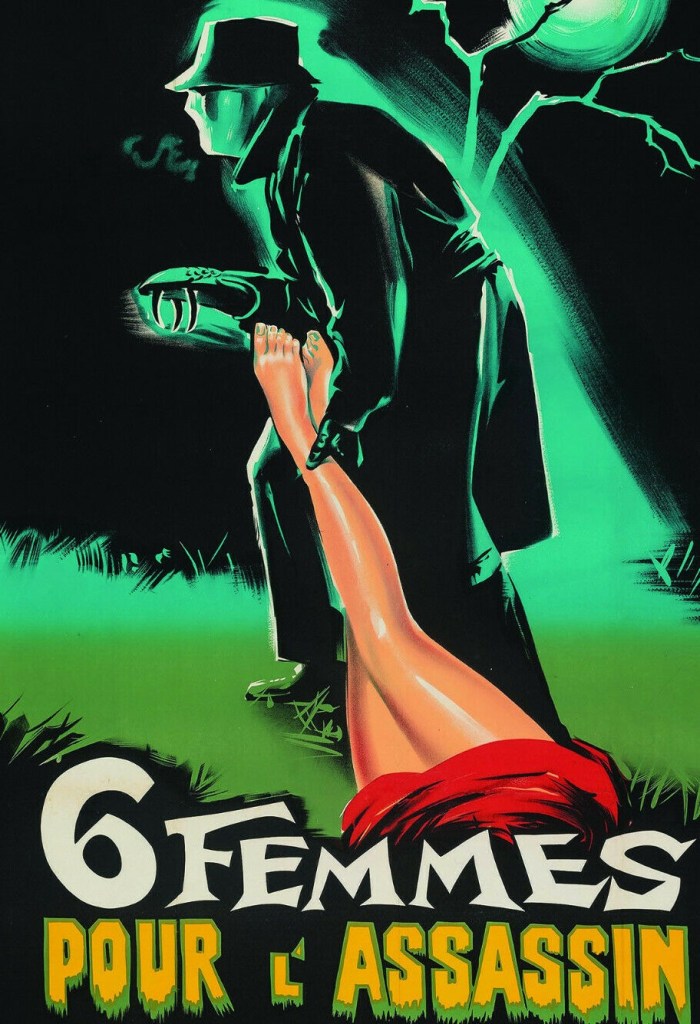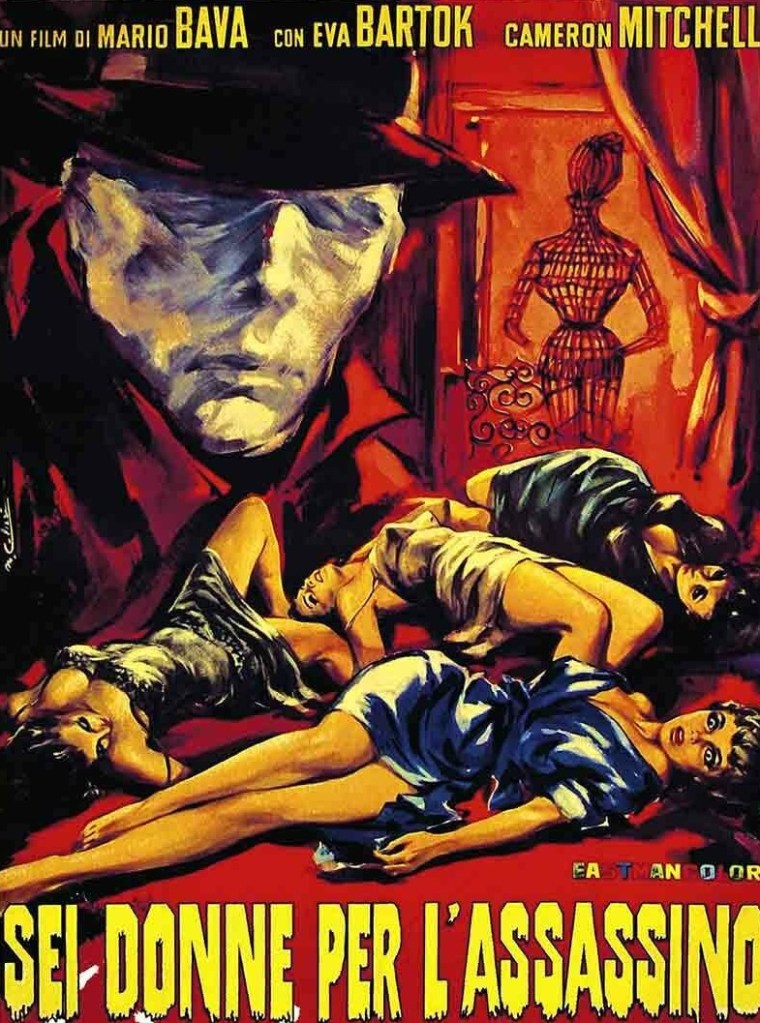
Blood and Black Lace (1964) ****

Director Mario Bava channels his inner Douglas Sirk in a rich color palette for this early version of giallo. About as surprisingly rich is the camerawork, which, for a low-budget picture is exceptionally accomplished, tracking, drifting, bobbing between characters. This early in the 1960s, nudity was not so prevalent but setting a movie in a fashion house – ensuring the beauty quotient is remarkably high – provided sufficient opportunity for ladies to be seen (within a work context naturally) in a certain amount of undress and you can be sure the killer leaves them half-naked. And it’s not the usual giallo sex maniac at work either but, despite the volume of murders, a killer driven by a desire to conceal shame.

Blackmail, theft, abortion, cocaine addiction, pregnancy, impotence and illicit affairs are among the secrets the protagonists wish to keep hidden, all risking exposure by a diary kept by the first victim Isabella (Francesco Ungaro). So rather than a whodunit, it’s a whydunit. The killer is particularly creepy, face concealed behind white gauze like an Egyptian mummy. As the Italian title explains, six women are intended for the chop, so that kind of rules out a great deal of tension as you spend your time counting. Are we nearly there yet? And as we run out of obvious potential victims, who the heck is there left to kill? Of course, by that time, we are into twist territory and that element is certainly neatly done.

The main candidates for the murderer are: Franco (Dante DiPaolo), Riccardo (Franco Ressel), Cesare (Luciano Piggozi). Massimo (Cameron Mitchell)  and Marco (Massimo Righi). These are the official ones, rounded up by Inspector Silvestri (Thomas Reiner). But that still leaves housekeeper Clarice (Harriet Medin) in her black leather coat. And a fashion house being a festering wound of jealousy, sex, status and privilege you wouldn’t discount any of the models either nor an owner Cristiana (Eva Bartok) who is such a slave-driver she denies her seamstresses time to mourn.

Emotions would be running high in this establishment never mind with a killer on the loose. Relationships are so fraught that even when this is the worst possible time to be alone in a house, certain of the models refuse to offer sanctuary to others and one, Tao-Li (Claude Dantes), just plans to head for the hills (Paris, in other words) and abandon the others. Add to that a high degree of stupidity. When Greta (Lea Lander) discovers the disfigured corpse of Nicole (Arianna Gorini) in the trunk of her car, rather than calling the police, she drags the body into the house and hides it under the stairs while her butler is about to serve tea. Except it’s not out of folly, it’s because Greta, like all the women here, wishes to protect a male, passion reigning supreme to the extent that the thought of losing a lover even if he is a murderer is too much to bear.

The inspector’s task would be made easy if the killer had a distinctive modus operandi. Death occurs through strangulation, suffocation, drowning (though with cut wrists to make it look like suicide), falling from a great height and Nicole’s face thrust into a stove. If victims take a long time to die, it’s not from the killer’s sadism but his/her incompetence. Virtually none are speedily dispatched, murder not as easy as you might imagine, an idea that Hitchcock purloined in Torn Curtain (1966)

For most of the time the way the camera moves you would wouldn’t think you were watching a film about a serial killer (in those days as rare in reality as in fiction) but a dense emotional tale as spun by the likes of Luchino Visconti (The Leopard, 1963) amidst a backdrop of wealth and beauty. Setting aside the murders, there is a feast of intrigue, and a rich seam of characters, though the central theme seems to be (not surprising for the era) that money and beauty are not as fulfilling as love, something that women will commit various crimes (though stopping short of murder) to achieve.   

I would imagine it was just such intricate camerawork that put audiences off the picture on initial release, a big flop in Italy and, if screened anywhere else (as in Britain) the lower part of a double bill. Not quite as intense as Bava’s previous The Whip and the Body (1963) nor so stylistically driven as Danger : Diabolik (1968) and some way short of horror masterpieces like Black Sabbath (1963), this is still an interesting watch, something of a template for future giallo and from a pure directorial perspective glorious to watch.

The number of characters featured and the time spent on the various deaths limit the opportunities for any one star to dominate but Hungarian Eva Bartok (Operation Amsterdam, 1960) leads the line on the female side while American transplant Cameron Mitchell (Minnesota Clay, 1964) and Dante DiPaulo (Sweet Charity, 1969) vie for male acting honors. The screenplay was a joint effort by Marcello Fondato, Giuseppe Barilla and Bava.

YouTube has this for free though be warned it comes with ads and for the sumptuous photography alone you may want in any case to splash out.

The Honey Pot (1967) ***

Shave 20-30 minutes from this and you would have had a taut thriller. You could start with the number of clever dicks who happen to notice that what’s going on bears a close resemblance to a play Volpone by Shakespeare contemporary Ben Johnson, even down to the anglicizing of the names of those fictional characters. And prune the number of detectives, three is two too many especially when there’s an actual genuine detective in the mix. And the shock ending is just…well…mince.

Otherwise, quite fun in a way. Wealthy Cecil Fox (Rex Harrison) hires sometime actor, sometime factotum, law graduate Marty McFly – oops William McFly – to help him pull off an elaborate joke, “people-baiting”, a modern version of “bear-beating” apparently. Fox pretends to be dying in order to bring three former lovers, all he presumes desperate to be named in his will, to his bedside in a grand palazzo in Venice. Upfront reason, some kind of revenge. Hidden reason, something darker obviously.

The trio are Texan Mrs Sheridan (Susan Hayward), movie star Merle (Edie Adams) and Princess Dominique (Capucine). Sheridan is accompanied by a nurse Sarah (Maggie Smith), the “voice of morality.” They all certainly seem to have a sense of humor. Two presenting Fox with gifts of clocks, the princess with an hour-glass filled with gold dust instead of sand, presumably with the notion that he can watch his life ticking away. Needless to say, this is like an reality TV show, Fox not having named an heir in his will, so they are all battling to be the heir, and as he points out, even the rich will succumb because there is no such thing as “enough money.”

Things do not go according to plan when Sheridan unexpectedly dies. Enter Inspector Rizzo (Adolfo Celi). Sarah suspects McFly because he used her as an alibi but disappeared for a time when she (for unexplained reasons) fell asleep in a posh restaurant (and nobody tried to wake her). Turning detective herself, she comes up with “proof positive.” Turns out the two remaining suspects had conspired to also give themselves an alibi, easily demolished by the kindly inspector. McFly, too, has been doing some digging.

But then comes another twist and everything you thought you knew flies out the window. Cue more investigation, more alibis and finally an Agatha Christie pay-off when the two amateur detectives and the real one confront everyone in the drawing room. By which time the twists are coming thick and fast.

Best thing about this is the playing. Although decidedly stagey, very little in the way of visual audacity, that works to the movie’s benefit, and not a bad choice to rely so heavily on the acting given the cast. With the exception of Edie Adams, Capucine and Celi, all were Oscar anointed. Two winners – Rex Harrison for My Fair Lady (1964) and Susan Hayward for I Want to Live (1958) – and between them another five nominations – and two future winners in Cliff Robertson for Charly (1968) and Maggie Smith for The Prime of Miss Jean Brodie (1969). The others were not out of their depth, Edie Adams (Made in Paris, 1966) clocking up Emmy nominations. Adolfo Celi (In Search of Gregory, 1969) a deuce of nominations from the Cannes Film Festival while even Capucine (The 7th Dawn, 1964) had been nominated for a Golden Globe.  

So director Joseph L. Mankiewicz (Cleopatra, 1964) makes the right decision to let his actors get on with. Rex Harrison is at his suave best, but with a malevolent undercurrent, and has most of the best – and zestiest – lines. Robertson, usually the hero, is sly and duplicitous. Susan Hayward was in her comfort zone, forthright and taking no prisoners, Capucine at her cold and haughty best. Smith and Celi were the revelations, the former losing the trademark drawl and the nurse’s mousiness as to some extent she exerts control, and Celi departing from the bombast and delivering a lower-keyed performance.

Doing double duty, Mankiewicz worked up the script from three sources: the original Volpone,  the play Mr Fox of Venice by Frederick Knott (Dial M for Murder) and a novel The Evil of the Day by Thomas Sterling. Next time the director went to the stage for inspiration he chose a better source for a mystery – Sleuth (1972).

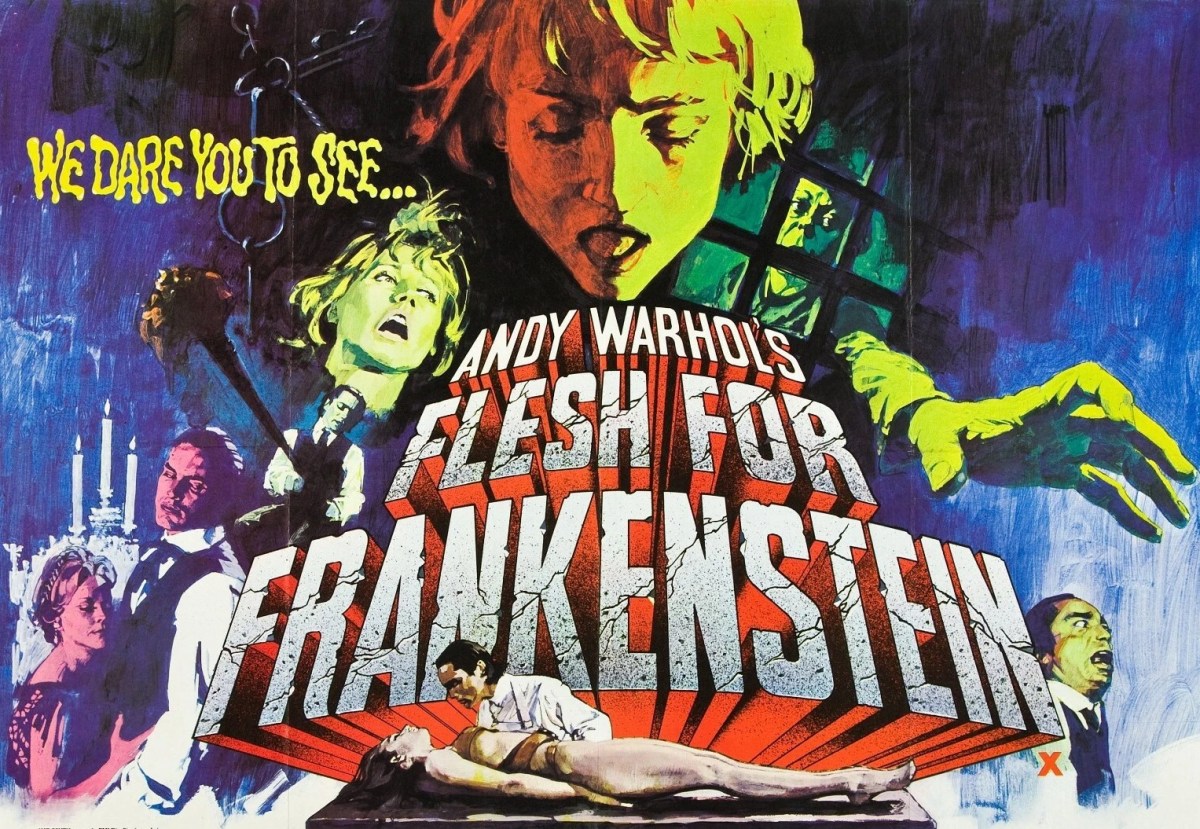
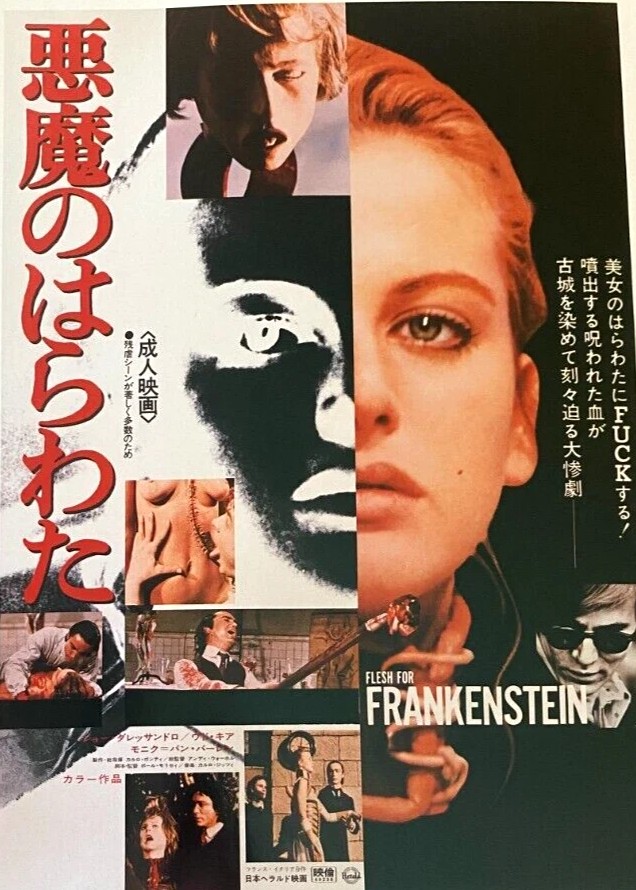
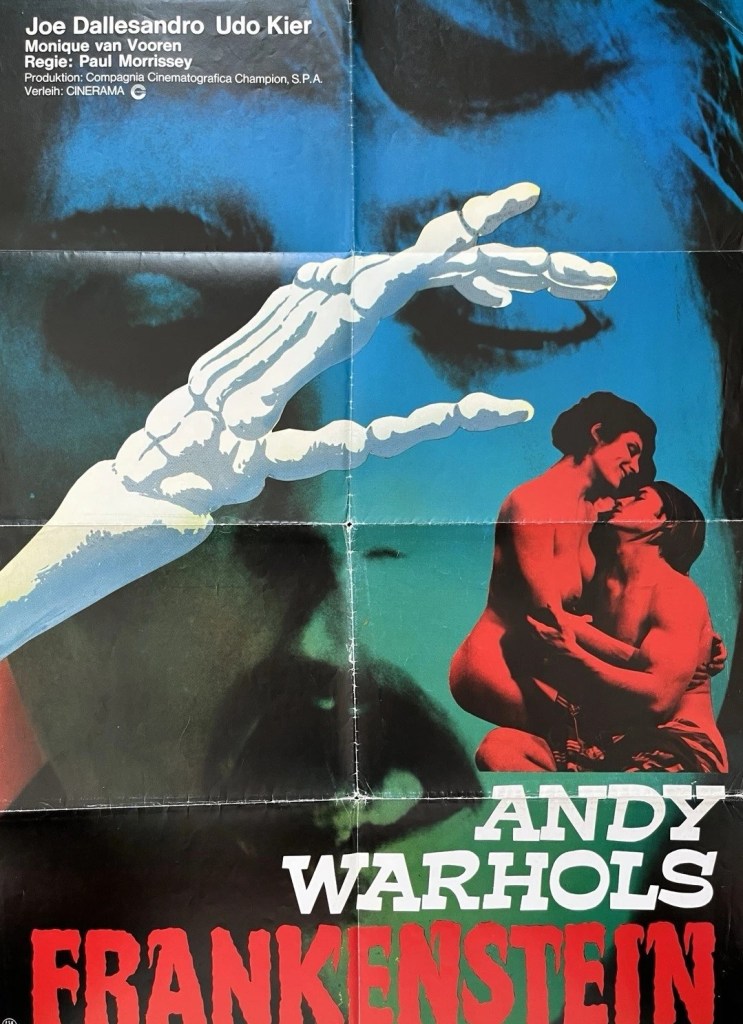
Flesh for Frankenstein (1973) ***

What with Jessie Buckley putting on her best Joker-style smile in Maggie Gyllenhaal’s Looney Tunes version of The Bride (2026) and Oscar Isaac going as high-tech as the 19th century would allow in Guillermo del Toro’s excellent Frankenstein (2025), Paul Morrissey’s Flesh for Frankenstein now appears tame in comparison though at the time its sexuality and gore came in for severe criticism. I’m guessing it’s the campiness that finds it rated so highly among the contemporary critics, but, apart from some poor acting, there’s little in this piece that would bring it down in your estimation or provide it with a free pass.

In terms of the thematic, there are connections to David Cronenberg’s Crash (1996), and in terms of trivia (although the version I saw lacked this) it was originally shot in 3D (though without, as was usually the way with such items, tons of things thrown into the viewer’s eyes) and included an early example of the imagination of SFX genius Carlo Rambaldi (Alien, 1979).

While you might recoil at the good doctor’s right-wing tendencies and his determination to bring to life a superior species, the rest of it is surprisingly good. There’s a determined stateliness to the camerawork and the score by Claudio Gizzi (he only did another two) is as far removed from the over-the-top menace that infected Hammer and AIP versions as you can get.

I wasn’t a card-carrying member of the avant-garde back in the day any more than I am now so didn’t rush out to see this on its first appearance and probably wouldn’t have been tempted to watch it at all except that the presence of Dalila di Lazzaro from Three Men to Kill (1980) piqued my interest. In truth, she has a small part as the female of the species in the monster department.

Here, Baron Frankenstein (Udo Kier) is aiming for the double whammy of not just creating male and female monsters but of getting them to procreate and provide him with a new master race. He’s handy with a set of garden shears, lopping off heads to suit his experiment, and stitching, molding cadavers to suit his purpose, and he clearly takes perverse delight in plunging his hands – and shades of David Cronenberg’s Crash (1996) – and other parts of his body into the innards for sexual satisfaction.

If I’ve read this correctly, we’re also in incest territory, his children the offspring of his sister. Or it may well be that she’s employed for her non-existent maternal skills rather than having played a part in their birth.  It’s hard to see why he wants any more creations in his own image since the kids are as creepy as they come, voyeurs to the core, guillotining dolls, making off with any spare body parts, and with a malignancy that sets the tone for a stunning last scene.

His sister Katrin (Monique Van Vooren) has a degree in hypocrisy, taking a moral high tone with villagers she catches having sex while recruiting lusty local stud Nicholas (Joe D’Allesandro) for her own bed. The Baron’s assistant Otto (Arno Jurging) is from the Marty Feldman (Young Frankenstein, 1975) school of eye-popping. The only flaw in Frankenstein’s plan is he hasn’t taken into account sexual preference, since Nicholas’s buddy Sacha (Srdjan Zelenovic),selected to supply a head and brain for his male monster, is more interested in men than women, so despite the best efforts of the female monster (Dalila di Lazzaro) his experiment is doomed to failure.

Most movies in this subgenre exist in a moral vacuum, beyond someone taking vengeance on the horror-meister, but here Sacha not only has no interest in sex but he’s so appalled at what he has become thanks to Frankenstein that he wants to die and is so scandalized by the baroness’s attempts to seduce him that he suffocates her.

For the most part, this is restrained, although over-acting is endemic, and the science as convincing as in the Del Toro version. The gore and sex would scarcely trouble a contemporary audience.

The climax is just superb. With corpses littering the floor, including that of the Baron and his creations, and Nicholas hanging from the ceiling, the kids each pick up a scalpel and begin to lower the captive, leaving the audience to guess the rest.

Any inherent campiness passed me by and I suspect that impact has faded with time. What we’re left with is an intriguing well-directed entry into the canon.

Not sure why Joe Dallesandro (Lonesome Cowboys, 1968) takes top billing,  aside from his beefcake potential and the central role he played in the Andy Warhol Factory, given he has a small part. Like Klaus Kinski, Udo Kier (The Salzburg Connection, 1972) has a cult following, and the freedom to overact as much as he likes.

Beside lending his name to the venture for publicity purposes, Andy Warhol played no part. The direction by Paul Morrissey (Heat, 1972) has, I thought, considerable distinction especially the camera movement and the music. He wrote the screenplay.
Surprisingly good.

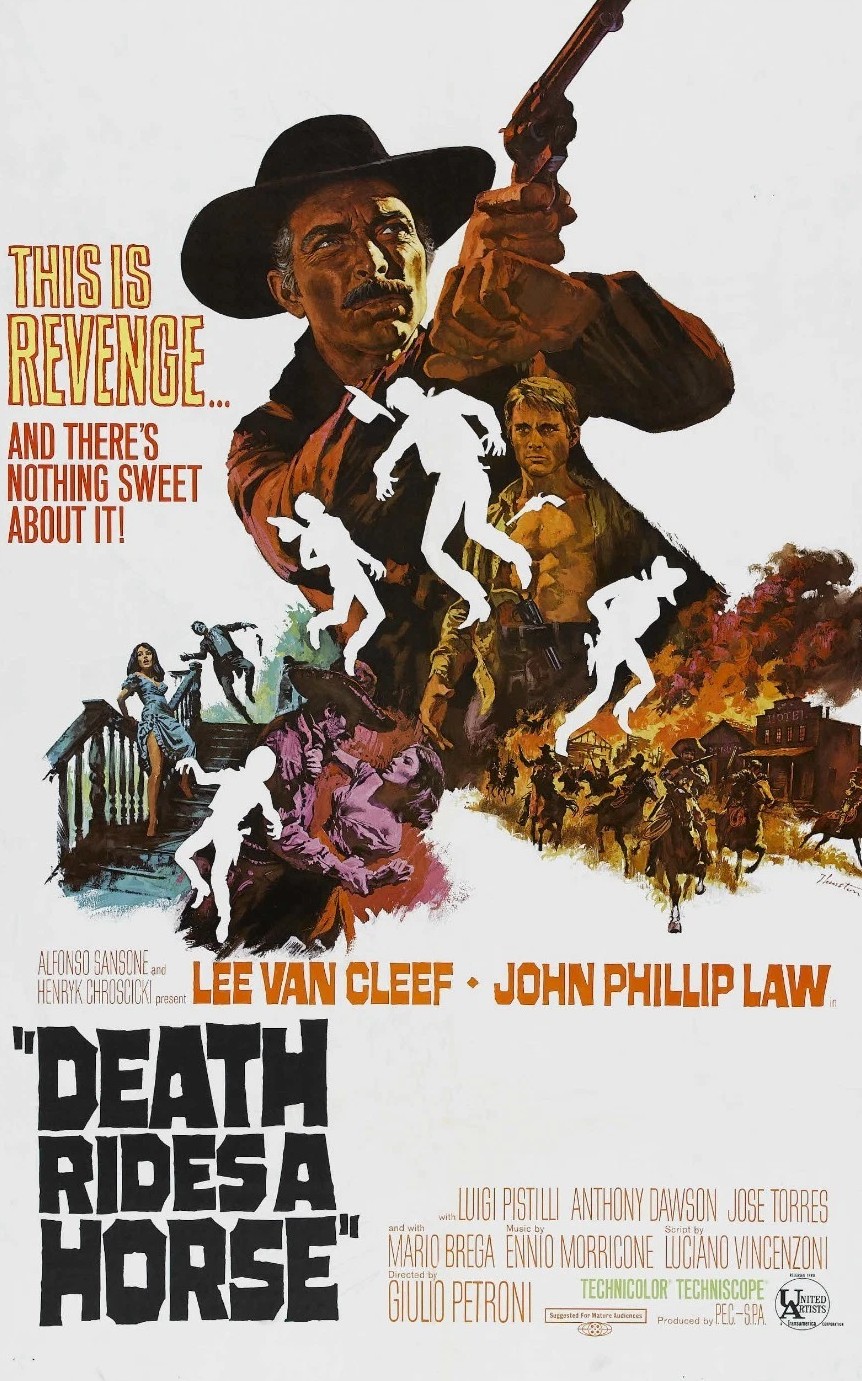
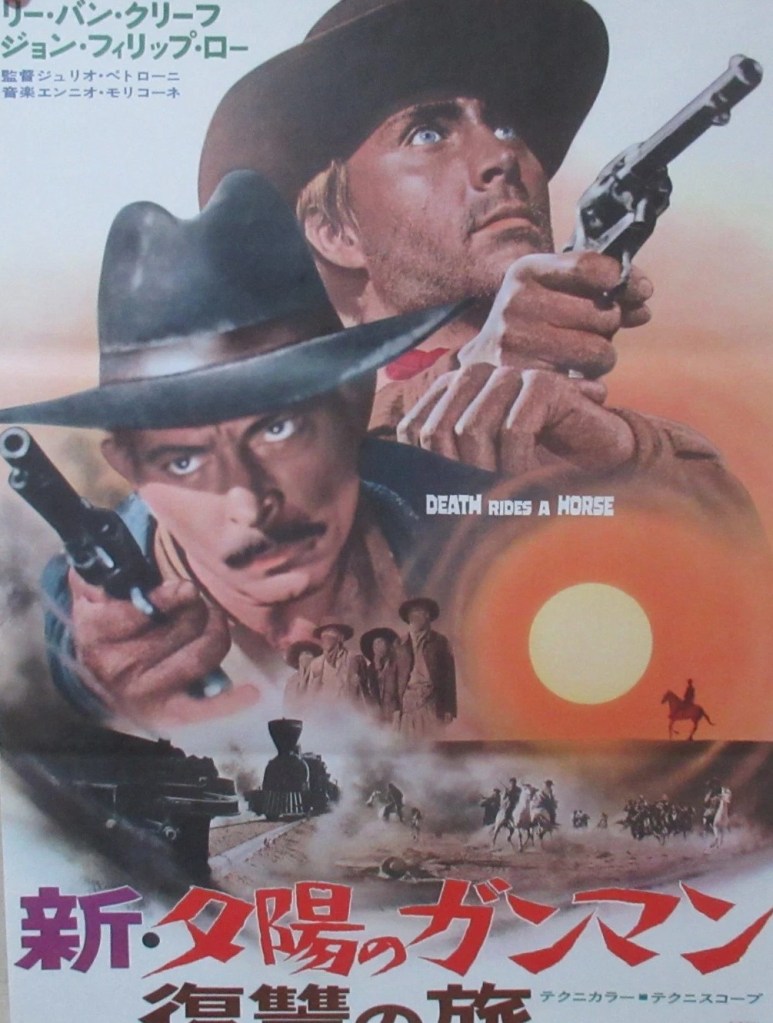
Death Rides A Horse (1967/1969) ****

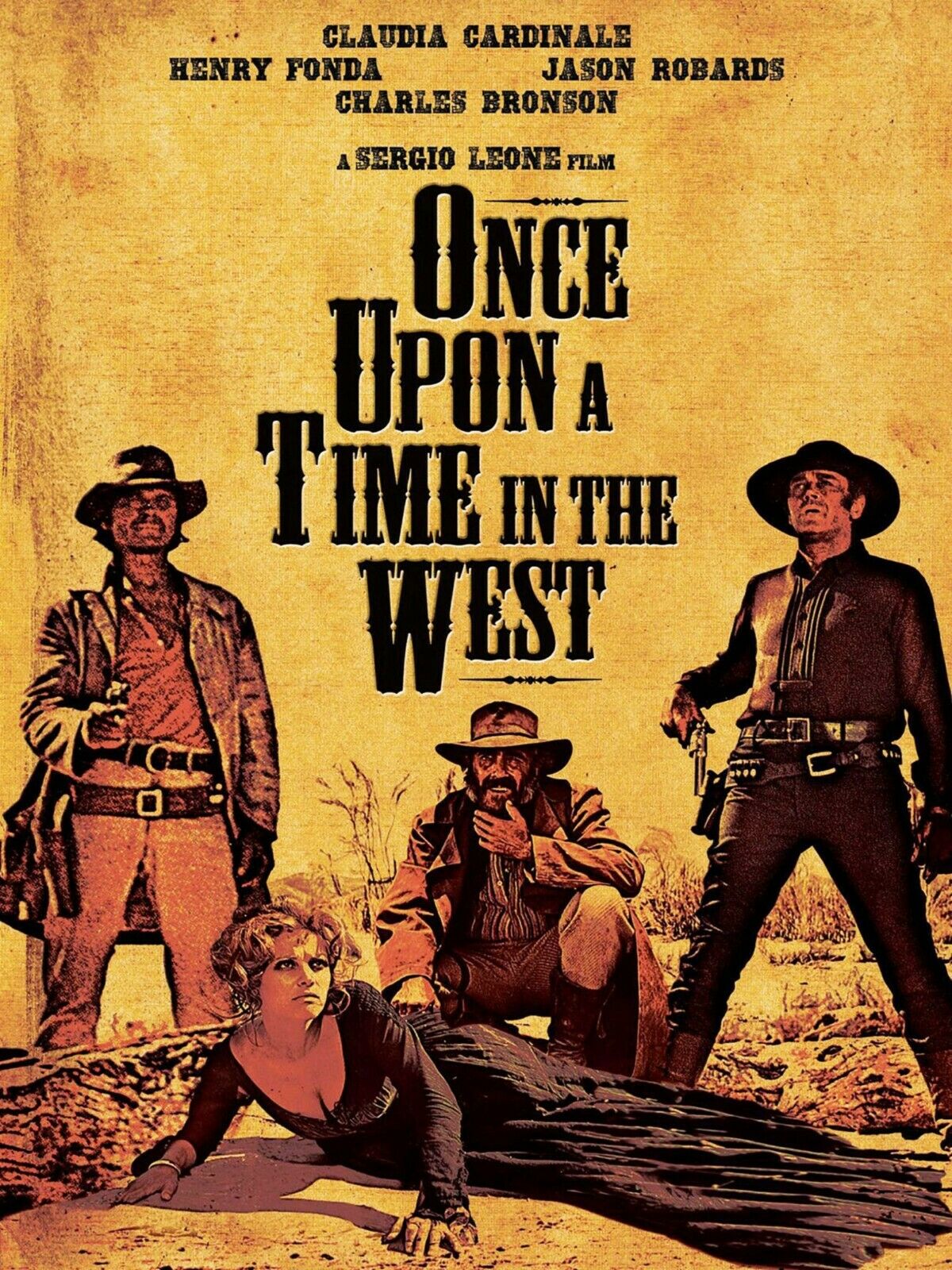
Although Once Upon a Time in the West (1969) is my all-time favorite western and although the first X-certificate movie I sneaked into as a teenager was The Good, the Bad and the Ugly (1966/1968), I never had much interest in spaghetti westerns. For a start, by the time I started my serious cinemagoing – bear in mind I grew up in towns without picture houses – the spaghetti western sub-genre was long gone.

So I was surprised to find how stylish and intriguing this little number was. People had odd ideas about style: they think it’s about capturing a vista at sunset or the way a director moves the camera or some effect gained from the cinematography. But there are other, as important, aspects. And two, perhaps the smallest of the effective ingredients, are on show here.

The first comes with the opening shot. Some cowboys are braving torrential rain. Now movie rain doesn’t behave the same way as real rain. It’s directed and its force depends on something else beyond nature. It’s too consistent in the way that real rain isn’t. So to convince us that these dudes are enduring a storm, director Giulio Petroni has set up on the very edge of the screen a lamp that moves, twisting one way and the other as the wind shifts direction, flaring up and flickering down depending on the position it holds. That little thing was what it took to convince me this was a storm.

The second thing was the editing. Again, critics intend to focus on some unusual aspect. Fast-cutting, for example, as in The Wild Bunch (1969) or cutting between a match and a sunrise (Lawrence of Arabia, 1962)) or from one pillow to another in separate households (Zee & Co, X Y & Zee, 1972). But actually the biggest benefit of good editing is to keep the story moving and not waste time

So here we cut from our blue-eyed anti-hero Bill (John Philip Law) being told to meet a bad guy in his office. Next thing, Bill is entering a darkened room. Automatically, you think this is a trap, that he’s going into villainous saloon owner Cavanaugh’s (Anthony Dawson) office. Instead, he confronts the other anti-hero, criminal Ryan (Lee Van Cleef), just released from prison after 15 years. And without any dialog to otherwise explain the situation, we understand immediately from previous interaction that Bill has been hired by the bad guy to kill Ryan.

There’s countless examples of this kind of editing where action sets the tone rather than dialog, although in the latter regard some of the lines are filled with edge.

Bill and Ryan really should be working as a team. They both want revenge on the same gang of outlaws, Bill because, as a child, he witnessed the gang murder his family and rape his mother and sister, and Ryan because he was fitted up for the robbery the gang committed. But both want the sole satisfaction of carrying out the revenge.

Ryan is something of a mentor to the greenhorn, a skilled gunslinger without the smarts necessary to hold his own. Ryan constantly shows Bill how much he still has to learn about looking after himself and the teaching comes with sharp consequence, Bill left horseless on two occasions and having to tramp miles into the nearest town.

So they get in each other’s way. Bill kills Cavanaugh without realizing that the only reason the businessman is still alive is that Ryan wants reparation from him of $15,000 – $1,000 for each of the years he spent in prison. And now he saddles Bill with that debt.

Ryan knows exactly who he’s hunting down but Bill has to do it the hard way, following a series of clues, personal elements of the masked guys who slaughtered his family, someone who wears distinctive spurs, another with a tattoo on his chest and so on.

This proves a particularly good twist on the older guy-younger guy narrative device so often used in Hollywood. The rivalry rarely cools, Bill taking simple revenge on Ryan at any opportunity.

Eventually, they do agree to work together after Bill works out that Ryan was one of the gang, except that the older man arrived too late to take part in the massacre but just in time to save Bill from being consumed by a raging fire.

The last twist is saved for the climax.

United Artists waited until Sergio Leone’s “Dollars” trilogy had opened the box office doors in America before pushing this out in 1969 (hence the odd dating). Lee Van Cleeef essays a more considered version of his Man in Black persona from For a few Dollars More (1965/1967). John Philip Law (Barbarella, 1969) would never work out, unlike George Peppard, say, that the intensity of his gaze and the blueness of his eyes distracted from his acting.

Put me in mind to check out some of the other spaghetti westerns directed by Guilio Petroni such as A Sky Full of Stars for a Roof (1968). Written by Luciano Vincenzoni (The Good, the Bad and the Ugly).

Well worth a look.

Behind the Scenes: Charles Bronson USA Box Office Bust, 1967-1972

That Farewell, Friend / Adieu L’Ami (1968) was a smash hit in France did nothing for Charles Bronson’s Hollywood career. Hollywood had form in disregarding U.S.-born stars that Europe had taken to its box office bosom. Example number one of course was Clint Eastwood, ignored by the big American studios until four years after his movies had cut a commercial swathe through foreign territories. Charles Bronson took about the same length of time for his box office grosses abroad to make an impact back home.

While we tend to look upon The Dirty Dozen (1967) as a career-making vehicle for many of the supporting stars, that wasn’t actually the case. Jim Brown was quickest out of the blocks, a full-blown top-billed star a year later in The Split (1968). Otherwise, John Cassavetes had the biggest crack at stardom after landing the male lead in box office smash Rosemary’s Baby (1968). But the rest of the gang – Telly Savalas, Donald Sutherland, Charles Bronson, Richard Jaeckal et al – remained at least for the time being strictly supporting players.

For Charles Bronson, the year of The Dirty Dozen produced nothing more than television guest spots in Dundee and the Culhane, The Fugitive and The Virginian. Beyond that he had a berth in two flop westerns Villa Rides (1968) and Guns for San Sebstian (1968) and no guarantee his career was moving in an upward direction. But the latter picture was primarily a French-Mexican co-production, the Gallic end set up by top French producer Jacques Bar under the aegis of Cipra which had previously been responsible for Alain Delon vehicles Any Number Can Win (1963), Joy House (1964) and Once a Thief (1965).

There was another, as vital, French connection. Henri Verneuil directed both Any Number Can Win and Guns for San Sebastian so could attest to Bronson’s screen presence. And another legendary French producer, the Polish-born Serge Silberman, best known for Luis Bunuel’s Diary of a Chambermaid (1964), had taken note of Bronson, whose screen persona was similar to that of French stars Lino Ventura and Jean Gabin. Silberman’s Greenwich Films production shingle was in the process of setting up Farewell Friend / Adieu L’Ami.

Like The Girl on a Motorcycle (1968), Farewell Friend was part of a new trend to make French productions in English as well as French, in this case the English version viewed as “the working one.” But that ploy failed to convince U.S. distributors to take a chance and the film sat on the shelf for five years. And little that Bronson did in the meantime increased his chances of a serious stab at the Hollywood big time.

Although Paramount had piled cash into the Italian-made Once upon a Time in the West (1968) it was counting on Henry Fonda – undergoing a career renaissance after Madigan (1968), The Boston Strangler (1968) and Yours, Mine and Ours (1968) – to provide the box office momentum. Bronson was billed fourth after Claudia Cardinale, Fonda and Jason Robards, so still in Hollywood’s eyes a supporting player.

And while the Sergio Leone picture flopped Stateside, the success of Farewell, Friend in France turned Bronson into a star and was instrumental in the western breaking box office records in Paris (where it ran for a year) and throughout the country.

Fortunately for Bronson, European producers recognized his potential. His next picture should have been an Italian-French-German co-production of Michael Strogoff, for which he was announced as the top billed star (Advert, Variety, May 8, 1968, p136-137).  When that fell through, Italian company Euro International, bidding to become the top foreign studio outside Hollywood, gave him top-billing in Richard Donner drama Twinky (aka Lola, aka London Affair, 1970) and Serge Silberman tapped him for Rene Clement thriller Rider on the Rain (1970), another French hit.

British director Peter Collinson (The Italian Job, 1969) was responsible for recruiting him for You Can’t Win ‘Em All (aka The Dubious Patriots, 1970), but with Tony Curtis taking top billing. Again, though funded by an American studio, this time Columbia, it was another big flop, mostly because the studio did not know how to market the picture, Curtis in a box office slump and Bronson considered to have little appeal.

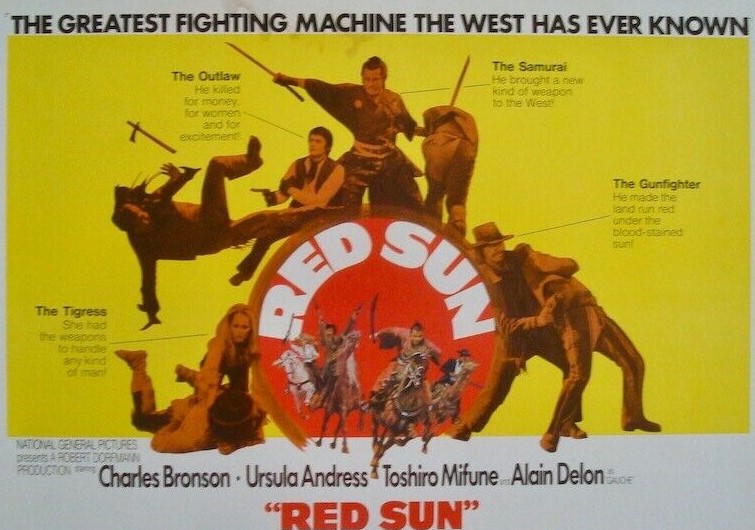
But still the Europeans kept the faith. Another French-Italian co-production Sergio Sollima’s Violent City (1970) gave him top billing over exiles Telly Savalas and Jill Ireland, Bronson’s wife. That was also the case with Cold Sweat (1970), helmed by British director Terence Young (Dr No, 1962).  He had another French-made hit with Someone Behind the Door (1971) and Terence Young hired him again, along with Farewell, Friend co-star Alain Delon, Japanese star Toshiro Mifune (Seven Samurai, 1954) and Dr No alumni Ursula Andress for international co-production Red Sun. While this western sent box office tills whirring all over the world, it only made a fair impression in the U.S., ranking 53rd in the annual box office chase.

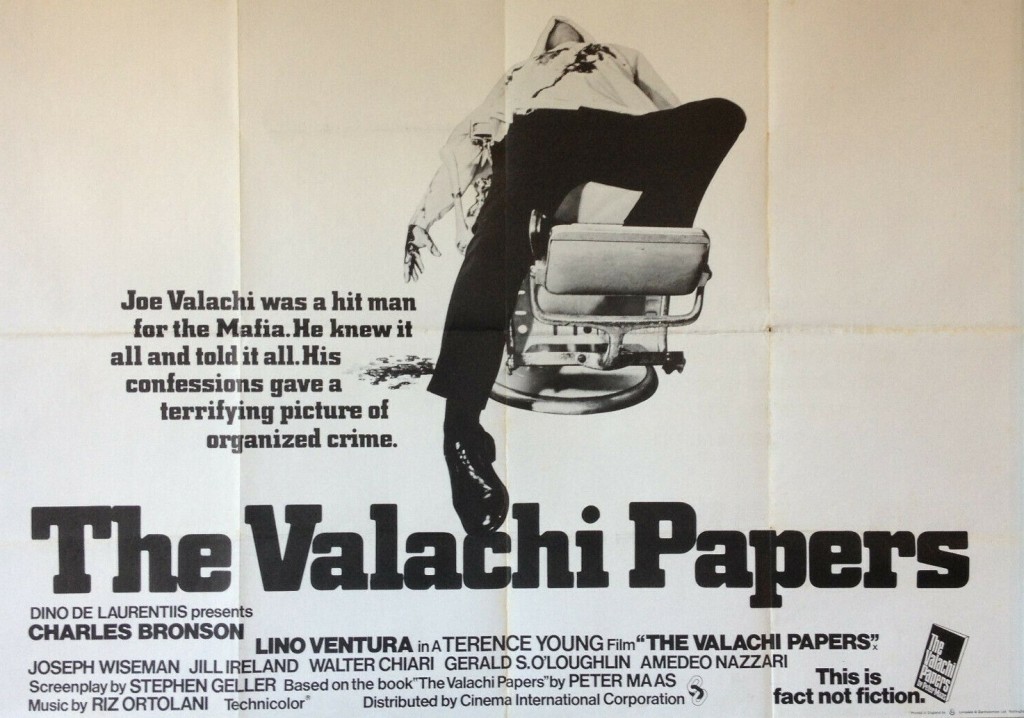
Riding on the back of The Godfather phenomenon, Italian producer Dino De Laurentiis chose Bronson for Mafia thriller The Valachi Papers (1972), again directed by Terence Young, which produced something of a box office breakthrough in the U.S., ending the year just outside the Top 20. But it took another British director, Michael Winner, to help solidify the Bronson screen persona and boost his global appeal. Four – and all of the hits – out of the star’s next six pictures were directed by Winner.  These were the western Chato’s Land (1972), The Mechanic (1972), The Stone Killer (1973) and Death Wish (1975). The Mechanic was such a big hit Stateside it did better in its second year of release than the first and Columbia redeemed itself by giving prison escape thriller Breakout (1975) the widest release – up to that point – of all time.

That America had little interest in developing Bronson as a breakout star could be judged by the distribution treatment of his pictures. As mentioned above, Farewell, Friend had to wait until 1973 for its U.S. debut and then renamed Honor among Thieves. Twinky was denied a cinema release in the U.S. and went straight to television in 1972. Violent City had to wait until 1973 for a distribution deal, Cold Sweat until 1974 and even Red Sun took nine months before it hit American shores.  Until The Valachi Papers did the business, Bronson was not considered the kind of star who could open a picture in the U.S.

By then, of course, Bronson had reversed the normal box office rules. Usually, for films starring American actors, foreign revenues were the icing on the cake. For Bronson it was the other way round. Along with Clint Eastwood he was the first of the global superstars, whose name resonated around the world, and whose pictures made huge amounts of money regardless of American acceptance or interest. But had it been left to Hollywood, Bronson would never have made the grade.

Forgive me for updating this and changing the title. I wrote the first version in 2021 before I came up with the bright idea of tagging as “Behind the Scenes” articles that were not movie reviews. Some of those earlier articles lost out because they lacked that instant identification. This is me making amends.

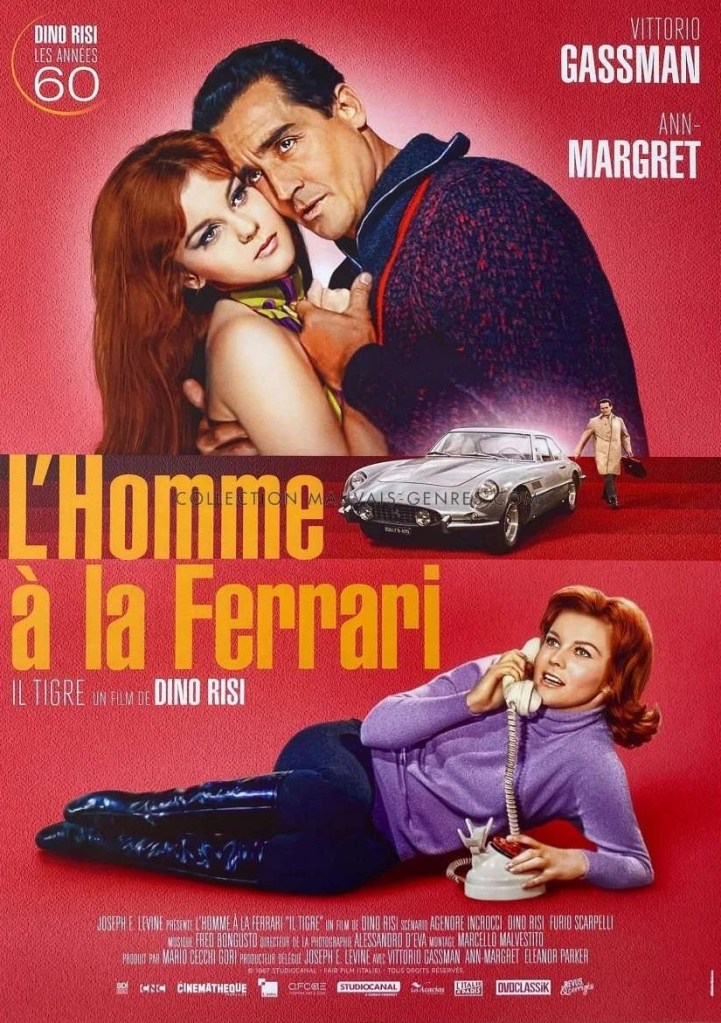
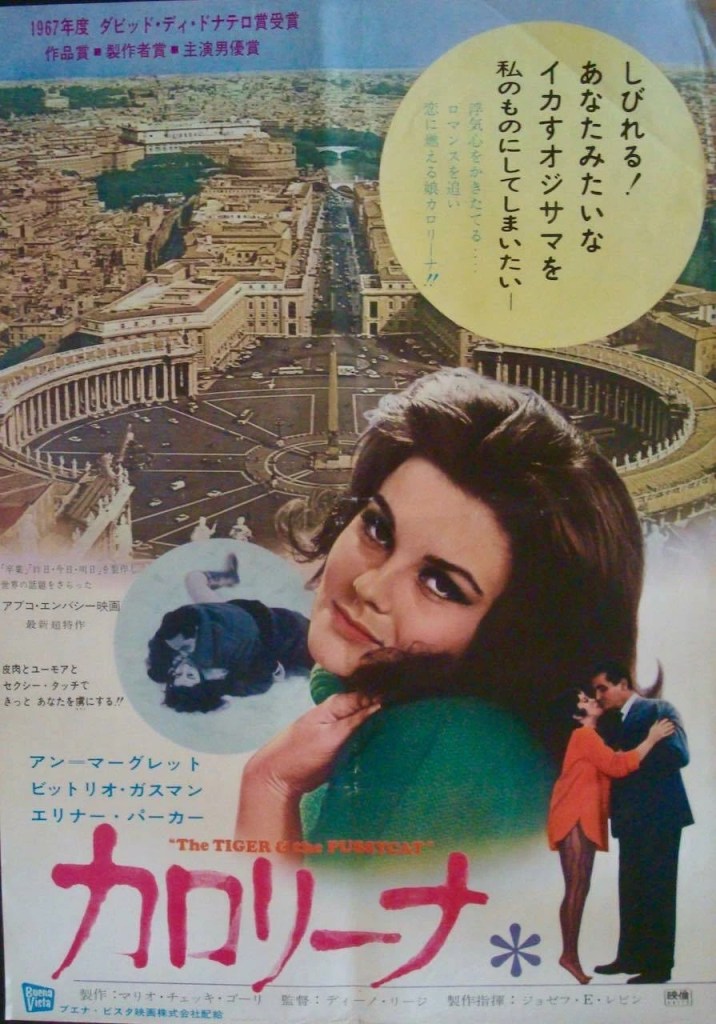
The Tiger and the Pussycat (1967) ***

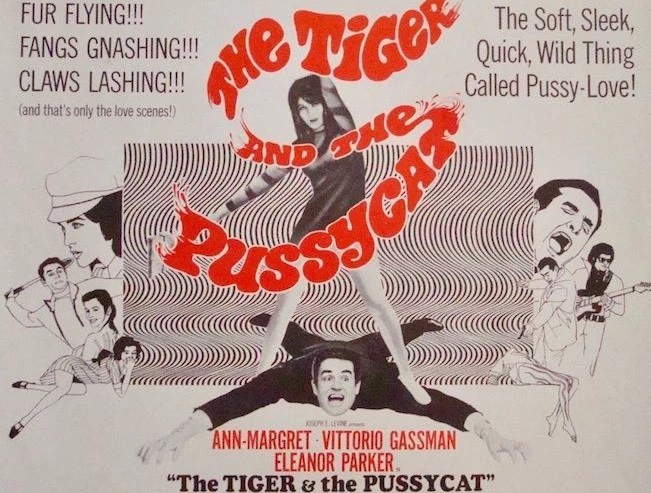
Ann-Margret was taking a leap into the unknown when she decided, temporarily, to turn her back on Hollywood and revive her fading fortunes – and buttress her bank account – by heading to Italy. By the time she made that decision, Clint Eastwood would not have been deemed to set a sparkling template since his spaghetti westerns were not released in the USA until after she had departed for Italy. She may well have had her head turned by such critically acclaimed fare as the Oscar-nominated Marriage Italian Style (1964) or perhaps the prospect, like Burt Lancaster in The Leopard (1963), of being taken up by critically-acclaimed director.

At one point she had easily been the fastest-rising star in Hollywood, with contracts for movies from rival studios, at one time balancing the demands of around a dozen movies. Had she been born in the previous decade she would have headlined any number of pieces of fluff that attracted box office. Even so, after making a number of pictures that scarcely challenged her – from Bye, Bye Birdie (1963) to The Swinger (1966) by way of a couple efforts that stretched her screen person (Once a Thief and The Cincinnati Kid, both 1965) – she had discovered that she was still perceived as little more than a Bond Girl, or the Matt Helm equivalent in Murderers’ Row (1966).

Quite what she expected to find in Italy is anybody’s guess. Probably not a standard Italian comedy. Nor to be playing second banana to Italian star Vittorio Gassman (A Virgin for the Prince, 1965) – three-time winner of a David (the Italian equivalent of the Oscars) – who knew how to frame his performance for an Italian audience. But while a huge star in his homeland he had not crossed-over like Marcello Mastroianni to win international favor.

Top executive Francesco (Vittorio Gassman), alarmed at becoming a grandfather at the age of 45, and believing life has now passed him by, begins a relationship with Carolina (Ann-Margret), an art student less than half his age. She makes a good bit of the running, being attracted to older men.

So a fair chunk of the picture is Francesco unable to make up his mind, or then suffering guilt from an illicit affair, worrying that his wife will find out and at the same time considering running away with the decidedly energetic girl.

The scenario will be more familiar to Italian audiences than American. Affairs were often seen as opportunities for comedy rather than, as in Hollywood, drama and angst. Francesco has the example of his friend Tazio (Fiorenzi Fionrentina), brought to financial ruin by an affair, and all the friends of his wife Esperia (Dorothy Parker) are divorcees after their husbands have run off with younger women.

Despite his excuses for being away from home mounting up, Esperia is not suspicious. You would have thought his colleagues would have more of an inkling given the number of times he dodges work commitments.

If you are a fan of Italian comedy, this will be right up your street, a number of sequences where Gassman falls back on physical comedy or stretches his features every which way but loose and gives the impression of not being able to follow his dreams at the same time as being suffocated by them.

If you’re here for Ann-Margret, you’ll be baffled. Sure, she has the occasional opportunity to shake her trademark booty, and she has lost none of her screen presence, but the role, effectively of second banana to the male lead, could have been played by a dozen other actresses, and Ann-Margret doesn’t bring anything particularly innovative or exciting to the role.

She went into Italian exile for three years and the movies she made all bombed at the American box office so in effect, as far as Hollywood and American audiences were concerned, she had inexplicably disappeared and there wasn’t exactly a long queue seeking her signature when she returned.

Directed by Dino Risi (Treasure of San Gennaro, 1966) from a script by himself, Enni De Concini (A Place for Lovers, 1968), Adriano Baracco (Treasure of San Gennaro) and Nino Manfredi (Treasure of San Gennaro).

A decent enough comedy. Gassman runs off with the picture but Ann-Margret completists will find little to enjoy.

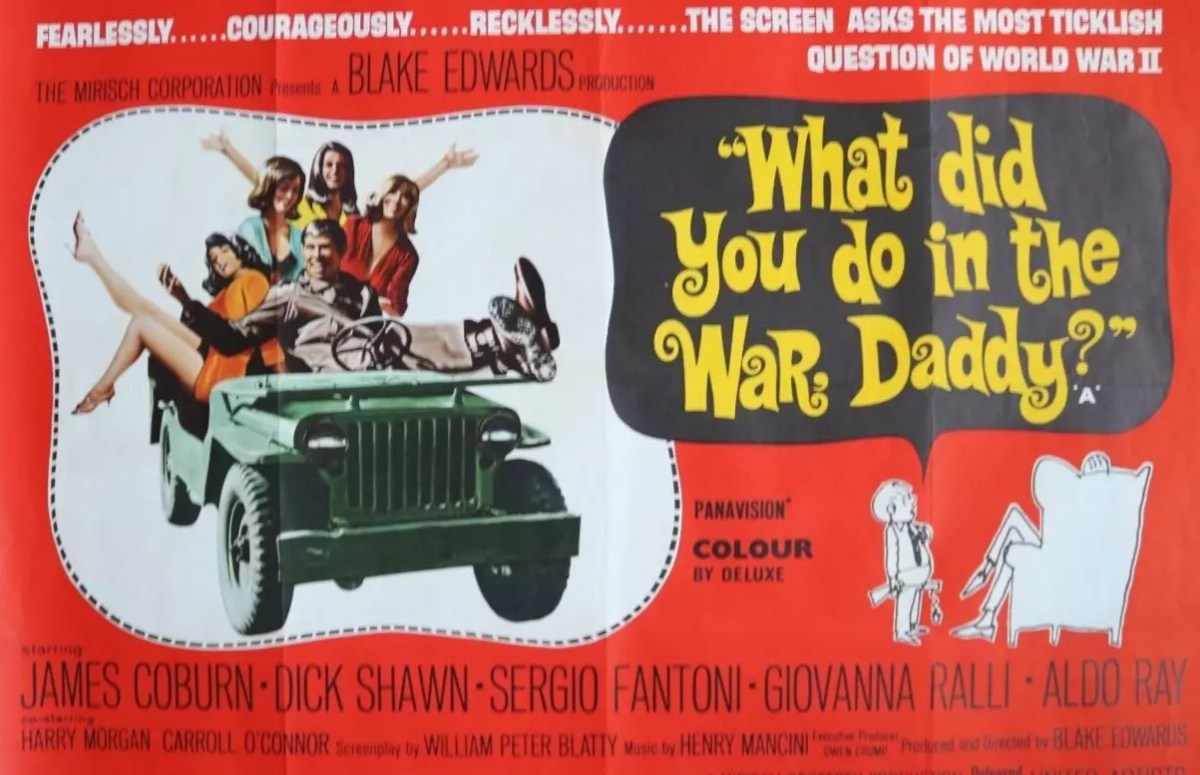
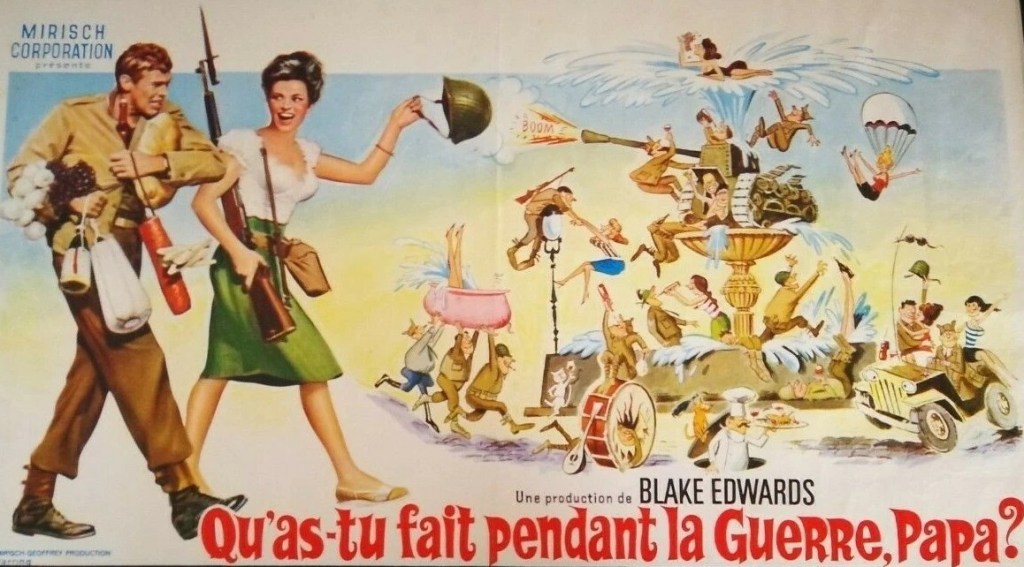
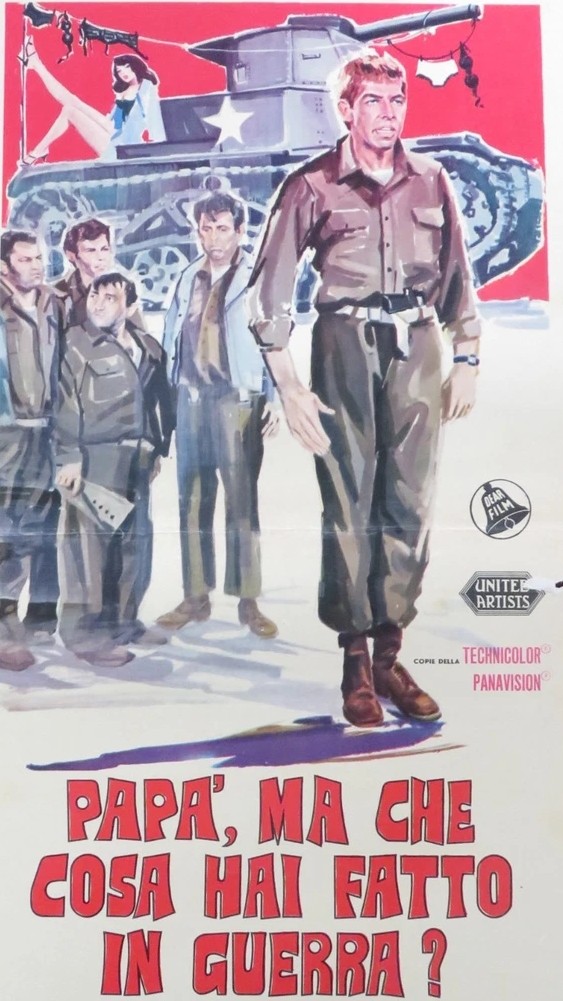
What Did You Do in the War, Daddy? (1966) **

How on earth did James Coburn get mixed up in this mess? I’m assuming that having suddenly been elevated from supporting actor to top billing as a result of Our Man Flint (1966) he took the first job that came along that reflected his ideas about salary. Director Blake Edwards was, to some extent, at something of a loose end. United Artists had passed on The Great Race (1965) and another project with the director had fallen by the wayside. Apparently, this movie was the result of a question asked by his son. During World War Two, Edwards had served in the U.S. Coastguard which meant he did not see active service though did suffer a back injury. Writer William Peter Blatty (A Shot in the Dark, 1964) was too young for World War Two and though he joined the US Air Force he didn’t see active service either, being employed in the psychological warfare division.

So this exercise wasn’t going to be based on personal experience. The mid-1960s wouldn’t exactly lend itself to poking fun at war, although Vietnam was fair game.

You might have thought Coburn, on reading the script, would have realized he’s not much in the movie for the first 20 minutes or so and then is at the mercy of a bundle of subplots.

During the invasion of Sicily in 1943, stickler for discipline Captain Cash (Dick Shawn) is handed command of a disorganized unit headed by Lt Christian (James Coburn) and instructed to take a strategic village from the Germans. Turns out the enemy is long gone and the resident Italian soldiers, commanded by Capt Oppo (Sergio Fantoni), are only too happy to surrender as long as they can continue to enjoy la dolce vita which in this case involves an annual wine festival. Most of the early part of the picture revolves around getting Cash to loosen up, and after imbibing copious amounts of liquor and being seduced by the mayor’s daughter Gina (Giovanni Ralli) he relents.

There are only two obstacles to the merry party. Oppo objects to his girlfriend Gina being used as a makeweight to make Cash see things the Italian way and Cash’s boss General Bolt (Carroll O’Connor) asks to see proof of their success. So, since not a shot has been fired and they can’t boast of a camp full of Italian POWs, they decide to invent the proof and start filming phoney footage.  Bolt reckons they need support and sends up reinforcements. Which is just as well because the Germans, either realizing what they’ve been missing or being nudged back into action, decide to reappear. And given the slovenly chaotic opposition it’s not hard for them to re-take control of the town which results in Cash hiding out in drag.

Theoretically, it’s a reasonable idea. There’s been no shortage of swindlers or con-men or black marketeers in war movies – think James Garner in The Great Escape (1963) and The Americanization of Emily (1964) – and various armies have been filled with shysters ranging from Sgt Bilko to the shifty recruits in British films up to all sorts of wheezes or doing their best to stay out of the line of fire.

But once the point has been made that it’s better to make love not war and drink as much wine as possible and become friends with the enemy, the point is made over and over again. There isn’t a single joke that isn’t belaboured and not many laffs to begin with. Going over-the-top is fine for slapstick like The Great Race but it doesn’t work here.

James Coburn has too little to do and Dick Shawn (A Very Special Favor, 1965) too much. Giovanni Ralli (Deadfall, 1968) and Sergio Fantoni (Hornet’s Nest, 1970 ) are wasted. Carroll O’Connor (Warning Shot, 1966) is the pick of a supporting cast that includes Aldo Ray (The Power, 1968) and Harry Morgan (The Mountain Road, 1960) but that’s only because he has a clever reversal of a role as a general who wants to be treated as an individual.

I should point out this has something of a cult following but I won’t be joining the fan club.

Must have seemed a good idea at the time.

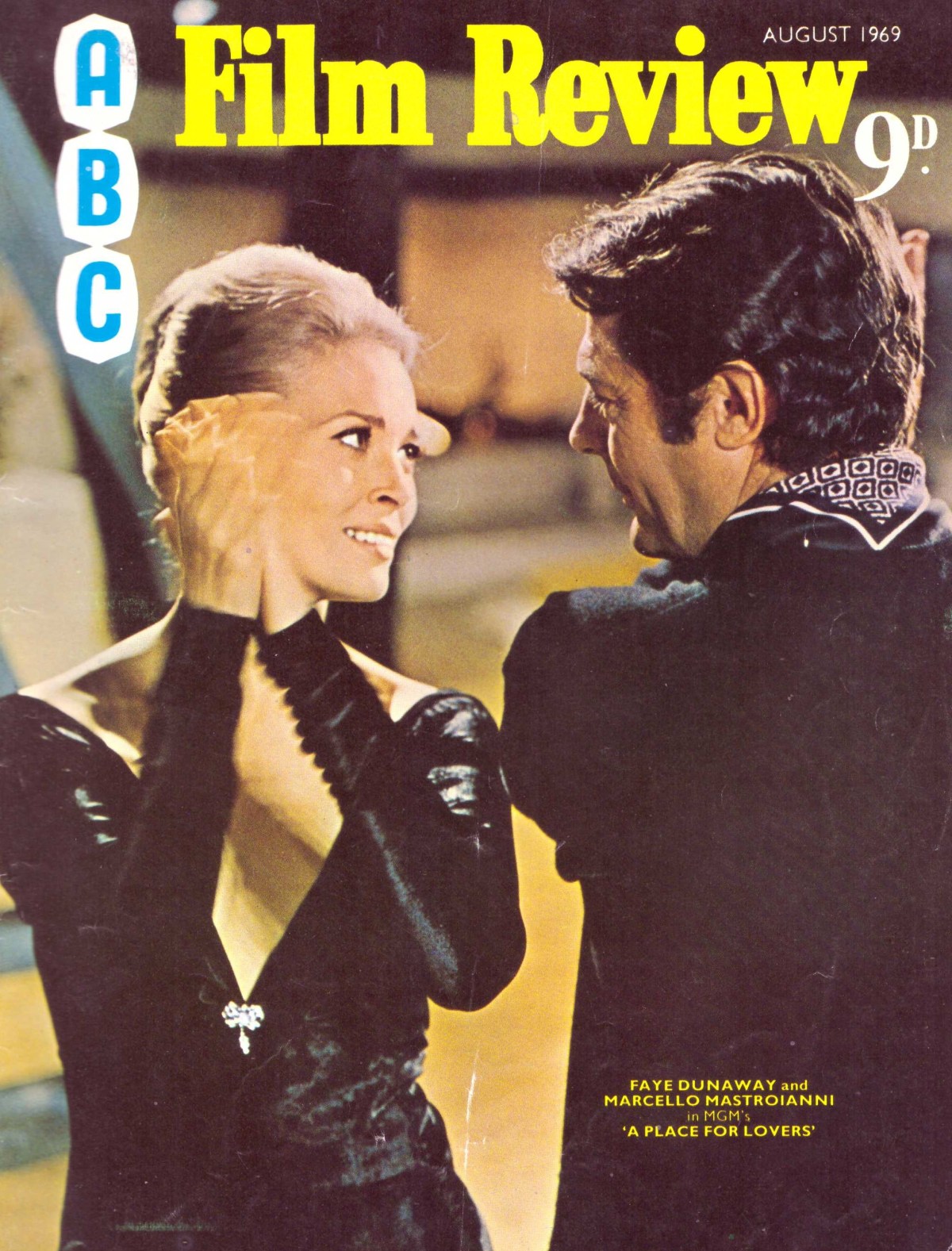
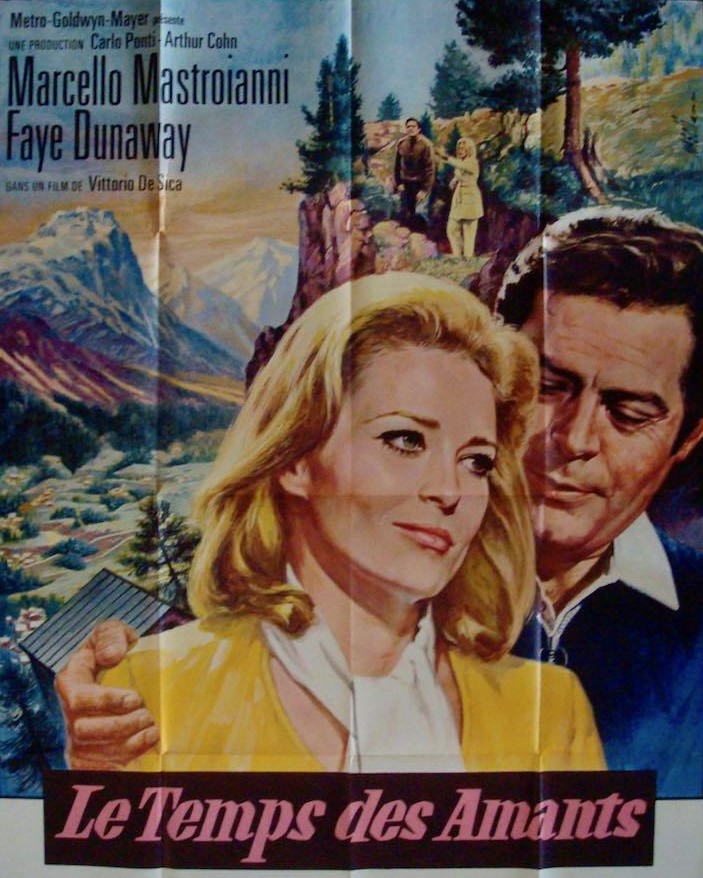
A Place for Lovers (1968) ****

I’ve marked this up since my previous viewing of it. And that’s an exceptionlly rare occurrence. What may not have suited the 1960s audience accustomed to standard boy-meets-girl boy-loses-girl even with whatever complications were available at the time, this should chime more with a contemporary audience seeking more reality and less glorification in a love story.

Not quite the Hollywood romance, too much bellyaching from the male for a start, and a couple of years before Love Story (1971) gave terminal illness a box office shot in the arm, but nonetheless very much an adult love affair and far from deserving a place in the top 50 worst films of all time.

For a start director Vittorio De Sica plays around with audience expectations. This always has the feel of a romance that could end at any time, of characters not quite sure of the other person’s feelings, real love or just sex, the sense of not knowing where this could go, and of where, emotionally, they find themselves. And it begins with confusion, a blaring horn in the background, a close-up of Julia (Faye Dunaway), and then she jiggles around with some bricks in a wall before retrieving a key and finding her way inside a grand though modern Italian pallazo. You’ve no idea why she is here and I guess neither does she.

There’s been no meet-cute and there’s no real intimation of how the attraction began except, judging from a brief flashback, they must have bumped into each other at an airport. That’s my conclusion anyway because the details of the actual meeting are never clarified, like a lot of what subsequently goes on. She hides information from him, he does the same, so for a time feelings are not spelled out. It’s clandestine in all the wrong ways. There’s a separation, a distance, characters often seen in very long shot. Sometimes there are physical barriers between them, a high fence in one instance, as if true intimacy is impossible.

Still no sign of the man she has come to visit. She rescues a stray dog from the town dog collector. It’s an exceptionally grand house, classically designed, marble floors, paintings and artistic artefacts all over the place, but no clutter. When Valerio (Marcello Mastroianni) arrives – it’s his house – he checks the labels on her luggage, presumably finding out her full name, possibly her address, possibly accustomed to lovers providing false information on both counts. We learn he’s a safety-conscious racing driver, a man who requires barriers.

They are on a deadline already. She is only in Italy for a further two days. This is a lie. She has 10 days at her disposal but wants to set the pace, heat up the sexual atmosphere. They make love beside a lake. He takes her to dinner with friends where the entertainment is a lecture on sexual positions shown in art. But after someone suggests a game of what we would these days term speed-dating, he calls an end to the affair, jealous that she would consider spending any time in close proximity to another man.

So that’s it. Grand love affair dead and buried after just one day. Except she turns up next day at a practice at a racing circuit. After they reconcile, she watches in a car mirror as he makes a call in a phone box – speaking to his wife or another lover, we never find out, except her reaction explains it must be either.

There’s little of the sparkling dialog found in Hollywood romances, especially for audiences who grew up on the Tracy-Hepburn pictures, but she tells him that “if you put all the houses I have lived in you would make a good little town” and not just that she had lived a peripatetic lifestyle but that she also had six grandfathers so a rather fluid upbringing. She confesses now she has more time to spare, she just wanted him to ask for it, being stricken by her potential absence an indication in her eyes of true love.

So this is a fragile individual, her smile is always hesitant, external confidence hiding vulnerability. Her face is never flush with passion. When he asks why she never revealed her terminal illness, she replies, “I can’t take any more sad eyes.” There’s an ironic ending.

It is of course set against glorious backdrops but instead of letting the audience wallow in the love affair, as would be the Hollywood temptation, De Sica finds some way of undercutting it. Valerio is never quite sure of her and she is never quite sure of him. Their pasts remain hidden. Their lovemaking beside the lake is interrupted by a hunter bagging game. She coos over a baby only to discover it has an ugly father. She drives too fast even with a racing driver in the passenger seat and she clearly has suicidal tendencies, the love affair almost a salve for her despair.

We could have been presented with the suave charming Marcello Mastroianni (La Dolce Vita, 1960) cliché from a dozen Italian films, but instead he is often jealous, annoyed, real. Faye Dunaway (Bonnie and Clyde, 1967) plays a character who never knows where she stands with her emotions, accepting her fate one moment, determined to end her life the next, and yet still time to dally in a love affair that of course can have no future.

Vittorio De Sica (Two Women, 1960) has fashioned a picture that is neither uplifting nor downhearted, a love affair that lives just for the moment, but with implied complications that could at any moment wreck it, a romance always teetering on the edge.

I’ve no idea what compelled Harry Medved to include this in The Fifty Worst Films of All Time, published in 1978, but you might easily question his judgement on discovering that his list includes Sergei Eisenstein epic Ivan the Terrible, Alain Resnais’s hypnotic Last Year at Marienbad, Otto Preminger’s Hurry Sundown, Alfred Hitchcock’s Jamaica Inn and even such passable entertainments as The Omen.

Maybe you’ve been put off giving this a whirl thanks to the Medved seal of disapproval. A Place for Lovers is not the greatest film ever made, but it’s certainly far from the worst, two striking actors and a director who could never make a terrible picture make sure of that. And, as I mentioned, exerts greater appeal for the contemporary viewer.

No DVD available so you will need to check out Ebay or streaming.

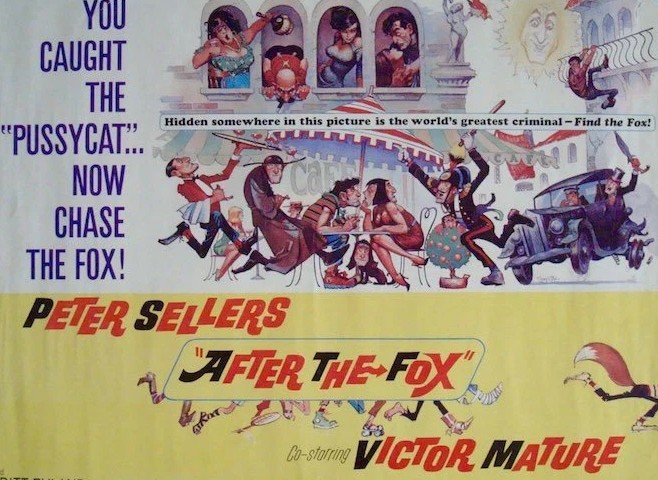
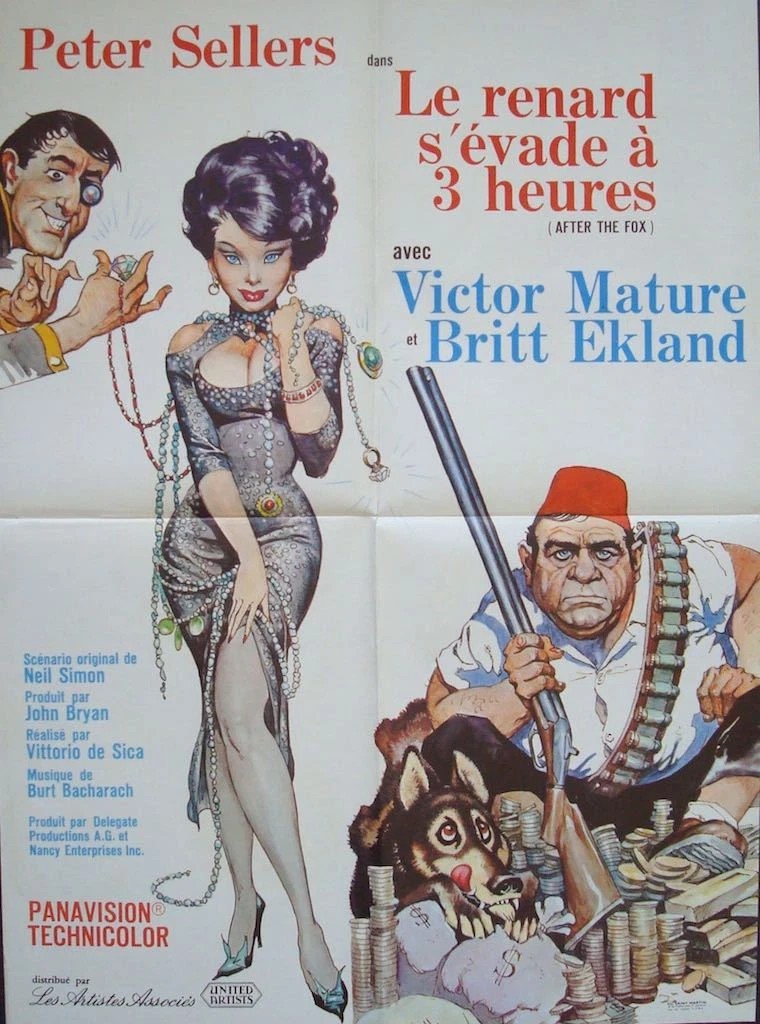
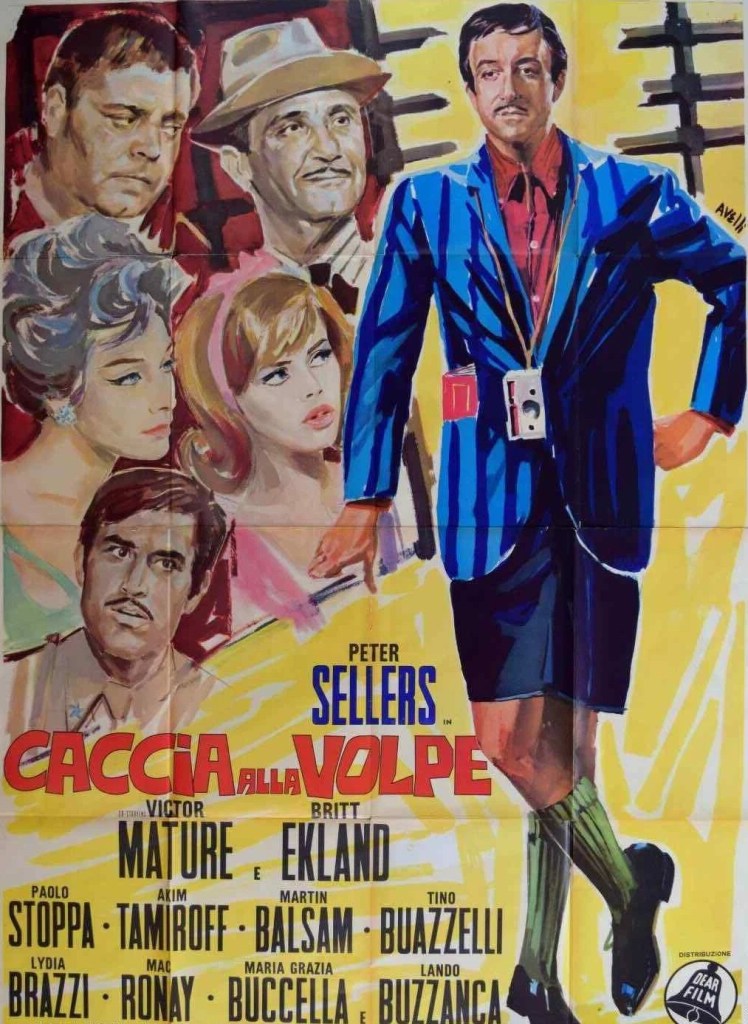
After the Fox (1966) ****

There’s a classic MacGuffin in here somewhere, but I can’t make out if it’s the heist serving the satire on movies or the satire on movies serving the heist. Whatever, this is about the funniest picture you’ll watch on the movie business (much better than Paris When It Sizzles two years earlier). You can keep your royalty and your top politicians dropping in from every corner of the globe, but it’s hard to beat Hollywood landing on your doorstep to transform everyone into a sycophant. To facilitate filming, individual streets and solid blocks will be closed and even businessmen whose businesses are threatened will stick their nose out into the road in the hope of being captured by a stray camera. Everyone wants to be in the movies and how brazenly the movies exploit such naked need.

Before we get to the movie part of the story, we find imprisoned top criminal Aldo Vanucci aka “The Fox” (Peter Sellers) escaping from confinement so that he can assist robber Okra (Akim Tamiroff) transport 300 solid gold bars from a heist in Cairo to Italy. Though the heist is deceptively simple (and might even have influenced The Italian Job, 1969), for a time it looks as if this will canter along going nowhere fast while we get bogged down in a subplot concerning the burgeoning acting career of Vanucci’s sister Gina (Britt Ekland). There’s a whole bunch of standard Italian comedy tropes – the dominant Mama, the incompetent crooks and the brother too controlling of his sister.

But once Vanucci hits on a movie shoot as the ideal way to disguise the bringing ashore of the loot into the Italian island of Ischia, he strikes pure comedy gold. The townspeople who might otherwise easily see through a con man are putty in his hands. The local cop comes onside when persuaded he has the cheekbones of actor. Aging vain star Tony Powell (Victor Mature) wearing a trademark trench coat like a latter-day Bogart is an easy catch once you play upon his vanity and even hard-nosed agent Harry (Martin Balsam) is no match for the smooth-talking Vanucci.

Vanucci has mastered the lingo of the film director and can out-lingo everyone in sight. The very idea that he has a hotline to Sophia Loren goes undisputed and Powell is even persuaded that Gina, who has never acted in her life, is the next big thing.

Pick of the marvelous set-pieces is the scene in a restaurant where Vanucci is astonished to find a peach of a girl (Maria Grazia Buccella) speaking in a deep male voice because while she’s opening her mouth the words are being supplied by Okra seated behind her. Not all the best scenes involve Vanucci. Harry tartly batting away Tony’s vanities is priceless while the theft of film equipment while a film director (played by the movie’s director) calls for more dust in a sandstorm is great fun.

Also targeted is the self-indulgence of the arthouse filmmaker determined to add meaning to any picture. Vanucci’s versions of such tropes as lack of communication or a man searching for identity and running away from himself are a joy to behold and one scene of Tony and Gina sitting at opposite ends of a long table at the seashore just about sums the kind of pointless but picturesque sequence likely to be acclaimed in an arthouse “gem.” And you might jump forward to villagers hiding the wine in The Secret of Santa Vittorio (1969) for the sequence where townspeople load up gold into a van, singing jauntily all the time.

Most of all Sellers (A Shot in the Dark, 1964) hits the mark without a pratfall in sight – the only pratfall in the picture is accorded Harry. Unlike The Pink Panther, Sellers doesn’t have to improvise or be funny. He just follows the script and stays true to his character and the one he has just invented of slick director. There’s even a great sting in the tail.

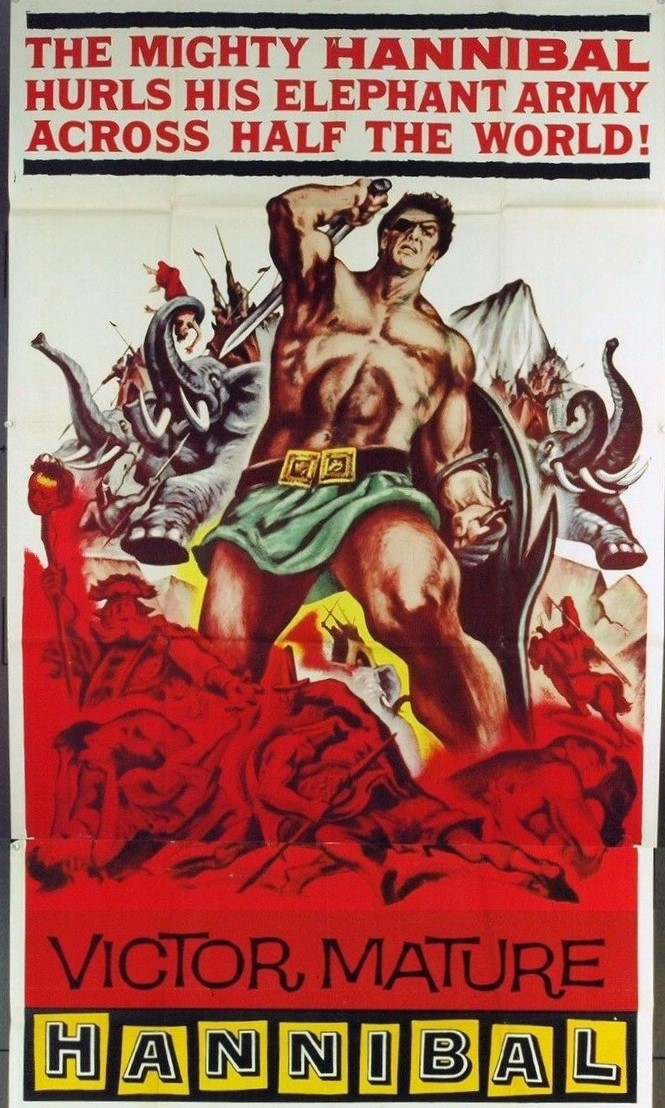
Sellers shows what he can do with drama that skews towards comedy. Though criticized at the time for, effectively, some kind of cultural appropriation – she was a Swede playing an Italian, what a crime! – Britt Ekland (Stiletto, 1969) is perfectly acceptable. Victor Mature (Hannibal, 1960) has a ball sending up the business as do Akim Tamiroff (The Vulture, 1966) and Martin Balsam (The Anderson Tapes, 1971).

Vittorio De Sica (A Place for Lovers, 1969) does pretty well to merge standard Italian broad comedy with several dashes of satire. The big surprise is that Neil Simon (Barefoot in the Park, 1967) wrote the script, helped out by De Sica’s regular collaborator Cesare Zavattini (A Place for Lovers).

I saw this and A Shot in the Dark on successive nights on Amazon Prime. I hadn’t seen either before. They had been received at either ends of the box office spectrum, the Clouseau reprise a big hit, the Hollywood satire a big flop, so I expected my response might reflect that. But, in reality, it was the other way round. I appreciated this one more.

Go figure.  

The Biggest Bundle of ‘Em All (1968) ***

Bunch of incompetent crooks kidnap an impoverished Mafia boss who pays his ransom by setting up a major heist. By a stroke of casting alchemy this brings together Cesare (Vittorio De Sica), the epitome of old world Italian charm, knock-out gangster’s moll and scene-stealer-in-chief Juliana (Raquel Welch) replete with scanty knock-out outfits and criminal mastermind Professor Samuels (Edward G. Robinson). In order to acquire the funds necessary to steal $5 million of platinum ingots from a train – the plan involving a tank and an WW2 bomber – the crew, initially headed by American Harry (Robert Wagner), need to carry out smaller jobs.

Problem is, none of them are any good, not even Cesare, who has lost his flair and botches an attempt to rob an old flame of her jewels. They can’t even carry out a simple theft from a restaurant. The heist itself is pretty spectacular and innovative. And the movie is quirky, with a darker edge. While there are few belly laughs, the light tone is enough to carry the gentle humor, mostly inspired by the misplaced team, amateurs for various reasons, not necessarily outright lawbreaking, on the run. These include London Cockney mechanic Davey (Davy Kaye), chef Antonio (Francesco Mule) distracted by hunger at every turn, cowardly violinist Benny (Godfrey Cambridge) and Joe (Mickey Knox) with a helluva brood to feed.

The story does a good bit of meandering, as does the camera, much of its focus on the voluptuous charms of Juliana, but the hurt pride of Cesare and the grandiose machinations of the professor keep it on course. The Italian settings, incorporating grand villas and ruins, do no harm either. The heist is terrific and there is a final twist you may or may not see coming. The interplay of characters works best when it involves Juliana, who attempts to twist Cesare around her little finger, that tactic mutual it has to be said, who keeps the professor on his toes by dancing with him in a disco, and it soon becomes apparent that she has the upper hand over loverboy Harry.

You could be forgiven for thinking the title refers to Raquel Welch – a cinematic infant at this stage with only One Million Years B.C (1966) in her locker – especially when her cleavage and looks receive such prominence, but the caper is classy and different. As well as being obvious she is both sinuous and seductive and clearly has a mind of her own, possibly the most criminally intent of the entire outfit, with weapons the others lack. By this point, she had invented the pop-out bikini, pictures of which had flooded Europe, making her the pin-up par excellence, but those who came to simply gawp quickly realised there was talent behind the body.

De Sica (The Shoes of the Fisherman, 1968) constantly plays around with the idea of being a defunct godfather and Robinson (Grand Slam, 1967) is the antithesis of the gangster roles on which his fame relied. Robert Wagner (Banning, 1967) is less effective, miscast and out of place in such august acting company and losing out to welch in every scene.

This was a considerable change of pace for British director Ken Annakin after Those Magnificent Men in Their Flying Machines (1965) and Battle of the Bulge (1965) and he brings to this the comedy of the former coupled with the narrative complications of the latter, wrapping everything up in an easy inviting style that makes the most of his stars and the locations. Screenwriter Sy Salkowitz was a television veteran (Perry Mason, The Untouchables et al) , this marking his first venture into the big screen.        

Discover WordPress

A daily selection of the best content published on WordPress, collected for you by humans who love to read.

The Atavist Magazine

by Brian Hannan

WordPress.com News

The latest news on WordPress.com and the WordPress community.