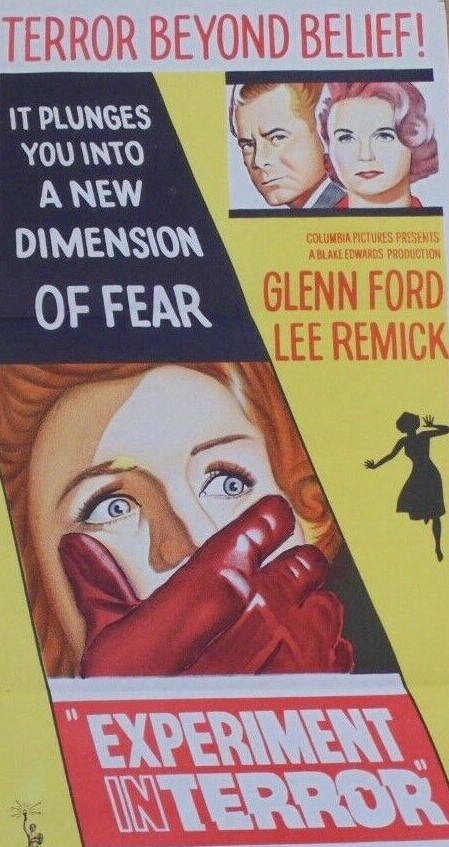
For a modern audience any film that contains mention of “Twin Peaks” and “Tarantino” either shows amazing prescience and/or an indication of what is to come. This classy thriller does not disappoint. Part police procedural, part portrait of a killer, part clever heist and part women in peril, it has you wondering why director Blake Edwards did not stick to the genre. Set in San Francisco in an era when the F.B.I. was generally considered a good thing rather than the paranoia-inducing entity it would become a decade later.
Bank teller Kelly Sherwood (Lee Remick) is terrorized by an unknown assailant into helping him carry out a audacious $100,000 heist. F.B.I. agent Ripley (Glenn Ford), aware of the prospective theft, is drawn into the diabolical web as is Sherwood’s younger sister Toby (Stefanie Powers). The only clue to the thief is his asthmatic voice. Levels of forensic detection set a new bar with the F.B.I. employing telephone, personal and even aerial surveillance, commandeering of television cameras to scan a crowd, and analyzing a telephone conversation to identify the criminal.
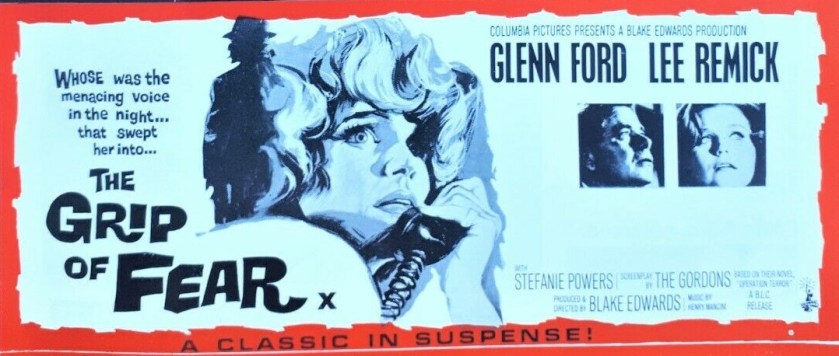
There are red herrings aplenty. Tension is racked up so adroitly that any character entering the frame automatically arouses suspicion. Edwards takes a leaf out of the Hitchcock suspense book by finding constant ways to remind Kelly – and the audience – just what is at stake, Ripley promising her a “reign of terror” and not, as you might expect, lying to her about the threat she faces.
As Ripley digs further into the robber’s past, he uncovers not only a catalogue of crime including rape and three murders, but also an unusual personality. Yes, as you might expect, a control freak, but also a guy capable of affection and of lavishing thousands of dollars on those worse off than himself. And, of course, he is exceptionally good at planning crime, outwitting the F.B.I., and picking the kind of vulnerable victim susceptible to intimidation. Every time, the F.B.I. thinks it is closing in, he remains one step ahead. Eventually, the F.B.I. has amassed so many clues, including his identity, a photograph and previous lovers, that you think it’s impossible for him to escape – until he does.
Kelly is so on edge, in following instructions, that she picks up the wrong man in a bar, the police so antsy they mistake a drunk for the assailant. Drenched in atmosphere and rich in subsidiary characters, there’s scarcely a dull moment, from a mannequin repairer (Nancy Ashton) with a roomful of dangling inert bodies, a karate class with (ironically) a woman well able to defend herself, to a small boy desperate to see a G-man’s weapon, an informant (Ned Glass) with a penchant (as did director Edwards) for silent comedies, and a bank manager who promises Kelly a promotion even if she has to steal the money.
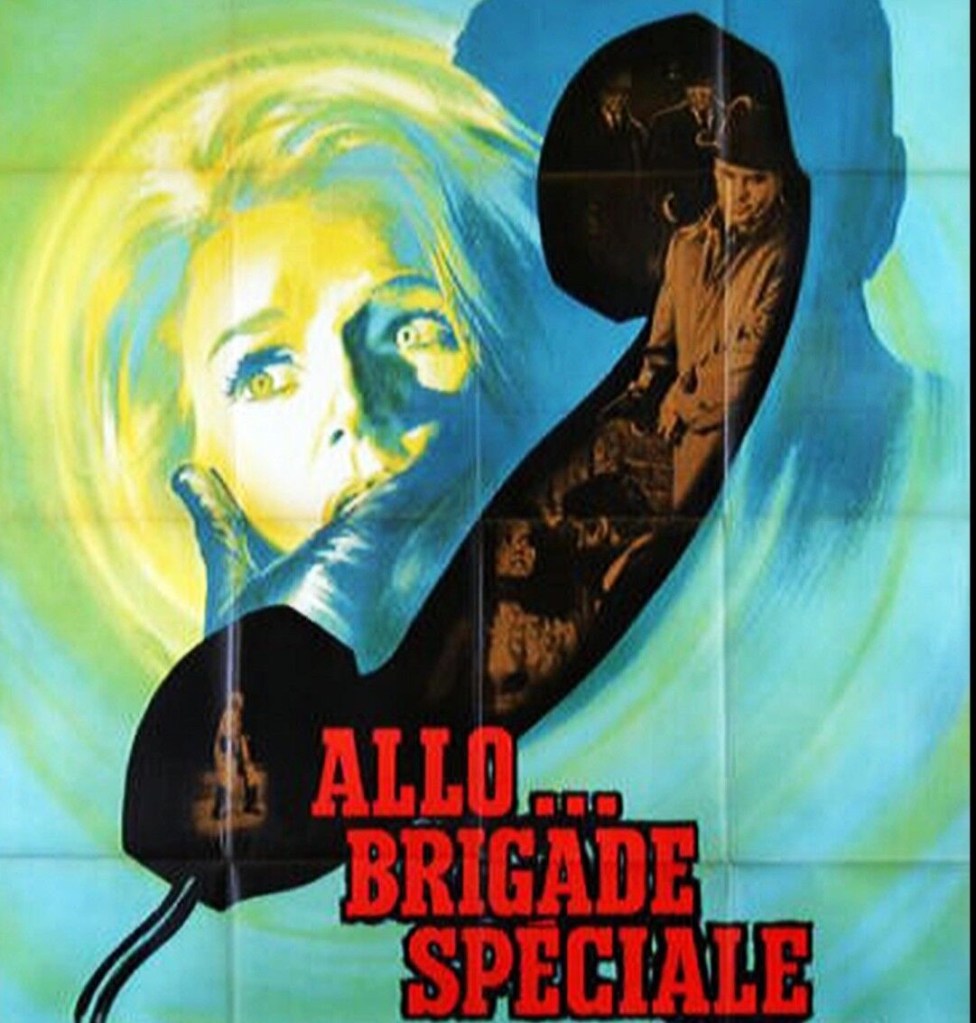
On top of this there are some genuine creepy moments that up-end our expectations. What Ripley doesn’t tell Kelly is that she’s also bait and clearly has little concern that she might end up collateral damage – anticipating at the very least she will have a nervous breakdown when it’s over, if, in fact, she survives – in his bid to snare the criminal. A terrified kidnapped Toby strips down to underwear in front a man we know is a rapist. And the movie touches on the woman-who-loves-a-killer motif, a theme very much in the contemporary vein.
Blake Edwards (Breakfast at Tiffany’s, 1961) delivers a directorial tour de force. The criminal is hidden for most the picture, drip-fed to the audience in glimpses, his mouth here, his back there, other times in disguise. Edwards establishes the F.B.I. as such a “very efficient organization” using the most up-to-date methods and involving a vast number of staff plus police that it seems impossible to fail – until it does. And there is an absolutely brilliant six-minute sequence at the outset, milking the best of film noir lighting, when the criminal surprises Kelly in her garage and spells out in detail her vulnerability and the basics of his plan. By keeping the criminal in the shade, and what little available light there is covering her face, Edwards makes the most of Lee Remick’s eyes – every bit as iconic as Audrey Hepburn’s outfits in Breakfast at Tiffany’s – and her acting skill.
Remick (Sanctuary, 1961) is superb, trapped by emotion as much as terror, placing her trust in an F.B.I. that lets her down time and again. This is an edgier role for Glenn Ford (Fate Is the Hunter, 1964) as he steps up from the trustworthy guy-next-door to reveal a more ruthless streak. Stefanie Powers (The Warning Shot, 1967) does well in a small role and there is sterling support from Ross Martin (The Ceremony, 1963), Patricia Huston (Synanon, 1965) and Clifton James (Live and Let Die, 1973). Gordon and Mildred Gordon wrote the screenplay based on their novel Operation Terror.
“Twin Peaks” in case you are wondering is the district in which Kelly lives. There’s a sign towards the end for Tarantino’s World-Famous Cocktails.


With your topical references, you had my attention, but then you had my interest. Bravo!
LikeLiked by 1 person
Thanks.
LikeLike
Much here:
“The 22 Aug 1960 DV noted that the original story, Operation Terror by Gordon and Mildred Gordon, first appeared in Ladies’ Home Journal as a three-part series. The story was set near The Gordons’ home in the Sherman Oaks district of Los Angeles, CA, with characters named after their neighbors. According to the 4 Jan 1961 DV, Columbia Pictures paid $112,500 for film rights to the property, which was due for publication in book form later that month. It was reportedly among the highest payments ever made for a suspense novel at that time.
A news item in the 9 May 1961 DV revealed that the project would be produced jointly by filmmaker Blake Edwards’s Geoffrey Productions and the recently-formed Kate Productions, owned by lead actress Lee Remick and her husband, Bill Colleran. The 1 Nov 1960 DV stated that Edwards was considering Jack Lemmon to play opposite Remick. He would later team the actors in Days Of Wine and Roses (1962, see entry). Edwards also offered parts to comedian Mort Sahl (2 Jun 1961 DV), and stage actress Elaine Dunn (19 Jun 1961 DV). Al Avalon, who’s scene was cut from the 1961 Edwards production, Breakfast at Tiffany’s (see entry), was compensated with a role in the upcoming film, according to the 2 Aug 1961 DV.
The 14 Aug 1961 LAT announced the film’s official title as Experiment in Terror, with Taffy Paul in the role of “Toby Sherwood.” The 26 Mar 1962 edition later revealed that she had changed her name to Stefanie Powers. The 7 Aug 1961 start of principal photography was reported four days later in a DV production chart. The 6 Sep 1961 issue noted that Edwards was forced to move the production to San Francisco, CA, because the heavy “smog” in Los Angeles interfered with shooting.
Additional castings included Edward Mallory (25 Aug 1961 DV) and Robert Caffey (21 Nov 1961 DV). The 31 Oct 1961 DV credited Bob Yeager as unit publicist, and the 18 Jan 1962 issue attributed title design to Armand Acosta.
As stated in the 1 Aug 1961 DV, Edwards planned to film an 18 Aug 1961 baseball game between the San Francisco Giants and the Los Angeles Dodgers at Candlestick Park. The script called for a “double play” during the game, although no such thing could be predicted. On 25 Aug 1961, DV reported that two nights earlier, filming in the park was interrupted by 50,000 Jehovah’s Witnesses, who had reserved the facility for a conclave. Edwards consulted with city officials, who arranged for the Witnesses to return the following Tuesday. Filming at the park concluded 24 Aug 1961. The 7 Sep 1961 LAT stated that several hundred background actors were used in the scene, along with a wind machine. An article in the 29 Aug 1961 DV revealed that, while there was no charge for filming in Candlestick Park during the Giants-Dodgers game, the production was billed $6,000 for six nights of additional shooting, as the city expected a rental fee from any group or entity using the park. Along with the additional expense, Edwards sustained a broken finger while directing the sequence, according to the 12 Sep 1961 DV. The 23 Aug 1961 issue reported plans to film at the Anglo-Crocker Bank. The 25 Mar 1962 LAT identified additional locations as Fisherman’s Wharf and Chinatown. According to the 14 Sep 1961 DV, Edwards moved the company back to Los Angeles, due to heavy fog in San Francisco. Production continued into early Nov 1961, during which time Edwards collapsed on the set. The 13 Nov 1961 DV claimed that he was suffering from bronchial pneumonia. One month later, Henry Mancini arrived at the Columbia Studios to begin scoring the film, as stated in the 13 Dec 1961 DV. Editing was underway by 18 Dec 1961, as reported in that day’s issue.
The 13 Feb 1962 DV announced the scheduled 6 Apr 1962 premiere at the Paramount Theatre in San Francisco. Openings followed in New York City on 13 Apr 1962, and in Los Angeles on 29 May 1962. Reviews were mixed: While the 31 May 1962 LAT described the film as “a shocker handled with good taste,” the 14 Apr 1962 NYT asserted that it was no better than its television counterparts. Public response was positive, placing it among the National Box Office Survey’s top ten releases, as reported in the 2 May 1962 and 23 May 1962 issues of Var. Supporting Actor Ross Martin received a Golden Globe nomination for his performance.
The 3 Oct 1961 DV declared Experiment in Terror to be Glenn Ford’s twenty-second and final picture under his contract with Columbia. He went on to form Newton productions with partners Al Rothman and Alex Tucker.”
LikeLiked by 1 person
Fascinating info. I’m a big fan of both leads.
LikeLike