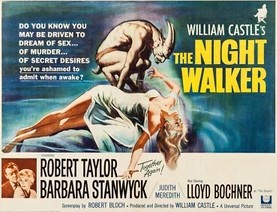
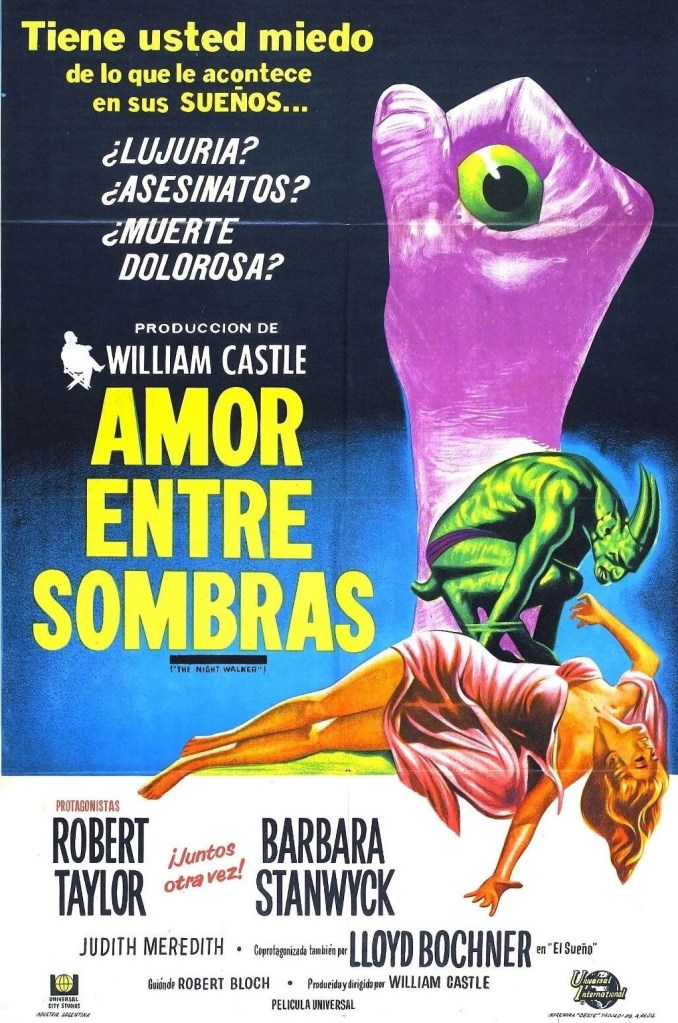
The Night Walker (1964) ****

Deserves its spot in the cult pantheon, hints of Spellbound (1945) and Vertigo (1958),  mesmeric atmosphere of dream/nightmare held together by a hypnotic performance by Barbara Stanwyck, tonsils in overdrive. But no point screaming at the unseen, at the unknown, when it invades reality, no point trying to escape a dream when you’re trapped inside.

Except that there’s no sign of the demonic figure haunting widow Irene Trent (Barbara Stanwyck) on the poster it delivers on all other fronts, driving you to question our heroine’s grip on reality as much as she questions herself. If there’s such a thing as self-gaslighting, she’s in the vanguard.
Creepy rich blind husband Howard (Hayden Rorke) is an emperor of surveillance, microphones everywhere catching her every word, including what she utters in her dreams, which convinces him that she’s having or has had an affair. When he dies in an explosion, body eviscerated in the inferno, she can’t come to terms with her freedom, holing up in the tiny apartment at the back of her beauty parlor, relying on assistant Joyce (Judi Meredith) and attorney Barry (Robert Taylor) for moral, and perhaps in relation to the solicitor, physical support.

When the unreal invades her daily life and she begins to believe in her dreams and when the handsome lover (Lloyd Bochner) of her night-time imagination takes shape, she begins to doubt her sanity. But so convinced, on the other hand, that she must be sane, she tries to convince Barry that her dreams have basis in fact. She tracks down the apartment (No 341) she visited in her dreams and the chapel where she imagined she was married to said lover.

You wish director William Castle (Straitjacket, 1964) had continued exploring the theme of dreams vs reality, and how to cope when the imagination takes over. But instead, it twists into thriller territory, the old set-up, the gaslighting that could send Irene over the edge and straight into a sanatorium while her husband’s substantial wealth ends up elsewhere.

Even so, once it heads down this particular path, it’s still mighty tricky. Who could be in on the act? All the people she trusts – Barry, Joyce, even Loverboy? And if she’s going to let her suspicions run riot, how is she going to come out the other side, for surely that will tip her over into madness?
Exceptionally lean, barely 80 minutes once you exclude the treatise on dreams at the start that establishes the premise of the “Night Walker” – the person who lives through their dreams – and exceptionally clever. Irene is so given to screaming that you’d scarcely think there’s space left in her brain to to work out just what’s going on. And there’s no shortage of permutations.

Has her dead husband, half his face obliterated by burns, come back to haunt her? Is the Lover just a figment of her imagination? Why can’t she make do with someone as handsome as Barry?

We’ve got smoke issuing from under doors, recurrent bright flashes of explosion, mannequins that seem alive, all sorts of jiggery-pokery with guns, telephone wires cut, a blind man who can tell the color of your dress, eyeballs plucked from faces and squeezed until they pop, and the expectation all the time of a straight dive into madness. No escape in other words.

Even when it fast approaches a climax you might have guessed the outcome of, turns out you were wrong and there’s still a few more twists – and screams – to come.

The fact that it turns into a straightforward thriller at the time tended to diminish the emphasis on the demonic, but these will be more fully appreciated today when the line between reality and fiction is stretched ever thin.

Four-time Oscar nominee Barbara Stanwyck (A Walk on the Wild Side, 1962) might have been accused of slumming it in low-budget horror fare such as this, but, boy, in her final big screen appearance, (although she successfully switched to television as star of The Big Valley, 1965-1969) does she give it her best shot. If this was Stanwyck’s swansong, Robert Taylor (A House Is Not a Home, 1964) , a fellow relic from Hollywood’s Golden Age, wasn’t far behind, only a few movies left in him.

For all this relied on William Castle’s directorial dexterity,  the imagination behind it came from master of the macabre Robert Bloch (Psycho, 1960).

Cult doesn’t come much better.
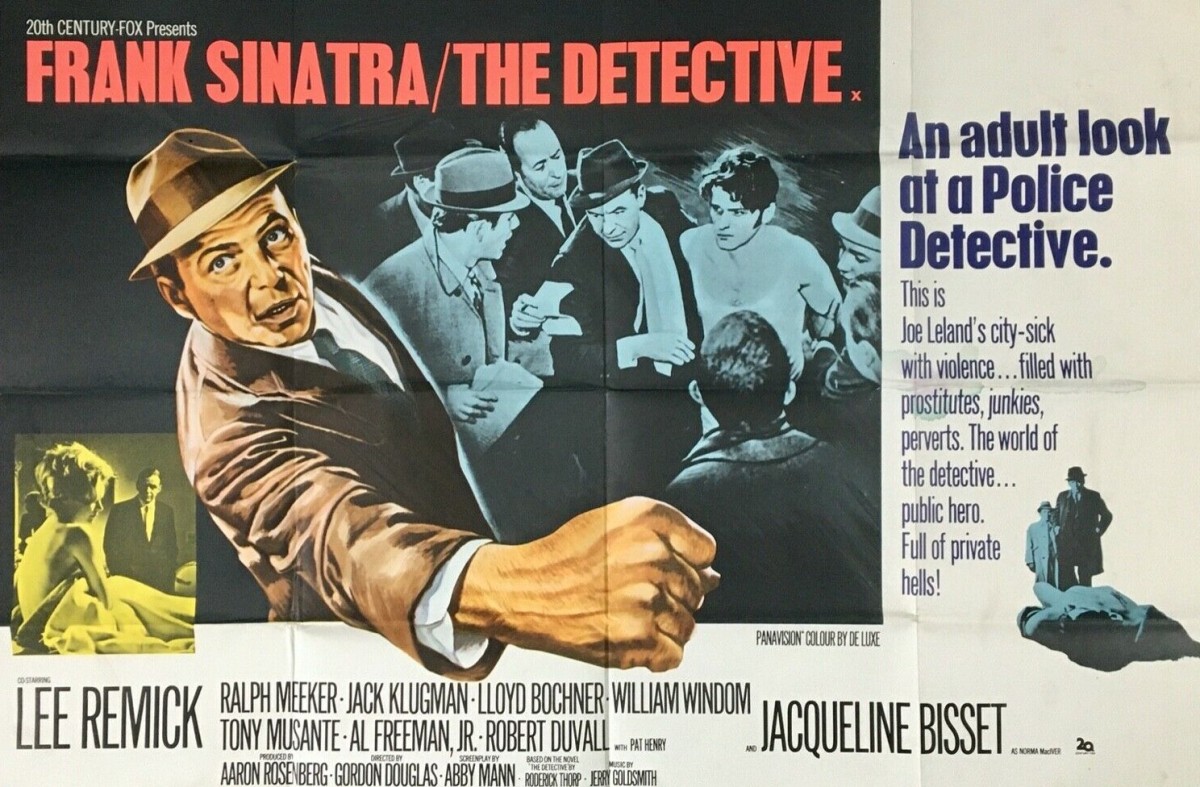
The Detective (1968) ****

Perhaps the boldest aspect of this raw look at the seamier side of life as a New York cop is that perennial screen loverboy Frank Sinatra plays a cuckold. Prior to what is always considered the more hard-hitting cop pictures of the 1970s – Dirty Harry (1971), The French Connection (1971), Serpico (1973) etc – this touched upon just about every element of society’s underbelly. Despite an old-school treatment, more a police procedural than anything else, homosexuality, nymphomania, corruption, police brutality, and a system that ensured poverty remained endemic all fell into its maw. And, for the times, several of these issues were dealt with in often sympathetic fashion.

Joe Leland (Frank Sinatra), an ambitious but principled detective gunning for promotion, investigates the murder of a prominent homosexual while dealing with the disintegration of his marriage to Karen (Lee Remick) and colleagues on the take. When other cops want to beat confessions out of suspects or strip them naked to humiliate them, Leland intervenes to prevent further brutality. He is not just highly moral, but takes a soft approach to criminals, not just playing the “good cop” part of a good cop/bad cop double-act but genuinely showing sympathy. Not only does Leland leap to the defense of those he feels unfairly treated, but he trades punches with those meting out such treatment. In addition, he clearly feels guilt over sending to the electric chair a man he believes should be treated in a mental institution.

Although at first glance this appears a homophobic picture, it is anything but, Leland showing tremendous sympathy towards homosexual suspect Felix (Tony Musante) – whom his  colleagues clearly despise – to the extent of holding his hand and gently cajoling him through an interview. Later, rather than condemn a bisexual the film shows empathy for his torment. Certainly, some of the attitudes will appear dated, especially the idea of sexual expression as a brand of deviancy, but the film takes a genuinely even-handed approach. Through the medium of Leland’s perspective, it is clearly demonstrated that it is other police officers who have the warped notions.  

Having solved the first murder, Leland takes up the case of an apparent suicide at the behest of widow Norma McIver (Jacqueline Bisset), only for this to lead not only to civic corruption on a large scale but back to the original investigation. Leland also has a wider social perspective than most cops and there is a terrific scene where he berates civic authorities for creating a system that perpetuates poverty. The ending, too, casts new light on Leland’s  character.

By this point, most screen cops were defined by their alcoholism and ruined domestic lives, but this is altogether a more tender portrait of an honest cop. Leland’s relationship with Karen is exceptionally well done. Normally, of course, it is the man who usually strays. This reversal in the infidelity stakes adds a new element. Karen has more in common with an independent woman like the Faye Dunaway character in The Arrangement (1969).

While playing the good cop would come relatively easy to an actor like Sinatra, carrying off the role of the hurt husband is a much tougher ask. Coupled with his sensitive approach to criminals, this is acting of some distinction, a mature performance by a mature star.  This is the last great Hollywood role by Lee Remick (No Way to Treat a Lady, 1968) and she brilliantly portrays a woman trapped by her self-destructive desires.

Jacqueline Bisset (Bullitt, 1969) leads an excellent supporting cast that includes Jack Klugman (The Split, 1968), Ralph Meeker (The Dirty Dozen, 1967), Robert Duvall (The Godfather, 1972), Lloyd Bochner (Point Blank, 1967) and Al Freeman Jr. (Dutchman, 1966).

While Gordon Douglas (Claudelle Inglish, 1961, and Tony Rome, 1967) was viewed very much as a journeyman director, he brings an inventive approach and some surprising subtleties to the picture. He opens with a very audacious shot. It looks like you are seeing skyscrapers upside down, as if a Christopher Nolan sensibility had entered a time warp, until you realize it is the city reflected off a car roof. There are some bold compositions, often with Sinatra appearing below Remick’s sightline, rather than the normal notion that the star must be taller or at least the same height as everyone else.

Oscar-winning Abby Mann (The Judgement at Nuremberg, 1961) adapted the bestseller by Roderick Thorp who achieved greater fame much later for writing the source novel for Die Hard (1988) – Nothing Lasts Forever, a sequel to The Detective. For the Bruce Willis film Joe Leland became John McClane. Sinatra, although 73 at the time, was offered that role first as part of his original contract for The Detective.

In The Detective Sinatra’s wife Mia Farrow was initially contracted to play the part of Norma McIver but pulled out when Rosemary’s Baby (1968) overshot its schedule. Partly in revenge, Sinatra sued her for divorce.

Discover WordPress

A daily selection of the best content published on WordPress, collected for you by humans who love to read.

The Atavist Magazine

by Brian Hannan

WordPress.com News

The latest news on WordPress.com and the WordPress community.