The Blood Beast Terror (1968) ***

As the title suggests there’s a vampiric element, and there’s not a great deal unusual in that, Hammer having successfully revived interest in bloodsuckers. What is unusual, however, and a couple of years before that studio’s The Vampire Lovers (1970) is the idea of female empowerment. Previously, the sole purpose of a damsel in a horror picture was to lay bare a convenient bosom for a passing thirsty creature, or, have their clothing disarrayed and let out a scream when a monster pounced.

The twist here is that the vampire is a woman, Clare (Wanda Ventham), and men who are the victims except on the occasions when her father Dr Mallinger (Robert Flemyng) hypnotizes young women in order to give the creature a blood transplant. The beast exists as a creature and then morphs into Clare. For a time it looks as if Clare is merely possessed, but in reality appears much more as if she is enjoying being the beast, abandoning the enforced respectability of the times, luring men into the forest to have her rapacious way with them, the men naturally thinking they are in for a romantic tryst rather than being targeted by a predator.
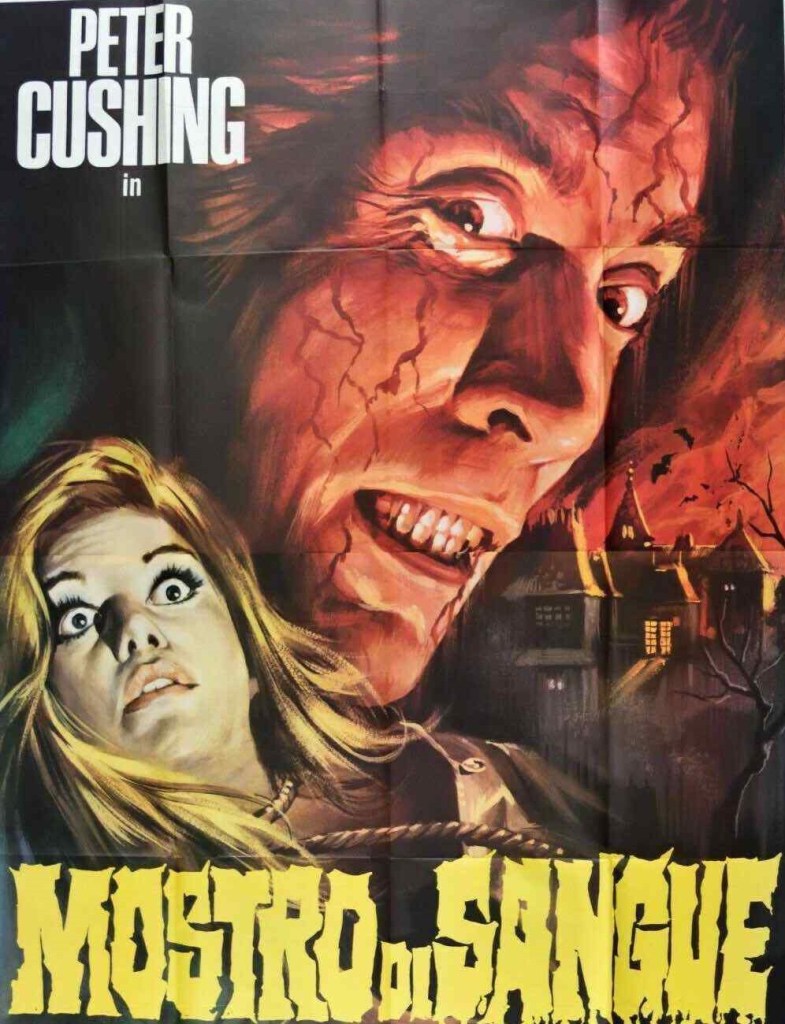
Continuing the theme of misleading the audience, this poster cleverly suggests that it’s a man who is the beast and the woman who are the victims.

There’s a wonderful scene that gives an insight into her mindset. Her friends put on a little play. Her role is the monster, a part she seizes with relish.

It’s one of those films you have to work out backward. In standard horror fashion it leaves the twist till close to the end and it would have been far more interesting if we had discovered at the outset that Clare was the beast, leading the men for the most part a merry dance, outwitting Inspector Quennell (Peter Cushing) and her adoring father Dr. Mallinger (Robert Flemyng).  

The inspector, faced with a growing pile of corpses drained of blood, is baffled throughout, no Sherlock Holmes clever deductions here, and it naturally would not occur to any of the males, beyond Dr Mallinger who is in on the secret, to imagine a woman capable of not just committing such crimes but of exerting such power over a man. The story glosses over the genetics, it’s a version of Frankenstein obviously, but the background to it is missing, and I can see why. There has to be some mystery.

Hitchcock could not have done a better job of misleading the audience. For a start the story is told entirely through the male perspective. And it’s set up as a murder mystery, Quennell our lead as he dances from one corpse to the other, helped along in his information accumulation by lugubrious mortuary attendant  (Roy Hudd), who is, ironically, as hungry as the beast, but for normal food rather than blood, always seen devouring something. Mallinger is not a mad professor either, but a distinguished one, celebrated in his field, giving lectures and attracting proteges like Britewell (William Wilde).

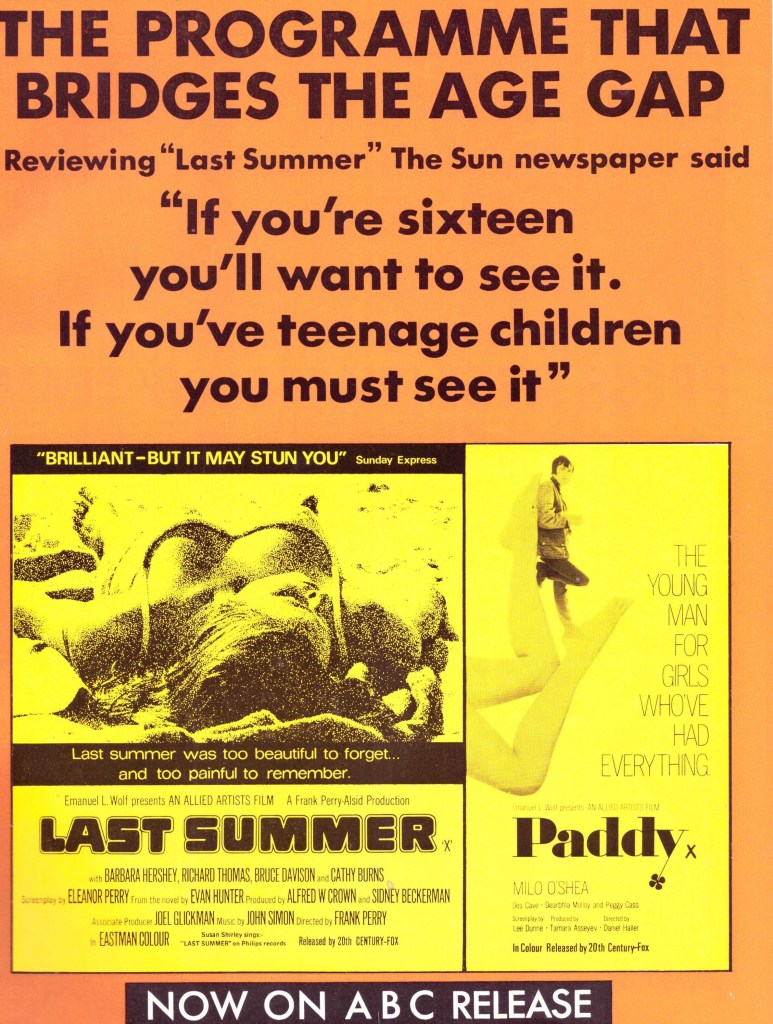
Initial British release double bill cleverly bringing together Peter Cushing and Christopher Lee –
though in separate pictures.

Although his daughter acts as laboratory assistant, Mallinger is hardly aware that his daughter is sizing up every male visitor as a potential victim.

The posters give away that the creature is a giant moth, and by and large the special effects (no CGI available of course) pull this off, the creature usually just glimpsed or seen from the distance, and the possibility that Mallinger is aware of what he is harbouring apparent when he enters a cellar wearing a leather hood and carrying a whip.

Tony Tenser’s production company Tygon has acquired cult status, in part for having the temerity to take on British horror giant Hammer at the height of its powers in the 1960s, and in part from the distinction of its output, making such films as The Sorcerers (1967) with Boris Karloff, Peter Cushing as Witchfinder General (1968) and Karloff, Christopher Lee and Barbara Steele in The Crimson Cult/ The Curse of the Crimson Altar (1968). Tenser ploughed a different furrow to Hammer at a time when that studio was also expanding into bigger-budgeted movies such as One Million Years B.C. (1966).

Capably not to say cleverly director by veteran Vernon Sewell (The Crimson Cult) it is miles ahead of its time and generally delivers the goods. Peter Cushing (The Skull, 1965) is excellent as usual, Robert Flemyng (The Deadly Affair, 1967) proves a more interesting scientist than usual, steering clear of any craziness.

Wanda Ventham in her first leading role provides a fascinating character study, but you have to work backwards as I said, to realize just how good she is, the way she has, for Victorian times, her father under her thumb, and the seductive glances she casts at men, not to mention the ease with which she assists her father in his diabolical experiments without him realizing why she is so enamored. Female monsters had evolved from creatures before – in Cat People (1942), Snake Woman (1961) and Hammer’s The Reptile (1966) – but this was a more rapacious example of the species. Vanessa Howard (Some Girls Do, 1969) has a small role and you can spot Scottish character actor Glynn Edwards (Zulu, 1963) and television comedian Roy Hudd in his movie debut.

Screenwriter Peter Bryan (The Brides of Dracula, 1960), something of an expert in the horror field, turns the whole genre on its head with the gender politics examined here.

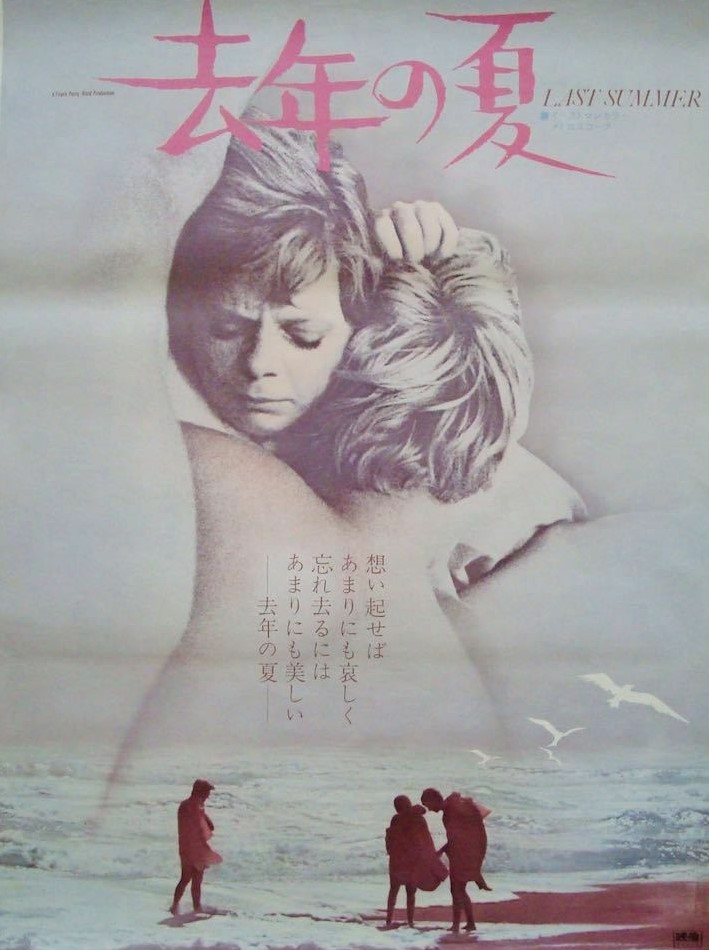
Last Summer (1969) ****

Given the severity of the crime involved, you leave Frank Perry’s coming-of-age-drama wondering what happened to the four principals. Did the aggressive three young demi-gods of a golden age go on to pursue similar acts of cruelty? While one of them might show remorse, or at least suffer from guilt, of the other two I have my doubts. They would find ways to blame the injured party. And what about the victim? Would she have the courage to report the crime, or suffer in shame for decades.

It’s odd how time changes entirely the shape of a movie. In its day this was seen as a bold exposition of frank adventure by teenagers seeking their first experiences of growing up and experimenting with sex and drugs (pilfered from a parental stash). Although there is little focus on dysfunctionality, both Sandy (Barbara Hershey) and Rhoda (Cathy Burns) are missing a parent, the former’s father running off with another woman, the latter’s mother drowned by stupid misadventure. Both have been abused, unable to prevent the wandering hands of males. All are vulnerable, if only by youth.

Of the boys, Dan (Bruce Davison) is the more confident, Peter (Richard Thomas), while easily swayed, the gentler of the two. Dan merely seeks his first taste of sex, Peter the more likely to need love as well. Sandy is sexually precocious, somewhat on the exhibitionist side, peeling off her bikini top with apparently at times no idea of the effect it will have on the boys, at other times clearly uncomfortable with the notion that the guys might have nothing else on their minds but staring at her breasts. But she is the one who wants to continue watching a gay couple cavorting on the beach while Dan is embarrassed. Sometimes the frank sexuality is rite-of-passage stuff, other times it is distinctly creepy. In the cinema both men grope her breasts. She claims to have been excited by the experience, but you can’t help thinking at least one of the men should have shown restraint, not treating her as if she was some kind of sex toy.

The movie begins on a clearer note. The guys come across Sandy nursing a wounded gull and perhaps entranced by her good looks help her remove a hook from the bird’s throat, provide convalescence and eventually help the bird recover the confidence to fly again. It’s a cosy trio, but edgy, too, Sandy allowing them considerable latitude. But, of course, the guys do the same to her. When she bludgeons the bird to death because it bit her (“the ungrateful bastard”), the pair, initially shocked, are not shocked enough to reject her, afflicted by unassailable male logic, the kind that drove film noir, that maintained a beautiful woman could not have a black heart. 

Separated from the other two, Peter displays a gentler side, teaching the shy Rhoda to swim, kissing her in far more considerate fashion than the boys treat Sandy. But, effectively, she is a pet, and it’s only a matter of time before the unsavory aspect of Sandy’s character breaks out. After setting Rhoda up on a date, the trio do everything they can to spoil it, angry at the poor girl for not getting the “joke.”

Worse is to follow. Date-rape we’d call it today. Retreating to the cool forest, Sandy taunts Rhoda by removing her bikini top. When the horrified Rhoda refuses to do the same, Sandy attacks her, holding her down along with Peter while Dan rapes her. That’s where the film ends, no consequences, no repercussion. Back in the day it was a shock ending, an act of violence to mar an otherwise relatively innocent summer. After the deed is done, the camera pulls back into an aerial shot to observe the  guilty trio walking back to the beach, but without drawing conclusion or offering moral judgement. It’s hard to know what to make of the ending. These days, of course, we’d be appalled. But back then it didn’t appear to appall, certainly not drawing the outrage that accompanied similar scenes in The Straw Dogs (1971) or A Clockwork Orange (1971) perhaps because the perpetrators were so attractive and it was, after all, a coming-of-age picture, as if such things could be expected.

Roger Ebert, writing in the Chicago Sun-Times, for example, judged that the conclusion “is not really important to the greatness of the movie.” Andrew Sarris of Village Voice noted that “Perry retreats from the carnal carnage” to end with a shot that “prefers symbolic evocation to psychological exploration.” In other words adolescence is fraught with risk and Rhoda is just collateral damage.

Certainly the acting is uniformly excellent for such inexperienced actors, coping with many changes in dramatic focus, from early exhilaration through growing pains to violence.  Barbara Hershey (Heaven with a Gun, 1969) would go on to become a major star. Amazing to realise that Bruce Davison (Willard, 1971) and Cathy Burns, Oscar-nominated for her role, were making their movie debuts and for Hershey and Richard Thomas (Winning, 1969) their sophomore outings.

Director Frank Perry (The Swimmer, 1968) had a special affinity with the young as he had proved with David and Lisa (1962) and at times the whole affair had an improvised free-wheeling style. Eleanor Perry (David and Lisa) wrote the screenplay based on the novel by Evan Hunter (The Birds, 1963).

This is very hard to find, it turns out, so Ebay might be your best bet.

My thanks to one of my readers, Mike, for digging up this story of the disappearance of Catherine Burns from the movie business.

https://www.hollywoodreporter.com/movies/movie-features/catherine-burns-inside-50-year-disappearance-an-oscar-nominee-1275646/

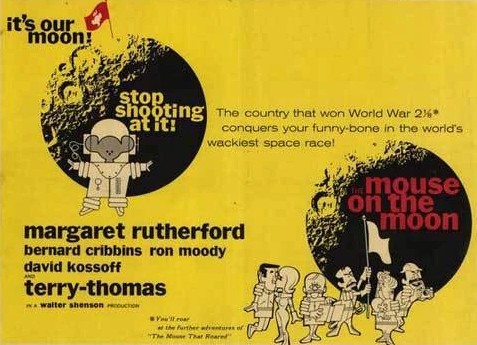
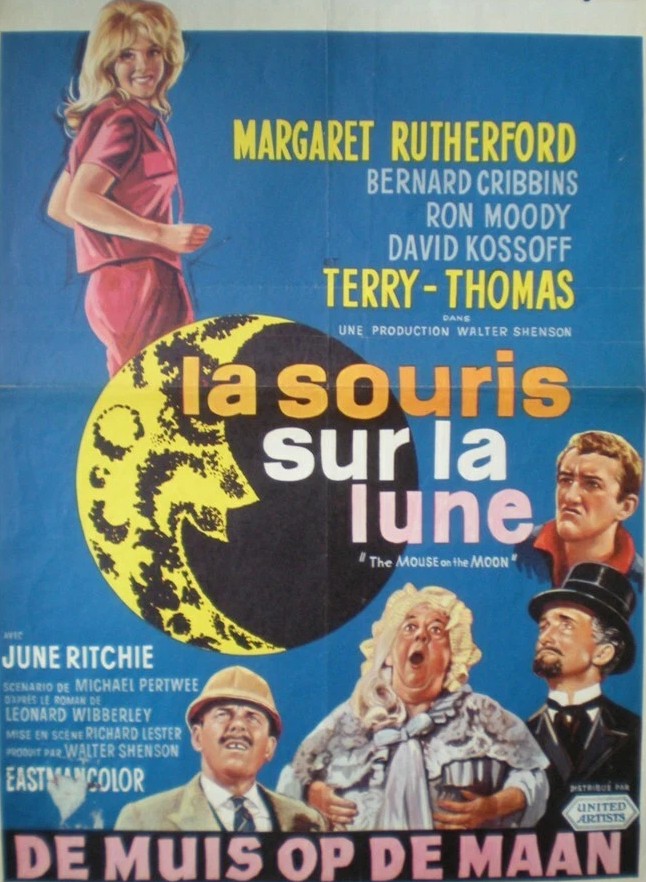
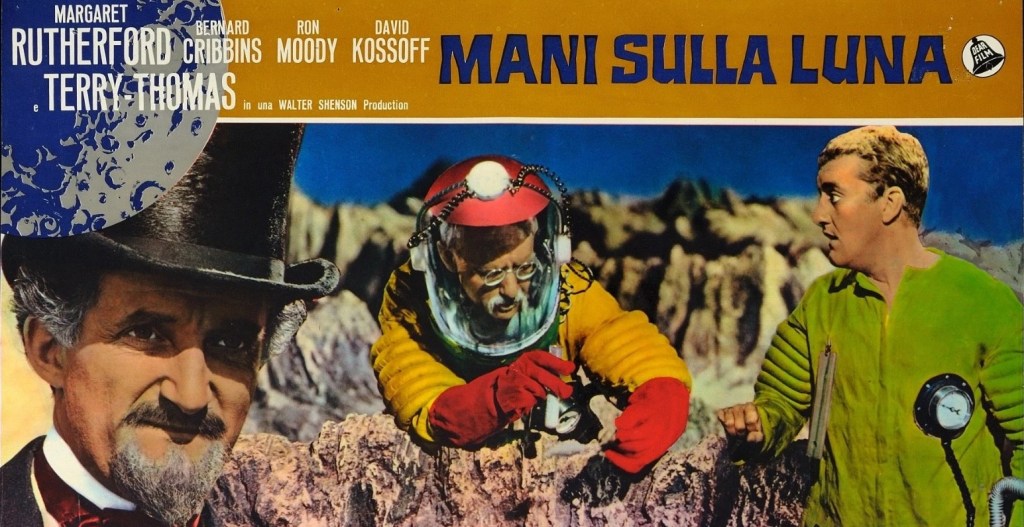
Mouse on the Moon (1963) ***

The gentle comedy for which the British were famous prior to the more raucous offerings from the Carry On team always contained an element of satire. Sometimes that has bite, but as often not, and almost, in a continuation of the gentleness of the format, appears like an afterthought. However, it’s not hard to skewer incompetence or hypocrisy or the foolish grandeur of nations, regardless of size.

There’s no blunderbuss required here – not with such easy targets as the space race, politics and the Cold War – just a gentle poke here and there at ambition, grandiosity and grandstanding as the tiny (barely comprising 15 square miles) country of the Duchy of Grand Fenwick somewhere in central Europe shows up global giants Russia and the United States. Sensibly, this doesn’t try to place one character at the center of the morass. Instead, stupidity is spread far and wide, as various characters cede vanity to the next.

The central conceit is one of those barmy ones that any scientist could make plausible – think of growing potatoes on Mars in The Martian or the nimble invention at play in Project Hail Mary (2026). The chemical reactions of bad wine set off the kind of explosions that could provide a substitute for rocket fuel and send a spaceship to the moon.

But that the idea is given oxygen in the first place by the superpowers wanting to be seen to be bigger than anyone else and by maintaining their rivalry when there’s little need.

Grand Fenwick is not just the type of place where nothing works – palace plumbing erratic, parades catastrophic, politicians corrupt and we are treated to a battalion of incompetents from Grand Duchess Gloriana (Margaret Rutherford), apt to nod off at state functions, Prime Minister Mountjoy (Ron Moody) who places having a hot bath about the needs of the populace and whose niece Cynthia (June Ritichie) is an agitator for reform, his untrustworthy political rival Benter (Roddy McMillan), and British spy Bender (Terry-Thomas) for whom bumbling is an art form.

Romance is in there somewhere when Mountjoy’s ineffective son Vincent (Bernard Cribbins) falls for Cynthia. But mostly it’s a concoction that relies on everything going wrong at the right time and anything that goes right nonetheless manages to cause appropriate chaos.

Having secured a million bucks in funding from America to purportedly send a rocket, a useless one donated by the Russians in a riposte to American generosity, to the moon, Mountjoy intends to pocket the cash by ensuring the rocket blows up on launch. However, it takes off, propelled by the wine with Vincent and scientist Professor Kokintz (David Kossoff) on board, triggering a genuine space race involving the two superpowers, propaganda the prize for the winner.

Naturally, nothing goes the way you expect and the little guys outwit the big guys.

This was an early directorial venture from Richard Lester (Petulia, 1968) so that accounts for some of the bite. Given this is populated in the main by character actors, Lester allows them do their thing while ensuring that the comedy is as much reliant on satire as buffoonery. No need here for double entendres or slapstick, the original set-up works out just fine.

Margaret Rutherford  (Murder Ahoy, 1964) could have run away with this picture but her natural instinct to dominate is kept in check. Ron Moody (Oliver!, 1968) heads a cast of movie also-rans, some of whom made a successful transition to television like John Le Mesurier (Dad’s Army), Hugh Lloyd (Hugh and I) and Roddy McMillan (The Vital Spark). Terry-Thomas (Our Man in Marrakesh/Bang! Bang! You’re Dead, 1966) would have stolen the picture if given more scenes. Bernard Cribbins (Carry On Spying, 1964) offers another of his hapless characters while June Ritchie (The World Ten Times Over, 1963) adds a note of glamor.

This was a sequel to The Mouse That Roared (1959) and had to make do without original star, Peter Sellers, who had played three roles. Two of those roles were allocated to other players, with the third character axed. And where that film benefited from Sellers’ presence, this one definitely benefits from his absence.

Written by Michael Pertwee (Strange Bedfellows, 1965) from the bestseller by Leonard Wibberley.

Engaging.

Blood and Black Lace (1964) ****

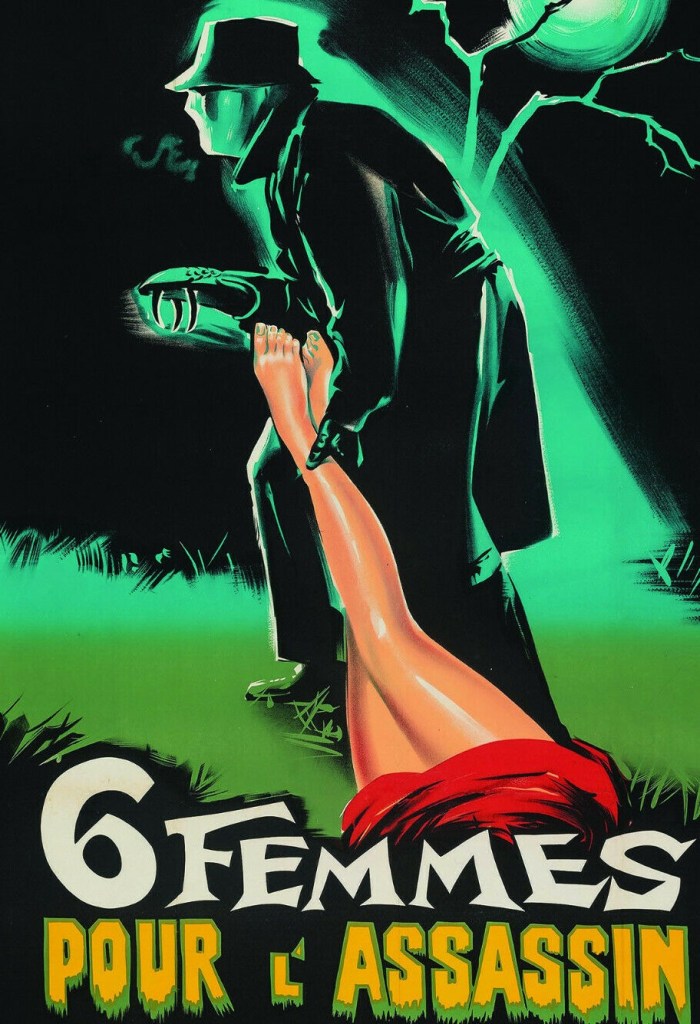
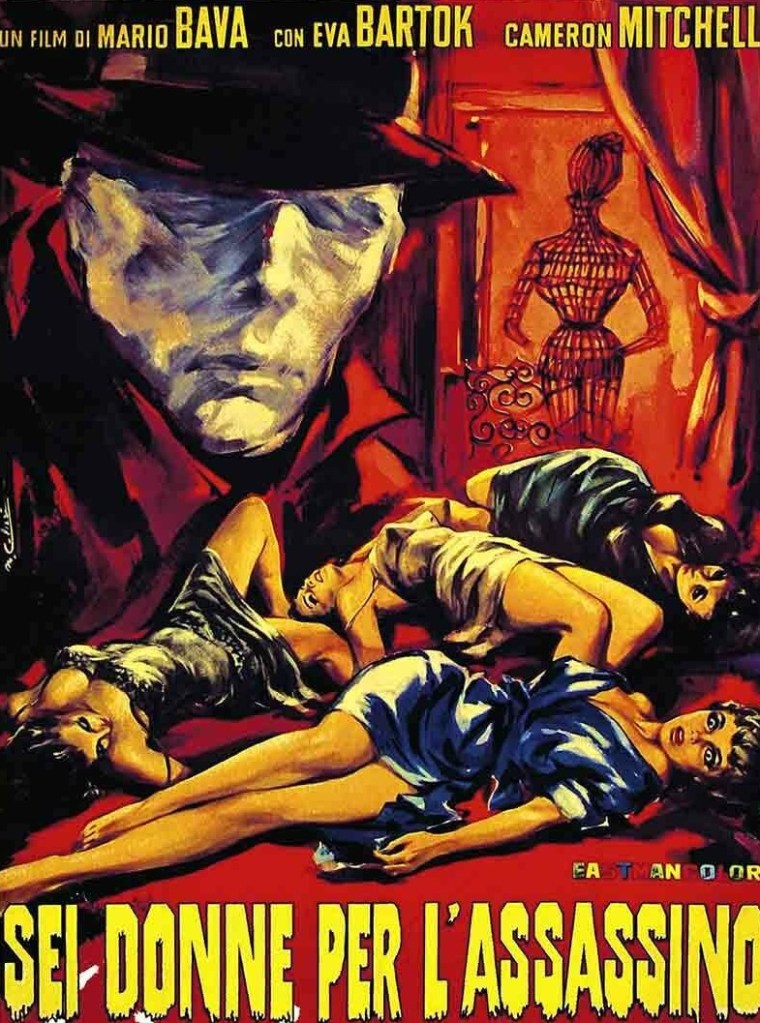
Director Mario Bava channels his inner Douglas Sirk in a rich color palette for this early version of giallo. About as surprisingly rich is the camerawork, which, for a low-budget picture is exceptionally accomplished, tracking, drifting, bobbing between characters. This early in the 1960s, nudity was not so prevalent but setting a movie in a fashion house – ensuring the beauty quotient is remarkably high – provided sufficient opportunity for ladies to be seen (within a work context naturally) in a certain amount of undress and you can be sure the killer leaves them half-naked. And it’s not the usual giallo sex maniac at work either but, despite the volume of murders, a killer driven by a desire to conceal shame.

Blackmail, theft, abortion, cocaine addiction, pregnancy, impotence and illicit affairs are among the secrets the protagonists wish to keep hidden, all risking exposure by a diary kept by the first victim Isabella (Francesco Ungaro). So rather than a whodunit, it’s a whydunit. The killer is particularly creepy, face concealed behind white gauze like an Egyptian mummy. As the Italian title explains, six women are intended for the chop, so that kind of rules out a great deal of tension as you spend your time counting. Are we nearly there yet? And as we run out of obvious potential victims, who the heck is there left to kill? Of course, by that time, we are into twist territory and that element is certainly neatly done.

The main candidates for the murderer are: Franco (Dante DiPaolo), Riccardo (Franco Ressel), Cesare (Luciano Piggozi). Massimo (Cameron Mitchell)  and Marco (Massimo Righi). These are the official ones, rounded up by Inspector Silvestri (Thomas Reiner). But that still leaves housekeeper Clarice (Harriet Medin) in her black leather coat. And a fashion house being a festering wound of jealousy, sex, status and privilege you wouldn’t discount any of the models either nor an owner Cristiana (Eva Bartok) who is such a slave-driver she denies her seamstresses time to mourn.

Emotions would be running high in this establishment never mind with a killer on the loose. Relationships are so fraught that even when this is the worst possible time to be alone in a house, certain of the models refuse to offer sanctuary to others and one, Tao-Li (Claude Dantes), just plans to head for the hills (Paris, in other words) and abandon the others. Add to that a high degree of stupidity. When Greta (Lea Lander) discovers the disfigured corpse of Nicole (Arianna Gorini) in the trunk of her car, rather than calling the police, she drags the body into the house and hides it under the stairs while her butler is about to serve tea. Except it’s not out of folly, it’s because Greta, like all the women here, wishes to protect a male, passion reigning supreme to the extent that the thought of losing a lover even if he is a murderer is too much to bear.

The inspector’s task would be made easy if the killer had a distinctive modus operandi. Death occurs through strangulation, suffocation, drowning (though with cut wrists to make it look like suicide), falling from a great height and Nicole’s face thrust into a stove. If victims take a long time to die, it’s not from the killer’s sadism but his/her incompetence. Virtually none are speedily dispatched, murder not as easy as you might imagine, an idea that Hitchcock purloined in Torn Curtain (1966)

For most of the time the way the camera moves you would wouldn’t think you were watching a film about a serial killer (in those days as rare in reality as in fiction) but a dense emotional tale as spun by the likes of Luchino Visconti (The Leopard, 1963) amidst a backdrop of wealth and beauty. Setting aside the murders, there is a feast of intrigue, and a rich seam of characters, though the central theme seems to be (not surprising for the era) that money and beauty are not as fulfilling as love, something that women will commit various crimes (though stopping short of murder) to achieve.   

I would imagine it was just such intricate camerawork that put audiences off the picture on initial release, a big flop in Italy and, if screened anywhere else (as in Britain) the lower part of a double bill. Not quite as intense as Bava’s previous The Whip and the Body (1963) nor so stylistically driven as Danger : Diabolik (1968) and some way short of horror masterpieces like Black Sabbath (1963), this is still an interesting watch, something of a template for future giallo and from a pure directorial perspective glorious to watch.

The number of characters featured and the time spent on the various deaths limit the opportunities for any one star to dominate but Hungarian Eva Bartok (Operation Amsterdam, 1960) leads the line on the female side while American transplant Cameron Mitchell (Minnesota Clay, 1964) and Dante DiPaulo (Sweet Charity, 1969) vie for male acting honors. The screenplay was a joint effort by Marcello Fondato, Giuseppe Barilla and Bava.

YouTube has this for free though be warned it comes with ads and for the sumptuous photography alone you may want in any case to splash out.

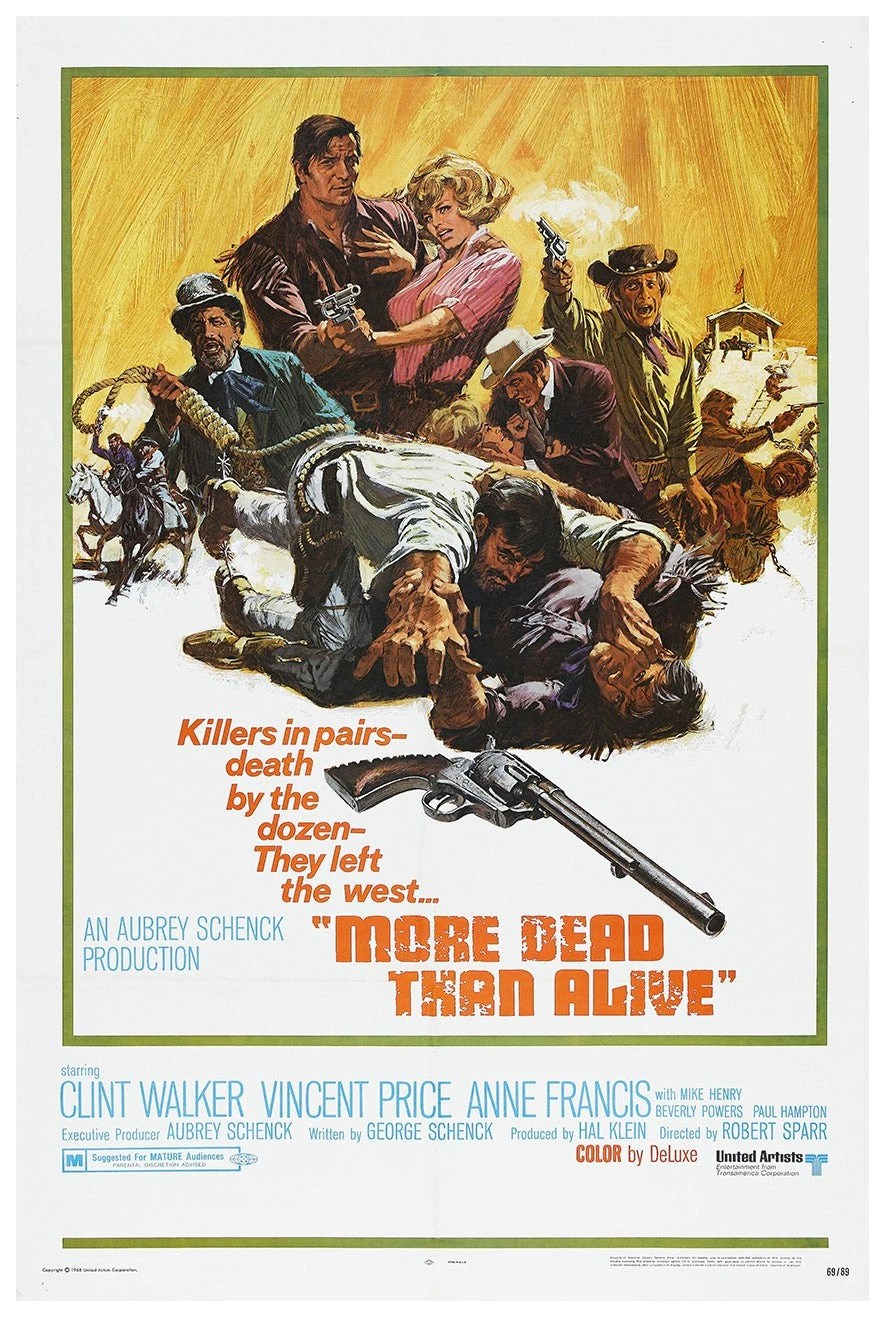
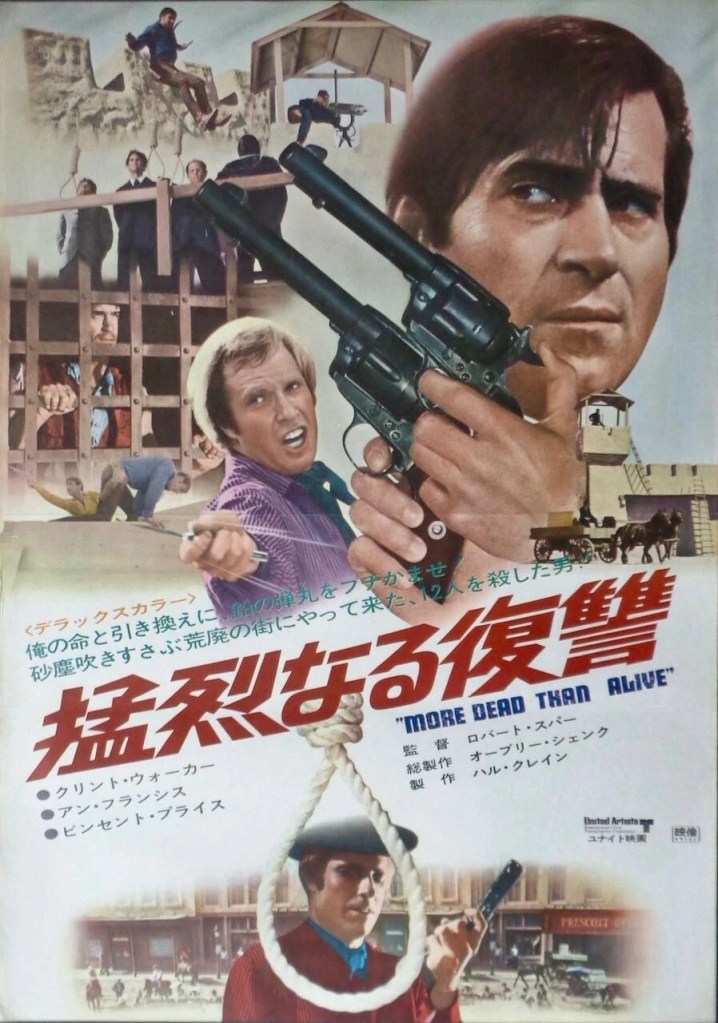
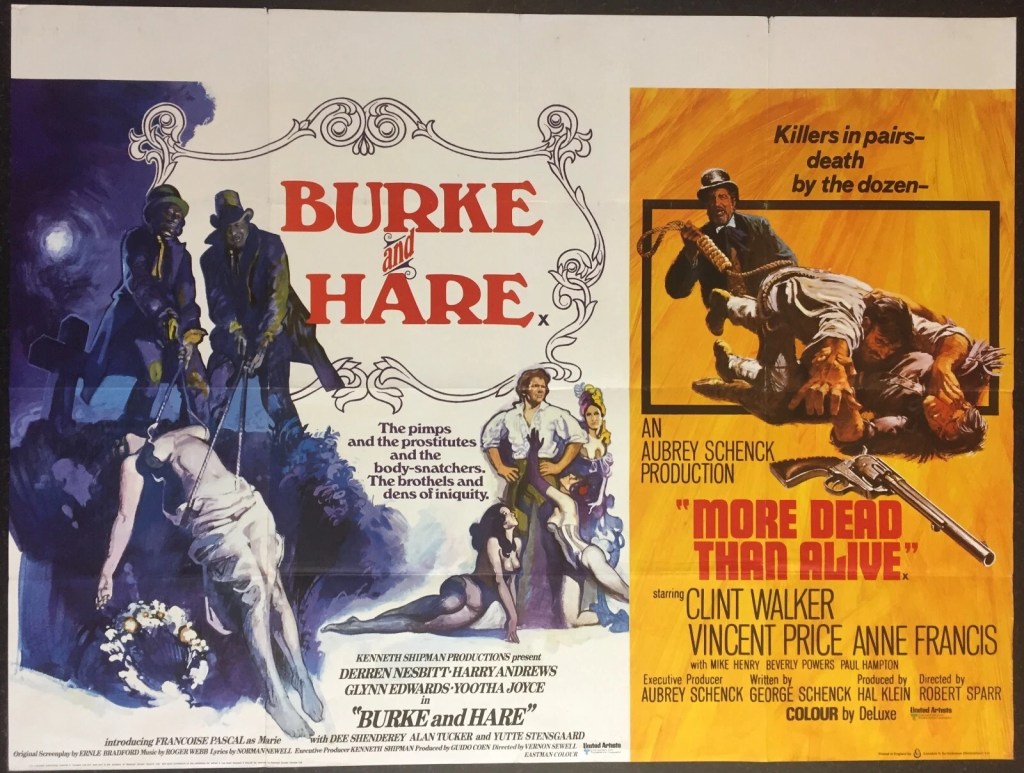
More Dead than Alive (1969) ****

You wonder why some actors never make it big. Clint Walker, with a hefty television career behind him, was one of the many graduates from The Dirty Dozen (1967). But whereas such disparate characters as Donald Sutherland (Mash, 1970), Charles Bronson (Farewell Friend, 1968), Jim Brown (100 Rifles, 1969) and even Telly Savalas (though mostly on the small screen) went on to become substantial marquee names, soft-spoken square-jawed gentle giant Clint Walker was left by the wayside. He still earned some top-billed credits, but these were all in low-budget programmers.

The odd thing is that had he come onto the scene a decade later when muscle-bound hunks like Sylvester Stallone and Arnold Schwarzenneger were all the rage he might have easily jumped to the top. Ironically, another muscleman Mike Henry (Tarzan and the Great River, 1967) pops up here, as if to prove to the newcomer that muscle no longer cuts it in Hollywood when slimmer stars like Paul Newman and Steve McQueen are all the rage and even denoted tough guys like Lee Marvin lack the heavyweight build.

Like the climax to The Wild Bunch (1969), the opening section is a paeon to the glories of the Gatling Gun as it mows down a posse of prisoners trying to escape. Cain (Clint Walker) is one of the few jailbirds who simply hunkers down and refuses to consider running. Whether it’s this determination not to cause the guards any trouble or some unexpected softer approach on the part of the authorities, he is later set free after serving 18 years.

It’s only then we realize he’s actually “Killer Cain” with twelve notches (presumably one for every death) on his revolver. But he’s determine to go straight and refuses the opportunity offer by travelling showman Dan Ruffallo (Vincent Price) to even play the part of the bad guy. But his record goes against him when trying to find employment. So he takes on the job of delivery guy only to end up in the arms of some thugs from prison led by Luke Santee (Mike Henry) who has a score to settle. Having beaten him up, they decide not to finish him off, so they can enjoy the pleasure of beating him up over and over. Given Clint Eastwood has set the tone for the hero being badly beaten up and/or left for dead, the thumping Cain takes tends towards the excessive.

So if you’re trying to get a killer to disavow his plan to avoid violence, that’s not the best plan. When Cain escapes, you expect this to turn into a revenge western. Except it doesn’t. It’s an avoidance western, Cain trying to stay out of the way of any kind of shooting.

There are some interesting directorial aspects. It looks very much as if Robert Sparr, a television director making his movie debut, has absorbed the influences of the French New Wave. There are jump cuts all over the place. We cut from Cain looking forlorn at night to him standing in a queue in daylight looking for a job. We go from an outdoor encounter with Ruffalo to suddenly the pair of them sitting down inside.

And as with like Butch Cassidy and the Sundance Kid and The Wild Bunch, both out the same year, the message is that the Old West is dying. Not only do we have primitive mechanized transport in the shape of a bicycle there’s also a rudimentary telephone while gunmen are more likely to prosper showing off their skills in a tent than being a gun for hire for ambitious ranchers and the like.

This is determinedly offbeat, not falling into the standard narrative traps for the genre. Cain, while trying to shed the murderous aspects of his previous life, eventually goes to work in the circus. That sets him down in the moral mire, taking advantage of his infamous reputation while at the same time not lifting a gun in anger and wooing artist Monica (Anne Francis).

However, no surprise this is under-rated. In part that’s because it doesn’t deliver on the early violent promise, the title very much a misnomer, so those expecting a spaghetti western leave disappointed while anyone looking for much else wouldn’t be attracted by the violence and the title. In fact, it’s a very thoughtful piece. Not entirely original because criminal-going-straight is standard stuff, usually quickly snookering the good guy-bad guy into mostly bad guy activity, regardless of his justification for doing so. But here, the killer manages to avoid further bloodshed despite  continuous provocation.

Apart from the moral aspect, it treads an interesting path between demystifying the Old West and mystifying it. Monica has come west to capture the Old West before it dies away. There’s a ghost town but the only gunslinging on show is staged. Cain is a major attraction because peace-loving law-abiding folks like nothing better than seeing a genuine killer up close.

The notches on his gun weren’t acquired in typical Hollywood hero style with a shootout in the main street and the good guy never drawing first. In fact, most of Cain’s killings fall into the dubious category.

Most westerns take place over a short period of time, just as long as it takes to set up the good guys and the bad guys with a bit of romance on the side. This takes place over a year and romance is very slow-burn so that artist Monica nips in and out of the narrative.

Having a record blunts Cain’s attempts to get a decent job, the only long-term work as a bouncer in a saloon until his pseudonym is blown. He joins the Wild West Show only to twice quit it, either when he is riled by intemperate gunman wannabe Billy (Billy Valence) or when he comes face to face with old lawman Carson. At the end he returns to earn enough cash to buy some livestock for a farm.

There are three significant deaths, two sudden, and all offer something unusual in that department. The ending is as unexpected as it is shocking.

Both Clint Walker (The Great Bank Robbery, 1969) and Vincent Price (Witchfinder General/The Conqueror Worm, 1968) deliver excellent subdued performances, the latter far removed from his usual horror line and the lugubrious tones kept in check. Anne Francis (The Satan Bug, 1965) has a rare big screen outing. Written by George Schenck (Barquero, 1970).

You would not call this – outside of the jump cuts – particularly stylistic, equally it avoids the visual traps of endless sunsets or panoramas and we’re not subjected to minutes wasted just watching cowboys ride somewhere. But it definitely is a cut above in terms of thematic complexity, in the ability to tell a story over a period of time, and to take the hero in an unexpected direction.

The Sweet Ride (1968) ***

Unusual drama mainlining on Californian surf, sex, bikers, a mystery of Blow-Up (1966) dimensions and the best entrance since Ursula Andress in Dr No (1962). Displays a 1960s vibe with a 1950s pay-off as the “hitchhiker” of responsibility rears its ugly head.

A woman thrown out of a car narrowly escapes being run over. The cops jack in the investigation after television actress Vickie (Jacqueline Bisset) refuses to explain why she’s been badly beaten up.  And so we enter flashback mode to supposedly find out. She makes a glorious entrance, emerging from the sea, minus bikini top, into the lives of surfer Denny (Michael Sarrazin), jazz pianist Choo-Choo (Bob Denver) and ageing beach bum and tennis hustler Collie (Tony Franciosca). From the off, she’s enigmatic, gives a false address, won’t explain bruises on her arm, has something clandestine going on with television producer Caswell (Warren Stevens) and like Blow-Up we are only privy to snippets of information.

She’s half-in half-out of a relationship with Dennis, with Collie hovering on the periphery hoping to pick up the pieces to his sexual advantage. Contemporary issues clog the background, Choo-Choo tries a camp number complete with pink dog to avoid the draft, a neighbor threatens to shoot Parker for wandering around in shorts and habitually stealing his newspaper, epithets like “degenerates” are tossed around, Choo Choo’s girlfriend Thumper, while appearing in movies with titles like Suburban Lust Queen acts den mother, there’s not much actual exciting surfing, and a biker called Mr. Clean is somehow involved.

The romance plays out well, Vicky unsure, Denny convinced but without a livelihood to offer and unable to get a straight answer out of her. Choo-Choo gets the gig of his dreams in Las Vegas and there’s an rape scene, more unsettling because it’s committed by Denny with the bizarre justification of getting “just for once something on my terms.”  And there’s the equally disquieting sense that the only explanation for Vickie’s behavior is to tab her a nymphomaniac, walking out of an argument with a mysterious man in a beach house to drop her clothes for a bout of sex with Mr Clean.

I must have seen a different picture from everyone else. A good few critics at the time and reviewers since appear to think Vickie was also victim of a gangbang by the bikers, but I can’t see why. When he sees Vickie coming down from the beach house, Mr. Clean shouts “everybody split” and his buddies clear the beach. However, Mr. Clean, ironically, gives the best indication of her state of mind, explaining that Vickie “kept staring back at the house and moaning about how she wanted to die” while he enjoyed the best night of his life sex-wise.

Denny and Collie prove not to be the pussycats they appear, bearding the bikers in their den and beating up Mr. Clean while Denny goes on to deliver a hiding to Caswell. But what this film turns out to be is an examination of vulnerability, how easily those with a new sense of freedom are trapped. An examination of contemporary mores, perhaps, but in not resolving the mystery of Vickie ultimately fails to deliver, especially as it does not, from the outset, carry the kind of artistic credentials of Antonioni in Blow-Up.

Perhaps the mystery needs no resolution, it’s just same old-same old dressed up in the novelty of sexual freedom. There’s no idea of why Vickie was beaten up, and essentially abandoned on the road to become accident fodder, and no hint really of why she fell foul of someone so badly she needed disposed of, no notion that she was a threat to anyone. (Or, for that matter, no explanation of what happened to her bikini top and why, if she was so apparently free with her charms, she was so shy about being seen half-naked.) On the other hand, victim may well have been Vicky’s destiny from the get-go, that kind of innocence only waiting to be defiled.

In any 1960s contemporary picture there’s always the temptation to accept as truthful or reject as phony the lives shown. The idea that sexual freedom bestows actual freedom is usually the issue until consequence (i.e. old-fashioned Hollywood morality) comes into play. This is less heavy-handed than, for example, Easy Rider (1969) or Bob & Carol & Ted & Alice (1969). The characters make decisions to grow up or to stay locked in a world of easy sex, dope and money. There’s no grand finale, just a more realistic drifting apart, and it’s only Vickie who comes apart, although that process had begun long before she met the drifters.  

Jacqueline Bisset (The Detective, 1968), in her divinely posh British accent, comes over well as an attractive screen presence and complex character. In fact, she has a bigger part here than in Bullitt (1968) or The Detective (1968). If you wanted anyone to portray a soulful hippie you need look no further than tousle-haired Michael Sarrazin (In Search of Gregory, 1969) and normally if you required someone on the sly, despicable side, Tony Franciosca (Fathom, 1967) might well be your first port of call, but Franciosca proves the surprise here, classic wind-up merchant and predator who exhibits considerable vulnerability when he realizes he is losing the worship of the idealistic young.

Former British matinee idol Michael Wilding (A Girl Named Tamiko, 1962) and Norma Crane (Penelope, 1966) appear as Vickie’s parents.  Bob Denver (Who’s Minding the Mint, 1967) and Michele Carey (The Spy with My Face, 1965) are solid support. Director Harvey Hart (Fortune and Men’s Eyes, 1970) tries to cover too much ground and could have done with narrowing the focus. Future Bond screenwriter Tom Mankiewicz (son of Joseph L.) made his screenwriting debut adapting the book by William Murray.

The DVD is a bit on the pricey side, but if you just want to check it out, YouTube has a print.

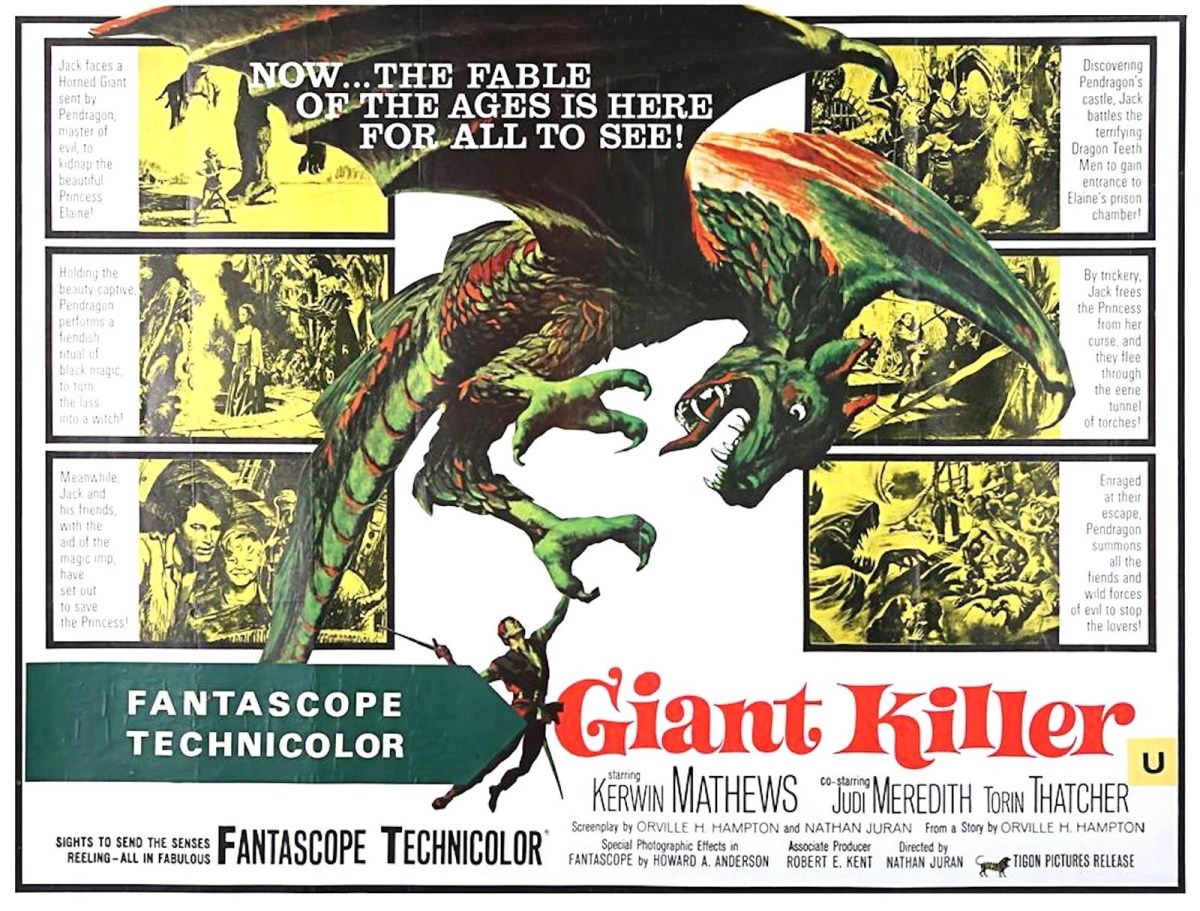
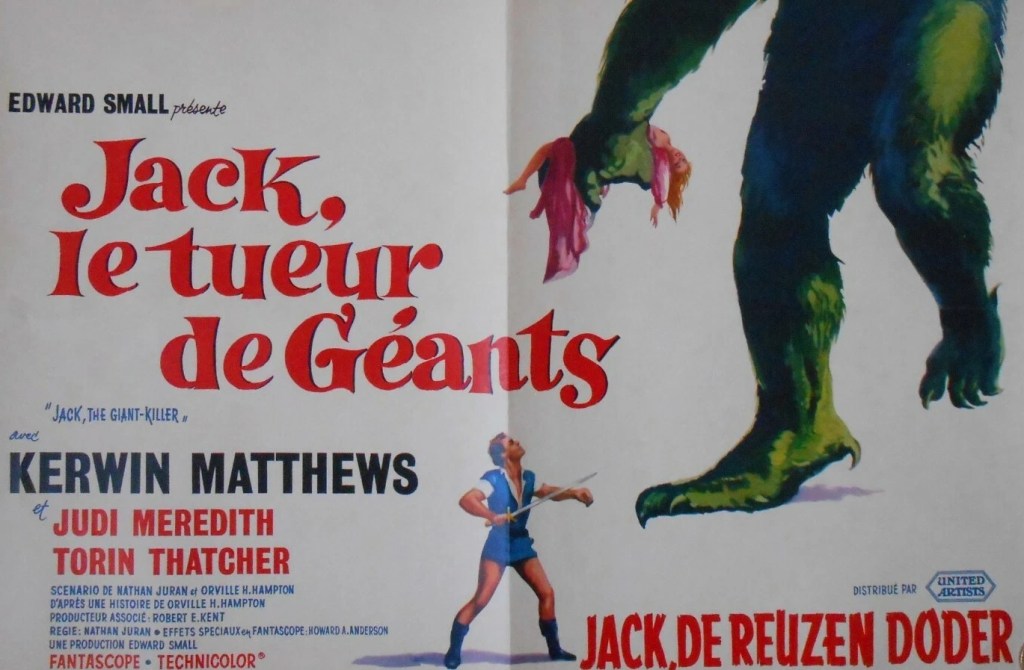
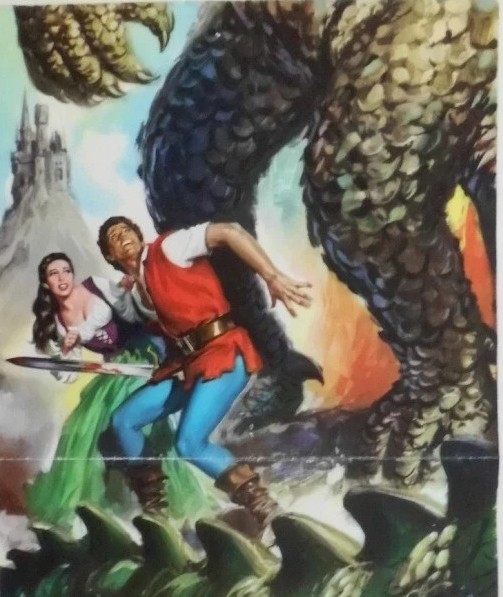
Jack the Giant Killer (1962) ***

Just to be clear, this is not, as I had automatically assumed, about Jack and the Beanstalk. Also, it’s worth pointing that the stop-motion animation is not, as I had equally automatically assumed, the work of Ray Harryhausen. It hadn’t occurred to me that anyone else could follow in Harryhausen’s footsteps, especially when this number has gathered together some of the other constituents of Harryhausen’s first gem, The Seven Voyages of Sinbad (1958), namely star Kerwin Matthews, co-star Torin Thatcher and director Nathan Juran 

This falls into the “See!” (don’t forget the exclamation mark!) category of moviemaking when the audience is expected to sit transfixed as strange creatures appear one after the other and in between is very much of the ho-hum variety.

To be sure, this is a very entertaining little piece with, as in the stop-motion formula, everything else taking second place to the variety of monsters – the titular giant, spectral figures, a dinosaur, a two-head monster, and a magician who can make things disappear. Given that the heroine doubles up as the villainess, this takes the narrative into unusual waters. And that’s before we come to the leprechaun-in-the-bottle.

It is just as well the special effects are up to scratch – for the time – because everything is played like a pantomime. The villain, Pendragon (Torin Thatcher), isn’t far short of issuing the occasional hiss and his face has a strange hue to put it mildly. But he’s a clever evil wizard and under the guise of playing tribute to King Mark (Dayton Lummis) presents his daughter Princes Elaine (Judi Meredith) with a large doll’s house from which emerges a tiny creature whose main appeal is that he can dance.

Come night, however, and after Pendragon has sneaked into the castle, the creature is released and turns into the rampaging titular giant who kidnaps the princess in his mighty claws. Farmer Jack (Kerwin Matthews) comes to the rescue and manages to tangle the giant in the workings of the mill and kills him.

You’d expect romance to bloom and initially it does, but you’d think the king would be more grateful than to nip romance in the bud by sending Elaine to France to hide out in a convent. (I should point out the tale is set in Cornwall, so France is just across the sea). But the ship doesn’t reach its destination. Skeletal witches attack. Elaine is captured once again. Jack and the ship’s captain’s son end up in the drink where they are rescued by a friendly Viking who has in his possession the imp-in-the-bottle who can grant wishes.

Pendragon’s scheming and magic ensures that Elaine is turned into a villainess and even when Jack rescues her for a second time her villainy ensures he’s the one who’s captured and the imp and bottle are chucked into the sea.

There’s a fair bit of the conjuring of bad spells – humans are turned into dogs and monkeys – and a fair bit of trying to break them but Pendragon always appears to have another spell up his sleeve and able to conjure up more creatures. Now it’s a two-headed giant confronting Jack who is then able to summon a sea monster to retaliate. But Pendragon can turn himself into a dragon.

There’s certainly an element of the Harryhausen in the clash of the monsters and the wanton destruction that appears to be their sole reason for existence. Naturally, it all ends happily and with all spells lifted romance can resurface.

I’m probably going to upset the Harryhausen cognoscenti by professing my admiration for the stop-motion animation work by Project Unlimited (The Time Machine, 1960). They might be a bit crude compared to Harryhausen but they certainly did the job.

This didn’t condemn Kerwin Matthews to fantasy and he moved immediately into thriller Maniac (1963). Judi Meredith wasn’t so fortunate and ended up as the female lead in low-budget thrillers like Dark Intruder (1965). Torin Thatcher (The Sandpiper, 1965) had a ball over-acting.

Nathan Juran (East of Sudan, 1964) sticks to the knitting. He wrote the screenplay with Orville H. Hampton (Riot on Sunset Strip, 1967).

Not going to tax your brain but good fun.

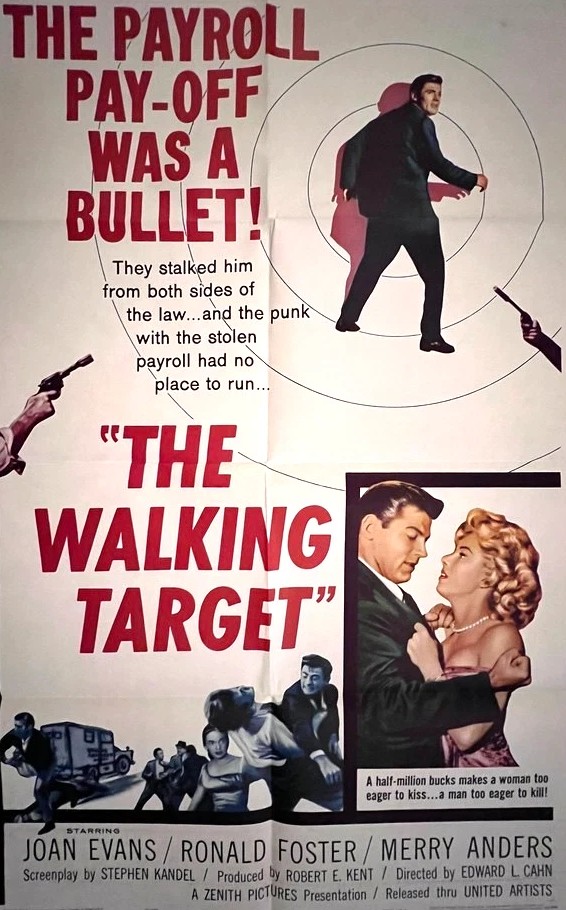
The Walking Target (1960) ***

The Double Cross Olympics. Or the Twist After Twist After Twist World Championships. Either way you’re in for a rattling good time. This is a hard-boiled B-movie the way Hollywood makes them, so there’s virtually no one involved who’s on the side of good.

Nick Harvin (Ron Foster) leaves prison after serving a five-year sentence for stealing $260,000. The money’s never been recovered so, in the words of the warden, he’s a “walking target,” fair game for anyone seeking a share or all of the loot – “they can smell that green round corners.”

Step up blonde girlfriend Sue (Merry Anders) and best buddy Dave Prince (Robert Christopher), whose credentials in the loving and friendship department are in doubt given neither visited him in jail. Also on his tail – the media, hoping to put him back on the front page where he belongs and Detective Max Brodney (Harp Maguire) a pair of cops hoping to put him back inside where he belongs. The cop tells it straight, “You’re a louse, you’re smarter but you’re still a louse.”

Nick envisions a future that’s “fat and rich” while Dave reckons he’ll be able to “coast forever.” Nick drops a bombshell. He’s planning to give a one-third share of the dough to the wife Gail (Joan Evans) of one of his two partners in the heist, both dead. Although there’s another reason he needs Gail. The money was stashed in her car’s undercarriage and she’s long ago left town.

Meanwhile, Dave begins the two-timing game. He’s worse than Sue. She’s only making sweet with Dave behind her lover’s back. But Dave has also stitched up Nick by selling him out to a big time crook Hoffman (Barry Kroeger).

Nick can’t even hide out. Newspapermen have caught up with him and he’s splashed all over the front pages. The cops and the crooks are on his tail. Nick high-tails it to Gold City, where Gail runs a diner. He’s got a soft spot for Gail, she threw him over for her mechanic husband Sam because she reckoned Sam was a safer bet, not realizing he was dumb enough to get snookered into a robbery.

So here’s the real twist. Nick manages to sweet talk Gail. When she turns down his offer of a share of the loot, he tells her he’s going to give it all back. Being the trusting sort, and maybe thinking she would have been better off with someone who wasn’t as dumb as Sam, Gail takes him to her car and watches him pull out the hidden cash.

So, of course, he’s just playing her for a sap. Yeah, maybe he feels guilty about Sam and yeah maybe he does still have a soft spot for Gail, but he’s a thief and what chance is there that he’s going to turn into a good guy and return the stolen money.

Before Gail gets the opportunity to realize he’s playing her for a sap, in burst the crooks, whacking nick around and promising to do worse to Gail unless he hands over the money. In the confusion, Brodney appears, and takes one for the team, but not before the thugs have got their come-uppance.

Yep, there is one last twist, one I certainly wasn’t expecting. Nick is going to go straight after all.

How do you like that? Of all the mean narrative tricks, the bad guy turns into a good guy.

This must have a made a cracking supporting feature. All the characters, including Gail, can squeeze the last bit of juice out of a line. There’s nothing but snap and zing. Plenty temper, car chases, fisticuffs and shoot-outs. And did I mention it was aiming for the gold ring in the double-crossing league.

Great cast of B-movie troopers in Ron Foster (Cage of Evil, 1960), Joan Evans (Roseanna McCoy, 1949),  Merry Anders (House of the Damned, 1963) and Harp Maguire (Incident in an Alley, 1962). Directed by Edward L. Cahn (Incident in an Alley) from a script by Stephen Kandel (Chamber of Horrors, 1966).

At a lean 75 minutes it’s story, story, story and belt along at a terrific pace.

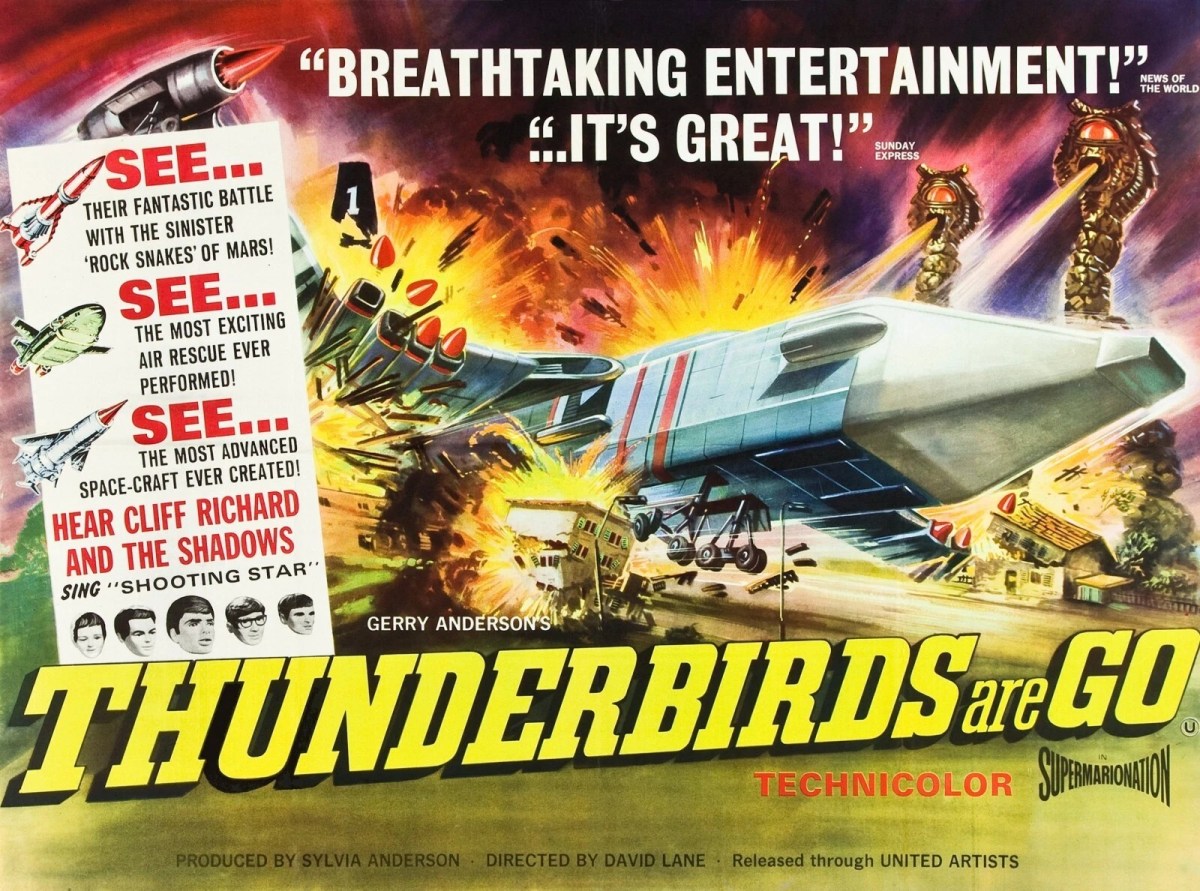
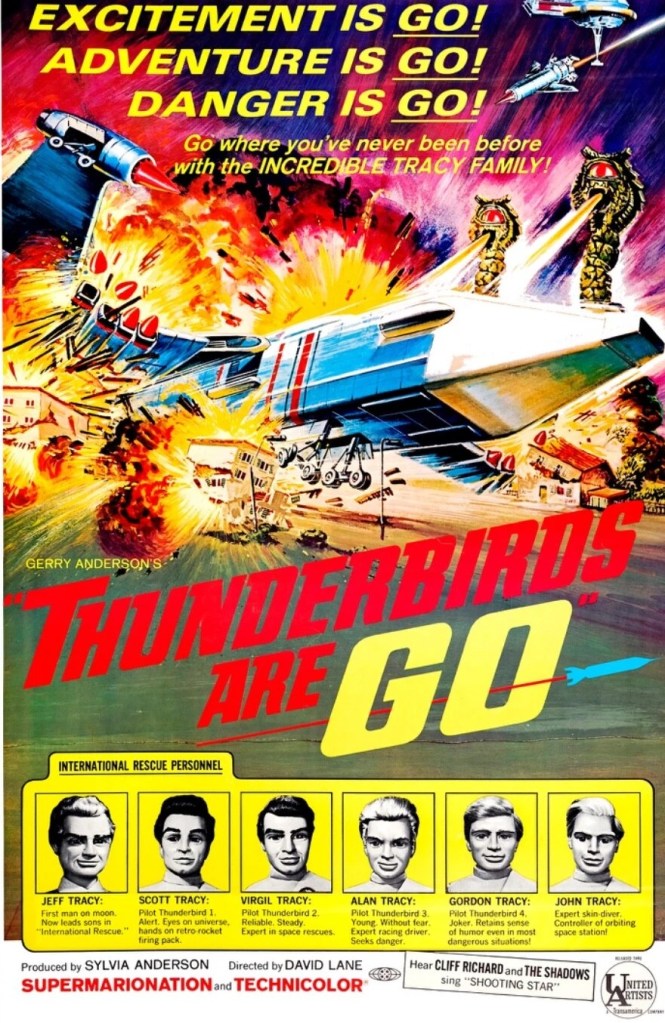
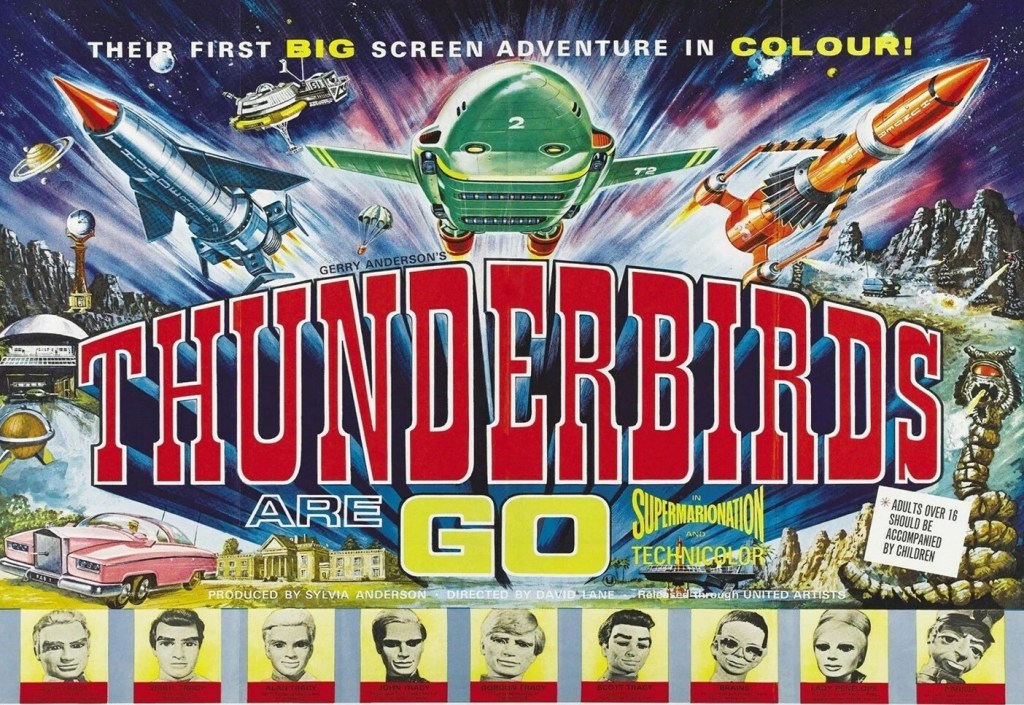
Thunderbirds Are Go (1966) ****

Nostalgia – and reappraisal – rule. Every bit as worthy a contender for a Father’s Day crown as the more favored likes of The Great Escape, 1963), The Dirty Dozen (1967) and Die Hard (1988). One of the reasons why Britain wasn’t in the thrall of DC and Marvel was that we had grown up with Dr Who and the Gerry and Sylvia Anderson portfolio of sci fi marionettes – Fireball XL5, Supercar, Stingray, Thunderbirds, Joe 90 and Captain Scarlet.

And while most of the nostalgia for the period goes the way of Ray Harryhausen, the Andersons’ achievements not so much with their puppetry but the miniaturization should not be underestimated.

It wouldn’t be too much of a call, for example, to guess that Stanley Kubrick learned a lot about the joy of spaceships coming together or moving around from Thunderbirds Are Go where a good chunk of the action is watching spaceships shift around one way or another. To top it all, and another one in the eye of Mr. Kubrick, the Andersons beat him to the psychedelia, a dream sequence set upon a “Swinging Star” and involving puppet versions of Cliff Richard and the Shadows, still a big noise in the pop world at the time despite the arrival of The Beatles and The Rolling Stones. Their appearance would be the equivalent to  Bruce Willis, for example, doing a guest turn in Friends.

With a bigger budget, the Andersons made two crucial changes from the TV series on which this was based. They managed to erase all sight of the puppet strings and they stopped them walking around so much which always made them look most like just puppets.

This is space as we should adore it. None of the manky, worn-down, dirty cargo ships that litter modern sci fi epics. Not only is every ship gleaming but they are also colorful, not to mention color-coded. When they move it’s with the majesty that Kubrick used to great effect in 2001: A Space Odyssey (1968). And as Kubrick also proved, when it came to space, you didn’t need much in the way of characterization or narrative. He follows the same rule as monster pictures, focus on the big beasts as much as possible.

But Kubrick, in his wildest dreams, could never imagine as sultry a character as blonde goddess Lady Penelope, and though she’s on the side of the angels as cunning as any femme fatale. Equally iconic is her pink Rolls Royce and the chauffeur Parker which his obedient “Yes, m’ lady.” Not to mention the glorious catchphrase “eff ay bee” – in other words FAB, the catchphrase for a generation. There’s another catchphrase that only means something to Londoners who would hear this warning every day on the Underground – “mind the doors.”

The narrative is relatively thin. Zero-X is trying to fly to Mars but the flight is sabotaged and crash-lands. When a second flight is planned, this time International Rescue (the Thunderbirds team in case you are unaware) is on standby with Lady Penelope employed to seek out the saboteur.

This flight does succeed but on Mars encounters venomous snake-like rocks and scarpers quickly only to hit trouble on re-entry to Earth that requires Thunderbirds to the rescue. There are some modest attempts at characterization, Zero-X doesn’t like the idea of needing help, and the youngest of the Tracy family is frightened of failing.

I’ve never seen this before. I probably thought I was above such childish things when it first came out and it was only when I spotted it on Amazon Prime that I thought to give it go, remembering how much I had enjoyed the revamped Fireball XL5.

I sat enthralled. The first section has no sign of the International Rescue team and just like those mesmerizing minutes watching Kubrick’s spaceship revolve in space this simply involved putting together the constituent parts of the Zero-X rocket ship prior to launch.

You had to hand it to these sci-fi whizzes. You only needed one fella in the control room. Each of the Thunderbirds required only a solo pilot. You could be whisked electronically from a seat in the waiting area to the spaceship and arrive there on the same seat or go along some kind of travelator. These guys had thought of everything.

Directed by David Lane and written by the Andersons with Sylvia doubling up to provide the voice of Lady Penelope

With the removal of the strings and every miniaturization so stunning, this would look great on the big screen. The 60th anni would be December this year so here’s a call-out to an enterprising cinema.

NOTE: today is British Father’s Day.  It may not be Father’s Day where you are.

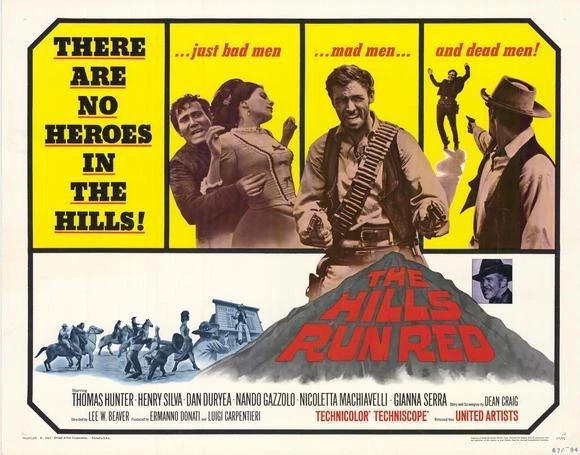
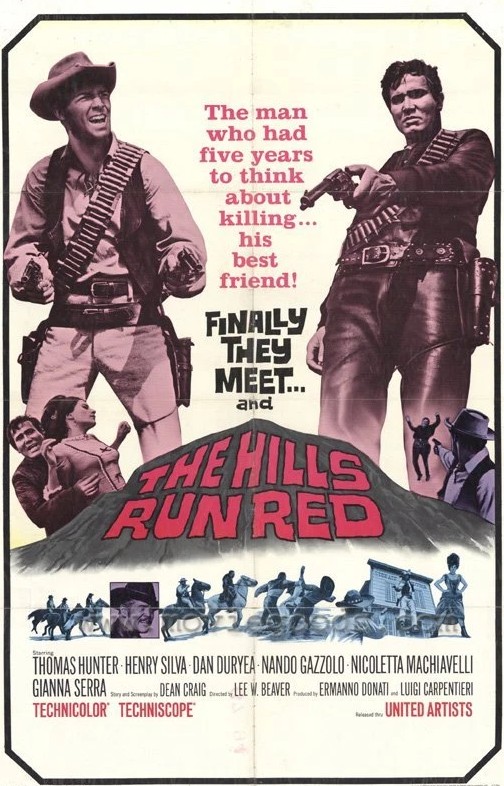
The Hills Run Red (1966) ****

Pretty decent revenge western boasting a couple of superb set pieces. No wonder Clint Eastwood made the decision to play down the emotions on The Man with No Name, because this is a good example of how pop-eyed emotions can get when restraint is missing especially when you’ve got Henry Silva in the mix. The lead Thomas Hunter is not, as you came to expect in spaghetti westerns, an Italian dude anglicizing his name, but a genuine Yank, heading to Europe to further his career whereas Hollywood veteran Dan Duryea is extending his. Bonus of an Ennio Morricone score.

A pair of Johnny Rebs, making off with Unionist loot, at the end of the Civil War, make an unusual pact. One, Jerry Brewster (Thomas Hunter), takes the rap for the heist, while his partner Ken Seagull (Nando Gazzallo) the other makes off with the loot, promising, as part of the deal, to look after his buddy’s wife and child. Five years later, the freed Jerry returns home to find his pal’s reneged on the deal, wife is dead, son Tim an orphan, and Ken, now a wealthy rancher, is more intent on muscling up and eliminating his rival than keeping to his  side of the bargain.

Jerry teams up with drifter Winny Getz (Dan Duryea) who gets himself a job on the ranch where tough foreman Garcia (Henry Silva) enjoys handing out beatings. There’s a smidgeon of nascent romance, not enough to get in the way of the action, when Ken’s sister Mary Ann (Nicoletta Machiavelli) takes pity on the roughed-up Jerry.

But let’s cut to the chase. There’s a brilliant ambush by Ken’s rivals. His high-handed methods have upset the townspeople and other ranchers. So with the help of our hero they ambush Ken’s cowboys herd horses through a canyon by rolling down on them  rolls of tumbleweed set aflame, decimating the cowboys by picking them off from the cliffs.

At the end a two-man army of Jerry and Winny (make it a two-and-a-half-man-army if we count in Tim, no mean shakes with a catapult) takes on a regiment of Garcia’s thugs in the town, fighting them on the rooftops and the streets, with the help of sticks of dynamite. This is tremendous stuff. I watched it immediately after seeing Dillinger (1973) and noted that I had automatically accorded the John Milius gangster picture top marks for the various shoot-outs whereas I was so used to shoot-outs in westerns that the tendency was to write them off. Whereas, this one, in particular, was easily on a par with the Milius, better in some ways because the two heroes had to be a good bit more inventive to outwit the enemy.

The climax at the ranch between Jerry and Ken is also well done, the pair employing clever tricks, and half the scene taking place in darkness.

The pace never lets up. The action is constant. Good plans become undone by spies. Saloons are wrecked. There are punch-ups and shoot-outs galore and some excellent lines and neat situations such as when the prison guards steal Jerry’s dough on release and send him off minus his gun.

Nobody who wasn’t already a star made much marquee headway from this and largely it’s been viewed as a western programmer, slotted into the lower half of a double bill, and largely forgotten. But perhaps because there’s no star requiring special treatment with slick lines and a denoted love interest and the kind of scene that always seems written just to give a big star a big moment, this falls into the leaner category, where the story is kept simple, the action continuous and whatever genuine emotion we require is limited to loss (of wife) and recovery (of son).

That still leaves room for Garcia to put on a whole show for himself and Winny to underplay him at every turn.

Thomas Hunter (The Magnificent Tony Carrera, 1968) might surprise in not offering the Yank equivalent of the traditional British upper lip, but sometimes we do under-do things by limiting male emotion, so you could view this as some kind of breakthrough for the incontinently emotional man. Henry Silva (Johnny Cool, 1963), with no restraint applied, just lets rip. Dan Duryea (Five Golden Dragons, 1967), in his last important role, enjoys a last hurrah.

Carlo Lizzani (The Violent Four, 1968) directs from a script by Piero Regnoli (Matchless, 1964).

Worth a look. Reassessment long overdue. What they used to call a rip-roaring western.

Discover WordPress

A daily selection of the best content published on WordPress, collected for you by humans who love to read.

The Atavist Magazine

by Brian Hannan

WordPress.com Blog

News, Tips & Website Tutorials