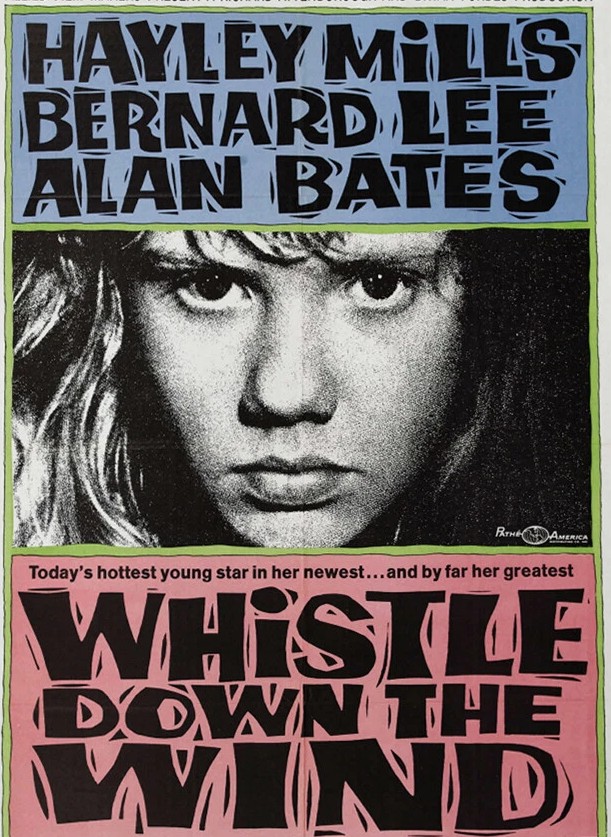
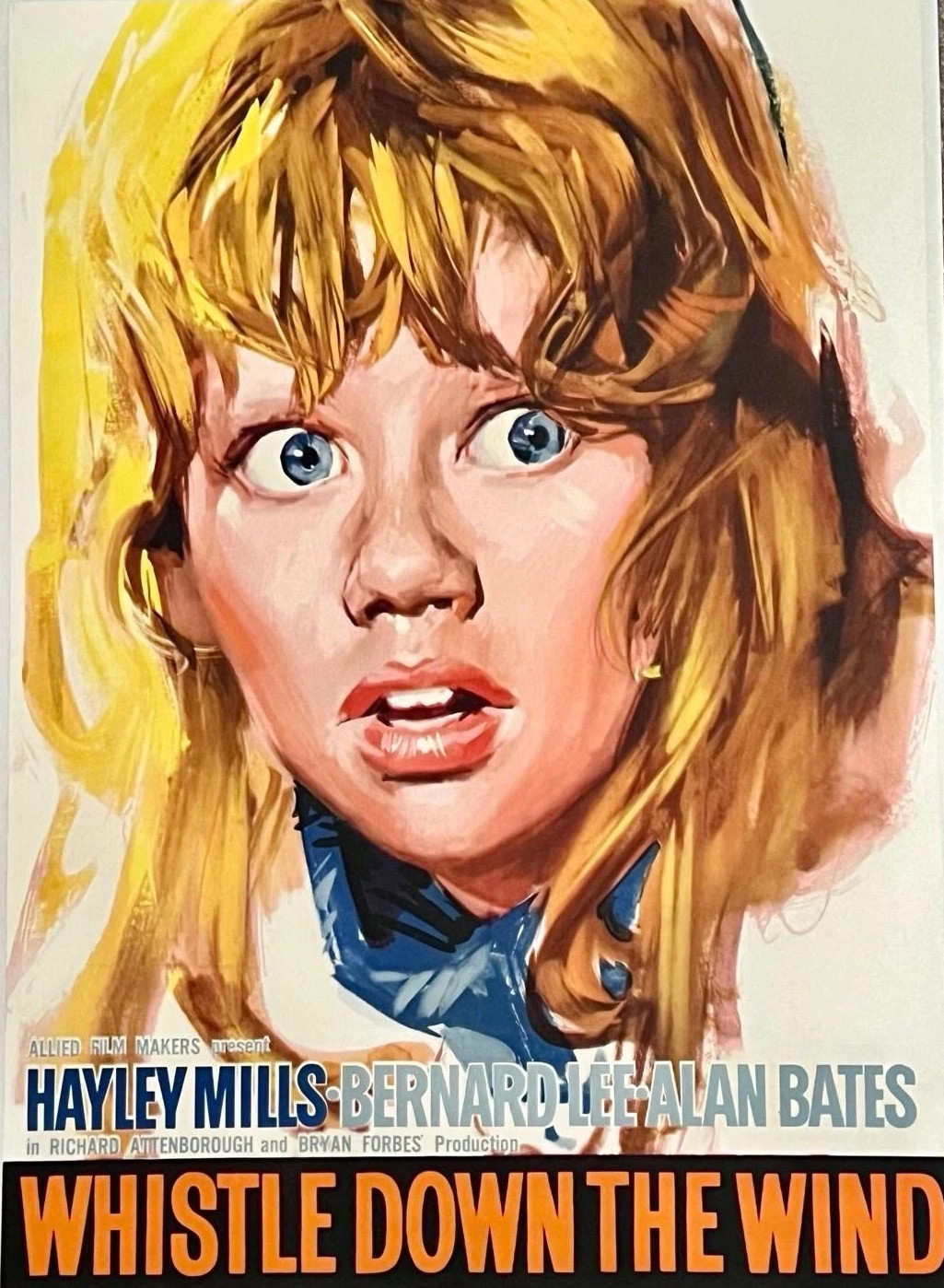
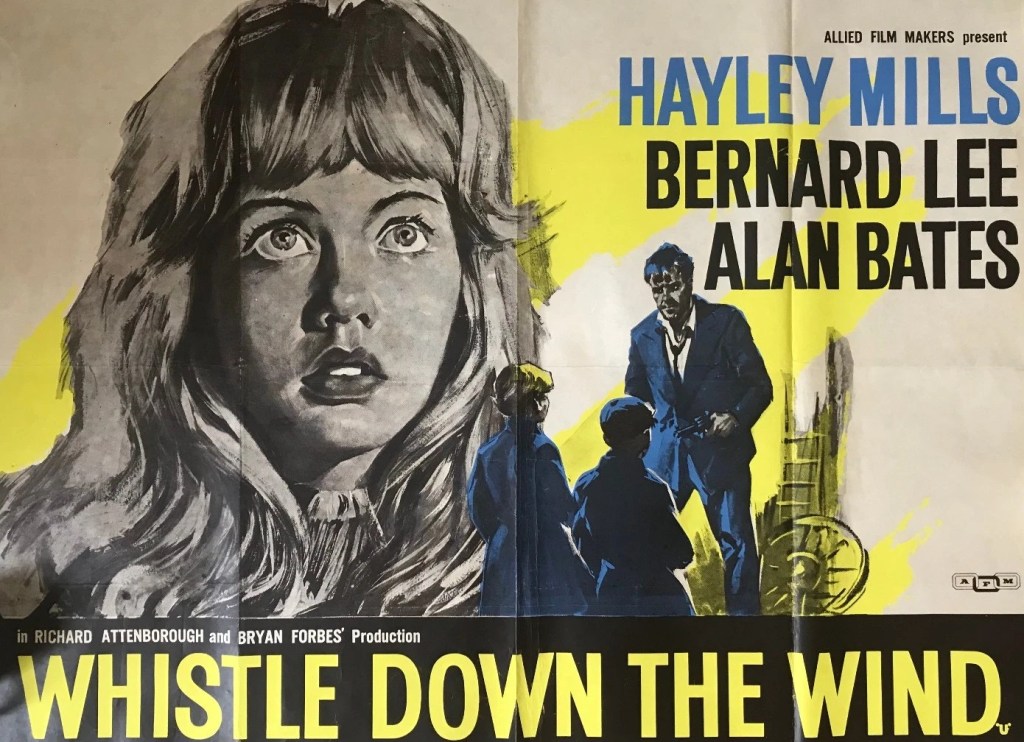
Whistle Down the Wind (1961) ****

Sheer coincidence that within the space of a week I’m watching three films that deal with the power of a child’s imagination. While The Magic Faraway Tree disappeared into the realms of fantasy and Eye Witness / Sudden Witness a lonely child’s fervid alternative realities, Whistle Down the Wind examines the ability of children to become involved in something that makes complete sense to them while keeping adults out of the picture.

And not just for the religious allegory is Whistle Down the Wind streets ahead. While the children in the other films are believable enough, this is much more down-to-earth. A farm here isn’t a refuge from the city and a place to indulge dreams, it’s muddy and cold and wet. Everyone trudges around in wellies. Adults drown kittens, are overly pious and view children as mostly a nuisance.  The children wouldn’t dare be cheeky to those in authority.

And their belief in something that defies belief is both touching and understandable given the circumstances. They are convinced they have found a reborn Jesus (Alan Bates) in their barn. Perhaps it’s only a child, with all that innocence, who could actually be persuaded that, as stated in the Bible, Jesus will come again.

The characters are very well-drawn. Kathy Bostock (Hayley Mills), eldest of three siblings, motherless, is the leader, saving the drowning kittens, stealing to feed the man, and guiding her flock in taking care of him. Youngest child Charlie (Alan Barnes) is instinctively more cynical. Mr Bostock (Bernard Lee) has his hands full dealing with his kids and his snippy sister Dorothy (Elsie Wagstaff) resents having to act as housekeeper.

The religious allegory elements include of course finding Jesus in a barn (doubling for the stables at Bethlehem), bringing him gifts as if the kids were the Magi, feeding him bread and wine (a bottle of port stolen from a cupboard), treating him with adoration and denying him thrice (Judas Iscariot). Even when the first crack appears in the façade after Jesus has allowed  a kitten left in his care to die, Kathy battles to keep the dream alive, pestering the local vicar to explain how Jesus could allow this and finding an answer that does the trick.

The enterprise collapses when a child is spotted secreting an extra piece of birthday cake for the man. By this time he has managed to secure a gun and we know he’s wanted for murder.

Even so, Kathy refuses to let go of her belief, promising to a younger child, saddened by the man’s capture, that Jesus will come again.

The allegorical aspects would have worked better at a time when fantasy was not all the rage. But the current diminution of Christian belief means that the ideas spelled out in the New Testament might well sound fantastical to a contemporary audience. Certainly, the idea of stumbling, by circumstance, onto a magical character forms part of the fantasy trope.

Understanding childhood from the remove of adulthood takes some doing. We are apt to forget how our younger minds worked. Children desperately want to believe in something else that lifts them from the gloom of the day-to-day. But, equally, they want to keep their childhood dreams secure from adult interference. No youngster really wants to entertain the cool dad who is “down with the kids.”

And the secret is something to savour. The local bully is disconcerted when a playground full of kids taunt him with “we know something that you don’t.” That fear of exclusion is highly potent.

Unlike The Magic Faraway Tree there is no complicit adult who will back up the fantasy. Here, the kids instinctively know adults will seek to destroy it, especially after the Sunday School teacher clearly can’t come to terms with the idea of Christ coming again any time soon and the vicar uses any interaction with children as an opportunity to blame them for something.

I was surprised this worked as well as it did. The viewer knows full well it’s only an accident of circumstance that there is a man in the barn and that the conjecture that he is Jesus Christ relies on his use of that word as a swear word (as it would be at the time). So we’re not being asked to believe in fairies or elves, as we are by now attuned to do after Lord of the Rings and Harry Potter etc. We are watching the reaction of the children to wondrous mystery.

By this point Hayley Mills was being turned into the standard vanilla child star by Walt Disney – Pollyanna had just confirmed that status – and I’m sure Disney was appalled that he had not secured her to an exclusive contract. Instead, every year she made a movie that, perhaps while capitalizing on the fame Disney was paying for, offered a more  challenging role.

She’s not coiffed and clothed as in the Disney ventures, more an ordinary scruffy child, and she gives a superb performance. In some respects, given the acting intelligence exhibited, no one should have doubted she would make the crossover into the adult star of The Family Way (1966). The questioning Alan Barnes (The Victors, 1963) is a treat. Bernard Lee (The Secret Partner, 1961) is the pick of the adults. Alan Bates (The Running Man, 1963) has less to do than you might imagine.

Bryan Forbes (King Rat, 1965) made an auspicious directorial debut, not just wrangling the kids expertly but using the visual to complement the narrative, the bleak landscape a million miles away from the more commonly seen blooming English countryside. Written by the team of Keith Waterhouse and Willis Hall (The Winston Affair, 1964) from the book by the star’s mother Mary Hayley Bell (Sky West and Crooked / Gypsy Girl, 1966).

Despite the unlikely premise, draws you in.    

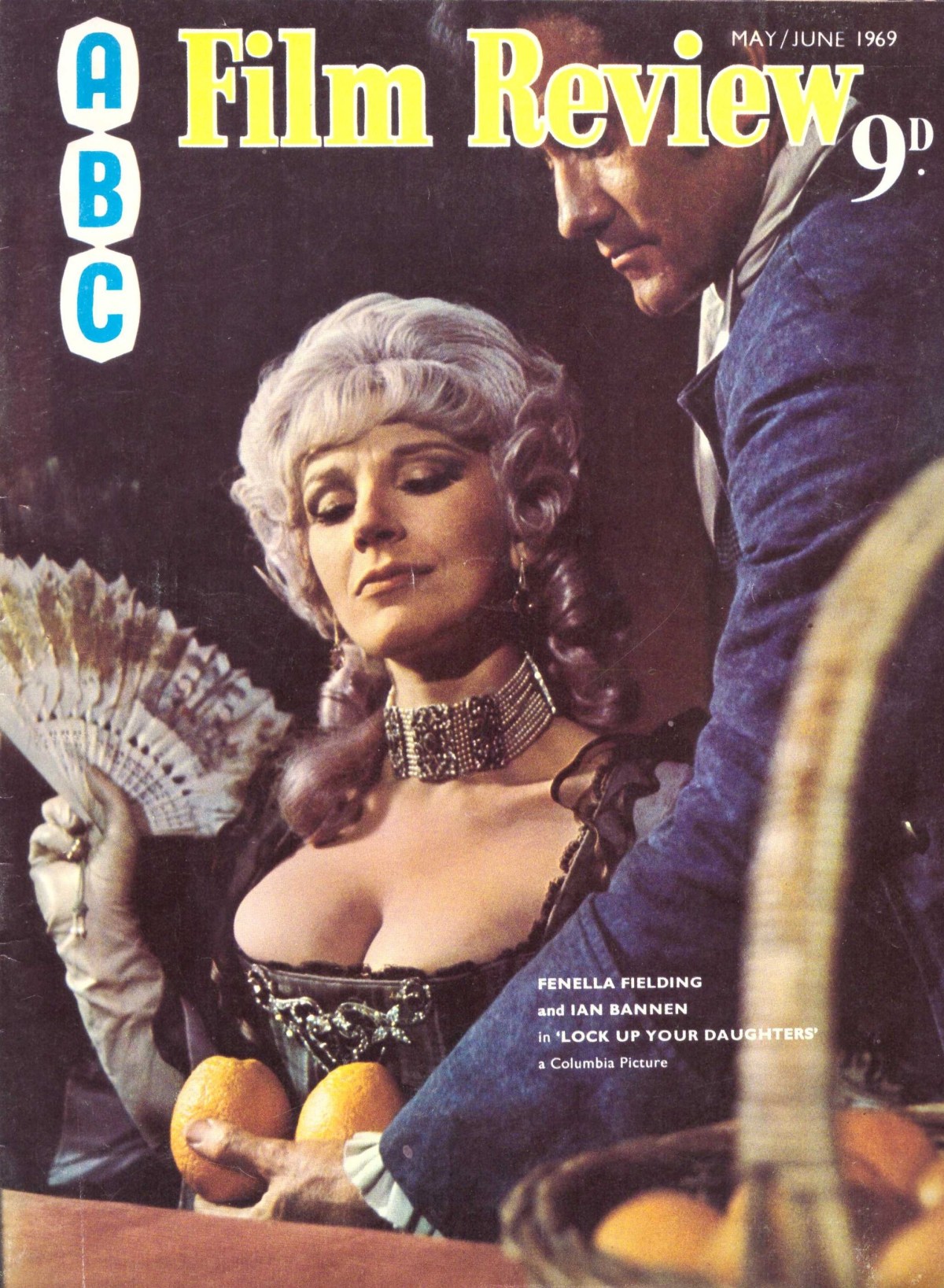
Lock Up Your Daughters (1969) **

Worth seeing for all the wrong reasons, prime example being Christopher Plummer with a false nose and almost unrecognizable as an eighteenth century periwigged English dandy in a pure squalor of a coastal town. The best reason is the very realistic background, all mud, missing teeth, drunkenness, cockfighting, poverty, debtors strung up in baskets – not the usual bucolic image of Olde England. But everything gets bogged down in an indecipherable plot. Robert Altman mastered the multi-character narrative in such gems as Nashville (1975) but here debut director Peter Coe most demonstrably did not.

This started life as a modestly successful London West End stage musical and probably for budgetary reasons the songs were discarded. All that’s left is plot. And plot and plot. All to do with sex as it happens. Husbands exist only to be cuckolded. Cleavage is obligatory for women. Young women lusting after sex have been brought up in contradictory fashion to view it as dirty. And no eighteenth century tale is complete without a regimen of long-lost daughters and sons.

Guess who?

It starts promisingly enough in early morning with a town crier (Arthur Mullard) filling us in on the predilections and problems of various prominent citizens, most notably Lord Foppington (Christopher Plummer), the foppest of the fops, gearing up for an arranged marriage to Hoyden (Vanessa Howard). As a virgin not wanting to come to his wedding night bereft of the necessary skills, he employs strumpet Nell (Georgia Brown) to bring him up to speed.

Meanwhile, it’s “lock up your daughters” time as a ship’s crew, at sea for ten months, given two days leave, start charging through the town, fondling and kissing any woman of any age who happens to stand still for a moment. Among this randy bunch are Ramble (Ian Bannen), Shaftoe (Tom Bell) and Lusty (Jim Dale). Ramble is given the eye by married Lady Eager (Fenella Fielding), Shaftoe takes a fancy to Hilaret (Susannah York) while old flame Nell is targeted by Lusty (Jim Dale). Mrs Squeezum (Glynis Johns) seeks sex anywhere and there’s maid Cloris (Elaine Taylor) also seeking physical fulfilment.

Of course, the whole purpose of the narrative is to thwart true and illicit love, husbands and fathers returning at inconvenient times. And had the storyline stuck to the tried-and-tested formula devised very successfully for Tom Jones (1963) and The Amorous Adventures of Moll Flanders (1965) it might well have worked. But the instinct to make meaningful comment by way of satire takes the story in very unlikely directions, an extended court scene with a barmy judge the worst of such excesses, though a food fight comes close.

It’s meant to play as a farce, the men climbing (literally) in and out of bedrooms, the town’s apparently only ladder put to continuous use. But what would work on stage sadly falls down here, and not just because the occasional song might have come as light relief. There is an element of the female confusion over sex, natural instinct going against education, and so ill-informed that at the slightest chaste kiss they are likely to cry rape, but that’s as close as the movie gets to anything that makes sense.  A movie that needed a sense of pace just becomes one scene tumbling into another.

Christopher Plummer (Nobody Runs Forever/The High Commissioner, 1968) makes by far his worst screen choice. He’s so concealed in his clothing that movement is inhibited and most of his acting relies on overworked eyeballs. Susannah York (Sands of the Kalahari, 1965) is pretty much lost in the shuffle. Ian Bannen (Penelope, 1966) is the pick, largely because he is required not to play villain, grump or idiot, and his Scottish charm and confidence works very well. Tom Bell (The Long Day’s Dying, 1967) is not cut out for comedy whereas Jim Dale (Carry On Doctor, 1967) who very much is does not get enough.  

The movie wastes the talents of a terrific supporting cast headed by former British box office queen Glynis Johns (The Chapman Report, 1962) plus Roy Dotrice (A Twist of Sand, 1968), Vanessa Howard (Some Girls Do, 1969), Elaine Taylor (Casino Royale, 1967), Roy Kinnear (The Three Musketeers, 1973), Kathleen Harrison (Operation Snafu, 1961), Fenella Fielding (Arrivedeci, Baby, 1966) and singer Georgia Brown (A Study in Terror, 1965).

Keith Waterhouse and Willis Hall (Billy Liar, 1963) wrote the screenplay based on, as well as the original musical, a number of sources drawn from the works of Henry Fielding (author of Tom Jones) and John Vanbrugh. Peter Coe never directed another movie.

Hard to find – and probably deservedly so unless you’re of the So Bad It’s Good fraternity.

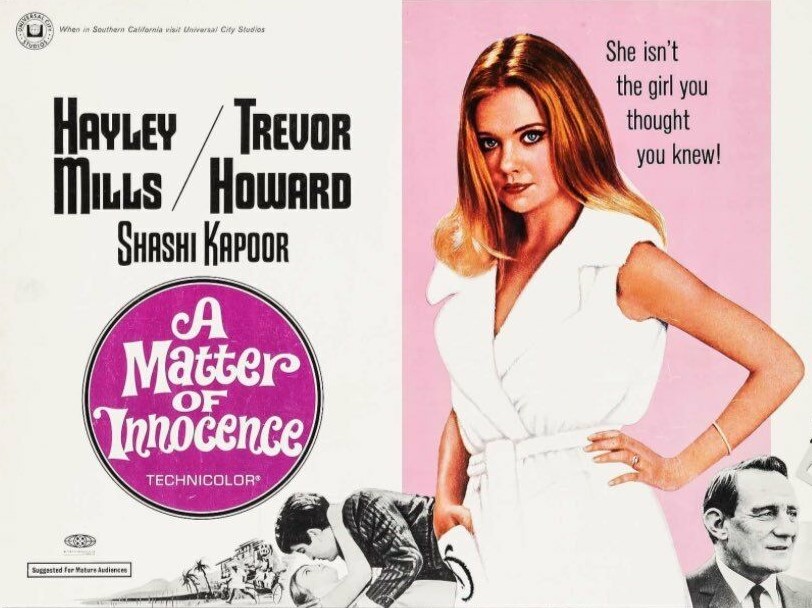
A Matter of Innocence / Pretty Polly (1967) ***

Dramatically undernourished coming-of-age tale over-reliant on “authentic” travelogue and continuing the transformation of Hayley Mills from child to adult star, although that change had been clearly wrought by her previous outing in  The Family Way (1966) which had contained her first nude scene. While there’s definitely way more sex here it’s all off-screen.

In Singapore, family black sheep Robert (Trevor Howard) tries to stifle romance blossoming between his ugly duckling niece Polly (Hayley Mill) and local king of the fixers Amaz (Shashi Kapoor), to quote from list of the clichés the screenplay happily summons up. Polly is the bespectacled, dowdy, shy travelling companion to snippy aunt (Brenda de Banzie) – Robert’s sister not wife – who resides in a magnificent suite in Raffles Hotel, consigning her niece to a hovel of a room. When said aunt drops dead in the swimming pool, Polly, wasting no time on mourning, is free to turn butterfly, channeling her inner Brigitte Bardot with bouffant hairstyle and tight red dress.

The genial Amaz is on hand as a guide, in sexual matters as well as tourist, until huffing-and-puffing plantation manager Robert threatens to intervene and smarmy American Critch (Peter Bayliss) attempts to sweep her off her feet. And that’s about it, plot-wise. The meandering story provides insights into different aspects of local culture –  Whicker’s World was the only globe-trotting television series available at the time so all this would probably have entranced moviegoers rather than, as now, bored them to death.

Perhaps what’s most interesting is what’s left unsaid or never dwelt upon, of the posh English girl having sex with a native of Singapore. In previous movies – Bhowani Junction et al – miscegenation would have been the sole plot point with Brits up in arms at the suggestion of it. Here, the only objection to Amaz is that he’s a bit of a Casanova, practised seducer in the main of older women. While Amaz falls in love, Polly is considerably more objective, viewing their relationship in terms of rite-of-passage, rather an un-British approach, more in keeping with the attitudes those bold females exhibited in pictures like The Group (1966).

Polly is a pretty cool-headed kid, with a good head for booze, not staggering in gutters or throwing up after imbibing too much, alert to the intentions of Critch and more than capable of putting her uncle in his place. Despite her delight at enjoying sex Polly is more independent than you might imagine and the film’s actually a character study of a woman refusing to be defined – or trapped – by love and its obvious consequence marriage and viewing this new freedom as merely the starting point of her life.

For Hayley Mills fans, of course, her career divides sharply into Disney and post-Disney. Few child stars ever manage to take the first steps to an adult career never mind sustain one, but the actress made a good stab at throwing off her previous precocious screen persona by taking on challenging roles that perhaps upset her core followers. But the film would have benefitted from a better storyline and minus the distracting tourist elements been a lot tighter.   

The career of Trevor Howard, long-time second male lead, was on a bit of an upswing after sterling roles in Von Ryan’s Express (1965) and The Long Duel (1967) and although he remained the scowler supreme he brings more vulnerability to this role. Bollywood heartthrob Shashi Kapoor had come to prominence as far as the English-speaking countries were concerned through arthouse director James Ivory’s The Householder (1963) and Shakespeare-Wallah (1966) but this was his mainstream debut. He certainly has a screen presence and enjoys the best character arc, going from the cynicism of sex to the innocence of love. I’m sure the title is intended to refer to Polly but she is innocent, in screen shorthand terms, for about two seconds. Pretty Polly, the title of the short story on which the film is based, was not usable in certain countries because the name was the trademark of a popular brand of hosiery.

This was the final film of Brenda de Banzie (The Man Who Knew Too Much, 1956) and the second for British television stalwart Patricia Routledge (Keeping Up Appearances, 1990-1995), while for Chinese star Kalen Liu (Welcome to Hard Times, 1967) it was both her second and last picture.

This was perhaps an odd choice for director Guy Green (A Patch of Blue, 1965) but he was mired in the on-again off-again saga of proposed MGM roadshow epic Forty Days of Musa Dagh and compared to those travails this may have been welcome light relief. Keith Waterhouse and Willis Hall (Lock Up Your Daughters, 1969) developed the screenplay from Noel Coward’s short story.
Discover WordPress

A daily selection of the best content published on WordPress, collected for you by humans who love to read.

The Atavist Magazine

by Brian Hannan

WordPress.com News

The latest news on WordPress.com and the WordPress community.