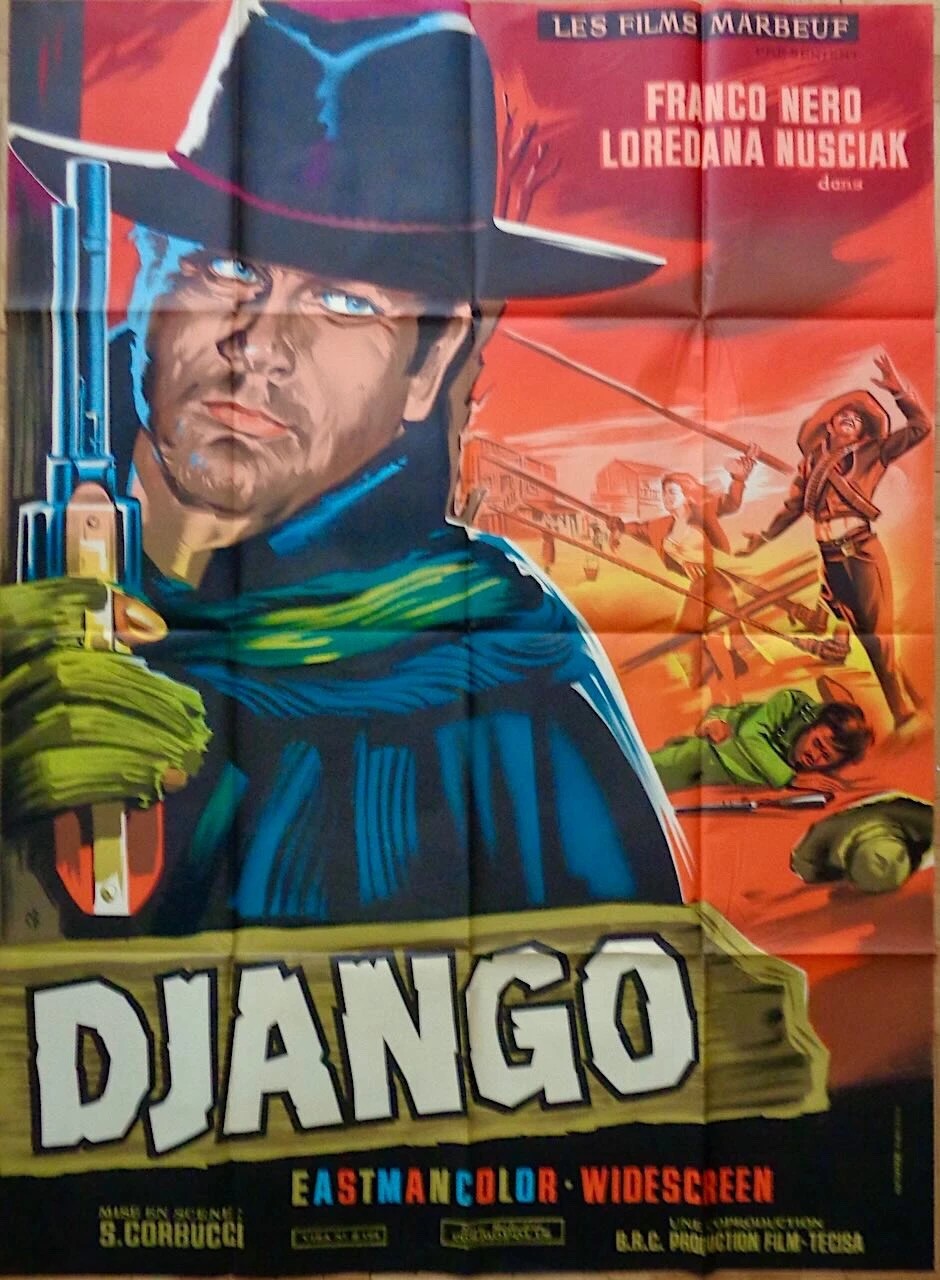
Django (1966) ****

You’re not going to get a more iconic opening than a cowboy dragging a coffin up a muddy hill. But just in case you think director Sergio Corbucci is trying to make some high-falutin’ statement, the next few minutes contain nine deaths and a woman whipped and then threatened with being burned to death. What followed resulted in deserved cult status, helped along by a ban from the British censor. Outside Sergio Leone 1960s western quartet, this is generally considered to be the best spaghetti western of the period.   

You’ll be familiar with the story, because basically it’s a rehash of A Fistful of Dollars, which in itself was an uncredited rehash of Akira Kurosawa’s Yojimbo (1961).
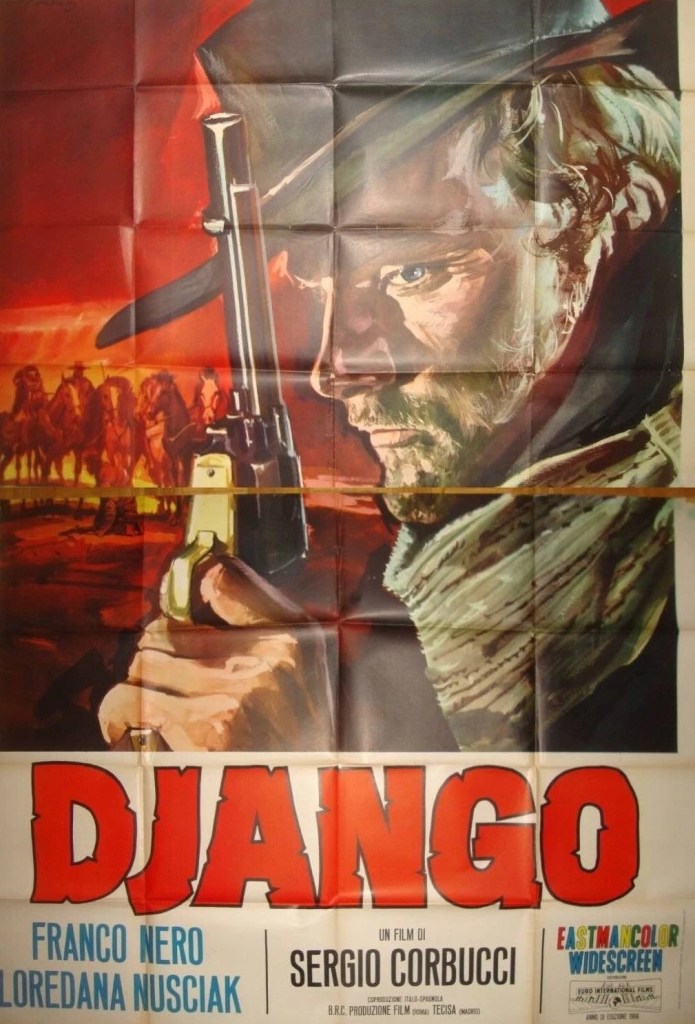
On the Mexican-U.S. border, two groups vie for control of a tiny town (population: six – one bartender and five whores), one led by ex-Confederate Major Jackson (Eduardo Fajardo) who would be dressed in the red shirts of revolutionaries except that the opposing bunch led by General Rodriguez’s (Jose Badalo) has chosen that color.

Django (Franco Nero) arrives in the town accompanied by the whipped woman Maria (Loredana Nusciak)  and the coffin, which contains a machine gun. Django wants revenge on Jackson who killed his lover. But that’s as much a MacGuffin as you need because, really, slaughter is the name of the game, not to mention a gold heist, then a heist of the stolen gold, which is stashed safely in Django’s coffin until it ends up in the quicksand.

This being a spaghetti western naturally there’s mutilation, Django’s hands crushed for the audacity of his theft, someone else forced to eat his own ear, and there’s attempted rape. Mostly, there’s massacre. A humungous heap of bodies provide the entertainment.  Jackson and the General are equally intent on killing as many people as possible, Rodriguez having the moral edge because he’s the legitimate revolutionary but it’s a close run thing.

But the good guys are always a hefty massacre away from safety.
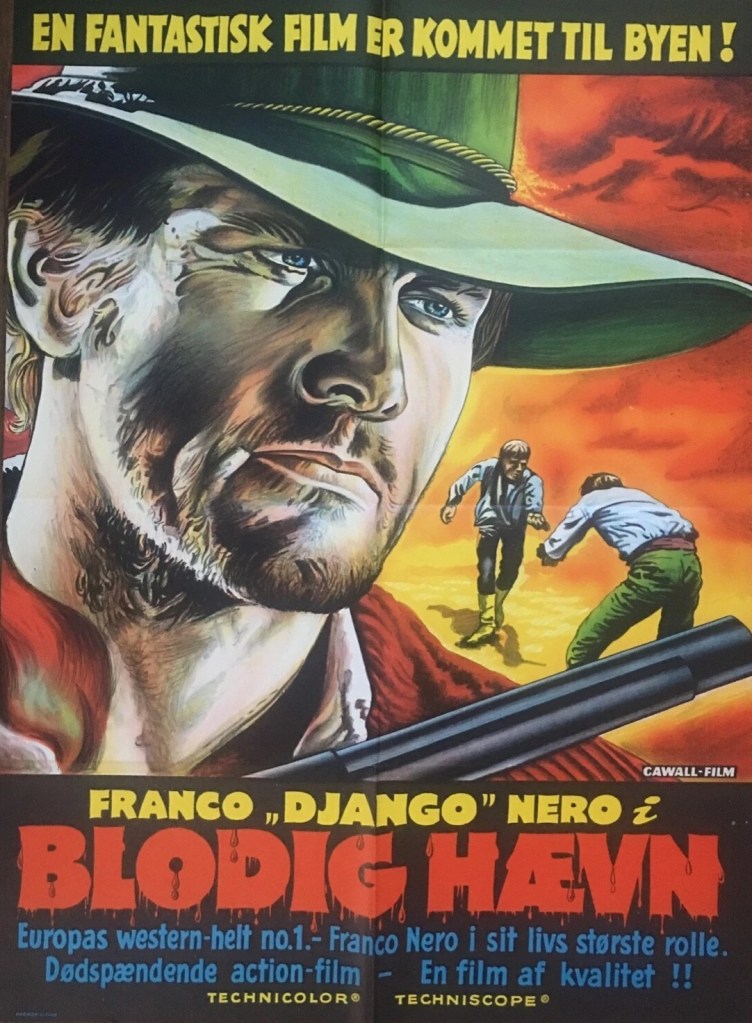
For reasons known only to mythmakers, the final shoot-out takes place in a cemetery in Tombstone, which is a heck of a long way (a mere 500 miles) from the Mexican border, but never mind. But there’s a clever ending, especially when you consider how difficult it is to shoot a revolver with a mangled hand.

This zips along with a ton of brio. Franco Nero (Camelot, 1967) resists the temptation to play up those baby blues. He’s virtually deadpan thoughout, quite an achievement in a movie where everyone else overacts. His character is even more down’n’dirty than The Man with No Name and comes across more as a man of the soil than a gunslinger. For such a violent movie, there’s an acknowledgement of politics that’s akin to the skewered morality of The Wild Bunch (1969). The plot takes us all over the place, but it’s so much fun who the heck cares.

The bloodshed (“excessive and nauseating” was the view of the British censor) was way ahead of its time, representing the reality of war and rebellion far more than the cartoonish killing of Leone’s spaghetti trilogy.

Director Sergio Corbucci (The Great Silence, 1968) isn’t trying to sell us a traditional western with sweeping vistas and terrific camerawork. This falls into the nihilistic vein. The huge tranches of mud at the outset set the tone, the land is barren and bleak, a desert of mud. There’s nothing opportunistic or greedy about Django. He’s not intent on playing off two sides for profit. His motive is personal. Where The Man With No Name was fleshed out with a certain amount of charm, there’s no recourse to that here. In a pitiless world, there’s no use for charm. Written by Sergio Corbucci and his brother Bruno.

This spawned as many rip-offs as the Leone versions.

Machine Gun McCain (1969) ***

Armed robbers lack the finesse of a jewel thief or burglar when it comes to pulling off a major heist. Rather than resorting to the weaponry of the title, they are more inclined, as John Cassavetes does here, to plant bombs, both as a diversionary tactic and within the target building, in this case a Las Vegas casino.

Although boasting Hollywood leads in Cassavetes and Peter Falk and rising Swedish leading lady Britt Ekland (The Double Man, 1967) and wife of star Peter Sellers, this was an Italian-made gangster thriller with the usual abundance of location work. Without the romantic complications of A Fine Pair (1968) it concentrates on the machinations of the central characters.

And it is a pretty lean machine. The robbery takes place against the background of warring Mafia chieftains, West coast boss Charlie Adamo (Peter Falk) trying to muscle in on a Vegas casino without being aware it is controlled by the New York hierarchy. Hank McCain (John Cassavetes) does not realize the robbery has been set up by his naïve son Jack (Pierluigi Apra) on behalf of Adamo. Irene Tucker (Britt Ekland) is on board as a kind of mostly mute magician’s assistant, helping out Hank.

Little dialogue comes Cassavetes’ way, either, which plays to his strength, that glowering intense unpredictable weasel-face, whose reactions are less likely to be emotional than violent. Falk gets the dialog and little help it does him, his goose is cooked when he has the temerity to shout at the New York kingpin. 

Yet this slimmed-down documentary-style hard-nosed picture in the vein of Point Blank (1967) manages several touching moments, even more effective for completely lacking sentimentality. When Hank’s son is knifed in the back, the gangster finishes him off with a burst from the titular machine gun rather than see him suffer. His old flame Rosemary (Gene Rowlands), making too brief an appearance, has a wall covered in newspaper headlines of herself with Hank celebrating her life as his moll and she accepts without enmity the new woman in his life and she proves the toughest moll of all when confronted with Mafia gunslingers.. 

The planning of the heist is well done, no explanatory dialog, just action on screen; there’s a car chase; and the gangster dragnet is unexpectedly powerful. Gabriele Ferzetti (the railroad baron in Once Upon a Time in the West, 1968) is excellent as the calm authoritative New York boss, Falk a bit too excitable, and Florinda Balkan (The Last Valley, 1971), in her third screen role, has a small part as a traitorous moll. Ekland is surprisingly good with not much to play with, a couple of lines here and there but still emoting with her face.

Cassavetes, who always claimed he was only acting to fill in the time between directing  (Faces, 1968), and as a means of financing them, was at a career peak, Oscar-nominated for The Dirty Dozen (1967) and male lead in Rosemary’s Baby (1968). He had just appeared in another Italian gangster movie Bandits in Rome (1968). Cassavetes and Falk would go on to have a fruitful partnership over another five films. Falk and Ekland had played opposite each other in Too Many Thieves (1967). Falk also had an Oscar nod behind him for Murder Inc. (1961) but his career was about to go in a different direction after the TV movie Presciption: Murder (1968) that introduced Columbo.

Trivia trackers might also note a score by Ennio Morricone. Though not one of his best, a few years later he would deliver one of his most memorable themes for Sacco and Vanzetti (1971) for the same director Giuliano Montaldo.

Discover WordPress

A daily selection of the best content published on WordPress, collected for you by humans who love to read.

The Atavist Magazine

by Brian Hannan

WordPress.com News

The latest news on WordPress.com and the WordPress community.