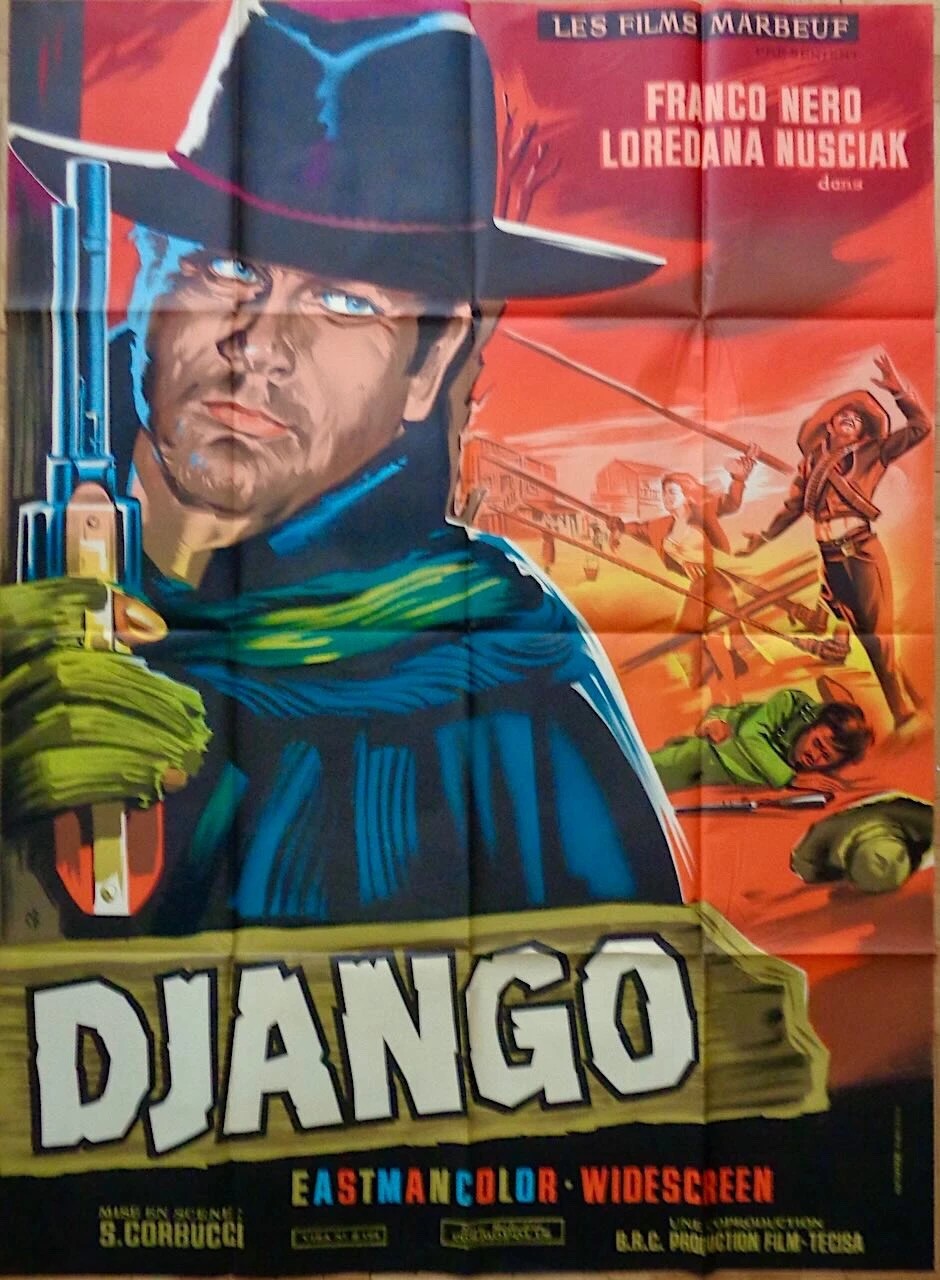
Django (1966) ****

You’re not going to get a more iconic opening than a cowboy dragging a coffin up a muddy hill. But just in case you think director Sergio Corbucci is trying to make some high-falutin’ statement, the next few minutes contain nine deaths and a woman whipped and then threatened with being burned to death. What followed resulted in deserved cult status, helped along by a ban from the British censor. Outside Sergio Leone 1960s western quartet, this is generally considered to be the best spaghetti western of the period.   

You’ll be familiar with the story, because basically it’s a rehash of A Fistful of Dollars, which in itself was an uncredited rehash of Akira Kurosawa’s Yojimbo (1961).
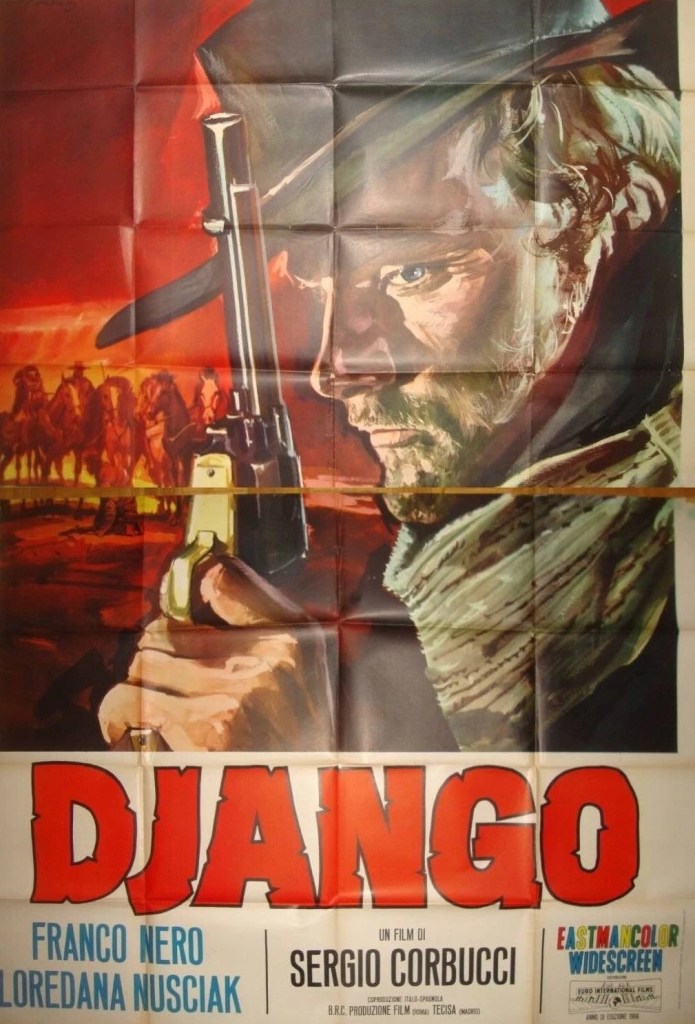
On the Mexican-U.S. border, two groups vie for control of a tiny town (population: six – one bartender and five whores), one led by ex-Confederate Major Jackson (Eduardo Fajardo) who would be dressed in the red shirts of revolutionaries except that the opposing bunch led by General Rodriguez’s (Jose Badalo) has chosen that color.

Django (Franco Nero) arrives in the town accompanied by the whipped woman Maria (Loredana Nusciak)  and the coffin, which contains a machine gun. Django wants revenge on Jackson who killed his lover. But that’s as much a MacGuffin as you need because, really, slaughter is the name of the game, not to mention a gold heist, then a heist of the stolen gold, which is stashed safely in Django’s coffin until it ends up in the quicksand.

This being a spaghetti western naturally there’s mutilation, Django’s hands crushed for the audacity of his theft, someone else forced to eat his own ear, and there’s attempted rape. Mostly, there’s massacre. A humungous heap of bodies provide the entertainment.  Jackson and the General are equally intent on killing as many people as possible, Rodriguez having the moral edge because he’s the legitimate revolutionary but it’s a close run thing.

But the good guys are always a hefty massacre away from safety.
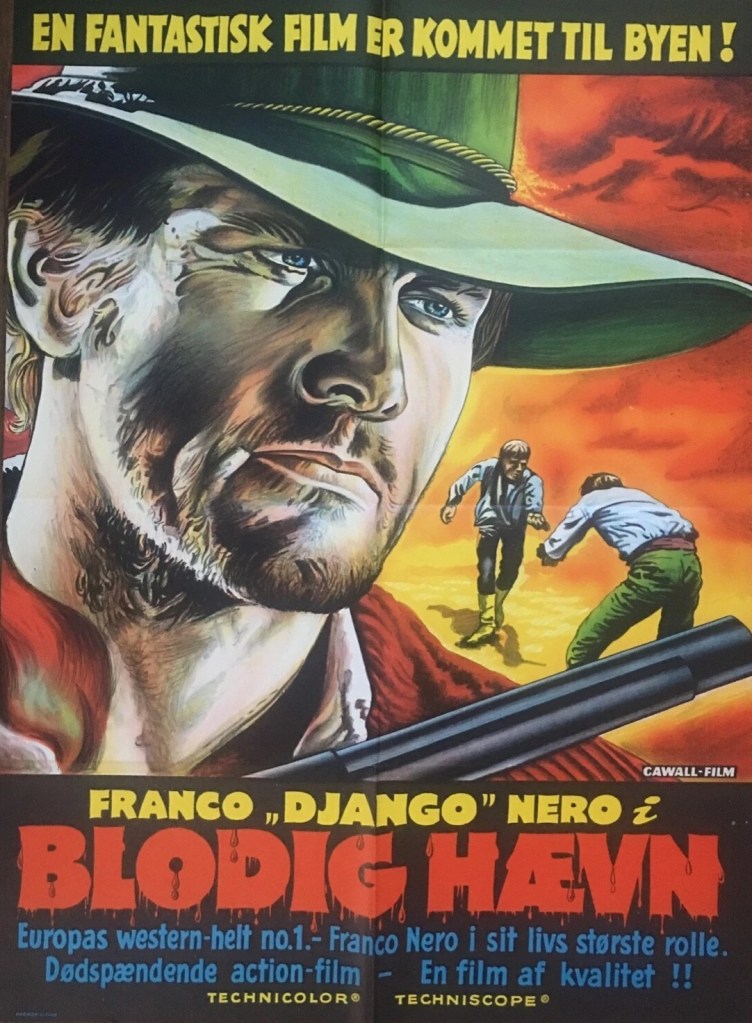
For reasons known only to mythmakers, the final shoot-out takes place in a cemetery in Tombstone, which is a heck of a long way (a mere 500 miles) from the Mexican border, but never mind. But there’s a clever ending, especially when you consider how difficult it is to shoot a revolver with a mangled hand.

This zips along with a ton of brio. Franco Nero (Camelot, 1967) resists the temptation to play up those baby blues. He’s virtually deadpan thoughout, quite an achievement in a movie where everyone else overacts. His character is even more down’n’dirty than The Man with No Name and comes across more as a man of the soil than a gunslinger. For such a violent movie, there’s an acknowledgement of politics that’s akin to the skewered morality of The Wild Bunch (1969). The plot takes us all over the place, but it’s so much fun who the heck cares.

The bloodshed (“excessive and nauseating” was the view of the British censor) was way ahead of its time, representing the reality of war and rebellion far more than the cartoonish killing of Leone’s spaghetti trilogy.

Director Sergio Corbucci (The Great Silence, 1968) isn’t trying to sell us a traditional western with sweeping vistas and terrific camerawork. This falls into the nihilistic vein. The huge tranches of mud at the outset set the tone, the land is barren and bleak, a desert of mud. There’s nothing opportunistic or greedy about Django. He’s not intent on playing off two sides for profit. His motive is personal. Where The Man With No Name was fleshed out with a certain amount of charm, there’s no recourse to that here. In a pitiless world, there’s no use for charm. Written by Sergio Corbucci and his brother Bruno.

This spawned as many rip-offs as the Leone versions.
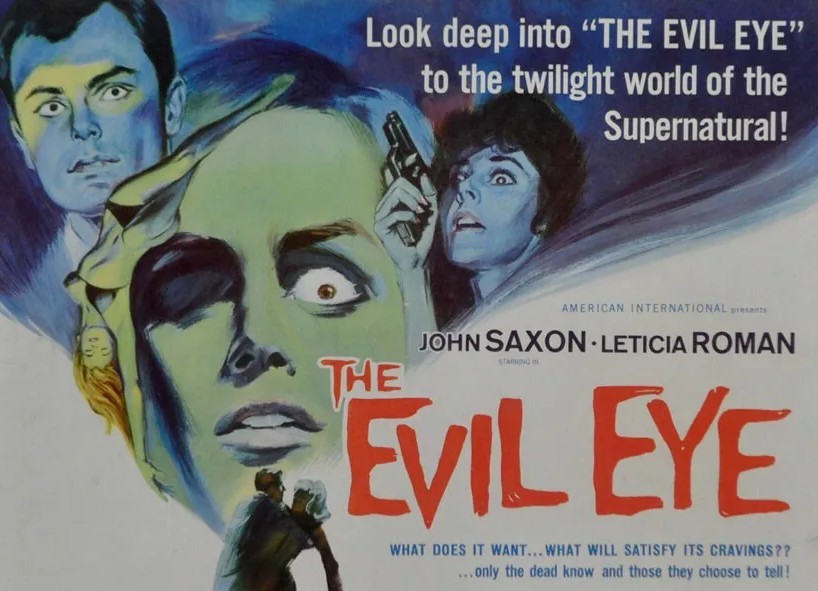
The Evil Eye / The Girl Who Knew Too Much (1963) ***

Don’t be taken in by claims that, since it was directed by Mario Bava, it kicked off the giallo sub-genre. More of the tropes come from mainstream horror – windows banging shut, locked doors, disembodied voices, stalkers, gaslighting, mysterious phone calls, premonition, retrocognition. And just for good measure, striking compositions that wouldn’t be out of place in an arthouse picture. But essentially it’s neo-noir – a woman can’t prove she’s witnessed a murder.

The Evil Eye was the American title, which makes little sense, although eye-popping eyes were in fashion from movies like Village of the Damned (1960), but in fact the original title of The Girl Who Knew Too Much is much more appropriate. This film is about a female character and what she discovers that threatens her life. The American version was chopped about by the distributor but, apparently, copies of that have gone astray so if locate a copy of the picture what you are likely to see if the Italian original.

American tourist Nora (Leticia Roman) is knocked out by a robber in Rome. On waking up she sees a murderer sticking a knife into a woman’s back. Only problem is – there’s no corpse to be found. But, strangely, a murder was committed on that spot a decade ago. So she might be having a vision of the past. But the murderer Straccianeve was caught.

The victim was the sister of Laura (Valentina Cortese), a new friend, whose apartment Nora temporarily occupies. There, Laura discovers newspaper clippings relating to the “alphabet killer”, a serial murderer whose victims’ surnames began with A, B, and C. Once Nora begins her investigations, it looks like she’ll be next on the list since her surname begins with “D”.  Meanwhile, she has struck a romantic vibe with Dr Marcello Bassi (John Saxon). But, of course, he might be not what he seems, sneaking off for assignations with strange women, following her.

Much of this is played out on deserted streets where the tourist sites acquire a dangerous veneer.

The finger points at journalist Landini (Dante DiPaulo), who has been following her. But he is as much a basket case as a potential murderer. He was instrumental in collecting the evidence that trapped the murderer but now believes Straccianeve was innocent.

In due course, after some more deaths, Nora traps the murderer, who comes out of left field, one of those where you think the writer has decided to pin the blame on the least likely suspect and come up with a spurious reason for the murders, so the twists pile up in helter skelter fashion at the end, including one which suggests Nora might well have the gift of seeing into the future.

Leticia Roman, in her debut, is mostly called upon to look baffled or frightened, there’s rather too much of the pop-eyes, and John Saxon (The Appaloosa, 1966) has the rare opportunity to play a hero. Valentina Cortese (Barabbas, 1961) drifts in and out of the tale. Written by future director Sergio Corbucci (Django, 1966), Oscar-winner Ennio De Concini (Divorce, Italian Style, 1963) and Eliana De Sabato (Marco Polo, 1962).

If it hadn’t been directed – and occasionally so stylishly – by Mario Bava (The Whip and the Body, 1963), it would have attracted considerably less contemporary attention. One of this main themes – the conflict between illusion and reality – is given a good airing. You can well believe that Nora is going mad. But it’s atmospheric enough and the director makes unusual use of the standard Rome tourist traps and this picture gives notice that he will move onto greater movies.

Discover WordPress

A daily selection of the best content published on WordPress, collected for you by humans who love to read.

The Atavist Magazine

by Brian Hannan

WordPress.com News

The latest news on WordPress.com and the WordPress community.