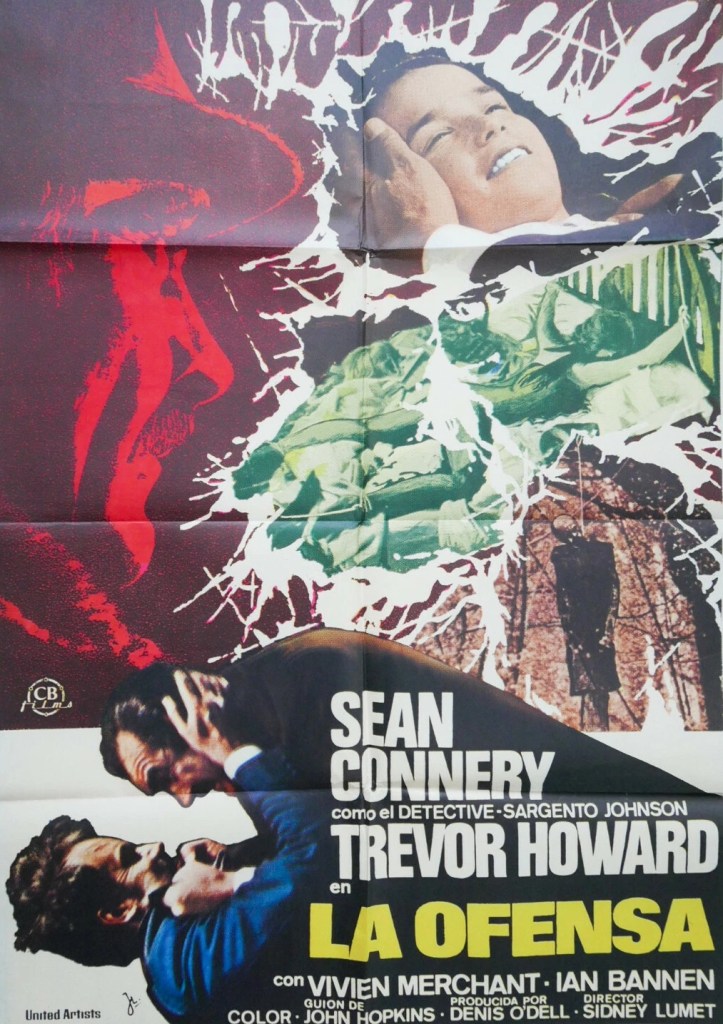
Behind the Scenes: “The Offence” (1973)

“Vanity project” – two words to strike terror into the heart of a Hollywood studio boss. It meant some star or director had you over a barrel. In return for them condescending to make a movie for you, they expected you to fork out for a movie you knew would never make a dime. But, in this case, as far as United Artists was concerned, it was worth the risk if it that meant getting the Bondwagon back on track after the disappointing box office of On Her Majesty’s Secret Service (1969). It was a (relatively) small price to pay to get Sean Connery signing on for Diamonds Are Forever (1971).

There was still a financial downside. In the Connery deal, United Artists agreed to stump up two million bucks for two pictures. The actor would cost nothing, so that might be considered a bonus, Connery relying on the back end to recoup his fee and share of profits. But the movie would still need marketing and advertising, which might add up to another half a million dollars per picture.

Worse, this was what was known in the business as a “put picture.” According to director Sidney Lumet that meant the studio “had nothing to say about it. A budget was picked – and in this instance it was $1 million – and then whatever Sean wanted to do with that million he could do. They would have no approval of script, director, cast, what-have-you and that’s how The Offence happened.”

Connery wasn’t the first actor to think he knew better than the studio or who fancied backing his own judgement. That particular line went back to the silent days of Mary Pickford and Charlie Chaplin and later included the likes of John Wayne, Marlon Brando, Gregory Peck and Doris Day.

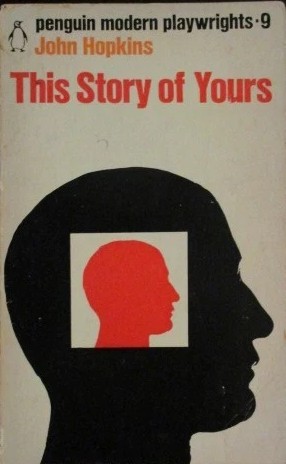
Connery planned to adapt a play by John Hopkins called This Story of Yours. He’d met Hopkins on Thunderball (1965) for which Hopkins had written the screenplay. UA might have been more interested had the play had been a whopping success in London’s West End and Broadway. But its London run was restricted to a few weeks at the Royal Court Theatre in 1968, so more arty than the general hit play.

Connery’s second choice for a “put picture” was an adaptation of Macbeth in which he would make his directorial debut.

“There was never a moment’s discussion,” noted Lumet, about how this would play with Connery’s global fanbase. “Sean knew exactly what he was getting into, shut his eyes and dived off the board without checking if there was any water in the pool.”

The budget was trimmed further following changes to the dollar-sterling exchange rate and Connery had only $900,000 to play with. But actually this wasn’t such a bad deal. Apart from three pictures, UA had limited budgetary exposure to $1.5 million for the rest of its slate. And Connery was flush, sitting on an estimated $6 million from his share of the proceeds of Diamonds Are Forever, his record fee of $1.2 million augmented by his 12.5 per cent share of $45 million in rentals.

Sidney Lumet, who had directed Connery in The Hill (1965) and The Anderson Tapes (1971) signed up. Ian Bannen, also from The Hill, took the main supporting role and Trevor Howard (The Long Duel, 1967), with just nine minutes screen time, added marquee lure. Lumet managed to bring the film in ahead of schedule, completing the film in just  28 days of shooting following a couple of weeks of rehearsal. The writer was on the set every day.

And UA hadn’t skimped on promotion either. Some of the 154 journos attending a junket for Man of La Mancha were shipped to London to cover The Offence.

Exteriors were shot in and around Bracknell in Berkshire in March and April 1972, making use of the Point Royal flats – the background made enough of an impression for a PhD student to use it for a thesis on the “brutalism” of modern architecture” – with interiors at Twickenham. The town’s library doubled as the film’s police station for exteriors.

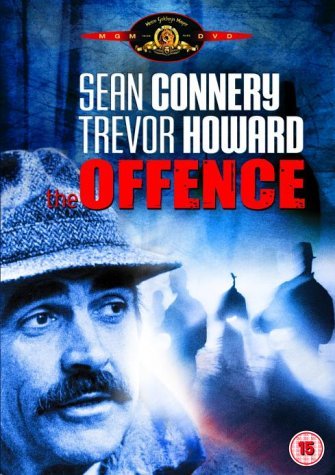
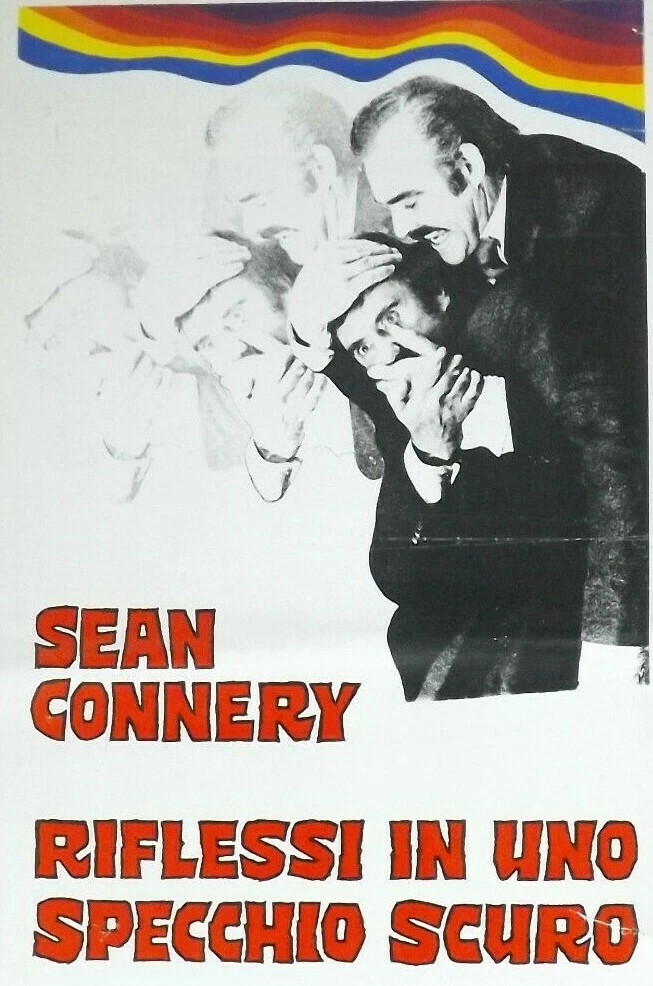
The title was changed to Something Like The Truth – artwork was devised for this – and only switched to the “much more impactive” The Offence a month before the movie opened.

All Connery’s Bond hits had opened at big London West End theaters. So although this might have fared better in a smaller house, or a West End cinema known for more discretionary fare such as the Odeon Haymarket or a genuine arthouse like the Curzon, UA slotted it into the 1,993-seat Odeon Leicester Square in January 1974.

In opening week it took $17,900, a few hundred dollars short of the seventh week of the movie it replaced, Charles Bronson thriller The Mechanic, so “disappointing” was an understatement. According to a later article by Variety’s Peter Debruge, it only lasted four days. But it didn’t. It ran for five weeks. Week two brought in $13,700, the third stanza $10,200 and then $8,900 and a final sally of $7,300. But nothing like his Bond box office.

It transferred to the 139-seat Cinecenta – where it might more sensibly have opened and where demand would surely have outstripped supply and led to a lengthy run. In fact, the second week there improved on the first, $2,400 compared to $2,200. And it shifted over to the equally tiny Centa Cinema where its second week sat at $2,400. The Odeon chain gave it a circuit release, backed by a reissue of western Support Your Local Gunfighter (1971) starring James Garner.

The London figures resulted in a distinct lack of interest in the U.S. Not even Connery’s success as James Bond could induce any notable theater to take it on. U.S. reviews didn’t help. Among the New York critics, six were negative and only two positive. However, Women’s Wear Daily commented on the “beautiful acting by Sean Connery” and the Independentl Film Journal noted, “He is so much more right for this than any glossier star would be that he has an unbeatable advantage.”

Peter Debruge reckoned the poor London box office stalled its opening Stateside for a year. That wasn’t true either. Although it was slow out of the gate. It had received an “R” certificate in December 1974, which generally indicated an opening one month or so further on. Instead, the opening was delayed until 11 May 1973 at the 546-seat Festival in New York, by which point Connery was again in the news, having replaced  Burt Reynolds on Zardoz.

Again according to Debruge, the distributor “buried it in a bad house” in New York. That wasn’t true either. The Festival, a Walter Reade arthouse, was the ideal location for a difficult movie that needed to find its feet. Success there could lead to a long run. The movie it replaced, Ten from Your Show of Shows, an equally odd proposition being a compilation of sketches from a 1950s TV show, was coming to the end of a 10-week run.

The first five days at the Festival hauled in $9,500 but neither the second nor third week figures were reported, which meant they were dire. That three-week run was the limit of its American release, as far as I could detect after researching the pages of Variety. It may well have turned up somewhere on the drive-in circuit or as a support. Judging from available posters, it was released at least in Germany, Finland, Australia, Belgium and Spain

Apparently, it turned a profit after nine years but my guess that would take a considerable amount of sales to television to get anywhere near recouping the investment. United Artists reneged on its deal to make another “put picture” with Connery, though likely there was a loophole in the contract that facilitated that. Interestingly enough, that might not have prevented Connery going down the directorial route. He was slated to direct and star in The Drooping W, based on a Leo Marks script, for Twentieth Century Fox.

Both Sidney Lumet and Christopher Nolan, possibly attracted by the complex flashback structure, both asserted it was Connery’s best work.

SOURCES:  “About UA Financing,” Variety, May 19, 1971; “Connery Truth 1st of 2 for UA,” Variety, May 29, 1972; “Lumet Brings In UA’s Truth Ahead of Sked,” Variety, May 31, 1971;  “UA Backed Mancha,” Variety, June 28, 1972;  “Connery May Earn $6-Mil,” Variety, July 19, 1972; “R for Offence,” Variety, December 27, 1972; “Sean Connery Film Retitled,” Box Office, January 8, 1973; “Review,” Women’s Wear Daily, May 14, 1973; “Connery into Zardoz,Variety, May 16, 1973; “N.Y. Critics Opinion,” Variety, May 23, 1973; “Review,” Independent Film Journal, May 28, 1973; “Fox Out-Races Hounds of TV,” Variety, September 19, 1973; Peter Debruge, “Helmers Tap into Charisma and Wigs,” Variety, June 7, 2006. Box office figures: Variety 1973, Jan 24-March 14 and May 16-30.

The Offence (1973) ****

Surprised no one figured to put Sean Connery on the stage. I know he did some hoofing in his early days and no doubt lacking the classical training of a Richard Burton, Laurence Olivier or Peter O’Toole, the theater snobs might have objected. We know Connery had a commanding screen presence but generally there was never any need for him to be in long shot. Here, that’s exactly what director Sidney Lumet does, setting the camera out as if the set was a stage and allowing Connery to take charge in a theatrical fashion.

Lumet and Connery had worked before, on The Hill (1965) and The Anderson Tapes (1971), and they would work together again on Murder on the Orient Express (1974) and Family Business (1989), and generally when actors and directors align it’s because the director is looking for some specific quality the actor can supply, and mostly that’s kind of a shorthand, the presence of Denzel Washington, for example, in a Tony Scott picture gives you an idea just what to expect.

But on their first three pictures together, Lumet draws something different out of Connery every time. This was something of a vanity project for the actor, made for well under a million bucks, and presented the actor in a completely different light. It was a bold, not to say dangerous move, to move so far away from his screen persona.

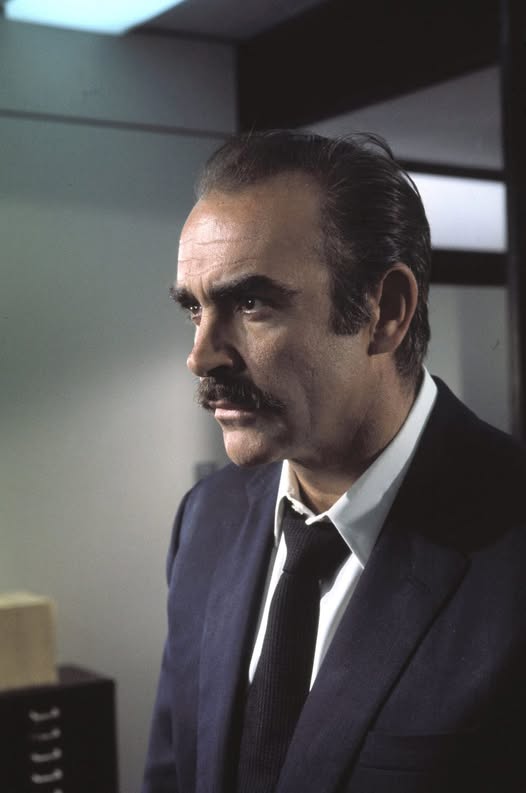
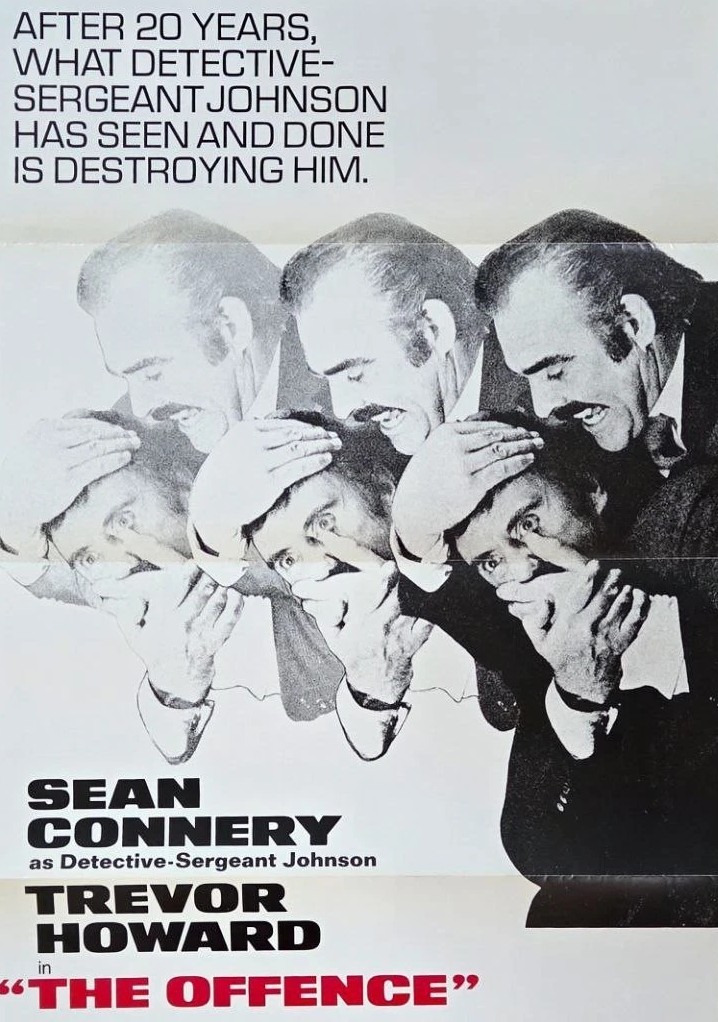
Fans of Christopher Nolan will find much to admire. There’s a tricky structure, flashbacks and flash forwards intermingle, we begin at the end and work our way back to the beginning. As well as the audience trying to work out what’s going on, the main character, Johnson (Sean Connery), a detective sergeant, is also trying to work out what he’s doing, why he reacts the way he does and what do his actions (and words) mean about himself. So, tricky in an intriguing way.

There are some unusual aspects. For a start, the other cops try to prevent cop Johnson (Sean Connery) from getting too aggressive with suspect Baxter (Ian Bannen), accused of paedophilia – at a time when British cops were just as skillful as their Yank counterparts in getting prisoners to fall down stairs or accidentally bang their heads into doors.

There’s a slightly arthouse feel to Lumet’s direction. We begin with slo-mo, for goodness sake, and there’s a bright light that pops onto the screen every now and then.

Three stories develop in parallel. The first is that Johnson is close to burn-out, fleeting flashbacks fill us in on his memories of victims he may have failed. The second is that he’s so determined to get his man, so convinced of the suspect’s guilt, that he doesn’t stop to consider his innocence and becomes so infuriated at Baxter’s continued assertion of innocence that he turns to violence, the old adage of beating the truth out of the man. But the third and most disturbing element is that Johnson is closer to temptation than you’d think, skirting an uneasy border into fantasies of murder and rape.

You might as well have shuttered the movie. Who was going to believe in Sean Connery as a rapist? Worse, who was going to watch him play one? It’s a wonder this saw the light of day at all even on a miniscule budget.

This rises or falls on Connery’s performance. We’ve got no problem – on past screen performance – on viewing the actor as a tough guy, even one who plays hard and fast with the rules. But it’s much harder for him to convince as a man on the verge of the mental breakdown and someone willing to accept he is harboring malevolent thoughts.

If you don’t believe in Connery it won’t work at all. So it’s entirely down to him that it works so well.

This must be the greatest amount of dialog he has ever spouted, huge monologues, intense arguments, and doesn’t look for a moment as if he’s struggling. His intensity is awesome. But for all that it relies on speechifying, some of the best moments involve no words. Johnson flinches at the touch of another man, even if it’s a gesture of sympathy.

The cast is superb. Ian Bannen (Lock Up Your Daughters, 1969) is superb, especially when the tables are turned and he gets to crow over his assailant’s weakness. The ever-choleric Trevor Howard (Von Ryan’s Express, 1965) is at his best when he doesn’t have to rein it in and he doesn’t here. Vivien Merchant (Alfred the Great, 1969) has a small role as the disillusioned childless wife.

Sidney Lumet has the good sense to give Connery the freedom of movement and expression he needs. Written by John Hopkins (Thunderball, 1965) from his play.

This tends to be overlooked because of the darkness into which the character delves but it’s well worth a look just to see what else Connery has to offer.

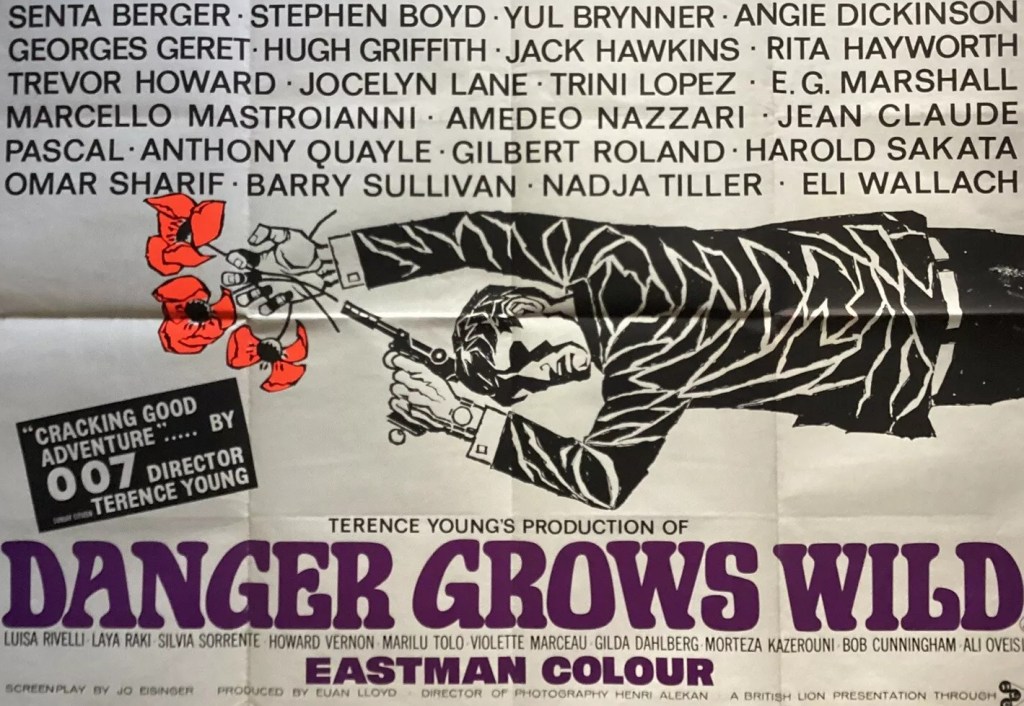
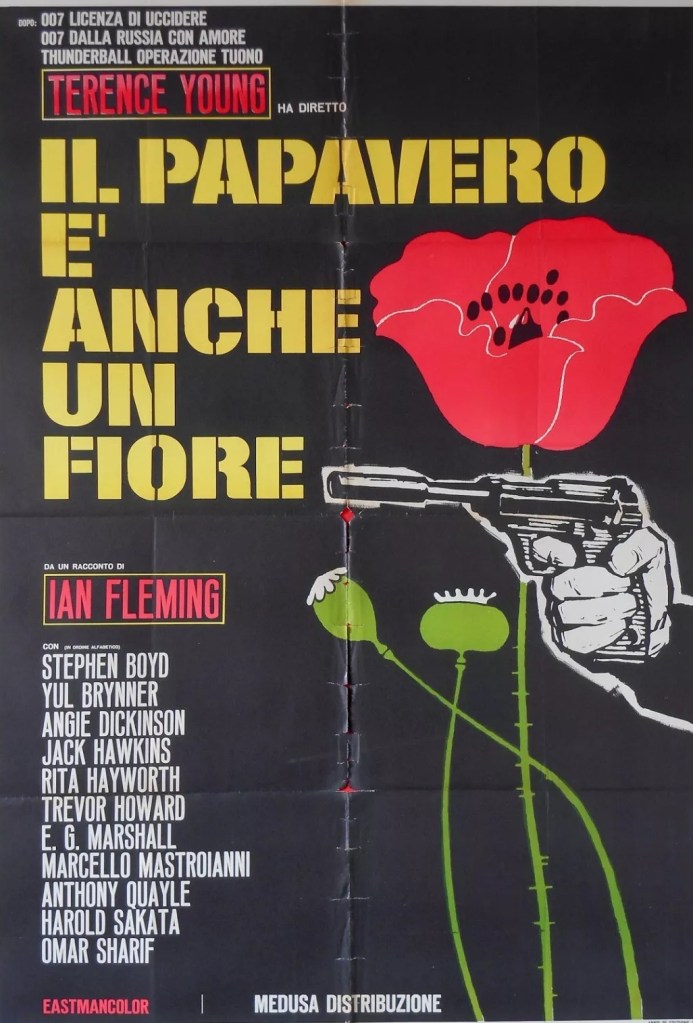
The Poppy Is Also A Flower / Danger Grows Wild (1966) ***

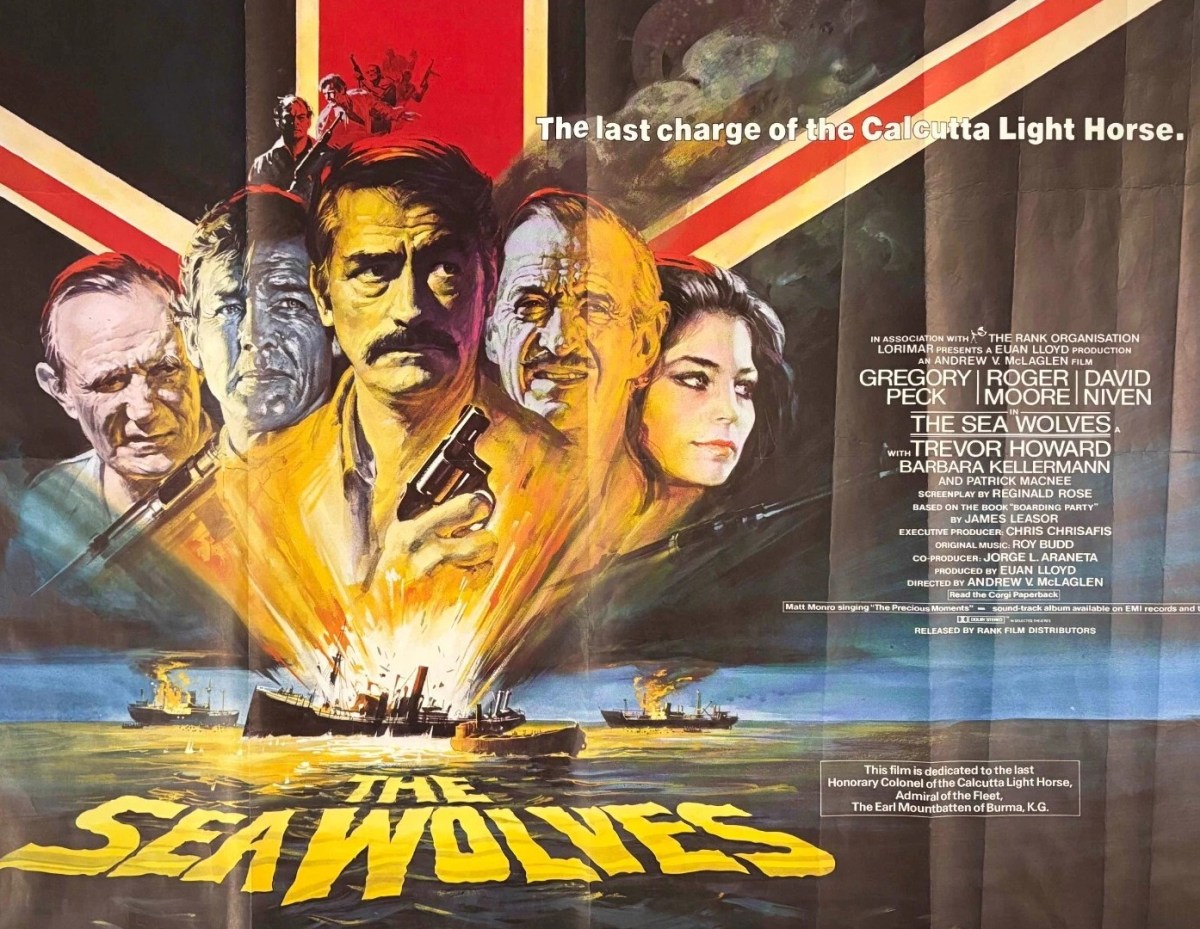
Audiences were likely disgruntled to discover that out of a heavyweight cast boasting the likes of Omar Sharif (Doctor Zhivago, 1965), Yul Brynner (The Magnificent Seven, 1960), Rita Hayworth (Circus World/The Magnificent Showman, 1964), Senta Berger (Cast a Giant Shadow, 1966) and Stephen Boyd (Genghis Khan, 1965), that the heavy lifting was done by a couple of supporting actors in Trevor Howard (Von Ryan’s Express, 1965) and E.G. Marshall (The Chase, 1966).

Most of the all-star cast barely last a few minutes, Stephen Boyd’s character killed in the opening sequence, Senta Berger and Rita Hayworth putting in fleeting appearances as junkies. Like many of the gangster pictures of the decade, it’s set up as a docu-drama, giving the down’n’dirty, courtesy of United Nations which funded the picture, on the international drugs trade.

Benson (Stephen Boyd) heads up an infiltration operation targeting drug suppliers in Iran, where poppies “grow wild as weeds.” Though quickly bumped off, and the goods he’s purchased stolen, he’s replaced by Col Salem (Yul Brynner) who has the Bond-esque notion of enriching the opium with radiation and then tracing it using Geiger counters.

When that scheme fails, it’s down to agents Sam Lincoln (Trevor Howard) and Coley Jones (E.G. Marshall) to hunt down the drugs. Considering themselves unlikely lotharios, they compete over women and play a neat game of stone-scissors-paper to decide who is assigned which task, varying from chatting up Linda (Angie Dickinson), the gorgeous widow of Benson, or searching her room. Linda isn’t all she seems, not least she may not be a widow, carries a gun, and turns up in too many unsavory dives to be on the side of the angels.

Given drug-dealing was not the rampant business it later became, audiences might not be so shocked to discover that opium was transported by cargo ship and refined in Naples before being shipped all over the world. Possibly as interesting is the use of ancetic anhydride in the refining process. As Sam and Coley trudge across half of Europe, from Naples to Geneva to Nice, the audience is filled in on the details of the drug business and they latch on to a Mr Big, Serge Marko (Gilbert Roland).

There’s a hard realism about the project – though not to the levels of The French Connection (1971) -: nightclub dancer needing make-up to hide the tracks on her arms; Marko’s wife (Rita Hayward) stoned out of her skull; director Terence Young (Dr No, 1962) pulling a fast one Hitchcock-style in killing off Sam; and, despite a climax which sees Coley collar Marko, it ends with a pessimistic air – “someone else to take his place.” There’s a good fistfight on a train, and you’ll have guessed what Linda is up to. But there’s an odd softer centre, the movie taking a couple of breaks to highlight the singing of Trini Lopez and female wrestlers.

Before virtue-signalling was invented this was a do-gooder movie, the cameo players signing up for a buck, Grace Kelly on hand for the introduction. These days it stands as an almighty alarm that was scarcely heeded, not as the drug-fuelled counter-culture was about to burst onto the world, and with middle-class drop-outs championing the illicit there was little chance of the warning being heeded.

More like The Longest Day (1962) than Lawrence of Arabia (1962) in its use of the all-star cast. Still manages to make its points with the least amount of lecturing and hectoring.

Terence Young comes into his own in the action highpoints. Written by Jo Eiseinger (Oscar Wilde, 1960) and Jack Davies (Gambit, 1966) from an idea by Ian Fleming.

Behind the Scenes: “The Long Duel” (1967)

Due some unexpected reverence after being chosen by Quentin Tarantino for his inaugural eponymous festival that kicked off at the Dobie theater in Austin, Texas, in 1996. I thought I’d throw that in since my opinion alone may not have swayed you as to this film’s merits. Ken Annakin (Battle of the Bulge, 1965) wasn’t first choice as director. It was initially on the slate of Jack Cardiff (The Girl on a Motorcycle, 1969) and should have also made waves as the first big British-Indian co-production. After his World War Two tank epic, Annakin’s career unexpectedly stalled.

He backed out of a project to make a Las Vegas version of Grand Hotel (1931), another, the $1.5 million The Fifth Coin, written by Francis Coppola and to star George Segal, got snarled up on the starting grid. He balked at Texas Across the River (1966) – when the females leads were going to be Shirley MacLaine and Catherine Deneuve – due to concerns about the schedule. He actually shot half of The Perils of Pauline (1967) with Terry-Thomas, Pat Boone and Pamela Austin, wife of super-agent Guy McIllwhaine, before being fired, for reasons that were unclear. Still, he remained in demand and was immediately off to Italy to shoot Raquel Welch heist picture The Biggest Bundle of Them All – not released until two years later as explained in my Behind the Scenes blog on that movie.

However, before jetting off to Italy, he had been sounded out by British producer Sydney Box who had a commitment from Yul Brynner and Trevor Howard to star in the $3 million The Long Duel being financed fifty-fifty by British studio Rank and fourteen Indian investors taking advantage of a tax-shelter deal. Annakin was in line for his biggest-ever fee. For Rank it was a brave new world. The British studio after years of relative inactivity was back on the production front foot, initially in co-production deals with American majors and British investment outfits like the National Film Corporation. It planned to invest $12 million in eight pictures. Initially, its stake in The Long Duel was limited to 60 per cent at a time when the movie was budgeted at $2.3 million. This was “particularly surprising because it came at a time when Britain was caught in a severe economic freeze” although the surprise success of the Bond pictures suggested the country’s movie industry was, in contrast, riding the crest of a wave.

Things turned sour on the location scouting trip to India. A “bottomless pit” of laborers was on standby to build a rope bridge across as soon as the money came through. Timber had been ordered to build a fort on a plateau with stunning views of snow-capped mountains, but nothing would arrive until money changed hands. While Rank had committed three-fifths of the finance with the rest coming from the release of blocked rupees guaranteed by a Maharajah, without any immediate cash and with the stars on pay-or-play contracts, there was no option but for Rank to pick up the entire cost and seek out alternative locations. That meant it was the single biggest British production financed domestically without a foreign partner.

Matters worsened when producer Sydney Box suffered a heart attack, triggering his departure from the business, in which he had been a mainstay for 33 years, movies ranging from The Seventh Veil (1945) to Accident (1966). In addition, Annakin was negotiating to make a permanent move to France while his wife was at home in England dealing with an adopted new-born baby. Annakin – acting also as producer for the first time – gambled on shifting the movie to Spain.

After the success of Doctor Zhivago (1965), Spain was fast being viewed as an ideal terrain, Custer of the West (1967), Camelot (1967), Fathom (1967) and The Bobo (1966) jostling for space. Having made a couple of movies there, Annakin assured the backers, the terrain was “not dissimilar” to the locations he had viewed in India. “I believe we can make Spain into India, so long as the crowds are dressed as Indians, which will cost quite a lot more because it means providing all the costumes whereas in India they already exist,” he explained. He had three weeks before the actors were due.

Yul Brynner and Trevor Howard would have seemed best buddies by now, having appeared in three films together over the past two years – Morituri (1965), The Poppy Is Also a Flower (1966) and Triple Cross (1966). Brynner’s career had revived thanks to Return of the Seven (1966). He was considered poor box office in the U.S. but made up for it with his global marquee appeal. Howard had been on an unexpected box office roll following Father Goose (1964), Operation Crossbow (1965), Von Ryan’s Express (1965) and The Liquidator (1965).

Annakin turned to the Sierra Nevadas to double as the Himalyas, located the rope bridge in a ravine near Ronda, the villages transplanted to the dusty Andalusian plains, and found sufficient horse-riding extras among the gypsies of Dacoit country. The Alhambra was called in to action for part of the Indian palace. A steam train of sufficient vintage was found.

Brynner supplied his own motor home, one of the most luxurious on the market, but required considerable assistance to move it around, especially on narrow country roads linking locations. Over 300 horses were required, with complications when the animals had to be moved in the dark. The major scenes required extensive lighting and nobody had taken into account the fierce winds which nearly blew everything away. The dancing bear was supplied by Chipperfield Zoo near Windsor, England. In the scene where Brynner returns to find his tribe massacred, the bear is also a victim. But, when the bear was knocked out by an injection, it didn’t wake up again. Cast and crew were so shocked that filming was abandoned for the day.

Howard’s alcoholism was another issue, liable to leave the actor so disoriented during the shooting of dangerous scenes that his close-ups were often shot at a later date, though, eventually informed of this accommodation, the veteran sobered up. If you felt when watching the movie that the female stars were out of place, you wouldn’t be far wrong. In the original tale there was no significant female role. But acceding to the demands of studio and distributor required various love interests. Suzanna Leigh (Subterfuge, 1968) turned down the lead, providing Charlotte Rampling (Three, 1969) with a worthy role.

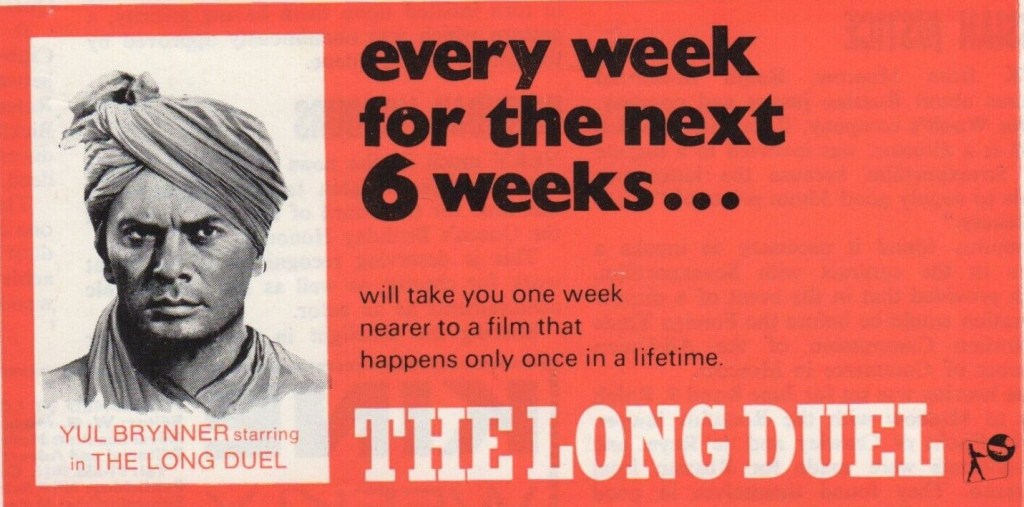
Convinced it was onto a winner, Rank took out adverts in the trades claiming “all signs point to it being…among the greats” and it took the bold step of launching it in roadshow at the Odeon Marble Arch simultaneous with continuous performance at the Odeon Leicester Square in London’s West End.

SOURCES: Ken Annakin, So You Wanna Be a Director (Tomahawk Press, 2001) p186-189, 197-206; “Sydney Box $10-Mil Prod Program,” Variety, January 26, 1966, p14; “Rank Now Measuring Up,” Variety, July 27, 1966, p25; Advert, Variety, August 24, 1966, p27; “$3-Mil Rank Duel May Be Costliest British Film Ever,” Variety, October 26, 1966, p5; Advert, Variety, November 9, 1966, p27; “Sydney Box Quits Film Posts,” Variety, August 7, 1967, p2.

The Long Duel (1967) ****

Surprisingly thoughtful action-packed “eastern western”  with obvious parallels to the plight of the Native American. Here, the British attempt to shift nomadic tribesmen from their traditional hunting grounds in north-west India to “resettlements.” Set in post World War One India, the duel in question between tribal chief Sultan (Yul Brynner) and police chief Young (Trevor Howard) brims over with mutual respect.

Unusually intelligent approach for what could otherwise have been a more straight forward action picture, more critical of the British, whose idea of civilization is to turn everything into “a bad replica of Surrey,” than you would have expected for the period. Ruthless pursuit in large part because the British “can’t afford local heroes.”   

After his tribe is taken captive with a view to forced repatriation by boorish police superintendent Stafford (Harry Andrews), Sultan organises a breakout, taking with him heavily pregnant wife Tara (Imogen Hassall) who dies while on the run. The Governor (Maurice Denham) of the province brings in Young – who knows the territory and is more familiar, through a previous career as an anthropologist, with the nomadic lifestyle, and largely sympathetic to their cause – to head up an elite force and bring to justice Sultan, whose men are now murderers.

Young seems lacking in the stiff upper lip department, condemned for “misplaced chivatry,” unwilling to just do his job, and certainly not to blindly obey the more ruthless ignorant Stafford. Aware he is unable to stop what the British would like to call progress, hopes he can ease the transition, avoid driving the tribesmen into the ground and prevent a noble leader like Sultan ending up a despised bandit, the kind who were forever presented as the bad guys in films like North West Frontier / Flame over India (1959).

Young has the sense not to be dragged all over the country searching for his quarry, and sets up his team in more sensible fashion, but still, is largely outwitted by Sultan, especially as Stafford, who later gets in on the act, is too dumb to fall for obvious lures. Adding  complication is the arrival of Stafford’s equally intelligent daughter Jane (Charlotte Rampling), a Cambridge University graduate, who falls for Young.

Thankfully, there’s no need for the British hero to transition from brute into someone more appreciative of the way of life he is forced to destroy – a trope in the American western – and equally there’s no corrupt businessman selling the tribesman weaponry and there’s no savage attack either on innocent women and children, and removal of these narrative cliches allows the movie more freedom to debate the central questions of freedom. The tribesmen acquire rifles and the occasional Gatling gun simply by stealing them from the more inept British soldiers.

Anyone expecting a shoot-out or more likely a swordfght between Sultan and Young will be disappointed, the title, as with the entire picture, is more subtle than that, especially as each, in turn, have the opportunity to save each other’s lives. Eventually, Young’s sympathetic approach is deemed ineffective and Stafford is put in charge, leading to a superb climax.

While Sultan’s nomadic lifestyle is eased by dancing girl Champa (Virginia North), whose loyalty to her lover is soon put to the test, and who is not, surprisingly, necessarily looking for love, his emotions center more around his younger son, whom he doesn’t want to grow up wearting the tag of bandit’s son. The solution to that problem seems a tad simplistic, but still seems to work.

With the feeling of western with splendid use of superb mountainous locales, and excellent widescreen, an astute script opts as much for intelligence as adventure.

One of Yul Brynner’s (The Double Man, 1967) last great roles before he turned into a parody of himself and certainly more than matched by Trevor Howard (Von Ryan’s Express, 1967), given a role with considerable depth and scope. Charlotte Rampling (Three, 1969) also impresses while Virginia North (Deadlier than the Male, 1967) and Imogen Hassall (El Condor, 1970) provide support. Harry Andrews (The Night They Raided Minsky’s / The Night They Invented Striptease, 1968) has played this role before. You can catch Edward Fox (Day of the Jackal, 1973) in a tiny role.

Superbly directed by Ken Annakin (Battle of the Bulge, 1965) from a script by Peter Yeldham (Age of Consent, 1969), Ernest Borneman (Game of Danger, 1954) and Ranveer Singh in his debut.

Well worth a look.

Father Goose (1964) ***

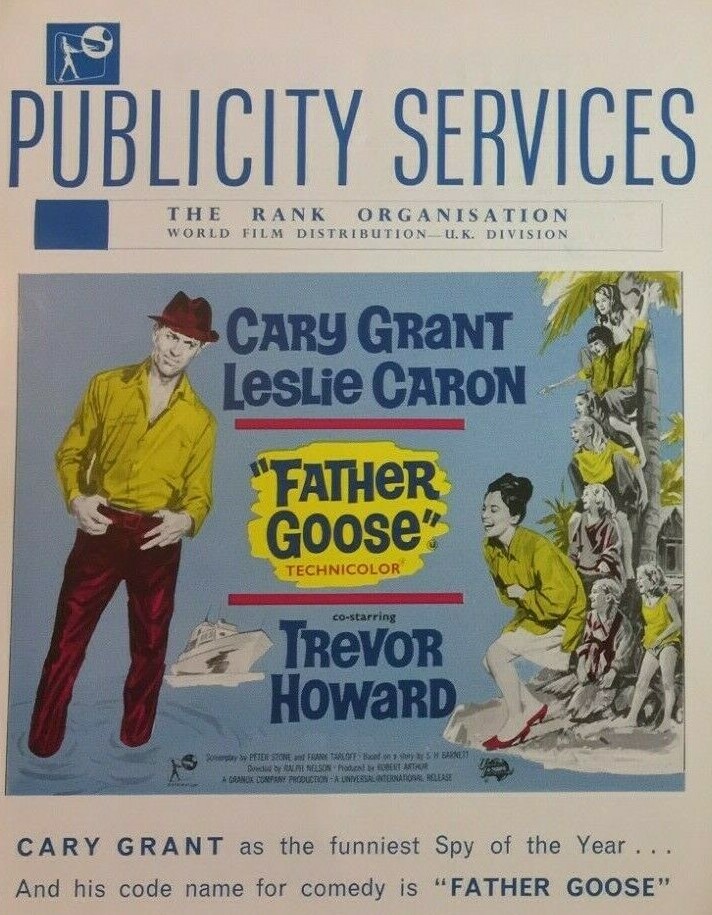
The African Queen with kids or 100 ways to see Cary Grant deflated. The penultimate movie in the screen giant’s career is a tame affair especially after the thrilling Charade (1963) and it may have prompted him to shy away from attempting to carry on a romance with a woman decades younger as occurs in his final offering Walk, Don’t Run (1966). When Trevor Howard (Von Ryan’s Express, 1965) effortlessly steals the picture with a performance that turns his screen persona on its head, you can be sure it’s not quite top notch.

In World War Two, Walter (Cary Grant), a hobo on water with a knack of stealing official supplies, is commandeered by British officer Houghton to operate a radio outpost on a Pacific island giving early warning on Japanese aircraft sorties. While there, he encounters Catherine (Leslie Caron), a French schoolmistress and consul’s daughter, in charge of a pack of female schoolkids.

Effectively, both relationships follow a pattern of verbal duels, initially with Walter losing them all as he is kept on a leash by Houghton and then is beaten by teacher and children. The kids steal his hut, his bedding, clothes (shredded and sewn to fit young girls), food, booze and sanity.

The straight-laced Catherine is happiest when straightening a picture. Walter only regains some of his standing when it transpires he has practical skills like catching fish, repairing a boat and encouraging to talk a girl who has been traumatized by war into temporary dumbness. Naturally enough, any time Leslie warms to him he does something off-putting. But gradually, of course, they get to know each other better, romance is in the air, and secrets are revealed, his hidden past laughable.

It’s a series of set pieces, designed to make the most of Cary Grant’s deftness with physical comedy, he can pull faces with best of them and long ago mastered the double take and the pratfall. So there’s little here you’ve not seen before. And the trope of man and woman trapped on a desert island – most recently probably best exemplified given its inherent twist in Heaven Knows, Mr Allison (1957) – has long been over-used and this addition to the sub-genre suffers from lack of originality.

The little blighters are less an innovation than a complication (or perhaps a multiplication) but they do have the advantage of reducing him to impotence, since he can hardly deal with their transgressions the way he might Catherine. And of them is smart enough to realize that he runs on booze and rations this out.

All in all it’s gentle stuff, nothing too demanding, redemption neither an issue nor an option. Cary Grant is an unusual species of top star in that, as with Rock Hudson and a few others, he didn’t mind being the butt of all the jokes, and in some respects sent up his screen persona. 

Keeping Cary Grant in check might well be a sub-genre of its own, so Leslie Caron (Guns of Darkness, 1962) is inevitably limited in the role, primarily a foil/feed for the Grant, the part not not quite of the caliber of the roles played by actresses in his thrillers such as like Grace Kelly (To Catch a Thief, 1965), Eva Marie Saint (North by Northwest, 1959) and Audrey Hepburn in Charade.

As I mentioned, Trevor Howard is the surprise turn, and steals the show. Ralph Nelson (Soldier Blue, 1970) directs from s script by Peter Stone (Charade), Frank Tarloff (The Double Man, 1967) and S.H Barnett, a television writer in his only movie. I’ve clearly under-rated the script because it collected the Oscar.

Perfectly harmless and enjoyable, if a tad obvious.

Operation Crossbow (1965) ****

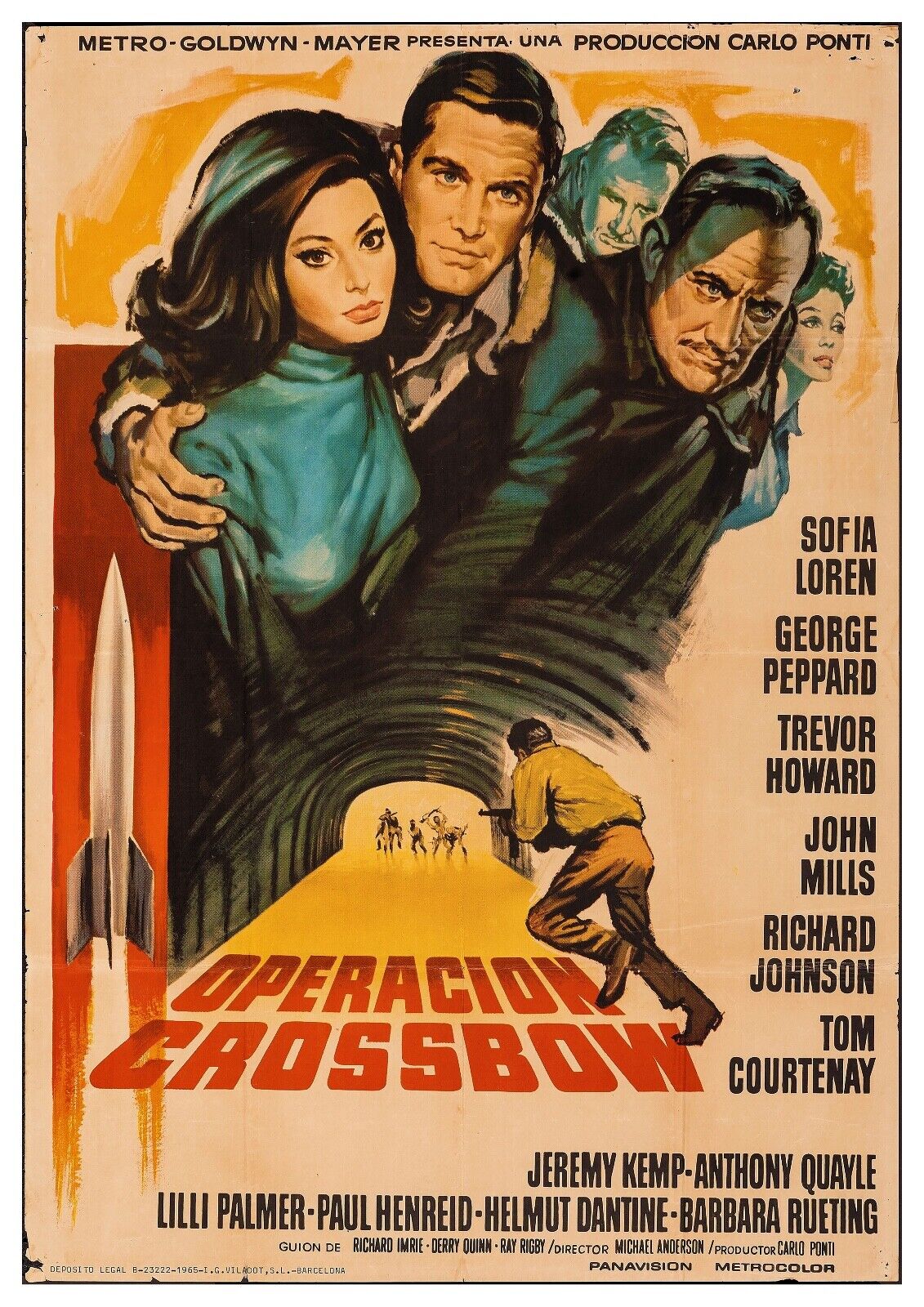
A clever mixture of detail and derring-do, World War Two picture Operation Crossbow (1965) – based on the true story of Allied infiltration of a German rocket factory – was a surprising hit at the British box office. The picture took a risk in keeping star George Peppard hidden from view for the first 28 minutes (top-billed Sophia Loren took nearly another 20 minutes to show up). Prior to their appearances the opening sequences were loaded up with a roll-call of British stars familiar with the genre in the vein of John Mills (Ice Cold in Alex, 1958), Trevor Howard (Cockleshell Heroes, 1955) and Richard Todd (The Dam Busters, 1955). Anthony Quayle, who puts in a later appearance, was also a war movie veteran after turns in Battle of the River Plate (1956), Ice Cold in Alex and The Guns of Navarone (1961).

Most war films relating to destroying a vital enemy base involved bombing  (The Dam Busters633 Squadron, 1964), sinking (Sink the Bismarck!, 1962) or blowing things up  (The Guns of Navarone, 1961). Operation Crossbow falls into the last-named category. The story breaks down into four sections: the discovery towards the end of the war by the British that the Germans are forging ahead with building V1 and V2 rockets; the recruitment and training of spies to parachute into Occupied France; a tense sequence abroad where complications arise; and, finally, attempts to obliterate the rocket plant.  

Director Michael Anderson (The Dam Busters) switches through the genres from docu-drama to spy film to action adventure, further authenticity added by bold use (for a mainstream picture) of subtitles, all characters speaking in their native tongues. Various real-life characters are portrayed, among them photo reconnaissance expert Constance Babington Smith (Sylvia Sims), German aviatrix Hannah Reitsch (Barbara Rutting) and Duncan Sandys (Richard Johnson) who was on the British War Cabinet Committee.

Trevor Howard, at his irascible best, is the scientist pouring scorn on the idea of rockets – until they start raining down on London. Volunteers – Peppard, Tom Courtenay (Billy Liar, 1963) and Jeremy Kemp (who appeared with Peppard the same year in The Blue Max) – trained to spike the new weapon are recruited primarily on their language skills. Character is sketchy, Peppard designated a womaniser because he arrives in a taxi with two women.

But the operation has been assembled in such haste that not enough attention has been paid to the identities assumed by the agents. Courtenay’s character turns out to be wanted for murder. Peppard is accosted by his character’s divorced wife (Loren). So the mission faces immediate exposure. Although Loren’s role in terms of screen time amounts to little more than a cameo, she delivers a powerful emotional performance to a picture that could as easily have got by on tension alone. The harsh realities of war are shown in abundance. Twists come thick and fast in the second half, not least that Peppard’s face has become known, before the movie reaches a thrilling denouement.

Morituri / Saboteur: Code Name Morituri (1965) ***

For a film that staggered around trying to find a plot to justify its tale of moral ambiguity during World War Two the final third is surprisingly potent. Featuring two good Germans and a bunch of bad Yanks ostensibly it’s a straightforward story of a saboteur trying to prevent a German cargo ship captain from scuttling his ship should it come under attack from the British determined to lay their hands on its vital supplies of rubber.

Supposed German pacifist Robert Crain (Marlon Brando) – actually a coward – hiding out in India is blackmailed by British Col Statter (Trevor Howard) into posing as a high-ranking SS officer on the German ship in order to prevent it being sunk by Captain Mueller (Yul Brynner). After his last command ended in drunken disgrace, Mueller assumes Crain has been sent to keep an eye on him. So Crain spends an almighty time down in the engine room and various below-decks spots defusing the wiring that would cause the ship to blow up at the touch of a button by the captain.

Mueller’s second-in-command Kruse (Martin Benrath) is suspicious of the cosmopolitan art-loving Crain but it’s a renegade band of criminals, led by Donkeyman (Hans Christian Blech) forced into armed service, who rumble Crain. But he talks them into mutiny. The ship avoids detection by disguising itself as a neutral Swedish freighter. Mueller’s attitude to Crain changes when the latter prevents him hitting the self-destruct button as a British destroyer seems poised to attack, changing its mind at the last minute.

Meanwhile, a group of American prisoners, from a ship sunk by a Japanese U-boat, come on board, including Jewess Esther (Janet Margolin). Surprisingly, Mueller steps up to the plate, protecting her from his crew, providing her with a private berth and permitting her to eat in the officer’s mess. On board the submarine are Admiral Wendel (Oscar Beregi), who commissioned Mueller, and a German counter-intelligence officer and, surprised to find Crain on the cargo ship, challenge him. Crain calls their bluff, but when the Admiral leaves he plans to radio Berlin to check Crain’s credentials, information passed on to Crain, who now has a very short deadline to organise mutiny, take over the ship and sail it to safety.

To do that, the mutineers require the support of the prisoners, a task detailed to Esther, who can only achieve that mission by surrendering her body to the prisoners, in much the same way as she has done previously to the Gestapo.

Mueller goes to pieces on hearing that his beloved son, also a ship’s captain, has been given a medal for sinking his fifth enemy vessel – only this time it is a hospital ship. After Mueller drinks himself unconscious, and Kruse assumes command, Crain fails to enlist Mueller to the mutiny which then begins. The surprise ending is both brutal and poetic.

But despite almost capsizing under the weight of an unwieldy cargo of plot and double-plot, the picture finally makes its points, that in war, ambiguity reigns. Mueller, who hates the Nazis but stoutly defends his Fatherland, proves to have the highest moral standards, agreeing to help Esther when they reach their destination, and preventing further molestation of her while aboard. Crain, purportedly the good German, has no compunction about sending Esther to do his dirty work, knowing the risks a sole woman faces in a hold of desperate sex-starved men. The good Yanks turn into rapists at the slightest opportunity, every bit as heinous in their depredations as their enemy.

That the movie stays afloat for so long is largely down to the excellence of Marlon Brando (The Chase, 1966) and Yul Brynner  (The Double Man, 1967). Brynner’s magisterial presence, chest out, legs apart, serves him well, and the ongoing duel with Brando is an acting treat, though Brynner has the best scene, the look of anguish on his face when he realises what his son has done. Brando, reprising the silky German accent of The Young Lions (1958), is very convincing as the dilettante pressed into service, negotiating his way round the recalcitrant Brynner, and living on his wits when faced with the criminals and then the  Admiral. And while Janet Margolin (Nevada Smith, 1966) is little more than a symbol, she invests the role with terrifying humanity, a woman reduced to being a sex object, utter submission her only way to achieve temporary reprieve. Most of her best acting is just with the look on her face.

In his Hollywood debut Martin Benrath appears just a standard German until his mask slips and we realise how much he covets the captain’s uniform. Wally Cox (The Bedford Incident, 1965) is another compromised by immoral behaviour, the doctor who steals the ship’s supply of morphine. Hans Christian Blech (Battle of the Bulge, 1965) excellent as a vengeful mutineer. You might also spot William Redfield (Fantastic Voyage, 1966). Trevor Howard (Von Ryan’s Express) is only there at the outset.

Austrian director Bernhard Wicki (The Visit, 1964) does his best with a plot bursting at the seams, but the scenes of sabotage are well done, and he does recreate the claustrophobic atmosphere of a ship, and the final sequence is worth waiting for. Daniel Taradash (Castle Keep, 1969) wrote the screenplay.  

Behind the Scenes – “Man in the Middle”/”The Winston Affair” (1964)

You were asking for trouble to pair heavy drinkers Robert Mitchum and Trevor Howard. But Man in the Middle was a fraught production long before the actors came on board. The picture was intended to kick off Twentieth Century Fox’s revamped 20-picture slate that signaled a studio back from the dead after near-bankruptcy. The success of The Longest Day (1962) triggered a cycle of World War Two pictures, Man in the Middle launching this cluster, which accounted for more than third of the studio’s projected output.

But before fox arrived on the scene, Man in the Middle was intended as a key element in the launchpad or an indie powerhouse, the grandly-named Entertainment Corporation of America (ECA), set up by Max Youngstein, one of the founders of the post-war version of United Artists. Youngstein had an 11-picture tab budgeted at $3 million including Honeybear, I Think I Love You starring Warren Beatty (Bonnie and Clyde, 1967), Cold War thriller Fail Safe, The Winston Affair (as Man in the Middle was originally tabbed) and The Third Secret.

But concerns about legal action against Fail Safe torpedoed the venture within a few months of opening for business in November 1962 after theatre chain Ace Films pulled the plug on its $1.3 million investment and distributor Allied Artists followed suit. Columbia took over Fail Safe (1964) and Twentieth Century Fox The Winston Affair in a co-production with Marlon Brando’s Pennebaker shingle and Talbot which was Robert Mitchum’s outfit. 

With Fox’s recent financial vicissitudes keeping the studio in the media spotlight, budget control was essential. The movie’s $1.35 million budget was trimmed by clever scheduling, no actor, outside of the star, on set for more than three weeks, ensuring that overtime vanished. The title, however, appeared forever in flux. Original title The Winston Affair, the name of the Howard Fast book on which the film was based, changed to The Man in the Middle, then back to The Winston Affair, reverting again to The Man in the Middle before ending up with a contracted version of that – Man in the Middle. The confusion played havoc with a movie called Light of Day that snapped up Man in the Middle when the Fox title became vacant but was released as Topkapi (1964) when Fox took the title back.

Producer Walter Seltzer (Number One, 1969) pushed for more African American representation on the picture. Three roles, not written as African Americans in the novel or in the Waterhouse and Hall screenplay, were given to African Americans, the “best men for the job,” according to the producer. The trio were: Errol John, the N.C.O of the prison cell where the murder suspect is held, Frank Killibrew who doubled as the jeep driver and confidante to attorney Adams (Robert Mitchum) and Oscar James as a court reporter.

The two ECA movies taken over by Fox.

Mitchum didn’t just have drink problems. He was in the middle of an affair with Two for the Seesaw (1962) co-star Shirley MacLaine which result in public rows with long-suffering wife Dorothy. Mitchum had enjoyed a long business relationship with Max Youngstein and when the producer came upon The Winston Affair the actor agreed to star in it, only to find the rights had already been snapped up by Pennebaker. However, Pennebaker was in no position to fund a movie and without a commitment from Brando as star unlikely to get it off the ground. Since the production company nonetheless required, for tax purposes, to show a movie on its books Brando had agreed to throw in his lot with Youngstein’s ECA. And when Fox took over, Brando and Talbot retained their production credits.

When Seltzer flew to London to meet Mitchum who was finishing off his cameo for The List of Adrian Messenger (1963) the star lived up to his hell-raising billing, walking drunk from his room along the hallway and down the elevator at the plush Savoy Hotel. He was buck naked.

The bulk of the filming took place in Elstree Studios in London with just a couple of weeks set aside for location work in India. The ongoing romance with MacLaine meant production could grind to a halt in the middle of a scene while Mitchum took a call from the actress in New York although conversation was inhibited with Selzer at his elbow looking at his watch.

“He was a professional in every respect,” recalled Selzer. “He was on time, knew his lines and didn’t make any trouble…very good with France Nuyen (A Girl Called Tamiko, 1962), who was a little unsure of herself, and he did a lot to help her performance and boost her confidence.”

Trevor Howard was a different kettle of fish. Mitchum and Howard had become friends in the 1950s while working in Mexico, and Mitchum was a great admirer of the Englishman’s talent. However, Howard had “been all but blackballed of late due to his drinking.” Oscar-nominated for Sons and Lovers (1960), Howard had only made two films since. And even the role here was more of an extended cameo than a main supporting role. To win the part, Howard invited director and producer to visit him at his home where he put on a very good act of restraint, limiting himself to tea while the others consumed alcohol.

Restraint proved an illusion. While Mitchum could drink and still turn up for work, Howard would go to pieces with a few drinks in his system. On his second day of shooting, Howard turned up on set wearing mismatched socks and threw a drunken fit when asked to change.

Director Guy Hamilton had worked with big Hollywood personalities Kirk Douglas and Burt Lancaster on The Devil’s Disciple (1959) but compared to them Mitchum was a pussycat.

“He understood the importance of listening,” said Hamilton, “which is very, very rare for American stars…If all else failed in a scene, you knew you could always fall back on Mitchum’s reaction shots, which could say more than the dialogue.”

Mitchum was blessed with a photographic memory. Even when confronted with pages of new script he would have no trouble remembering his lines. In fact, if anyone fluffed their lines they could rely on Mitchum helping them out. When the movie decanted to India, he had an encounter with a maharajah’s daughter, which ended up in the bedroom. Once the movie was finished, Mitchum resorted to type, getting stoned on raw marijuana on the 16-hour flight home from India, a zip bag full of the stuff, and sailing through the Nothing To Declare section at Customs at the airport.

Most reports have this down as a big flop. But I’m not so sure. It cost comparatively little and earned $1 million in rentals in the U.S. Mitchum was a big enough star for it to be released around the world and I’d be surprised if it didn’t manage the extra $300,000 required to break even.

SOURCES: Lee Server, Robert Mitchum, Baby, I Don’t Care (Faber and Faber, 2001) p457, 462-467; “Marlon Brando To Film Winston Affair,” Box Office, April 9, 1962, p16, “Youngstein As Exec Producer,” Variety, January 16, 1963, p4; “Entertainment Corp Sets Mitchum Film Overseas,” Variety, January 16, 1963, p4; “Four Months To The Day For Man,Variety, January 26, 1963, p5; “From Surefire to Fail Safe,” Variety, April 10, 1963, p3; “Winston Affair Set To Start 20th-Fox  British Production Program,” Variety, April 24, 1963, p22; “Fascination With Own Era,” Variety, May 22, 1963, p3.“Use Negro Skills in Seltzer’s Film,” Variety, October 2, 1963, p4; “No Principal On Role Longer Than 3 Weeks, Key Budget Control,” Variety, November 27, 1963, p3.

Man in the Middle / The Winston Affair (1964) ***

Scratch a war picture and you often find something more interesting underneath. This creditable courtroom drama makes a pitch for justice for all in the Compulsion (1959) vein while exploring the fragile and occasionally fractious relationship between the Allies during  World War Two. In front of several witnesses American officer Lt. Winston (Keenan Wynn) kills  in cold blood an ordinary British soldier in a remote depot in India.

It’s an open-and-shut case requiring a defence attorney of no great distinction. In fact so little legal ability is required that it’s assigned to Lt. Col Adams (Robert Mitchum), recovering from a war wound, who  hasn’t practised law in 14 years. It doesn’t help that Winston is a racist and psychopath, convinced left-wing conspirators are planning to take over the world. While dutiful, Adams displays no great enthusiasm for the task, taking time out to embark on romance with nurse Kate (France Nuyen), who is a good deal more fired-up about injustice than him. Adam’s superior officers just want Winston found guilty and hanged in double-quick-time to placate the British.

As if the odds aren’t already stacked against Adams, his boss General Kempton (Barry Sullivan) has brought in top prosecutor Major Smith (Paul Maxwell) while saddling Adams with two useless assistants. However, when Adams finally gets going, he discovers that Winston was assessed as mentally ill by psychiatrist Dr Kaufman (Sam Wanamaker) who has, unfortunately, been transferred and his report has vanished. Col Burton (Alexander Knox), who has taken over the case, refuses to accept Kaufman’s diagnosis. And Adams gets around to thinking there’s something fishy going on, the bottom line being that if the Winston is declared insane, then he won’t be hanged, the case neither open nor shut, fears rising of repercussions at a time when Allied unity is under threat.

So then we’re into classic courtroom territory. Kate has a carbon copy of the Kaufman report but as any lawman knows that in itself is inadmissible.  They can call back Kaufman to testify but there’s no allowing for the state of the roads and a driver in a hurry is liable not to make it. Major Kensington (Trevor Howard) might prove a trump card – or he may not. It’s a given that any defence lawyer’s life is filled with obstacles and this is no different. The out-of-practice Adams is in a hell of a pickle, and that’s how it should be.

On top of that, or underlying it, is the fight for justice for all. It’s easy to fight for the innocent but harder to battle for the sick and the mentally ill, however repellent their prejudices. You might despise the Winstons of this world, as Kate puts it, but you wouldn’t want to be his executioner.

And in the background are wartime considerations. What is one man’s life when judged against the uproar that would ensue and disrupt war planning should the self-proclaimed murderer be set free. Also, normally the mentally ill at this stage of Hollywood history are generally appealing characters, not hateful, but it’s only when Adams digs away at the experience of Winston that he realises the reasons for the murder, the hell that the insecure undergo when cleverer minds decide on torment.

Robert Mitchum (Secret Ceremony, 1968) is on excellent form as the attorney initially just going through the motions who determines to fight his superiors rather than toe the party line, even at the cost of losing his much-delayed promotion. France Nuyen (A Girl Named Tamiko, 1962) is somewhat spunkier than Hollywood nurses of this period and refuses to let romance get in the way of truth. Keenan Wynn (Warning Shot, 1967), a stubborn nutcase, is the worst kind of client, constantly shooting himself in the foot.

Trevor Howard (The Charge of the Light Brigade, 1968) has toned down the normal irascible persona and makes a respectable showing. Barry Sullivan (Light in the Piazza, 1962) is as ruthless as he is charming. The solid supporting cast includes Sam Wanamaker (Danger Route, 1967), Alexander Knox (In the Cool of the Day, 1963) and Errol John (The Sins of Rachel Cade, 1961).

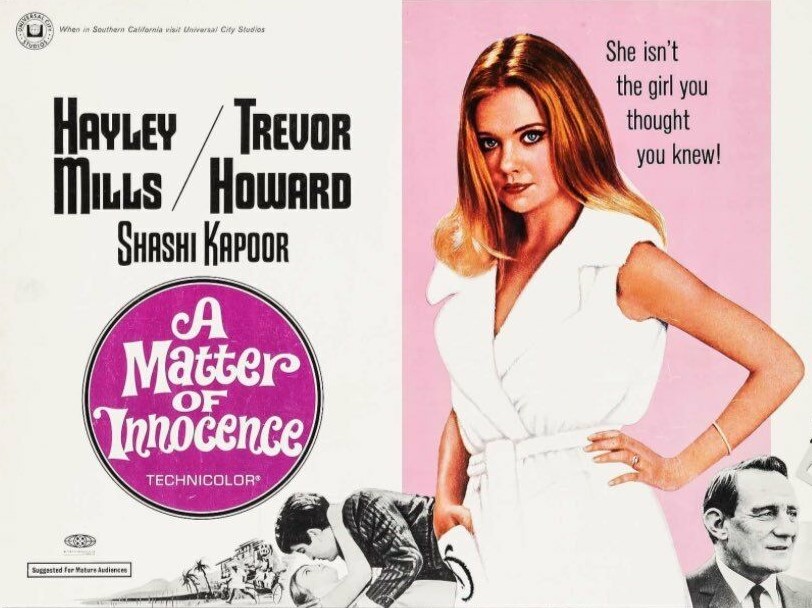
This was director Guy Hamilton’s last film before he shot to international fame on the back of Goldfinger (1964). The screenplay by British pair Keith Waterhouse and Willis Hall (A Matter of Innocence/Pretty Polly, 1967) was adapted from the novel by Howard Fast (Mirage, 1965).

Courtroom with depth, giving a glimpse of the politics prevalent among High Command in wartime, almost a companion piece of The Charge of the Light Brigade.

Cinema Archives has a much pricier edition but I reckon this cheaper version will do the job.

Discover WordPress

A daily selection of the best content published on WordPress, collected for you by humans who love to read.

The Atavist Magazine

by Brian Hannan

WordPress.com News

The latest news on WordPress.com and the WordPress community.