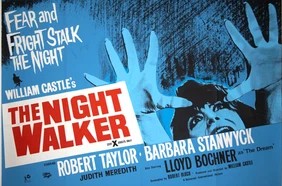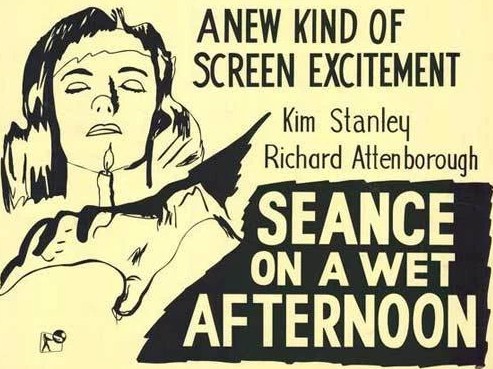
Seance on a Wet Afternoon (1964) ****

Highly atmospheric psychological gem that should appeal mightily to the current generation hooked on the new genre of scams – this one coming with a gut-wrenching twist. That it concerns a medium should add to the intrinsic appeal. And it turns on two terrific performances.

I have an unusual connection to this movie – and a whole bundle of others with music by John Barry. I heard the scores of this and the likes of King Rat (1965), The Chase (1966), Deadfall (1968) and The Lion in Winter (1968) long before I caught up with the movies. So I came at them with a kind of aural advance warning. The score John Barry wrote for this not only exemplifies the inherent creepiness but maximizes it.
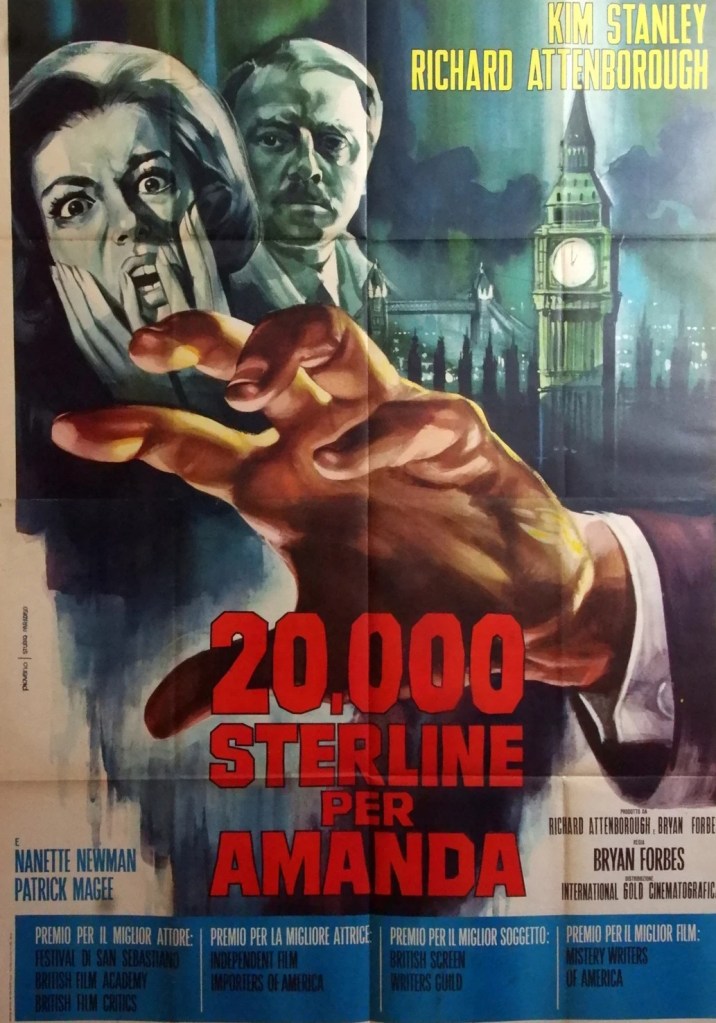
Even before we get into any notion of criminality, you can see that this unlikely middle-aged marriage between the dominant Myra (Kim Stanley) and the weak Bill (Richard Attenborough) is unhealthy to say the least. She’s the kind of psychic who’s likely to swoon and get lost in ethereal otherworlds while hosting seances. He’s just trying to keep her from toppling over into insanity, driven by her conviction that she is conversing with their dead son.

In the kind of scam you could see someone coming up with today, she decides she’ll thrust herself into public consciousness by becoming the sort of psychic police tent to consult during kidnappings or murders. In this case it’s the kidnapping of  Amanda (Judith Donner), daughter of wealthy businessman Mr Clayton (Mark Eden). This might sound like the usual wishful thinking for publicity by an over-earnest psychic, but, in fact, it’s Bill, at his wife’s  behest, who’s carried out the kidnapping. To make it look kosher, the couple demand a ransom.

The lass is kept imprisoned in their house, in a room made up to look like a hospital with Myra playing the role of nurse. Mr Clayton is sceptical of the psychic’s claims but his wife (Nanette Newman) is duped.

Given that Bill generally looks impotent, the harried look of the weak hen-pecked husband, it’s quite astonishing how he rises to the occasion to collect the ransom money, dodging the cops on the underground. The plan comes undone, however, when Myra decides the dead Arthur wants a buddy in the afterlife, with Amanda the prime candidate and Bill called upon to step up to the murder plate.

So we’re knee-deep in tension. The key here is that our point-of-view is that of the couple rather than the child or the parents. Amanda is a bit more worldly-wise than Myra expects so she’s kept on her toes keeping the suspicious child in check. So you’ve got what would be a contemporary trope but unusual then of being forced to want the criminals to succeed. Everyone loves a psychic, even more these days after the whopping success of The Conjuring series, and everyone loves the downtrodden husband, so we’re hoping they can outwit the pompous wealthy businessman and fleece him of some dosh, awake the world to the powers of the medium and live happier ever after.
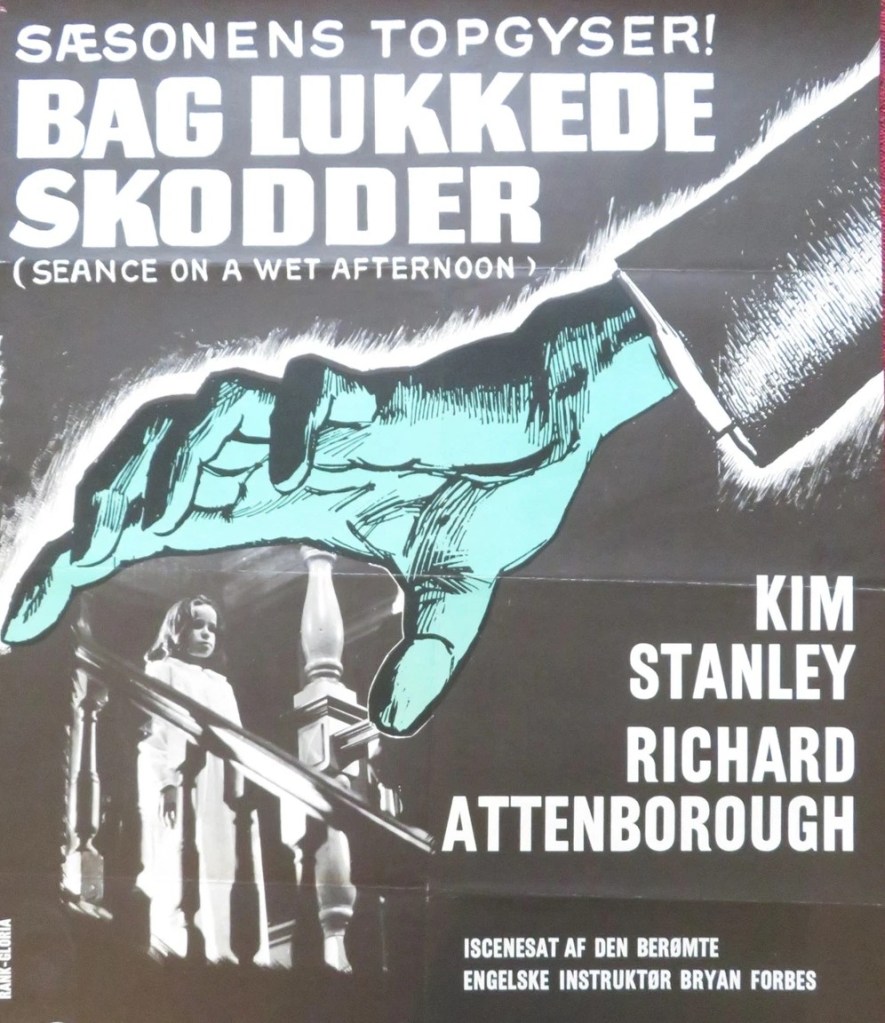
But that’s before Myra changes the plan and you’re wondering if Bill is going to be able to stand up to her. The cops come mighty close to smelling a rat, but the suckered wife appears to help their case.

The beauty of this is less in the plotting – but those twists would work as real zingers today – than in the playing. Critics were reaching for superlatives when two Daniel Day Lewis movies – Room with a View and My Beautiful Launderette – both opened on the same day in New York in 1985 and were astonished by the actor’s range. Richard Attenborough’s diffident mouse of a man in Séance on a Wet Afternoon appeared the same year as his bluff hard-nosed soldier in Guns at Batasi. The British Academy noticed, awarding him the Bafta Best Actor for the achievement.

He’s quite superb here, always on the verge of telling his wife what-for before sinking back into complaisant compliance. When we speak about edgy performances, we generally mean something else entirely, but this is an emotional edge that he’s always about to tip over into one way or the other.

American stage specialist Kim Stanley hardly made a movie, only one more this decade and none for another 16 years, but she carries this intense complicated character smothered by insecurities. Nanette Newman (The Wrong Box, 1966) is a believable mother. Mark Eden (The Pleasure Girls, 1965) crops up, as does Patrick Magee (The Skull, 1965) who tones down his trademark growl.

Written and directed by Bryan Forbes (King Rat) from the bestseller by Mark McShane.

The John Barry score not just sets the tone but helps carry the picture.

I understand plans are underway to remake this and I can see why

The Spy Who Came in from the Cold (1965) ****

The perfect riposte to the James Bond phenomenon. By comparison, a kitchen sink spy drama that challenges the glamorous version of espionage promoted by 007. Had the film been made as soon as the source novel by John Le Carre hit the bestseller charts in 1963 it might have stopped the Bond bandwagon, which didn’t really kick off until Goldfinger (1964), in its tracks. Realistic to the point of cynicism, the innocent are sacrificed in a ruthless chess battle for espionage supremacy.

Alec Leamas (Richard Burton) infiltrates the East German counter-espionage system after purportedly becoming a defector. His intention, however, is to stitch up Mundt (Peter van Eyck), the head of the East German unit, so that he is overthrown. Mundt has been causing too much grief to the British spy network in East Germany, the film opening with Leamas at the Berlin Wall watching an escaping agent being shot trying to pass through Checkpoint Charlie. At  the behest of Control (Cyril Cusack), the head of the British spy organization, Leamas pretends to quit the outfit, and playing the embittered card, ends up in prison for assault, on release being surreptitiously recruited by the East Germans as a potential defector.

Initially, the British appear almost too gentlemanly for the vicious spy game, Control almost apologizing (over endless cups of tea) about having to take such ruthless steps. Leamas has a tale he hopes will incriminate Mundt largely through the envy of his subordinate Fiedler (Oskar Werner). But once Leamas falls into the enemy’s hands, the game does not go according to plan. After initial gentle interrogation by Fiedler, the arrival of Mundt causes Leamas to be arrested and then tried for treason. Along the way, Leamas’s naïve girlfriend Nancy (Claire Bloom) is implicated and Leamas realizes he is a patsy, forced into quite a different role, that tests his beliefs.

The British, portrayed in Bond films and every other spy film up till then, as being on the side of the angels, are revealed as being just as heinous as the enemy. All through his defection Leamas is able to snigger at the abominable way the Communist superiors treat their underlings, simple demonstrations of power intended to humiliate at every opportunity, but it is soon apparent that the British are every bit as heartless. There is a very telling scene when Leamas realizes he may well be walking into a trap when his face appears on the front pages of a British newspaper. The look in Leamas’s eyes suggests he knows he has been betrayed.

If you remember Le Carre’s most famous creation George Smiley (Rupert Davies) as a humble man from the Tinker, Tailor, Soldier, Spy (1979) television series, you will be surprised to discover what depths the man will sink to here.

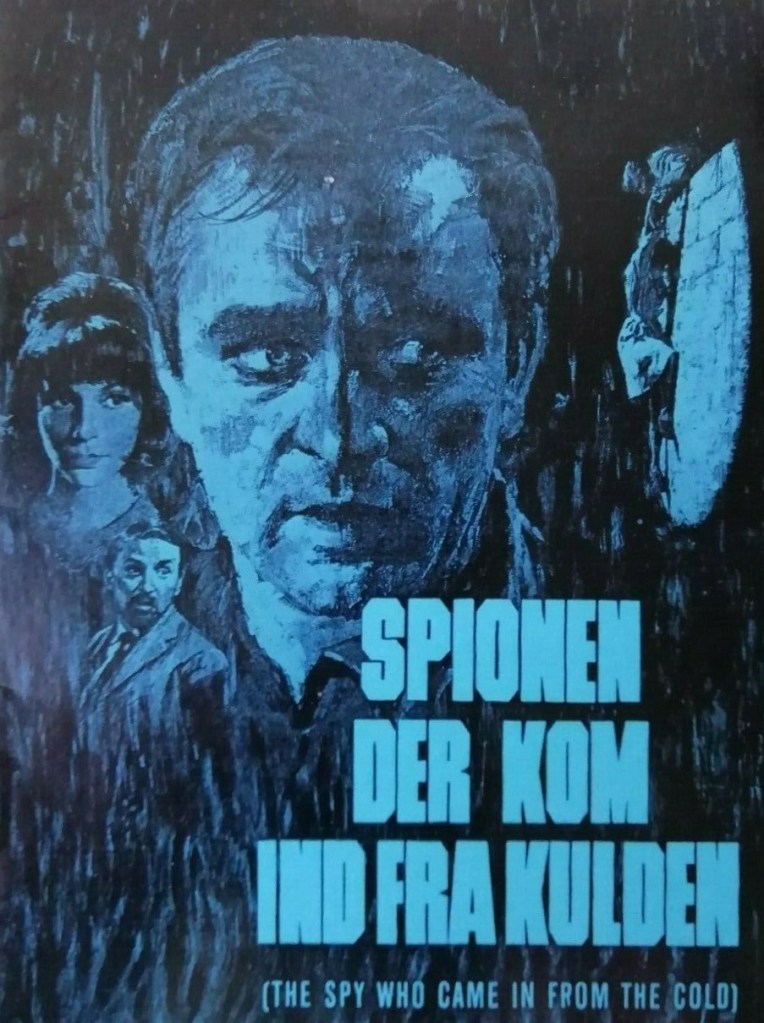
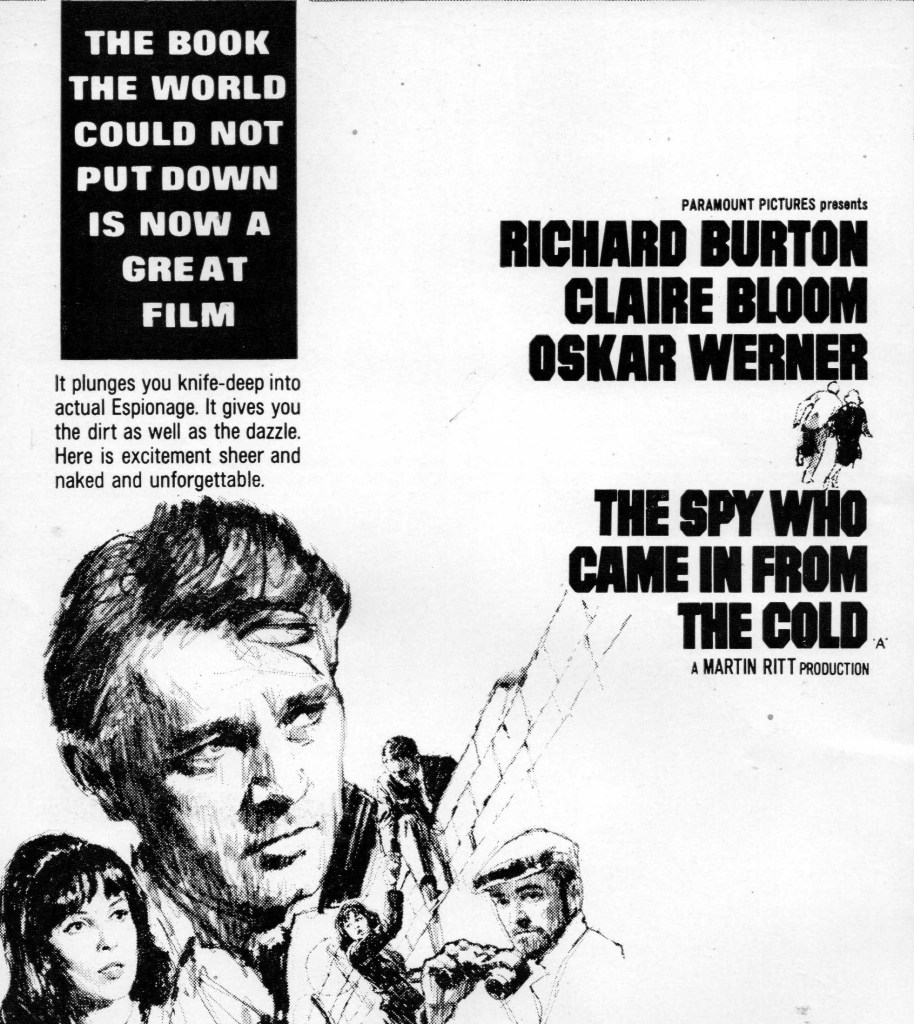
Oscar-nominated American director Martin Ritt (Hud, 1963) filmed this in black-and-white – even the advertising material was in mono – to remove all sense of glamour. There are no gadgets or girls in bikinis. This is the down-and-dirty version of espionage. And while the British top brass clearly regarded any staff lost as collateral damage, Leamas had a more human, more emotional, response.

Richard Burton (Where Eagles Dare, 1968) is superb, received a well-deserved Oscar nomination (his fourth), as a character destroyed by “minor human error” in a world where humanity is the last thing on anyone’s mind. Oskar Werner (Interlude, 1968) presents his character is such a way that he comes across as anything but a villain, even his costume has a little bit of the beatnik about it, and he treats his captive with courtesy. Peter van Eyck (Station Six Sahara, 1963) is a more standard German villain, complete with blond hair. Claire Bloom (Three into Two Won’t Go, 1969) has a small but pivotal role as a sweet librarian.

And there’s strength in depth in the supporting cast beginning with Cyril Cusack (Fahrenheit 451, 1966) in a deftly underplayed part. Sam Wanamaker (Warning Shot, 1967) and Michael Hordern (Khartoum, 1966) are among those routinely humiliated by their paymasters. Also watch out for Rupert Davies (television’s Maigret), Bernard Lee, moonlighting from James Bond duties, Beatrix Lehmann (Psyche ’59) and Robert Hardy (All Creatures Great and Small series 1978-1990).

Also taking time off from Bond duties was screenwriter Paul Dehn (Goldfinger, 1964) who adapted the novel with the help of Guy Trosper (Birdman of Alcatraz, 1962).

Paramount boldly opened around the same time as Thunderball in December 1965 and although the fourth Bond proved a box office tsunami, the Martin Ritt picture survived the onslaught and did pretty well.

The Spy Who Came in from the Cold was the number U.S. hardback bestseller of 1964, according to the Publishers Weekly annual chart. That year You Only live Twice by Ian Fleming came eighth, the first time a Bond had appeared in the annual top ten. The following year Le Carre’s The Looking Glass War took the number four spot while The Man with the Golden Gun was seventh. It was the beginning of a mini-boom in spy novels among hardback buyers, and although neither Le Carre nor Fleming featured again during the decade Helen MacInnes placed fifth in 1966 with The Double Image and third with The Salzburg Connection in 1968 while Leon Uris’ Topaz was fourth in 1967.

Check out the “Behind the Scenes” article on this film.

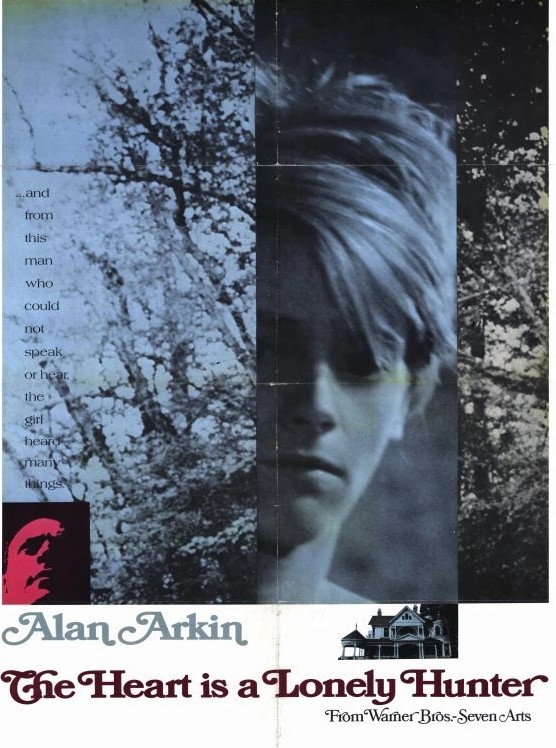
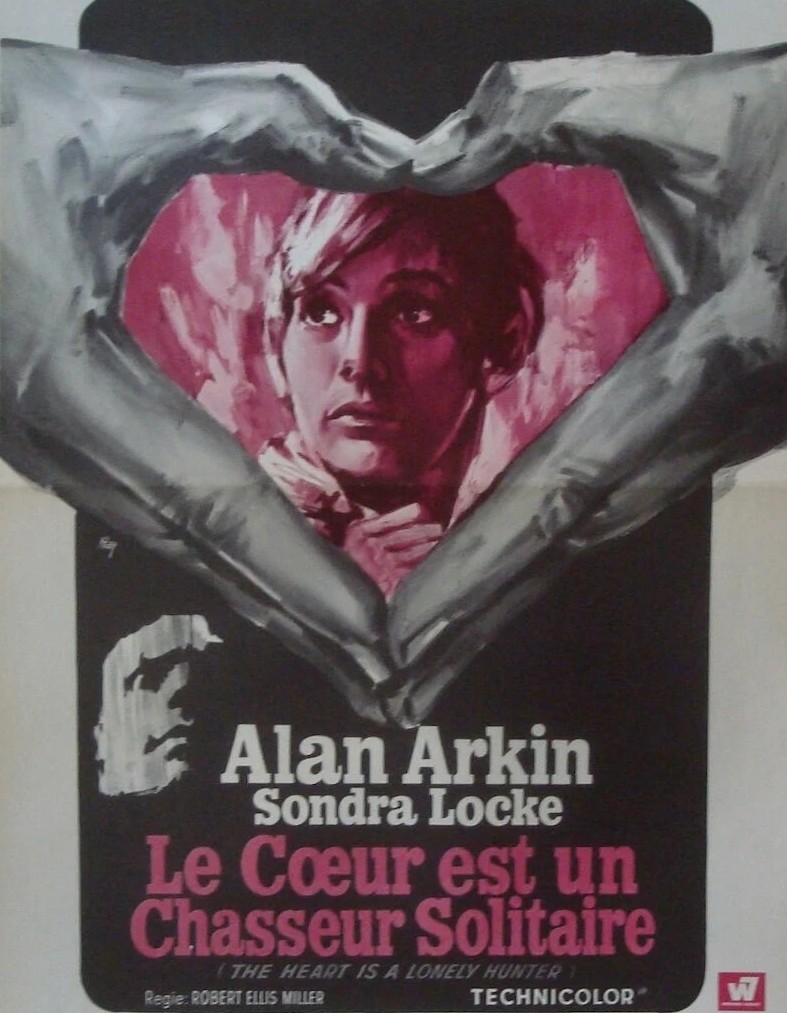
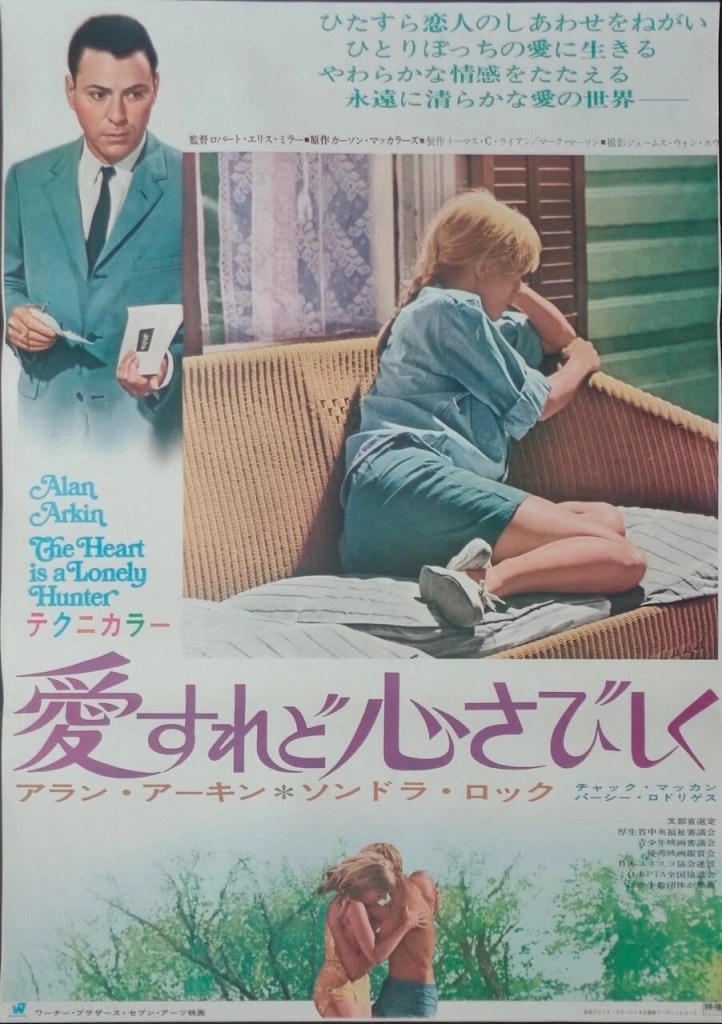
The Heart Is A Lonely Hunter (1969) ***

The American equivalent of the kitchen sink drama. Awash with the dispossessed, rejected, oppressed and underprivileged. You’re not going to be more of an outsider in the U.S. of the 1930s than to be a deaf mute or, worse, a mentally challenged deaf mute who can’t see a tasty cake in a baker’s shop without indulging in a bit of smash-and-grab.

By this point the Deep South had fallen out of favour. Adaptations of Tennessee Williams plays were now bombing at the box office – even the Burton-Taylor combo couldn’t rescue Boom! (1968) and a previous adaptation of the work of acclaimed novelist Carson McCullers (who wrote this), John Huston’s Reflections in a Golden Eye (1967), with Taylor again and Marlon Brando, had proved a commercial disappointment. Otto Preminger’s Hurry Sundown (1967) with Michael Caine and Jane Fonda did only marginally better.

While on paper it’s unremittingly bleak, in reality it’s loaded down with the mawkish and the sentimental, as the characters struggle to fit in, fail to establish lasting relationships or are abandoned. Given he is playing a character, John, who can’t talk, star Alan Arkin is forced to abandon those irritating vocal tics.

John, an engraver, has befriended Spiros (Chuck McCann), the deaf mute with the sweet tooth. When Spiros is institutionalized, John moves town to be near him, taking up residence in the Kelly household. As the result of a recent injury, Mr Kelly (Biff McGuire) is forced to take in a boarder, his teenage daughter Mick (Sandra Locke) giving up her bedroom to accommodate the stranger.

There’s not much of story, John acting as a narrative conduit around whom various situations and characters revolve. John mostly fails to win over the resentful Mick but befriends alcoholic drifter Jake (Stacy Keach) and African American cancer ridden Dr Copeland (Percy Rodriguez).

Copeland’s daughter’s husband has his leg amputated after being wrongly imprisoned. Mr Kelly ends up disabled, meaning Mick has to take a job to support the family rather than go to college. When she loses her virginity, you expect she’s going to end up pregnant, but, luckily she’s the only one whom fate favors. Unable to cope with the institute, Spiros rebuffs John’s friendship and, thoroughly depressed, gives up the ghost and dies. John commits suicide. We only later discover that Mick had fallen in love with his gentle nature.

So not what you’d call a feel-good picture. Nobody’s going to escape their situation. If anything, that’s only going to get worse. We’re talking two deaths here and another on the way, one fellow permanently disabled and a girl stuck in a cycle of poverty.

While I didn’t find it unrealistic or forced, I wasn’t as taken with it as I expected. It felt like a Charles Bukowski picture, minus the degradation, where the actors and director were given a free pass because they were putting the spotlight on an area of existence normally ignored by Hollywood. But it just felt too worthy. Beyond their indignities, none of the characters really took flight.

But don’t take my word for it. The Academy didn’t. Both Alan Arkin (The Russians Are Coming, The Russians Are Coming, 1966) and Sondra Locke, in her debut, were Oscar-nominated.

Prior to this, only a handful of pictures dealt with deafness. James Stewart, deaf in one ear in It’s A Wonderful Life (1946), Jane Wyman, winning an Oscar for Johnny Belinda (1948), and The Miracle Worker (1962), Anne Bancroft picking up an Oscar here, were the best known.

Robert Ellis Miller (Bachelor Girl Apartment/Any Wednesday, 1966) could have done better to steer clear of the obvious sentimentality. Written by Thomas C. Ryan (Hurry Sundown, 1967).

Behind the Scenes: “Two for the Seesaw” (1962)

Had already cost a bundle before one foot of film was shot. Mini-major Mirisch Bros, flush from the commercial success of West Side Story (1961), had forked out $600,000 (plus a percentage) for the screen rights to the Broadway hit by William Gibson. (this was $250,000 more than West Side Story fetched). Between another $500,000 (plus percentage) for star Elizabeth Taylor and likely $250,000 for Gregory Peck, the producers were already well over a million bucks out of pocket.

The play had run for nearly two years on Broadway, earning a $570,000 profit, a remarkable sum in those days, and also set records for a touring production. It marked the Broadway debut of both  Anne Bancroft, who won a Tony, and writer William Gibson. They re-teamed for The Miracle Worker both on Broadway and in the 1962 film.

Over-runs on Cleopatra (1963) put paid to Taylor’s involvement, Peck pulled out, temporarily replaced by Paul Newman. Producer Walter Mirisch presumably didn’t think Henry Fonda and Anne Bancroft who’d played the parts on stage had sufficient marquee heft, nor was he keen on Broadway director Arthur Penn, and instead pursued Shirley MacLaine who he’s turned into a star thanks to The Apartment (1960) with Robert Mitchum stepping in for Newman (leaving him free to make the first of his iconic pictures, The Hustler, 1961)  Robert Wise, director of West Side Story and looking for a less onerous gig, signed on to direct.

Despite being filmed on a 60-day schedule, the bulk of it on a sound stage, the budget had rocketed to $3 million, around half of which went on the main players and the screen rights.

Mitchum wasn’t too keen on the role, believing himself miscast from the outset. The lighter touch of James Garner, also considered for the role, might have worked better. Mitchum had turned down the movie twice, suggesting Mirisch would be better off with William Holden or Glenn Ford, for whom repression was a given.

MacLaine was on a roll, signed to a four-picture deal with Mirisch. She was given not one but two roles previously advertised with huge fanfare to have starred Elizabeth Taylor. As well as Two for the Seesaw, Taylor had been primed for Irma La Douce. The Taylor deal came unstuck in part due to her illness but also was attributed to her insistence that a role be found for her husband Eddie Fisher.

Wise and Mitchum had worked together earlier in their careers, in western Blood on the Moon (1948). And, no, this wasn’t the director hankering after working again with the actor. Noted Wise, “It was one of the few times I went on to a picture where the cast was already set. I don’t think Mitchum was quite right for the part. He was more believable in rougher, outdoor kinds of stuff.”

When they met at rehearsal, MacLaine was already a fan. Seventeen years younger than her co-star, she’d seen all his films, and was thrilled at working with one of her screen heroes. She was amazed at his photographic memory. He never had a problem with his lines. They certainly seemed to be getting on remarkably well for. Recalled Wise, “they got to ribbing and making jokes and making us all laugh so that the biggest problem we had was getting the two of them to settle down and get into the scene.” Added the director, “I had to have a closed set for a while. It was kind of embarrassed over what they were saying to each other. It was pretty spicy kidding, pretty ribald.2

Mitchum, apt to spout poetry, was revelation as a person far removed from his tough guy screen image. He was popular on set, very down to earth, mingling with all the crew and other actors. There was no entourage just a secretary bringing in lunch – and no hard liquor – for everyone.

What was going on between Mitchum and MacLaine was not obvious to everyone. Assistant director Jerome Siegel thought their light-heartedness was just a way of keeping tensions low on the set. “They were very subtle about it. You never saw anything where you could be sure there was a romance going on. but it didn’t surprise me when I did hear about it.” Needless to say, both actors were married at the time.

When Frank Sinatra and writer Malachy McCourt popped in to the set, Mitchum embarked on a drinking session that temporarily halted production, at least for the day. Wise infuriated his stars by using a stopwatch to time a kiss, one that was maybe going on too long with a pair of enamored characters. In his defense, Wise was just wary of the existing screen censorship, during which an overlong kiss would draw censure.

Wise had opened up the play with scenes set on Brooklyn Bridge and other parts accompanied by music suggesting the character was downcast. There’s a clever use of the split screen when the pair are on the telephone to each other.

The movie did well enough in first run New York and other big cities where the play had been performed but response outside those key sites and in the babes was muted. Most critics blamed the miscasting and Wise’s heavy direction.

SOURCES: Lee Server, Robert Mitchum, Baby I Don’t Cry (Faber and Faber, 2001); J.R. Jordan, Robert Wise, The Motion Pictures (BearManor, 2020); “Two Broadway Play Buys,” Variety, July 23, 1958;  “Seasaw Earned $570,000 Profit,” Variety, November 4, 1959; “Shirley MacLaine’s Creamy roles,” Variety, October 26, 1960; “Two for Seesaw Budget at $3-Mil,” Variety, February 14, 1962.

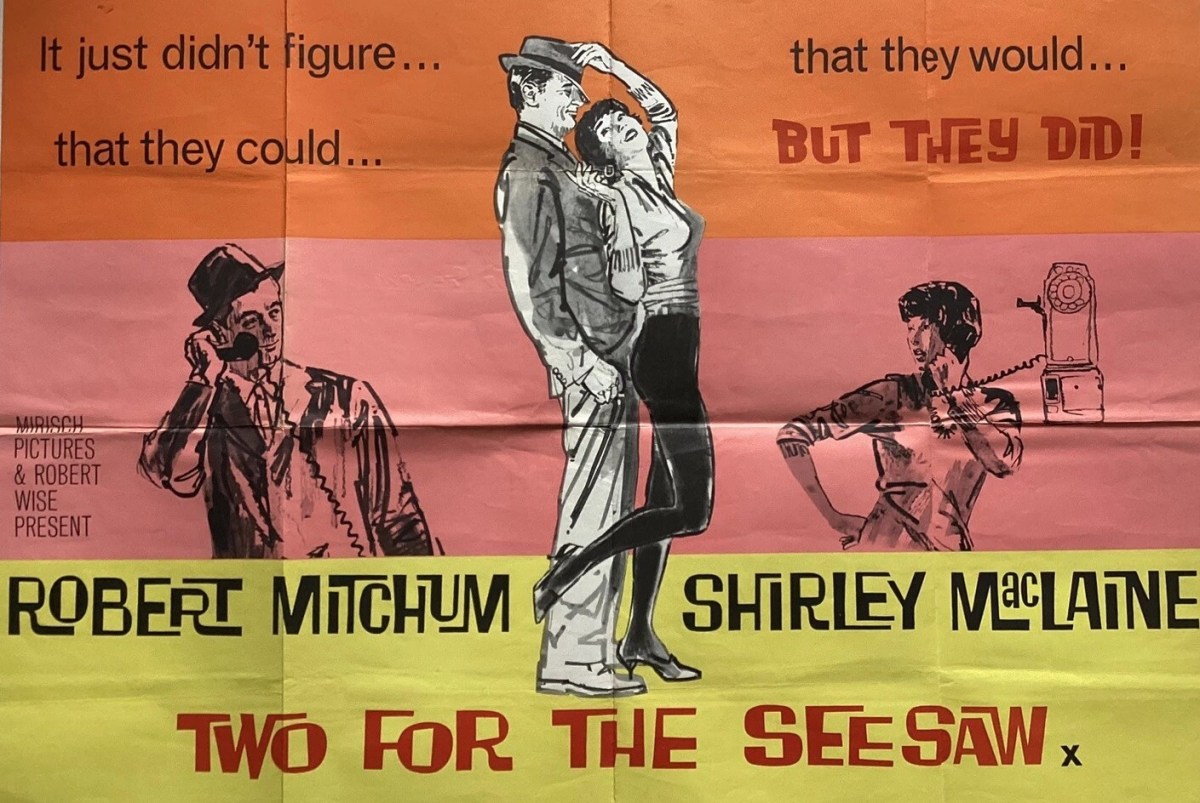
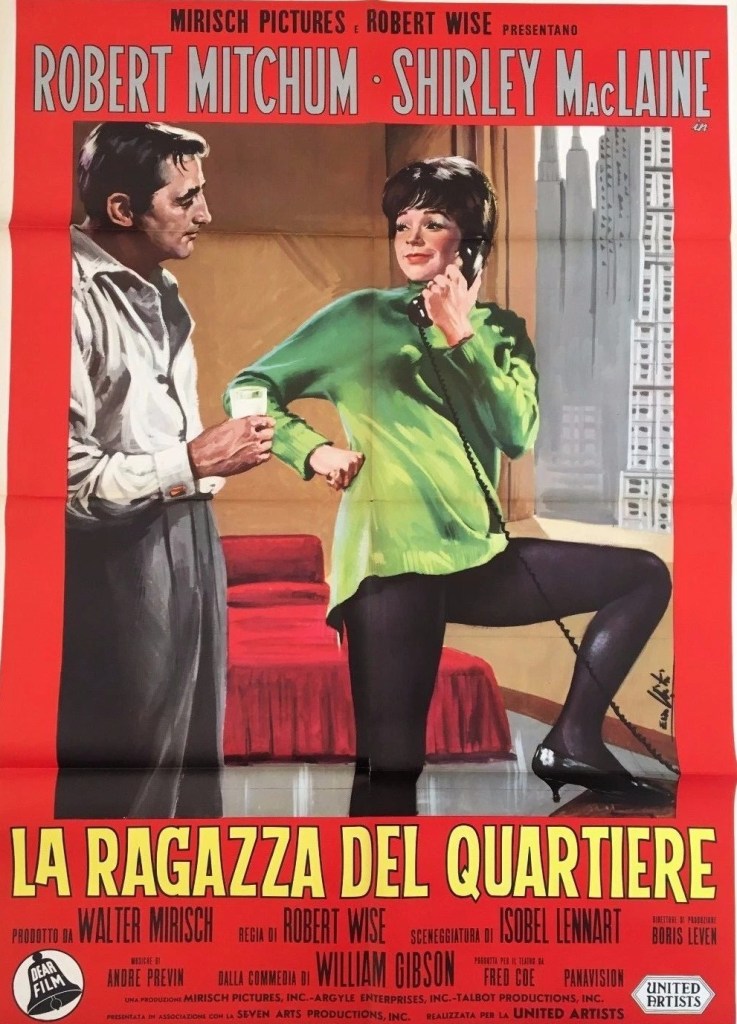
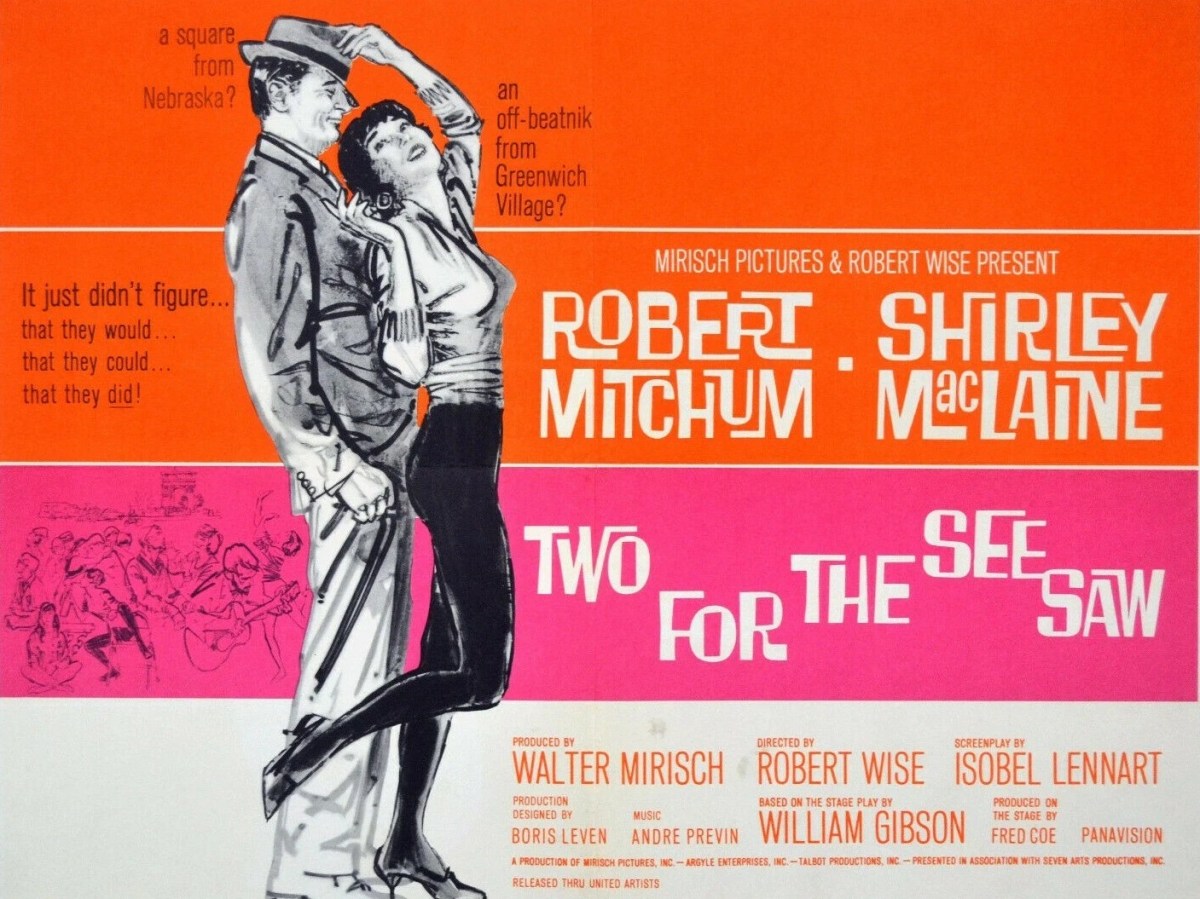
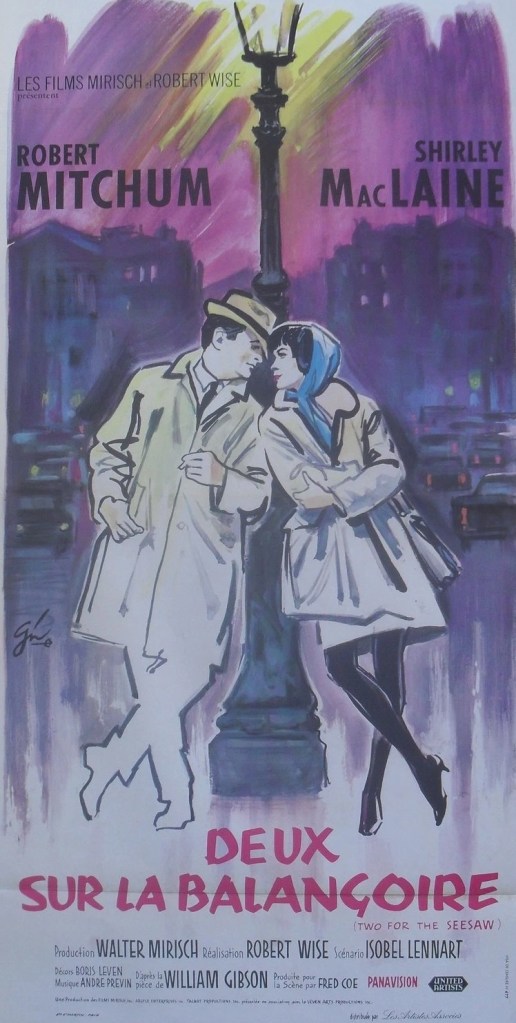
Two for the Seesaw (1962) ***

Whatever chemistry Robert Mitchum and Shirley MacLaine enjoyed in real life – they embarked on-set on an affair that lasted three years – does not come across on screen. Of course, we’re accustomed to the adage that opposites attract and this screen couple Jerry Ryan (Robert Mitchum), a lawyer running away from his marriage, and bohemian dancer Gittel Mosca (Shirley MacLaine) seem particularly ill-matched.

For a contemporary audience this gets off to the oddest of starts. There’s no meet-cute. If there’s something else we’re accustomed to these days it’s a clever, intriguing, smart or even dopey meet-cute. They barely acknowledge each other at first encounter, at the kind of party where intellectuals arguing obscure points of art or politics  mingle with what would pass in those days for the in-crowd.

He couldn’t be more out of place, turning up at a trendy event in a trenchcoat, and he’s only there because he is friends with party host, artist Oscar. They exchange one line. It’s not as though that’s a zinger either. But, on an odd pretext, he pursues her.

Now any ditzy dame is going to run a mile from a stranger who has made virtually no impression on her and can hardly make up his mind whether he wants to see her or not and to whom she only relents when he tells her what a lonely spud he is. So it’s a big narrative hole to dig the audience out of. We establish that she’s good-hearted, but we already know he traipses around the streets of New York doing nothing and lives in a shoddy apartment.

This derived from a Broadway hit and although director Robert Wise attempts to open it up it appears acutely stage-bound, but lacking the dialog zip that marked out such numbers as Barefoot in the Park (1967).

Despite MacLaine’s appealing screen personality, and the tremendous work she did establishing herself as a marquee name via The Apartment (1960), this is more of a romantic drama than a comedy, two ships (somewhat distantly) that pass in the night only to discover not only have they little in common and with opposite personalities but that he is having second thoughts about his impending divorce.

He doesn’t quite settle in New York and she hasn’t made it there. In some respects, they are too similar, emotional losers. She lacks the zap to make this work and he’s just too aggressive and quick with the put-downers to come across as a lonely guy. Once he found work – as an attorney – he’d have a swathe of dames on his trail.

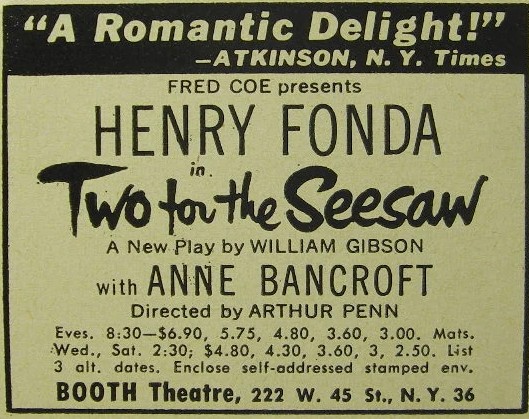
Hard put to see the movie version qualifying as a “romantic delight”. On broadway it starred Henry Fonda and Anne Bancroft and was directed by Arthur Penn.

He commits the mortal sin of the meet-cute romance by slapping her around. Although by this point I doubt if audiences went much for the idea of the unlikely couple getting it on. With a little financial help from him, she manages to make a success of herself, but in a business rather than an artistic sense, and you get the impression she’s going to end up as the joke in a tale he’s going to tell his buddies when he gets back home to Omaha, Nebraska.

It just seems too contrived a set-up to work.  Turns out he’s going through a mid-life crisis – he spends a good deal of time just moping –  and has been too indulged most of this life.

She’s more convincing, the type of free-spirited gal who, though street-smart is other ways, always falls for the wrong guy, unable to rein in her generosity of heart and waste her emotions on men who demand too much of her, including that she rein in that generosity of heart and free spiritedness.

For a May-December romance (she’s 17 years younger) it’s too weighted down by the dour.  In recent years, Mitchum had appeared at his romantic best when up against a sprightly star like Deborah Kerr (Heaven Knows, Mr Allison, 1957, and The Sundowners, 1960) who could more than hold their own, rather than a relationship where, apart from his depression, he needs to have the upper hand.

Mitchum appears miscast and the flaw in the ointment. MacLaine, despite or because of the character’s flaws, is much more believable.  

Robert Wise (The Sound of Music, 1965) directs from a script by Isobel Lennart (The Sundowners) based on the William Gibson play.

Hard going. Fans of MacLaine should be satisfied enough. Fans of Mitchum less so.

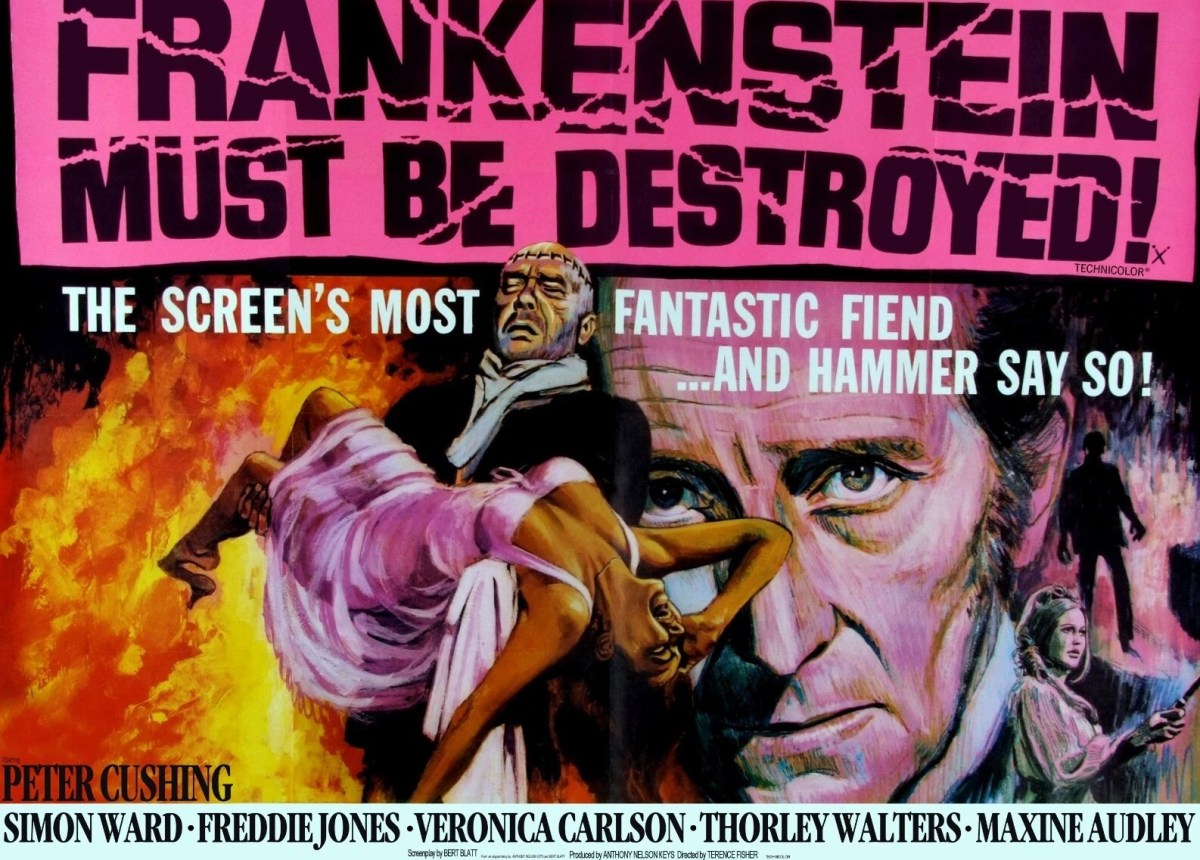
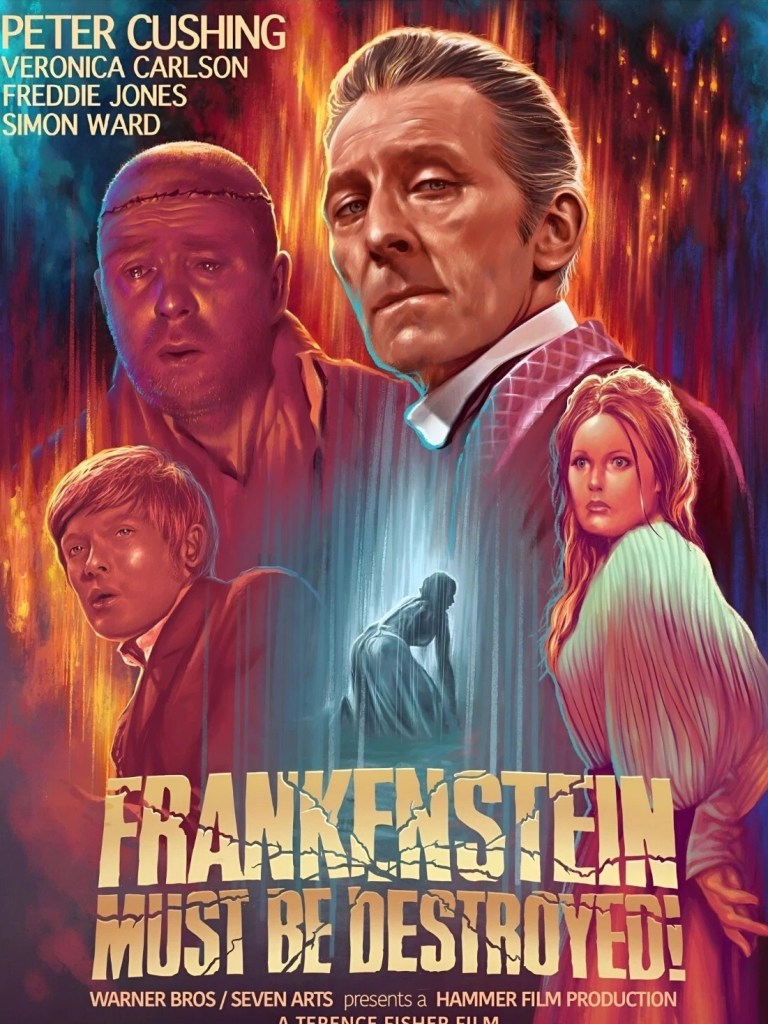
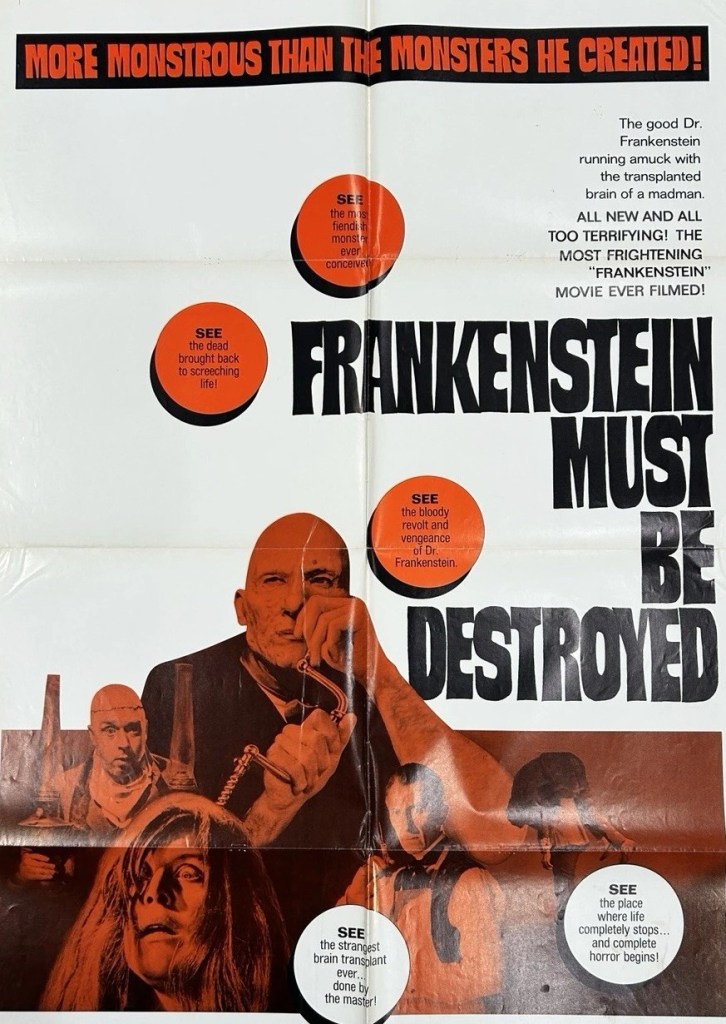
Frankenstein Must Be Destroyed (1969) ****

Hugely enjoyable, mainly because it throws away the standard template for this kind of horror picture. Long before Hollywood got into the habit or remaking or reimagining hit films, Hammer was constantly finding a reason to revive a character who in his previous iteration had met a sticky end. Even though Baron Frankenstein was not one of those villains who always managed to escape at the end of every episode, audiences had no trouble accepting him in whatever guise, era or location he turned up in.

But this is a considerable reinvention of the accepted characterization. Usually, Frankenstein is represented as somewhat academic arrogant scientist, not suffering fools gladly, but rarely has he been given such a wealth of finely tuned insults to offer. Nor has he ever exhibited what you might term passion. You’d never wonder, for example, who he fancied. But that’s all changed here. When he takes a woman here, it’s an extension of his power as much as his passion, and although the sex takes the form of rape, it does reveal him (if that’s not too awful to contemplate) as more human than before.

And the young couple in love, dragged into his web, are far from the usual innocents. On top of that, there are scenes of tremendous pathos when a wife cannot accept the husband brought back from the dead. And there’s quite a brilliant, if ironic, climax that you would not see coming.

In addition, at times the direction by Terence Fisher exhibits tremendous confidence, not just following a structure that brings out far more emotion than is generally accorded the genre, but surprises with flashes of humor and the kind of editing that would generate acclaim had it been in anything other than this.

This time round Baron Frankenstein (Peter Cushing) is in London, haunting the streets with a scythe to lop off the heads of passing pedestrians on dark nights. While he’s employed in this endeavor a burglar discovers the secrets of the baron’s cellar and inadvertently destroys the monster undergoing creation. Frankenstein hides out in a boarding house run by Anna (Veronica Carlson), whose fiancé Dr Holst (Simon Ward) is stealing drugs from the mental asylum where he works, thus making him easy prey for blackmail. The baron wants to kidnap asylum inmate and former colleague Dr Brandt (George Pravda) to find the secret formula for their previous work together.

With Holst soon knee-deep in murder, Anna an accessory to the drug theft, the “innocent” pair are dragged further into the baron’s web. When Holst pleads with Frankenstein, “Let her go, you don’t need here,” the baron replies in deliciously supercilious tones, “I need her to make coffee.”

During the escape from the asylum, Brandt has a heart attack so Frankenstein arranges to transplant his brain into the body of Professor Richter (Freddie Jones). Brandt’s wife Ella (Maxine Audley), initially delighted to find her husband not just alive but cured of insanity, nonetheless is later repulsed by this “creature”, even though in appearance he is not awful, just not the husband she knew.

The plot quickly turns. Frankenstein rapes Anna. In turn, she wounds the creature. And the baron murders Anna, meanwhile realizing that Holst cannot be trusted. The creature, turned away by Ella, and now determined to gain revenge, sets a fiery trap for Frankenstein and in a superb ending hauls the baron into a burning house.

As I said, the structure takes a considerable detour from the standard Frankenstein picture, in particular taking time out from the main plot of the “innocents” escaping and/or thwarting the baron in order to focus on the relationship between Ella and the creature. Her rejection of him, his disgust with his new appearance, and the emotional loss of his wife moves into territory you wouldn’t normally associate with the genre, much closer to the more contemporary reading of the original tale.

Every now and then we dip into a subplot of a police investigation aided by the thief and Ella as witnesses. At first the pompous Inspector Frisch (Thorley Walters) seems little more than a comedic diversion, but actually he’s more switched-on than you’d expect and his detective work adds more tension.

Making Frankenstein more human – even if it’s just him giving into evil impulse – works to the movie’s advantage, as it allows him to pepper his lines with rapier wit. Peter Cushing (The Skull, 1965) has never been better but Freddie Jones (Otley, 1969) as the victim steals the show with a performance of tremendous pathos.

Simon Ward should count himself lucky that Richard Attenborough overlooked his performance and saw something in him that made him the ideal candidate to play Young Winston (1972). Veronica Carlson (Hammerhead, 1968) became the latest Hammer Scream Queen.

Occasionally inspired direction from Terence Fisher (The Devil Rides Out, 1968) in allowing the characters to develop and relationships to foster. Screenplay by Bert Batt, in his debut, and producer Anthony Nelson Keys (Pirates of Blood River, 1962) and based, somehow, on the original by Mary Frankenstein.

Surprised how much I appreciated it.

A Man Could Get Killed (1966) ****

An unexpected delight. More farce than spoof and more Hitchcockian thriller than espionage adventure, but bursting with laughs. Spinning on the premise of mistaken identity, a New York banker becomes mixed up with diamond smugglers while being pursued by a posse of Europe’s shadiest characters and a very determined femme fatale. All the more enjoyable because identity confusion is very difficult to pull off unless you have a top class cast like Cary Grant and Eva Marie Saint in North by Northwest (1959).

Landing in Lisbon, New York banker William Beddoes (James Garner) is mistaken for the emergency replacement for a recently-deceased British spy. It’s not just embassy officials like Hatton Jones (Robert Coote) who are afflicted by this notion, the villains are so determined to get rid of their man two bombs are planted in his car. Attending his supposed predecessor’s funeral brings Beddoes into contact with glamorous Aurora (Melina Mercouri). Smuggler Steve (Anthony Franciosca) offers his service to Beddoes to help recover $5 million in stolen industrial diamonds. To complicate matters, identity is also an issue for Steve, who while working under an assumed name is outed by Amy (Sandra Dee) who recognizes him as her family’s former gardener.

Unable to convince anyone he is not who he says he is, Beddoes is swept into the conspiracy, his every move under surveillance by rival villains, including Florian (Gregoire Aslan) and Milo the Murderer (Arnold Diamond), while Aurora attempts seduction to bring him to heel.  Eventually, while never ruling out double-cross, Beddoes, Aurora, Steve, Amy and embassy officials work together to decipher a series of clues revolving around rice, azaleas, a red pig and a man who sneezes, none of which align with obvious meanings and naturally are interpreted as something to do Red China or the Iron Curtain.

A picture based on a simple premise is better than a spoof that labors to create a plot and so it’s true here. Everything springs from the mistaken identity and the diamond hunt, and as one twist effortlessly follows another characters with conflicting agendas collide. Beddoes spends all his time trying to escape from kidnap, assassination or seduction. It’s helter-skelter stuff, so no surprise that chases, of the Buster Keaton variety, produce laughs. I found myself laughing out loud at the scene where Steve can’t find anywhere to sit in a café that is not next to a villain, Beddoes getting attacked by drapes, an ambassador (Cecil Parker) more concerned with knotty chess problems than espionage, and a great visual gag where Beddoes  wallops a cop. Escaping pursers, Steve takes a short cut that leads him straight back into danger.

Naturally, the whole enterprise is loaded with confusion, not least because making the wrong decision, taking the wrong turn and making the wrong assumption sets up the next gag. Throw in ambulance theft, Beddoes sitting in a row of hookers in jail, a tape recording turning up in a bread roll and you get the idea.

The cast could have been hand-picked for this kind of picture. James Garner (The Hour of the Gun, 1967) is the  natural successor to Cary Grant in the double-take department. This role is a play on previous ones where he was the trickster and not the patsy. He’s more stiff-upper-lip than the Brits. Comedy skills honed on this one that were put to terrific use in Support Your Local Sherriff (1969). And while Melina Mercouri (Topkapi, 1964) is more than a little over-the-top, the dominant woman from whom ordinarily Beddoes would run a mile, but also possessing the cunning survival instincts lacking in an innocent like him. One scene that depicts their contrasting characters so well is when she runs around half-naked to create a diversion and he chases after trying to cover her up, clearly no idea that distraction is necessary.

Tony Franciosca (The Swinger, 1966) leads with his teeth, his smarminess undercut by Sandra Dee reminding him he is a glorified gardener. Dee (Tammy and the Doctor, 1964), however, never manages to stray from her ingénue roots. An excellent supporting cast includes Robert Coote (The Swinger), Gregoire Aslan (Moment to Monet, 1966), Cecil Parker (A Study in Terror, 1965). This was British actress Dulcie Gray’s final film.

The movie had a fractured genesis. Original director Cliff Owen (The Vengeance of She, 1968) fell out with the stars and was shunted aside in favor of Ronald Neame (Gambit, 1966), more adept at male-female chicanery. The screenplay originated from comedic masters – Richard Breen (Do Not Disturb, 1965) and T.E.B. Clarke (The Lavender Hill Mob, 1951)  – based on the book Diamonds for Danger by David E. Walker. And there are many delightful lines. “I’m my own bait,” spouts Aurora. Trying to placate Amy, Steve explains “It’s unusual to find this many dead spies in one day.”

The movie failed to register with the public which was astonishing. At a time when theme songs helped turn other films like Alfie (1965) into successes, the movie contained the tune that would give Frank Sinatra his first number one single in over a decade, “Strangers in the Night.” Unfortunately, the movie did not carry Sinatra’s imprimatur. The music in the film was an instrumental. Had Sinatra’s voice been heard in the movie it might have turned it into a hit.

For a long time, this under-rated delightful comedy was hard to find. There still is not a Region 1 DVD, but you can find it on Region 2 and YouTube has kindly provided a free copy.

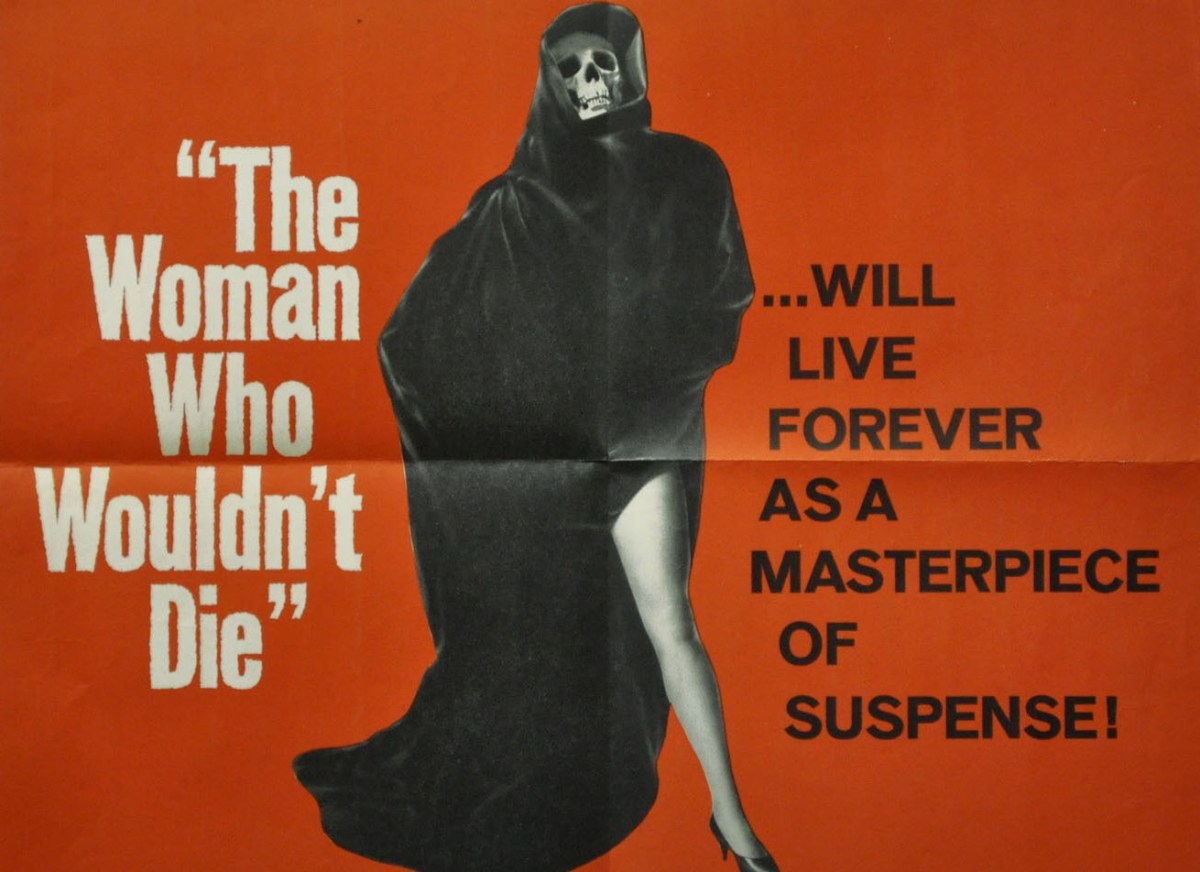
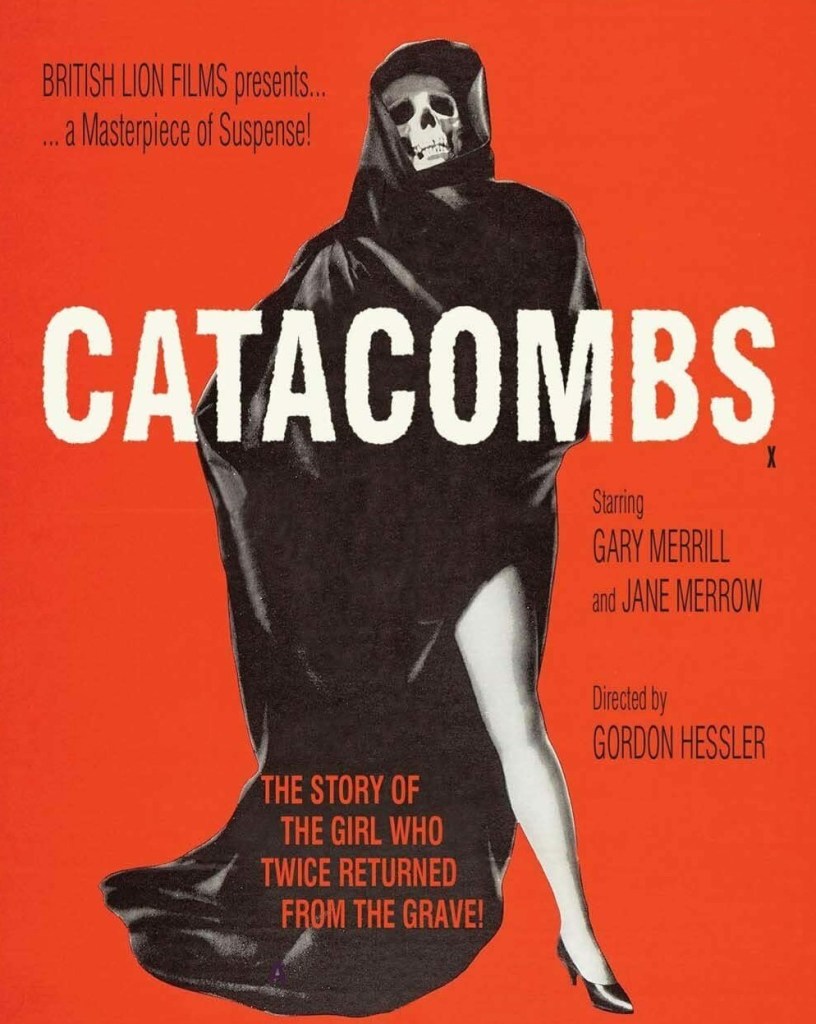
The Woman Who Wouldn’t Die/Catacombs (1965) ***

Gordon Hessler (The Oblong Box, 1969) makes his directorial debut with this neat horror thriller. It starts with a twist exceptional for the times.  Ellen (Georgina Cookson) is the shrewd and shrewish millionaire businesswoman, her husband Raymond (Gary Merrill), from whom she demands frequent sex, the eye candy, a kept man. “I married a lover, not a businessman,” she retorts when, bored out of his mind, he asks for the opportunity to play a  role in her business. In a further twist on the norm of the damsels decorating 1960s movies by displaying cleavage or disporting themselves in bikinis, Raymond is often seen with his chest bared in all its hirsuteness. In a further gender twist her secretary is also male, Dick  (Neil MacCallum), a former, unknown to her, jailbird.

Tall, beautiful, dominant and domineering Ellen appears to have occult power, able to read minds, which keeps the larcenous-minded Dick in check, and has command of her own physical frailty – she walks with a stick – and can put herself in a trance to overcome occasional pain from her injured hip.

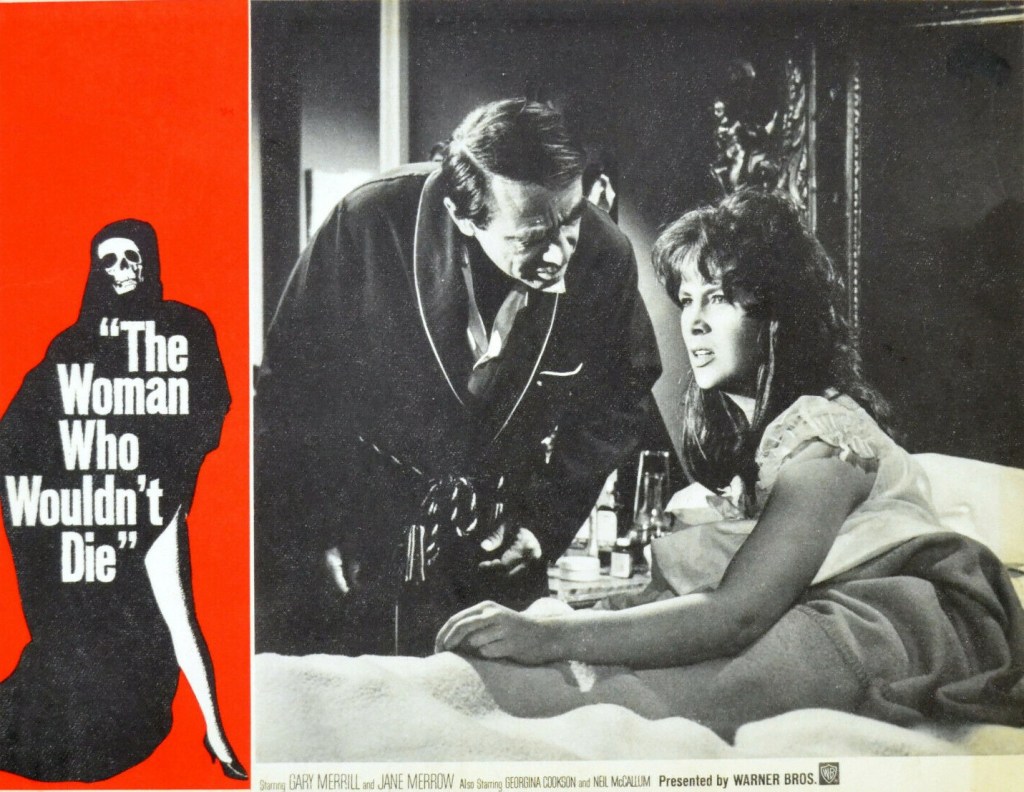
Conspiracy of fear: Raymond (Gary Merrill) and Alice (Jane Merrow).

But when Raymond falls for Ellen’s niece Alice (Jane Merrow), an artist returned from a year in Paris, he puts into action a plan that had clearly only been a pipe-dream, blackmailing Dick into participating. It’s quite clever as murderous plans go. He hires an actress to impersonate Ellen, known to go off to Italy on her own for spa treatments and with a knack for reckless driving, various driving charges over the years. Meanwhile, he strangles Ellen, allows Alice at a distance from an airport viewing terrace, to see her aunt, complete with walking stick, climbing up the steps of a plane. Faked cables and postcards arrive from Italy purportedly showing Ellen enjoying herself, even visiting the famous catacombs. In Italy Dick fakes a car accident to kill the actress.

However, twist number one comes at the reading of the will. Raymond and Alice split the million-pound bounty but while the latter is given custody of the big house the former is condemned to live for life, on pain of forfeiting the inheritance, in the cottage, in whose potting shed Ellen’s body lies. Further twists naturally follow. The maid (Rachel Thomas) doesn’t quite so much smell a rat but adds to the killer’s incipient discomfort by proclaiming that with her hip problem and claustrophobia that Ellen would never descend into the catacombs.

Entitled “Catacombs” in the U.K. after the novel by Jay Bennett on which it was based, it was retitled
“The Woman Who Wouldn’t Die” for the U.S. market.

And Raymond might have lived happily ever after with Alice except for his guilt. Several creepy incidents, knocking, tapping, door handles turning, shadows, a depression the shape of a body in a bed, cigarettes smoking in ashtrays, lights going on and off indicate to the already nervous Raymond and the visibly frightened Alice that Ellen may not be dead after all. Virtually the entire third act is the pair of them reacting to real or imagined fears. Alice has a good line in looking scared witless. But Raymond, while trying to contain his inner demons, is equally rattled.

As you might expect there are further excellent twists to come. In fact, they are soon piling up and even at the very end the screen freezes on a final twist.

Georgina Cookson (The Picasso Summer, 1969) steals the show as the imperious businesswoman, with everyone cowering under her glare and not above stating the obvious, “I bought you body and soul,” she reminds Raymond. I’m not sure Gary Merill (The Power, 1968) is quite as good in the second half as he is in the first. Initially, he exudes charm, physical prowess, and, while under his wife’s thumb, still emotes a certain measure of confidence. He doesn’t appear to me to quite frightened enough in the second half as his plans go awry. Jane Merrow (The Lion in Winter, 1968) is excellent as the young woman caught in a mental trap and Neil MacCallum (The Lost Continent, 1968) is surprisingly effective.

But this is a low-budget B-picture that was destined for the lower half of a double bill so there was no particular reason why it should be as good as it is. Except for the Italian sequence, the action takes place on just two sets and for most of the time it’s a three-hander. But Hessler has a keen eye for composition and in a number of critical scenes makes bold choices. For Ellen’s murder, he concentrates on Raymond’s face rather than the victim’s, only showing her feet. There’s one super-shocker with a mirror. But mostly he is content to built up the tension, either by the various noises or by the reactions of Raymond and Alice.

An old-fashioned gem of a picture.

The Unfinished Task / I’ll Give My Life (1960) ***

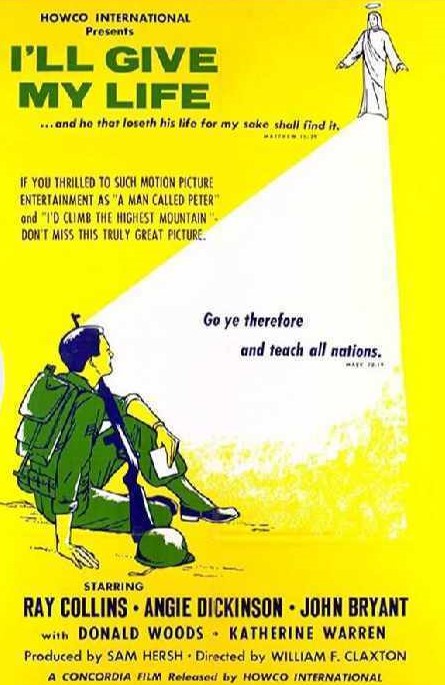
For completists only. Fans of Anglie Dickinson have responded to reviews of Jessica (1962) and several others. This should round off your Angie Dickinson collection with the bonus that it’s a long-lost number. Almost unrecognizable as a brunette, Dickinson carries much of the emotional weight of this tale about an outsider rejecting a chosen career.

Hollywood pictures about creative outsiders such as artists and writers relied on charismatic actors – Kirk Douglas in Lust for Life (1956), Charlton Heston in The Agony and the Ecstasy (1965) – to bring the project to life. Similarly, you might think, in movies about another type of outsider, of the religious variety, having the likes of Gregory Peck (The Keys of the Kingdom, 1944) or Bing Crosby in Going My Way (1944) goes a long way to giving such ventures audience-appeal.

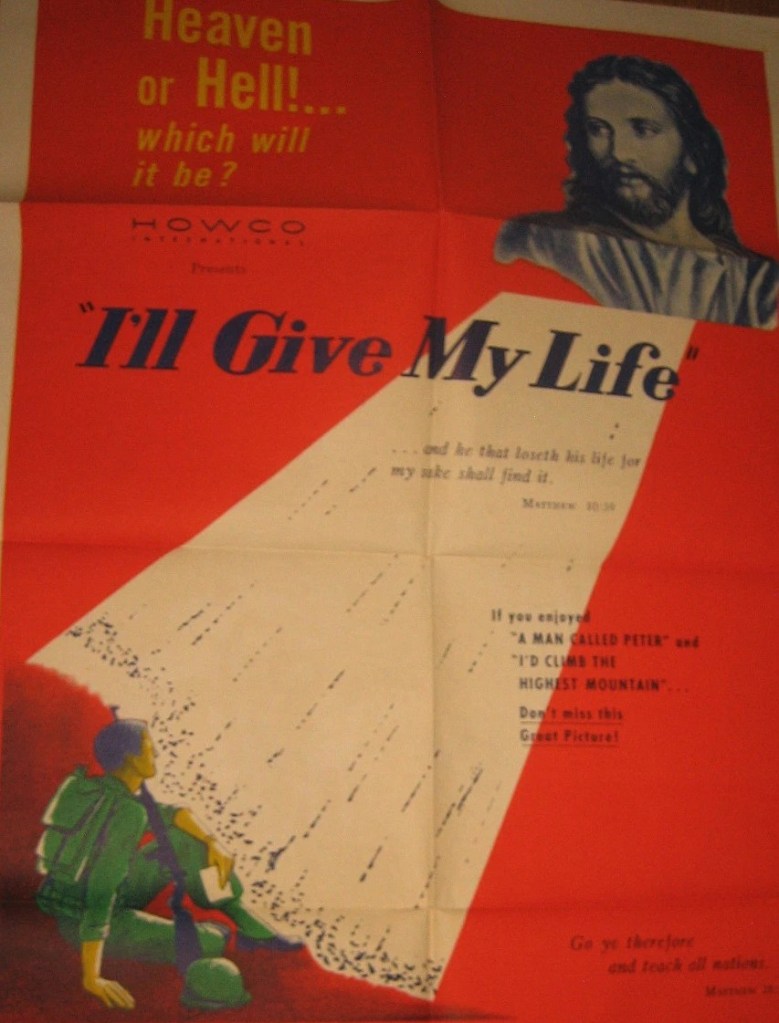
This poster does not do the film justice. It’s nothing like as “heavenly” as that. Howco was an exhibition company that entered distribution in order to provide enough product for its cinemas.

Here, Jim (John Bryant), the son of a successful construction tycoon, having completed a degree goes against the wishes of father John (Ray Collins) by becoming a minister instead. In due course he is sent overseas to a mission in New Guinea, and like Father Stu (2022) contracts a deadly disease. Jim is far from charismatic, just a plodding ordinary guy who has found “something more important than building skyscrapers.”

The story is instead told through the eyes of John, resentful of his son’s decision, and his girlfriend/fiancée/wife Alice (Angie Dickinson) who, expecting marriage to a wealthy engineer, instead has to set aside her own ambitions and go along with her husband’s wishes, this being post-WWII America, and independence hardly a prerequisite in a wife, never mind a woman.

But if this is a story of a conversion – as was the case in Father Stu – it’s about the conversion of the father and Alice and the bulk of the story hinges upon their reactions to the path taken by Jim rather than him taking center stage. So it’s cleverly done, and whether this is due to budgetary pressure, or creative decision, it proves the right choice. John is the kind of self-made man who would dominate any stage, forever making plans, spinning the world as he would like it to be. In Alice’s eyes we see nothing but her weighing up Jim’s choices, sometimes accompanied by shock, occasionally elation, but mostly resignation and infrequent resentment as she, too, is parted from family to follow her husband into an unknown in which she had considerably less faith.

Unlike Father Stu, conversion does not come easily. Jim is long dead, two-thirds of the way through the picture as it happens, before John comes to realize that his son’s demise should not be in vain and that he left behind “an unfinished task” for his father to complete, namely raising awareness of the power of missionaries to improve the lot of the miserable and poor in foreign parts. Bear in mind the era in which this was made, so there are some attitudes that will make you wince, but generally it is well done, not weighted down with platitudes and, in concentrating on the doubter, brings alive a difficult subject.

And although this was before questions were asked about the sexual corruption of priests and ministers, men who followed religion were still not as easily accommodated in the general community, seen as overly pious and, to the businessman, existing in a vacuum. The idea that the Church, of various kinds, had not done enough to ease global suffering, is continually raised and nobody here is giving themselves a pat on the back.

Alice is actually given more screen time than Jim, his father using her as a sounding board, and, while Jim is off in New Guinea, enjoying herself with the firm’s resident beau, Bob (Jon Sheppod), and finally taking on motherhood and coping with the premature death of her husband and still fighting to open the father’s eyes to the good being done.

Angie Dickinson (Jessica, 1962) gives a very good account of herself, especially as the narrative restricts her to the kind of wifely 1950s role rather than the frisky sexuality she exhibited in the 1960s. Her acting skill saved her from being lumbered with portentous dialogue since she could portray her feelings more easily with her eyes.

Ray Collins (famed for a running role in the Perry Mason series) is excellent as the father confused by his son’s decision, fighting him every inch of the way. John Bryant (The Bat, 1959), it has to be said, does not light up the screen, lacking the magnetism of a Peck or a Crosby but in some regard this kind of straight playing suits the film, since the character is not meant to be out of the ordinary.

William F. Claxton (Desire in the Dust, 1960) directed from a script by Herbert Moulton, better known as a producer of shorts. Although this film was released in 1960, it appears to have been made before that, some suggest as early as 1955. Given it was funded by the Lutheran Church, the script does not make heavy weather of the religious elements and John’s resistance to his son’s vocation reflected that of any father to a son embarking on as shaky a career as painting or writing.

You can catch this on YouTube, though it’s not a great print. And, yes, that is Angie Dickinson sitting demurely at a desk.

The Night Walker (1964) ****

Deserves its spot in the cult pantheon, hints of Spellbound (1945) and Vertigo (1958),  mesmeric atmosphere of dream/nightmare held together by a hypnotic performance by Barbara Stanwyck, tonsils in overdrive. But no point screaming at the unseen, at the unknown, when it invades reality, no point trying to escape a dream when you’re trapped inside.

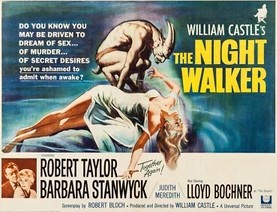
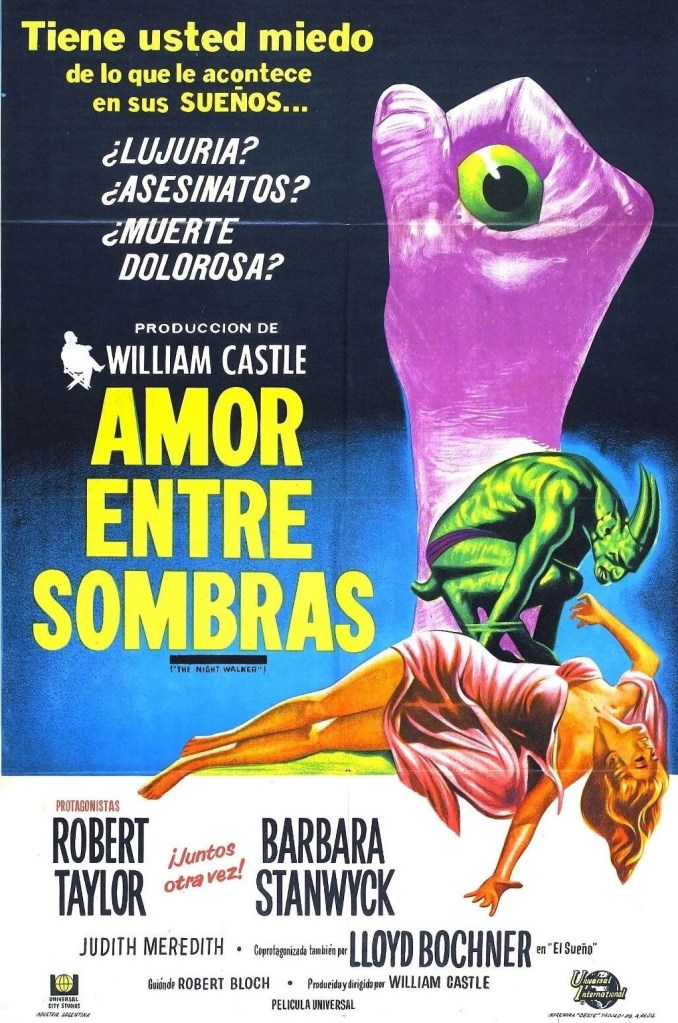
Except that there’s no sign of the demonic figure haunting widow Irene Trent (Barbara Stanwyck) on the poster it delivers on all other fronts, driving you to question our heroine’s grip on reality as much as she questions herself. If there’s such a thing as self-gaslighting, she’s in the vanguard.

Creepy rich blind husband Howard (Hayden Rorke) is an emperor of surveillance, microphones everywhere catching her every word, including what she utters in her dreams, which convinces him that she’s having or has had an affair. When he dies in an explosion, body eviscerated in the inferno, she can’t come to terms with her freedom, holing up in the tiny apartment at the back of her beauty parlor, relying on assistant Joyce (Judi Meredith) and attorney Barry (Robert Taylor) for moral, and perhaps in relation to the solicitor, physical support.

When the unreal invades her daily life and she begins to believe in her dreams and when the handsome lover (Lloyd Bochner) of her night-time imagination takes shape, she begins to doubt her sanity. But so convinced, on the other hand, that she must be sane, she tries to convince Barry that her dreams have basis in fact. She tracks down the apartment (No 341) she visited in her dreams and the chapel where she imagined she was married to said lover.

You wish director William Castle (Straitjacket, 1964) had continued exploring the theme of dreams vs reality, and how to cope when the imagination takes over. But instead, it twists into thriller territory, the old set-up, the gaslighting that could send Irene over the edge and straight into a sanatorium while her husband’s substantial wealth ends up elsewhere.

Even so, once it heads down this particular path, it’s still mighty tricky. Who could be in on the act? All the people she trusts – Barry, Joyce, even Loverboy? And if she’s going to let her suspicions run riot, how is she going to come out the other side, for surely that will tip her over into madness?

Exceptionally lean, barely 80 minutes once you exclude the treatise on dreams at the start that establishes the premise of the “Night Walker” – the person who lives through their dreams – and exceptionally clever. Irene is so given to screaming that you’d scarcely think there’s space left in her brain to to work out just what’s going on. And there’s no shortage of permutations.

Has her dead husband, half his face obliterated by burns, come back to haunt her? Is the Lover just a figment of her imagination? Why can’t she make do with someone as handsome as Barry?

We’ve got smoke issuing from under doors, recurrent bright flashes of explosion, mannequins that seem alive, all sorts of jiggery-pokery with guns, telephone wires cut, a blind man who can tell the color of your dress, eyeballs plucked from faces and squeezed until they pop, and the expectation all the time of a straight dive into madness. No escape in other words.

Even when it fast approaches a climax you might have guessed the outcome of, turns out you were wrong and there’s still a few more twists – and screams – to come.

The fact that it turns into a straightforward thriller at the time tended to diminish the emphasis on the demonic, but these will be more fully appreciated today when the line between reality and fiction is stretched ever thin.

Four-time Oscar nominee Barbara Stanwyck (A Walk on the Wild Side, 1962) might have been accused of slumming it in low-budget horror fare such as this, but, boy, in her final big screen appearance, (although she successfully switched to television as star of The Big Valley, 1965-1969) does she give it her best shot. If this was Stanwyck’s swansong, Robert Taylor (A House Is Not a Home, 1964) , a fellow relic from Hollywood’s Golden Age, wasn’t far behind, only a few movies left in him.

For all this relied on William Castle’s directorial dexterity,  the imagination behind it came from master of the macabre Robert Bloch (Psycho, 1960).

Cult doesn’t come much better.

Discover WordPress

A daily selection of the best content published on WordPress, collected for you by humans who love to read.

The Atavist Magazine

by Brian Hannan

WordPress.com Blog

News, Tips & Website Tutorials