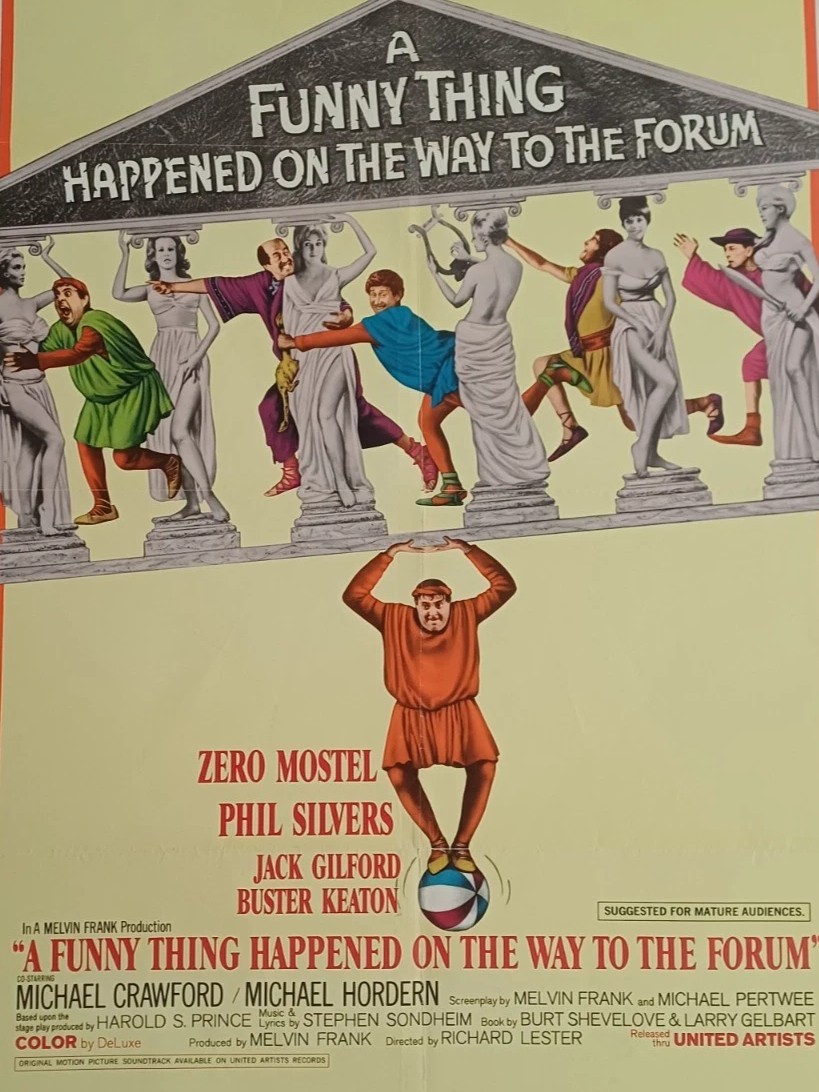
The funniest thing that happened on the way to turning this hit Broadway musical into a Hollywood movie was that composer Stephen Sondheim (Sweeney Todd, 2007), now denoted a legend, was considered such a poor marquee attraction that the producers cut half the songs of the original production, turning the result into more of a comedy with intermittent songs rather than a full-blown musical in the Rodgers and Hammerstein tradition.
Sondheim had an unusual theatrical development, starting out purely as a writer of lyrics – for West Side Story (filmed 1961) and Gypsy (filmed in 1964). He took on the dual roles of composer and lyricist for this one, which made its Broadway debut in 1962 and ran for three years.
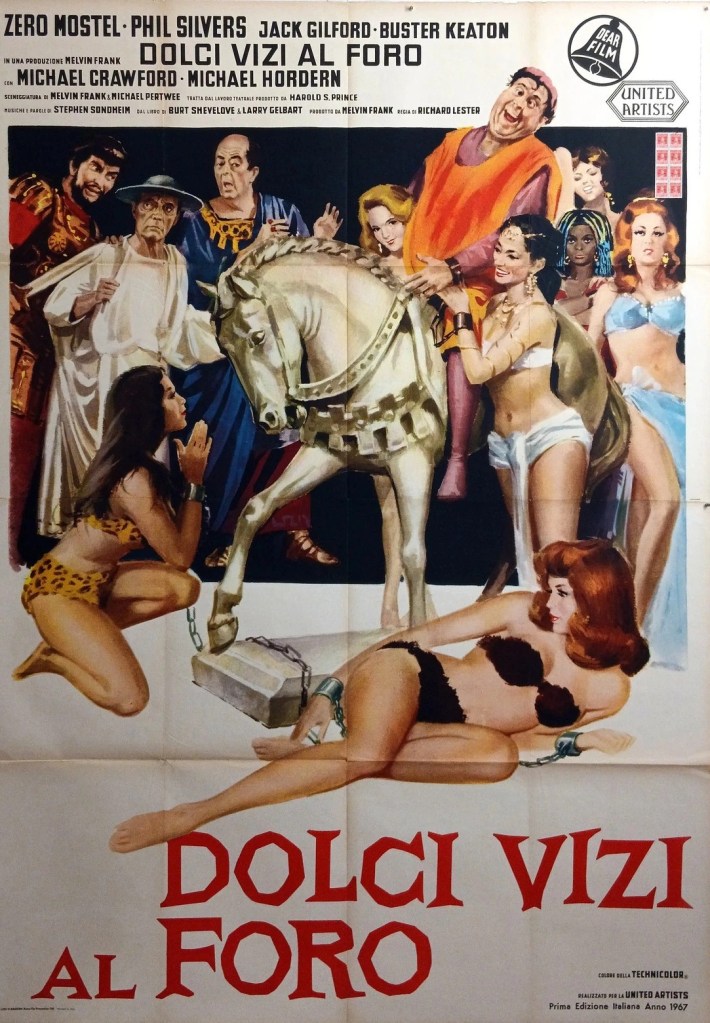
You wouldn’t have Zero Mostel, a year before The Producers (1967), down as much of a marquee name either – he hadn’t appeared in a movie in 15 years, and then in only a bit part. But Broadway has its own method of producing stars and he had become a stage headline act and really there were few contenders for the role of a fat middle-aged Roman hustler.
Contemporary audiences will appreciate the actor breaking the fourth wall and talking directly to the audience, but while it was highly unusual at the time, it had the effect of putting the audience on his side. You might not associate Richard Lester (Petulia, 1968) with musicals but that would only be if you excluded A Hard Day’s Night (1964) and Help! (1965) from his portfolio, though admittedly those would hardly be classed as traditional song-and-dance efforts.
The picture was larded with other top comedic names, Phil Silvers of Sgt Bilko TV fame and legendary silent comic Buster Keaton. It didn’t hinder the movie’s prospects that with the phalanxes of nubile young women on show it might have been considered an audition for actresses aiming no higher than the sobriquet of Bond Babe.
What’s perhaps most unusual of all is that this is a sex farce, not a medium at which Hollywood was renowned. Screwball romantic comedy, yes, farce set in a brothel, no. Luckily, it delivers on all fronts. If you want a hint of what Sondheim could bring to the party, there are seven songs to choose from. If you reckon Zero Mostel provides a distinct brand of comedy you would be proved correct. If you were here for the cheesecake it was in abundance. And if you went looking for laffs there was no shortage, pratfalls included.
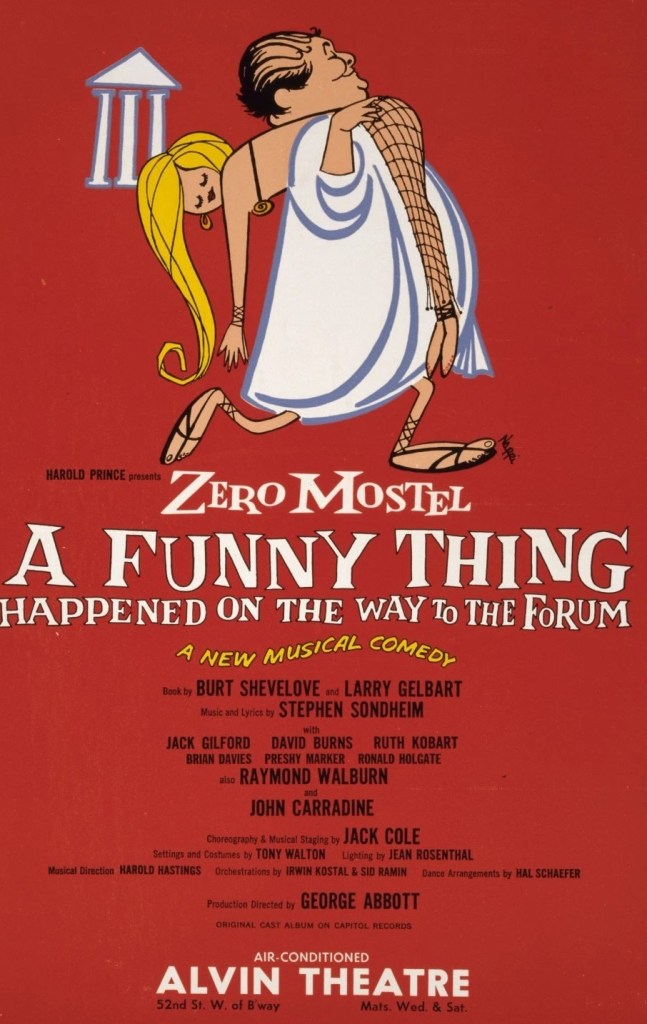
The story is slight, if complicated. Slave Pseudolus (Zero Mostel) wants his freedom, young swain Hero (Michael Crawford) wants to win the heart of Philia (Annette Andre). All sorts of obstacles get in the way. Since Philia, a virgin slave, has already been sold to a great warrior Gloriosus (Leon Greene), Pseudolus must convince him that the girl has been exposed to a deadly plague and must be hidden away. He is eventually distracted by an orgy and persuaded that the girl is dead. However, when Gloriosus determines to cut out her dead heart, she is suddenly very much alive.
In the tradition of Shakespearean comedy, there are oodles of mistaken identity and the while the narrative twists itself into various contortions to accommodate the sub-plots, naturally, it all ends happily, Philia turns out to be not a slave at all, and Pseudolus walks off with his freedom and Amazonian temptress Gymnasia (Inga Neilsen) to boot.
It’s all very good-natured fun, bordering on the licentious, but steering well clear of the meretricious and anything so off-putting as nudity or sex.
Having conquered Broadway, Zero Mostel now conquers Hollywood, doubling down on his fame next year with Mel Brook’s The Producers. Unlike The Devils (1971), any sign of campness is tamped down, helped along by serious players like Michael Hordern (Where Eagles Dare, 1968) taking their roles seriously. Phil Silvers and Buster Keaton keep the show on the road. Future British television and Broadway musical star Michael Crawford (The Jokers, 1967) shows his promise. In small parts you might spot Ingrid Pitt (Countess Dracula, 1971) and Jon Pertwee, the third Doctor Who.
I didn’t go away humming any of the songs, but they were pleasurable enough and for Sondheim lovers more than enough.
Director Richard Lester proves himself adept at this kind of comedy. Written by Melvin Frank (Buona Sera, Mrs Campbell, 1968) and Michael Pertwee (Make Mine Mink, 1960) from the Broadway production by Sondheim, Burt Shevelove (The Wrong Box, 1966) and Larry Gelbart (The Notorious Landlady, 1962) which took its impetus from the work of Roman writer Plautus.
Good fun.


Brian, I enjoyed reading your good write-up of, as you say a “Good fun” of a movie A FUNNY THING HAPPENED ON THE WAY TO THE FORUM(filmed 1965, released 1966). I first viewed this hilarious, madcap, burlesque comic romp, filled with a cornucopia of laffs and pratfalls galore on television’s the NBC SATURDAY NIGHT AT THE MOVIES in 1970. I would give it **** stars at least. The story first written as a Broadway play by Burt Shevelove and Larry Gelbart, who gave credit to the comic Roman plays of Titus Maccius Plautus(254-184 B.C.). Shevelove and Gelbart admitted that they helped themselves to Plautus’ popular comic plays written from 205-184 B.C. Also, William Shakespeare borrowed from Plautus as have so many others over the last 2,200 years. Ah, yes, there is nothing new under the sun.
“If you reckon Zero Mostel provides a distinct brand of comedy you would be proved correct.” Yes, I wholeheartedly agree with you, and I think there was only one Zero Mostel and there will never be another. The entire cast is wonderful, Jack Gilford, Phil Silvers, Michael Hordern, Buster Keaton, Patricia Jessel, Michael Crawford, Annette Andre, Leon Greene, John Bluthal, Inga Nielsen, Jon Pertwee, and Roy Kinnear.
After watching the movie, I went away whistling the “Comedy Tonight” tune for at least a week. Also, if anyone likes their funny bone to be tickled, this is the movie for you.
LikeLiked by 1 person
I’m probably spoiled by the BBC series Up Pompeii which took a similar talk to camera approach.
LikeLike