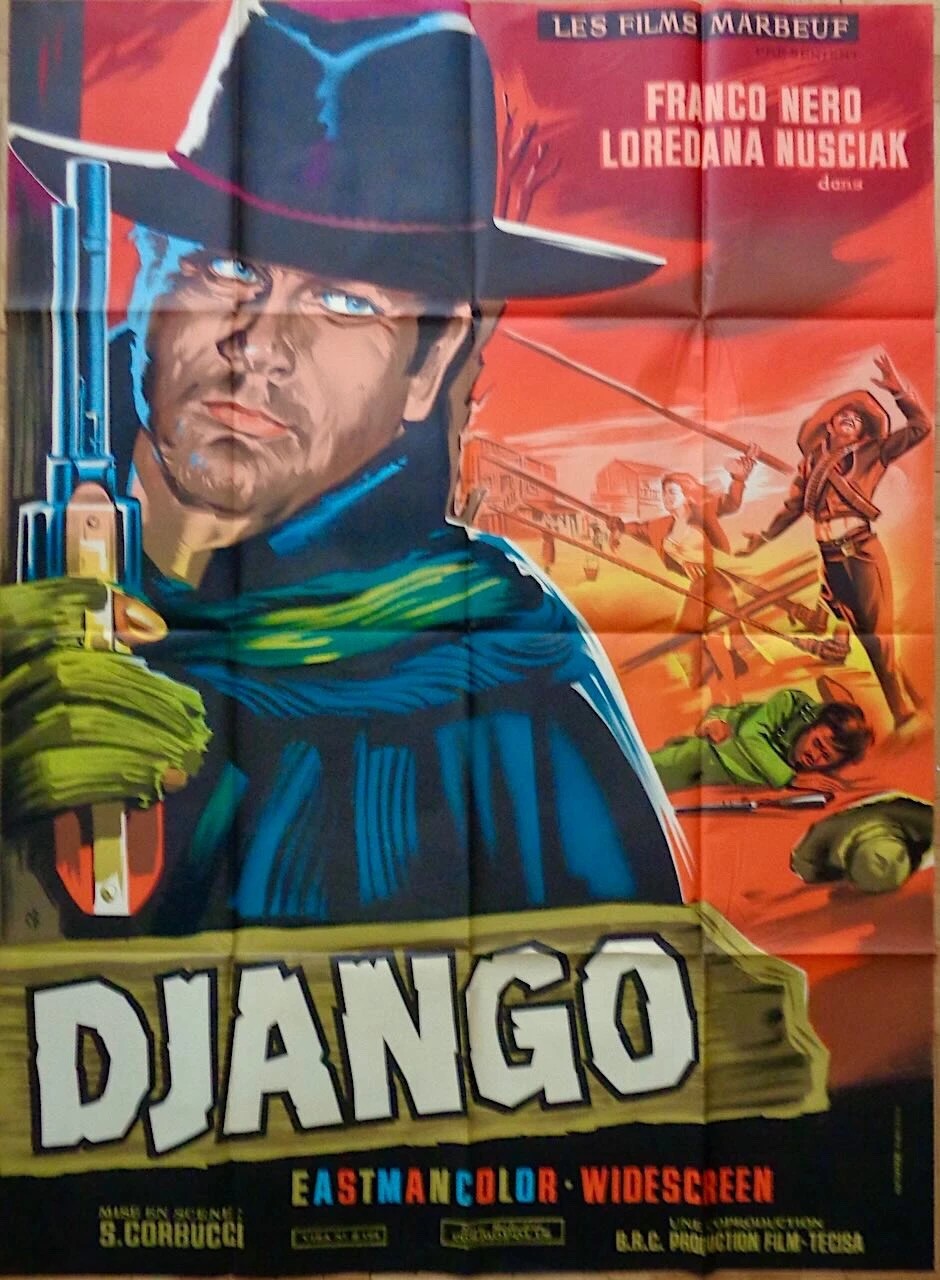
You’re not going to get a more iconic opening than a cowboy dragging a coffin up a muddy hill. But just in case you think director Sergio Corbucci is trying to make some high-falutin’ statement, the next few minutes contain nine deaths and a woman whipped and then threatened with being burned to death. What followed resulted in deserved cult status, helped along by a ban from the British censor. Outside Sergio Leone 1960s western quartet, this is generally considered to be the best spaghetti western of the period.
You’ll be familiar with the story, because basically it’s a rehash of A Fistful of Dollars, which in itself was an uncredited rehash of Akira Kurosawa’s Yojimbo (1961).
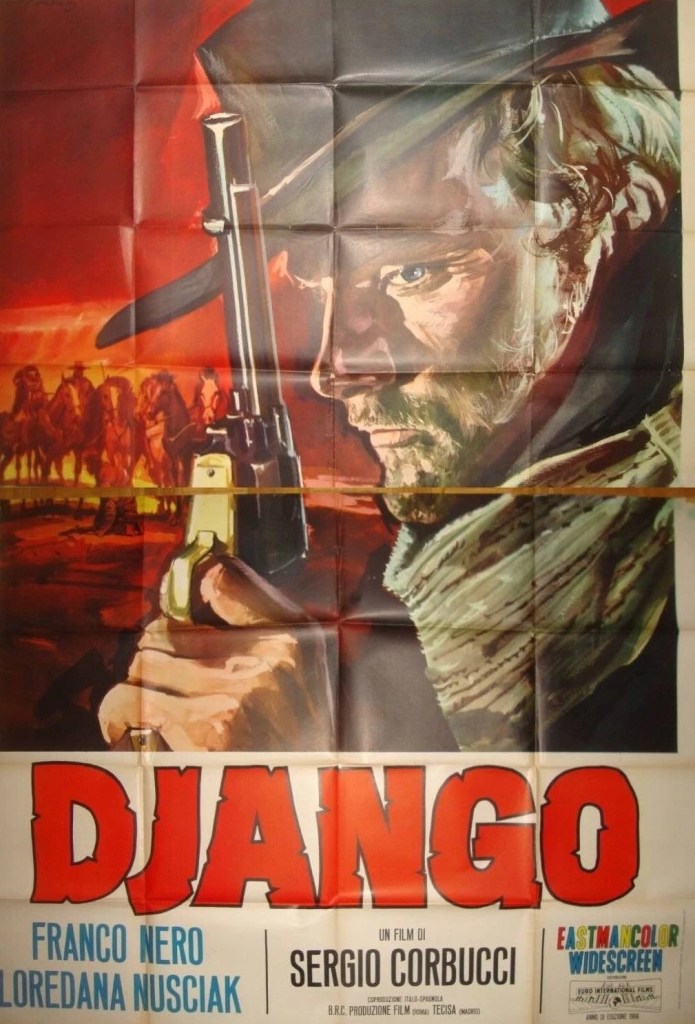
On the Mexican-U.S. border, two groups vie for control of a tiny town (population: six – one bartender and five whores), one led by ex-Confederate Major Jackson (Eduardo Fajardo) who would be dressed in the red shirts of revolutionaries except that the opposing bunch led by General Rodriguez’s (Jose Badalo) has chosen that color.
Django (Franco Nero) arrives in the town accompanied by the whipped woman Maria (Loredana Nusciak) and the coffin, which contains a machine gun. Django wants revenge on Jackson who killed his lover. But that’s as much a MacGuffin as you need because, really, slaughter is the name of the game, not to mention a gold heist, then a heist of the stolen gold, which is stashed safely in Django’s coffin until it ends up in the quicksand.
This being a spaghetti western naturally there’s mutilation, Django’s hands crushed for the audacity of his theft, someone else forced to eat his own ear, and there’s attempted rape. Mostly, there’s massacre. A humungous heap of bodies provide the entertainment. Jackson and the General are equally intent on killing as many people as possible, Rodriguez having the moral edge because he’s the legitimate revolutionary but it’s a close run thing.
But the good guys are always a hefty massacre away from safety.
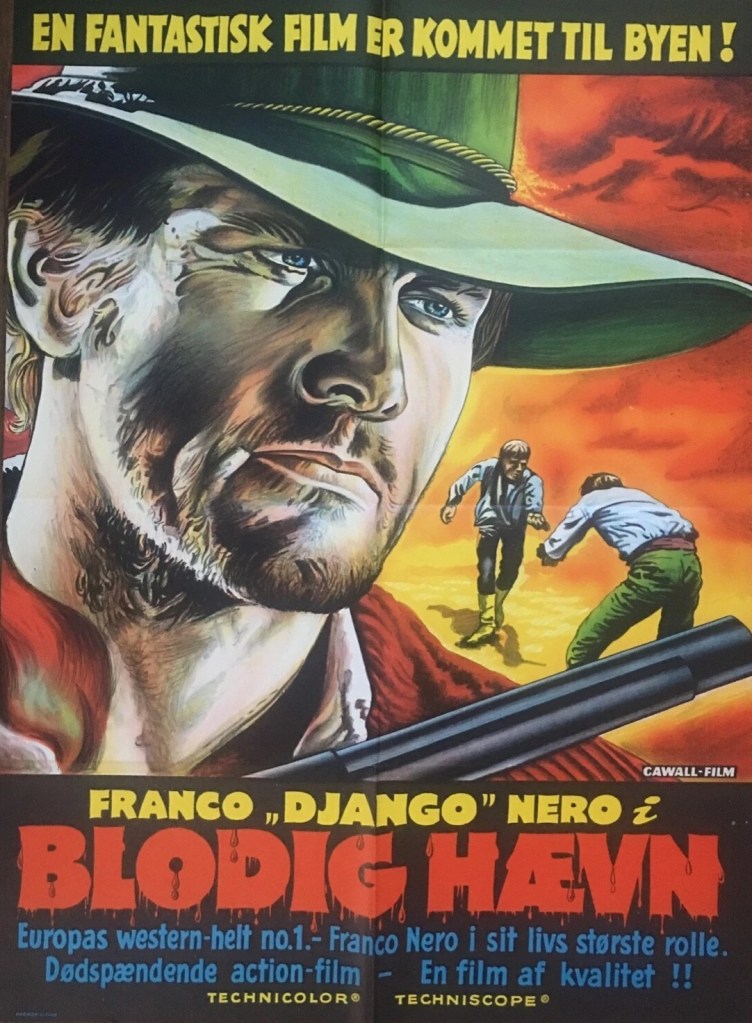
For reasons known only to mythmakers, the final shoot-out takes place in a cemetery in Tombstone, which is a heck of a long way (a mere 500 miles) from the Mexican border, but never mind. But there’s a clever ending, especially when you consider how difficult it is to shoot a revolver with a mangled hand.
This zips along with a ton of brio. Franco Nero (Camelot, 1967) resists the temptation to play up those baby blues. He’s virtually deadpan thoughout, quite an achievement in a movie where everyone else overacts. His character is even more down’n’dirty than The Man with No Name and comes across more as a man of the soil than a gunslinger. For such a violent movie, there’s an acknowledgement of politics that’s akin to the skewered morality of The Wild Bunch (1969). The plot takes us all over the place, but it’s so much fun who the heck cares.
The bloodshed (“excessive and nauseating” was the view of the British censor) was way ahead of its time, representing the reality of war and rebellion far more than the cartoonish killing of Leone’s spaghetti trilogy.
Director Sergio Corbucci (The Great Silence, 1968) isn’t trying to sell us a traditional western with sweeping vistas and terrific camerawork. This falls into the nihilistic vein. The huge tranches of mud at the outset set the tone, the land is barren and bleak, a desert of mud. There’s nothing opportunistic or greedy about Django. He’s not intent on playing off two sides for profit. His motive is personal. Where The Man With No Name was fleshed out with a certain amount of charm, there’s no recourse to that here. In a pitiless world, there’s no use for charm. Written by Sergio Corbucci and his brother Bruno.
This spawned as many rip-offs as the Leone versions.

