Django (1966) ****

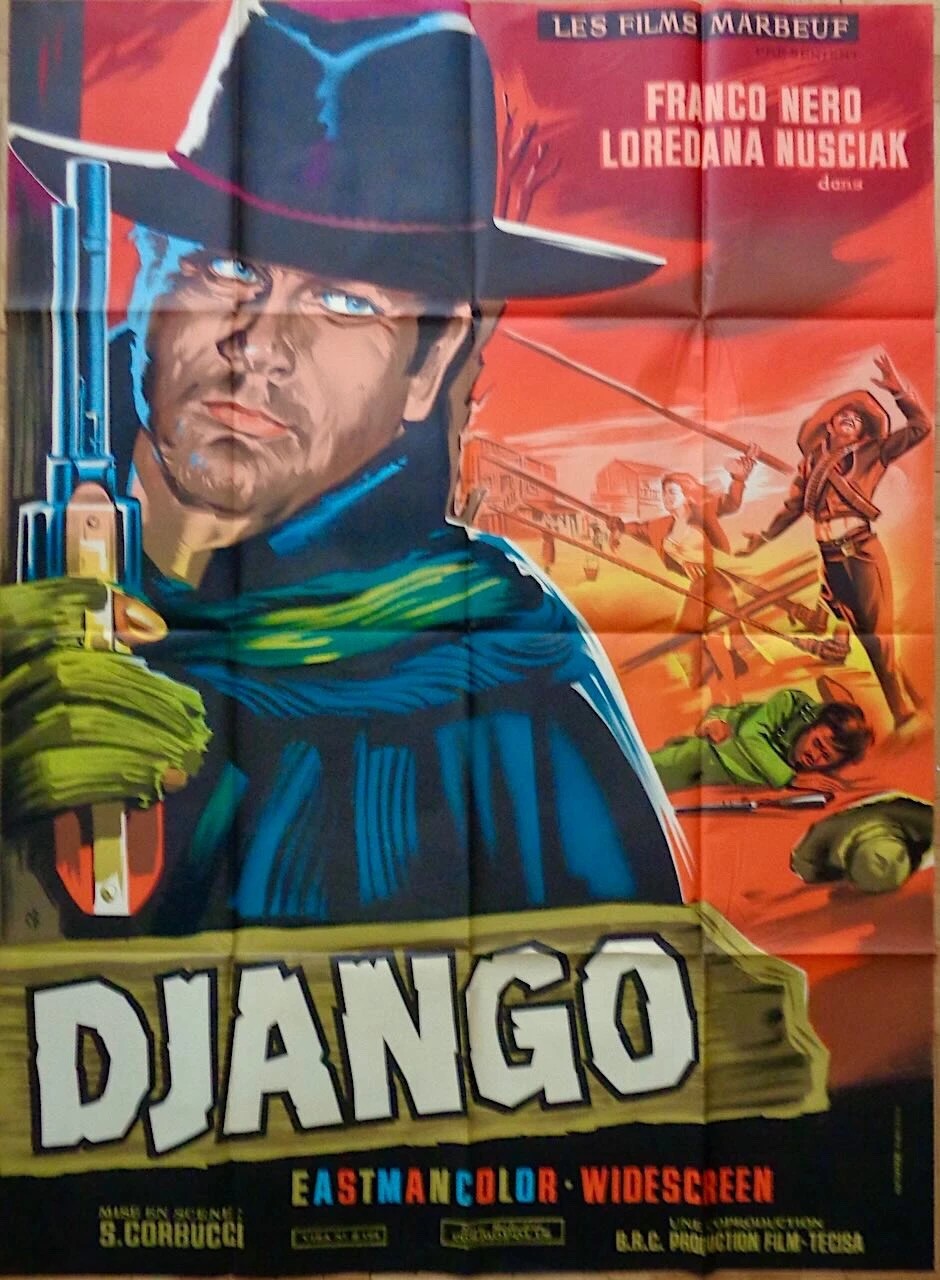
You’re not going to get a more iconic opening than a cowboy dragging a coffin up a muddy hill. But just in case you think director Sergio Corbucci is trying to make some high-falutin’ statement, the next few minutes contain nine deaths and a woman whipped and then threatened with being burned to death. What followed resulted in deserved cult status, helped along by a ban from the British censor. Outside Sergio Leone 1960s western quartet, this is generally considered to be the best spaghetti western of the period.   

You’ll be familiar with the story, because basically it’s a rehash of A Fistful of Dollars, which in itself was an uncredited rehash of Akira Kurosawa’s Yojimbo (1961).
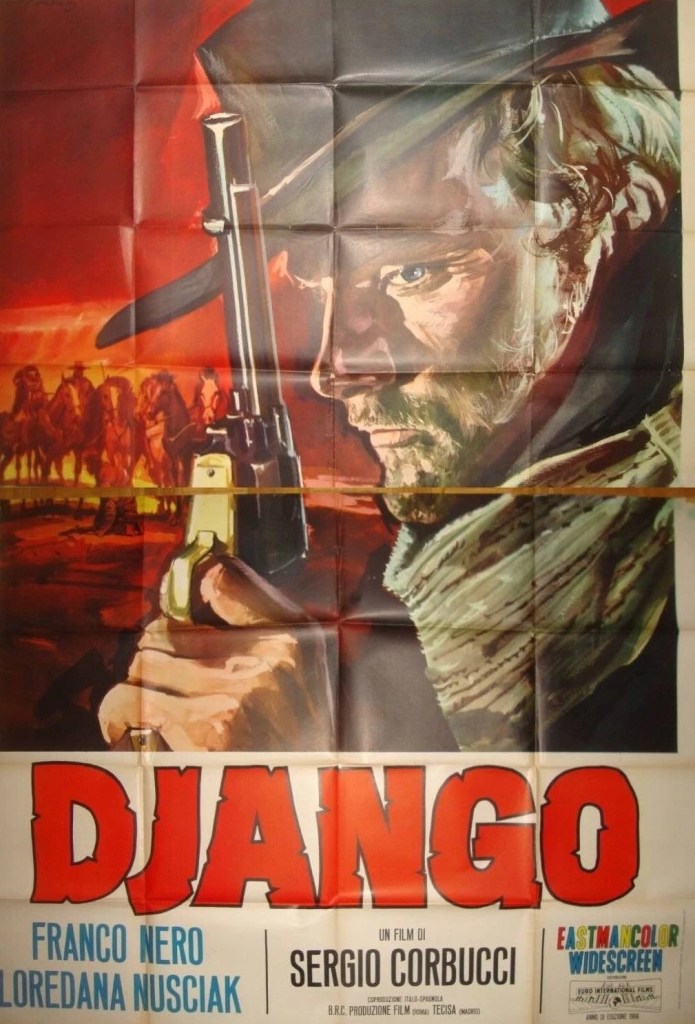
On the Mexican-U.S. border, two groups vie for control of a tiny town (population: six – one bartender and five whores), one led by ex-Confederate Major Jackson (Eduardo Fajardo) who would be dressed in the red shirts of revolutionaries except that the opposing bunch led by General Rodriguez’s (Jose Badalo) has chosen that color.

Django (Franco Nero) arrives in the town accompanied by the whipped woman Maria (Loredana Nusciak)  and the coffin, which contains a machine gun. Django wants revenge on Jackson who killed his lover. But that’s as much a MacGuffin as you need because, really, slaughter is the name of the game, not to mention a gold heist, then a heist of the stolen gold, which is stashed safely in Django’s coffin until it ends up in the quicksand.

This being a spaghetti western naturally there’s mutilation, Django’s hands crushed for the audacity of his theft, someone else forced to eat his own ear, and there’s attempted rape. Mostly, there’s massacre. A humungous heap of bodies provide the entertainment.  Jackson and the General are equally intent on killing as many people as possible, Rodriguez having the moral edge because he’s the legitimate revolutionary but it’s a close run thing.

But the good guys are always a hefty massacre away from safety.
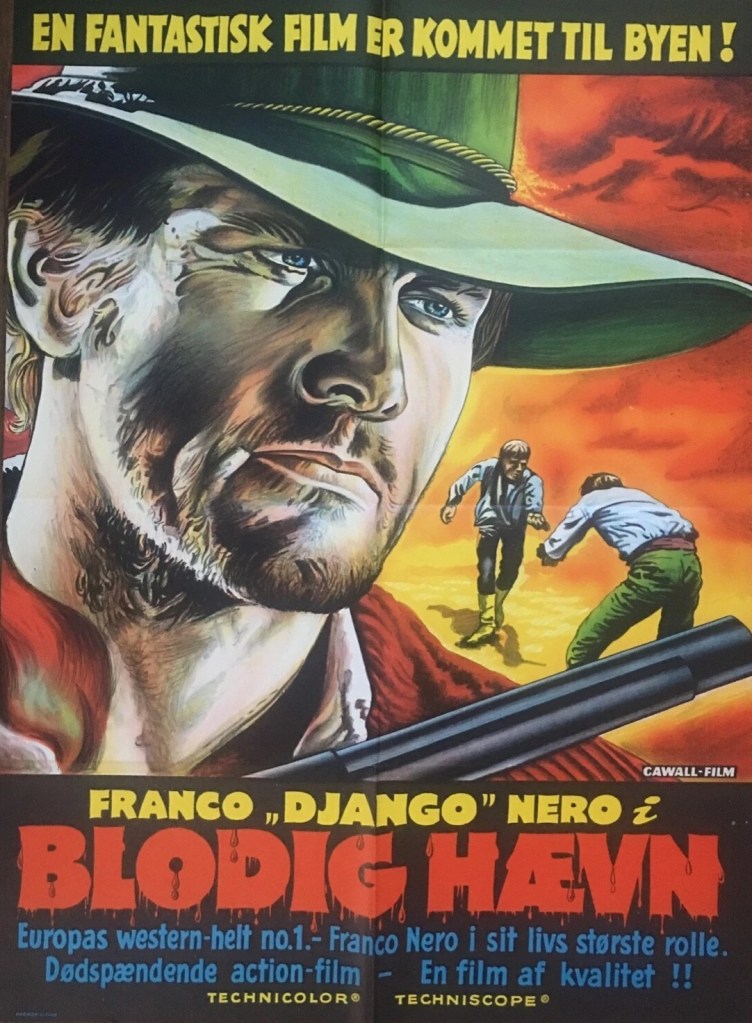
For reasons known only to mythmakers, the final shoot-out takes place in a cemetery in Tombstone, which is a heck of a long way (a mere 500 miles) from the Mexican border, but never mind. But there’s a clever ending, especially when you consider how difficult it is to shoot a revolver with a mangled hand.

This zips along with a ton of brio. Franco Nero (Camelot, 1967) resists the temptation to play up those baby blues. He’s virtually deadpan thoughout, quite an achievement in a movie where everyone else overacts. His character is even more down’n’dirty than The Man with No Name and comes across more as a man of the soil than a gunslinger. For such a violent movie, there’s an acknowledgement of politics that’s akin to the skewered morality of The Wild Bunch (1969). The plot takes us all over the place, but it’s so much fun who the heck cares.

The bloodshed (“excessive and nauseating” was the view of the British censor) was way ahead of its time, representing the reality of war and rebellion far more than the cartoonish killing of Leone’s spaghetti trilogy.

Director Sergio Corbucci (The Great Silence, 1968) isn’t trying to sell us a traditional western with sweeping vistas and terrific camerawork. This falls into the nihilistic vein. The huge tranches of mud at the outset set the tone, the land is barren and bleak, a desert of mud. There’s nothing opportunistic or greedy about Django. He’s not intent on playing off two sides for profit. His motive is personal. Where The Man With No Name was fleshed out with a certain amount of charm, there’s no recourse to that here. In a pitiless world, there’s no use for charm. Written by Sergio Corbucci and his brother Bruno.

This spawned as many rip-offs as the Leone versions.
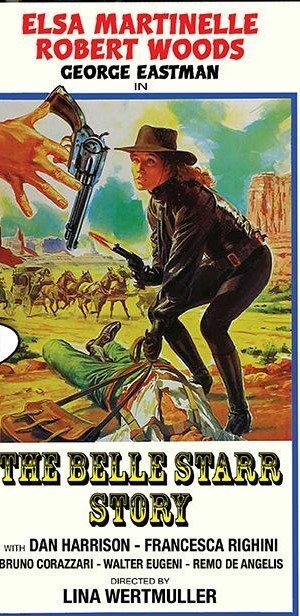
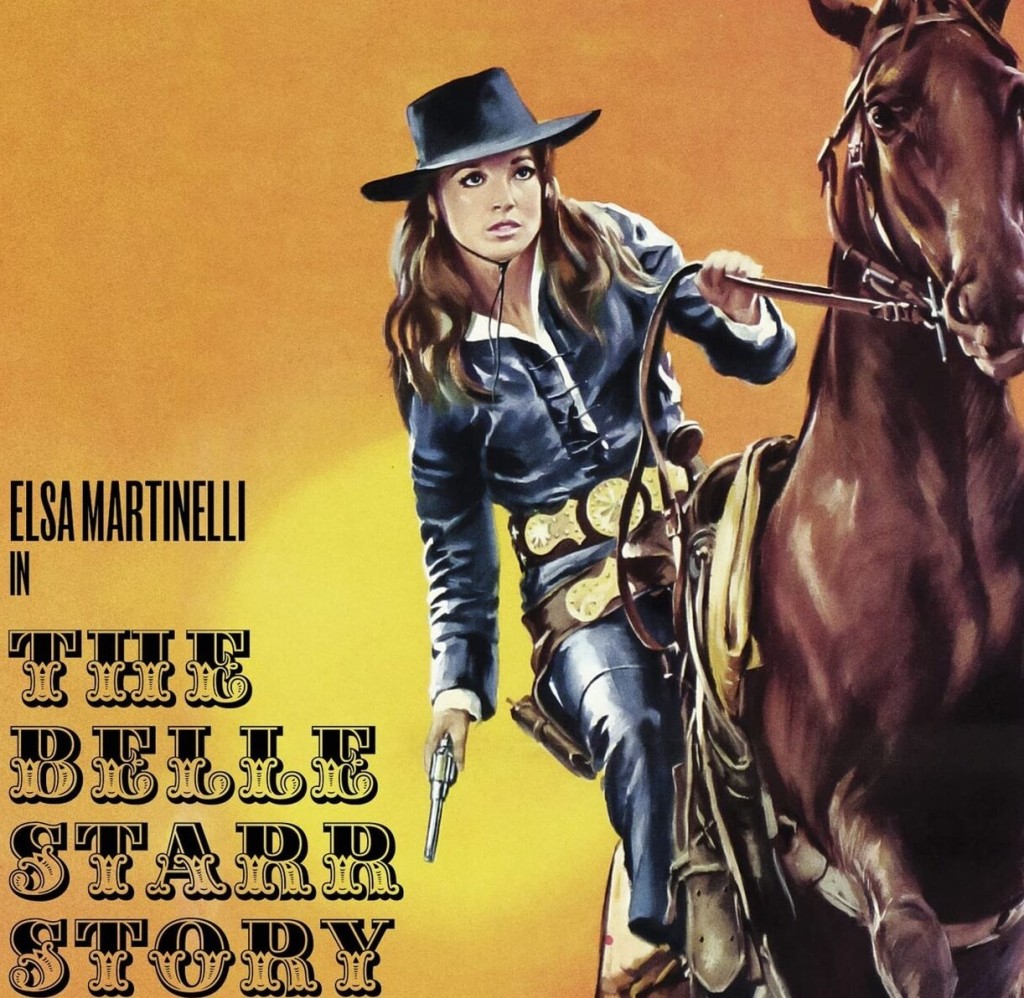
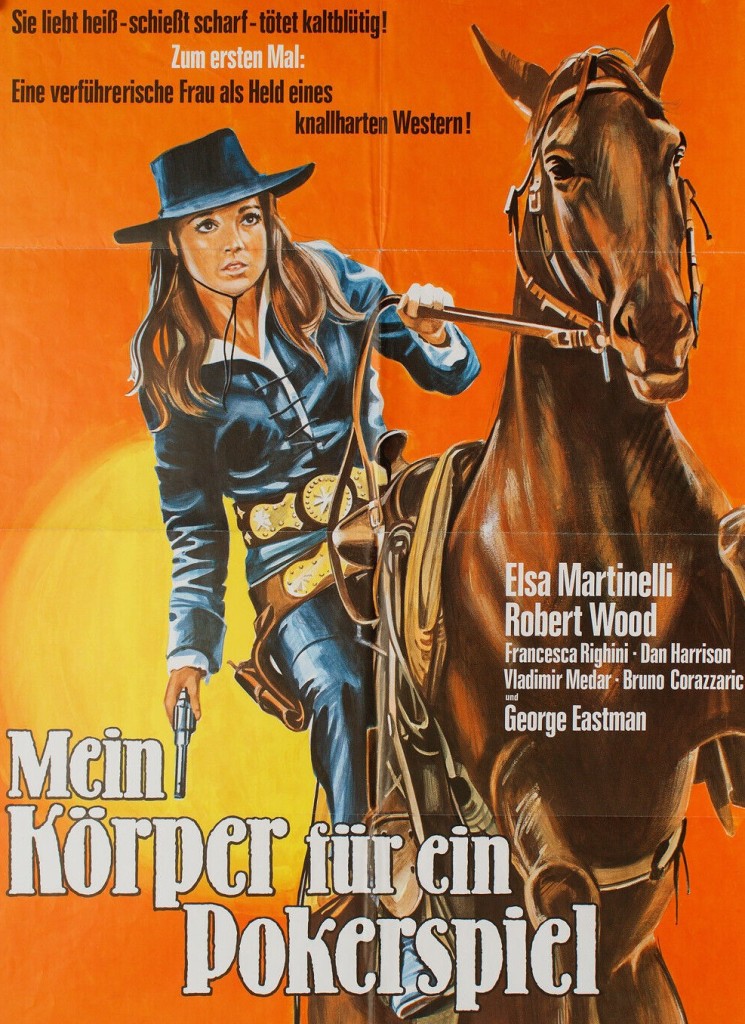
The Belle Starr Story (1968) ***

Only spaghetti western directed by a woman. Brings a distinctly feminist feel to that most sexist of the subgenres. You tend to forget that the sexy female Europeans imported to Hollywood as co-stars or to add spice further down the credits were actually top-billed stars in their natïve countries and demonstrated a greater range than the American industry allowed.

Not only do we have Elsa Martinelli (Maroc 7, 1967) as the leather-clad cigar-smoking titular gunslinger, whose watchword is female independence, but it was helmed by arthouse icon Lina Wertmuller (Swept Away, 1974).  There’s a thematic consistency lacking in most Italian-made westerns, for example predating Once Upon a Time in the West (1969) in its water imagery. But any potential for lyricism is undercut by the risk attached to being a lone woman. And there’s a Tracy-Hepburn tone to the endless bickering and battle for superiority in her niggling romance with outlaw Blackie (George Eastman).

And, unusually in that decade, a woman who throws caution to the wind and will even bet her body when the money runs out at the poker table, as twisty a meet-cute as a screenwriter could devise. But thereafter it’s a struggle for dominance between the pair. She won’t take orders from a man. He won’t accept female equality even when she shoots the wooden fence  he’s sitting on from under him, making him fall to the ground, and for good measure putting a bullet in his heels.

The first act builds up Belle Starr, cool at the poker table, even cooler in the bedroom, and demonstrating the gunplay that attracted her notoriety. The second act take an odd route, a lengthy flashback that digs deep into feminism, the orphaned Belle Starr running away after being sold into marriage by her uncle to an ugly old rich powerful man, traded, effectively, for political favor.

She returns to save a servant condemned to death for the crime of attacking the uncle when he tried to rape her. Sexual humiliation is a theme. Another outlaw Harvey (Robert Woods), who she regards as a platonic friend, steals her clothes as she swims in a lake, and then, having saved her from a posse, forcibly tries to take his reward.

The third act, like the duel between The Man With No Name and The Man in Black, is a case of double- and triple-cross. She refuses to join Blackie’s gang when he plans a million-dollar jewel heist, but hijacks the concept, recruiting her own gang to beat him to the robbery, and teach him a lesson.

But it backfires. Blackie is waiting. She has inadvertently hired his men. In the subsequence shoot-out he is captured. She rides to his rescue. But with their opposing ideas of a woman’s place in the world part on good terms.

The flashback was more subtly observed in Once Upon a Time in the West, and while she shared with Charles Bronson gunslinging skills he was not at any time viewed as a commodity or a piece of property or a candidate for rape. The flashback here fleshes out for the audience the powerlessness of women. But also the kind of camaraderie that is generally also usually only conferred on male characters.

We are pretty conversant with the notion that the gun rules the West. But less conscious of what happens when you are gun-less. Depriving someone of their fundamental weaponry makes them instantly impotent, as humiliating as denying someone water in a desert.

There are some nice directorial touches, blood dripping from a ceiling onto a dinner table, a saloon door opening to cast sudden light onto a corpse, waterfalls suggest sanctuary whereas open water attracts predatory males, and the finale, as they part, of Blackie, desperate to demonstrate his superiority, shooting off her hat from some distance.

Elsa Martinelli is a revelation as a star working to her own beat rather than playing second fiddle to some Hollywood marquee name. This wasn’t Lina Wertmuller’s first film and she had already made an impact with the Rita the Mosquito series, featuring another rebellious woman. Don’t be fooled by the co-directing credit, she replaced debut director Piero Cristofani after a few days.

It’s somewhat ironic that in a contemporary Hollywood attempt to create a female outlaw leader in Cat Ballou (1965), Jane Fonda was upstaged by Lee Marvin, and that in Bonnie and Clyde (1967), despite taking precedence in the title, Faye Dunaway was not the dominant one in the relationship.

By no means a great western but worth a look to see what Elsa Martinelli can achieve when not slotted in to the Hollywood co-star cliche and to get a preview of what Lina Wertmuller could offer.  

Decent print on YouTube.

Discover WordPress

A daily selection of the best content published on WordPress, collected for you by humans who love to read.

The Atavist Magazine

by Brian Hannan

WordPress.com Blog

News, Tips & Website Tutorials