Make Mine Mink (1960) ****

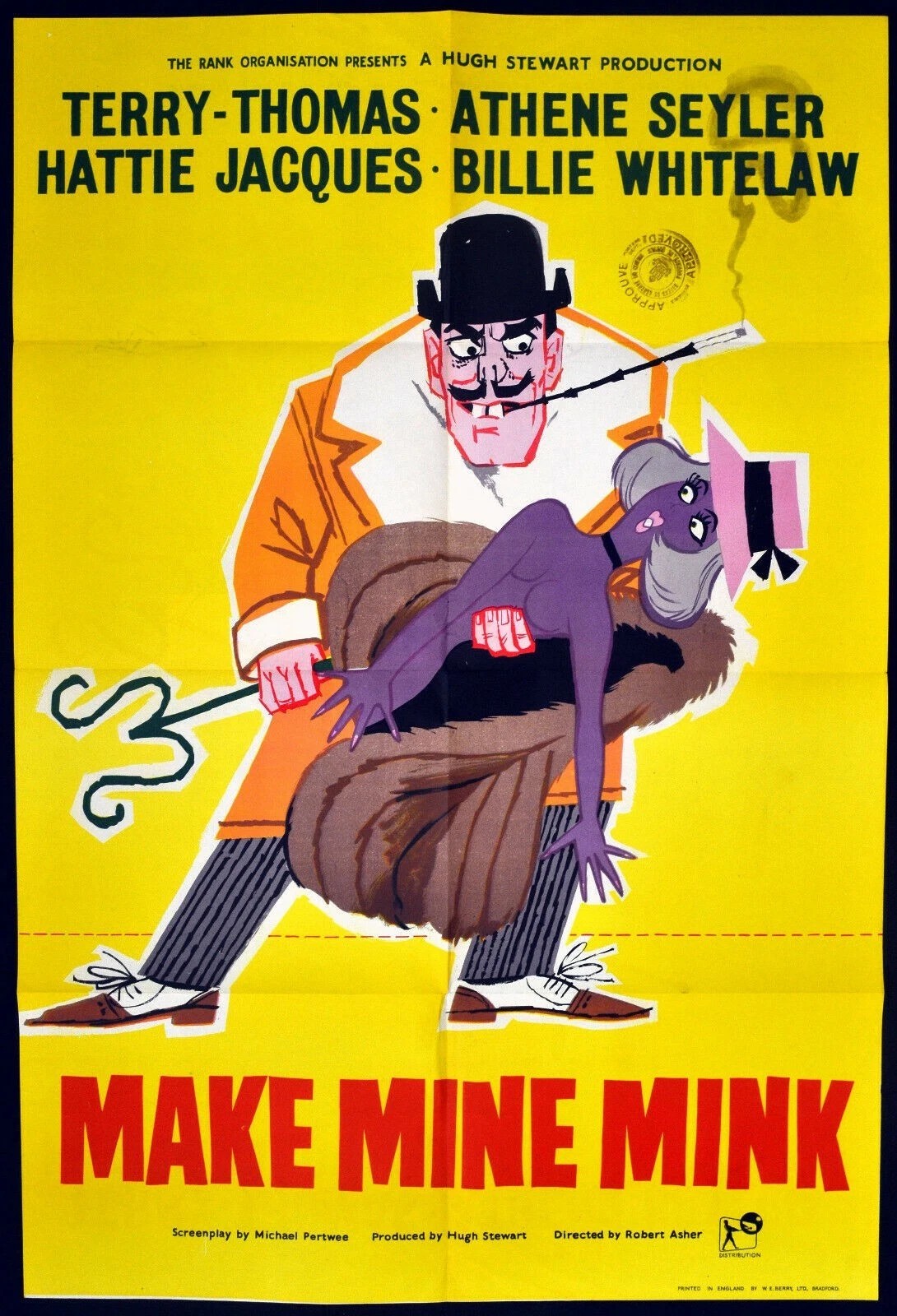
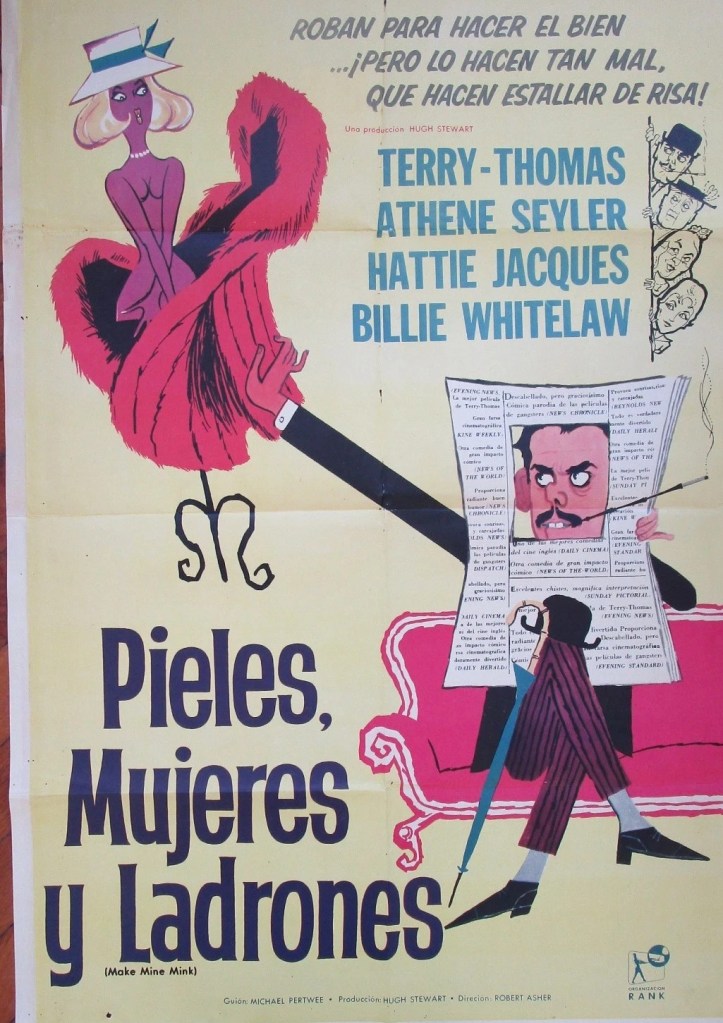
Jaunty little picture full of gags and visual treats pivoting on amateur crooks finding life tough in professional waters. While Terry-Thomas proves once again that he can spin any movie on its head with his own brand of upper-class buffoonery and those very distinct nasal tones, it’s very much a team effort with every one of the gang making a contribution.

The down-on-their-luck lodgers of impoverished Dame Beatrice (Athene Seyler) turn to crime after successfully returning a stolen mink. In the impenetrable logic of such tales, the quartet decide that if they can with military precision carry out a robbery reversal they would be well placed to actually carry out a robbery. Anal retentive Major Rayne (Terry-Thomas) would be a one-man League of Gentlemen except he has to rely on a motley crew of females, the luckless Dame, etiquette tutor Nanette (Hattie Jacques) and generally neurotic nincompoop Pinkie (Elspeth Duxbury). Getting very much in their way is the Dame’s maid Lily (Billie Whitelaw), an ex-jailbird, who wants nothing to do with illegitimate schemes and is romancing, to boot, Scottish cop Jim (Jack Hedley).

Nanette spends all her time puncturing the major’s pomposity, Pinkie spends all her time requiring liquid courage, and the major spends all his time happily barking orders and maintaining strict military order. Most of the time the incompetent crooks get away with their crimes because their victims are equally dense.

There’s a marvellous daftness to proceedings. Dame Beatrice, whose efforts at parking her car have resulted in continuous prangs and scrapes, is only too delighted to visit the local cop shop with the proviso that she needn’t bring along her license because she hasn’t seen it in a long time. The flat-chested Pinkie’s disguise is an inflated bosom. Trying to get rid of their ill-gotten gains to a fence sends Major into uncomfortable territory where being out of his depth is an invitation to a welter of fabulous comedy.

Naturally, they are not proper crooks since their thievery is all in the aid of charity. For a time, when Lily finds out, they are forced to give up, but then opportunity beckons.

There’s no attempt at either the satire that seemed necessary to seed into comedic ventures at the time if one were to achieve any sort of critical acclaim nor the double entendres, saucy innuendo and sex jokes that appeared to more easily to attract an audience. This is good old-fashioned comedy and I found myself laughing out loud a lot, which, to my mind, is the definition of a good comedy.

Here, the characters seem to mesh so well, and the narrative scarcely troubles the imagination that virtually everything works right off the bat, including a homage to The Third Man and those gags where bombs refuse to work. The major’s misplaced confidence, Nanette’s crunching handshake and the whimpering Pinkie all burst out of the screen. Lily is luminous most of the time except when she has to tell off the gang.

Terry-Thomas is a delight. This proved something of a breakthrough role in Hollywood terms and soon he would be tangling with Tuesday Weld in Bachelor Flat (1961) and challenging Peter Sellers as the country’s best comedic export. Hattie Jacques is relieved of the stern matron roles of the Carry On films and there’s something both impish and innocent in her head girl demeanor to the extent of still wearing her school uniform. Terrific ingénue turn from Billie Whitelaw (Twisted Nerve, 1968) and a knowing veteran’s one from Athene Seyler (I Thank a Fool, 1962) purring along in Margaret Rutherford fashion. Elspeth Duxbury, in movie debut, makes the most of a peach of a role.

Directed by Robert Asher (The Intelligence Men, 1965) from a screenplay by Michael Pertwee (Mouse on the Moon, 1963) based upon the stage play Breath of Spring by Peter Coke.

Having complained about the music in The Invite (2026), I would like to point to Philip Green’s (Masquerade, 1965) music here as exactly the kind of score that helps complement the action and establish the moiod..

Hugely enjoyable eccentricity.

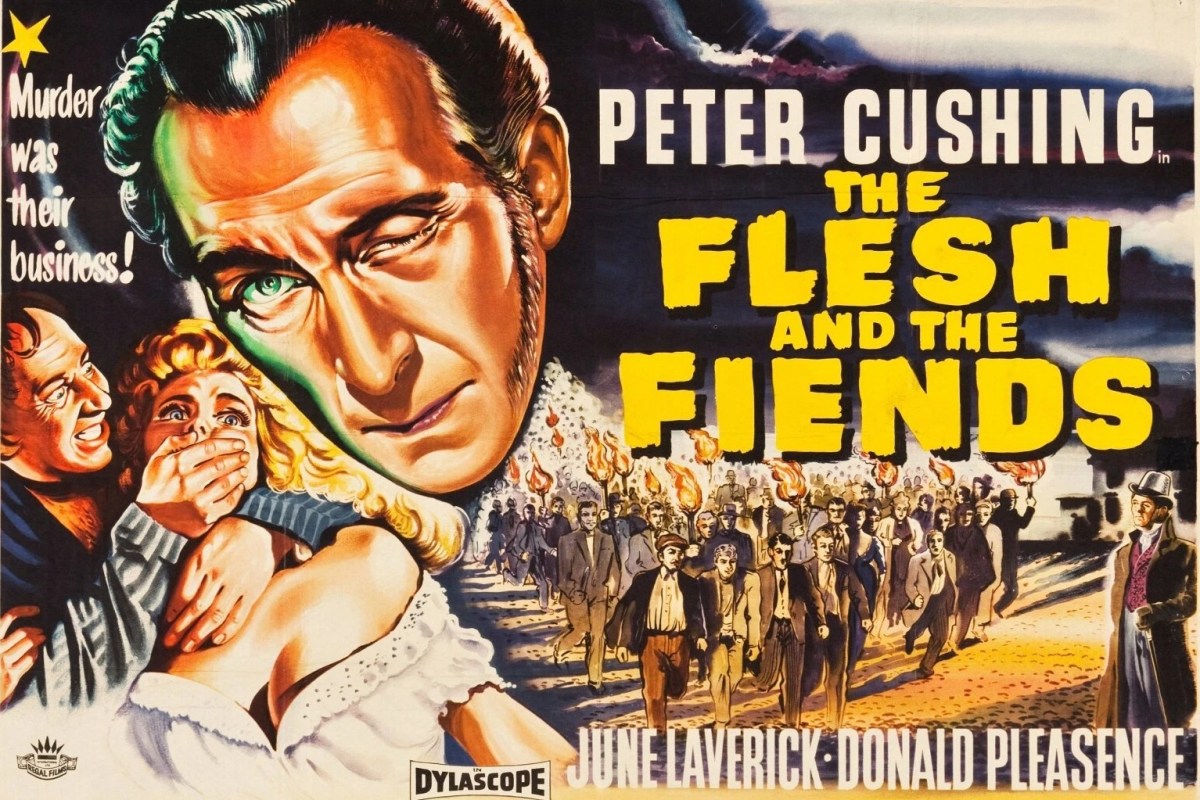
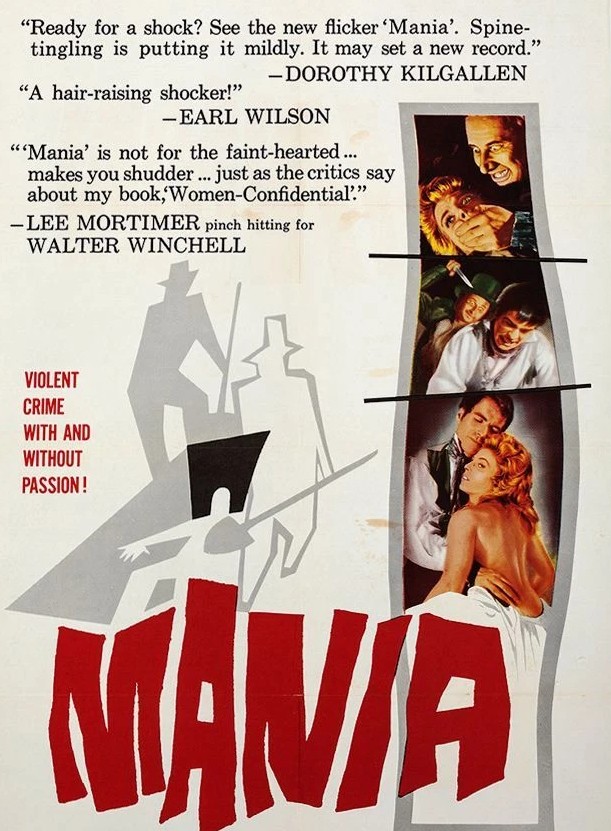
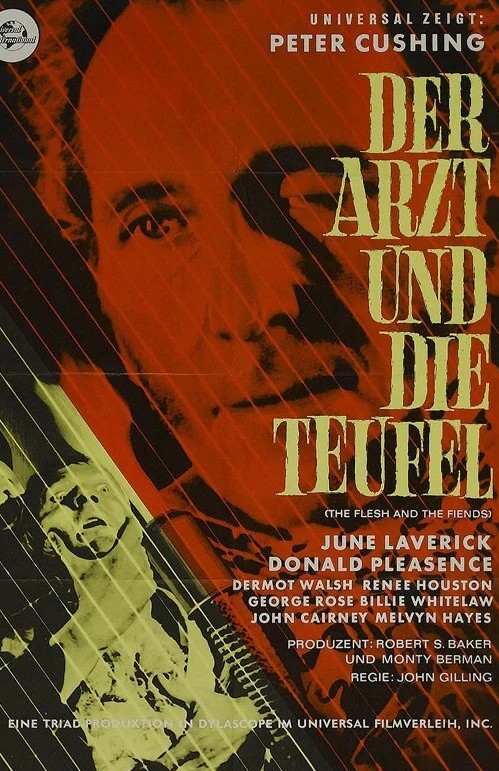
The Flesh and the Fiends / Mania / The Fiendish Ghouls (1960) ***

Hypocrisy runs rampant as an entitled medical hierarchy effectively condones vile practice. Of course it wouldn’t do to have Peter Cushing, who generally hounded demonic fiends like Dracula, to be tabbed a villain so with a little bit of jiggery-pokery he gets off scot-free and, in fact, is considered so much above other mortals that he receives a standing ovation at the end.

The self-justification, or deification if you like, of Edinburgh surgeon Dr Knox (Peter Cushing) is promoted on the back of primitive medicine, whereby, through sheer ignorance and laziness surgeons were more apt to kill than to cure.

Dr Knox is an advocate of using recently interred corpses to teach his students the real fundamentals of anatomy. However, his colleagues feel that the use of fresh corpses goes against the grain and there was no such thing in the early 19th century of donating your body to medical science. Grave-robbing was a crime.

Enterprising duo Burke (George Rose) and Hare (Donald Pleasance) get round that problem by skipping the burial aspect, murdering assorted drunks and vagabonds and delivering fresh meat to the good doctor, who turns a blind eye to their actions, determined as he is to improve teaching standards. He’s not the only one who believes that a streetwalker, killed in this fashion, has achieved more in death than life.

The good doctor has a conscience in the shape of Dr Mitchell (Dermot Walsh) who is wooing his daughter Martha (June Laverick), but he eventually comes round Knox’s way of thinking. The hierarchy in the shape of the Medical Council would get their claws into Knox were it not for the fact that in their incompetence they inflict more damage than good.

As a sub-plot, and as a way of weaselling into the lower classes who provide the bulk of Burke and Hare’s supply chain, earnest medical student Chris Jackson (John Cairney) falls for drunken goodtime girl Mary (Billie Whitelaw) who spends as much time making fun of him as she does sharing his bed.

You would have thought the high mortality rate of the period would not have made the local populace suspicious of a few extra deaths, but when Burke and Hare kill too close to home – Mary, Jackson and Daft Jamie – townspeople like a regular Transylvanian village mob light their torches and head off in pursuit.

The question of whether Knox was in collusion with Burke and Hare becomes the crux. But given the medical profession does not want to bring itself into disrepute, he is given a free pass and declared not guilty.

The high-mindedness which Peter Cushing (The Skull, 1965) usually brings to a role works in his favor here and, until the death rate mushrooms, audiences may be inclined to go along with his thesis that fresher corpses should be made available as a matter of course to doctors. His pinpoint arrogance brooks no quarter. He’s in entitlement heaven. And that his superiors back off informs you that hierarchies were as good at closing ranks and defending themselves then as now.

This was the first venture of Donald Pleasance (Soldier Blue, 1970) into the sleazy characterizations which would become a trademark. The nervous tics were a later addition. Here’s he’s mostly sweaty. 

I should profess an interest. John Cairney was a relative of our family but acknowledging his work in our household was limited to such less contentious material as Jason and the Argonauts (1963). Along with Billie Whitelaw (The Comedy Man, 1964), he was in the rising star category. Both deliver solid performances. You might also spot Melvyn Hayes of the It Ain’t Half Hot, Mum series (1974-1981).

Dodgy accents abound, Pleasance and Rose affect Irish accents and Whitelaw makes a stab at a Scottish one. I was surprised, given the date, to see a deal of nudity, but it transpires I was watching the “continental version.”

Directed by John Gilling (The Reptile, 1966) from a screenplay by himself and Leon Griffiths (The Hellfire Club, 1961).

You catch this on YouTube

Twisted Nerve (1968) ***

Another rich kid with mental health issues though without Orson Welles to offer expiation. The cause of this character’s illness is undetermined but it’s easy enough to spot the trigger to violence. The lad’s father is dead and his mother’s new husband, a wealthy banker, wants him out of the way, or at least out of the house, or at least, given he’s twenty-one, out working rather than mooning about the house all day.

And this was certainly the year for the movies exploring split personality – if such shallow treatment could be deemed investigation – what with Tony Curtis and Rod Steiger in serial murderous form in, respectively, The Boston Strangler (1968) and No Way to Treat a Lady (1968). And for movie fans it was an unexpecteldy speedy reteaming for Hayley Mills and Hywel Bennett after the humungous success of The Family Way (1967) in which the actress shed her child-star persona in no uncertain manner and the British film industry was, apparently, suddenly blessed with a duo with marquee appeal.

A poster that gives the game away. And an apostrophe issue.

This takes the Rod Steiger route of charming killer rather than a Tony Curtis puzzled and horrified by the demands of his ulterior personality. Given the emphasis on mental illness these days, Twisted Nerve is the hardest of the trio to take, since it’s effectively a play on an old gimmmick, deviousness concealed inside appeal.

Martin (Hywel Bennett) faced with expulsion from his house by overbearing substitute father Henry (Frank Finlay) pretends to scoot off to France but instead inveigles himself into the boarding house run by Joan (Billie Whitelaw) after tricking her librarian daughter Susan (Hayley Mills) into extending a sympathetic hand to his alter ego, the childish Georgie, whose behavior falls only a little way short of sucking his thumb and clutching a teddy bear.

Joan’s initial cynicism gives way to maternal feelings when he clambers into her bed in the middle of the night after a supposed nightmare. (And not with sexual intent.)

Occasionally, Martin cannot control his true feelings, despite Susan rebuffing his romantic overtures. Father is the first victim, substitute mother Joan the second and it’s only a matter of time before Susan becomes a target either for his stifled sexuality or his inner venom.

This would probably work just as well minus the schizophrenic element. In fact, there’s too much of tipping the nod to the audience. Eventually, Susan’s suspicions are aroused but  director Roy Boulting (The Family Way) is no Alfred Hitchcock able to manipulate an audience. So, mainly, what we are left with is Hywel Bennett’s ability to pull off a double role rather than his victims’ susceptibility to his charms.

Hayley Mills’ character could do with fattening up, otherwise she’s just the dupe, bright, bubbly, self-confident and attractive though she is, although her mother, in passing, is given more depth, a lonely attractive widow prone to sleeping with her attractive guest Gerry (Barry Foster) and, unnerved to some extent by her daughter’s growing independence, wanting a son to mother.

It’s only un-formulaic in the sense that the director is playing with an audience who were not expecting anything like this as a story fit for their two newest adult stars so hats off especially to Bennett for considering a role that could as easily have typecast him for the rest of his career. As I said, setting aside the mental illness elements, Bennett is good fun, as he toys with both aspects of his character, adeptly dealing with those who would patronise him, and like Leopold and Lowe convinced he can get away with the perfect crime, whose planning and attention to detail is noteworthy.

As with the Chicago killers it’s only accident that gives him away, although the policeman here (Timothy West) is less dominant than his American counterpart.

Clearly filmmakers of the 1960s were beginning to grapple with mental illness but either lurching too far towards romance as a way of instigating tragedy as with Lilith (1964) or to the most violent aspects of the condition as with virtually anything else beginning with Psycho (1960).

Worth a look for Hywel Bennett’s chilling performance – template for Edward Norton’s turn in Primal Fear (1996) – and Hayley Mills fans won’t want to miss it. Strong performances by Billie Whitelaw (The Comedy Man, 1964), Barry Foster (Robbery, 1967) and Frank Finlay (The Shoes of the Fisherman, 1968) help enormously. There was quite an input into the screenplay. Along with Boulting, Leo Marks (Sebastian, 1968) doing the heavy lifting adapting work by Roger Marshall (Theatre of Death, 1967) and, in his only movie credit, Jeremy Scott. Great score by Bernard Herrmann.

Well done with misgivings.   

Discover WordPress

A daily selection of the best content published on WordPress, collected for you by humans who love to read.

The Atavist Magazine

by Brian Hannan

WordPress.com Blog

News, Tips & Website Tutorials