Disclosure Day (2026) *** – Seen at the Cinema

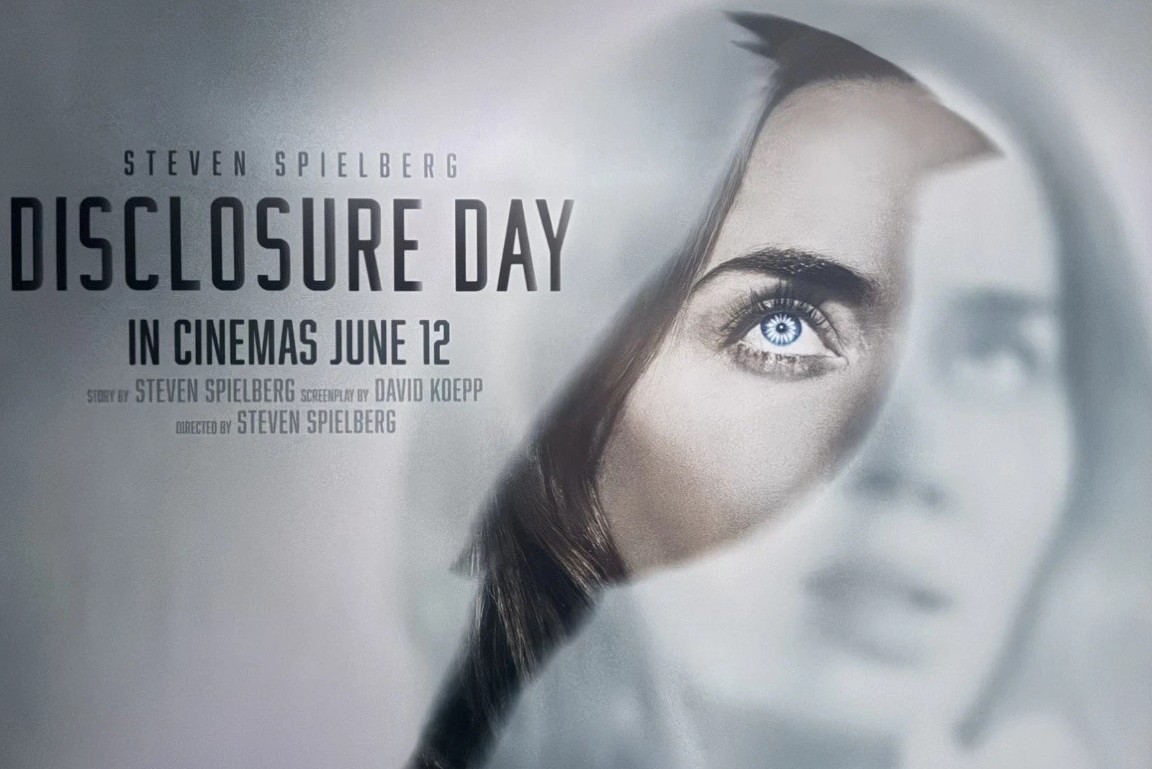
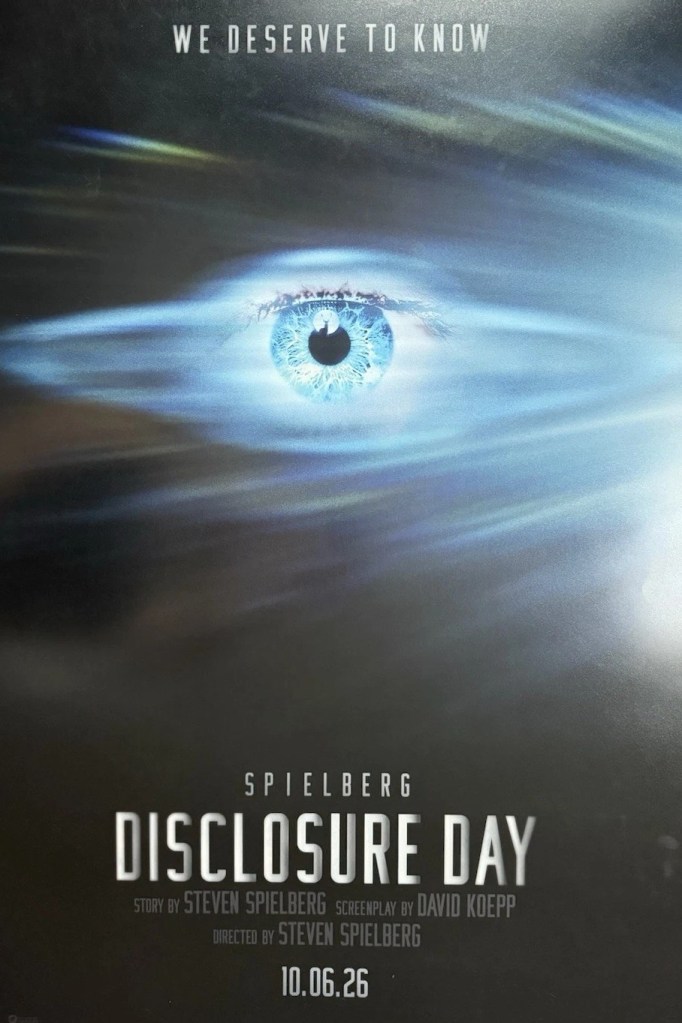
Thanks goodness other directors stepped up to the summer box office plate otherwise Hollywood would be left wringing its hands at this workmanlike, sanctimonious, effort. Like the recent Star Wars number, you get the impression the Steven Spielberg IP has long gone off the boil with the exception of sojourns into the prehistoric. He has not had a box office hit in years – The Fabelmans (2022) and West Side Story (2021) bit the dust along with The Post (2017) while Ready Player One (2018) only just made its money back.

Maybe it’s simply age (he’s pushing 80), but he’s lost that special magic that made him one of the all-time greats, the idea that he create something new, awesomely visual, rather than that he’s turned into an earnest lecturer.
Luckily, some other unexpected contenders – Project Hail Mary, Michael, Obsession, Backrooms – have stepped up the box office plate and Toy Story 5 is way ahead of initial projections while we we’ve still got another instalment of Minions and Spiderman to come, though judging from the trailers I’m less confident of Supergirl and The Odyssey delivering, though the latter may hit it big upfront judging from Imax advance bookings

This is a retread of Close Encounters of the Third Kind (1977), with the same male-female characters – weatherperson  Margaret (Emily Blunt) and ex-jailbird scientist Daniel (Josh O’Connor) – in search of something unknown, as though they are conduits to an alien world, one that serves up the same soup of aliens being wondrous beings, not to be illicitly tampered with. However, to peg all this on the Roswell “conspiracy” and to deck out almost every scene with men in black and men in black driving black cars seems an immense miscalculation.

The plot is full of holes, too, if you don’t mind me saying. How on earth did the rebels manage to snag a living alien from under the noses of the uber-security security forces of the quasi-government facility, or, even worse, have they made off with a baby creature and grown it themselves.

In social media world sure everyone is going to drop what they are doing and go past their bus stops or remain in situ to watch on their mobile phones “disclosure day” when an alien appears on their screen, but in the cinema world my guess is that audiences, like me, were staggered that after well nigh two-and-a-half-hours of a shaggy dog story this was all Mr. Spielberg could come up with.

Sure, there’s a bit of a chase scene here and there, and some form of telekinesis and people holding the kind of brick – that old-style mobile phones use to be made off – that has some kind of magical power, enough that Daniel’s girlfriend Jane (Eve Hewson) can be used as a conduit for Noah’s (Colin Firth) evil intentions, which is mainly to prevent “disclosure day.”
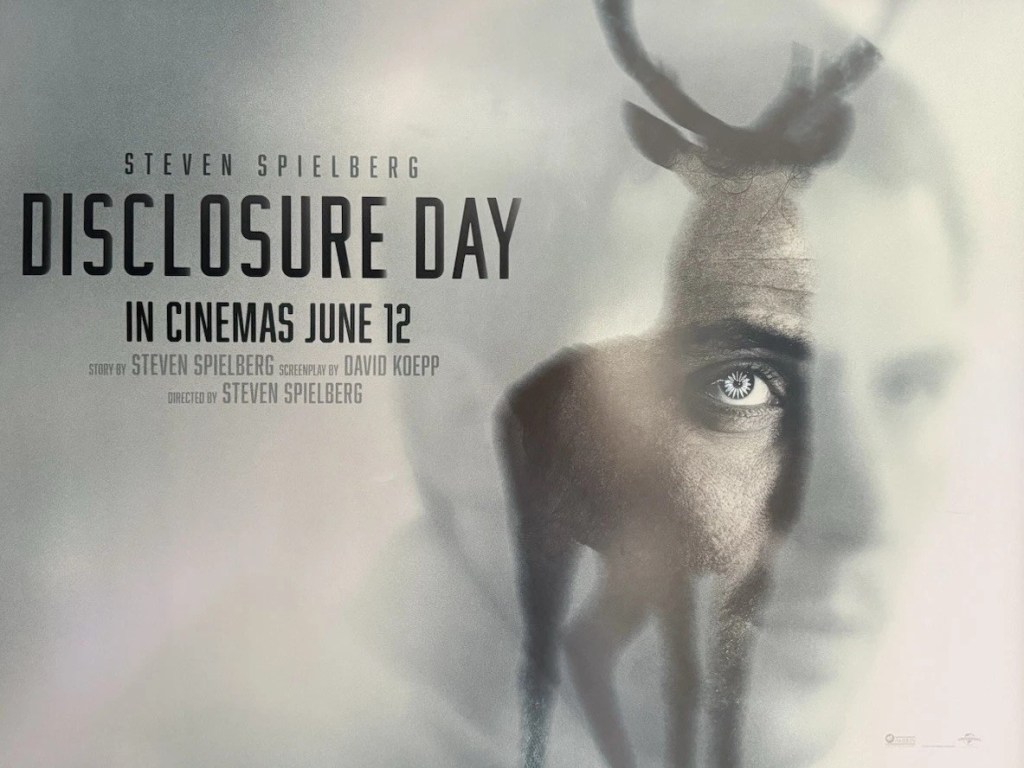
None of the supposed supernatural powers on show here are much to write home about, and there’s none of the wonder of Close Encounters and E.T. (1982), or even the more violent sci fi of Minority Report (2022) and War of the Worlds (2005) where aliens, whether artificially induced or not, are not on their best behavior. There’s not a single scene that you could say has the distinctive Spielberg stamp, rather a ramshackle screenplay that throws together a lot of different tangents in the hope, somehow, that they’ll all miraculously come together.

The only characters given any characterization are rootless Margaret and ex-novitiate Jane. Margaret is always on the look-out for something better, quite happy to wander from city to city to do so, the kind of ambitious also-ran who thinks they have a chance of grabbing the golden ring even if it means adding the occasional sexy shimmy to her weather-reading chores. Jane, Lord help us, is landed with the worst characterization I can remember, laden down with the idea that we might have to share the God-made universe with someone other than human beings. How on earth that 1950s idea made it into a contemporary movie is anybody’s guess and remember that Paul Schrader was yanked off screenwriting duties on Close Encounters for making it overtly religious.

Luckily, Emily Blunt (The Devil Wears Prada 2, 2026) more than holds the picture together and there’s certainly something touching in the way, using her sudden special powers, she puts troubled people at their ease. Daniel is there as a plot conduit, tasked with little more than exposition.

Noah and rebel leader Hugo (Colman Domingo) come across like the grown-ups, one trying to keep the spook in the box, the other trying to let it out.

There’s probably enough going on to keep you hooked, but the big reveal is a big disappointment.

Steven Spielberg does not save summer.  
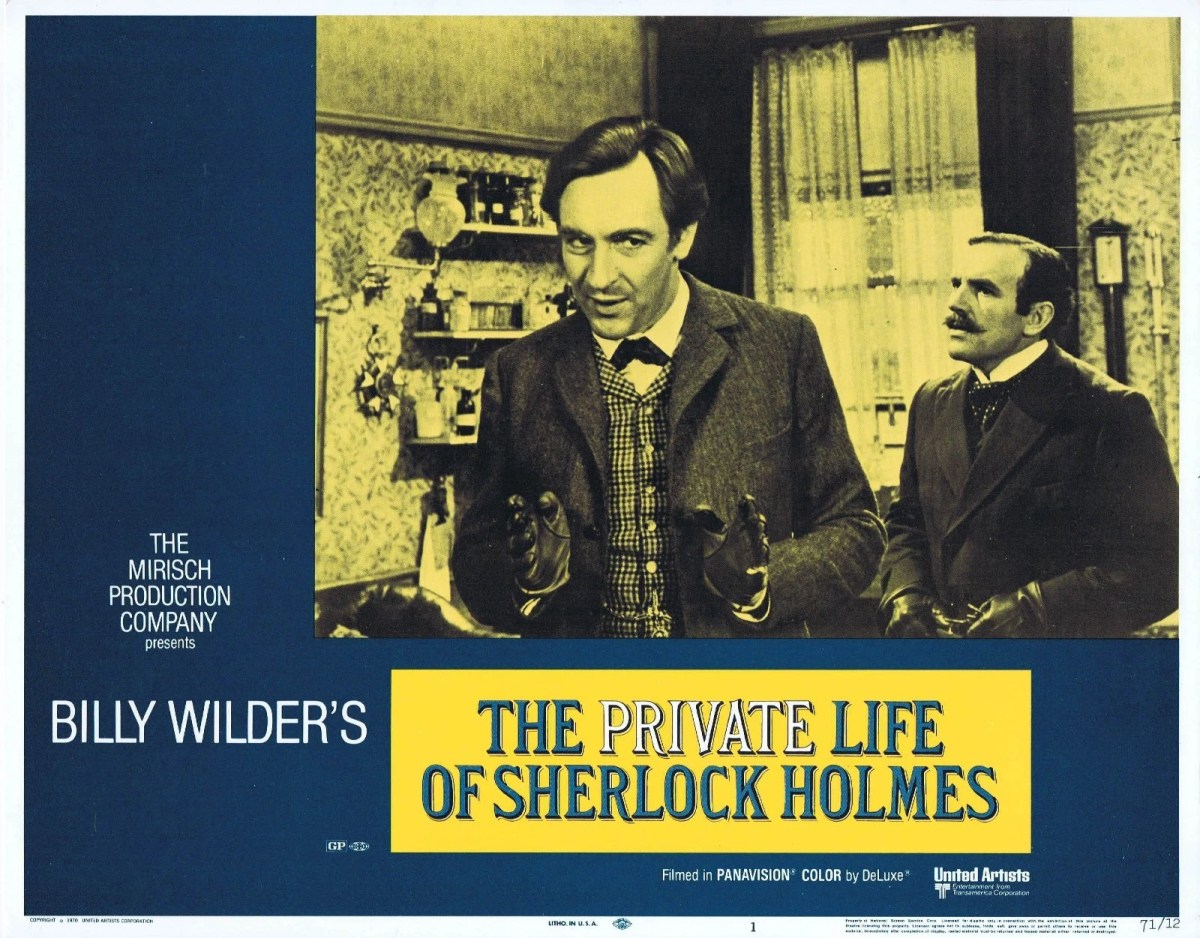
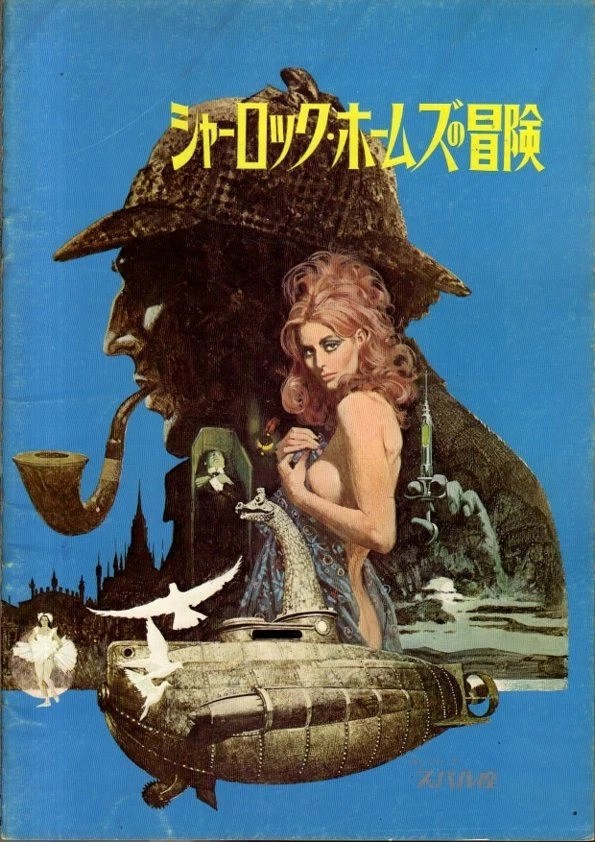
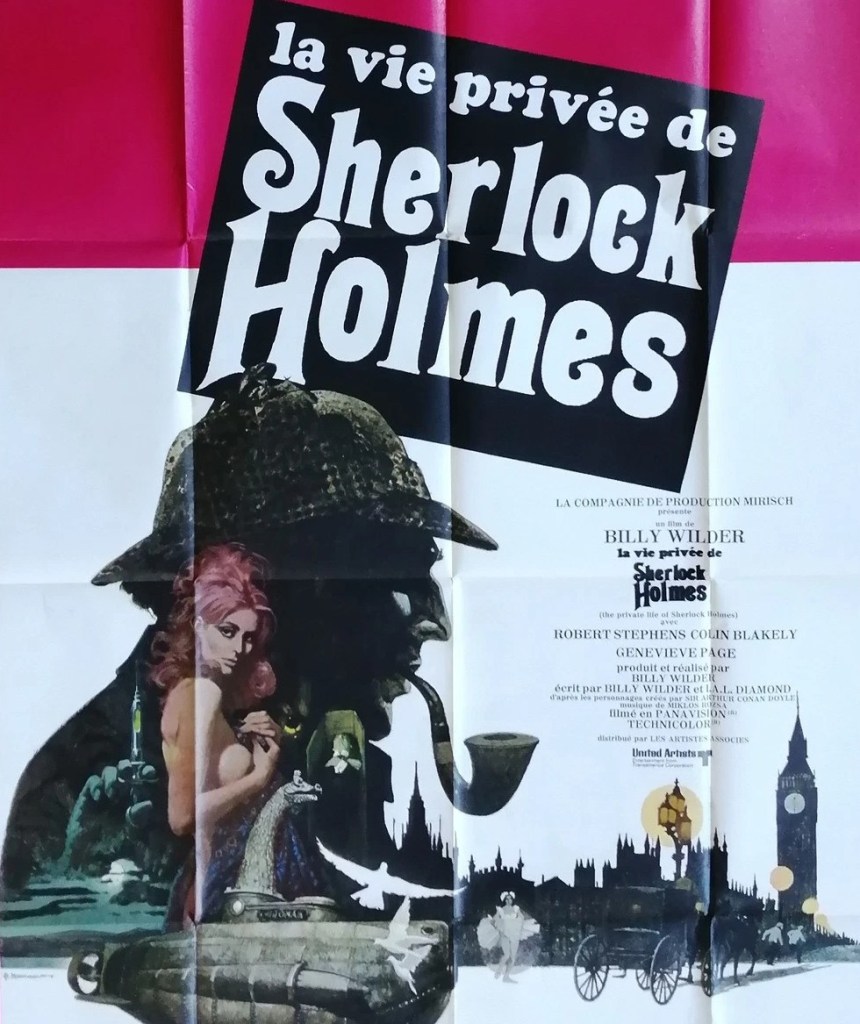
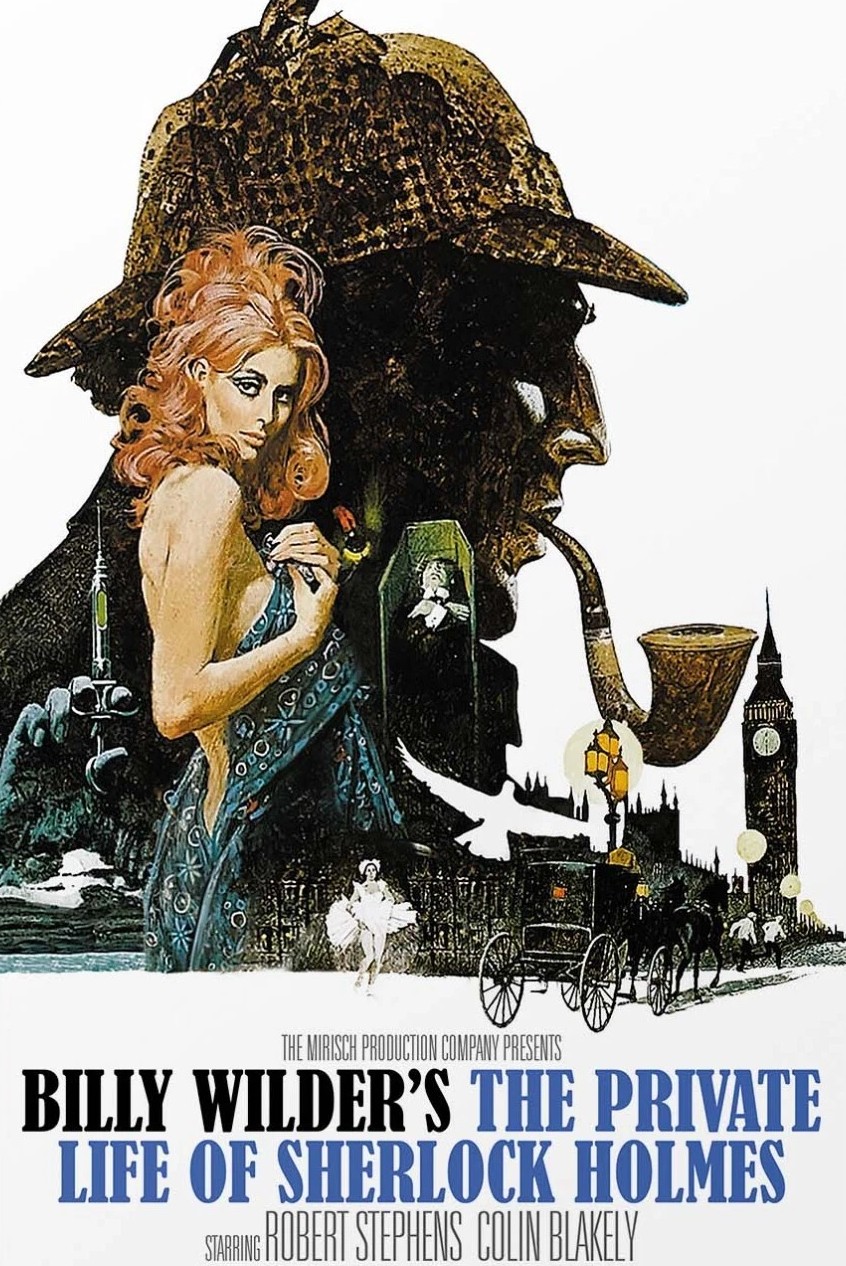
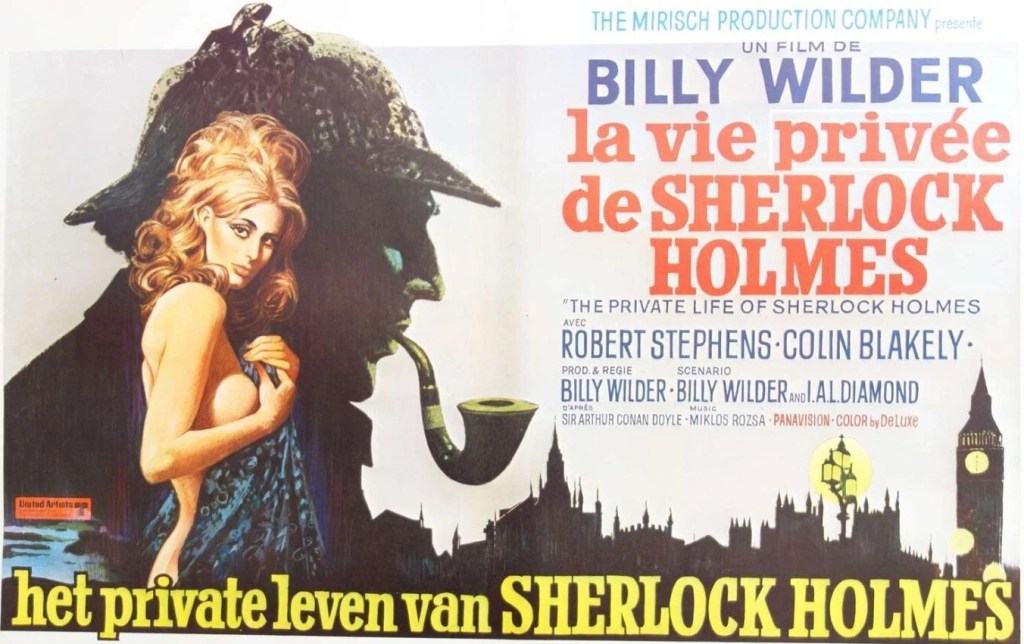
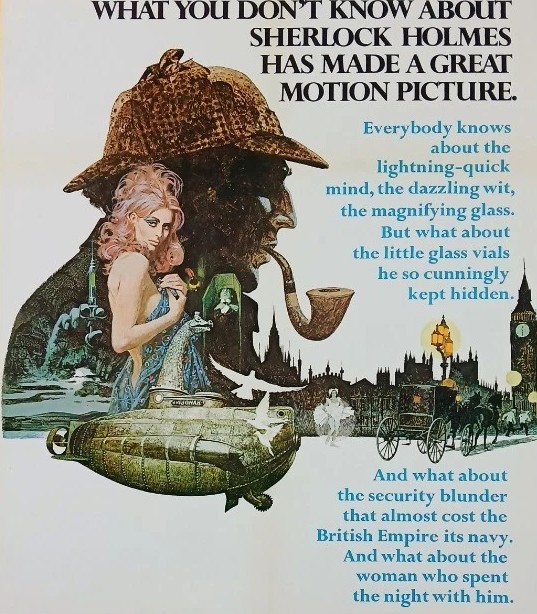
Behind the Scenes: “The Private Life of Sherlock Holmes” (1970)

Although Billy Wilder had written a script based on The Life of Sherlock Holmes (in fact he had three versions of the project running in his head, initially conceiving of the movie – twice – as a musical) by the time it came round to seeking funding in the early 1960s  he was not originally considered as its director. Mirisch was looking to contain the budget to around the region of $2 million, which would rule out any big star. However, at this early stage of the production, there were issues with the Conan Doyle Estate which was in the process of firing up other movies based on Sherlock Holmes, A Study in Terror (1965) being the most recent and also had another Conan Doyle property The Adventures of Gerard (1969) in mind.

A Study in Terror had been the brainchild of producer Henry Lester (who was also behind The Adventures of Gerard) and perhaps to general astonishment these days Mirisch had  agreed Lester would be allowed to make more Sherlock Holmes pictures as long as they remained very low-budget, on the assumption, presumably, that the marketplace would treat them as programmers rather than genuine competition.

However, Mirisch and UA retained the upper hand as regards the Conan Doyle Estate and “could cut him (Lester) off at such time as we have made definite plans to proceed.”

There was another proviso to the deal. The Estate would agree to forbid any further television productions unless Mirisch decided it wished to go down the small screen route itself. It was odd that Mirisch had eased Billy Wilder out of the frame given the mini-major had enjoyed considerable success with the director on Some Like it Hot (1959) and The Apartment (1960), a commercial partnership that would extend to The Fortune Cookie (1966).

Instead, Mirisch lined up British director Bryan Forbes who would be contracted to write a screenplay based on the Wilder idea. The sum offered – $10,000 – was considered too low, but it was intended as enticement, to bring Forbes into the frame as director. If Forbes refused to bite, “the only other name suggested and agreed upon was that of John Schlesinger.”  Although David Lean was mooted, UA were not in favour. Mirisch didn’t want to risk paying for a screenplay before there was a director in position.

The offer of the Sherlock Holmes picture was seen as a sop to Forbes. Mirisch had canned The Egyptologists, a project which Forbes believed had been greenlit. And why would he not when he was being paid $100,000 for the screenplay. In bringing the project to an untimely close Mirisch hoped to limit its financial exposure to two-thirds of that  fee.

Should Forbes balk at Sherlock Holmes, he was to be offered The Mutiny of Madame Yes, whose initial budget was set at $1.5 million, plus half a million for star Shirley Maclaine. Another Eady Plan project, this was aimed to go before the cameras the following year. If Forbes declined, then Mirisch would try Norman Jewison with Clive Donner and Guy Hamilton counted as “additional possibilities.”

As for Billy Wilder he had much bigger fish to fry. He was seeking a budget of $7.5 million to adapt into a film the Franz Lehar play The Count of Luxembourg to pair Walter Matthau and Brigitte Bardot. Should Matthau pass, Wilder would try for Cary Grant (whose retirement had not yet been announced) or Rex Harrison. Both sides played negotiation hardball. UA currently in the hole for $21 million for The Greatest Story Ever Told (1965) and Mirisch, having pumped $13 million into the yet-to-be-release Hawaii (1966), didn’t want to commit to another unwieldy expensive project.

So Mirisch insisted the project advance on a “step basis” allowing UA to reject the project after seeing the screenplay. Wilder countered by insisting that if it went into turnaround he, rather than the studio, would have the right to hawk it elsewhere (generally, studios tried to recover their costs if a movie was picked up by another studio). But Wilder was also in placatory mood and even if UA rejected this idea he was willing to work with the studio on a Julie Andrews project called My Sister and I.

However, UA and Mirisch were all show. “After Billy left the meeting,” read the minutes, “it was agreed we would not proceed with The Count of Luxembourg since we did not want to give Billy the right to take it elsewhere if United Artists did not agree to proceed.” Harold Mirisch was detailed to give Billy the bad news, but use a different excuse.

Initial casting had mooted Frenchman Louise Jourdan (Made in Paris, 1966) as the detective with Peter O’Toole or Peter Sellers as Dr Watson. Jourdan had worked, anonymously as it happened, for Wilder before, providing the uncredited voice for the narrator of Irma La Douce (1963).

By 1967, the Sherlock Holmes business was heating up. MGM was planning an adaptation of Broadway musical Baker Street and Paramount had on the cards The Man who Was Sherlock Holmes. Mirisch was also ramping up production, with $20 million invested in five properties, its busiest period ever.

Although Walter Matthau had been mooted for a supporting role, presumably Mycroft Holmes (the part ultimately played by Christopher Lee), wilder had decided the new picture would have no stars, to keep down the mushrooming budget – the eleven-month shoot would cost $10 million – and so that audiences would not come to the film with preconceived ideas. A future Holmes, Nicol Williamson (The Seven Per Cent Solution) was considered but rejected in favor of Robert Stephens (The Prime of Miss Jean Brodie, 1969) and Colin Blakely (Alfred the Great, 1968). All three effectively qualified as unknowns though by the time the movie appeared, Stephens, by default, had a stronger marquee name.

Although it was know that Rex Harrison (My Fair Lady, 1964) was desperate to play Sherlock, wilder stuck to his guns and opted for the lesser-known names. James Robertson Justice (Mayerling, 1968) and George Sanders (The Best House in London, 1969) were originally tapped for the role of Mycroft but were replaced by Christopher Lee (The Devil Rides Out, 1968).

There was extensive location work including several sequences set in Scotland. Baker Street was reconstructed on the Pinewood lot, where filming began on May 5, 1969.

Problems began after Mirisch viewed the first cut which ran to an epic three hours and 20 minutes. After a disastrous preview, Walter Mirisch kicked Wilder off the picture and carved one-third out of the picture, restructuring it, removing several episodes where Holmes solves various crimes and focusing on the Russian ballerina subplot and then the Belgian woman looking for her missing husband which takes Holmes to Loch Ness.

Naturally, the deletions altered the entire tone of the picture but as it stood it resembled little more that half a dozen 30-minute episodes, the kind of thing audiences could get for nothing on television.

United Artists did its best to make a big splash. It opened in November 1970 at the Radio City Music Hall in New York, the biggest and most prestigious house in the U.S., and that was to be followed by a Xmas release. However, the result at the Music Hall were deemed “dame” – just $150,000 from the 6,000-seat auditorium. Elsewhere it faltered, a “dim” $9,000 from five houses in Baltimore, a “pale” $5,000 in Boston, a “dismal”  $3,500 in Cleveland and a “light” $5,000 in Kansas City. It came nowhere near covering its costs.

A gala royal premiere at the Odeon Leicester Square – the biggest and most prestigious cinema in London’s West End – did little to bring in the public and it opened to a distinctly underwhelming £7,000.

SOURCES: United Artists Archive, Wisconsin Center for Film & Theater Research; Walter Mirisch,  I Thought We Were Making Movies, Not History (University of Wisconsin Press);  “Billy Wilder Return from Great Silence,” Variety, May 19, 1965; “New Sherlock Holmes Pix,” Variety, January 21, 1967; Box office – Variety November 1970-January 1971.

The Private Life of Sherlock Holmes (1970) **

The word is that you can’t blame director (and producer and co-writer) Billy Wilder for this disaster because it was taken out of his hands by studio United Artists and drastically re-cut. But when you learn that Wilder’s version ran three hours and counting and even in the shortened version looks a preposterously bad bet, you can see why UA felt the need to take charge.

Wilder had been the poster boy for sexual identity after the frolics of Tony Curtis and Jack Lemmon as cross-dressing musicians hankering after Marilyn Monroe in Some Like it Hot (1959). Whether Sherlock Holmes was a closet gay would have been a minor footnote to the author’s massive fanbase, and to put it so upfront looks, especially for a contemporary audience, like a massive misstep.

The first part of the movie largely consists of Dr Watson (Colin Blakely) being accused of over-mythification of Sherlock Holmes (Robert Stephens). Turns out (according to the Wilder version) that Holmes is a couple of inches shorter than Watson (his narrator in the Conan Doyle stories) had claimed and never wore the deerstalker. Blimey, lock that man up. Shock horror! Holmes’s other predilection, a regular injection of cocaine (I’ve no idea what a seven per cent solution would be in today’s money) is no invention, however.

But whether Holmes is attracted to the opposite sex forms the focus of the first section of this (even at just over two hours) unwieldy movie. A famous Russian ballerina Madame Petrova (Tamara Toumanova) wants to make him the father of her child. The only way Holmes can get out of this predicament is to pretend to be gay.

Eventually, after exhausting this joke (!), we get the proper mystery. Mysterious Belgian Gabrielle (Genevieve Page), just fished out of the Thames by a passing cab driver, turns up soaking wet at 221B Baker St and (eventually) Holmes is inveigled to find her missing husband.

In other circumstances this would have probably been a relatively straightforward case for the ace detective although there would have been, of necessity, ample opportunity for him to demonstrate his special set of skills. But this being of a more lumbering project, the investigation involves monks, midgets and the Loch Ness Monster. Yes, you heard right.

That should have killed off the project at the start. Like whether Holmes is gay or not, the Loch Ness Monster is another minor footnote. Apart from being a tourist attraction and keeping the conspiracy theorists going and competing with Roswell for public attention, it’s the dumbest of notions, even if, as the audience will expect, that it’s not the real monster (if there is such a thing) but a Macguffin of considerable dimensions.

I might have been happy to go along with a narrative that ran close to spoof except I didn’t take to either of the principal actors. I’ve no idea what made Billy Wilder believe that Robert Stephens (The Prime of Miss Jean Brodie, 1969) would make a good Holmes. I’m not one of those traditionalists who believe a specific actor was the quintessential Holmes, but it’s a part that’s far easier to get wrong than get right. And I think Stephens with his wafting loose style got his characterization spectacularly wrong.

Colin Blakely (Alfred the Great, 1968) is one of those actors who generally knows how important it is to rein it in, because if the ham in him is given an inch he will most certainly take a mile and he’s so over-the-top you think he’s going to disappear over the nearest horizon.

This was a huge flop and no wonder. And Billy Wilder, given he wears the three hats vital to a film’s creativity, must take the blame. It’s a rubbish story badly done. Like any other great director, we tend to remember Wilder’s successes – Hollywood drama Sunset Boulevard (1950), media excoriation Ace in the Hole (1951), POW camp thriller Stalag 17 (1953), comedy The Seven Year Itch (1955), Some Like it Hot and sexual satire The Apartment (1960) – and we tend to forget that he often, especially in the 1960s, fell flat on his face. One Two Three (1961) and Kiss Me Stupid (1964) were colossal miscalculations, the result as much of miscasting as of script.

This stands as even worse than that pair. Wilder had got way too big for his boots and at a point where a studio had to cut him down to size. But even the truncated version isn’t much cop. And the only thing that keeps it from attracting a one-star review is that it’s better than Orgy of the Dead (1965).

Steer clear.

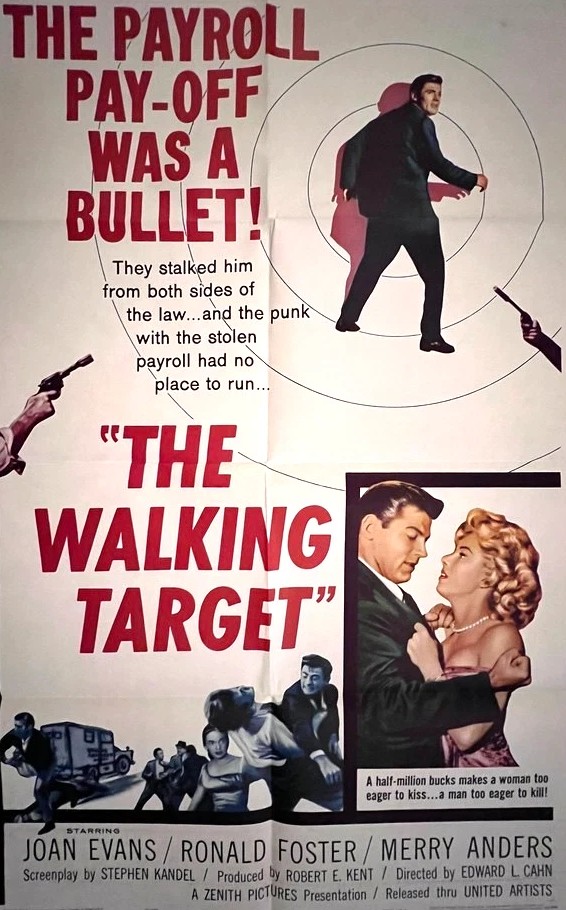
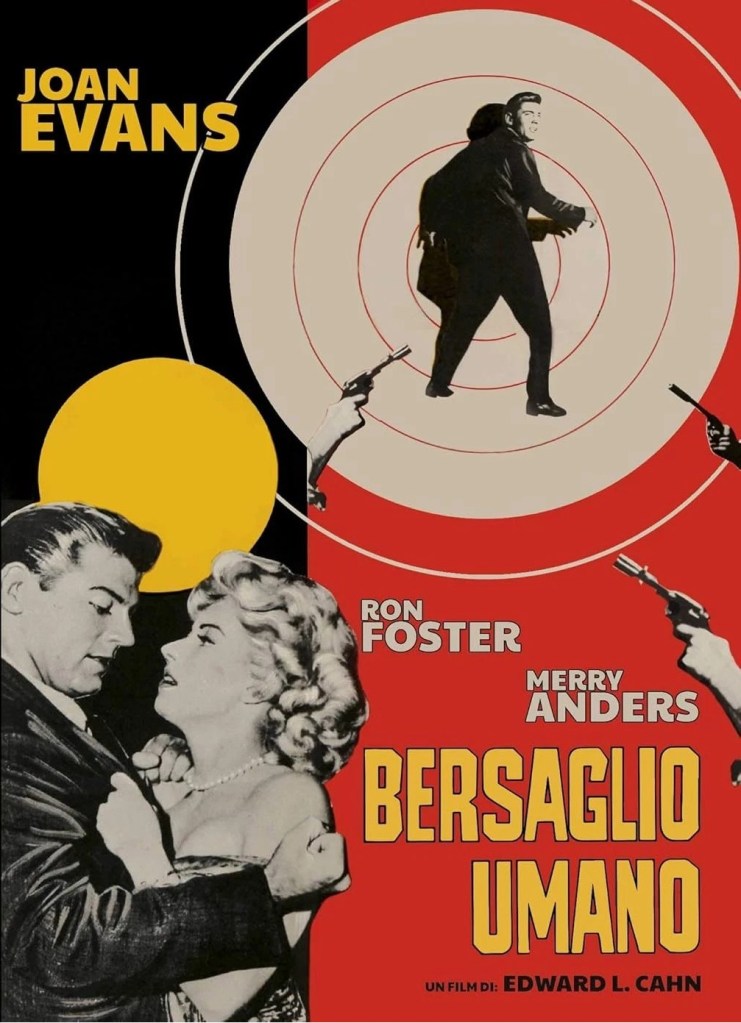
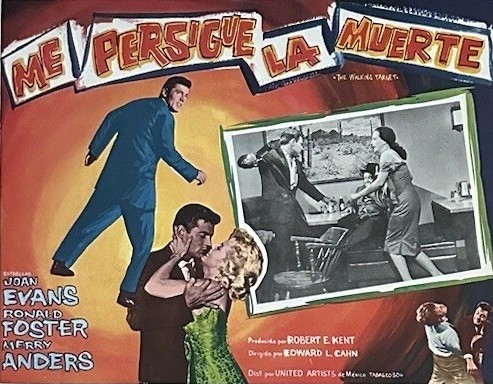
The Walking Target (1960) ***

The Double Cross Olympics. Or the Twist After Twist After Twist World Championships. Either way you’re in for a rattling good time. This is a hard-boiled B-movie the way Hollywood makes them, so there’s virtually no one involved who’s on the side of good.

Nick Harvin (Ron Foster) leaves prison after serving a five-year sentence for stealing $260,000. The money’s never been recovered so, in the words of the warden, he’s a “walking target,” fair game for anyone seeking a share or all of the loot – “they can smell that green round corners.”

Step up blonde girlfriend Sue (Merry Anders) and best buddy Dave Prince (Robert Christopher), whose credentials in the loving and friendship department are in doubt given neither visited him in jail. Also on his tail – the media, hoping to put him back on the front page where he belongs and Detective Max Brodney (Harp Maguire) a pair of cops hoping to put him back inside where he belongs. The cop tells it straight, “You’re a louse, you’re smarter but you’re still a louse.”

Nick envisions a future that’s “fat and rich” while Dave reckons he’ll be able to “coast forever.” Nick drops a bombshell. He’s planning to give a one-third share of the dough to the wife Gail (Joan Evans) of one of his two partners in the heist, both dead. Although there’s another reason he needs Gail. The money was stashed in her car’s undercarriage and she’s long ago left town.

Meanwhile, Dave begins the two-timing game. He’s worse than Sue. She’s only making sweet with Dave behind her lover’s back. But Dave has also stitched up Nick by selling him out to a big time crook Hoffman (Barry Kroeger).

Nick can’t even hide out. Newspapermen have caught up with him and he’s splashed all over the front pages. The cops and the crooks are on his tail. Nick high-tails it to Gold City, where Gail runs a diner. He’s got a soft spot for Gail, she threw him over for her mechanic husband Sam because she reckoned Sam was a safer bet, not realizing he was dumb enough to get snookered into a robbery.

So here’s the real twist. Nick manages to sweet talk Gail. When she turns down his offer of a share of the loot, he tells her he’s going to give it all back. Being the trusting sort, and maybe thinking she would have been better off with someone who wasn’t as dumb as Sam, Gail takes him to her car and watches him pull out the hidden cash.

So, of course, he’s just playing her for a sap. Yeah, maybe he feels guilty about Sam and yeah maybe he does still have a soft spot for Gail, but he’s a thief and what chance is there that he’s going to turn into a good guy and return the stolen money.

Before Gail gets the opportunity to realize he’s playing her for a sap, in burst the crooks, whacking nick around and promising to do worse to Gail unless he hands over the money. In the confusion, Brodney appears, and takes one for the team, but not before the thugs have got their come-uppance.

Yep, there is one last twist, one I certainly wasn’t expecting. Nick is going to go straight after all.

How do you like that? Of all the mean narrative tricks, the bad guy turns into a good guy.

This must have a made a cracking supporting feature. All the characters, including Gail, can squeeze the last bit of juice out of a line. There’s nothing but snap and zing. Plenty temper, car chases, fisticuffs and shoot-outs. And did I mention it was aiming for the gold ring in the double-crossing league.

Great cast of B-movie troopers in Ron Foster (Cage of Evil, 1960), Joan Evans (Roseanna McCoy, 1949),  Merry Anders (House of the Damned, 1963) and Harp Maguire (Incident in an Alley, 1962). Directed by Edward L. Cahn (Incident in an Alley) from a script by Stephen Kandel (Chamber of Horrors, 1966).

At a lean 75 minutes it’s story, story, story and belt along at a terrific pace.

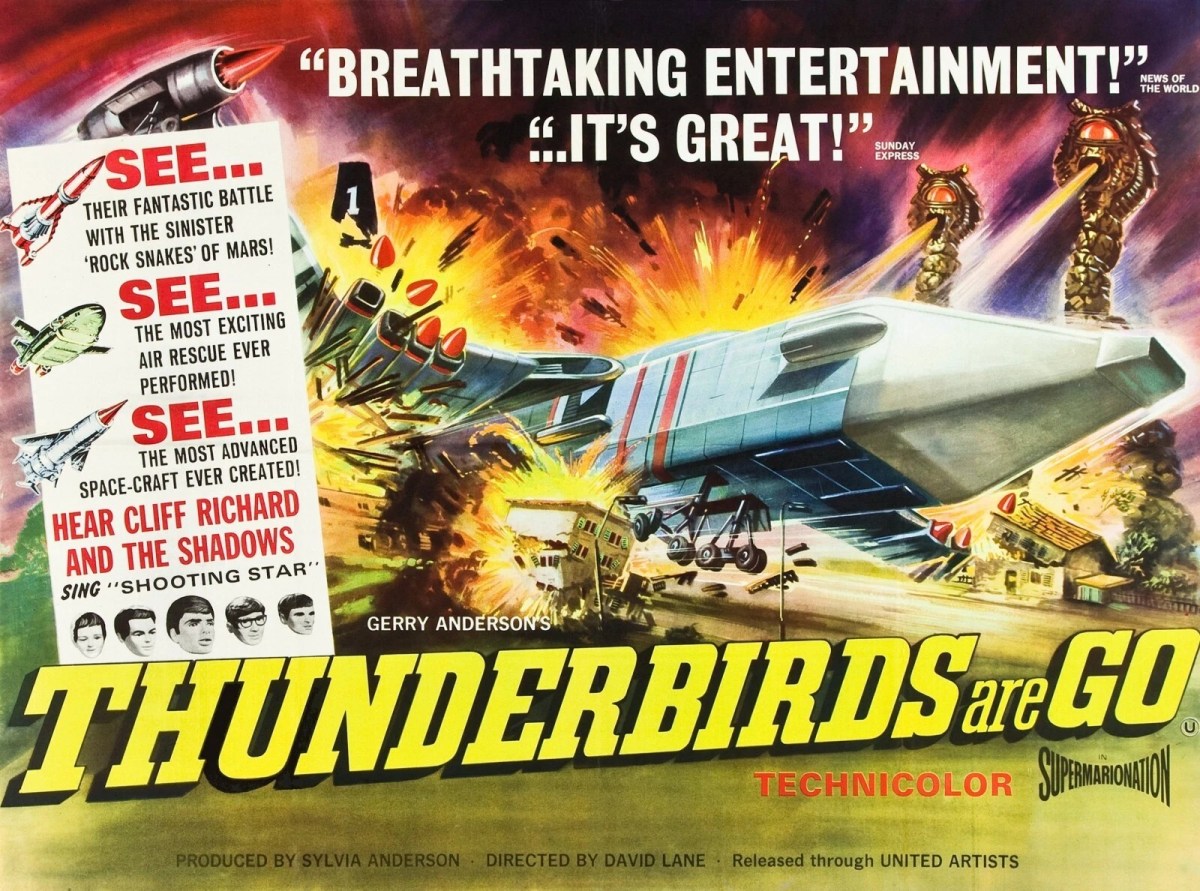
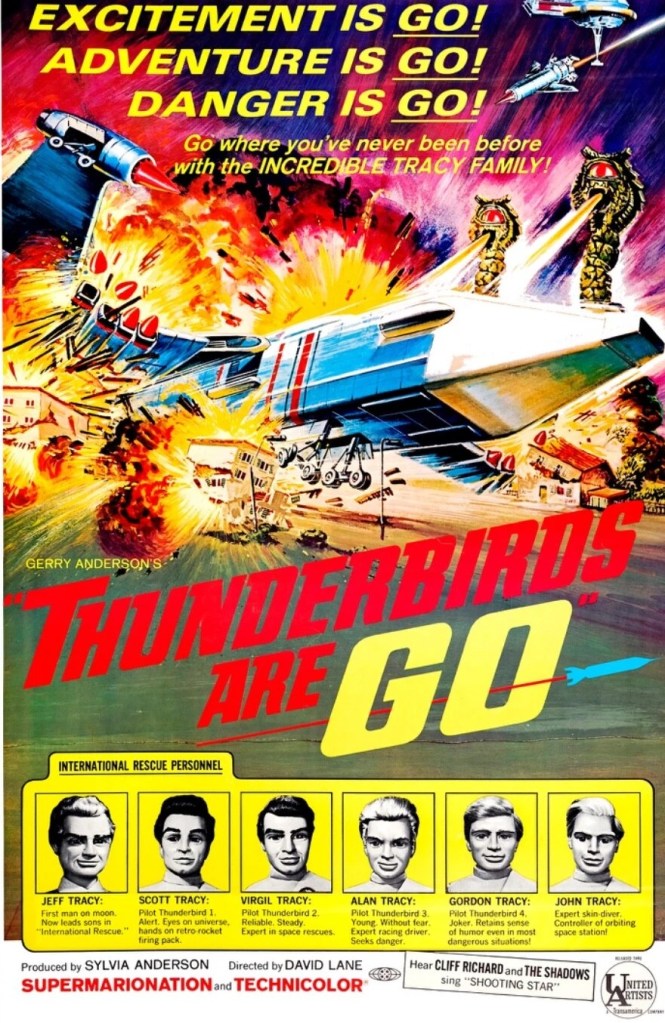
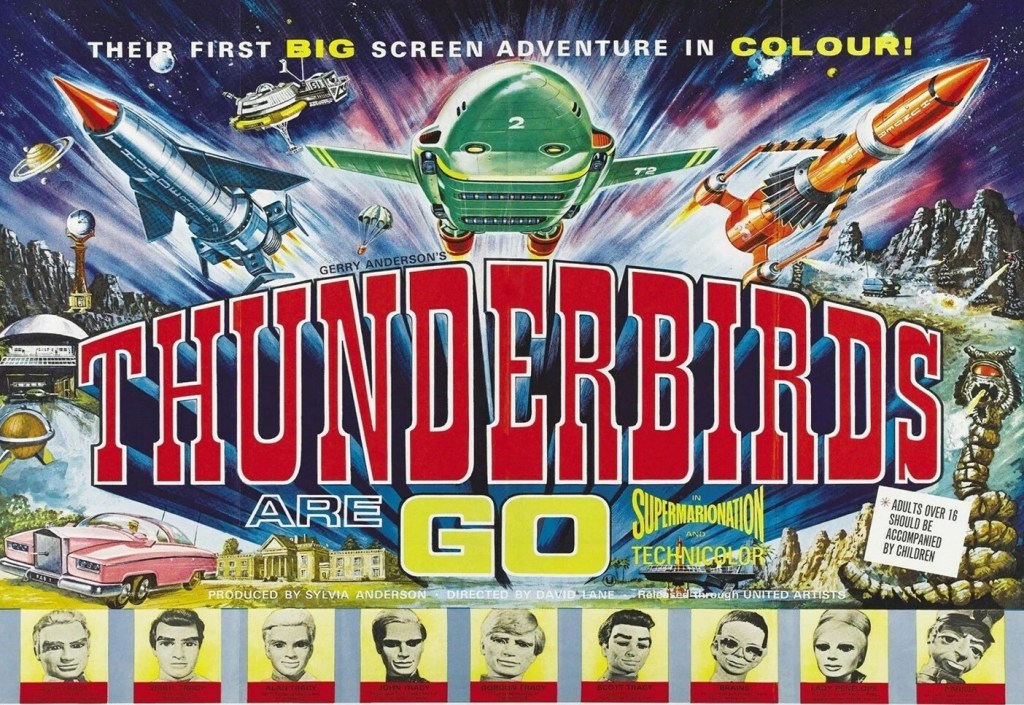
Thunderbirds Are Go (1966) ****

Nostalgia – and reappraisal – rule. Every bit as worthy a contender for a Father’s Day crown as the more favored likes of The Great Escape, 1963), The Dirty Dozen (1967) and Die Hard (1988). One of the reasons why Britain wasn’t in the thrall of DC and Marvel was that we had grown up with Dr Who and the Gerry and Sylvia Anderson portfolio of sci fi marionettes – Fireball XL5, Supercar, Stingray, Thunderbirds, Joe 90 and Captain Scarlet.

And while most of the nostalgia for the period goes the way of Ray Harryhausen, the Andersons’ achievements not so much with their puppetry but the miniaturization should not be underestimated.

It wouldn’t be too much of a call, for example, to guess that Stanley Kubrick learned a lot about the joy of spaceships coming together or moving around from Thunderbirds Are Go where a good chunk of the action is watching spaceships shift around one way or another. To top it all, and another one in the eye of Mr. Kubrick, the Andersons beat him to the psychedelia, a dream sequence set upon a “Swinging Star” and involving puppet versions of Cliff Richard and the Shadows, still a big noise in the pop world at the time despite the arrival of The Beatles and The Rolling Stones. Their appearance would be the equivalent to  Bruce Willis, for example, doing a guest turn in Friends.

With a bigger budget, the Andersons made two crucial changes from the TV series on which this was based. They managed to erase all sight of the puppet strings and they stopped them walking around so much which always made them look most like just puppets.

This is space as we should adore it. None of the manky, worn-down, dirty cargo ships that litter modern sci fi epics. Not only is every ship gleaming but they are also colorful, not to mention color-coded. When they move it’s with the majesty that Kubrick used to great effect in 2001: A Space Odyssey (1968). And as Kubrick also proved, when it came to space, you didn’t need much in the way of characterization or narrative. He follows the same rule as monster pictures, focus on the big beasts as much as possible.

But Kubrick, in his wildest dreams, could never imagine as sultry a character as blonde goddess Lady Penelope, and though she’s on the side of the angels as cunning as any femme fatale. Equally iconic is her pink Rolls Royce and the chauffeur Parker which his obedient “Yes, m’ lady.” Not to mention the glorious catchphrase “eff ay bee” – in other words FAB, the catchphrase for a generation. There’s another catchphrase that only means something to Londoners who would hear this warning every day on the Underground – “mind the doors.”

The narrative is relatively thin. Zero-X is trying to fly to Mars but the flight is sabotaged and crash-lands. When a second flight is planned, this time International Rescue (the Thunderbirds team in case you are unaware) is on standby with Lady Penelope employed to seek out the saboteur.

This flight does succeed but on Mars encounters venomous snake-like rocks and scarpers quickly only to hit trouble on re-entry to Earth that requires Thunderbirds to the rescue. There are some modest attempts at characterization, Zero-X doesn’t like the idea of needing help, and the youngest of the Tracy family is frightened of failing.

I’ve never seen this before. I probably thought I was above such childish things when it first came out and it was only when I spotted it on Amazon Prime that I thought to give it go, remembering how much I had enjoyed the revamped Fireball XL5.

I sat enthralled. The first section has no sign of the International Rescue team and just like those mesmerizing minutes watching Kubrick’s spaceship revolve in space this simply involved putting together the constituent parts of the Zero-X rocket ship prior to launch.

You had to hand it to these sci-fi whizzes. You only needed one fella in the control room. Each of the Thunderbirds required only a solo pilot. You could be whisked electronically from a seat in the waiting area to the spaceship and arrive there on the same seat or go along some kind of travelator. These guys had thought of everything.

Directed by David Lane and written by the Andersons with Sylvia doubling up to provide the voice of Lady Penelope

With the removal of the strings and every miniaturization so stunning, this would look great on the big screen. The 60th anni would be December this year so here’s a call-out to an enterprising cinema.

NOTE: today is British Father’s Day.  It may not be Father’s Day where you are.

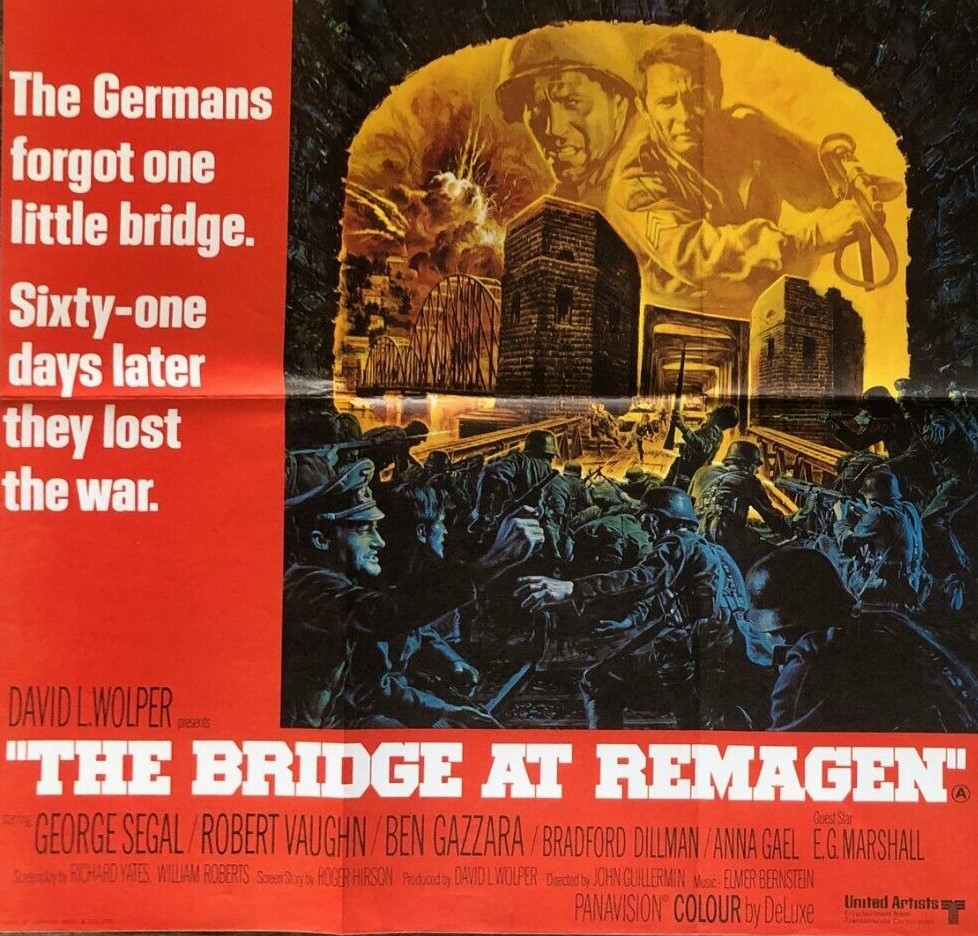
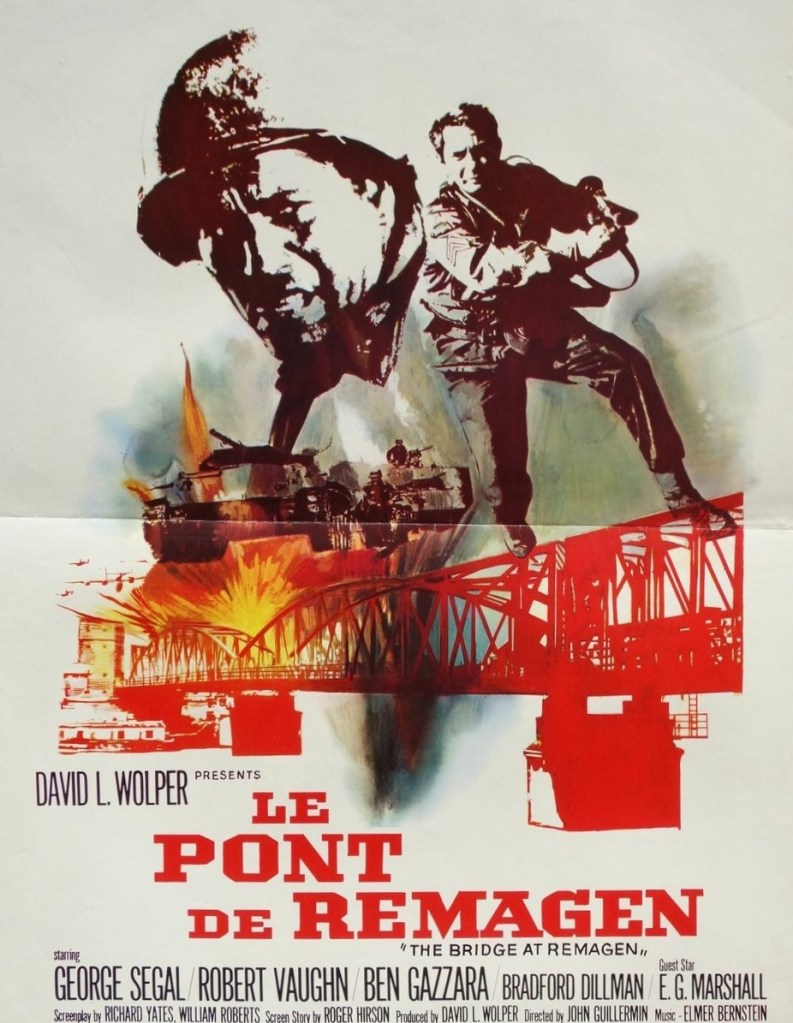
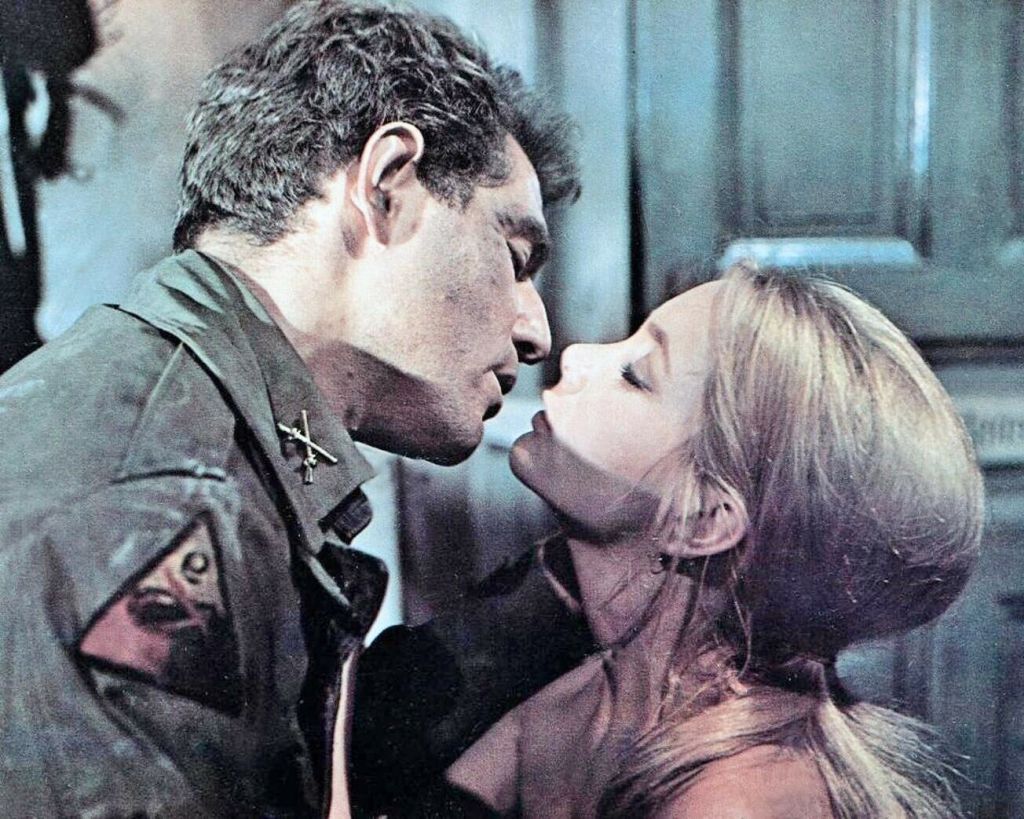
The Bridge at Remagen (1969) ****

Superior war film, somewhat underrated. Not just realistic battle scenes, but realistically weary soldiers and taking an even-handed approach to war in the manner of Battle of the Bulge (1965). The Americans want to destroy the bridge to trap 75,000 German soldiers on the wrong side of the Rhine, the German Major Krueger (Robert Vaughn) overrides his orders to also destroy the bridge and prevent the Allies with a direct route to Berlin. Instead with depleted forces – think Zulu (1963) – and hugely outnumbered he attempts to keep the bridge open so the cornered Germans can escape.

Unlike most war films there’s no time for comedy to lighten the spirits, it’s gruelling non-stop action. Even when the advance company, headed by grizzled Lt. Hartman (George Segal) find an abandoned village where the exhausted squad could rest up for a bit, they are ordered to keep going until they find more enemy to engage. Unlike the humane Krueger, the Allied high command are merciless, gung-ho Major Barnes (Bradford Dillman) and glory-hunter Brigadier Shinner (E.G. Marshall) drive their troops on, the latter not bothered how many of his men die in an attempt to blow up the bridge – “it’s a crap shoot” is the closest he gets to apology, claiming his actions will shorten the war.

When Allied attempts to blow the bridge fail and with the enemy so close Krueger has to proceed with detonating the explosives littering the bridge and that plan is also scuppered, it’s a battle to the death to secure the crossing. And the story itself is accentuated by nods to the grisly cost of war – on both sides. Heartless Sgt Gazzaro (Ben Gazzaro), whose freebooting Hartman despises, is brought up short when he kills a youth commandeered into action by Krueger in a bid to bolster his meagre outfit – barely 200 men when he expected a force of around 1600.  Krueger is sickened to see a German firing squad executing deserters, but has little sympathy for an innkeeper who has lost a son to the fighting when four million Germans are already dead.

While reining in the worst excesses of Angelo, preventing him taking advantage of a captured woman (Anna Gael) and refusing himself to accept her offer of sex, Hartman does not rail (like Patton, 1970) against those of his men who succumb to pressure. Finding one soldier collapsed, he sympathizes, “sometimes it hits you like that,” and he refuses to put his men in unnecessary line of fire, prompting Barnes into almost killing him. Unlike Battle of the Bulge, however, there is no arrogant German commander (like Robert Shaw) nor complacent Americans.

The action is not only non-stop but hectic and the film begins brilliantly with tracking cameras scarcely able to keep up with American tanks barrelling along the road and aerial shots showing the destruction of another bridge over the Rhine. American tanks and German artillery exchange fire over the river. Buildings are blown out or majestically collapse (turns out these were real buildings, not mock-ups). Bridge stanchions fall in slow motion into the water. Refugees are collateral damage, the camera hardly registering a crying child or an abandoned doll.

As in the best war pictures, strategy and tactics are laid out for the audience, the American blunderbuss approach compares poorly to Krueger’s desperate attempts to utilise every advantage to the point of arming a barge in the river. Hartman and Krueger are well-matched in courage, the former thrown endlessly into action by cynical superiors, the latter, having discharged himself from hospital to fight on, landed with the task of rallying defeatist troops, and leading them into harm’s way in a manner that the American’s immediate superior, Barnes, point-blank refuses to do. Pride drives on the German, the war is almost lost, but surrender would be tantamount to humiliation. All Hartman has to fall back on is an inner core and the chain of command, soldiers obey orders.

Both George Segal (The Quiller Memorandum, 1966) and Robert Vaughn (The Venetian Affair, 1966) are well outside their acting comfort zone. Two stars whose hallmarks are cocky characters and suave charm turn into determined men who barely crack a smile. Segal has done cynical before but not to this degree and what catches the eye more is his sheer physical exhaustion. This is an early career highlight for Vaughn, rarely offered such juicy roles.

Although associated in the general audience mind for playing creepy, not to mention sleazy, characters, Ben Gazzara (Capone, 1975) had not made much impact on 1960s moviegoers, and beyond a handful of supporting roles best known to Americans for a starring role in television series Arrest and Trial (1963-1964). The general untrustworthy screen persona he would come to inhabit is given a good work-out here except for two scenes where his character takes unselfish action. Bradford Dillman, also best known for television (Court Martial, 1965-1966), portrays a largely one-dimension character lifted out of the ordinary in a couple of scenes.

E.G. Marshall (The Defenders, 1961-1965) and Peter Van Eyck (Station Six Sahara, 1963) are the opposing commanders. You can also spot Hans Christian Blech (Battle of the Bulge), Anna Gael (Therese and Isabelle, 1968), Sonja Zieman (The Secret Ways, 1961) and Bo Hopkins (The Wild Bunch, 1969).

John Guillermin (The Blue Max, 1966) directs with aplomb from a screenplay by William Roberts (The Devil’s Brigade, 1968) and novelist Richard Yates (Revolutionary Road, 2008) in his only work for the screen.

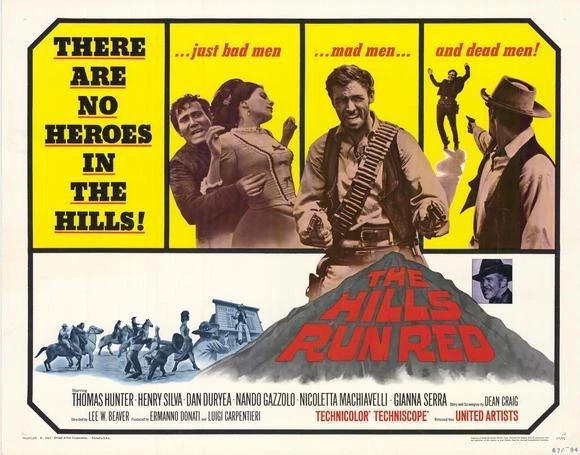
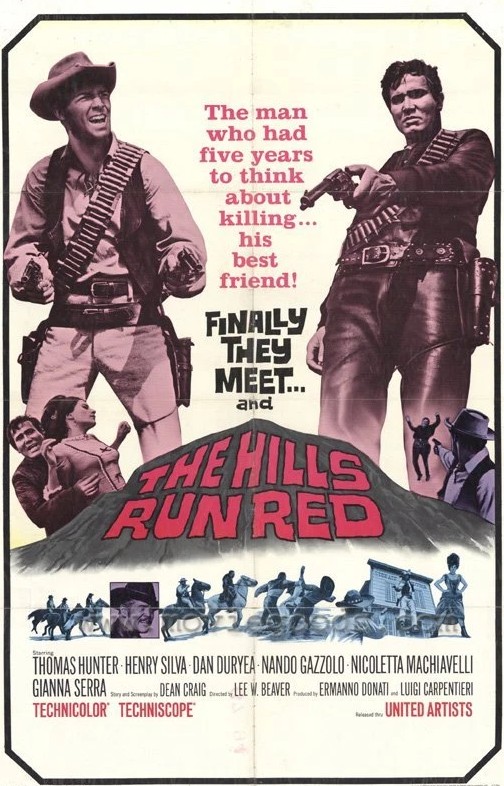
The Hills Run Red (1966) ****

Pretty decent revenge western boasting a couple of superb set pieces. No wonder Clint Eastwood made the decision to play down the emotions on The Man with No Name, because this is a good example of how pop-eyed emotions can get when restraint is missing especially when you’ve got Henry Silva in the mix. The lead Thomas Hunter is not, as you came to expect in spaghetti westerns, an Italian dude anglicizing his name, but a genuine Yank, heading to Europe to further his career whereas Hollywood veteran Dan Duryea is extending his. Bonus of an Ennio Morricone score.

A pair of Johnny Rebs, making off with Unionist loot, at the end of the Civil War, make an unusual pact. One, Jerry Brewster (Thomas Hunter), takes the rap for the heist, while his partner Ken Seagull (Nando Gazzallo) the other makes off with the loot, promising, as part of the deal, to look after his buddy’s wife and child. Five years later, the freed Jerry returns home to find his pal’s reneged on the deal, wife is dead, son Tim an orphan, and Ken, now a wealthy rancher, is more intent on muscling up and eliminating his rival than keeping to his  side of the bargain.

Jerry teams up with drifter Winny Getz (Dan Duryea) who gets himself a job on the ranch where tough foreman Garcia (Henry Silva) enjoys handing out beatings. There’s a smidgeon of nascent romance, not enough to get in the way of the action, when Ken’s sister Mary Ann (Nicoletta Machiavelli) takes pity on the roughed-up Jerry.

But let’s cut to the chase. There’s a brilliant ambush by Ken’s rivals. His high-handed methods have upset the townspeople and other ranchers. So with the help of our hero they ambush Ken’s cowboys herd horses through a canyon by rolling down on them  rolls of tumbleweed set aflame, decimating the cowboys by picking them off from the cliffs.

At the end a two-man army of Jerry and Winny (make it a two-and-a-half-man-army if we count in Tim, no mean shakes with a catapult) takes on a regiment of Garcia’s thugs in the town, fighting them on the rooftops and the streets, with the help of sticks of dynamite. This is tremendous stuff. I watched it immediately after seeing Dillinger (1973) and noted that I had automatically accorded the John Milius gangster picture top marks for the various shoot-outs whereas I was so used to shoot-outs in westerns that the tendency was to write them off. Whereas, this one, in particular, was easily on a par with the Milius, better in some ways because the two heroes had to be a good bit more inventive to outwit the enemy.

The climax at the ranch between Jerry and Ken is also well done, the pair employing clever tricks, and half the scene taking place in darkness.

The pace never lets up. The action is constant. Good plans become undone by spies. Saloons are wrecked. There are punch-ups and shoot-outs galore and some excellent lines and neat situations such as when the prison guards steal Jerry’s dough on release and send him off minus his gun.

Nobody who wasn’t already a star made much marquee headway from this and largely it’s been viewed as a western programmer, slotted into the lower half of a double bill, and largely forgotten. But perhaps because there’s no star requiring special treatment with slick lines and a denoted love interest and the kind of scene that always seems written just to give a big star a big moment, this falls into the leaner category, where the story is kept simple, the action continuous and whatever genuine emotion we require is limited to loss (of wife) and recovery (of son).

That still leaves room for Garcia to put on a whole show for himself and Winny to underplay him at every turn.

Thomas Hunter (The Magnificent Tony Carrera, 1968) might surprise in not offering the Yank equivalent of the traditional British upper lip, but sometimes we do under-do things by limiting male emotion, so you could view this as some kind of breakthrough for the incontinently emotional man. Henry Silva (Johnny Cool, 1963), with no restraint applied, just lets rip. Dan Duryea (Five Golden Dragons, 1967), in his last important role, enjoys a last hurrah.

Carlo Lizzani (The Violent Four, 1968) directs from a script by Piero Regnoli (Matchless, 1964).

Worth a look. Reassessment long overdue. What they used to call a rip-roaring western.

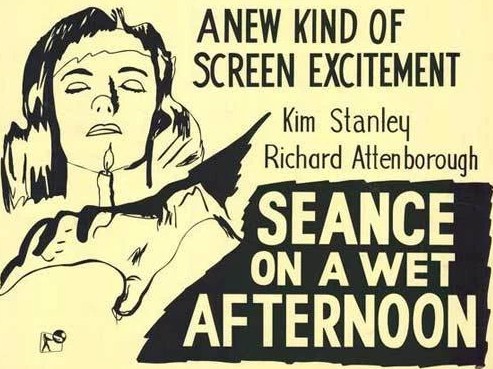
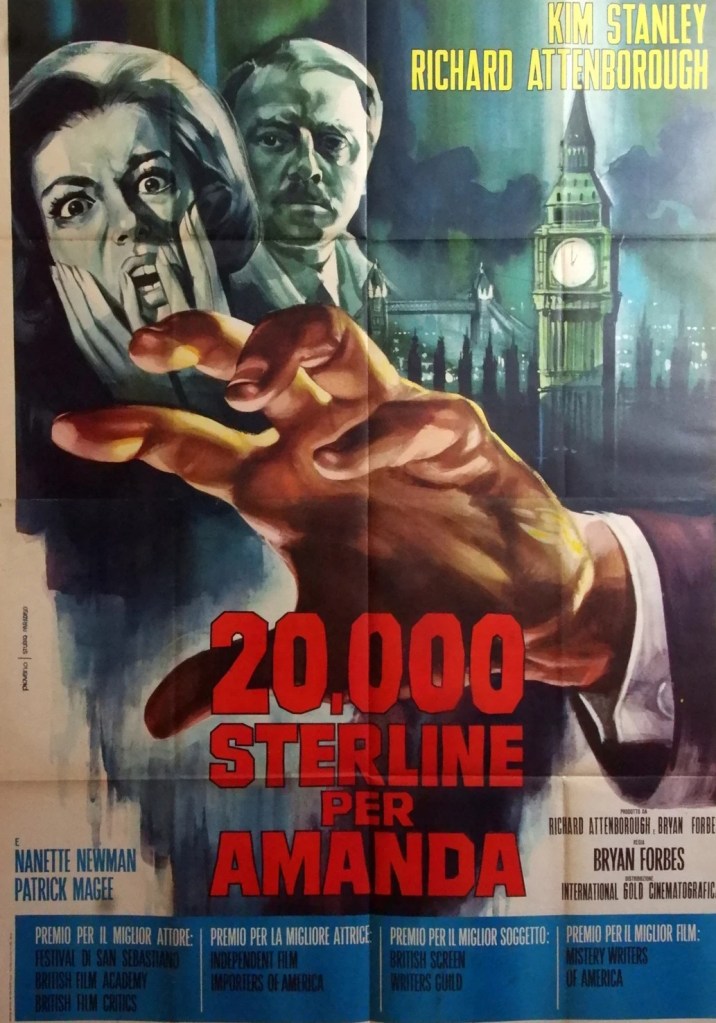
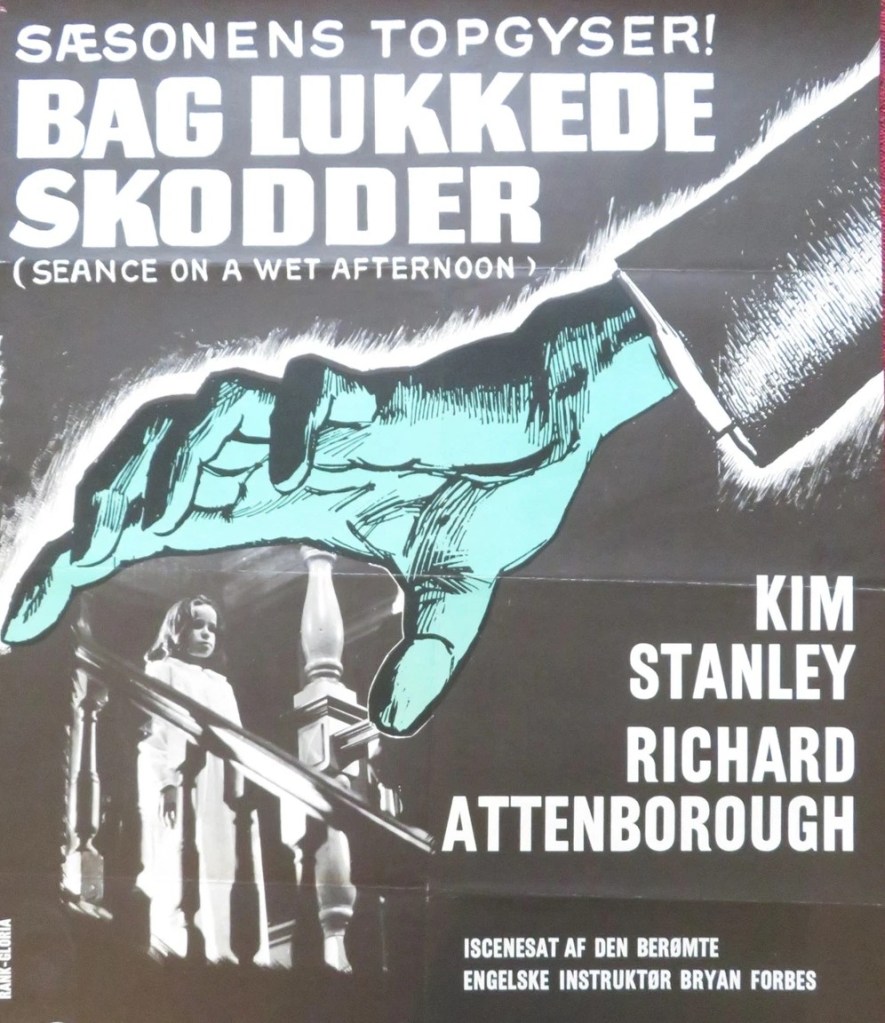
Seance on a Wet Afternoon (1964) ****

Highly atmospheric psychological gem that should appeal mightily to the current generation hooked on the new genre of scams – this one coming with a gut-wrenching twist. That it concerns a medium should add to the intrinsic appeal. And it turns on two terrific performances.

I have an unusual connection to this movie – and a whole bundle of others with music by John Barry. I heard the scores of this and the likes of King Rat (1965), The Chase (1966), Deadfall (1968) and The Lion in Winter (1968) long before I caught up with the movies. So I came at them with a kind of aural advance warning. The score John Barry wrote for this not only exemplifies the inherent creepiness but maximizes it.

Even before we get into any notion of criminality, you can see that this unlikely middle-aged marriage between the dominant Myra (Kim Stanley) and the weak Bill (Richard Attenborough) is unhealthy to say the least. She’s the kind of psychic who’s likely to swoon and get lost in ethereal otherworlds while hosting seances. He’s just trying to keep her from toppling over into insanity, driven by her conviction that she is conversing with their dead son.

In the kind of scam you could see someone coming up with today, she decides she’ll thrust herself into public consciousness by becoming the sort of psychic police tent to consult during kidnappings or murders. In this case it’s the kidnapping of  Amanda (Judith Donner), daughter of wealthy businessman Mr Clayton (Mark Eden). This might sound like the usual wishful thinking for publicity by an over-earnest psychic, but, in fact, it’s Bill, at his wife’s  behest, who’s carried out the kidnapping. To make it look kosher, the couple demand a ransom.

The lass is kept imprisoned in their house, in a room made up to look like a hospital with Myra playing the role of nurse. Mr Clayton is sceptical of the psychic’s claims but his wife (Nanette Newman) is duped.

Given that Bill generally looks impotent, the harried look of the weak hen-pecked husband, it’s quite astonishing how he rises to the occasion to collect the ransom money, dodging the cops on the underground. The plan comes undone, however, when Myra decides the dead Arthur wants a buddy in the afterlife, with Amanda the prime candidate and Bill called upon to step up to the murder plate.

So we’re knee-deep in tension. The key here is that our point-of-view is that of the couple rather than the child or the parents. Amanda is a bit more worldly-wise than Myra expects so she’s kept on her toes keeping the suspicious child in check. So you’ve got what would be a contemporary trope but unusual then of being forced to want the criminals to succeed. Everyone loves a psychic, even more these days after the whopping success of The Conjuring series, and everyone loves the downtrodden husband, so we’re hoping they can outwit the pompous wealthy businessman and fleece him of some dosh, awake the world to the powers of the medium and live happier ever after.

But that’s before Myra changes the plan and you’re wondering if Bill is going to be able to stand up to her. The cops come mighty close to smelling a rat, but the suckered wife appears to help their case.

The beauty of this is less in the plotting – but those twists would work as real zingers today – than in the playing. Critics were reaching for superlatives when two Daniel Day Lewis movies – Room with a View and My Beautiful Launderette – both opened on the same day in New York in 1985 and were astonished by the actor’s range. Richard Attenborough’s diffident mouse of a man in Séance on a Wet Afternoon appeared the same year as his bluff hard-nosed soldier in Guns at Batasi. The British Academy noticed, awarding him the Bafta Best Actor for the achievement.

He’s quite superb here, always on the verge of telling his wife what-for before sinking back into complaisant compliance. When we speak about edgy performances, we generally mean something else entirely, but this is an emotional edge that he’s always about to tip over into one way or the other.

American stage specialist Kim Stanley hardly made a movie, only one more this decade and none for another 16 years, but she carries this intense complicated character smothered by insecurities. Nanette Newman (The Wrong Box, 1966) is a believable mother. Mark Eden (The Pleasure Girls, 1965) crops up, as does Patrick Magee (The Skull, 1965) who tones down his trademark growl.

Written and directed by Bryan Forbes (King Rat) from the bestseller by Mark McShane.

The John Barry score not just sets the tone but helps carry the picture.

I understand plans are underway to remake this and I can see why

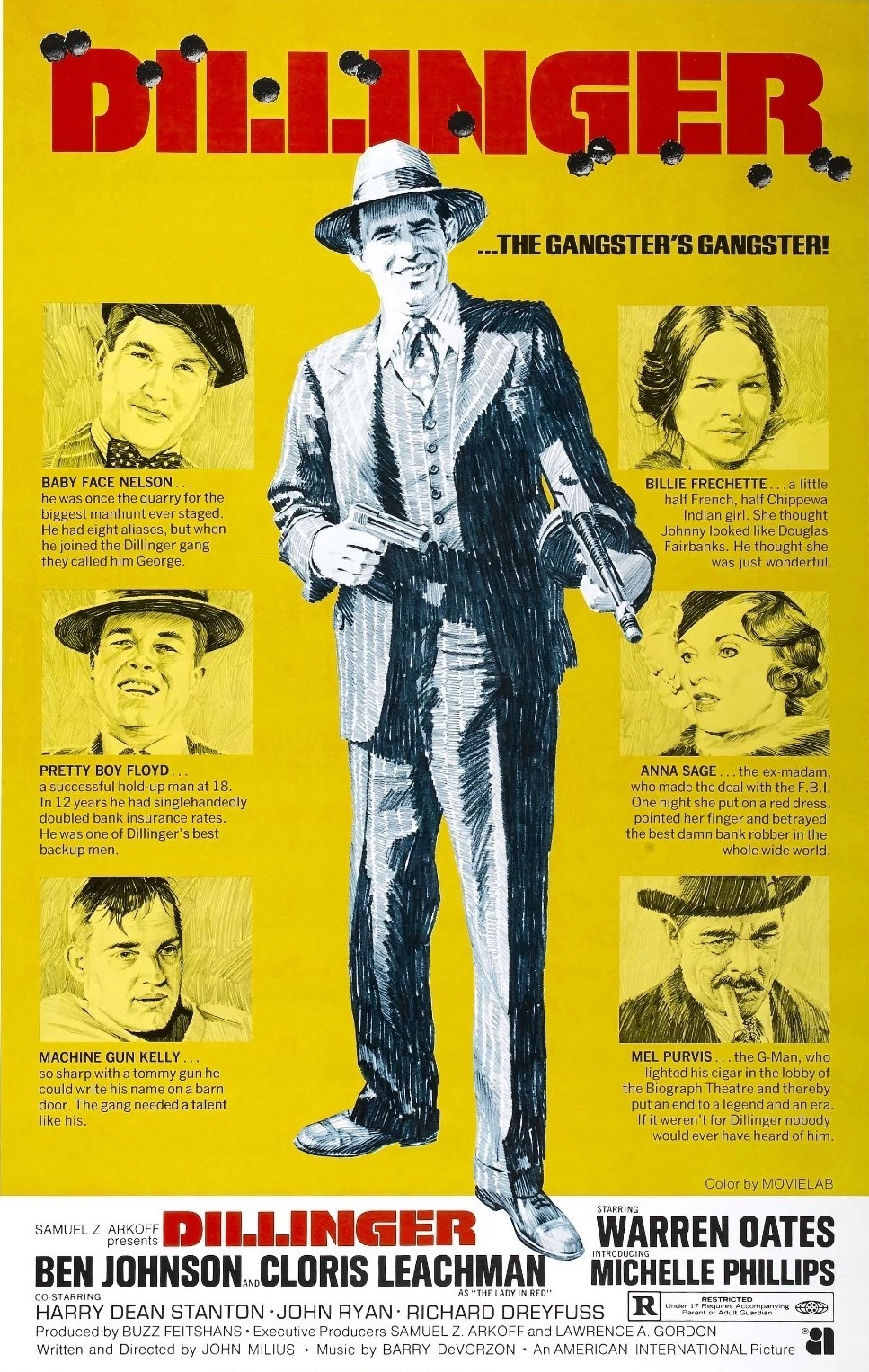
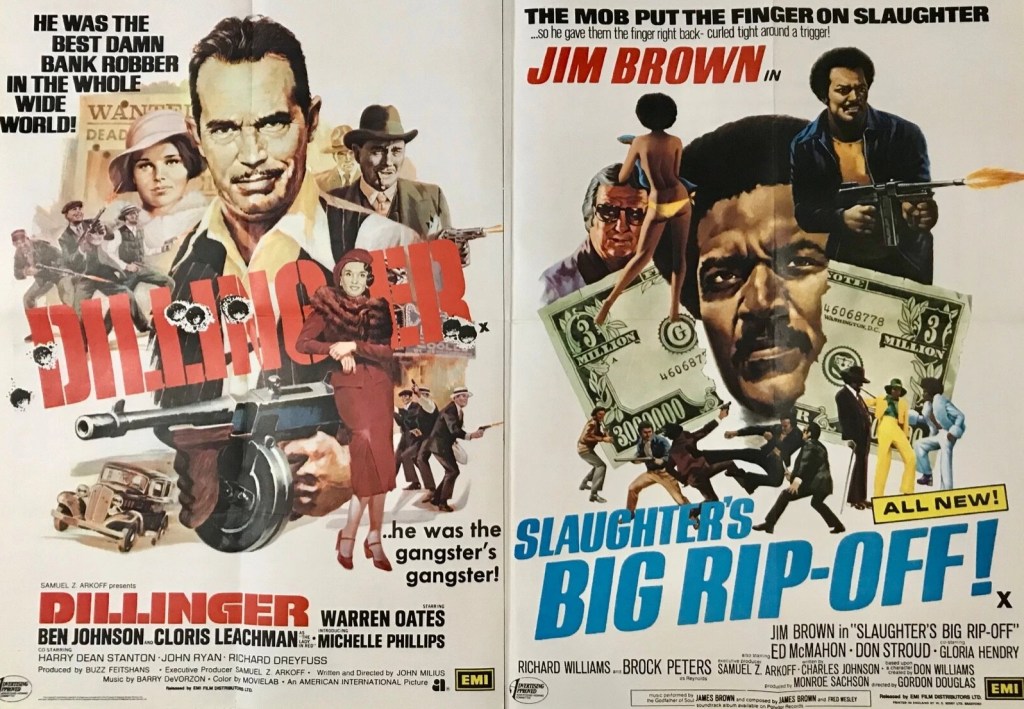
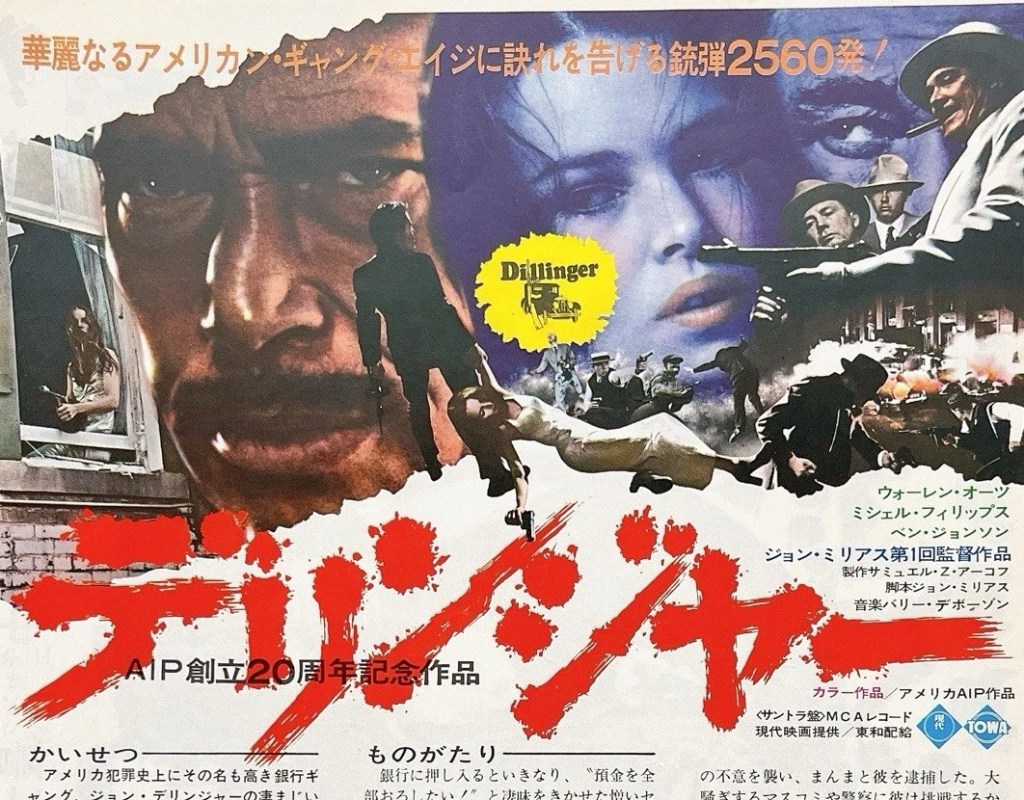
Dillinger (1973) ****

How to make a cult movie. Well, you can start with an uber-macho gun-loving director in the form of John Milius (instrumental in the making of Apocalypse Now, 1979, for which he wrote the script). Then throw in the kind of actor who would never have been a star except for the chisel-faced likes of Lee Marvin and Charles Bronson changing what audiences appreciated in a leading man, as opposed to a supporting character – step forward Warren Oates (Bring Me The Head of Alfredo Garcia, 1974).

Throw in two of the best supporting actors who ever lived. The first one, Ben Johnson, has by pure chance stepped up from the John Ford Stock Company and by golly snaffled himself an Oscar in The Last Picture Show (1971) and made the unlikely leap, in his mid-50s, to just about top-billed status. The second is Harry Dean Stanton (Cool Hand Luke, 1967), just about everyone’s favorite cult actor.

For good measure chuck in another actor, Cloris Leachman (Butch Cassidy and the Sundance Kid, 1969) who had barely had a movie career and now in her mid-1940s it was taking off thanks, oddly enough, also to an Oscar for The Last Picture Show. And a couple of fresh faces in Richard Dreyfuss (Jaws, 1975) and pop singer Michele Philips of The Mamas and the Papas.

That the tale happens to revolve around the second most popular – after Bonnie & Clyde – of the hero bandits of the Great Depression, John Dillinger, and cult is home and dry.

As with the later Michael Mann version, we’re telling two stories at once. Publicity hound John Dillinger (Warren Oates) would have been a social media god these days – you bet he would have filmed every damned bank robbery on his phone, not to mention all the innocent bystanders filming him on theirs. He just loved appearing on the front pages of newspapers and on wanted posters. And he had a set of terrific catch phrases, mostly revolving around thinking people would remember forever being in his presence.

Then we’re following F.B.I. kingpin Melvin Purvis (Ben Johnson) tasked by J. Edgar Hoover to rid the country of these murderous varmints. All of this to the rat-a-tat-tat soundtrack of blazing machine guns mowing down gangsters and cops alike and the equally rat-a-tat-tat tones of a voice-over intent on creating high drama the way they used to on newsreels. The voice-over seemed particularly beloved by makers of gangster movies, though this avoid the biographical excesses of The St Valentine’s Day Massacre (1967).

Purvis and Dillinger are battling it out in more ways than one. Purvis appears equally determined to steal the headlines. He’s the one that goes in and captures single-handedly a bunch of notorious killers armed only with a bulletproof jacket and a cigar and weapon of some sort. He’s delighted when a gangster fashions the moniker “G-Men”, a nickname that seems to elevate the F.B.I. in the eyes of the media which have a tendency, for the sake of easier-to-write headlines, to shorten names.

You wouldn’t have needed an F.B.I. except for a peculiarity. In the U.S. state law meant that you could escape pursuit in one state if you hopped over into the next state where the law wouldn’t bother you one hoot because your crime wasn’t within your jurisdiction. If you were smart enough you could even evade the F.B.I. if you stuck to doing all your robbing in one state and all your hiding-out in another. But should you be dumb enough, as here, to truck a stolen car over the state line, then the F.B.I. could come gunning for you.

Dillinger isn’t likely to let the little matter of jurisdiction get in the way of his aim to become the best bank robber in the world, a claim that could be contested if he limited his sprees to one little state. Although his fame grows momentously when he escapes from a high-security prison that is supposed to be escape-proof.

Then Dillinger formed the gangster equivalent of the rock star Supergroup, bringing together Baby Face Nelson (Richard Dreyfuss) and Pretty Boy Floyd (Steve Kanaly) and  others.  .

If anyone could improve on the Raymond Chandler adage of when a narrative is in trouble bring in a man with a gun, it’s here. Dozens of men with dozens of machine guns, shotguns and pistols are apt to arrive at any point – every male in any godforsaken town totes a shotgun into the bargain. Dillinger might have been a great robber but he wasn’t much good at hiding out – he was always getting ambushed.

The gun battles are certainly lively and occasionally inventive.

Dillinger is eventually captured because, as one of his crew cautions, he’s a sucker for women. With Billie (Michele Philips) in irons he gallivants around with illegal immigrant Anna (Cloris Leachman) who snitches him out to Purvis leading to the legendary shootout at the Biograph cinema in Chicago.

As now, media (including social media) has their cake and munches it down, giant headlines describe the robbers in detail to sell copies while at the same time hypocritical editorials complain about their exploits to satisfy the more moralistic readers.

Characterization is sketchy to the point of cartoonish, but the characters, including the cop, are so cocky they only need to chuck out a few catchphrases to keep our interest.

Warren Oates and Ben Johnson make a decent stab at stardom, Richard Dreyfuss steals a few scenes, Harry Dean Stanton has some great lines.

Given the derisory budget, this is a great debut by John Milius, who also wrote the script.

The Deadly Affair (1966) ***

Initially, much more of a character study than murder mystery or spy tale. And like the previous John Le Carre adaptation The Spy Who Came in from the Cold (1965) directed by an American, there Martin Ritt, here Sidney Lumet. Although as repressed as the main character in Lumet’s  The Pawnbroker (1964) and sharing with it remembrance of the Holocaust, master spy Charles Dobbs (name changed from George Smiley due to Paramount’s rights from the earlier film) is far more capable of expressing his feelings and taking action than the pawnbroker.

Dobbs sleeps in a separate bedroom, his wife Ann (Harriet Andersson) indulging in so many affairs she is considered a nymphomaniac. Although resigned to this behavior, he is nonetheless shocked when her latest amour turns out to be his old friend and colleague Dieter (Maximilian Schell) and even attempts to offer him advice, the politeness of the English at its best. “In any other country,” retorts Dieter, “we wouldn’t be on speaking terms.” This kind of betrayal Dobbs can manage, but the other kind, of a professional nature, has him rushing to the bathroom to throw up.

If you’ve come to admire the character of George Smiley (aka Dobbs) as played by Alec Guinness in BBC TV series Tinker, Tailor, Soldier, Spy (1979) and its sequel where he is generally a passive character you might get a shock when here the man springs into action.

Dobbs comes up against the Establishment when his boss (Max Adrian) refuses to investigate the suicide of a low-level agent Fennan (Robert Flemyng), a former Communist cleared of suspicion of being a double agent by Dobbs himself. Dobbs resigns in order to go his own way enlisting retired policeman Mendel (Harry Andrews), a pet lover and prone to falling asleep at inopportune moments. Although it is essentially a murder story, it’s Mendel who does most of the detecting, using his resources to track relevant pieces of information – typewriters, wake up calls, theatre tickets fall into his purview – and very much the old-school cop, not above a bit of burglary and beating up a suspect.

There are leaks within the secret service, Dobbs tailed, a blond man Harek (Les White) hovering into view long enough to tamper with witnesses, including dodgy car dealer Scarr (Roy Kinnear), a bubbly character with “two wives.”  Key to the investigation is Fennan’s wife Elsa (Simone Signoret), a Jewish refugee from the concentration camps, and committing the cardinal sin of not offering Dobbs a cup of tea when he comes to visit, though pouring herself one. “I’m a battlefield for your toy soldiers,” she proclaims, another in le Carre’s stream of innocents unwittingly caught up in the “game.”

This is dingy rather than tourist London, Battersea power station on the horizon, rain prominent, a murky Embankment, the Thames a river of sludge, dubious pubs in unsavory locations, except for a very English spurt of theatre (a plot point) involving characters with very jolly accents. In The Spy Who Came in from the Cold, the spy’s downfall is “minor human weakness” i.e. falling in love and so it is here, Dobbs’ mental health taking a beating by not just his wife’s unfaithfulness but by remaining faithful to her. Of course, he wouldn’t be the first man to have married out of his league and be unwilling to surrender his prize.

Lumet’s gaze is anything but sentimental. In fact, as much as Dobbs is a master of the spy game, he is a dunce at the game of love, and Lumet does not let him off lightly. Any man who commiserates with his wife’s lover on the grounds that he (said lover) will be hurt when the woman ultimately abandons him, is straight from idiot school.

So this is a far more complex, and human, reflection on the spy game, and it’s not so much about paying the price of being a spy, as occurred with Alec Leamas, than the folly of marrying the wrong woman. You can see how easily Dobbs was seduced by the insane prospect that a beautiful woman had fallen in love with him, rather than, as he must have been trained to do, examining her reasons.

Of course, it’s not unusual for detectives to have miserable home lives and end up as loners, but this was part of a trend (see The Quiller Memorandum, 1966) to see spies not as bed-hoppers of the James Bond variety but as human beings with normal failings. One oddity is that, in line with the Paramount dictat on names, Dobbs’ boss is called “The Adviser” rather than “Control” (although apparently there was such a title in le Carre’s version of the secret service prior to this book).

James Mason (Age of Consent, 1969) is excellent as brilliant spy/bewildered lover. Harry Andrews (The Hill, 1965) has a ball in a change from his normal taciturn characters. Oscar-winner Maximilian Schell (Topkapi, 1964) is equally convincing but I found Harriet Andersson (Through a Glass Darkly, 1961) too much one-note certainly compared to the riveting performance by Simone Signoret (Is Paris Burning? 1966).

You can spot a string of future stars in a supporting cast led by Lynn Redgrave (Georgy Girl, 1966), Corin Redgrave (The Girl with a Pistol, 1968) and Kenneth Haigh (A Lovely Way to Die, 1968) among older hands like Robert Flemyng (The Blood Beast Terror, 1968), Roy Kinnear (The Hill) and Max Aitken (Henry V, 1944).

Paul Dehn (The Spy Who Came in from the Cold) wrote the screenplay based on John le Carre’s novel Call for the Dead, which was written before the book which made the author famous.

Discover WordPress

A daily selection of the best content published on WordPress, collected for you by humans who love to read.

The Atavist Magazine

by Brian Hannan

WordPress.com Blog

News, Tips & Website Tutorials