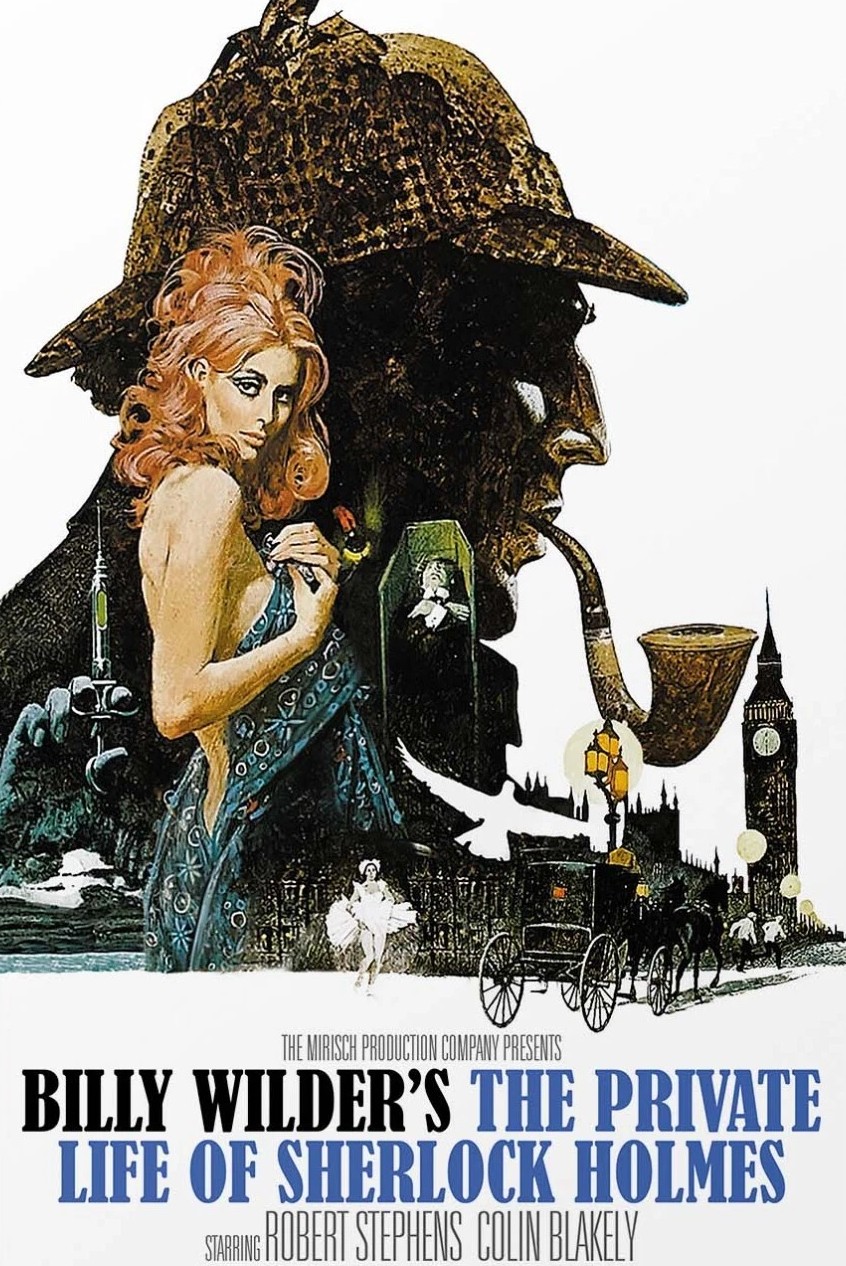
The Private Life of Sherlock Holmes (1970) **

The word is that you can’t blame director (and producer and co-writer) Billy Wilder for this disaster because it was taken out of his hands by studio United Artists and drastically re-cut. But when you learn that Wilder’s version ran three hours and counting and even in the shortened version looks a preposterously bad bet, you can see why UA felt the need to take charge.

Wilder had been the poster boy for sexual identity after the frolics of Tony Curtis and Jack Lemmon as cross-dressing musicians hankering after Marilyn Monroe in Some Like it Hot (1959). Whether Sherlock Holmes was a closet gay would have been a minor footnote to the author’s massive fanbase, and to put it so upfront looks, especially for a contemporary audience, like a massive misstep.
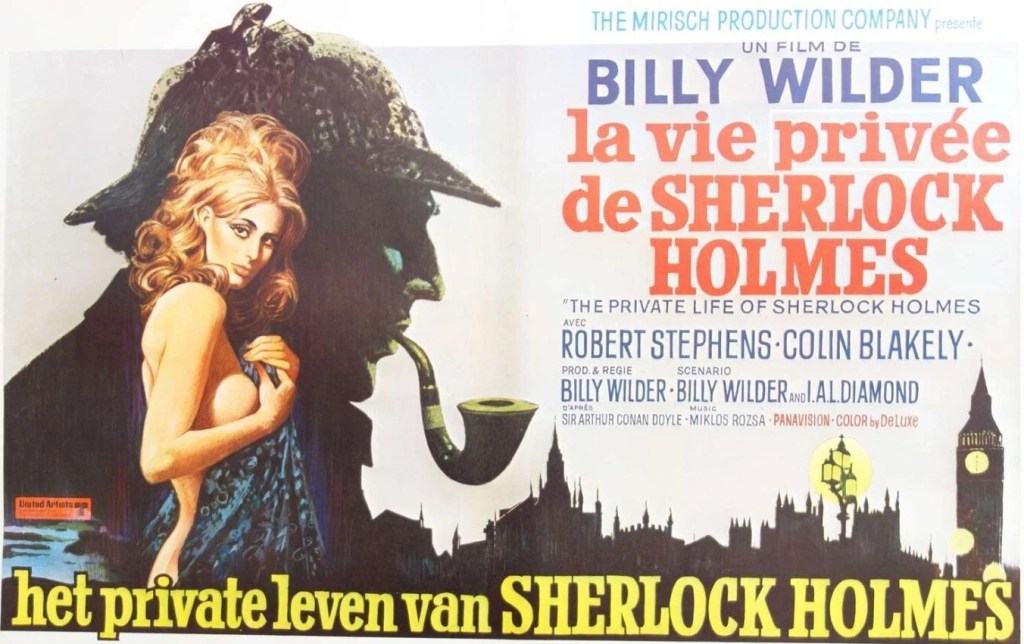
The first part of the movie largely consists of Dr Watson (Colin Blakely) being accused of over-mythification of Sherlock Holmes (Robert Stephens). Turns out (according to the Wilder version) that Holmes is a couple of inches shorter than Watson (his narrator in the Conan Doyle stories) had claimed and never wore the deerstalker. Blimey, lock that man up. Shock horror! Holmes’s other predilection, a regular injection of cocaine (I’ve no idea what a seven per cent solution would be in today’s money) is no invention, however.

But whether Holmes is attracted to the opposite sex forms the focus of the first section of this (even at just over two hours) unwieldy movie. A famous Russian ballerina Madame Petrova (Tamara Toumanova) wants to make him the father of her child. The only way Holmes can get out of this predicament is to pretend to be gay.

Eventually, after exhausting this joke (!), we get the proper mystery. Mysterious Belgian Gabrielle (Genevieve Page), just fished out of the Thames by a passing cab driver, turns up soaking wet at 221B Baker St and (eventually) Holmes is inveigled to find her missing husband.

In other circumstances this would have probably been a relatively straightforward case for the ace detective although there would have been, of necessity, ample opportunity for him to demonstrate his special set of skills. But this being of a more lumbering project, the investigation involves monks, midgets and the Loch Ness Monster. Yes, you heard right.
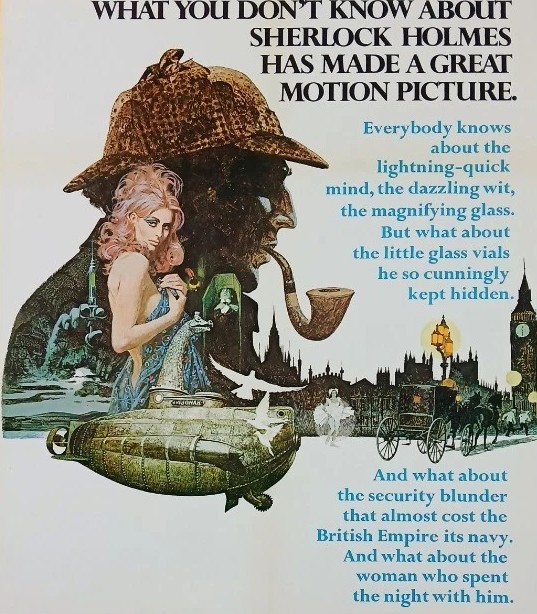
That should have killed off the project at the start. Like whether Holmes is gay or not, the Loch Ness Monster is another minor footnote. Apart from being a tourist attraction and keeping the conspiracy theorists going and competing with Roswell for public attention, it’s the dumbest of notions, even if, as the audience will expect, that it’s not the real monster (if there is such a thing) but a Macguffin of considerable dimensions.

I might have been happy to go along with a narrative that ran close to spoof except I didn’t take to either of the principal actors. I’ve no idea what made Billy Wilder believe that Robert Stephens (The Prime of Miss Jean Brodie, 1969) would make a good Holmes. I’m not one of those traditionalists who believe a specific actor was the quintessential Holmes, but it’s a part that’s far easier to get wrong than get right. And I think Stephens with his wafting loose style got his characterization spectacularly wrong.

Colin Blakely (Alfred the Great, 1968) is one of those actors who generally knows how important it is to rein it in, because if the ham in him is given an inch he will most certainly take a mile and he’s so over-the-top you think he’s going to disappear over the nearest horizon.

This was a huge flop and no wonder. And Billy Wilder, given he wears the three hats vital to a film’s creativity, must take the blame. It’s a rubbish story badly done. Like any other great director, we tend to remember Wilder’s successes – Hollywood drama Sunset Boulevard (1950), media excoriation Ace in the Hole (1951), POW camp thriller Stalag 17 (1953), comedy The Seven Year Itch (1955), Some Like it Hot and sexual satire The Apartment (1960) – and we tend to forget that he often, especially in the 1960s, fell flat on his face. One Two Three (1961) and Kiss Me Stupid (1964) were colossal miscalculations, the result as much of miscasting as of script.

This stands as even worse than that pair. Wilder had got way too big for his boots and at a point where a studio had to cut him down to size. But even the truncated version isn’t much cop. And the only thing that keeps it from attracting a one-star review is that it’s better than Orgy of the Dead (1965).

Steer clear.
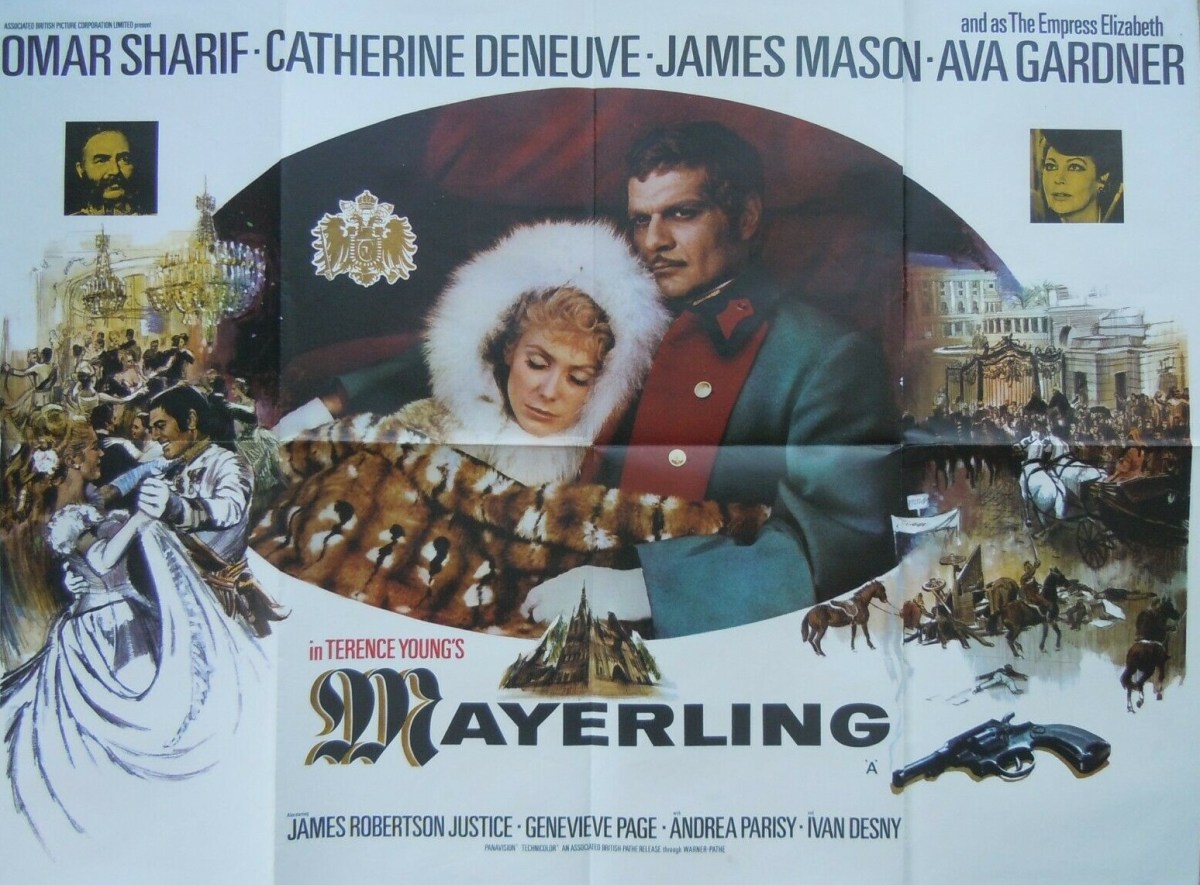
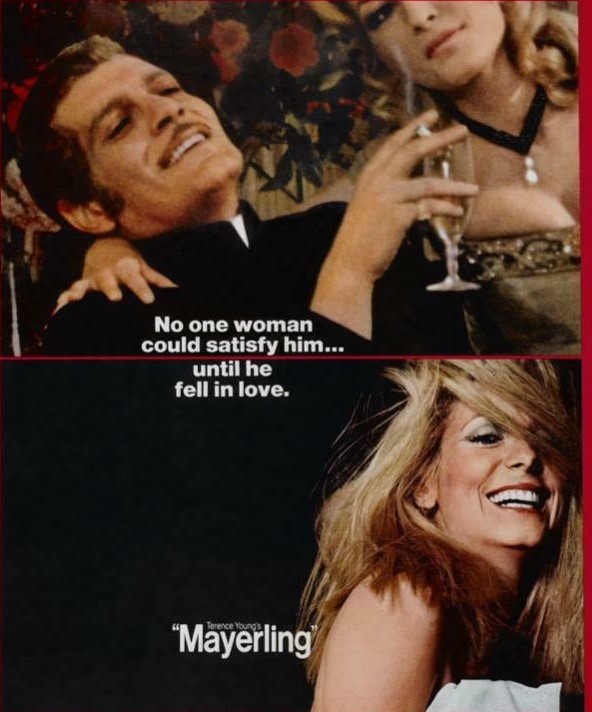
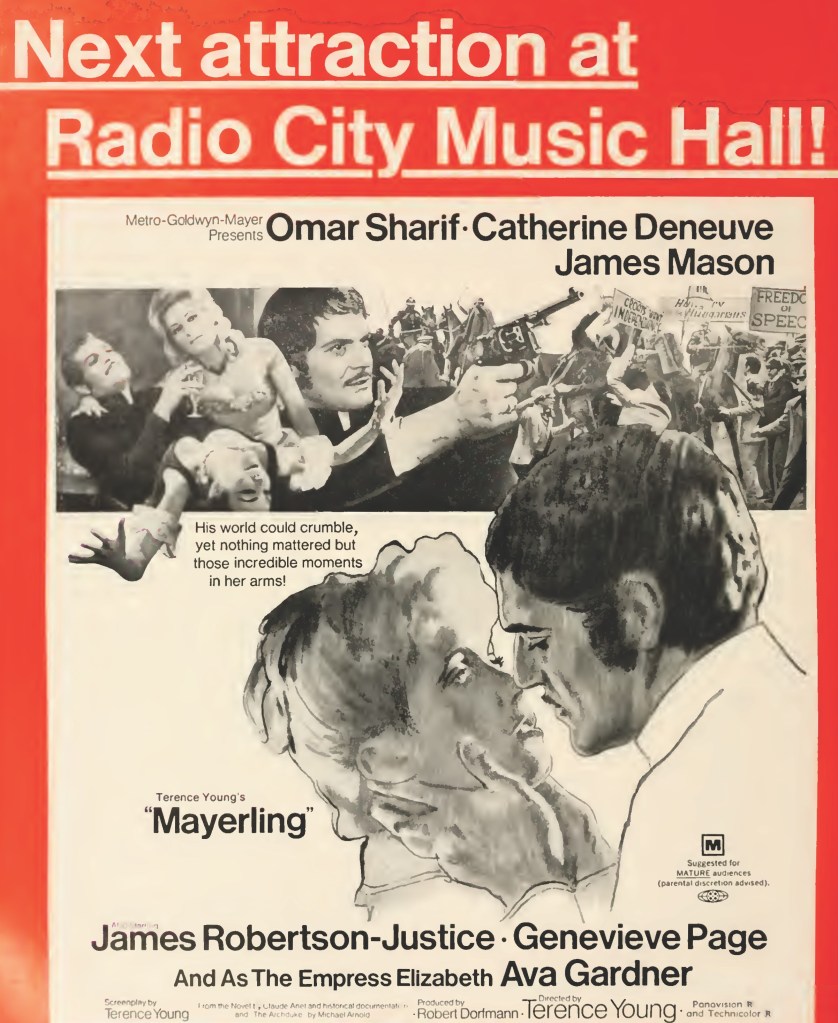
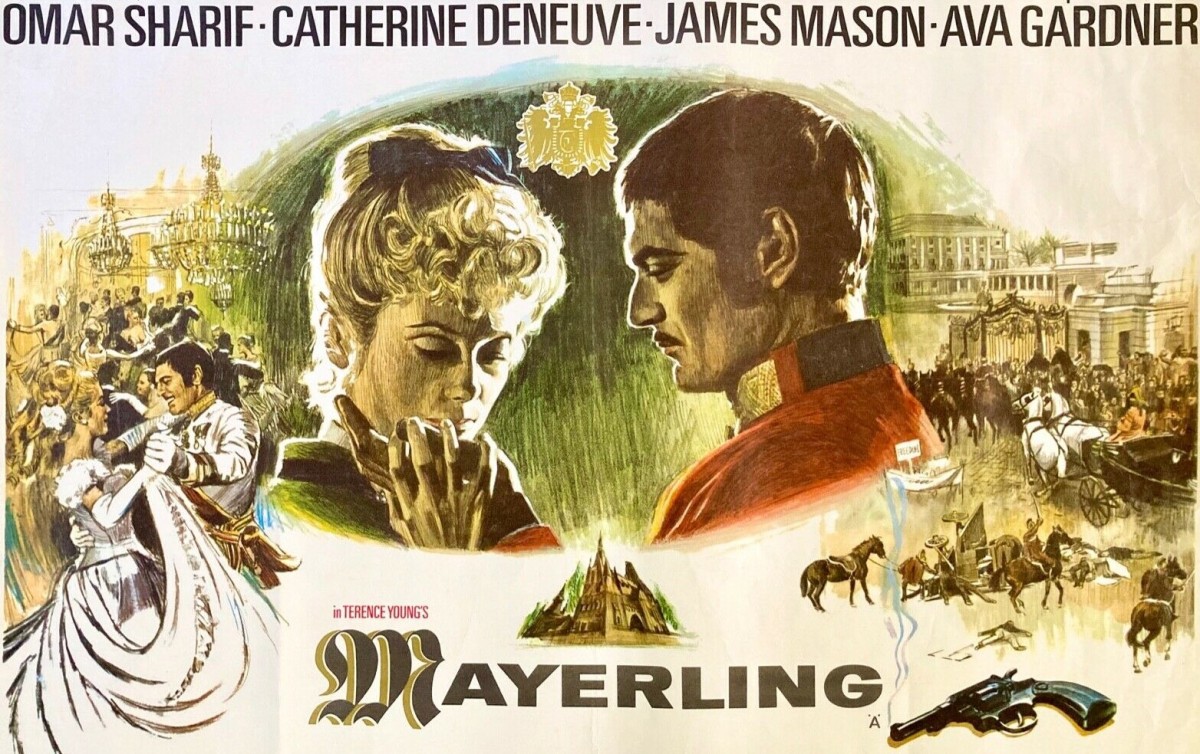
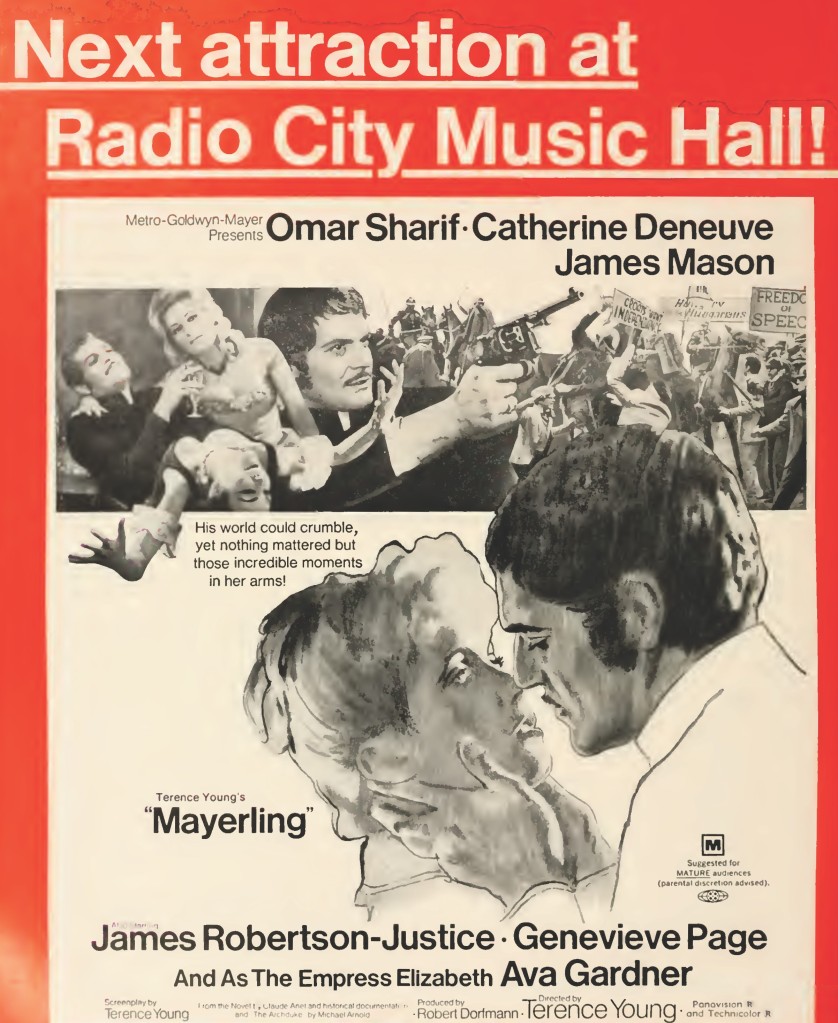
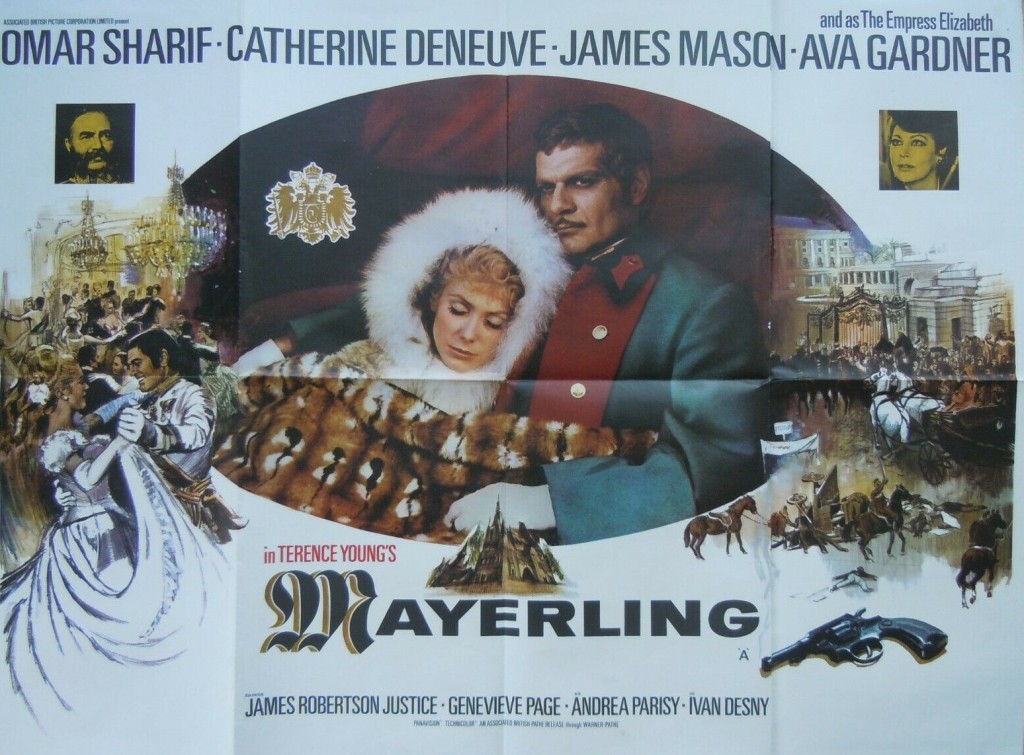
Mayerling (1969) ****

Sumptuous historical romantic drama set in a fading European empire awash with political intrigue and incipient revolution. Archduke Rudolf (Omar Sharif), married heir to the throne and constantly at odds with rigid father Emperor Franz-Josef (James Mason), sympathizes so strongly with Hungarian dissidents that he threatens to tear apart the Austro-Hungarian Empire. However, when he falls in love with Maria (Catherine Deneuve) and wants to marry her instead that, too, threatens to throw the empire into disarray.

Although dissolute, a mistress (or two) on the side, and addicted to morphine, that is not the way Rudolf is introduced to the audience. Instead, he is one of a string of bloodied men arrested after a demonstration giving his name to an officer in a police station who, once he is recognized, orders all other prisoners be released. He is the poster boy for good royalty. The Hungarians, agitating for independence, want him to become their king.

Beautifully mounted with lavish sets and enough in the way of balls, ballet, processions,  horse riding and sleighs to keep up a steady parade of visually interesting distractions, the films steadily builds up an undercurrent of tension, both between father and son and between rebels and ruler. The emperor is a political genius, not just spying on his son, but full of devious devices to hold together whatever threatens to break up the empire.

The romance develops slowly and with true historical perspective, the first kiss they share is not on the lips, Rudolf kisses both her cheeks, she kisses his palm. Yet, there is a real sense that, no matter his power, they can still both be trapped in roles they despise, separated at the whim of parents. Rudolf, as he understands true love for the first time, finds the self-belief to challenge political certainties.

The regal aspects are well done, arguments about the rule of monarchy come over as heated conversation rather than boring debate, the political realities unavoidable. Rudolf is  desperate to avoid a future where someone has to die before he has a reason to live. Escape is not an option.

There is a wonderful bitchy atmosphere in the court, where ladies-in-waiting disparage each other behind their backs, one dress described as “wallpaper,” and are forever seeking advancement. Countess Larish (Genevieve Page) is a self-appointed procurer-in-chief for Rudolf, not caring what chaos she causes.

I should add, if you are as ignorant of your European history as myself, that Mayerling is a place not a person. I tell you this so that you don’t make my mistake of waiting for a Mayerling character to appear. The film pointedly avoids a history lesson but it could have spared a minute to explain that the events depicted take place just 20 years after the establishment of the Austro-Hungarian Empire, the second largest land-mass in Europe, and among the top two or three nations. That would have helped clarify why Franz-Josef was in such a constant state,  worried about forces that could break up the empire, and as concerned that his son, living such a debauched life, lacked the personal skills to hold it together after his father’s death.

It is ironic that Rudolf does prove his worth as a result of being briefly separated from Maria, taking the army to task for its incompetent officers and poor maintenance of everything from weaponry to horses.

To his credit director Terence Young (Dr No, 1962) does not rely on Omar Sharif’s soulful brown eyes and instead allows action to convey character and looks and touch the meaning of his love. This is probably Omar Sharif’s best role, one where he clearly made all the acting decisions rather than being over-directed by David Lean as in Doctor Zhivago (1965). Catherine Deneuve is equally impressive as a far-from-docile innocent, especially given the wide range of more sexually aware characters she has created for Repulsion (1965) and Belle de Jour (1967).

James Mason (Age of Consent, 1969) is superb as the conniving emperor, so rigid he will not approve a change of buttons for the army, so cunning that an apparent rapprochement with his son has unseen strings attached. Ava Gardner (55 Days at Peking, 1963) sweeps in briefly as an empress protective of her son and making the best of life in a gilded cage. Also impressive are Genevieve Page (Grand Prix, 1966) and James Robertson Justice (Doctor in Distress, 1963) as the high-living British heir nonetheless under the thumb of his mother Queen Victoria.

Terence Young also wrote the literate, often amusing. script, although Denis Cannan (A High Wind in Jamaica, 1965) and Joseph Kessel (Night of the Generals, 1967) are credited with additional dialog. While Francis Lai (The Golden Claws of the Cat Girl, 1968) wrote the score he relies heavily on classical music from Aram Khachaturian’s Spartacus.

If you come at this not expecting a David Lean style affair full of striking compositions, but an old-fashioned drama advancing at leisurely pace, you will not be disappointed.

Mayerling (1968) ****

Sumptuous historical romantic drama set in a fading European empire awash with political intrigue and incipient revolution. Archduke Rudolf (Omar Sharif), married heir to the throne and constantly at odds with rigid father Emperor Franz-Josef (James Mason), sympathizes so strongly with Hungarian dissidents that he threatens to tear apart the Austro-Hungarian Empire. However, when he falls in love with Maria (Catherine Deneuve) and wants to marry her instead that, too, threatens to throw the empire into disarray.

Although dissolute, a mistress (or two) on the side, and addicted to morphine, that is not the way Rudolf is introduced to the audience. Instead, he is one of a string of bloodied men arrested after a demonstration giving his name to an officer in a police station who, once he is recognized, orders all other prisoners be released. He is the poster boy for good royalty. The Hungarians, agitating for independence, want him to become their king.

Beautifully mounted with lavish sets and enough in the way of balls, ballet, processions,  horse riding and sleighs to keep up a steady parade of visually interesting distractions, the films steadily builds up an undercurrent of tension, both between father and son and between rebels and ruler. The emperor is a political genius, not just spying on his son, but full of devious devices to hold together whatever threatens to break up the empire.

The romance develops slowly and with true historical perspective, the first kiss they share is not on the lips, Rudolf kisses both her cheeks, she kisses his palm. Yet, there is a real sense that, no matter his power, they can still both be trapped in roles they despise, separated at the whim of parents. Rudolf, as he understands true love for the first time, finds the self-belief to challenge political certainties.

The regal aspects are well done, arguments about the rule of monarchy come over as heated conversation rather than boring debate, the political realities unavoidable. Rudolf, desperate to avoid a future where someone has to die before he has a reason to live. Escape is not an option.

There is a wonderful bitchy atmosphere in the court, where ladies-in-waiting disparage each other behind their backs, one dress described as “wallpaper,” and are forever seeking advancement. Countess Larish (Genevieve Page) is a self-appointed procurer-in-chief for Rudolf, not caring what chaos she causes.

I should add, if you are as ignorant of your European history as myself, that Mayerling is a place not a person. I tell you this so that you don’t make my mistake of waiting for a Mayerling character to appear. The film pointedly avoids a history lesson but it could have spared a minute to explain that the events depicted take place just 20 years after the Austro-Hungarian Empire, the second largest land-mass in Europe, and among the top two or three nations. That would have helped clarify why Franz-Josef was in such a constant state,  worried about forces that could break up the empire, and as concerned that his son, living such a debauched life, lacked the personal skills to hold it together after his father’s death.

It is ironic that Rudolf does prove his worth as a result of being briefly separated from Maria, taking the army to task for its incompetent officers and poor maintenance of everything from weaponry to horses.

To his credit director Terence Young (Dr No, 1962) does not rely on Omar Sharif’s soulful brown eyes and instead allows action to convey character and looks and touch the meaning of his love. This is probably Omar Sharif’s best role, one where he clearly made all the acting decisions rather than being over-directed by David Lean as in Doctor Zhivago (1965). Catherine Deneuve is equally impressive as a far-from-docile innocent, especially given the wide range of more sexually aware characters she has created for Repulsion (1965) and Belle de Jour (1967).

James Mason (Age of Consent, 1969) is superb as the conniving emperor, so rigid he will not approve a change of buttons for the army, so cunning that an apparent rapprochement with his son has unseen strings attached. Ava Gardner (55 Days at Peking, 1963) sweeps in briefly as an empress protective of her son and making the best of life in a gilded cage. Also impressive are Genevieve Page (Grand Prix, 1966) and James Robertson Justice (Doctor in Distress, 1963) as the high-living British heir nonetheless under the thumb of his mother Queen Victoria.

Terence Young also wrote the literate, often amusing script, although Denis Cannan (A High Wind in Jamaica, 1965) and Joseph Kessel (Night of the Generals, 1967) are credited with additional dialogue. While Francis Lai (The Golden Claws of the Cat Girl, 1968) wrote the score he relies heavily on classical music from Aram Khachaturian’s Spartacus.

If you come at this not expecting a David Lean style affair full of striking compositions, but an old-fashioned drama advancing at leisurely pace, you will not be disappointed.

Discover WordPress

A daily selection of the best content published on WordPress, collected for you by humans who love to read.

The Atavist Magazine

by Brian Hannan

WordPress.com News

The latest news on WordPress.com and the WordPress community.