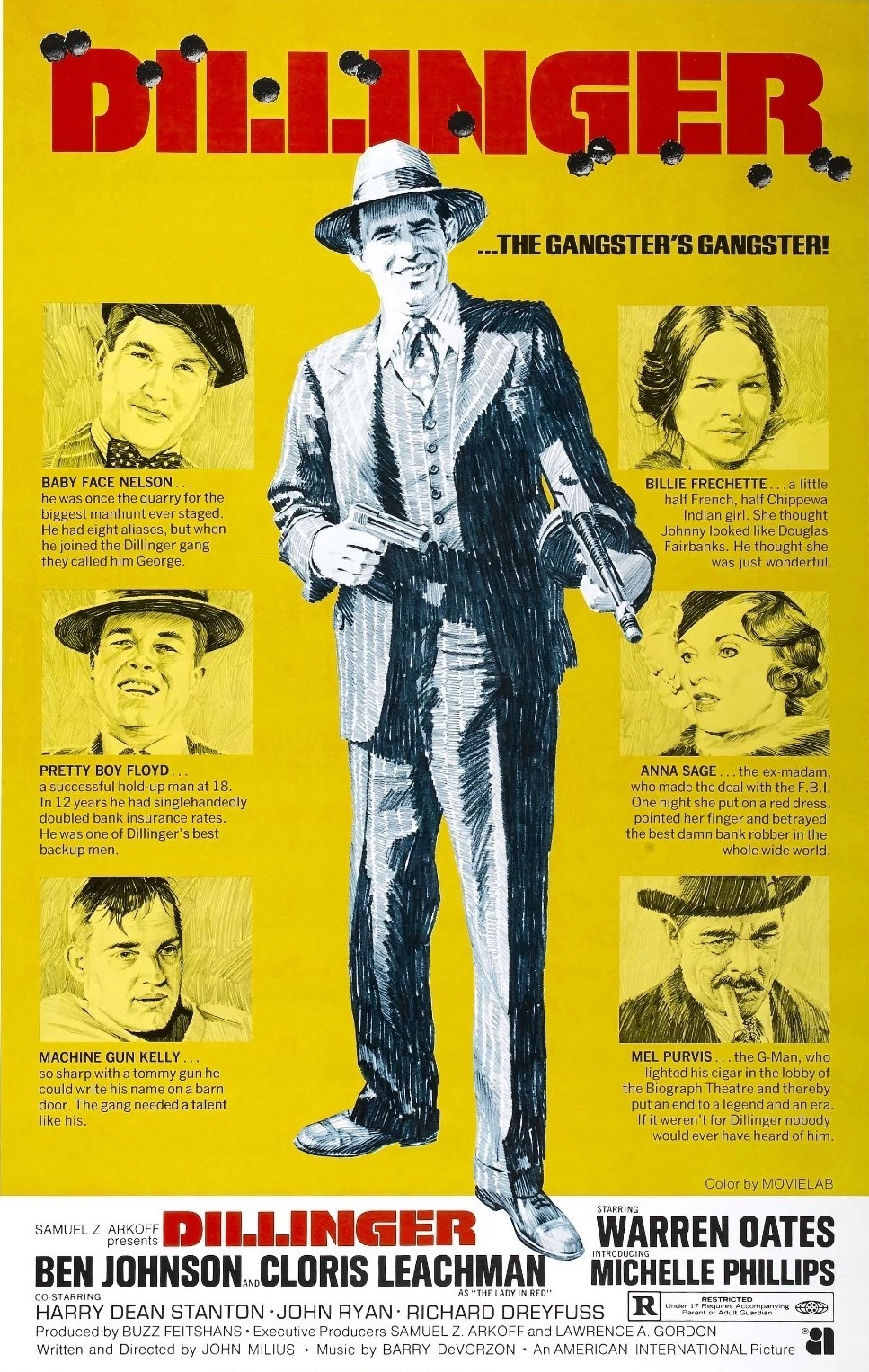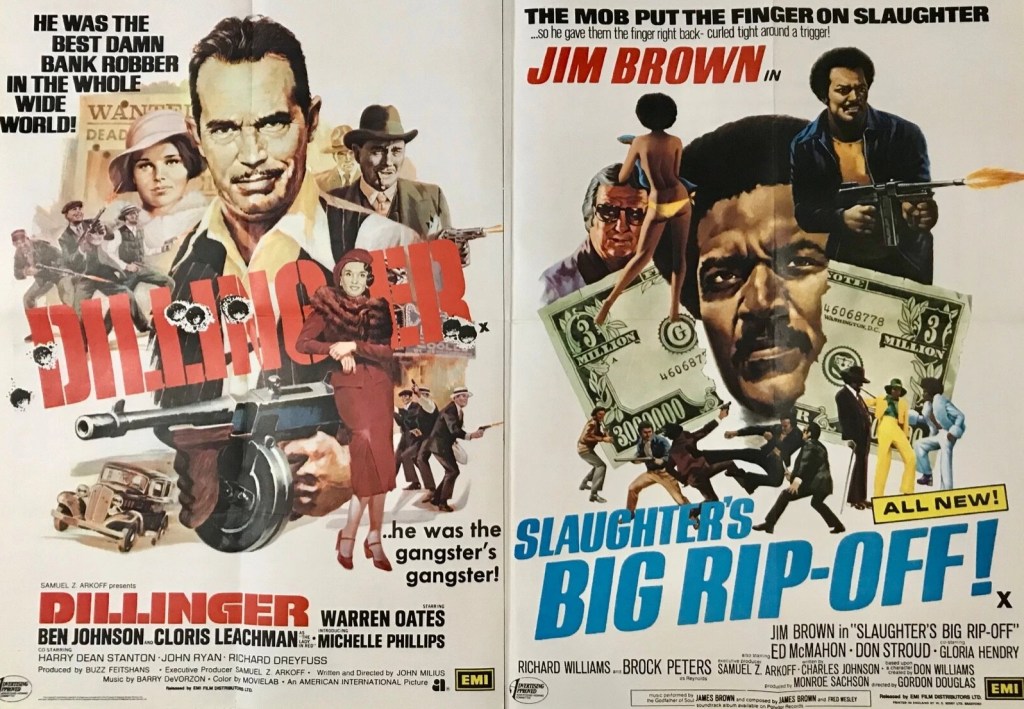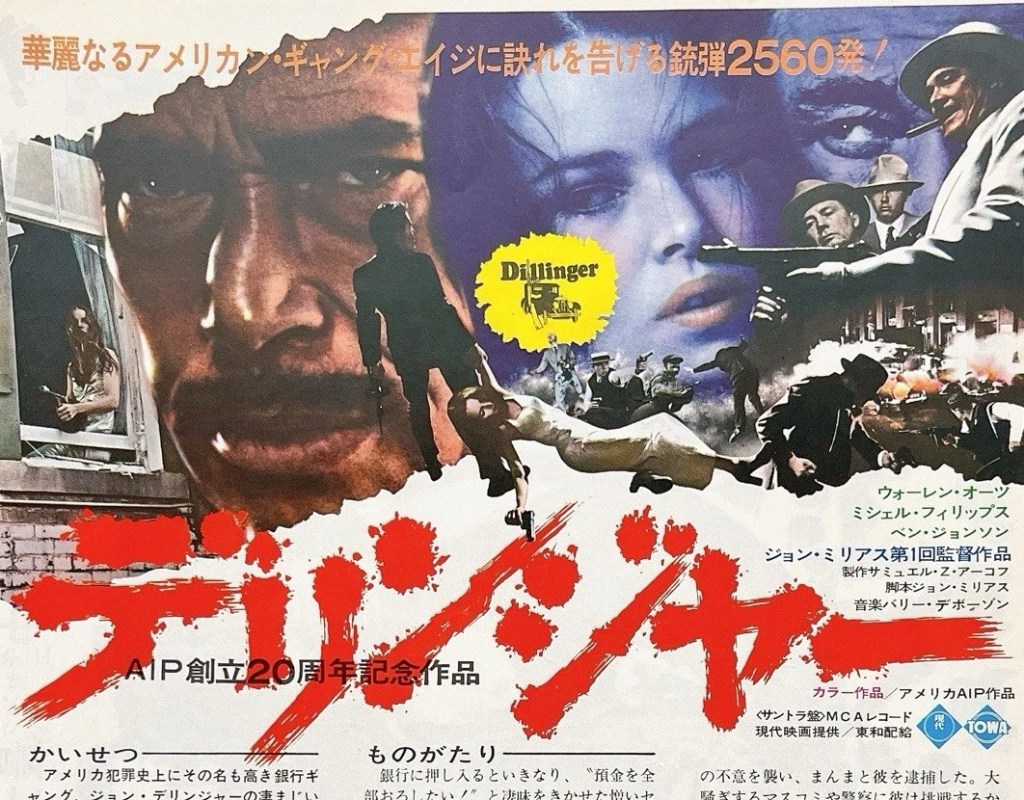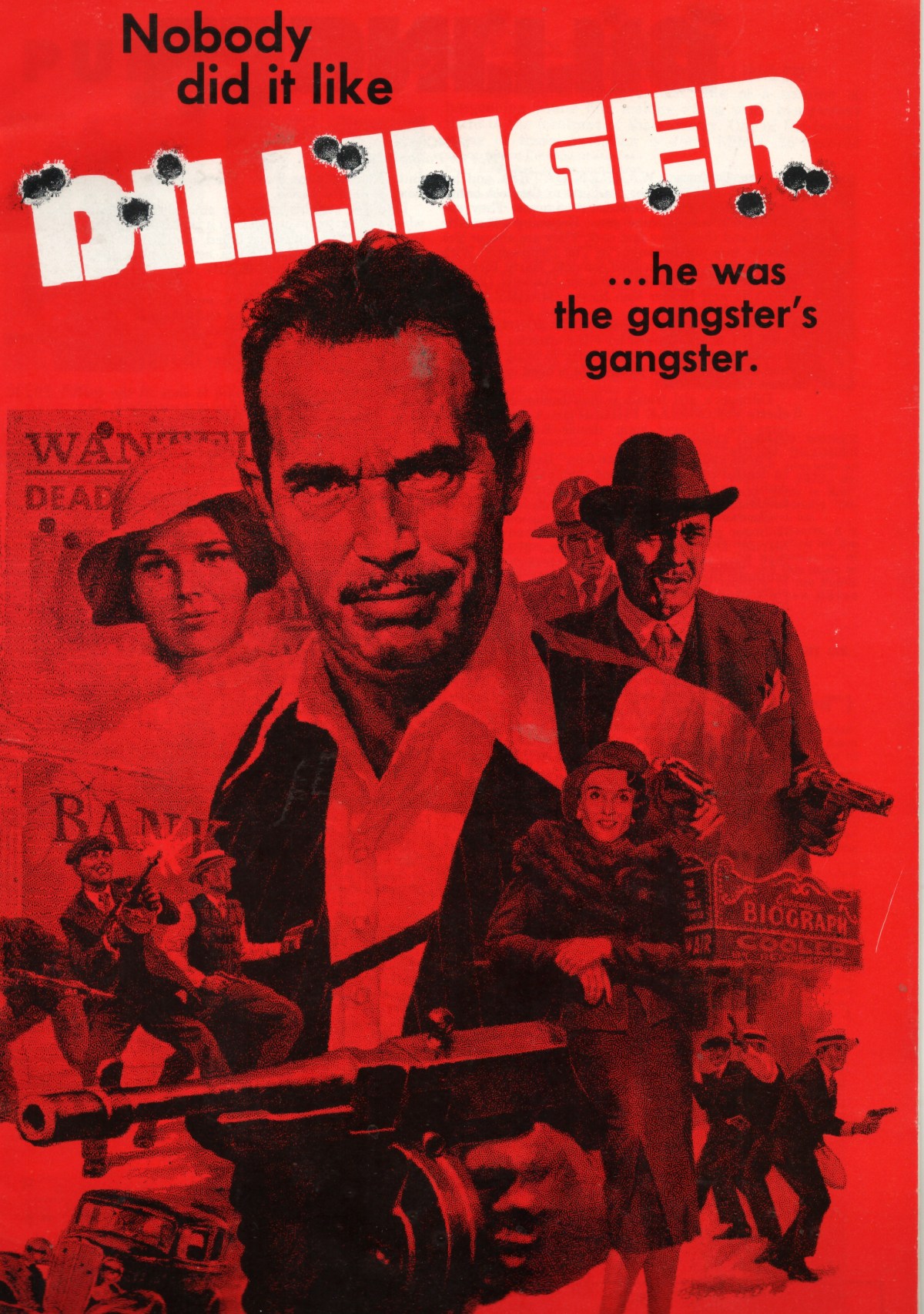
AIP made no bones about how it was pitching this one. It was selling notorious 1930s gangster as a hero, a folk hero perhaps, a narcissistic character perhaps, but still someone audiences could root for, just as the American public had back in the day when the only way to beat the system was via crime.
“The Gangster’s Gangster” sang the taglines, as if Dillinger was held in extraordinary high esteem by his fellow robbers, to be mentioned in the same august tones as Al Capone. Where Bonnie and Clyde (1967) used romance to leaven the killing, Dillinger preferred charm. Dillinger felt the people he robbed should be honoured to be robbed by such a status symbol as himself.
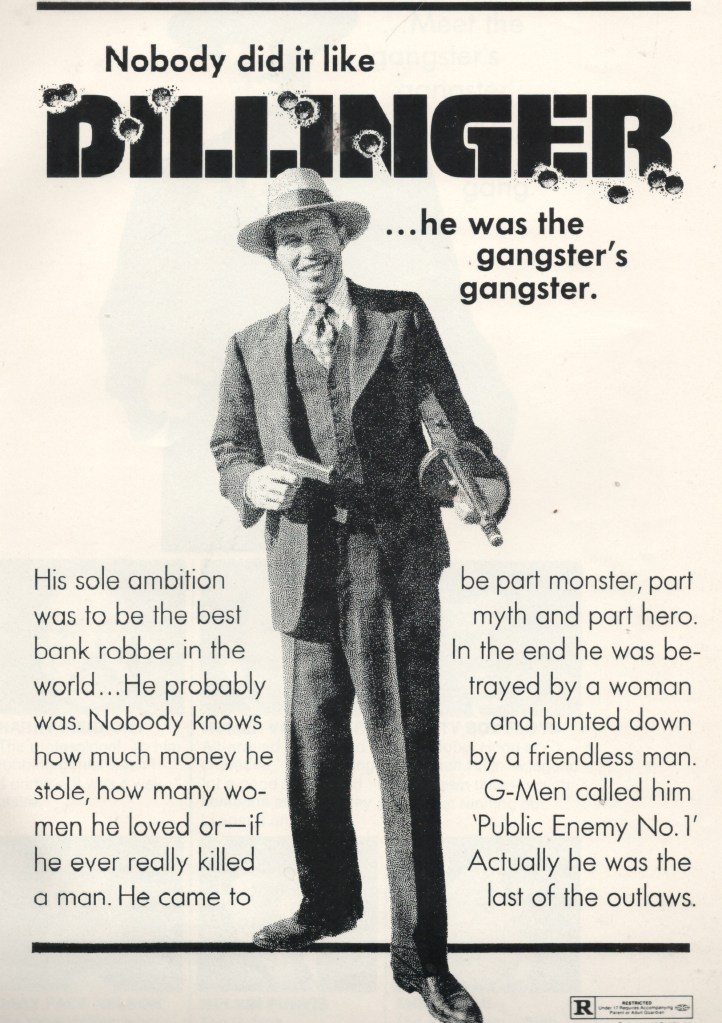
“His sole ambition was to be the best bank robber in the world,” rang out another of the taglines. He was “the last of the outlaws.” His robbing spree was only curbed after being “betrayed” and hunted by a “friendless” lawman. If the marketeers’ idea was to squeeze every ounce of pity from the audience for the ruthless gangster, they certainly did their best.
The Pressbook/Campaign Manual from AIP ran a handsome 28-pages in A3.
It helped that star Warren Oates bore a remarkable resemblance to Dillinger. He played the role without any make-up or prosthetics. Oates wasn’t as yet a big enough star for the writers of the Pressbook to focus the entire marketing efforts on him. He was recognized primarily as a character actor despite being touted as the “new Humphrey Bogart.”
Rancher’s son Ben Johnson was a better bet, having just picked up the Oscar for The Last Picture Show (1971) and it was another Oscar-winner Cloris Leachman who played the woman who double-crossed the gangster that led to his execution.
In fact, writer-director John Milius was reckoned to be a more attractive publicity vehicle than either Oates or Johnson. Certainly, the article about him too precedence. But then he did have a winning turn of phrase. “I consider John Dillinger to be a folk hero,” claimed Milius, “just as Pecos Bill, Paul Bunyan and Buffalo Bill were immortalized. Dillinger…won a tremendous following because people who were scrounging for the bare necessities of life had no love for the strongholds of finance.”
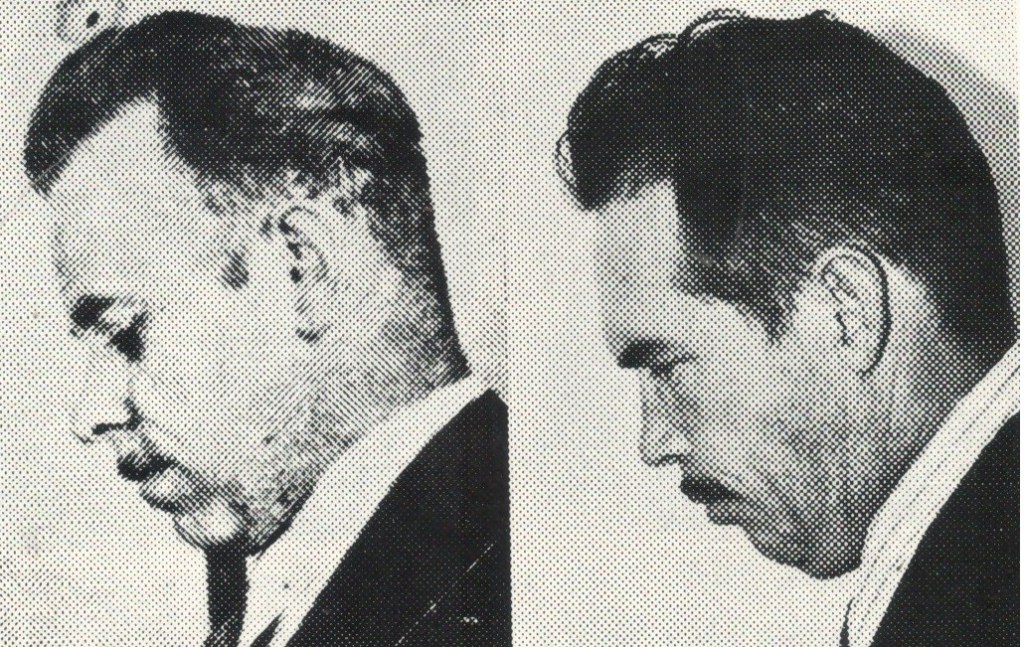
Oddly enough, Dillinger wasn’t born in poverty. He was the son of a prosperous grocer and known as “the cutest kid on the block.” Like he was in a swashbuckler, he would vault over the bank rail. He never wore a mask. He was determined to make his name as a bank robber and anonymity would not suit.
The advertising was limited to three spreads – the bold “gangster’s gangster” with a machine-gun-toting Dillinger and a “nobody did it like Dillinger” tagline; a second one with provided him with a biography and set him up as a good guy; and the final one which including details of his cohorts.
There was plenty meat for cinema managers to feed journalists, plenty of the detail about the filming to arouse local interest. Eight stunt men, many specialists in particular fields like car crashes or falls, were involved and nine antique cars wrecked in car chases or riddled with bullets from Thompson sub-machine guns or Browning automatic rifles. All were pre-1934 models and included three Fords, a Franklin, an Erskine and a Studebaker costing $1,200.
And another 15 vehicles came from the Horseless Carriage Club of Enid, Oklahoma, where the movie was filmed. Real-life modern gangsters though local cops would be so preoccupied with the filmmakers that they could get away with a couple of robberies.
When it came to smashing up the windscreens the director was heavily involved, hammer in hand. Since the window screens lacked safety glass this was a straightforward, enjoyable, chore. Seven gallons of Jerry Cash’s Special Formula Blood, ten times as much as was usual for an actioner, was purchased. The gangsters got through over 150 pieces of weaponry including 88 Springfield Model ’03 rifles, 40 handguns, 25 shotguns and rifles, eight sub machine guns, four automatic rifles, three Lewis machine guns plus a howitzer. They fired off 50,000 rounds of blanks.
And the Pressbook came with two pages of ideas with which cinema managers could attract attention. Antique car clubs were an obvious target for marketing tie-ins as were gun shops. Cinema managers were urged to mount lobby displays using borrowed weaponry. Dressing up usherettes as gun molls and encouraging customers to attend in 1930s costumes would have been cheap promotional devices as well as suggesting clothing stores feature 1930s fashions – which had proved a winner for Bonnie and Clyde. .
“Wanted” posters might be borrowed from police stations. Many banks cooperated with the filming so these were viewed for further cooperation. Cinemas might dress up a “Lady in Red” and have her walking the sidewalks and then loitering in front of the cinema, in imitation of the role played in the picture by the real Lady in Red. A Dillinger tie-in paperback was available in drugstores and retail outlets.