Disclosure Day (2026) *** – Seen at the Cinema

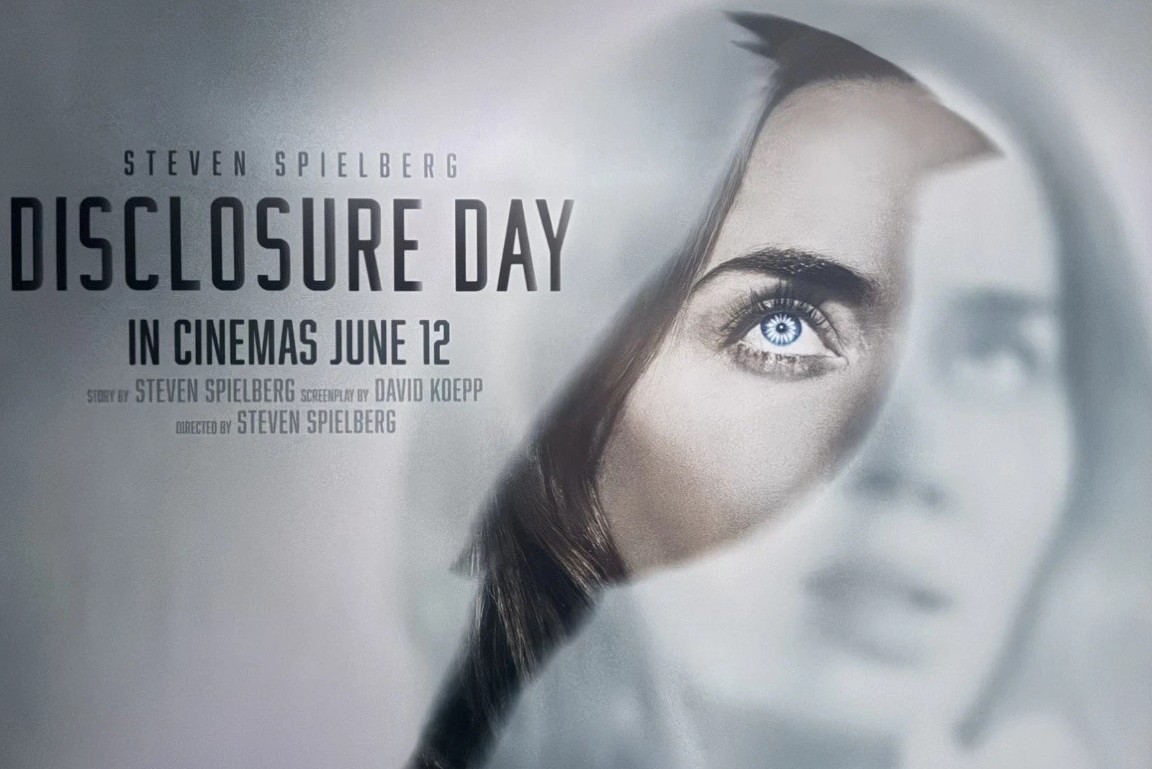
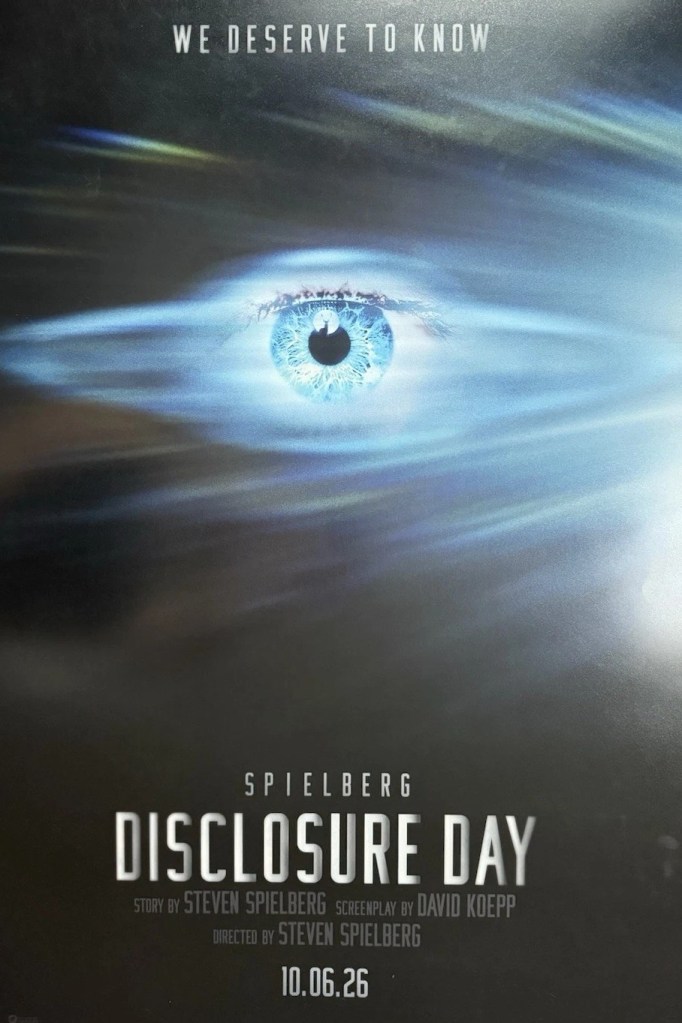
Thanks goodness other directors stepped up to the summer box office plate otherwise Hollywood would be left wringing its hands at this workmanlike, sanctimonious, effort. Like the recent Star Wars number, you get the impression the Steven Spielberg IP has long gone off the boil with the exception of sojourns into the prehistoric. He has not had a box office hit in years – The Fabelmans (2022) and West Side Story (2021) bit the dust along with The Post (2017) while Ready Player One (2018) only just made its money back.

Maybe it’s simply age (he’s pushing 80), but he’s lost that special magic that made him one of the all-time greats, the idea that he create something new, awesomely visual, rather than that he’s turned into an earnest lecturer.
Luckily, some other unexpected contenders – Project Hail Mary, Michael, Obsession, Backrooms – have stepped up the box office plate and Toy Story 5 is way ahead of initial projections while we we’ve still got another instalment of Minions and Spiderman to come, though judging from the trailers I’m less confident of Supergirl and The Odyssey delivering, though the latter may hit it big upfront judging from Imax advance bookings

This is a retread of Close Encounters of the Third Kind (1977), with the same male-female characters – weatherperson  Margaret (Emily Blunt) and ex-jailbird scientist Daniel (Josh O’Connor) – in search of something unknown, as though they are conduits to an alien world, one that serves up the same soup of aliens being wondrous beings, not to be illicitly tampered with. However, to peg all this on the Roswell “conspiracy” and to deck out almost every scene with men in black and men in black driving black cars seems an immense miscalculation.

The plot is full of holes, too, if you don’t mind me saying. How on earth did the rebels manage to snag a living alien from under the noses of the uber-security security forces of the quasi-government facility, or, even worse, have they made off with a baby creature and grown it themselves.

In social media world sure everyone is going to drop what they are doing and go past their bus stops or remain in situ to watch on their mobile phones “disclosure day” when an alien appears on their screen, but in the cinema world my guess is that audiences, like me, were staggered that after well nigh two-and-a-half-hours of a shaggy dog story this was all Mr. Spielberg could come up with.

Sure, there’s a bit of a chase scene here and there, and some form of telekinesis and people holding the kind of brick – that old-style mobile phones use to be made off – that has some kind of magical power, enough that Daniel’s girlfriend Jane (Eve Hewson) can be used as a conduit for Noah’s (Colin Firth) evil intentions, which is mainly to prevent “disclosure day.”
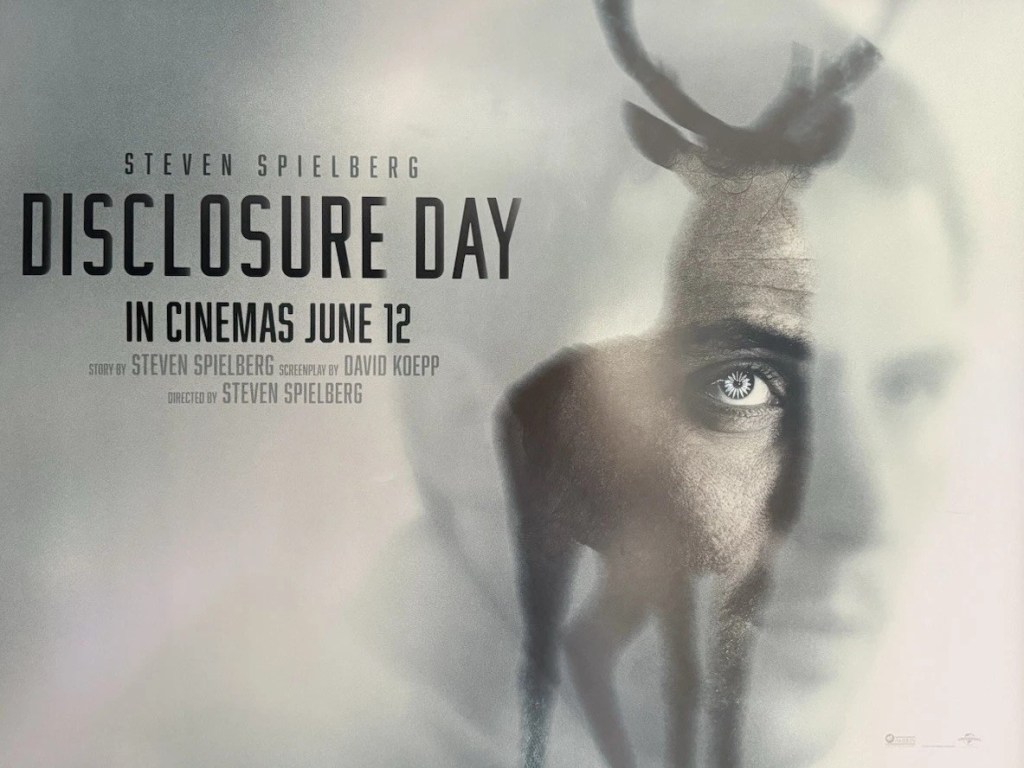
None of the supposed supernatural powers on show here are much to write home about, and there’s none of the wonder of Close Encounters and E.T. (1982), or even the more violent sci fi of Minority Report (2022) and War of the Worlds (2005) where aliens, whether artificially induced or not, are not on their best behavior. There’s not a single scene that you could say has the distinctive Spielberg stamp, rather a ramshackle screenplay that throws together a lot of different tangents in the hope, somehow, that they’ll all miraculously come together.

The only characters given any characterization are rootless Margaret and ex-novitiate Jane. Margaret is always on the look-out for something better, quite happy to wander from city to city to do so, the kind of ambitious also-ran who thinks they have a chance of grabbing the golden ring even if it means adding the occasional sexy shimmy to her weather-reading chores. Jane, Lord help us, is landed with the worst characterization I can remember, laden down with the idea that we might have to share the God-made universe with someone other than human beings. How on earth that 1950s idea made it into a contemporary movie is anybody’s guess and remember that Paul Schrader was yanked off screenwriting duties on Close Encounters for making it overtly religious.

Luckily, Emily Blunt (The Devil Wears Prada 2, 2026) more than holds the picture together and there’s certainly something touching in the way, using her sudden special powers, she puts troubled people at their ease. Daniel is there as a plot conduit, tasked with little more than exposition.

Noah and rebel leader Hugo (Colman Domingo) come across like the grown-ups, one trying to keep the spook in the box, the other trying to let it out.

There’s probably enough going on to keep you hooked, but the big reveal is a big disappointment.

Steven Spielberg does not save summer.  
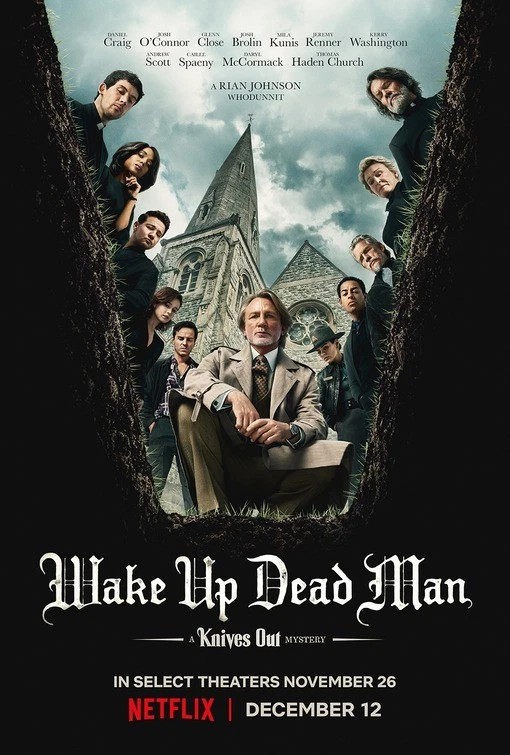
Wake Up Dead Man: A Knives Out Mystery (2025) ** – Seen at the Cinema (out on Dec 12 on Netflix)

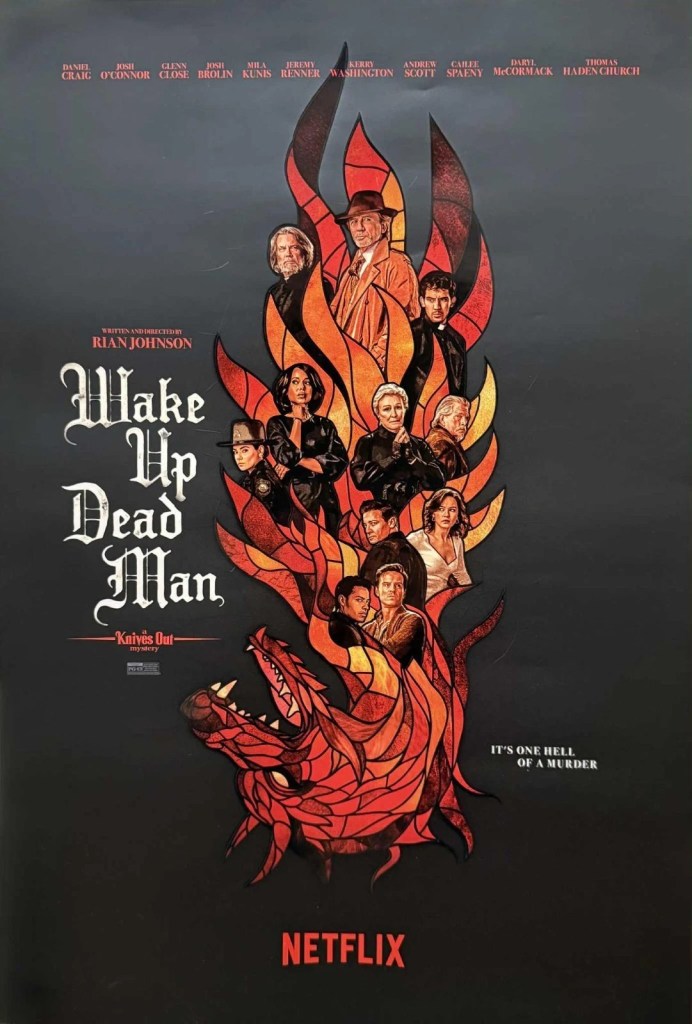
An unholy mess. Serve Netflix right for once again indulging one of their “visionary” directors. I’m assuming either director Rian Johnson is a true believer or he’s embarked on a spoof that doesn’t work. Either way it’s a bone-headed venture filled with the dullest characters you would ever come across and testing audience patience to the limit by keeping the star of the show, private detective Benoit Blanc (Daniel Craig), out of the picture for the first 30 minutes, dumping all the exposition on Fr Jud Duplenticy (Josh O’Connor), the most cliched priest this side of Bing Crosby and relying on the “locked room” conceit, handled with some deadly ham-fistedness, to see the audience through an extremely trying time.

Once you work out that the title relates to the Resurrection of Jesus Christ and that we’re entombed in a flummery of Christian jargon, you start hoping this is going to head down the satirical route and that at least you’ll get a few laughs for your hard-earned bucks. But, no, it’s so straitlaced it might as well have called on a corset to design the narrative. In order to help the director out of a whole series of cinematic cul de sacs everyone overacts and we skip over inconvenient plotholes.

The priest is sent to help out in a rundown parish run by nutcase Monsignor Jefferson Wilks (Josh Brolin) whose idea of fun is to relate in detail, under the guise of confession, how many times, and how, he has masturbated that week. There’s a godforsaken subplot about lost treasure and a mysterious child who you’ve guessed from the off is the son of Wilks.

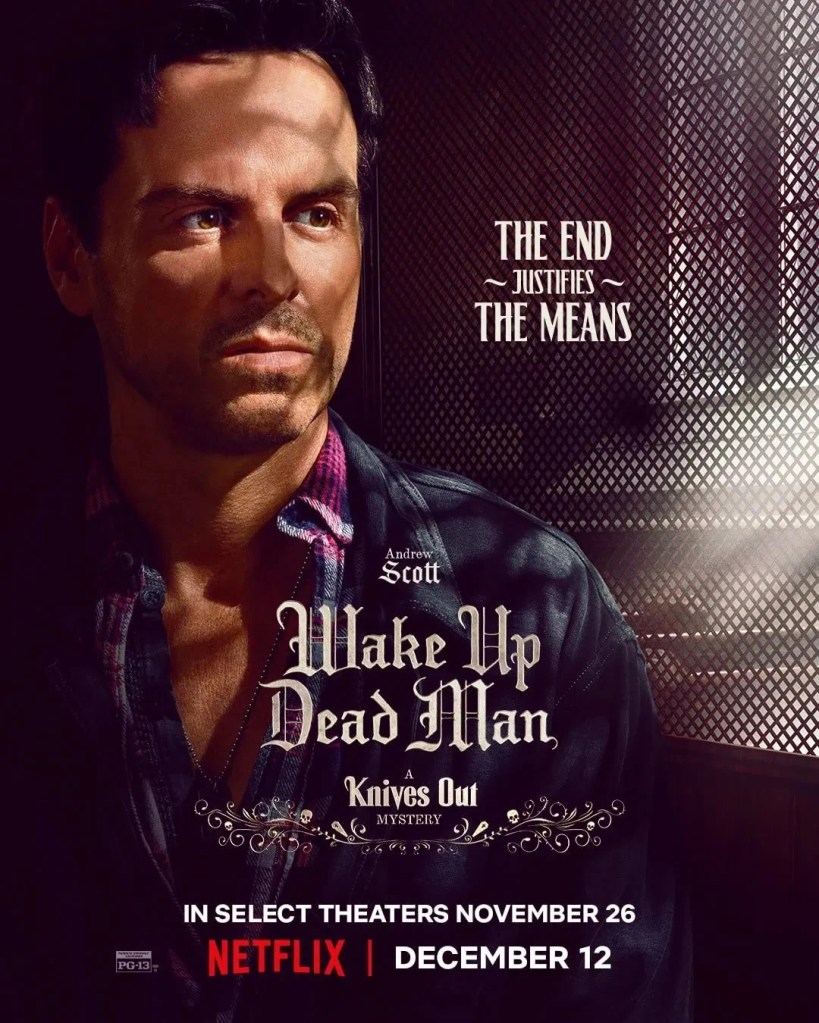
When Wilks is done to death in church in a small room off the altar, then we get the standard roll-call of suspects. These include church manager Martha (Glenn Close), who specializes in letting out blood-curdling screams, alcoholic doctor Nat (Jeremy Renner), barmy novelist Lee (Andrew Scott), suffering from the opposite of writer’s block who can’t stop spewing out an interminable book, Vera (Kerry Washington) who’s been put in charge of bringing up mysterious boy Cy (Daryl McCormack), now a failed influencer, and crippled Simone (Caillee Spainey) who Wilks has bled dry. Every now and then local cop Geraldine (Mila Kunis) turns up to listen in awe to Blanc.

Fr Jud is the main suspect for no apparent reason that I could see except the writer says so and he’s the most handsome guy around and wouldn’t it be great if Blanc could recruit a priest sidekick in the way of the television series of yore.

So first of all we get a lecture on the “locked room” thesis with reference to Golden Age of Crime novelist John Dickson Carr who invented the term and then to the likes of Agatha Christie and others who took up the challenge.  A variety of theories are presented by Blanc with the sole purpose of showing everyone how clever he is by knocking them all down.

Once we enter Resurrection territory it gets downright stupid, the dead man rising again on the third day in the manner of a certain religion, and then there’s another murder and because we’ve run out of things with which to add genuine tension a lot of the action now takes place in pouring rain and Fr Jud who looks like he is in the clear gets once again targeted as the main suspect.

And then we’re into scene after scene after scene of exposition and a ton of talk about “free will” and “grace” – religious terms you understand. Confession, you might not be surprised to learn, plays a key role.

This might have been more acceptable with a better cast. This is nothing like an all-star cast such as used to decorate Hercule Poirot epics and helped out with keeping an audience engrossed in the first two in the series. This is populated by over-the-hill stars like Glenn Close (Hillbilly Elegy, 2020), Mila Kunis (Bad Moms, 2016) and Jeremy Renner (Avengers: Endgame, 2019) and actors who wouldn’t be considered stars except in television like Andrew Scott (Blue Moon, 2025). Josh O’Connor (Challengers, 2024) is out of his depth. Josh Brolin (Weapons, 2025) would be closest we’ve got to what might constitute a genuine star but he was second-billed in that and only then because everyone else was a nobody.

The role of the star is to enliven a picture and those with an undiluted screen presence give audiences something to hang their hat on or direct their sympathies to. But none of this bedraggled lot, every character underwritten, would you care a fig for.

Rian Johnson ruins his own creation.

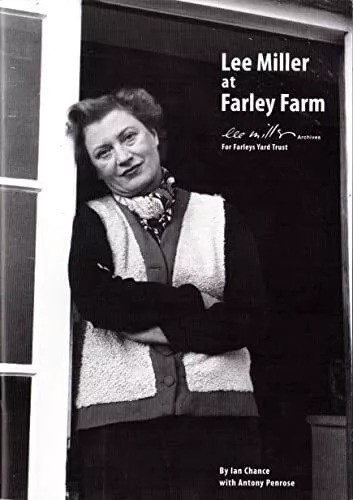
Lee (2024) *** – Seen at the Cinema

Would have worked better as a documentary. Bit puzzled too by the deceit of the structural device, flashing back from her war years to being interviewed by an apparent journalist in old age at her country cottage. Seems an interesting conceit that he turns out to be her son Antony (Josh O’Connor) and she’s able to turn the tables and ask what she was like as a mother (not good, apparently, Antony grew up feeling he was an imposition). But also a standard biopic trope as he uses her famed photos to stimulate memories. But then, presumably in the interests of honesty (or who knows what) the credits blow these sequences to pieces by pointing out that her son didn’t have a scoobie about her war activities until after the death a forage in the attic turned up boxes of her photos. What the heck, artistic license and all that.

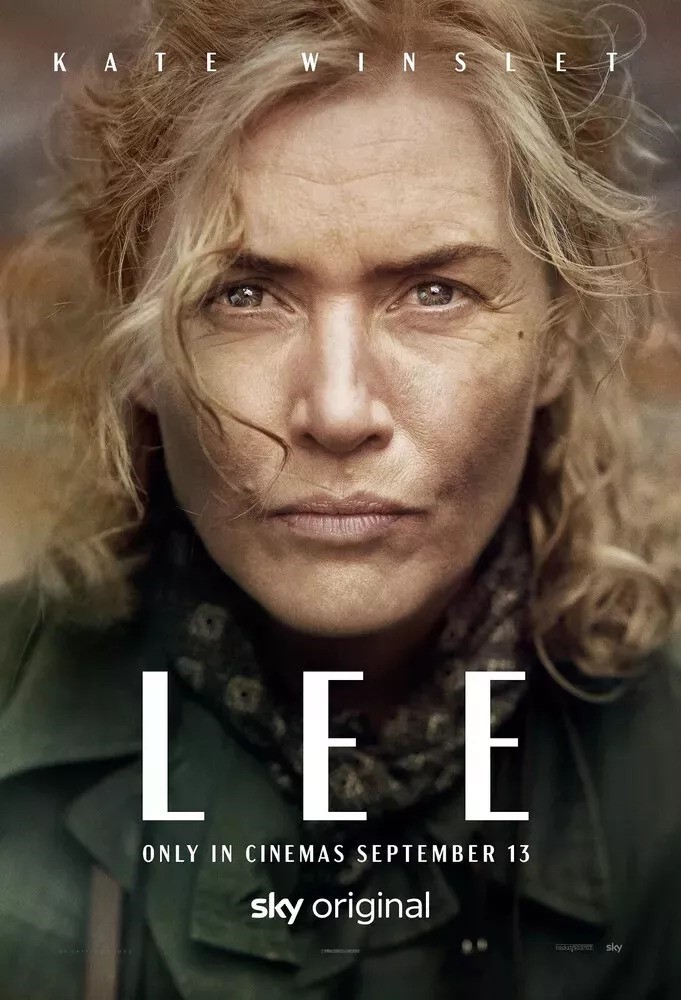
My other quibble, since I’m in that sort of mood, is that the ageing process seems to have passed our star Kate Winslet by. Sure, she’s dabbed on a bit of oldie make-up for her later years but the crow’s nest of lines around her eyes are noticeably prominent for a woman just turned thirty in the immediate pre-war year.

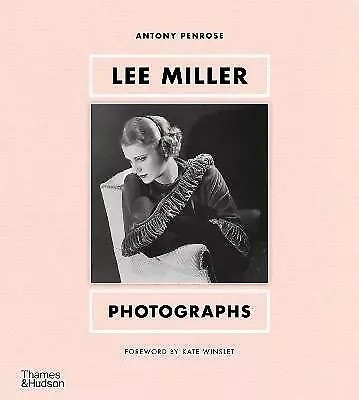
Still, on with the show, in which her pre-war fame as a surrealist is also ignored, as is her liaison with Man Ray, or that before she took up with another surrealist Roland Penrose (Alexander Skarsgard) she had been married to –  and not divorced from – an Egyptian businessmen. The thrust of the movie is her war years as Vogue correspondent. There’s a bit of falling back on characters skitting around in the background (Cecil Beaton, for example) and keeping us up-to-scratch on timescale, invasion imminent etc.

Misogyny is fairly rampant, the British squeamish about sending women unnecessarily to the front line, the Yanks less so. Though Lee Miller is treated, for dramatic purposes, as the only female war correspondent, breaking through the usual class ceiling, in fact the Yanks had squads of them including Martha Gellhorn and Mary Welsh, third and fourth wives of Ernest Hemingway, respectively, Kathleen Harriman, Dixie Tighe and Helen Kirkpatrick, and Tania Long, none of whom would be unknown to Miller since she posed for a photo with the gang in 1943.

There was nothing subtle about Lee Miller, she said it like it was, a hard-drinking what used to be known as a free spirit, an euphemism for embracing a love-‘em-and-leave-‘em mentality. But there’s some subtlety here, a scene of her peeling potatoes revealing more about male expectation than any verbal punch-up with any officious male, being covered with supposedly invisible paint by Roland more effective in catching sexual attraction than the rest of her let-it-all-hang-out persona.

The only problem is that the concentration camp scenario has been dealt with by any number of far superior films and her staggering back with shock at the sight of the piled-up corpses not compensation enough. I don’t know enough about war photographers to compare what she captures through the lens with the dozens of others doing the same job. By the time her photos of the Holocaust were printed in American Vogue, Richard Dimbleby and Edward Murrow had delivered radio devastating reports and anonymous military photographers supplied tons of evidence against the Nazis.

I’m not sure it actually helps her case that she took a bath, naked, in Hitler’s bath.

Kate Winslet (Ammonite, 2020) almost single-handedly keeps the movie on course, but it lacks impact as a war picture, and the idea that nobody other than Lee was taking note of the suffering of the British during the Blitz seems a bit of a stretch. Pick of the support is most definitely Andrea Riseborough as the doughty British Vogue editor, every bit as tough if not as outspoken as Miller. Josh O’Connor (Challengers, 2024) spends all his time looking soulful for no reason I can divine. Marion Cottillard (La Vie en Rose, 2007) is wasted.

Ellen Kuras directed from a script by Liz Hannah (All the Bright Places, 2020), Marion Hume (movie debut) and John Collee (Monkey Man, 2024).

Movie not as hard-nosed as Winslet.

Discover WordPress

A daily selection of the best content published on WordPress, collected for you by humans who love to read.

The Atavist Magazine

by Brian Hannan

WordPress.com News

The latest news on WordPress.com and the WordPress community.