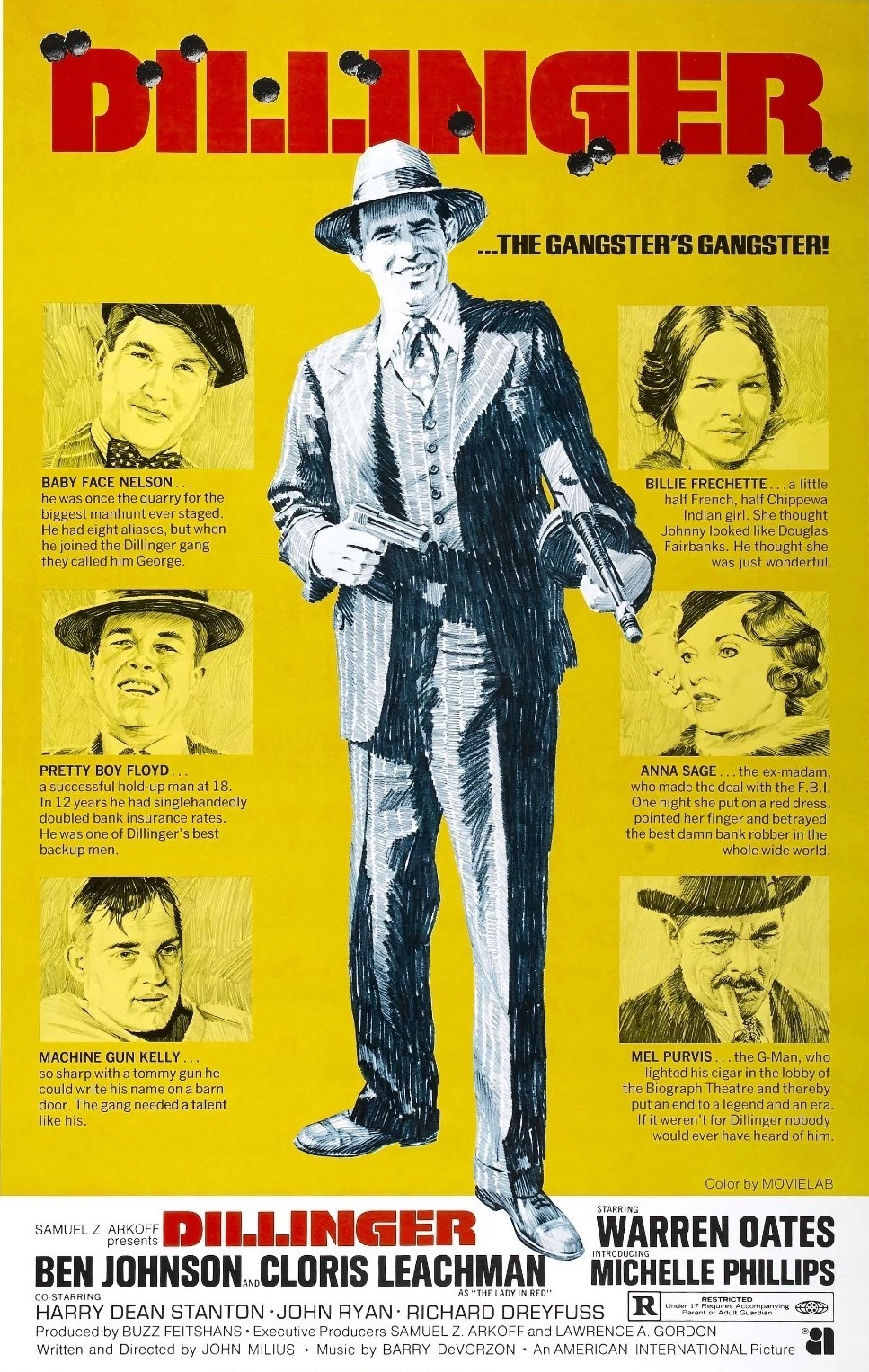
How to make a cult movie. Well, you can start with an uber-macho gun-loving director in the form of John Milius (instrumental in the making of Apocalypse Now, 1979, for which he wrote the script). Then throw in the kind of actor who would never have been a star except for the chisel-faced likes of Lee Marvin and Charles Bronson changing what audiences appreciated in a leading man, as opposed to a supporting character – step forward Warren Oates (Bring Me The Head of Alfredo Garcia, 1974).
Throw in two of the best supporting actors who ever lived. The first one, Ben Johnson, has by pure chance stepped up from the John Ford Stock Company and by golly snaffled himself an Oscar in The Last Picture Show (1971) and made the unlikely leap, in his mid-50s, to just about top-billed status. The second is Harry Dean Stanton (Cool Hand Luke, 1967), just about everyone’s favorite cult actor.
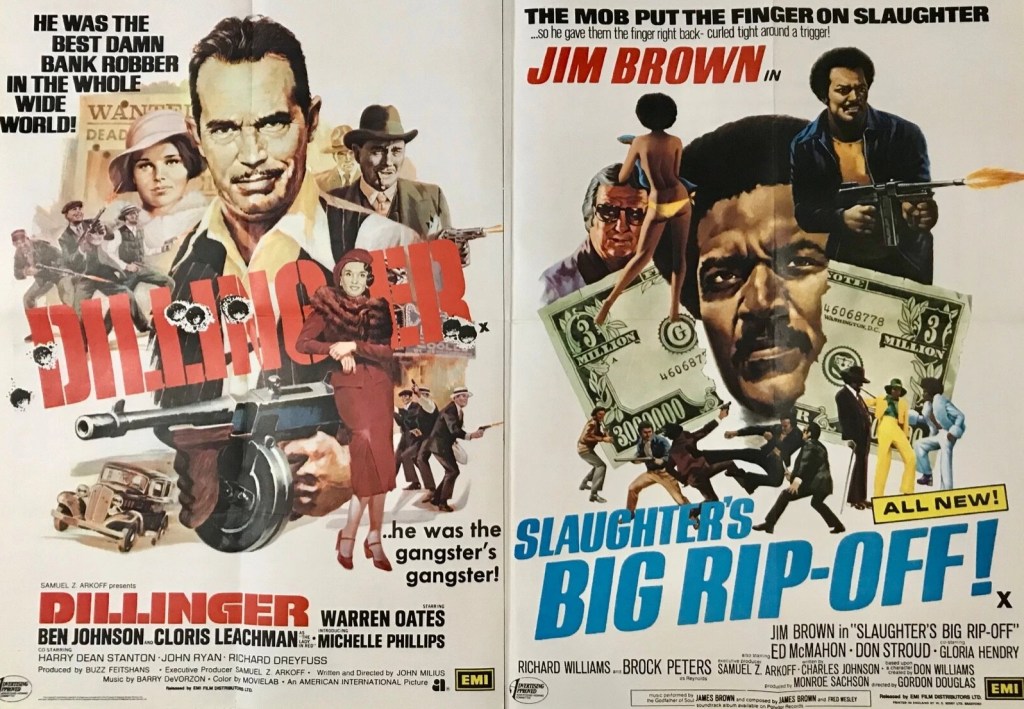
For good measure chuck in another actor, Cloris Leachman (Butch Cassidy and the Sundance Kid, 1969) who had barely had a movie career and now in her mid-1940s it was taking off thanks, oddly enough, also to an Oscar for The Last Picture Show. And a couple of fresh faces in Richard Dreyfuss (Jaws, 1975) and pop singer Michele Philips of The Mamas and the Papas.
That the tale happens to revolve around the second most popular – after Bonnie & Clyde – of the hero bandits of the Great Depression, John Dillinger, and cult is home and dry.
As with the later Michael Mann version, we’re telling two stories at once. Publicity hound John Dillinger (Warren Oates) would have been a social media god these days – you bet he would have filmed every damned bank robbery on his phone, not to mention all the innocent bystanders filming him on theirs. He just loved appearing on the front pages of newspapers and on wanted posters. And he had a set of terrific catch phrases, mostly revolving around thinking people would remember forever being in his presence.
Then we’re following F.B.I. kingpin Melvin Purvis (Ben Johnson) tasked by J. Edgar Hoover to rid the country of these murderous varmints. All of this to the rat-a-tat-tat soundtrack of blazing machine guns mowing down gangsters and cops alike and the equally rat-a-tat-tat tones of a voice-over intent on creating high drama the way they used to on newsreels. The voice-over seemed particularly beloved by makers of gangster movies, though this avoid the biographical excesses of The St Valentine’s Day Massacre (1967).
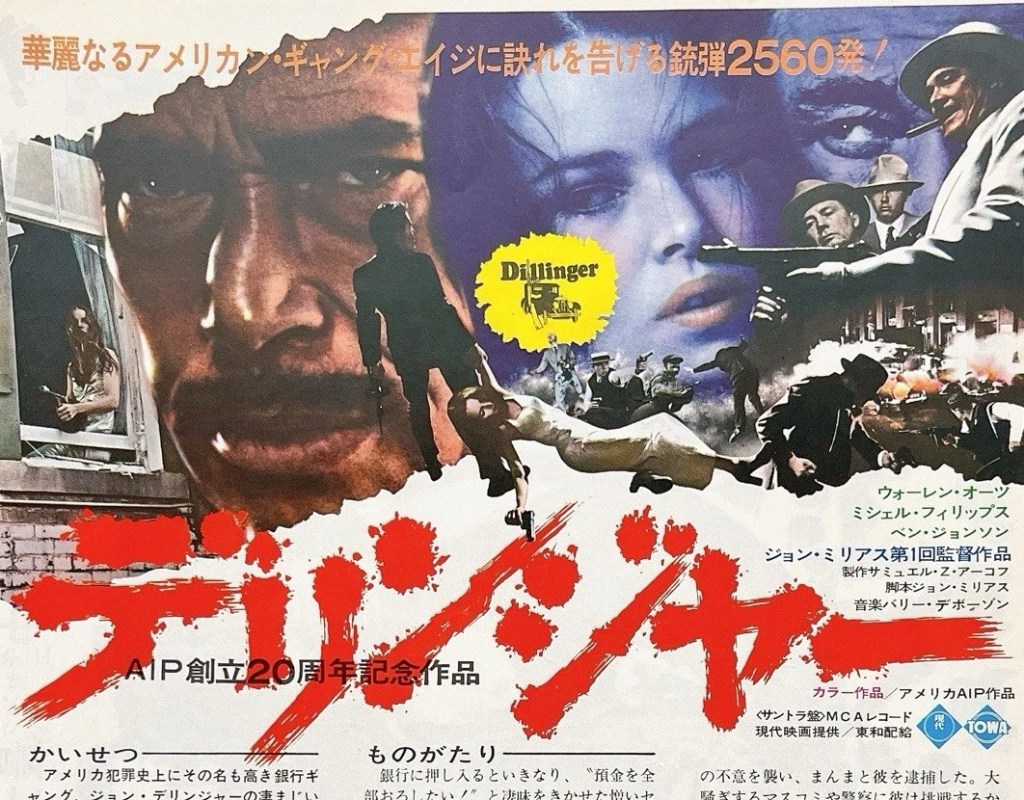
Purvis and Dillinger are battling it out in more ways than one. Purvis appears equally determined to steal the headlines. He’s the one that goes in and captures single-handedly a bunch of notorious killers armed only with a bulletproof jacket and a cigar and weapon of some sort. He’s delighted when a gangster fashions the moniker “G-Men”, a nickname that seems to elevate the F.B.I. in the eyes of the media which have a tendency, for the sake of easier-to-write headlines, to shorten names.
You wouldn’t have needed an F.B.I. except for a peculiarity. In the U.S. state law meant that you could escape pursuit in one state if you hopped over into the next state where the law wouldn’t bother you one hoot because your crime wasn’t within your jurisdiction. If you were smart enough you could even evade the F.B.I. if you stuck to doing all your robbing in one state and all your hiding-out in another. But should you be dumb enough, as here, to truck a stolen car over the state line, then the F.B.I. could come gunning for you.
Dillinger isn’t likely to let the little matter of jurisdiction get in the way of his aim to become the best bank robber in the world, a claim that could be contested if he limited his sprees to one little state. Although his fame grows momentously when he escapes from a high-security prison that is supposed to be escape-proof.
Then Dillinger formed the gangster equivalent of the rock star Supergroup, bringing together Baby Face Nelson (Richard Dreyfuss) and Pretty Boy Floyd (Steve Kanaly) and others. .
If anyone could improve on the Raymond Chandler adage of when a narrative is in trouble bring in a man with a gun, it’s here. Dozens of men with dozens of machine guns, shotguns and pistols are apt to arrive at any point – every male in any godforsaken town totes a shotgun into the bargain. Dillinger might have been a great robber but he wasn’t much good at hiding out – he was always getting ambushed.
The gun battles are certainly lively and occasionally inventive.
Dillinger is eventually captured because, as one of his crew cautions, he’s a sucker for women. With Billie (Michele Philips) in irons he gallivants around with illegal immigrant Anna (Cloris Leachman) who snitches him out to Purvis leading to the legendary shootout at the Biograph cinema in Chicago.
As now, media (including social media) has their cake and munches it down, giant headlines describe the robbers in detail to sell copies while at the same time hypocritical editorials complain about their exploits to satisfy the more moralistic readers.
Characterization is sketchy to the point of cartoonish, but the characters, including the cop, are so cocky they only need to chuck out a few catchphrases to keep our interest.
Warren Oates and Ben Johnson make a decent stab at stardom, Richard Dreyfuss steals a few scenes, Harry Dean Stanton has some great lines.
Given the derisory budget, this is a great debut by John Milius, who also wrote the script.


Some bits:
“Following the company logo, and prior to the opening credits, a title card reading “Indiana, 1933” appears, followed by a brief color sequence in which John Dillinger (Warren Oates) robs a small-town bank, bragging about his fame and telling the frightened bystanders that they will be able to tell stories about the day for years to come. The black-and-white credits then are shown over photographs of the Depression era, including desolate farms, impoverished families and President Franklin D. Roosevelt. Cloris Leachman’s credit, the only opening cast credit with a character name, reads “And Cloris Leachman as The Lady in Red.” After John Milius’ credit, which reads “Written and directed by,” the action begins as “Melvin Purvis” (Ben Johnson), in voice-over, describes what became known as the Kansas City Massacre, during which several of his friends and colleagues “died like dogs in the gutter” at the hands of escaping gangsters. Purvis then tells of his vow to kill all of those responsible.
Johnson’s voice is heard in voice-over narration at several junctures during the film, variously explaining the passage of time and place or giving background on how he apprehended or killed various criminals. There are additional black-and-white montages in the film that illustrate Dillinger’s robberies or activities as well as Purvis’. Similar to gangster films of the 1930s, Dillinger includes numerous newspaper headlines within the montages that follow up on the action. One of the montages also includes stock footage from unidentified gangster films from the 1930s and 1940s that show police raids, shootouts and car chases.
At the end of the action, four title cards incorporate photographs of “Anna Sage,” “Billie Frechette,” Melvin Purvis and John Dillinger next to brief, written explanations of what happened to them after Dillinger’s death: Sage was deported to Romania in 1935; that same year, Frechette toured the country with Dillinger’s father in a show entitled Crime Does Not Pay and died on an Indian reservation in 1969; Purvis left the FBI after Dillinger’s death, became a businessman and committed suicide in 1961, using the same gun he used to kill Dillinger. The final card, of Dillinger, reads “John Dillinger now adorns combat silhouette targets used by the F.B.I.” Dillinger’s photograph is shown as a shooting range target.
Some of the details within the storyline, as well as the information on the brief sketches in the end credits, are at variance with established historical facts. For example, although Dillinger was identified by Anna, “The Lady in Red,” outside the Biograph Theatre in Chicago, Frechette was not with them and, according to historical sources, was in prison at the time. Within the film it is implied that Frechette and “Polly” were the same person. According to historical accounts, Dillinger’s girl friend at the time was a woman named Polly Hamilton. The shootout and aftermath at the Little Bohemia Lodge did not result in the deaths of “Harry Pierpont,” “Charles Arthur ‘Pretty Boy’ Floyd” or “George ‘Baby Face’ Nelson,” as shown in the film. Floyd and Nelson died in separate incidents in 1934, and Pierpont was executed in Oct 1934 after being captured in Tucson, AZ.
Purvis actually died in 1960. The gun was not used to kill Dillinger, and some biographical sources have reported that his death may have been accidental rather than a suicide.
Some of the characters within the film were fictional, as were many of the dramatized incidents. The coining of the term “G-Men,” for example, has been attributed to various sources, although it has been popularly reported to have started just as described in the film. According to Filmfacts, actress Susan Tyrrell was initially announced for the role of Anna. Modern sources add David Dorr to the cast. As noted in contemporary news items, the picture was shot on location in Oklahoma, in and around Oklahoma City, Ardmore and Enid. According to a 3 May 1973 HR article, because there was a “heavy demand” by exhibitors to show more gangster pictures, American International Pictures was planning to release three more gangster biographies in 1973: Baby Face Nelson, Pretty Boy Floyd and Machine Gun Kelly. None of these projects were produced, although a 1974 television movie entitled Baby Face Nelson starring Martin Sheen was produced by Universal Pictures.
Dillinger marked the directorial debut of John Milius, who previously had written several successful screenplays, among them the 1972 release Jeremiah Johnson (see below). Dillinger received mixed reviews, with many critics comparing it, some favorably and others unfavorably, to Arthur Penn’s Bonnie and Clyde (see above) or Sam Peckinpah’s The Wild Bunch (see below). Dillinger also marked the motion picture acting debut of Michelle Phillips of the popular 1960s singing group The Mamas and the Papas. Producer Buzz Feitshans was the son of film editor Fred R. Feitshans, Jr. Milius’ screenplay, according to a 25 Jul 1973 Var news item, was being turned into a book that would be marketed as a tie-in to the film, but its publication is undetermined. The film’s pressbook was made to emulate a collection of articles about Dillinger, as written in the fictitious Chicago News Gazette, with photographs of the stars and commercial advertisements from the 1930s.”
LikeLike
I reckpned a fair amount of license had been taken with the facts. Thanks for this.
LikeLike