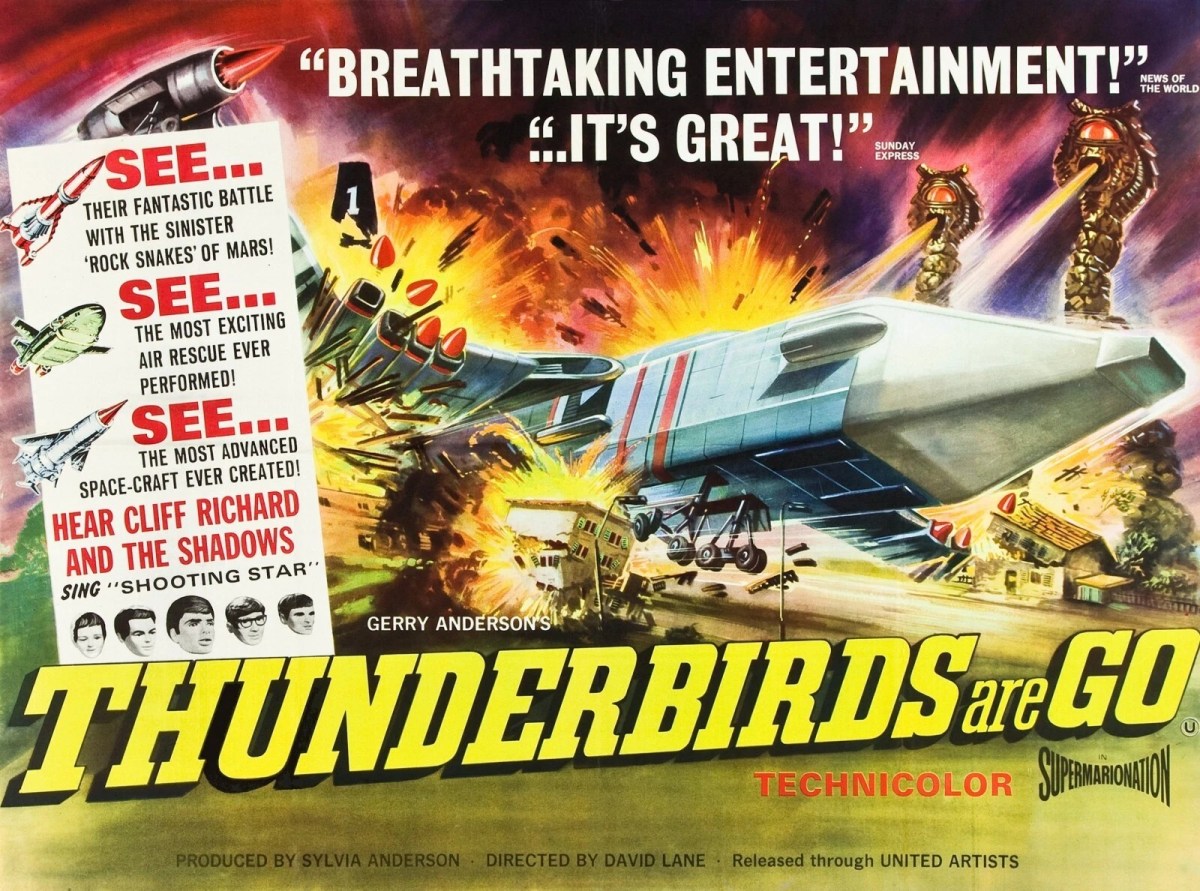
Thunderbirds Are Go (1966) ****

Nostalgia – and reappraisal – rule. Every bit as worthy a contender for a Father’s Day crown as the more favored likes of The Great Escape, 1963), The Dirty Dozen (1967) and Die Hard (1988). One of the reasons why Britain wasn’t in the thrall of DC and Marvel was that we had grown up with Dr Who and the Gerry and Sylvia Anderson portfolio of sci fi marionettes – Fireball XL5, Supercar, Stingray, Thunderbirds, Joe 90 and Captain Scarlet.

And while most of the nostalgia for the period goes the way of Ray Harryhausen, the Andersons’ achievements not so much with their puppetry but the miniaturization should not be underestimated.
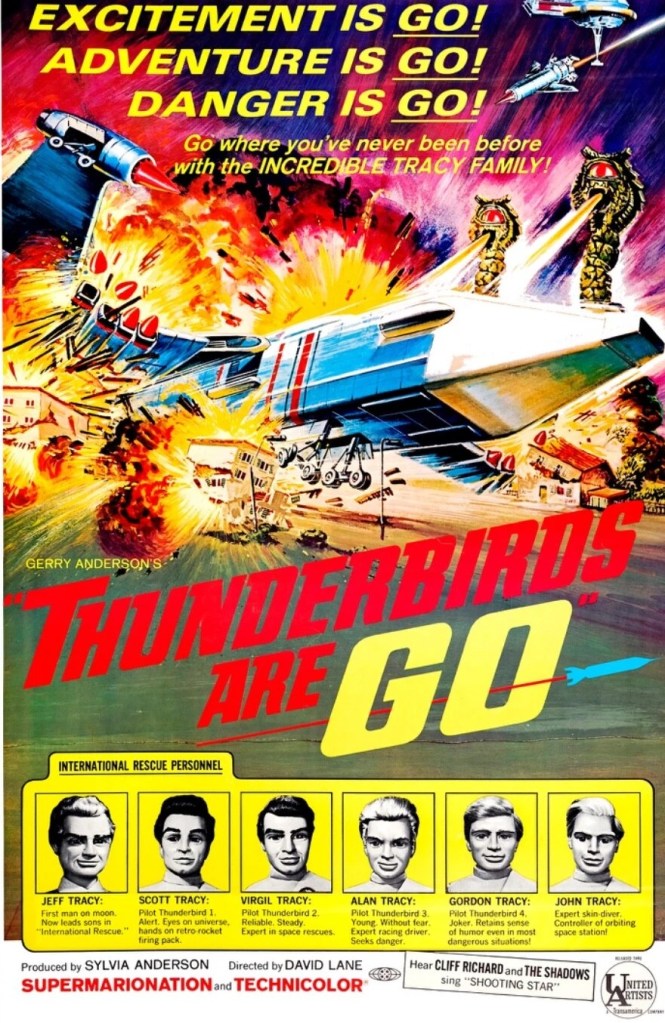
It wouldn’t be too much of a call, for example, to guess that Stanley Kubrick learned a lot about the joy of spaceships coming together or moving around from Thunderbirds Are Go where a good chunk of the action is watching spaceships shift around one way or another. To top it all, and another one in the eye of Mr. Kubrick, the Andersons beat him to the psychedelia, a dream sequence set upon a “Swinging Star” and involving puppet versions of Cliff Richard and the Shadows, still a big noise in the pop world at the time despite the arrival of The Beatles and The Rolling Stones. Their appearance would be the equivalent to  Bruce Willis, for example, doing a guest turn in Friends.

With a bigger budget, the Andersons made two crucial changes from the TV series on which this was based. They managed to erase all sight of the puppet strings and they stopped them walking around so much which always made them look most like just puppets.
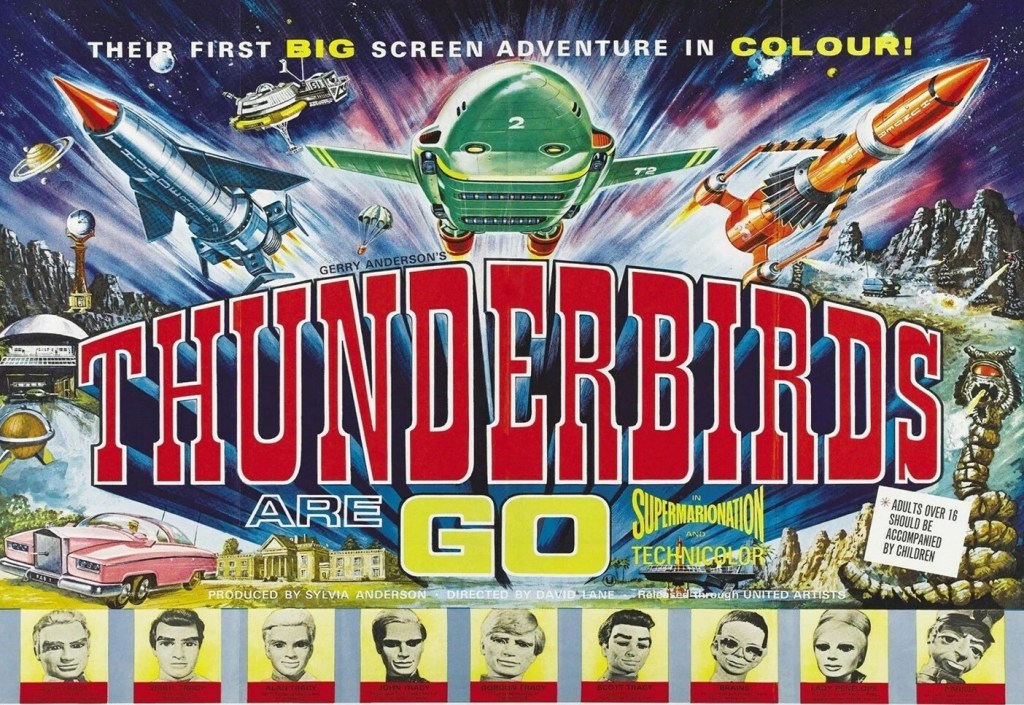
This is space as we should adore it. None of the manky, worn-down, dirty cargo ships that litter modern sci fi epics. Not only is every ship gleaming but they are also colorful, not to mention color-coded. When they move it’s with the majesty that Kubrick used to great effect in 2001: A Space Odyssey (1968). And as Kubrick also proved, when it came to space, you didn’t need much in the way of characterization or narrative. He follows the same rule as monster pictures, focus on the big beasts as much as possible.

But Kubrick, in his wildest dreams, could never imagine as sultry a character as blonde goddess Lady Penelope, and though she’s on the side of the angels as cunning as any femme fatale. Equally iconic is her pink Rolls Royce and the chauffeur Parker which his obedient “Yes, m’ lady.” Not to mention the glorious catchphrase “eff ay bee” – in other words FAB, the catchphrase for a generation. There’s another catchphrase that only means something to Londoners who would hear this warning every day on the Underground – “mind the doors.”

The narrative is relatively thin. Zero-X is trying to fly to Mars but the flight is sabotaged and crash-lands. When a second flight is planned, this time International Rescue (the Thunderbirds team in case you are unaware) is on standby with Lady Penelope employed to seek out the saboteur.

This flight does succeed but on Mars encounters venomous snake-like rocks and scarpers quickly only to hit trouble on re-entry to Earth that requires Thunderbirds to the rescue. There are some modest attempts at characterization, Zero-X doesn’t like the idea of needing help, and the youngest of the Tracy family is frightened of failing.

I’ve never seen this before. I probably thought I was above such childish things when it first came out and it was only when I spotted it on Amazon Prime that I thought to give it go, remembering how much I had enjoyed the revamped Fireball XL5.

I sat enthralled. The first section has no sign of the International Rescue team and just like those mesmerizing minutes watching Kubrick’s spaceship revolve in space this simply involved putting together the constituent parts of the Zero-X rocket ship prior to launch.

You had to hand it to these sci-fi whizzes. You only needed one fella in the control room. Each of the Thunderbirds required only a solo pilot. You could be whisked electronically from a seat in the waiting area to the spaceship and arrive there on the same seat or go along some kind of travelator. These guys had thought of everything.

Directed by David Lane and written by the Andersons with Sylvia doubling up to provide the voice of Lady Penelope

With the removal of the strings and every miniaturization so stunning, this would look great on the big screen. The 60th anni would be December this year so here’s a call-out to an enterprising cinema.

NOTE: today is British Father’s Day.  It may not be Father’s Day where you are.
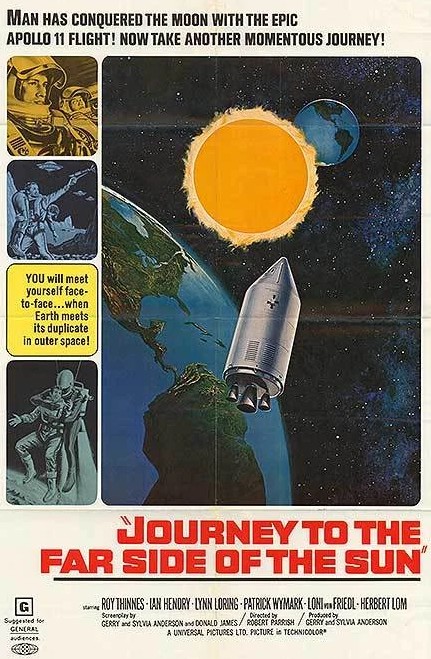
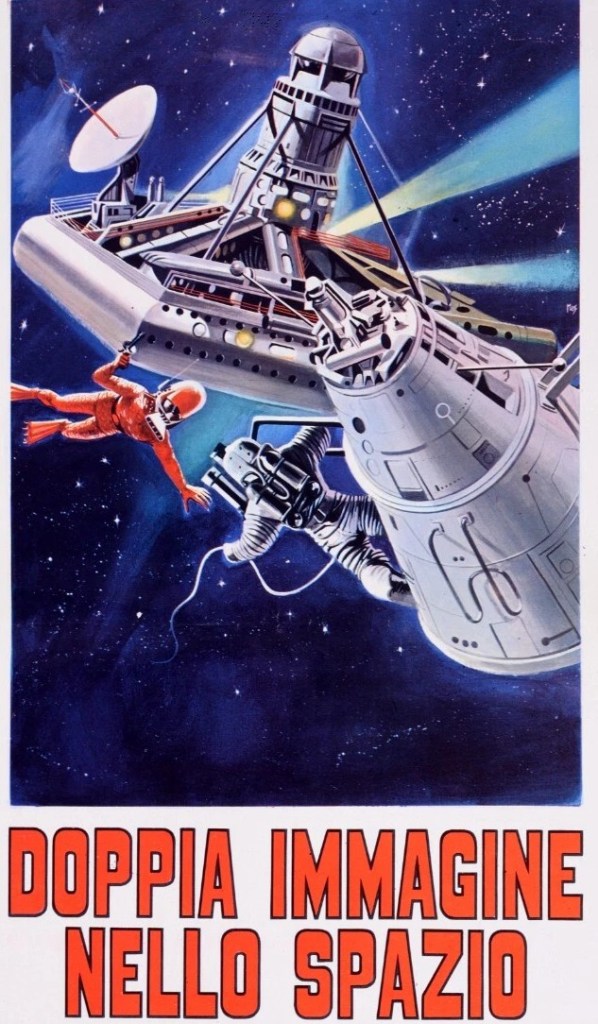
Journey to the Far Side of the Sun / Doppelganger (1969) ****

Bring Gerry and Sylvia Anderson into the equation and it’s a straightforward free pass of the cult kind. For the fanboys, the inventors of Supermarionation (Thunderbirds Are Go!, 1966) live on an exalted plane immune from criticism. however, sci fi buffs have tended to be less than impressed by the pair’s first venture into (to use a Walt Disney phrase) “live-action.” So response swings between these extremes. I fit into neither category so I come at this with something of an open mind and for a variety of reasons found it a far more enjoyable experience than I had anticipated, though I hazard a guess that on the big screen the flaws in the special effects would have been more obvious.

Some aspects even have a contemporary chime, the X-ray security screening machines, for example, and the fact that there’s no such actual entity called Europe and if you want to advance a project you have to navigate your way through the representatives of several countries as well as the hovering financial weight of the United States, bristling at being asked to pay more than its share but worried about being excluded.

And there’s no ice-cool scientific boffin. Instead we have the choleric, not to mention bombastic, Jason Webb (Patrick Wymark). Nor do non-combatants scoot through training. The rigors potential astronauts are put through in the likes of The Right Stuff (1983) or Apollo 13 (1995) are nothing to the body-wringing and mind-blowing experience of John Kane (Ian Hendry).

His companion space buddy Col John Ross (Roy Thinnes) is well-drawn for a sci fi adventure. He’s worried that exposure to radiation and worse in space has knocked his masculinity on the head, his wife Sharon (Lynn Loring) complaining it has left him sterile. Though it turns out she’s a wily creature, secretly using contraception.

We also get a spy, Dr Hassler (Herbert Lom), and it’s not so much that he has a gadget – a mini camera secreted in a false eyeball – than the detail involved in him retrieving the film. In most movies there would be no gap between the reveal of the gadget and the production of its secrets. But here Dr Hassler has to go through a whole procedure, dipping the eyeball into four solutions and dabbing it with this and that, before he can view a single frame.

The picture breaks down into a straight three-act vehicle. The first section getting to lift off, then the journey including the kind of phantasmagorical event you found in 2001: A Space Odyssey (1968) and which even Christopher Nolan relied upon in Interstellar (2014), and arrival.

Most sci fi movies play fast and loose with audiences, rarely remaining true to the logic of their invented worlds or concepts. This sticks to its original notion even if that means ending up with a distinctly downbeat ending. Initially, the astronauts are searching for a new planet, whose orbit is similar to Earth, but on the other side of the sun. This being the year 2068, distance is no object and they reckon it’s a six-week return trip.

But what the astronauts discover on arrival at the new planet is a nightmare situation, that in terms of ability to drive you mad skews close to enigmatic British TV series The Prisoner (1967) or Lost (2004-2010) before it jumped the shark. Ross and Kane have landed on a doppelganger planet and the movie takes this world to its logical conclusion. It’s the real parallel universe, or multiverse in the current vernacular, except everything happens the same as on Earth.

So the choleric Webb initially accuses the astronauts of cowardice, to have turned back and failed to complete their mission which would have led them to our Earth. Doppelganger literally means mirror image which eventually explains why writing goes left to right and everything is a step out of normal kilter. Identical except not quite. And stuck in a world where everything that seems real is one step away from your known reality. The kind of situation that would have been created by a mad scientist intent on torturing minds.

Ross determines to attempt to return to Earth but that means connecting what remains of his spaceship with a space vessel made on the new planet but the parts that should fit exactly don’t fit because they have designed in mirror fashion. So that’s it for your chances of a happy ending.

Left me with a nightmare feeling, the ultimate what if. As far as stings in the tail go, comparable with Planet of the Apes (1968).

For the concept as much as the clever detail, I’ve given it a higher mark than maybe it deserves.

Discover WordPress

A daily selection of the best content published on WordPress, collected for you by humans who love to read.

The Atavist Magazine

by Brian Hannan

WordPress.com News

The latest news on WordPress.com and the WordPress community.