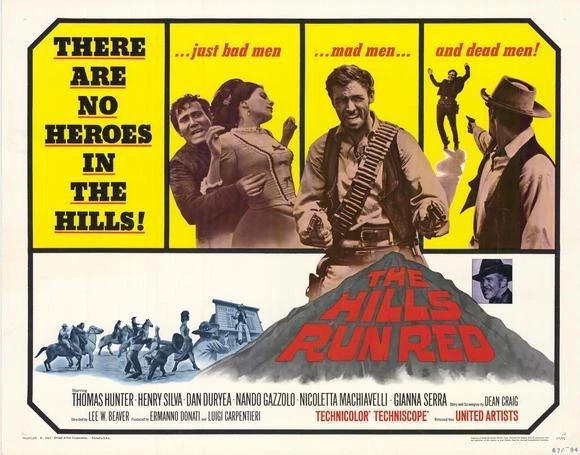
Pretty decent revenge western boasting a couple of superb set pieces. No wonder Clint Eastwood made the decision to play down the emotions on The Man with No Name, because this is a good example of how pop-eyed emotions can get when restraint is missing especially when you’ve got Henry Silva in the mix. The lead Thomas Hunter is not, as you came to expect in spaghetti westerns, an Italian dude anglicizing his name, but a genuine Yank, heading to Europe to further his career whereas Hollywood veteran Dan Duryea is extending his. Bonus of an Ennio Morricone score.
A pair of Johnny Rebs, making off with Unionist loot, at the end of the Civil War, make an unusual pact. One, Jerry Brewster (Thomas Hunter), takes the rap for the heist, while his partner Ken Seagull (Nando Gazzallo) the other makes off with the loot, promising, as part of the deal, to look after his buddy’s wife and child. Five years later, the freed Jerry returns home to find his pal’s reneged on the deal, wife is dead, son Tim an orphan, and Ken, now a wealthy rancher, is more intent on muscling up and eliminating his rival than keeping to his side of the bargain.
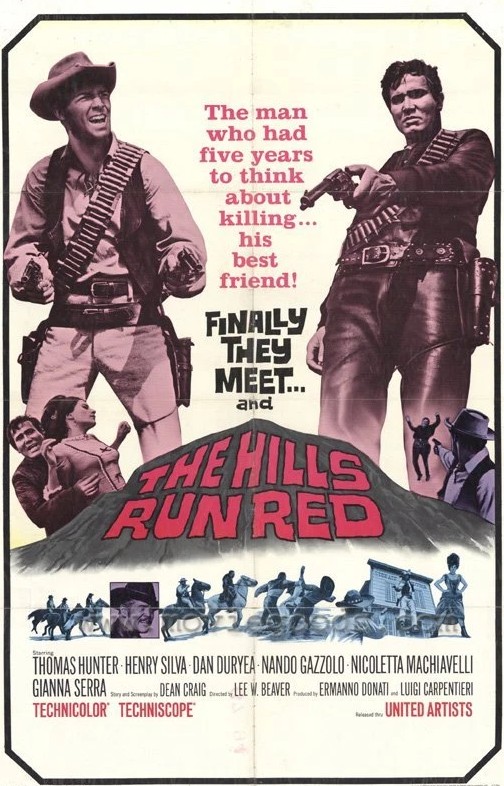
Jerry teams up with drifter Winny Getz (Dan Duryea) who gets himself a job on the ranch where tough foreman Garcia (Henry Silva) enjoys handing out beatings. There’s a smidgeon of nascent romance, not enough to get in the way of the action, when Ken’s sister Mary Ann (Nicoletta Machiavelli) takes pity on the roughed-up Jerry.
But let’s cut to the chase. There’s a brilliant ambush by Ken’s rivals. His high-handed methods have upset the townspeople and other ranchers. So with the help of our hero they ambush Ken’s cowboys herd horses through a canyon by rolling down on them rolls of tumbleweed set aflame, decimating the cowboys by picking them off from the cliffs.
At the end a two-man army of Jerry and Winny (make it a two-and-a-half-man-army if we count in Tim, no mean shakes with a catapult) takes on a regiment of Garcia’s thugs in the town, fighting them on the rooftops and the streets, with the help of sticks of dynamite. This is tremendous stuff. I watched it immediately after seeing Dillinger (1973) and noted that I had automatically accorded the John Milius gangster picture top marks for the various shoot-outs whereas I was so used to shoot-outs in westerns that the tendency was to write them off. Whereas, this one, in particular, was easily on a par with the Milius, better in some ways because the two heroes had to be a good bit more inventive to outwit the enemy.
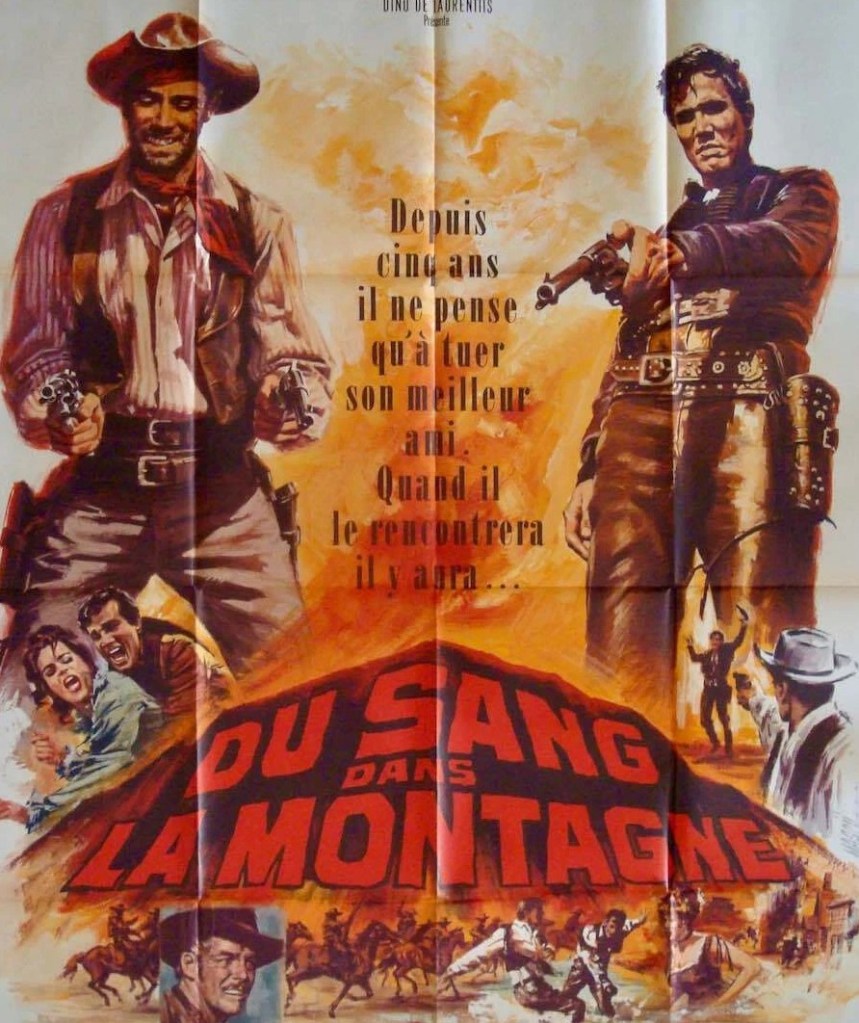
The climax at the ranch between Jerry and Ken is also well done, the pair employing clever tricks, and half the scene taking place in darkness.
The pace never lets up. The action is constant. Good plans become undone by spies. Saloons are wrecked. There are punch-ups and shoot-outs galore and some excellent lines and neat situations such as when the prison guards steal Jerry’s dough on release and send him off minus his gun.
Nobody who wasn’t already a star made much marquee headway from this and largely it’s been viewed as a western programmer, slotted into the lower half of a double bill, and largely forgotten. But perhaps because there’s no star requiring special treatment with slick lines and a denoted love interest and the kind of scene that always seems written just to give a big star a big moment, this falls into the leaner category, where the story is kept simple, the action continuous and whatever genuine emotion we require is limited to loss (of wife) and recovery (of son).
That still leaves room for Garcia to put on a whole show for himself and Winny to underplay him at every turn.
Thomas Hunter (The Magnificent Tony Carrera, 1968) might surprise in not offering the Yank equivalent of the traditional British upper lip, but sometimes we do under-do things by limiting male emotion, so you could view this as some kind of breakthrough for the incontinently emotional man. Henry Silva (Johnny Cool, 1963), with no restraint applied, just lets rip. Dan Duryea (Five Golden Dragons, 1967), in his last important role, enjoys a last hurrah.
Carlo Lizzani (The Violent Four, 1968) directs from a script by Piero Regnoli (Matchless, 1964).
Worth a look. Reassessment long overdue. What they used to call a rip-roaring western.


This was fast moving and entertaining! Hunter, Silva n Duryea were great. Thumbs up!
LikeLiked by 1 person
Glad you enjoyed it as much as I did.
LikeLike