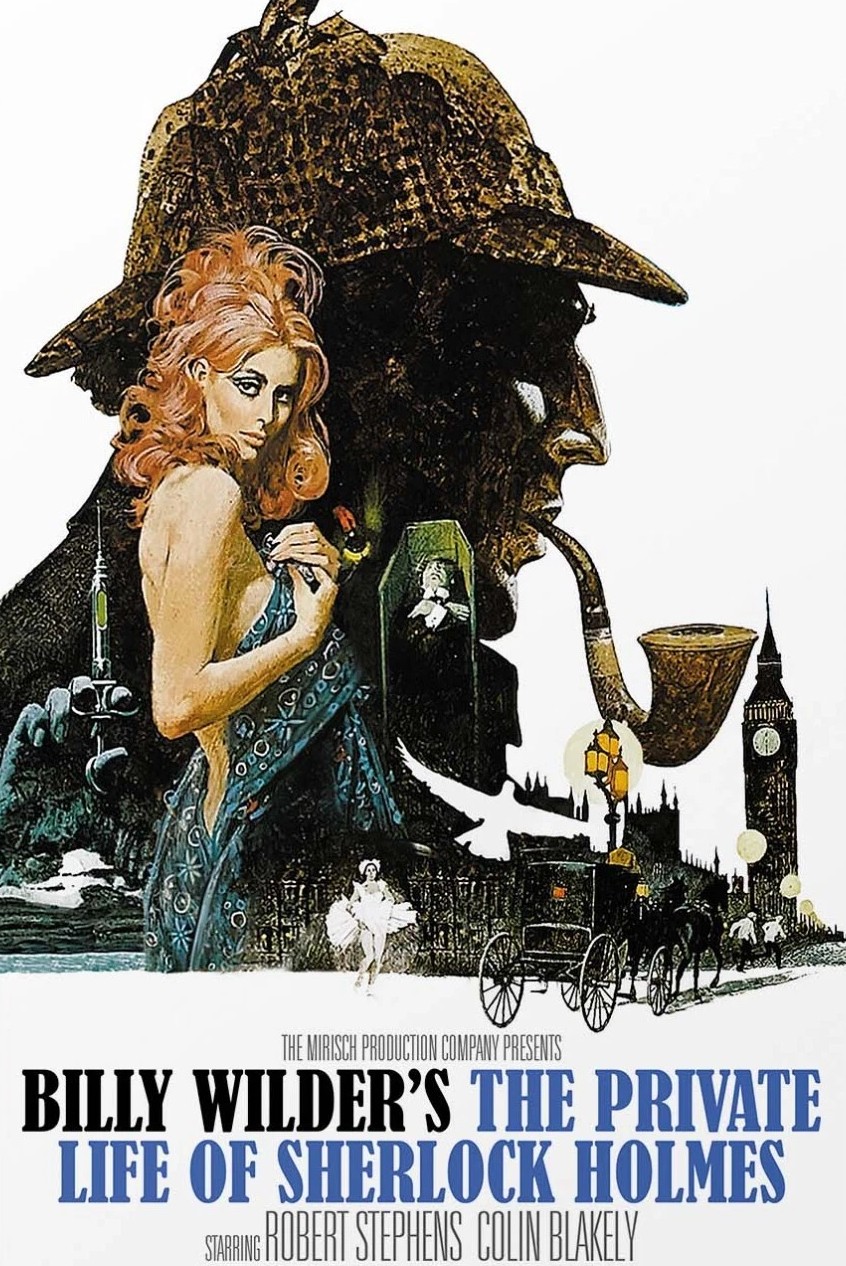
The word is that you can’t blame director (and producer and co-writer) Billy Wilder for this disaster because it was taken out of his hands by studio United Artists and drastically re-cut. But when you learn that Wilder’s version ran three hours and counting and even in the shortened version looks a preposterously bad bet, you can see why UA felt the need to take charge.
Wilder had been the poster boy for sexual identity after the frolics of Tony Curtis and Jack Lemmon as cross-dressing musicians hankering after Marilyn Monroe in Some Like it Hot (1959). Whether Sherlock Holmes was a closet gay would have been a minor footnote to the author’s massive fanbase, and to put it so upfront looks, especially for a contemporary audience, like a massive misstep.
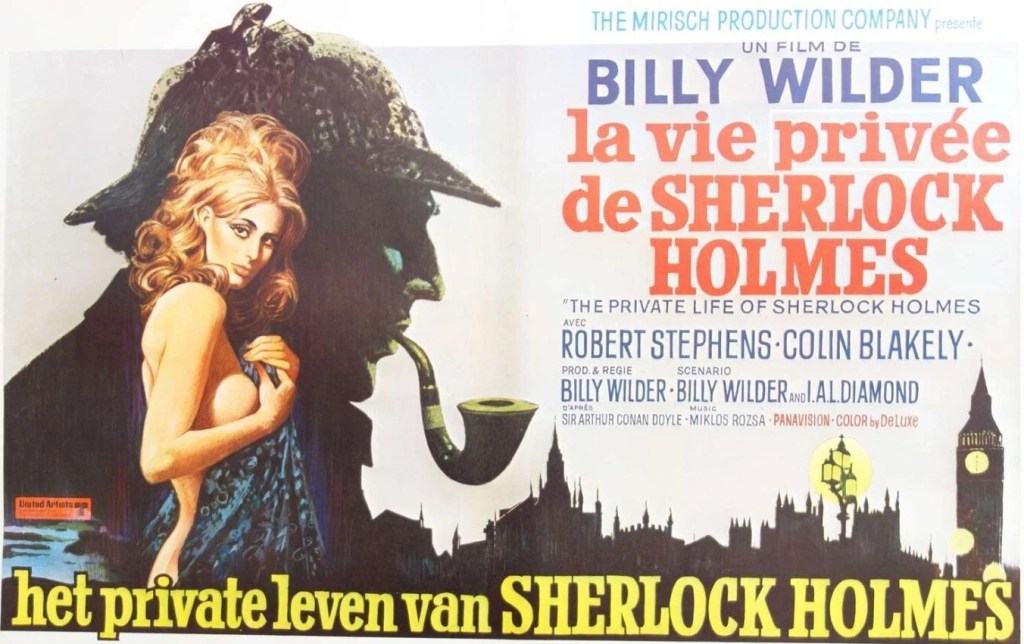
The first part of the movie largely consists of Dr Watson (Colin Blakely) being accused of over-mythification of Sherlock Holmes (Robert Stephens). Turns out (according to the Wilder version) that Holmes is a couple of inches shorter than Watson (his narrator in the Conan Doyle stories) had claimed and never wore the deerstalker. Blimey, lock that man up. Shock horror! Holmes’s other predilection, a regular injection of cocaine (I’ve no idea what a seven per cent solution would be in today’s money) is no invention, however.
But whether Holmes is attracted to the opposite sex forms the focus of the first section of this (even at just over two hours) unwieldy movie. A famous Russian ballerina Madame Petrova (Tamara Toumanova) wants to make him the father of her child. The only way Holmes can get out of this predicament is to pretend to be gay.
Eventually, after exhausting this joke (!), we get the proper mystery. Mysterious Belgian Gabrielle (Genevieve Page), just fished out of the Thames by a passing cab driver, turns up soaking wet at 221B Baker St and (eventually) Holmes is inveigled to find her missing husband.
In other circumstances this would have probably been a relatively straightforward case for the ace detective although there would have been, of necessity, ample opportunity for him to demonstrate his special set of skills. But this being of a more lumbering project, the investigation involves monks, midgets and the Loch Ness Monster. Yes, you heard right.
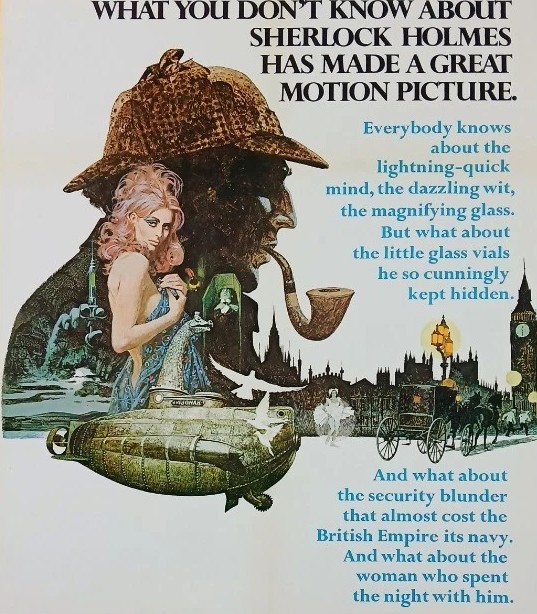
That should have killed off the project at the start. Like whether Holmes is gay or not, the Loch Ness Monster is another minor footnote. Apart from being a tourist attraction and keeping the conspiracy theorists going and competing with Roswell for public attention, it’s the dumbest of notions, even if, as the audience will expect, that it’s not the real monster (if there is such a thing) but a Macguffin of considerable dimensions.
I might have been happy to go along with a narrative that ran close to spoof except I didn’t take to either of the principal actors. I’ve no idea what made Billy Wilder believe that Robert Stephens (The Prime of Miss Jean Brodie, 1969) would make a good Holmes. I’m not one of those traditionalists who believe a specific actor was the quintessential Holmes, but it’s a part that’s far easier to get wrong than get right. And I think Stephens with his wafting loose style got his characterization spectacularly wrong.
Colin Blakely (Alfred the Great, 1968) is one of those actors who generally knows how important it is to rein it in, because if the ham in him is given an inch he will most certainly take a mile and he’s so over-the-top you think he’s going to disappear over the nearest horizon.
This was a huge flop and no wonder. And Billy Wilder, given he wears the three hats vital to a film’s creativity, must take the blame. It’s a rubbish story badly done. Like any other great director, we tend to remember Wilder’s successes – Hollywood drama Sunset Boulevard (1950), media excoriation Ace in the Hole (1951), POW camp thriller Stalag 17 (1953), comedy The Seven Year Itch (1955), Some Like it Hot and sexual satire The Apartment (1960) – and we tend to forget that he often, especially in the 1960s, fell flat on his face. One Two Three (1961) and Kiss Me Stupid (1964) were colossal miscalculations, the result as much of miscasting as of script.
This stands as even worse than that pair. Wilder had got way too big for his boots and at a point where a studio had to cut him down to size. But even the truncated version isn’t much cop. And the only thing that keeps it from attracting a one-star review is that it’s better than Orgy of the Dead (1965).
Steer clear.


I really liked this movie. Saw on the big screen in ’70. Has stayed with me.
Info:
“The project originated in 1963, when Billy Wilder signed on to produce and direct for the American company, Mirisch Productions, Inc., and the British entity, Sir Nigel Films, which had an agreement with the estate of “Sherlock Holmes” creator Sir Arthur Conan Doyle. Items in the 29 May 1963 Var and 31 May 1963 DV indicated that Peter O’Toole and Peter Sellers were the frontrunners to play “Sherlock Holmes” and “Dr. John H. Watson,” respectively. Once the two were firmed for the leading roles, Louis Jordan was cast as their co-star, according to the 25 Oct 1963 DV. Mirisch was set to finance the $6 million production, as stated in the 2 Jun 1964 DV.
Billy Wilder was quoted in the 7 May 1969 Var as saying that his and I. A. L. Diamond’s screenplay was based on “four previously unpublished adventures of [Sherlock Holmes], purportedly written by Watson.” Wilder claimed they hadn’t been published due to the “personal and somewhat delicate matters” they centered around. He also explained that “the stories come to light when Dr. Watson’s grandson visits present-day London and opens a battered tin-dispatch box which has been lodged in the vaults of a bank for many years.”
On 19 May 1965, Var announced the film had been put on hold so that Wilder could take advantage of Jack Lemmon’s availability for The Fortune Cookie (1966, see entry). However, an article in the 1 Aug 1965 NYT indicated that The Private Life of Sherlock Holmes had actually been postponed so that Wilder could “cast it properly.” Wilder later acknowledged in an 8 Jun 1969 LAT interview that he had had a falling out with both Peter Sellers, whom he had called “an unprofessional rat fink” after Sellers’s “unfriendly comments to the British press” following his experience on Wilder’s Kiss Me, Stupid (1964, see entry), and Peter O’Toole, who had made demands that Wilder wasn’t willing to accommodate. After resuming work on the project and securing the involvement of United Artists Corp., named as distributor in a 21 Jun 1967 Var news brief, Wilder cast Robert Stephens as Holmes and Colin Blakely as Watson. In the 8 Jun 1969 LAT, Wilder praised the virtues of casting lesser-known actors like Stephens and Blakely, claiming that bigger stars often detracted from a film’s “dramatic values.” He also stated that, after developing the project for so many years, he was “in no mood to be dictated to by an actor.”
Principal photography began on 5 May 1969 at Pinewood Studios in London, England, as stated in the 7 May 1969 Var. Shooting also took place in Loch Ness, Scotland, which stood in for itself, the 21 May 1969 Var reported. Following two weeks on location at Loch Ness, filming was set to resume in London but was delayed when Robert Stephens collapsed from exhaustion and had to be hospitalized, the 6 Aug 1969 Var noted. The actor’s illness was the third such incident for Wilder, as pointed out in the 12 Aug 1969 DV, after Peter Sellers had been felled by a heart attack during the filming of Kiss Me, Stupid, and Walter Matthau had suffered a heart attack on The Fortune Cookie. Stephens’s absence caused the production to shut down for at least two weeks, as noted in a 20 Aug 1969 Var brief, and although the actor was able to resume his duties, he was forced to pull out of a future commitment on The Three Sisters (1969, see entry), according to the 14 Oct 1969 DV.
Principal photography was completed by 25 Nov 1969, as stated in that day’s DV.
The picture was set to be Wilder’s first “roadshow release,” with screenings to include intermissions, according to LAT. It opened on 29 Oct 1970 at New York City’s Radio City Music Hall, and nearly two months later, on 23 Dec 1970, at the Fox Wilshire Theatre in Beverly Hills, CA. A theatrical release in London, England, also occurred in Dec 1970. Critical reception was lackluster.”
LikeLiked by 1 person
I’ve got a Behind the Scenes tomorrow. We are out of step on this one.
LikeLike