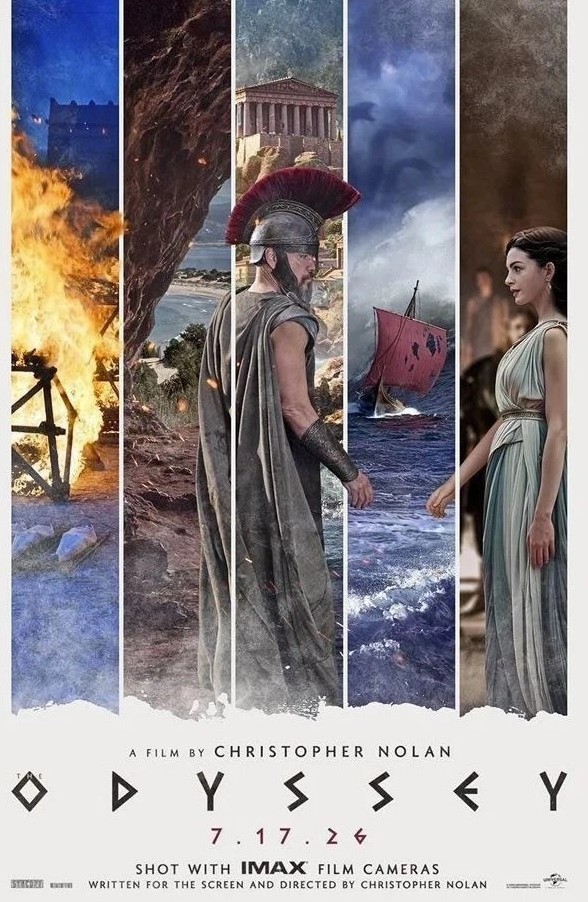
The Odyssey (2026) ***** – Seen at the Cinema, Twice in the One Day

What sets Christopher Nolan aside is not the visual dexterity, imagination or the confidence of his reach, it’s his intelligence. Once you come to the tortuous end, having perhaps shifted time or point of view several times, and wondered at all the amazing stunts or worlds he has opened up, you are left with something utterly human. Emotion that leaves characters bereft. Here, he turns on its head the greatest deception ever practised in war – the Wooden Horse of Troy. Instead of, as since time immemorial everyone has done, praising the trick and Odysseus the ultimate trickster, he chooses another route in his ruthless examination of the artifice. In sneaking the horse into the besieged city, Odysseus has broken the most basic rule of Civilization. A stranger must be given hospitality. And the visitor must leave his weapons at the door. In this picture it’s known as The Code of Zeus, but it’s what held ancient Greek Civilization together, that trust in one another. Strangers were welcomed and once inside a foreign abode they did not seek to carry out violence.

On top of that, the hero realizes what a hero actually is. Once the warrior in him is let loose, the havoc is unjustified. That PTSD and war guilt would probably be enough for any contemporary audience, yet the confession of Odysseus turns out to be the re-wooing of his wife Penelope, telling her he is not at all, after two decades apart, the man that he once was.
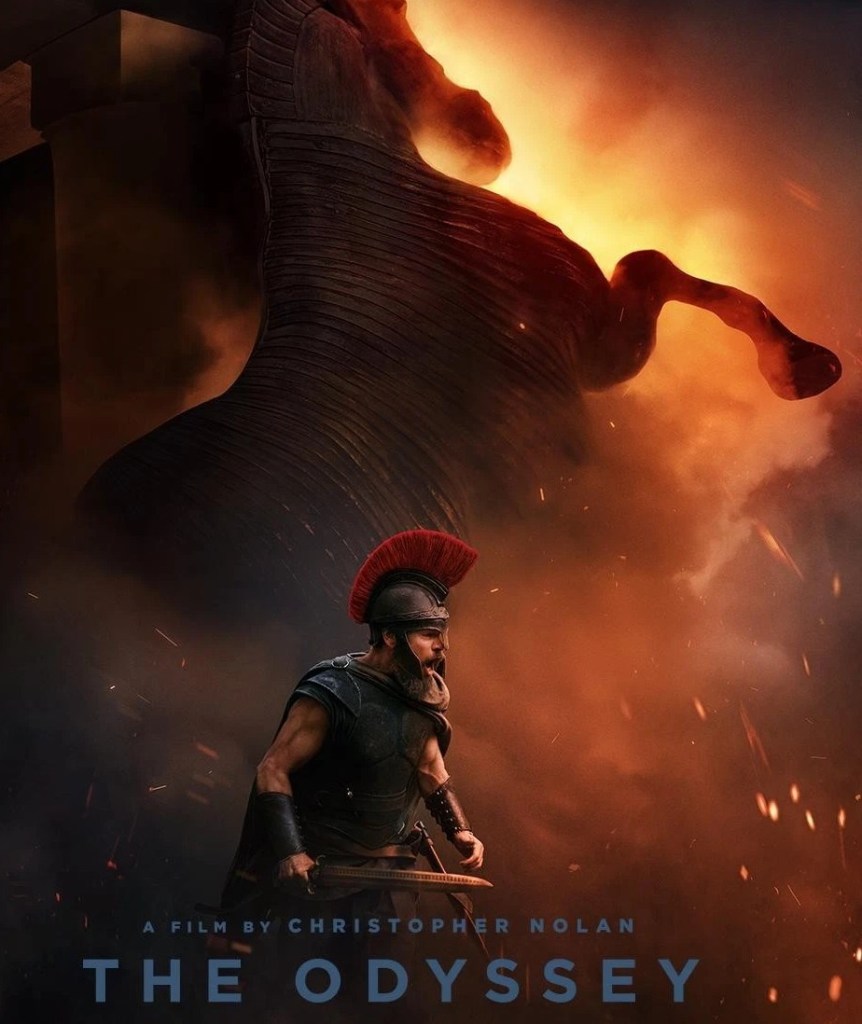
There are few directors who can genuinely claim to be auteurs. Usually, they are not screenwriters so are stealing someone else’s original invention. While Nolan relies heavily on the writings of the legendary Homer, he not only Nolanesques everything, the screenwriter in him takes care to ensure that the groundwork is quietly laid for what will spark emotional tumult later on.

There are four exceptionally clever examples of this. Odysseus’s old dog is on the point of death. When Odysseus strokes him, in recognition the dog wags his tail. At this point Odysseus is in disguise – two decades separating him from an infant son now grown up – and it’s how his heir Telemachus recognizes him. Emotional beat no 1. The younger Odysseus has been gored in the ankle by a boar. When he returns, still in disguise, his nurse recognizes him from the scar. Emotional beat no 2. Odysseus has a bow that only he is strong enough to use. Once it’s ready, he’s in the habit of pulling on the bowstring so it gives a distinctive twang. It’s that twang that makes wife Penelope, in a state of desperation, realize that her husband has come home. Emotional beat no 3.

But the best is the mystery sewn into the lining of the script. Everyone lives in a state of fear. They are preparing for invasion by the unknown. “People from the sea” are reputed to be on their way, who knows from where, nobody knows who they are. When the solution is found it’s an overriding emotional beat no 4 – Odysseus himself is one of the people from the sea, the Greeks who landed on the shores of Troy and set siege to the city and eventually burned and pillaged it.
For all the monsters and witches and slaughter, there is incredible restraint. There’s no nudity. There’s no rape shown or even visually implied. But when Odysseus speaks of the horror of war, we know to include that element.. While it’s certainly stated on several occasions that women, either killed as innocent bystanders or left behind and prey to any passing male predator, they have ways of defending themselves. The witch Circe can turn men into pigs. The sorceress Calypso uses lotus leaves to keep her lover sedated. Penelope keeps her suitors at bay with a clever ruse. Agammemnon’s wife can’t be bothered with any of that, she simply cuts her husband’s throat on his triumphant return.

I’m not so familiar with the Greek myths. I’ve not read Henry Treece since childhood. So I can’t tell you what Nolan has adapted, eliminated or added. But I can tell you it all adds up. All the legends I expected are here – the one-eyed Cyclops, the whirlpool Scylla, Charybdis, Circe, the lotus eaters, the underworld, Troy. I don’t recall the giant soldiers so they may or may not be figments of the director’s imagination. For heroes, the Odysseus gang do a lot of running away as they head for home. And for all that he is hailed as the cleverest of the Greek generals, Odysseus is a mite dumb at time, incapable of reading the room on the boat, unwisely irritating monsters.

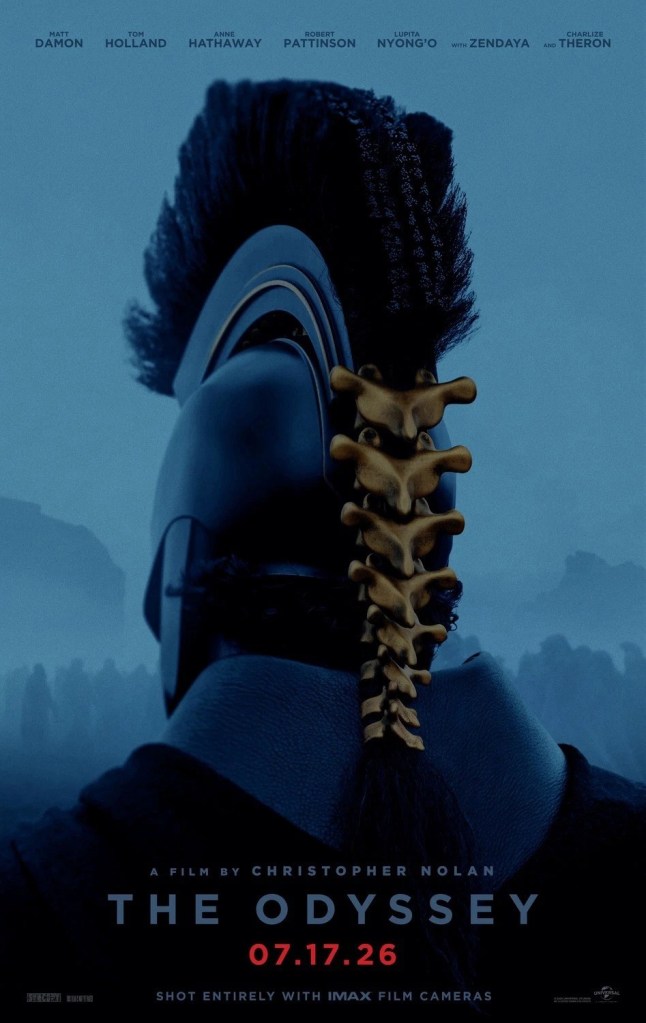
Matt Damon (The Martian, 2025) is terrific as Odysseus, and while redoubtable in action, is tasked with carrying the emotional thrust, the fatigue and guilt of war, the knowledge that his actions could bring down Civilization. Anne Hathaway (The Devil Wears Prada 2, 2026) is surprisingly good as his wife, the totem for the women left to suffer. Of the rest, Robert Pattinson (The Batman, 2022) is easily the pick as the glowering surly cowardly suitor. Samantha Morton (Minority Report, 2022) is gleefully venomous as Circe. I’m not entirely sure what Zendaya (Challengers, 2024), as ghostly goddess Athena, is doing in the mix and Charlize Theron (The Old Guard, 2020) as Calypso is mostly there for the exposition and it sometimes feels as if that’s the sole purpose of Tom Holland (Spiderman: No Way Home, 2021) as Telemachus.

Jon Bernthal (The Accountant 2, 2025) and John Leguizamo (Tin Soldier, 2025) stand out for the wrong reasons. They sound as if they’ve strayed in from a Martin Scorsese gangster picture.

Back in the days before VHS, DVD and streaming, you couldn’t watch a picture over and over. But occasionally, I’d be so taken with a movie that, in the days of continuous performance (you might not know what that is but when you go to the movies these days it’s for a separate performance, everyone kicked out after the showing) I would stay on and watch it again.

First time I did that it was for Terence Malick’s hypnotic Badlands (1973) – Martin Sheen, Sissy Spacek, Erik Satie – when it turned up in the UK as the support to It’s Alive and there have been countless other examples. So, on my weekly Monday outing to the cinema, I decided I’d take in this picture again rather than grumble at whatever The Evil Dead Burns brought to the table.

When you watch a movie a second time, you’re not held in your seat by the narrative. You know what’s going to happen. You can marvel at all the rest, the writing, the camera movement, the special effects, the acting. I’ll probably go back next week.

Truly awesome.
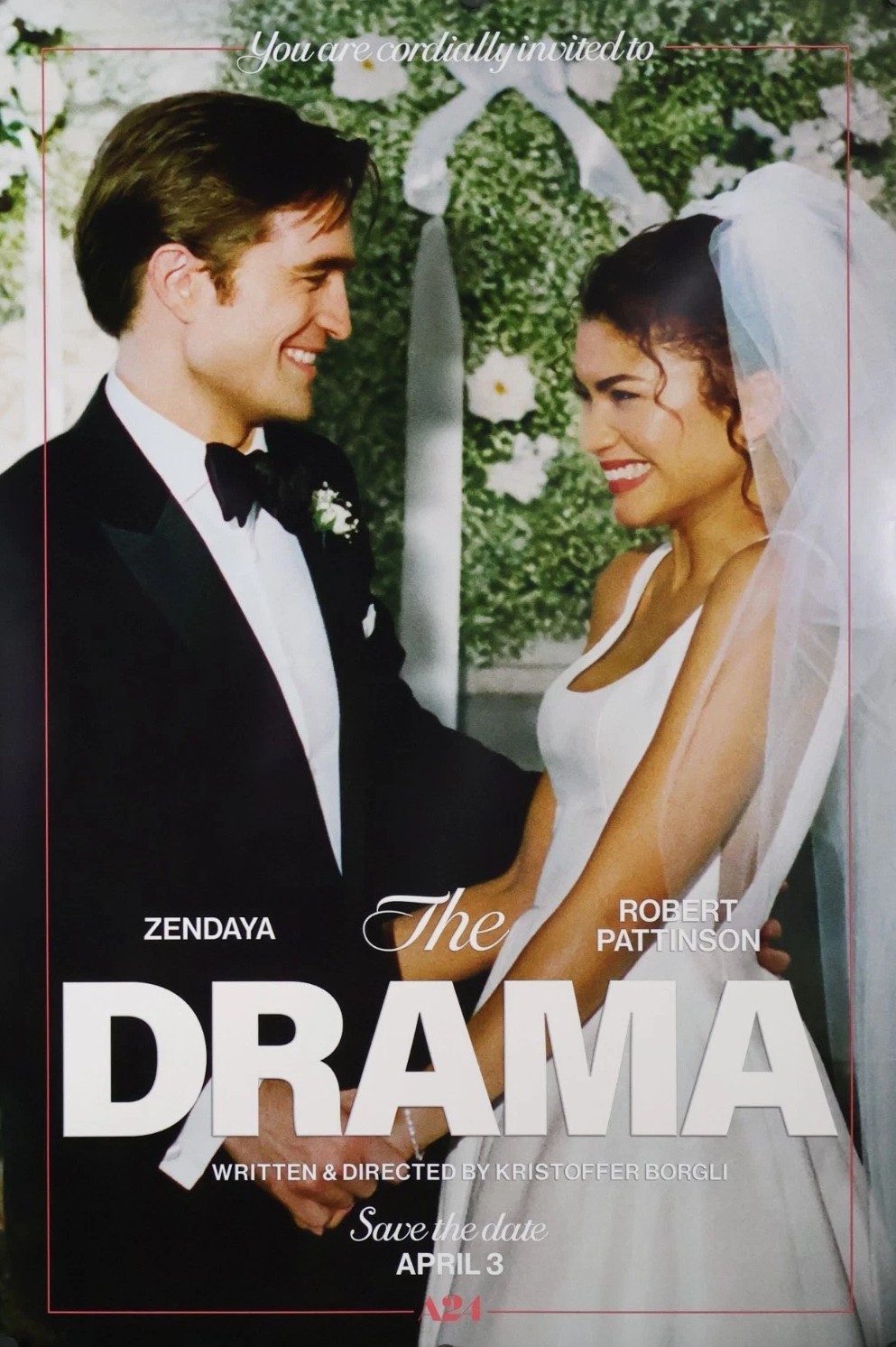
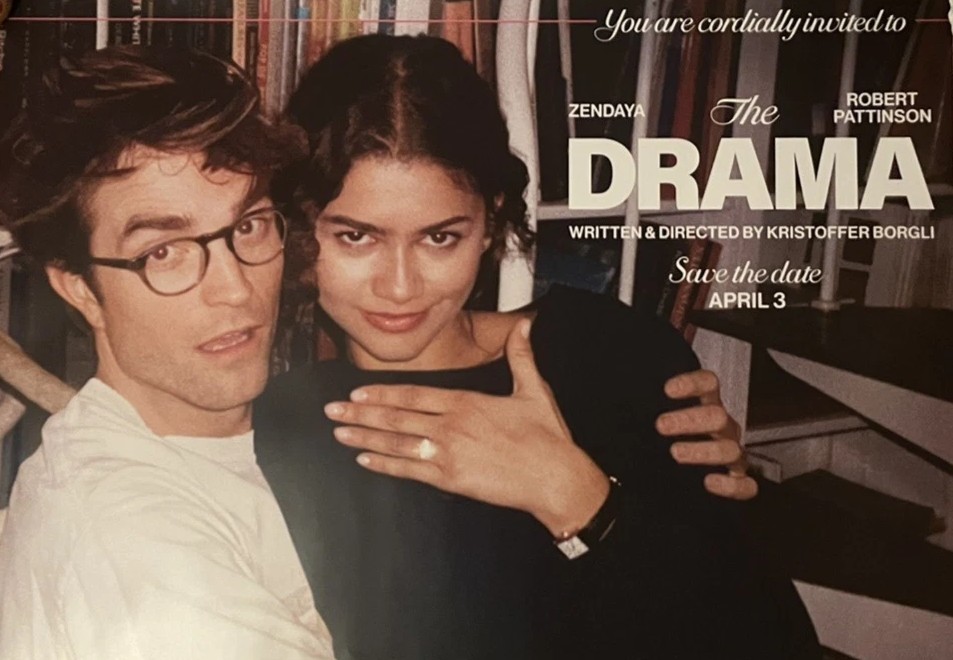
The Drama (2026) * – Seen at the Cinema

Today’s stars – and that’s an ever-decreasing category – seem to want to get into the kind of edgy material that used to be the province of the arthouse. They might even cut their fees to get a beloved project off the ground. I couldn’t remotely begin to understand what was going through the minds of Zendaya (Challengers, 2024)  and Robert Pattinson (Die My Love, 2025) to make them think this had any value whatsoever. It skirts the only important subject in the whole picture, trying to fashion a rom-com-gone-bad in order to come up with, after an inordinate amount of time, a happy ending.

The premise, probably understandable in these suspicious times is: what secret is your partner hiding? Could they be bigamists? Have they changed gender? Have they been in prison? Nope, it’s much worse than that.

Emma (Zendaya) confesses that as a 15-year-old she was so fascinated by guns that she intended to slaughter her schoolmates. She didn’t go through with it because on the appointed day someone else had stolen her potential thunder. So what you might expect is that we backtrack and dig into the reasons why. But apart from a superficial stab at what turns an ordinary girl into a serial murderer and the notion that thousands of people would fall into the same category if they could ever get up the courage to do so.

Instead, this information is set against a rom-com backdrop and is used as narrative ammunition to derail her upcoming wedding to soft-hearted museum curator Charlie (Robert Pattinson). Po-faced pals Rachel (Alana Haim) and Mike (Mamadou Athie) get into an almighty snit over this, never mind that they have been guilty of heinous acts themselves. Bear in mind that Emma never actually injured anyone. But this pair who (Mike) used their previous girlfriend as a human shield against a ferocious dog and (Rachel) locked a mentally handicapped child in a cupboard in a remote house in the wood and ran away and didn’t fess up when a search party was formed.

Nobody thinks to send Rachel for counselling to ensure that whatever issues drove her to murder have been resolved. Instead, all concerned get agitated, and start examining Emma’s past and current life to see if she is going to go off on one. She’s certainly tougher than her wuss of a boyfriend, no problem sacking the DJ on the eve of the wedding or removing Rachel from a project.

Just to make sure Emma gets some audience sympathy she’s deaf in one ear and Charlie, on the edge of a mental breakdown, makes an unwise move on Misha (Hailey Gates), a member of his staff, which permits her boyfriend to give Charlie, literally, a bloody nose at the actual wedding.  

You would hardly believe after all this nonsense and out of the detritus of the calamitous wedding that writer-director Kristoffer Borgli (Dream Scenario, 2023) manages to fashion a happy ending. This is witless stuff. And Hollywood at its hypocritical worst. I couldn’t begin to count how many people Pattinson has killed in his various movies and Zendaya in Dune has begun to express her violent tendencies. What’s that except glorifying violence and yet they still turn up in movies pontificating against violence.

There’s not a single likeable character. Charlie does his floppy-haired best and, supposedly, has such charm that he can get away with reading the same literary book as Emma – that’s the lame meet-cute – only to admit he hasn’t read a single word. Liar, liar, pants on fire appears to be a line that’s never entered Emma’s vocabulary, no doubt because, at 28, she’s never been in love (that in itself would be worth a piece of psychological digging).

This is one of the laziest attempts to provide contemporary stars with the “edge” they appear to so desperately seek as they try to emulate the Hollywood legends who genuinely did tackle important issues.

A mess.

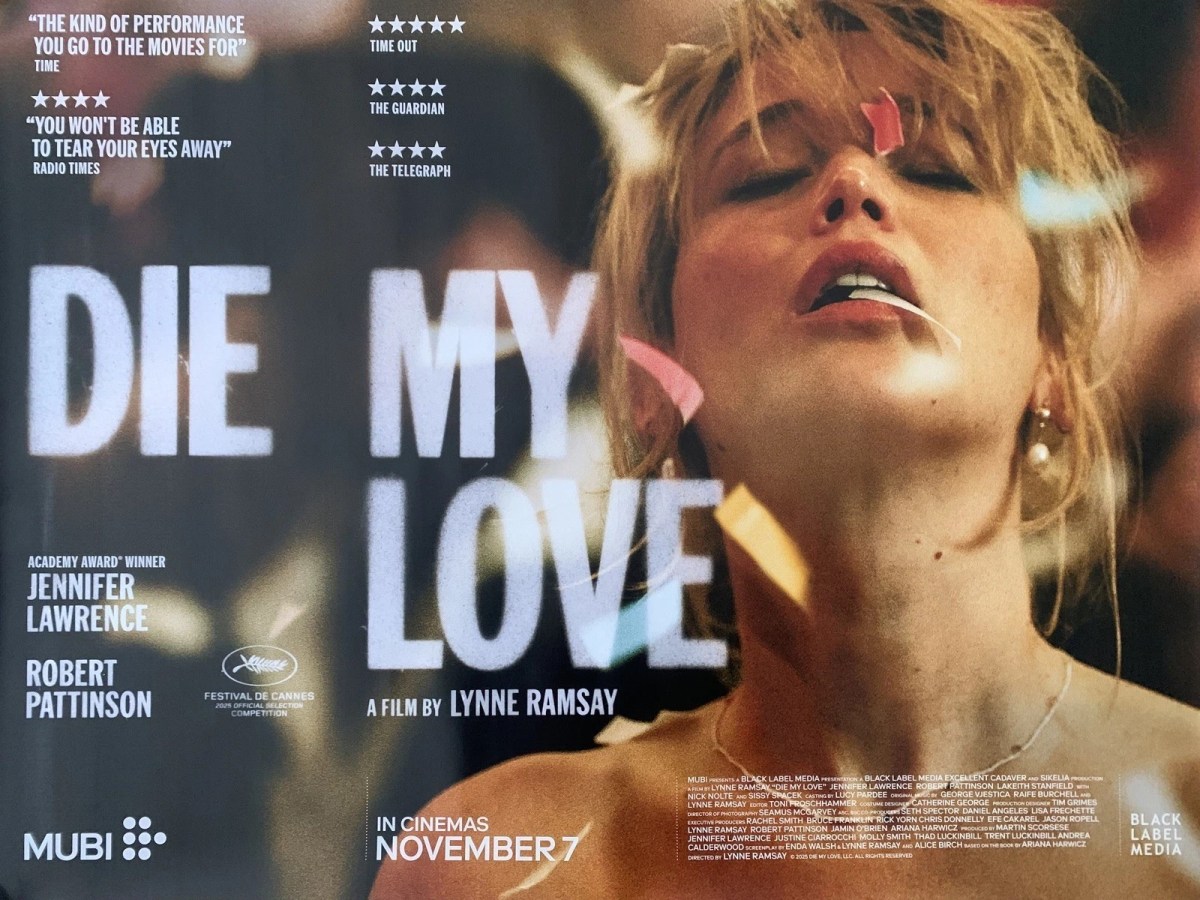
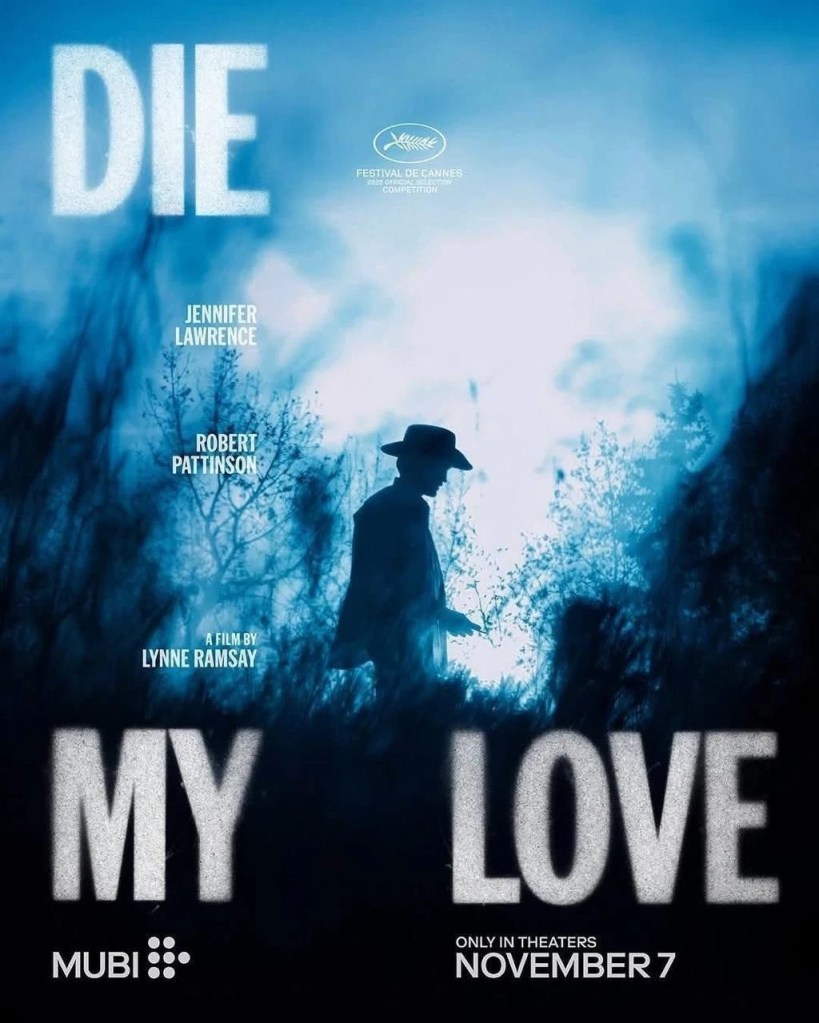
Die, My Love (2025) * and Dragonfly (2025) * – Seen at the Cinema and A Stinker of a Double Bill

I can’t be the only one knocked sideways – if we were still awake – by a bizarre climax that pays homage to Daenerys Targaren of Game of Thrones, the dragon queen who could walk naked through fire. Given our heroine here, Grace (Jennifer Lawrence), has plenty other examples of easier ways to die – her uncle committed suicide by sticking a shotgun up his ass, she kills a really annoying dog with a shotgun and her mum or it could be her mother-in-law (it’s one of these pictures where relationships are vague) Pam (Sissy Spacek) is given to carrying a shotgun while out on midnight perambulations, it’s an odd choice. Especially as she’s the one that sets the woods on fire. Quite why she needs to tramp naked into the flames is anybody’s guess unless, as I mentioned, it’s a homage.

Used to be that Oscar buzz was the icing on the cake, the chance, once awards season kicked in, for worthy vehicles to pick some more box office dough. Now it seems to be the entire cake and the promise of seeing a potentially Oscar-winning performance has become the main marketing plank of way too many pictures. Performance used to be linked to narrative with the latter taking precedence. Now narrative is way down the line of considerations.

It’s entirely possible that Jennifer Lawrence and Robert Pattinson ended up here because they were short of offers having fallen from the box office heights. Lawrence has been in one flop after another – Passengers (2016), Mother! (2017), Red Sparrow (2018), Don’t Look Up (2012), No Hard Feelings (2023) – since The Hunger Games quartet and Joy (2015). So we’re talking a solid decade of box office turkeys. Apart from The Batman (2022), Robert Pattinson hasn’t done much better. So you’d think both would be aiming to consolidate their fading box office attraction rather than taking time out for this self-indulgent nonsense.

Grace and Jackson (Robert Pattinson) are a hot-for-each-other couple who take up residence in a house you are led to believe is remote but turns out to be a pram’s walk from shops. In a very vague sort of way you are led to believe that they’re here because Grace wants solitude to write the Great American novel. He’s got a job, but that’s vague too, except he’s on the road a lot and it’s hinted that he’s having one-night stands and also hinted that she’s had an affair with a neighbor.

All that’s pretty much by-the-by as the main tale appears to be a study of post-natal depression. But that hardly rings true. There’s clearly been a lot wrong long before the baby arrives and it’s not as if she doesn’t bond with the baby – if anything it’s Jackson who doesn’t bond and clearly feels so left out of the equation that he buys a particularly noisy attention-seeking dog. The house isn’t a mess the way it might be for a manic depressive.

But every now and then Grace goes bananas, smashing up the bathroom, charging though a solid pane of glass and her sharp tongue awaits anyone who attempts a friendly overture. So, we’re just waiting? For what? Some explanation of her madness? Some narrative thread?

Too bad, there’s nothing here except Jennifer Lawrence doing what she thinks might garner an Oscar. Robert Pattinson overacts and director Lynne Ramsay (We Need To Talk About Kevin, 2011) does nothing to stop either.

**

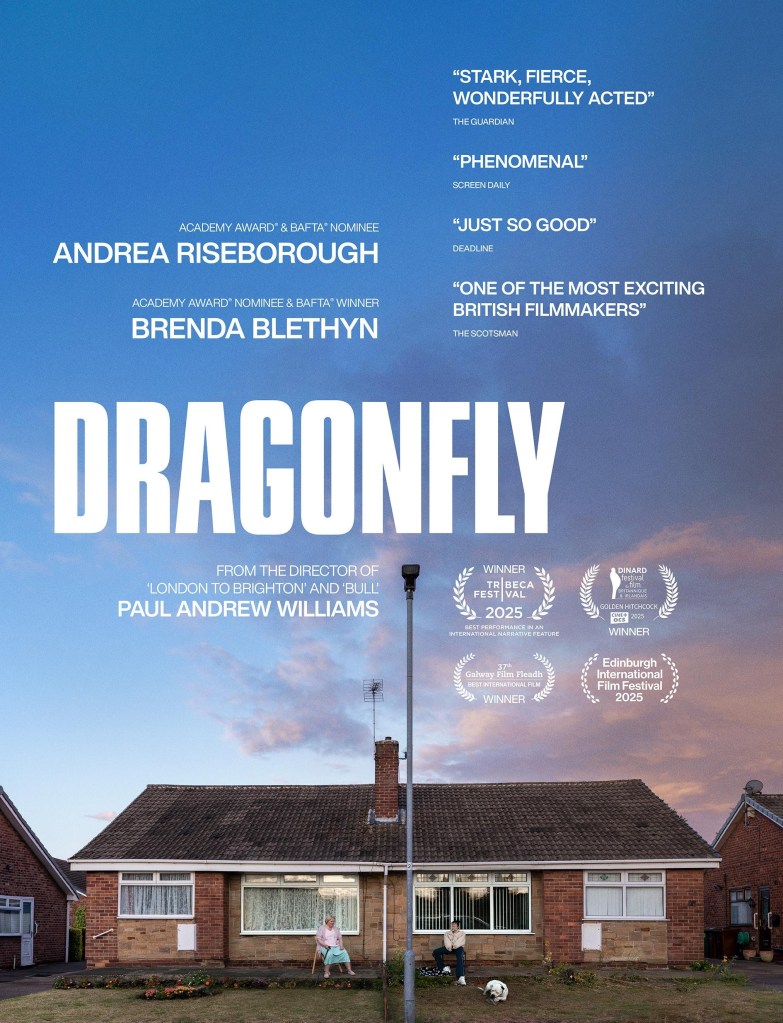
Dragonfly

A glorified television film. Not even that, a blown-up out of all proportion episode of a soap. You can see where this is going from the outset. The director aims to take swipes at all sorts who don’t deserve it in the hope of striking up some sympathy for a murderous Colleen (Andrea Riseborough) who does a kindly turn for elderly widowed neighbor Elsie (Brenda Blethyn). Both are lonely, though Colleen has a brute of a dog for company. They become friends and except for Colleen’s murderous instincts this would have ended badly anyway once the younger woman starts stealing.  

That it goes another way is blamed on middle-class meddling. Elsie’s son John (Jason Watkins), who doesn’t visit nearly often enough, doesn’t trust the friendly neighbor and realizing that the brute of a dog is actually a dangerous outlawed dog informs the cops who destroy it. In revenge, Colleen murders John and then slits her wrists in Elsie’s kitchen.

Whaat? Yes, whaaaat? Who greenlit this? As much about loneliness as Die, My Love is about post-natal depression. Essentially, it’s a gentle two-hander that, if it had only been about a gentle friendship developing between two lonely souls, wouldn’t have been greenlit at all. Writer-director Paul Andrew Williams (Song for Marion, 2012) has a point to make, although for the life of me I can’t work out what that is except give people on benefits a cushy number and they’re liable to slaughter someone. 

Discover WordPress

A daily selection of the best content published on WordPress, collected for you by humans who love to read.

The Atavist Magazine

by Brian Hannan

WordPress.com Blog

News, Tips & Website Tutorials