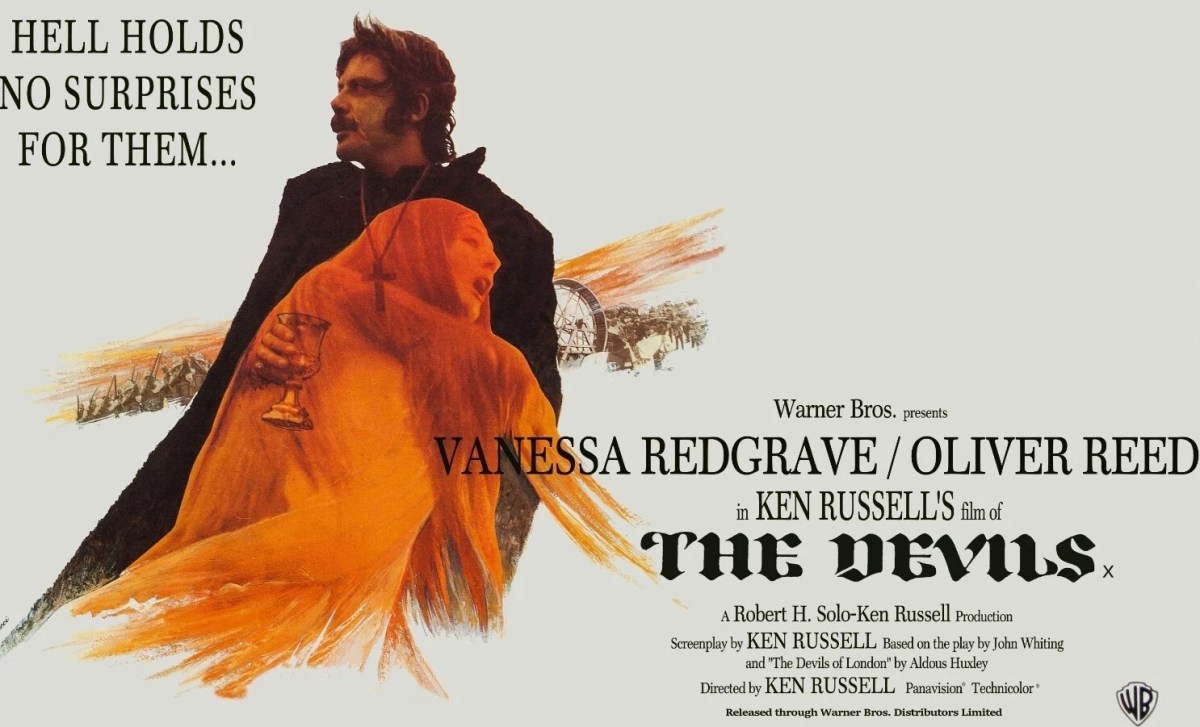
It’s a conspiracy! The British Film Institute and critic Mark Kermode are on a mission to force the public to reconsider this epic travesty. They have managed to convince Warner Brothers to reissue the film in cinemas in October 2026. The only problem is – this is the second time they’ve tried this maneuver. And it was no more successful last time round – two decades ago in a limited release in arthouses – and despite a lavish follow-up DVD packed full of extras and an expensive illustrated brochure.
Knowing this was the second attempt to regenerate interest in this shambolic enterprise from Ken Russell (Billion Dollar Brain, 1967) – who will no doubt be tabbed a “visionary” director this time round – I thought I’d dig out the DVD featuring the original 1971 release cut in the genuine hope that I might be able to add a little spark to the promotional hoopla for the forthcoming cinematic reissue.
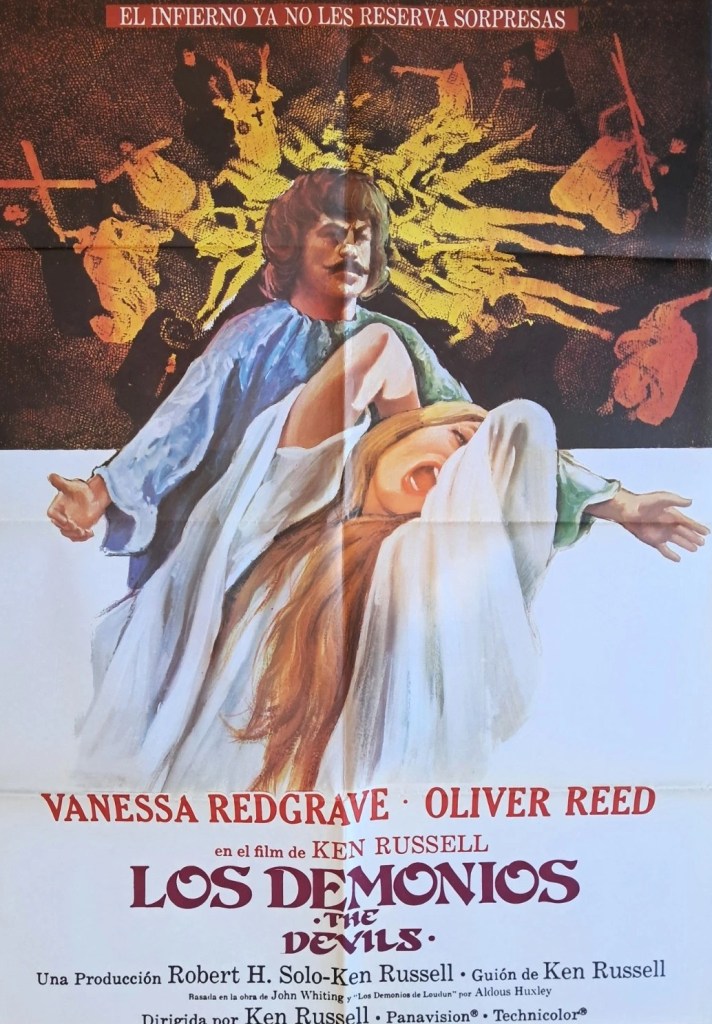
The problem is – it’s still awful. And not in healthy cult fashion or as a slam-dunk for the So Bad It’s Good category. It’s just awful every which way but loose. And it commits the worst error of the awful picture – it’s plain boring. And that’s a shame because the tale is an interesting one. How the French church and state connived to get rid of an irritant challenging their authority by placing false charges of satanic possession against the nuns of the small town of Loudon.
It would certainly have helped had not every single person in a position of power not just looked like an idiot and if Russell had cast the parts with actors of authority, say rising star John Hurt in the role of the exorcist or John Gielgud as the conspiratorial Cardinal Richeliu, a character who as we know from The Three Musketeers was always up to no good. Instead, we’ve got actors way out of even their modest league who make an unintentional mockery of their parts.
Anyone complaining about the modern vernacular of Christopher Nolan’s The Odyssey (2026) would have a field day here with a cornucopia of accents so it sounds more like a Carry On picture. In fact, Carry On Ken would have been a more apt title.
Vanessa Redgrave (Blow-Up, 1966) had, unfortunately, gone down the Oscar-bait route of hoping that exaggerations of physical affliction will inform her acting. Instead, with her head twisted at ninety degrees, it looks like she’s intent on comedy. And when that only leaves Oliver Reed (Hannibal Brooks, 1968) to hold your picture together you are in dire straits.
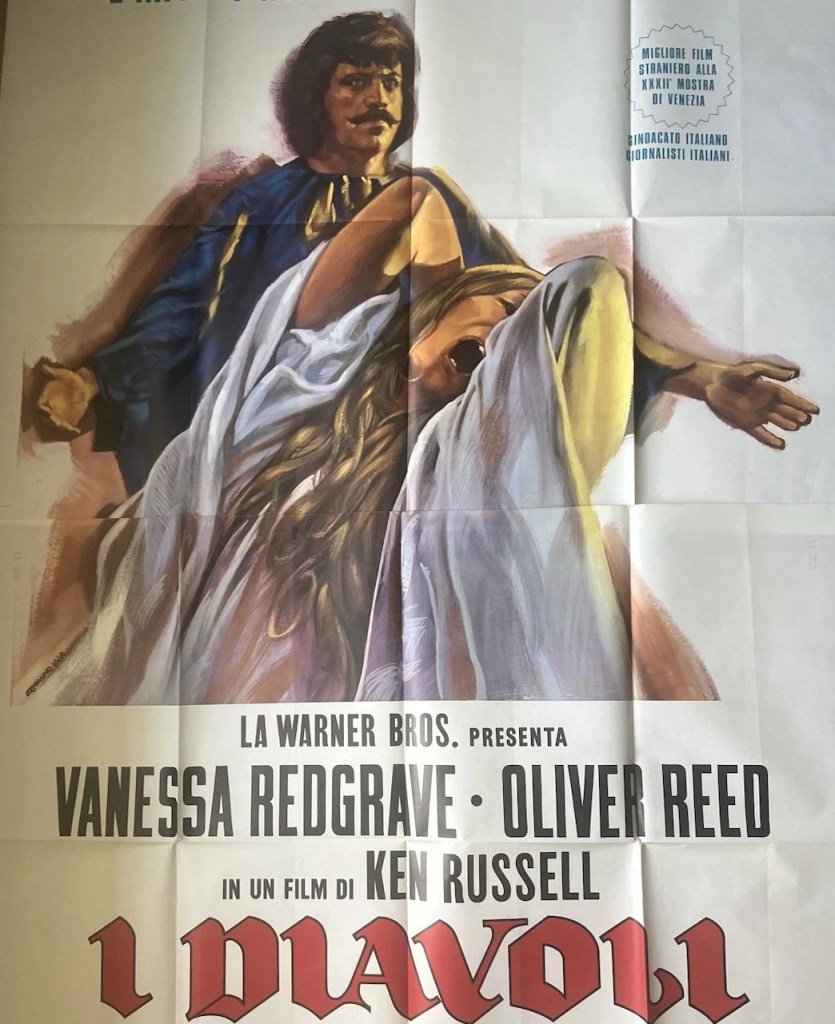
Had the director concentrated on the obvious points, that the clergy was corrupt and liable to indulge in sex with any willing participant in the usual male power-abuse scenario, and that nobody went into a nunnery by choice but were sent there by families who could not provide a dowry or who were incapable of themselves finding a husband to support them, then you might have had the beginnings of a good picture.
But Russell is just intent on indulgence. So the nuns behave as if they were being directed by Jess Franco in a Women-in-Prison movie and strip off their clothes and consort with each other. Chief nun Sister Jeanne (Vanessa Redgrave) doesn’t need to wait for a fake exorcist to pass by, she’s already knee-deep in sexual fantasies about Father Grandier (Oliver Reed) who is trying to impregnate as many women as possible.
The American censor had the good sense to cut out the worst sexual extravagances, the British censor was much more lenient though oddly enough David Lean owed the liberal censor a debt of gratitude for when Glasgow City Council, exerting their right as did many other local authorities, banned this atrocity it left roadshow venue ABC2 short of a program so it decided to keep running Ryan’s Daughter.
“Based on true story” has never been more abused. Back in the day it would certainly have challenged a moral order where the Church of any denomination was not yet known for hiding a flock of pedophiles. But any student of history – and in those days, like it or not, that would be all of us given how important that subject was to the school curriculum – would not have been surprised to discover that kings and cardinals were not above unethical maneuver.
I’m not saying this movie required a Hollywood-style heroic figure, but it certainly didn’t deserve these cartoon cut-outs. The campness of the presentation, the excess and overload, only serves to stultify what would otherwise be an examination of how easy it was back in the 17th century for the authorities to bring down any challenger – but, heck, we knew that.
I saw the original version on my DVD. Theoretically, it was welcomed at Cannes this year, but although it certainly made the kind of controversial splash often associated with the Festival, it didn’t seem to me that critics were united in their praise.
If you are familiar with the Russell oeuvre this has more in keeping with The Lair of the White Worm (1988) rather than a genuine cinematic – and restrained – achievement like Altered States (1980).
If Warner Bros has any sense, they will pitch this as a Halloween picture for the cinematic reissue.
There will be hype, so you have been warned.


Much here:
“The film begins with the following written statement: “This film is based on historical fact. The principal characters lived and the major events depicted in the film actually took place.” After a depiction of “Louis XIII” performing in a play as a tranvestite Venus and agreeing with “Cardinal Richelieu” to merge the state and church of France, the opening title credit appears, reading: “Ken Russell’s film of The Devils.” All other credits appear after the film has ended.
When “Sister Jeanne” fantasizes about “Father Urbain Grandier,” much of the sequences appear in black-and-white. Although Jeanne has a hump in the film, during the fantasies she is a lovely, young woman with no deformity. The film includes strong sexual content, nudity and graphic violence.
The Devils was based on Aldous Huxley’s novel The Devils of Loudon and John Whiting’s theatrical adaptation The Devils. Both depicted the true-life events of 1634, when Father Urbain Grandier was convicted of witchcraft on the testimony of a group of Ursuline nuns. The play opened in New York in 1965; when it opened in Los Angeles in Apr 1967, it marked the premiere presentation of the Mark Taper Forum. Russell stated in an Apr 1971 NYT article that he admired Whiting’s play but found it “too sentimental” and so plumbed Huxley’s book for more material. The writer-director also added some elements that appeared in neither source, including the details about the plague, which were supplied by Russell’s brother-in-law, a French scholar, according to a Sep 1970 Today’s Cinema article.
After the play’s New York opening, as noted in a Nov 1965 NYT news item, producer Alexander H. Cohen planned to adapt it to the screen, and stated that he made a formal offer to Huxley’s estate. That deal was never finalized, however, and in Aug 1969, HR reported that United Artists had signed a deal with producer Robert H. Solo to produce the film version of The Devils. While Filmfacts noted that UA subsequently dropped the project because of budget constraints, modern sources state that the studio backed out after reading the controversial screenplay. By Mar 1970, Warner Bros. was announced as the new distributor and financial backer.
When the project was in its initial stages, in Sep 1969, Richard Johnson, who played Grandier on the London stage, was announced as a possible star. Glenda Jackson, who played Jeanne on the New York stage, stated in a Feb 1971 NYT feature that Russell pursued her for the film, but she did not want to play another “neurotic, sex-starved lady.” Jackson starred in Russell’s earlier films Women in Love (1970, also starring Oliver Reed) and The Music Lovers (1971, see below for both) as well as Russell’s The Boy Friend, a Dec 1971 releass (see above). Although during filming Reed announced to the press that he would retire after making The Devils, he did not. As noted onscreen, the film was shot at Pinewood Studios in London, and an Aug 1970 Evening News and Dispatch news item stated that some scenes would also be shot at Bamburgh Castle in Northumberland.
The Devils marked set designer Derek Jarman’s feature film debut. Jarman went on to direct such experimental films as 1978’s Jubilee. Russell’s then-wife Shirley created the costumes for the production, and his son Alexander appeared in the film as a child at the royal court. Although a Sep 1970 The Evening News news item adds Patricia Varley to the cast, her appearance in the final film has not been confirmed. Modern sources add Robin Browne (2d unit dir of photog) and Gordon K. McCallum (Sd mixer) to the crew.
The film’s violence and sexual content garnered much controversy both before and after its release. Numerous contemporary sources reported various outrages taking place on the closed set, asserting that Russell was filming lewd and depraved acts; a laboratory destroyed footage after declaring it obscene; and, according to a Nov 1970 Daily Record article, several young actresses reported that they were assaulted while being forced to walk naked through the crew, resulting in a demand by Actors’ Equity that their representative be present during production. The fact that the nudity and sexual content of the film revolved around religious figures deepened the concern of its critics, who took further offense at Catholic convert Russell’s description of himself as “a sinning Catholic,” as noted in an Apr 1971 NYT article. In an Oct 1972 NYT article he stated, “I’m astonished that not everyone could see that The Devils was a religious film.”
Russell, who was considered an extremist by some critics, edited the film multiple times for several releases. The Apr 1971 NYT article described how Russell was attempting to edit the footage himself to appease the censors. Despite what he described in the Oct 1972 NYT article as extensive cuts, the MPAA awarded the film an X rating and, as noted by DV in Jul 1971, Warners chose not to appeal the decision. The cuts made by English censors, as noted in Filmfacts, included a sequence in which the nuns pull down a life-sized crucifix and masturbate with it, dubbed “the Rape of Christ scene,” and the seduction of Christ by Sister Jeanne. American censors retained those edits and cut additional footage. The British version ran for 111 minutes, while the American version, released at the same time, ran for 108-109 minutes.
Russell discussed his frustration with the edits in various sources, stating in the Oct 1972 NYT article that British censors “killed the key scene” [the Rape of Christ] and in a Jul 1972 NYT article that “Warner Brothers cut out the best of The Devils.” The MPAA upgraded the film’s rating from X to R in 1979, as noted in a May 1979 DV article and confirmed in MPAA records, and Warners released another edited version on video in 1981; that version, which had a running time of 109 minutes, was the print viewed. A 2 Jul 1980 Var article stated that the American version had grossed only $2 million when first released theatrically, while the European version made $8-9 million.
Despite the modifications, the film was still much maligned by various audience watchdogs. As noted in a Sep 1971 LAT article, the Vatican denounced the film after it was shown at the Venice Film Festival on 28 Aug 1971, calling for the resignation of the festival’s director. Notwithstanding this and generally poor reviews, The Devils won the Best Foreign Film award at the Venice Film Festival and won the National Board of Review award for Best Director, in conjunction with Russell’s The Boy Friend (1971, see above).
As noted in the Oct 1972 NYT article, footage of the Rape of Christ sequence, which was edited from the film, was stolen from Pinewood Studios. In Nov 2002, film historian Mark Kermode discovered the footage and included it in his documentary, Hell on Earth. On 23 Nov 2004, the BFI ran the restored, uncut version of The Devils at the National Film Theatre. That version, which ran for 111 minutes.”
LikeLiked by 1 person
Controversy has followed this every step of the way. Thanks for that.
LikeLike