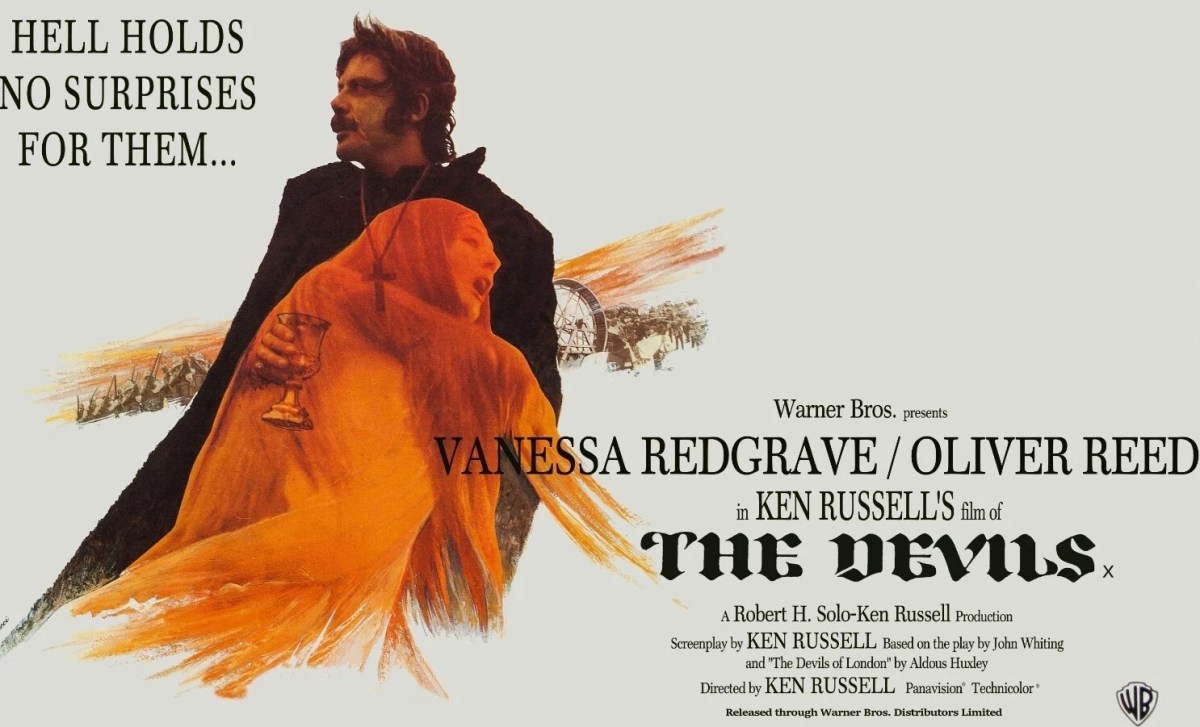
The Devils (1971) *

It’s a conspiracy! The British Film Institute and critic Mark Kermode are on a mission to force the public to reconsider this epic travesty. They have managed to convince Warner Brothers to reissue the film in cinemas in October 2026. The only problem is – this is the second time they’ve tried this maneuver. And it was no more successful last time round – two decades ago in a limited release in arthouses – and despite a lavish follow-up DVD packed full of extras and an expensive illustrated brochure.

Knowing this was the second attempt to regenerate interest in this shambolic enterprise from Ken Russell (Billion Dollar Brain, 1967) – who will no doubt be tabbed a “visionary” director this time round – I thought I’d dig out the DVD featuring the original 1971 release cut in the genuine hope that I might be able to add a little spark to the promotional hoopla for the forthcoming cinematic reissue.
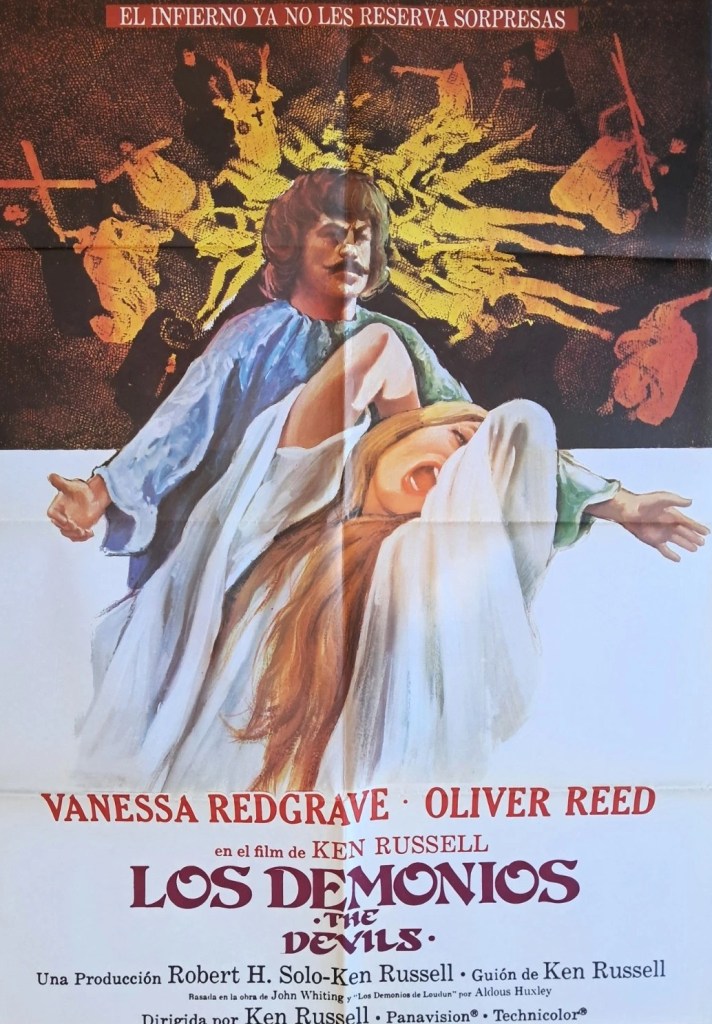
The problem is – it’s still awful. And not in healthy cult fashion or as a slam-dunk for the So Bad It’s Good category. It’s just awful every which way but loose. And it commits the worst error of the awful picture – it’s plain boring. And that’s a shame because the tale is an interesting one. How the French church and state connived to get rid of an irritant challenging their authority by placing false charges of satanic possession against the nuns of the small town of Loudon.

It would certainly have helped had not every single person in a position of power not just looked like an idiot and if Russell had cast the parts with actors of authority, say rising star John Hurt in the role of the exorcist or John Gielgud as the conspiratorial Cardinal Richeliu, a character who as we know from The Three Musketeers was always up to no good. Instead, we’ve got actors way out of even their modest league who make an unintentional mockery of their parts.

Anyone complaining about the modern vernacular of Christopher Nolan’s The Odyssey (2026) would have a field day here with a cornucopia of accents so it sounds more like a  Carry On picture. In fact, Carry On Ken would have been a more apt title.

Vanessa Redgrave (Blow-Up, 1966) had, unfortunately, gone down the Oscar-bait route of hoping that exaggerations of physical affliction will inform her acting. Instead, with her head twisted at ninety degrees, it looks like she’s intent on comedy. And when that only leaves Oliver Reed (Hannibal Brooks, 1968) to hold your picture together you are in dire straits.
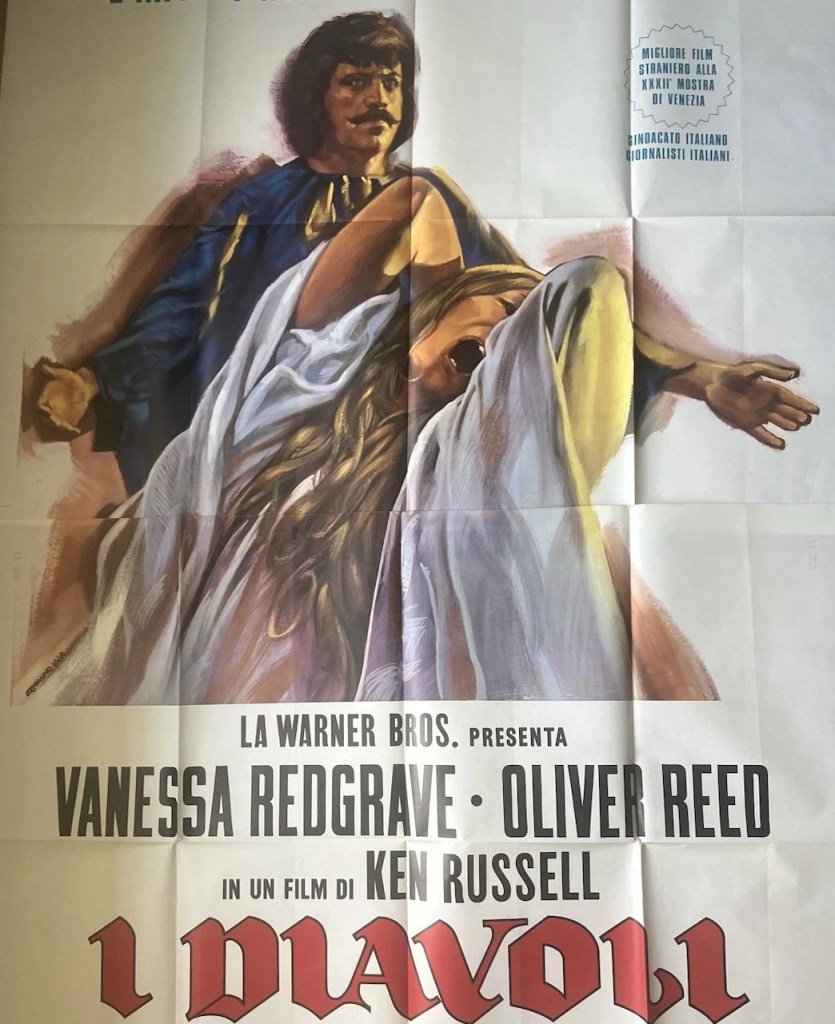
Had the director concentrated on the obvious points, that the clergy was corrupt and liable to indulge in sex with any willing participant in the usual male power-abuse scenario, and that nobody went into a nunnery by choice but were sent there by families who could not provide a dowry or who were incapable of themselves finding a husband to support them, then you might have had the beginnings of a good picture.

But Russell is just intent on indulgence. So the nuns behave as if they were being directed by Jess Franco in a Women-in-Prison movie and strip off their clothes and consort with each other. Chief nun Sister Jeanne (Vanessa Redgrave) doesn’t need to wait for a fake exorcist to pass by, she’s already knee-deep in sexual fantasies about Father Grandier (Oliver Reed) who is trying to impregnate as many women as possible.

The American censor had the good sense to cut out the worst sexual extravagances, the British censor was much more lenient though oddly enough David Lean owed the liberal censor a debt of gratitude for when Glasgow City Council, exerting their right as did many other local authorities, banned this atrocity it left roadshow venue ABC2 short of a program so it decided to keep running Ryan’s Daughter.

“Based on  true story” has never been more abused. Back in the day it would certainly have challenged a moral order where the Church of any denomination was not yet known for hiding a flock of pedophiles. But any student of history – and in those days, like it or not, that would be all of us given how important that subject was to the school curriculum – would not have been surprised to discover that kings and cardinals were not above unethical maneuver.

I’m not saying this movie required a Hollywood-style heroic figure, but it certainly didn’t deserve these cartoon cut-outs. The campness of the presentation, the excess and overload, only serves to stultify what would otherwise be an examination of how easy it was back in the 17th century for the authorities to bring down any challenger – but, heck, we knew that.

I saw the original version on my DVD. Theoretically,  it was welcomed at Cannes this year, but although it certainly made the kind of controversial splash often associated with the Festival, it didn’t seem to me that critics were united in their praise.

If you are familiar with the Russell oeuvre this has more in keeping with The Lair of the White Worm (1988) rather than a genuine cinematic – and restrained – achievement like Altered States (1980).

If Warner Bros has any sense, they will pitch this as a Halloween picture for the cinematic reissue.

There will be hype, so you have been warned.

Young Cassidy (1965) ***

I’m assuming MGM adjudged that a film about a playwright, no matter how famous, and even if directed by John Ford (Cheyenne Autumn, 1964), would not be enough to attract an audience. And that a better physical match for said writer would have been a weedy actor of a Tom Courtenay  disposition. So, I came to this with no idea it was about world-famous Irish playwright Sean O’Casey since his name is never mentioned and the main character is called John Cassidy (Rod Taylor).

Which was just as well because I was wondering what kind of lad Cassidy was when despite his obvious brawn he was an inept labourer, requiring instruction on how to properly use a spade. That this working-class fellow has any inclination towards authorship is not obvious until halfway through the picture, by which time he has demonstrated qualities more appropriate for brawling, revolution and sex. 

Technically, this was a John Ford film as he was the producer.
The French chose not to point out he was not the director.

It probably says a lot about me that I was unaware of the significance of the title of O’Casey’s most famous play – The Plough and the Stars (1926 and, incidentally, filmed a decade later by Ford). By the time I was cogniscent of the country – early on, I assure you, as my grandfather was an Irish immigrant – the Irish flag was the tricolor made up of green, white and orange. I hadn’t known that the flag created by rebels two years before the Easter Uprising of 1916 was a representation of the plough and the stars, hence public outrage when O’Casey blithely adopted it as the title for his breakthrough play.

But you only need a vague idea of history to appreciate the movie. A couple of stunning scenes provide the background of dissent and poverty. The brutality of soldiers and police in quelling a riot is matched by striking transport workers tossing a scab into the river, his drowning ensured by the wagon that follows him in. Cassidy’s true position in the hierarchy is best shown when he is given a cheque rather than cash from a publisher. Lacking a bank account, not only does he fail to cash the cheque but is treated dismissively by clerks at the bank. His joy at rising above his station in receiving such a payment is immediately destroyed by feeling out of place and unwelcome in a bank.

Because, otherwise, Cassidy is quite the confident young fellow, winning over almost any young woman who falls within his compass, varying from upmarket prostitute Daisy (Julie Christie) to meek bookshop assistant Nora (Maggie Smith) and casual acquaintances.

Writing isn’t presented in the romantic manner of David Lean in Doctor Zhivago out the same year (with Julie Christie in a much bigger role), no stunning imagery and no close-up of soulful eyes, just Cassidy sitting at a table working through the night. But there is no indication as to why he chose plays as his metier, especially when the main theatre in Dublin, the Abbey, was the fiefdom of the middle- and upper-classes.

Ironically, Cassidy is tested more when his situation improves than as a downtrodden worker joining the revolutionary cause. As a worker his fists, brawn, brain and looks see him through. But once he steps up into the intellectual class, he is adrift, his new occupation driving a wedge through relationships.  

Not aware that this was a biopic of a playwright, I had little need to question the narrative, and just took each incident as it came. I never had the impression of a condensed biopic, crammed full of cameos. More of an interesting story set  against the background of rising Irish nationalism.

There’s a certain amount of “Oirishness” to contend with – the accents vary – the poverty is never as bleak as you might expect, and once the story heads out of Dublin you might think it’s going to go all the way to The Quiet Man country. But then you have to bear in mind that working-class poverty, as long there was employment available, was not quite of the slum kind, and that once you get out of Dublin you do indeed hit beautiful countryside.

Rod Taylor is good as the brawler-turned-playwright. In the duel of the rising stars, Maggie Smith (The Prime of Miss Jean Brodie, 1969) wins by a nose from Julie Christie, but then, though further down the credits, she has the bigger role. Michael Redgrave (Assignment K, 1968) as poet W.B. Yeats (responsible for the phrase “a terrible beauty is born”) makes the most of choice lines, Edith Evans (The Chalk Garden, 1964) is a quirky, mischievous  Lady Gregory, co-founder of the Abbey. It’s top-heavy with talent including Sian Philips (Becket, 1964), Flora Robson (55 Days at Peking, 1963), Jack MacGowran (Age of Consent, 1969) and T.P. McKenna (Perfect Friday, 1970).

Turns out John Ford was too ill to direct more than few minutes and that role fell to Jack Cardiff (Dark of the Sun, 1968) and I would have to say he does an agreeable job. John Whiting (The Captain’s Table, 1959) drew from O’Casey’s autobiography to write an intelligent script.

Discover WordPress

A daily selection of the best content published on WordPress, collected for you by humans who love to read.

The Atavist Magazine

by Brian Hannan

WordPress.com Blog

News, Tips & Website Tutorials