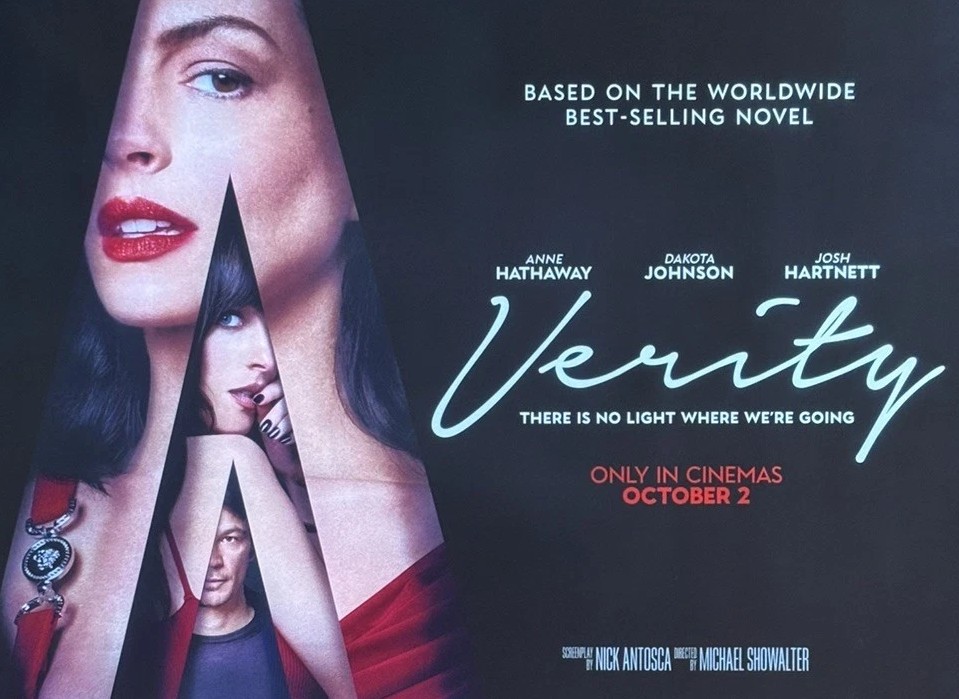
Verity (2026) **** – Seen at the Cinema

The Housemaid set a very high bar for the glossy, slick, twisty, female-led thriller. With the same background of wealth and privilege – and the underdog staring through the shop window – this terrific three-hander more than meets the bill. (I saw this on the same day as Digger and there was scarcely a seat left).

Given the twistiness of the genre now, the audience is aware nothing is what it seems and like me from the outset starts to wonder what the reality really is behind the glitzy façade. When you begin to out-think yourself, you know the movie has done its job.
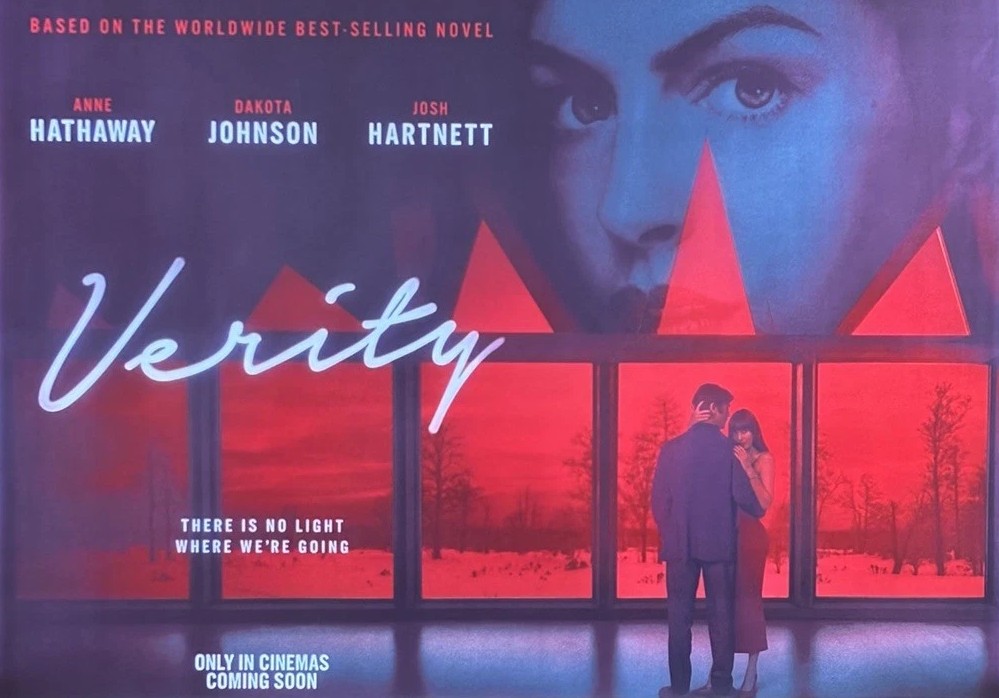
I had a different scenario in mind, one where impoverished ghost writer Lowen (Dakota Johnson) has set it all up, inveigled herself into the household of bestselling crippled author Verity Crawford (Anne Hathaway) and conspired to write a tale, purportedly an autobiography, that would make husband Jeremy (Josh Hartnett) want to kill her. I was wrong, as it turned out, but the screenwriter’s line was just as twisty. In the end the pun on the author’s name, Verity, ensures that we can never know the entire truth.

Given Verity has made fortune imagining villainous heroines, it’s not long before the apparently innocent Lowen begins to fall under some kind of villainous spell, or the self-justification that amounts to the same thing.

The stunning meet-cute sets the tone. When Jeremy comes across Lowen her face is dripping with blood, the result of being too close to a city center car crash. He’s the ultimate gentleman, gives her his shirt in place of her despoiled top, and just as well because she’s going in to interview for the job of a lifetime. Verity needs someone to write three books, based on her voluminous notes, and learn to write in her distinctive style.

I should point the meet-cute between Verity and Jeremy is equally accomplished, Jeremy commandeering someone else’s limousine to make out with Verity.

Lowen is little more than a literary wannabe, published but without commercial success. She’s emotionally raw, too, having just buried her mother and inclined to self-medicate on a combination of her mother’s medication and alcohol. .
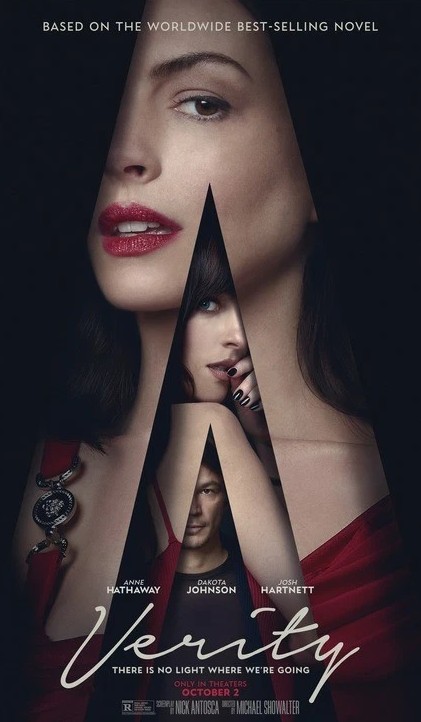
Naturally, with the wife out of action and confined to bed, paralyzed, unable to communicate, a romantic vacuum has opened up, a romantic job opportunity if you like, a sort of bonus to the writing gig, and maybe even an opening for a new wife. Kicking off the it’s-not-what-it-seems business, Lowen by accident discovers a memory stick containing, ironically, too much memory, the retelling of Verity’s life minus the fairy tale aspects that appears to cast Verity as a calculating mother resentful of her two children, fearing they are coming between herself and her husband.  There’s a tragic accident in which one of the children dies. But is it an accident or convenient murder?

Meanwhile, either Lowen is going barmy with guilt, what with playing around with the husband, or going mad, because she begins to see the paralyzed woman watching her. There’s a terrific scene where Lowen sticks a pin in Verity’s hand, drawing blood, hoping to force the wife out of her stupor and admit her supposed paralysis is all part of some kind of sadistic plan, the aim of which is unclear, unless, like her villainous heroines, this is just the kind of fun Verity enjoys.

Thanks to the autobiography, Verity very much comes alive in flashback. But whose version of her life are we seeing? By the time Lowen and Jeremy had made their own judgements, they have already devised a construct which permits villainous action under the guise of self-justification.

You’ll find a few plot holes if you look hard enough, but I doubt if anyone will be anything but swept along in the dazzling tale with convincing characters. This wouldn’t be a twisty thriller if it didn’t come with a couple of dynamite twists at the end.

This is the fourth adaptation of novels by Colleen Hoover (It Ends With Us, 2024) and I’ve enjoyed every one, and each quite different from the other. Nick Antosca (Cape Fear mini series, 2026) wrote the screenplay while Michael Showalter (The Idea of You, 2024 – also with Hathaway) directed but I reckon they followed Hoover’s guidelines.

This is turning out to be the Year of Anne Hathaway, with two big hits – The Devil Wears Prada 2 and The Odyssey – in the bag. All three actors are superb. I’ve not been that impressed with Dakota Johnson (Madame Web, 2024) before – although admittedly I skipped the Shades movie series – but this works for me, and Josh Hartnett’s delicious turn in Trap (2024) turned my preconceptions of him on their head.

Thoroughly enjoyable.
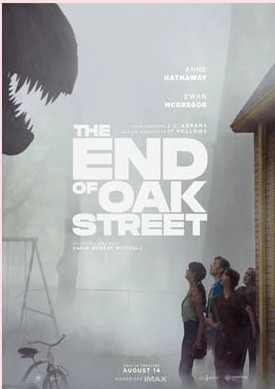
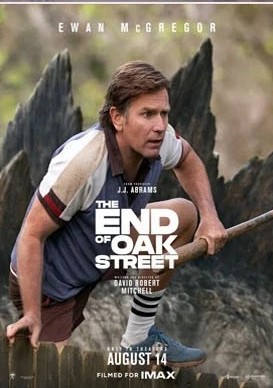
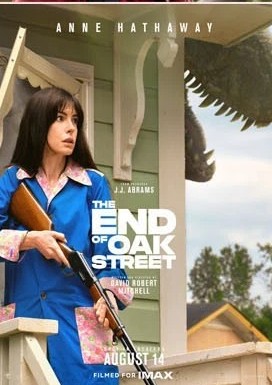
The End of Oak St (2026) ** – Seen at the Cinema

Truly terrible. When your standout scene is two dinosaurs humping each other or having their snouts covered in ice cream or a slithosaurus slithering through a house your picture is in dire trouble. Basically, it’s like a random selection of Steven Spielberg offcuts – the dazzling overhead light from Close Encounters of the Third Kind (1977), the kids cycling in E.T (1982), the heaps of dinosaur pooh from Jurassic Park (1993). Plus being trapped in a car and feral threats in the kitchen, also from Jurassic Park.

This feels like a sci fi B-movie from the 1950s when the plot comprises preposterous nonsense. I laughed out loud when I listened to the stars, clearly barely able to contain themselves when they had to do the exposition. A wormhole or a ripple in the universe had either transported a small town back 200 million years to the prehistoric period or the reverse, transported the prehistoric period complete with jungle and swamps to 1982.

And someone’s being trimming the budget. Once the dinosaurs go on the attack there’s barely a dozen people around for them to prey on, you’d have expected an entire feast awaiting them on the streets.

The cast are required to do little more than run and scream and the screenwriter little more than find ways of the cast getting in the way of the dinosaurs rather than doing their level best to hide. And there’s one of those dumb twists at the end to provide us with a happy ending, so that one of the stars, whose been munched by a dinosaur, can be reunited with his family.

The wormhole bounces around a bit, from house to house, garden to garden, for some reason. It’s this big wobbly ball and minus any of the sensible mumbo-jumbo analysis or assessment of other big-budget sci fi pictures this relies on someone deducing that if they jump into this big wobbly ball they’ll end up back where they came from.

Anne Hathaway has blown all the esteem she’s earned from this year’s The Devil Wears Prada 2 and The Odyssey and unless it was her heart’s desire to make the kind of picture that is cannon fodder for Netflix or Amazon rather than 20th Century Fox it’s an awful decision. This is Ewan McGregor’s first picture since the low-budget Mother Couch (2023) and it’s not done him any favors unless a casting director is looking for someone who can run and scream and both at the same time.

Trying to fill out the story we have dissatisfied couple Denise (Anne Hathaway) and Greg (Ewan McGregor). She’s a budding writer, but her novel reveals that she’s desperate to leave husband and two kids. He’s lost his job but hasn’t told his wife, making ends meet by making  pizza deliveries and he’s prone to secret nips of whisky.

Daughter Audrey (Maisy Stella) is a big fan of Carl Sagan and astronomy and can chip in with nonsensical mumbo-jumbo should the need arrive. Son Brian (Christian Convery) is being bullied by a bigger boy, but that’s because he broke the arm of the bigger boy’s younger brother, so not quite as straight-on a victim as he appears. And there’s a dog, improbably called Starbucks, which both goes missing and turns up as the narrative requires.

Apart from the slithosaurus and the dinosaurs shagging each other there’s nothing new here. The premise is as barmy as One Night Only (2026), so maybe studios believe they’ve dumbed down the movies sufficiently for audiences to accept the dumbest of plots.

Nobody comes out of this well, least of all uber-producer J.J. Abrams (Star Wars – Episode VII: The Force Awakens, 2015). Lazy rip-offs did not seem to fit into his portfolio.

Writer-director David Robert Mitchell made a splash with It Follows (2014) but doesn’t carry this off.

The best you can say is that maybe it will be candidate for the So-Bad-It’s-good subgenre.

Laughable.

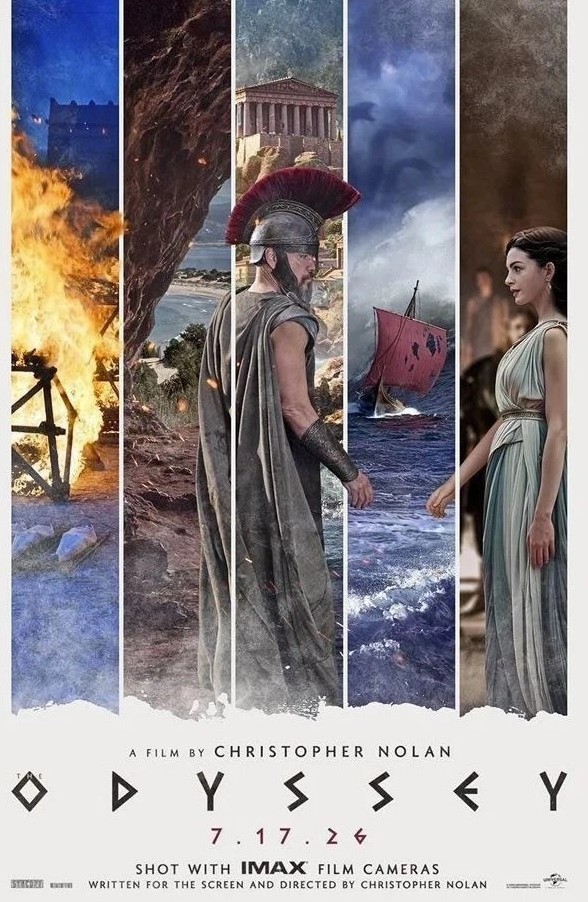
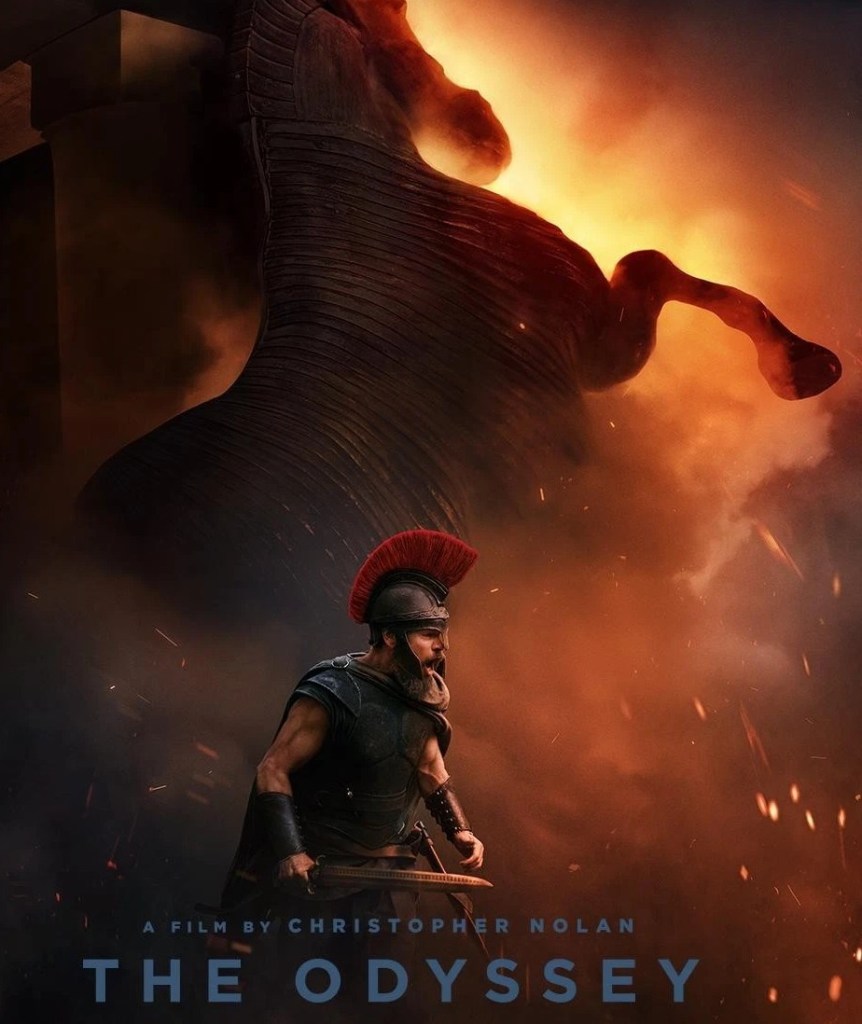
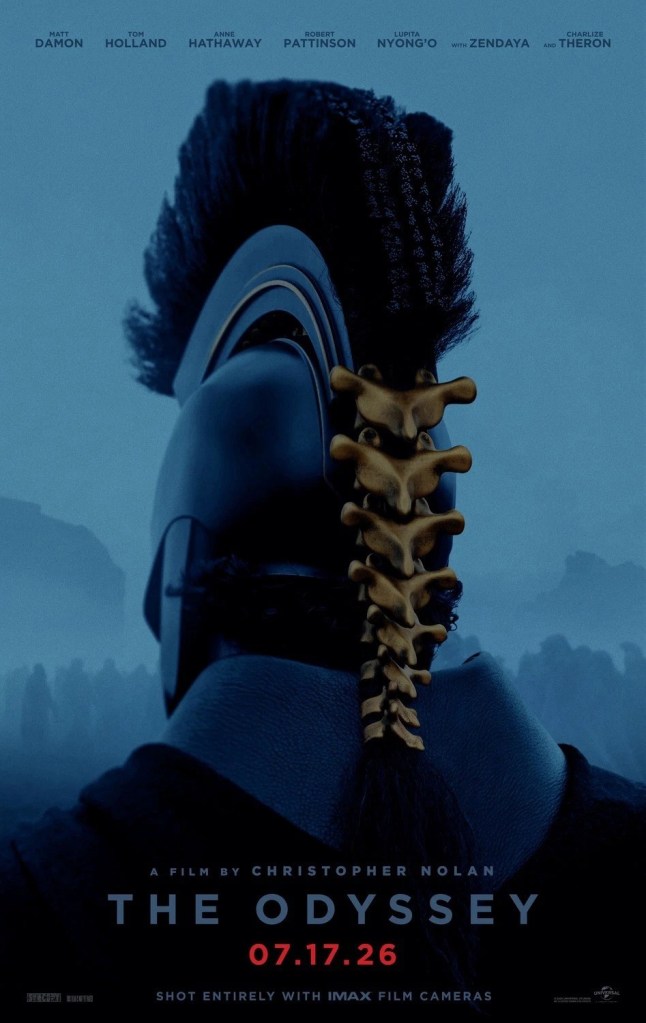
The Odyssey (2026) ***** – Seen at the Cinema, Twice in the One Day

What sets Christopher Nolan aside is not the visual dexterity, imagination or the confidence of his reach, it’s his intelligence. Once you come to the tortuous end, having perhaps shifted time or point of view several times, and wondered at all the amazing stunts or worlds he has opened up, you are left with something utterly human. Emotion that leaves characters bereft. Here, he turns on its head the greatest deception ever practised in war – the Wooden Horse of Troy. Instead of, as since time immemorial everyone has done, praising the trick and Odysseus the ultimate trickster, he chooses another route in his ruthless examination of the artifice. In sneaking the horse into the besieged city, Odysseus has broken the most basic rule of Civilization. A stranger must be given hospitality. And the visitor must leave his weapons at the door. In this picture it’s known as The Code of Zeus, but it’s what held ancient Greek Civilization together, that trust in one another. Strangers were welcomed and once inside a foreign abode they did not seek to carry out violence.

On top of that, the hero realizes what a hero actually is. Once the warrior in him is let loose, the havoc is unjustified. That PTSD and war guilt would probably be enough for any contemporary audience, yet the confession of Odysseus turns out to be the re-wooing of his wife Penelope, telling her he is not at all, after two decades apart, the man that he once was.

There are few directors who can genuinely claim to be auteurs. Usually, they are not screenwriters so are stealing someone else’s original invention. While Nolan relies heavily on the writings of the legendary Homer, he not only Nolanesques everything, the screenwriter in him takes care to ensure that the groundwork is quietly laid for what will spark emotional tumult later on.

There are four exceptionally clever examples of this. Odysseus’s old dog is on the point of death. When Odysseus strokes him, in recognition the dog wags his tail. At this point Odysseus is in disguise – two decades separating him from an infant son now grown up – and it’s how his heir Telemachus recognizes him. Emotional beat no 1. The younger Odysseus has been gored in the ankle by a boar. When he returns, still in disguise, his nurse recognizes him from the scar. Emotional beat no 2. Odysseus has a bow that only he is strong enough to use. Once it’s ready, he’s in the habit of pulling on the bowstring so it gives a distinctive twang. It’s that twang that makes wife Penelope, in a state of desperation, realize that her husband has come home. Emotional beat no 3.

But the best is the mystery sewn into the lining of the script. Everyone lives in a state of fear. They are preparing for invasion by the unknown. “People from the sea” are reputed to be on their way, who knows from where, nobody knows who they are. When the solution is found it’s an overriding emotional beat no 4 – Odysseus himself is one of the people from the sea, the Greeks who landed on the shores of Troy and set siege to the city and eventually burned and pillaged it.

For all the monsters and witches and slaughter, there is incredible restraint. There’s no nudity. There’s no rape shown or even visually implied. But when Odysseus speaks of the horror of war, we know to include that element.. While it’s certainly stated on several occasions that women, either killed as innocent bystanders or left behind and prey to any passing male predator, they have ways of defending themselves. The witch Circe can turn men into pigs. The sorceress Calypso uses lotus leaves to keep her lover sedated. Penelope keeps her suitors at bay with a clever ruse. Agammemnon’s wife can’t be bothered with any of that, she simply cuts her husband’s throat on his triumphant return.

I’m not so familiar with the Greek myths. I’ve not read Henry Treece since childhood. So I can’t tell you what Nolan has adapted, eliminated or added. But I can tell you it all adds up. All the legends I expected are here – the one-eyed Cyclops, the whirlpool Scylla, Charybdis, Circe, the lotus eaters, the underworld, Troy. I don’t recall the giant soldiers so they may or may not be figments of the director’s imagination. For heroes, the Odysseus gang do a lot of running away as they head for home. And for all that he is hailed as the cleverest of the Greek generals, Odysseus is a mite dumb at time, incapable of reading the room on the boat, unwisely irritating monsters.

Matt Damon (The Martian, 2025) is terrific as Odysseus, and while redoubtable in action, is tasked with carrying the emotional thrust, the fatigue and guilt of war, the knowledge that his actions could bring down Civilization. Anne Hathaway (The Devil Wears Prada 2, 2026) is surprisingly good as his wife, the totem for the women left to suffer. Of the rest, Robert Pattinson (The Batman, 2022) is easily the pick as the glowering surly cowardly suitor. Samantha Morton (Minority Report, 2022) is gleefully venomous as Circe. I’m not entirely sure what Zendaya (Challengers, 2024), as ghostly goddess Athena, is doing in the mix and Charlize Theron (The Old Guard, 2020) as Calypso is mostly there for the exposition and it sometimes feels as if that’s the sole purpose of Tom Holland (Spiderman: No Way Home, 2021) as Telemachus.

Jon Bernthal (The Accountant 2, 2025) and John Leguizamo (Tin Soldier, 2025) stand out for the wrong reasons. They sound as if they’ve strayed in from a Martin Scorsese gangster picture.

Back in the days before VHS, DVD and streaming, you couldn’t watch a picture over and over. But occasionally, I’d be so taken with a movie that, in the days of continuous performance (you might not know what that is but when you go to the movies these days it’s for a separate performance, everyone kicked out after the showing) I would stay on and watch it again.

First time I did that it was for Terence Malick’s hypnotic Badlands (1973) – Martin Sheen, Sissy Spacek, Erik Satie – when it turned up in the UK as the support to It’s Alive and there have been countless other examples. So, on my weekly Monday outing to the cinema, I decided I’d take in this picture again rather than grumble at whatever The Evil Dead Burns brought to the table.

When you watch a movie a second time, you’re not held in your seat by the narrative. You know what’s going to happen. You can marvel at all the rest, the writing, the camera movement, the special effects, the acting. I’ll probably go back next week.

Truly awesome.

Discover WordPress

A daily selection of the best content published on WordPress, collected for you by humans who love to read.

The Atavist Magazine

by Brian Hannan

WordPress.com Blog

News, Tips & Website Tutorials