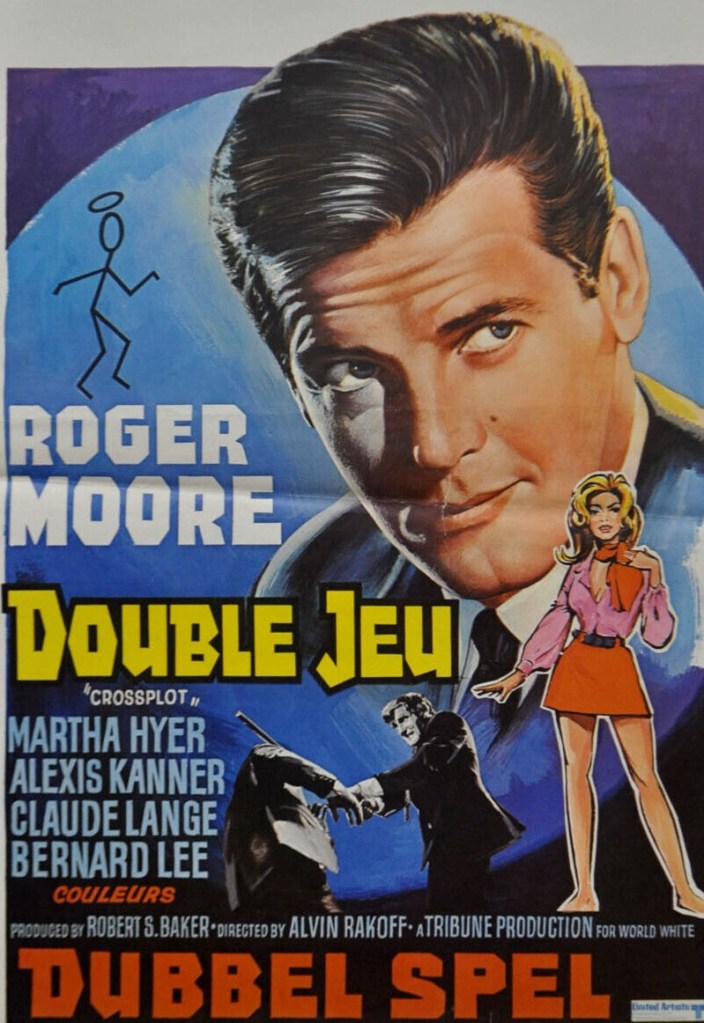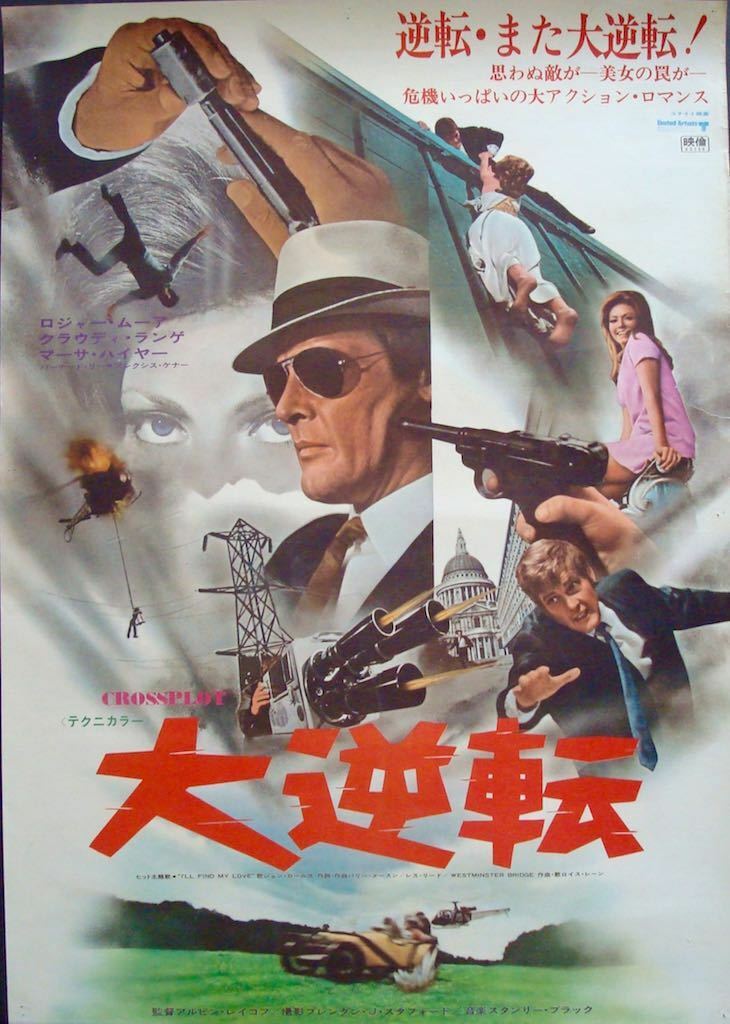
Crossplot (1969) ***

Roger Moore – in his first movie in seven years – almost auditioning for James Bond with his lothario instinct, light touch for dialog, a nice side-line in double takes, and enough action to show that even in his early 40s he was still nimble enough. Not in the Charade (1963) or Arabesque (1966) league and over-reliant on the Swinging Sixties and other “Tourist Britain” clichés and a plot that takes far too long to get going, it takes all the actor’s charm to make it watchable.

After one of his staff Warren (Dudley Sutton) switches the photo of a model in his portfolio, ad-man Gary (Roger Moore) finds himself on the trail of Marla (Claudia Lange), a sometime fugitive hiding out on a houseboat. Meet-cute is prompted when she pushes him into the Thames. On leaving he is knocked out and framed on a dope charge and once he manages to get her into the photographic studio Warren attempts to throw her off the roof, the would-be killer himself eliminated by his boss Ruddock (Francis Matthews) who in a marvelous piece of quick-thinking throws his gun to Gary who instinctively catches it, further implicating himself.

After going all round the houses (including a stately home), evading pursuit via an antique car race and a wedding, Gary finally gets to the bottom of why Marla is in such danger – she overheard a conversation between her aunt Joe (Martha Hyer) and Ruddock. Only problem is – she can’t remember it. And it takes even more time for Gary to figure it out, (not realizing, how could he,  that the clue is in the title, in fact two clues in a crossword puzzle). You can imagine how it goes from then.

This poster takes the easy route by trying to sell the picture on the back of “The Saint.”

On the plus side is mostly Roger Moore. “I come from a long line of hippopotamuses,” isn’t the sort of line you can deliver without some skill. But Moore’s performance lifts what is for the most part  a shaggy dog story, and he’s game enough to do all the running and fighting required, even the heavy lifting (of his eyebrows), to keep the story moving. It’s far from as funny as it thinks and not as funny as it needs to be, but there are still some good stabs at humor, a pistol held to Gary’s head discovered to be a toy gun, Gary turning the tables in a shower on Marla, telling the bride that her groom is a bigamist, and a running joke about the Marla being perennially hungry.  

The politics barely touches on the conspiracy aspects that Hollywood would have pounced upon and made a better fist of, although the idea that Britain could be undermined by civil strife was not far off the mark for the times. It needed some smarter thinking, though, for that element to work.

A much better attempt at selling a thriller with scenes from the film,
including the toy pistol pointed at Roger Moore’s head.

The rest of the cast are game enough. Claudie Lang (The Gatling Gun, 1968) is no Sophia Loren or Audrey Hepburn but nobody is pretending she is and she just about gets away with the dumb model approach. Martha Hyer (The Chase, 1966) delivers a glamorous villain and the suave Francis Matthews (Rasputin: The Mad Monk, 1966) her ideal match.

There’s quite a supporting cast: Veronica Carlsen (Dracula Has Risen from the Grave, 1968), Gabrielle Drake (Suburban Wives, 1972), Dave Prowse (Star Wars, 1977),  Bernard Lee (You Only Live Twice, 1967), Alexis Tanner (The Ernie Game, 1967), Ursula Howells (BBC’s The Forsyte Saga, 1967) and Dudley Sutton (Rotten to the Core, 1965).

If Alvin Rakoff (The Comedy Man, 1964) is in charge of the material he doesn’t have enough material to work with. He does enough to keep it on course but would have benefitted from a a tighter screenplay from Leigh Vance (The Frightened City, 1961). Both had done better in the past, but it is easy to be seduced by the romantic thriller format, almost a mini-genre in itself, assuming it is easier to pull off than it looks. The likes of Alfred Hitchcock (North by Northwest, 1959) and Stanley Donen (Charade) made it look easy but they had the advantage of big stars in Cary Grant and Audrey Hepburn who possessed the ability to make the lightest confection work.

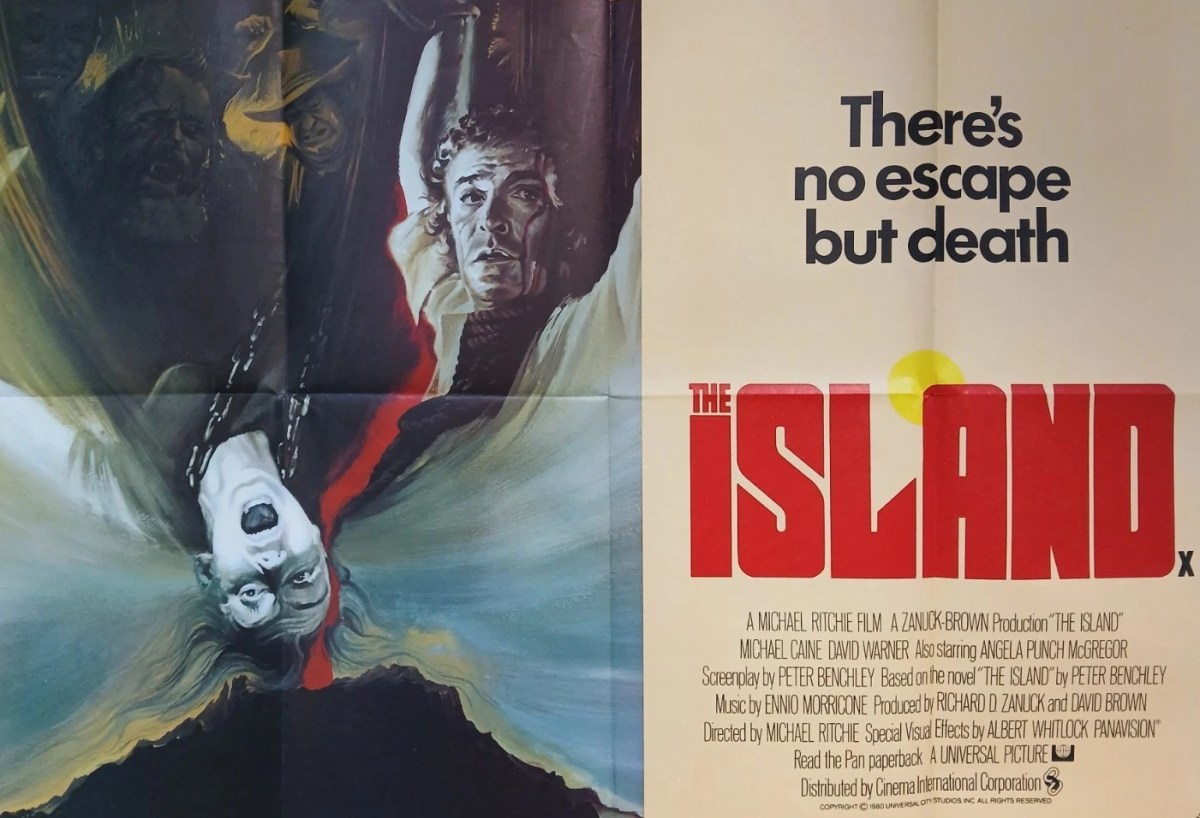
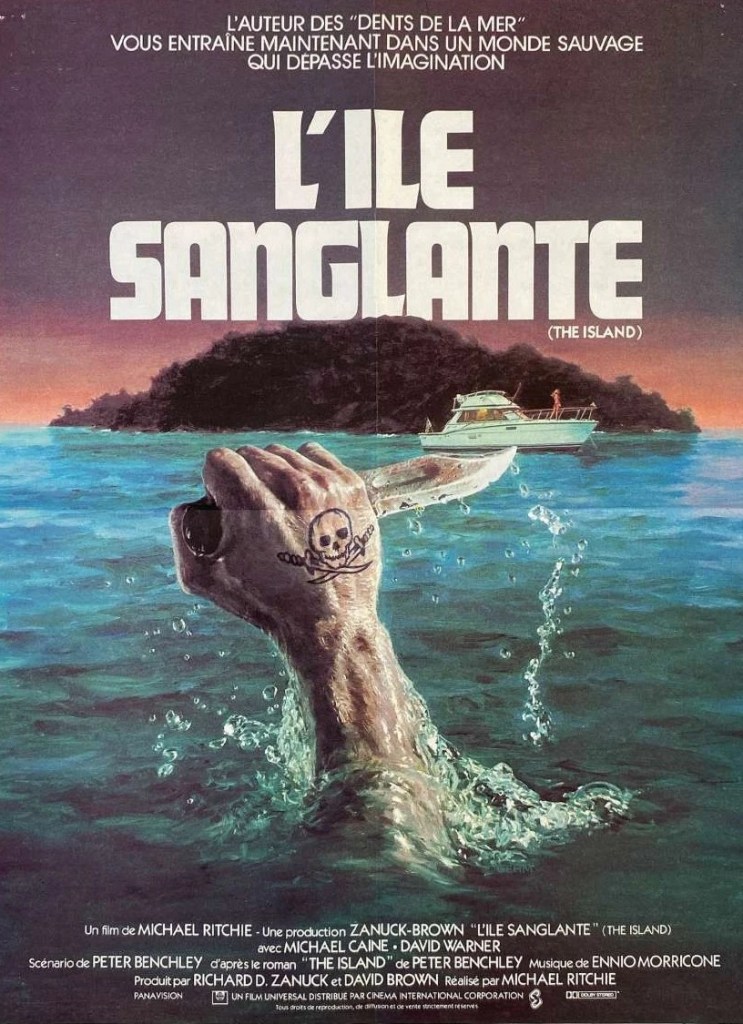
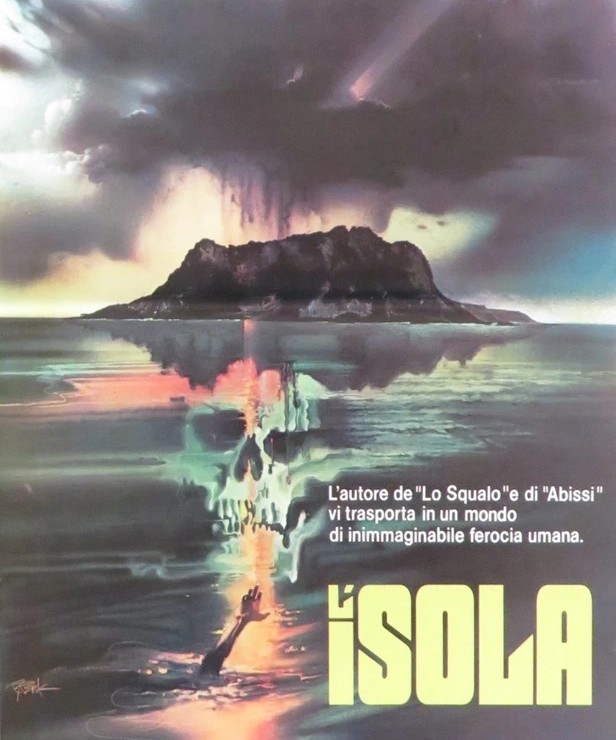
The Island (1980) ***

By common consent one of Michael Caine’s worst films – on a par with The Swarm (1978), The Hand (1981), Jaws, The Revenge (1987), and, for sheer embarrassment, Blame It On Rio (1984) – so naturally I had steered clear of it for four decades. But in the grip of reassessment fever and given how big a fan I am of pirate films, I wondered if I might come to a different conclusion after another vewing.

This was being touted as another blockbuster from the author of Jaws (1975) and The Deep (1977) so it’s entirely possible the actor was not necessarily its biggest drawing card.

The odd thing is that – terrible though it is – it has some aspects very much in its favor. And if it had the courage of its convictions would have taken The Wicker Man route and not permitted journalist Blair Maynard (Michael Caine) to escape from the titular island where he is being held captive by a primitive tribe of pirates. Once he had fulfilled his purpose, which was to impregnate a female pirate, he could as easily have had his throat cut.

There is also some power reversal. He’s raped by said female, Beth (Angela Punch McGregor), and she keeps him chained by the neck, dragging him along behind her like a pet. And there’s an exploration of the gun-love fantasy, expressed by Blair’s  12-year-old son Justin (Jeffrey Frank), given the chance to wield a pistol like his hero Dirty Harry, enjoy the feeling of pulling the trigger, and in an extreme version of early teenage revolt, embracing the opportunity to put one over on his father.

And you might also go for the islanders, untouched and therefore uncorrupted by civilization, who still negotiate the seas in small sailing craft, and, except for their murderous instincts, could easily come across as innocents, living the same life – the “good life” in the eyes of many these days – as they would have done 300 years ago.

What counts against the movie is, for a start, the set-up. Had Blair been just on a sailing trip with his son and been captured by pirates that would have been fine. Instead, he’s a journalist managing to convince his editor to send him to investigate that hoary old chestnut, the Bermuda Triangle.

While the pirates are a gift to anthropological studies, sometimes they speak in perfect English, sometimes they speak pidgin English, sometimes they’re speaking in some form of Olde English complete with naff ritual and rules. Although they’re desperate to find a way of prolonging their species – which is where Blair comes in – they tend to kill any other males or females who could help them achieve this aim.

And although they steal plenty of modern supplies in the way of food and clothing from the ships they pirate, they still wear scraps and live off scraps.

When Blair attempts his first escape the presence of a giant jellyfish cuts that short. But, miraculously, the next two times he’s in the water, no jellyfish. Not much of this is discreet, but there is one relationship that gets by with looks. A young island boy, jealous of the attention given to Justin by Nau (David Warner), the pirate chief,  appears to be helping Blair escape in a tiny craft until, far out at sea, the journalist notices that the boat has been sabotaged and is sinking fast. Even so, it’s a bit complicated. I couldn’t work out the young fellow’s motives. Getting rid of Blair wouldn’t get rid of his rival for the chief’s affections.

The ending is a complete mess. Luckily, we’ve been informed that Blair fought in the Korean War so when he finds a deck-mounted machine gun on the U.S. Coastguard vessel the pirates have just taken over, he can open fire like Rambo and slaughter near enough the entire contingent of his enemies. The only survivors are his son and Nau, so we can have one last hand-to-hand skirmish, and the boy and father can enjoy a sentimental reunion.

So, yes, this is a hidden civilization, a lost tribe, that might be treasured for living the simple life, but Blair, despite being a journalist, is hardly salivating at the prospect of his scoop. Too much time is spent on trying to establish the pirates’ way of life via their rituals and oddities.

But this was certainly a bold move on Caine’s part, to take on a role that was akin to Charlton Heston in Planet of the Apes (1968), to be treated as not just an inferior but only useful for his semen. The reversal of the power balance between himself and Beth, who, as in Planet of the Apes, begins to care for her captive, would certainly chime with the contemporary audience.

There’s very little that’s noble about the savages, all are unkempt and few have a full set of teeth.

But Caine does put in a good acting shift. Angela Punch McGregor (The Chant of Jimmie Blacksmith, 1978) is the pick of the rest. David Warner (Morgan!/Morgan, A Suitable Case for Treatment, 1966) excels in this kind of oddball part. Jeffrey Frank didn’t make another movie.

Disappointing choice, though, for director Michael Ritchie, who had built up a solid reputation through Downhill Racer (1969), Prime Cut (1972), The Candidate (1972) and Smile (1975). Written by Peter Benchley.

To be honest, I’m a bit disappointed to find so much to admire in what I had expected to be an ideal candidate for the So Bad It’s Good category.

The Devils (1971) *

It’s a conspiracy! The British Film Institute and critic Mark Kermode are on a mission to force the public to reconsider this epic travesty. They have managed to convince Warner Brothers to reissue the film in cinemas in October 2026. The only problem is – this is the second time they’ve tried this maneuver. And it was no more successful last time round – two decades ago in a limited release in arthouses – and despite a lavish follow-up DVD packed full of extras and an expensive illustrated brochure.

Knowing this was the second attempt to regenerate interest in this shambolic enterprise from Ken Russell (Billion Dollar Brain, 1967) – who will no doubt be tabbed a “visionary” director this time round – I thought I’d dig out the DVD featuring the original 1971 release cut in the genuine hope that I might be able to add a little spark to the promotional hoopla for the forthcoming cinematic reissue.

The problem is – it’s still awful. And not in healthy cult fashion or as a slam-dunk for the So Bad It’s Good category. It’s just awful every which way but loose. And it commits the worst error of the awful picture – it’s plain boring. And that’s a shame because the tale is an interesting one. How the French church and state connived to get rid of an irritant challenging their authority by placing false charges of satanic possession against the nuns of the small town of Loudon.

It would certainly have helped had not every single person in a position of power not just looked like an idiot and if Russell had cast the parts with actors of authority, say rising star John Hurt in the role of the exorcist or John Gielgud as the conspiratorial Cardinal Richeliu, a character who as we know from The Three Musketeers was always up to no good. Instead, we’ve got actors way out of even their modest league who make an unintentional mockery of their parts.

Anyone complaining about the modern vernacular of Christopher Nolan’s The Odyssey (2026) would have a field day here with a cornucopia of accents so it sounds more like a  Carry On picture. In fact, Carry On Ken would have been a more apt title.

Vanessa Redgrave (Blow-Up, 1966) had, unfortunately, gone down the Oscar-bait route of hoping that exaggerations of physical affliction will inform her acting. Instead, with her head twisted at ninety degrees, it looks like she’s intent on comedy. And when that only leaves Oliver Reed (Hannibal Brooks, 1968) to hold your picture together you are in dire straits.

Had the director concentrated on the obvious points, that the clergy was corrupt and liable to indulge in sex with any willing participant in the usual male power-abuse scenario, and that nobody went into a nunnery by choice but were sent there by families who could not provide a dowry or who were incapable of themselves finding a husband to support them, then you might have had the beginnings of a good picture.

But Russell is just intent on indulgence. So the nuns behave as if they were being directed by Jess Franco in a Women-in-Prison movie and strip off their clothes and consort with each other. Chief nun Sister Jeanne (Vanessa Redgrave) doesn’t need to wait for a fake exorcist to pass by, she’s already knee-deep in sexual fantasies about Father Grandier (Oliver Reed) who is trying to impregnate as many women as possible.

The American censor had the good sense to cut out the worst sexual extravagances, the British censor was much more lenient though oddly enough David Lean owed the liberal censor a debt of gratitude for when Glasgow City Council, exerting their right as did many other local authorities, banned this atrocity it left roadshow venue ABC2 short of a program so it decided to keep running Ryan’s Daughter.

“Based on  true story” has never been more abused. Back in the day it would certainly have challenged a moral order where the Church of any denomination was not yet known for hiding a flock of pedophiles. But any student of history – and in those days, like it or not, that would be all of us given how important that subject was to the school curriculum – would not have been surprised to discover that kings and cardinals were not above unethical maneuver.

I’m not saying this movie required a Hollywood-style heroic figure, but it certainly didn’t deserve these cartoon cut-outs. The campness of the presentation, the excess and overload, only serves to stultify what would otherwise be an examination of how easy it was back in the 17th century for the authorities to bring down any challenger – but, heck, we knew that.

I saw the original version on my DVD. Theoretically,  it was welcomed at Cannes this year, but although it certainly made the kind of controversial splash often associated with the Festival, it didn’t seem to me that critics were united in their praise.

If you are familiar with the Russell oeuvre this has more in keeping with The Lair of the White Worm (1988) rather than a genuine cinematic – and restrained – achievement like Altered States (1980).

If Warner Bros has any sense, they will pitch this as a Halloween picture for the cinematic reissue.

There will be hype, so you have been warned.

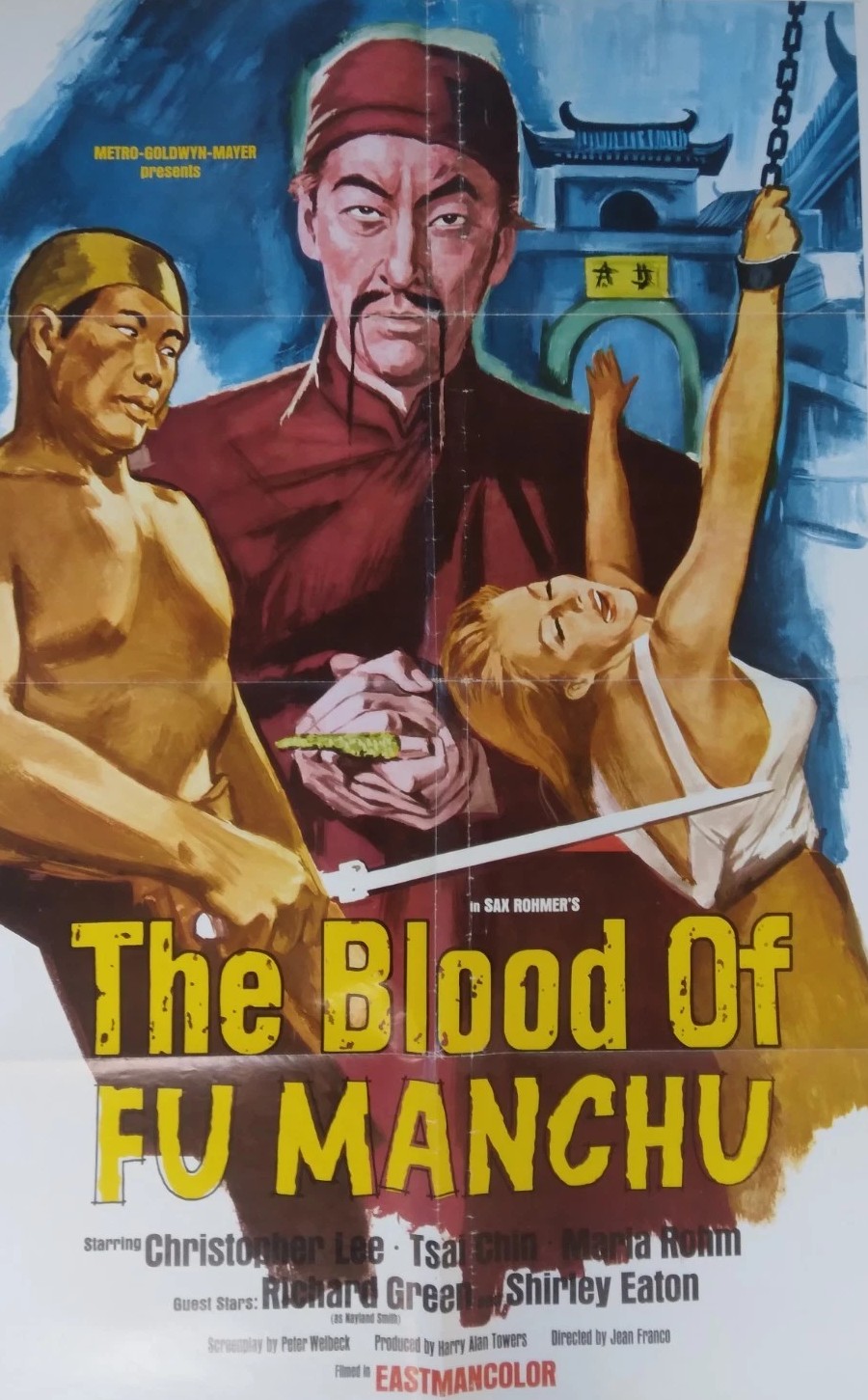
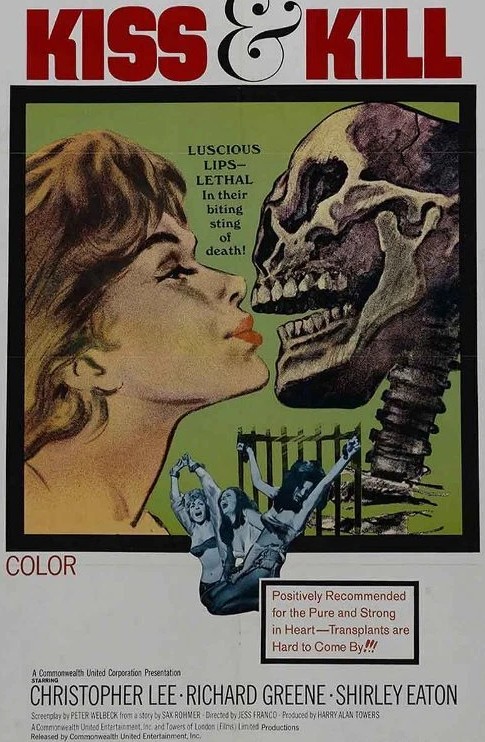
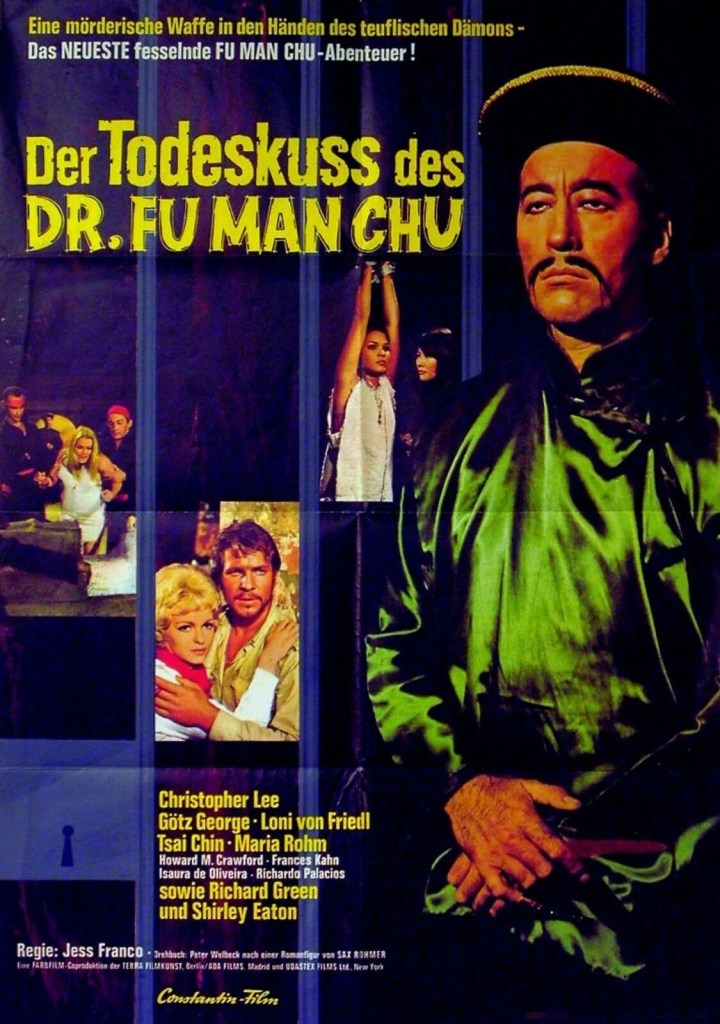
The Blood of Fu Manchu / Kiss & Kill (1968) **

Three stories in one, except only one tale remotely holds our interest. So what compelled producer Harry Alan Towers and director Jess Franco to sideline the titular character and devote more time to a young explorer Carl Janseon (Gotz George) and bandit Sancho Lopez (Ricardo Palacios). You could probably guess that the physical involvement of Fu Manchu (Christopher Lee) would be in any case limited once you grasped the crux of the narrative which saw ten girls sent out into the big wide world to kill his ten most hated enemies. You’ll probably be surprised to learn that he had only ten major enemies, but since one of them is his old nemesis Nayland Smith (Richard Greene), then you can be sure that that aspect is going to suck up a good deal of what time remains after the subplots concerning the explorer and the bandit.

 Which is a shame because neither explorer not bandit employ the kid of evil little grey cells that would allow them to come up with a plot that any of the James Bond villains would be proud of in their bids for global domination. Fu Manchu has located an ancient poison which is transmitted by women in the form of a kiss. It originates in certain snakes and although the women are “kissed” by the snakes, they are apparently impervious to its venom, so the first gender-specific poison in history.

And that’s about it. As usual Towers has rounded up a bevy of young beauties, no doubt sold on the idea that he’s going to turn them into the next big female star, as carriers of the deadly poison. Not all are so keen on the idea, but since he’s got them chained by the neck in a Brazilian cave that passes for his stronghold and with his daughter Lin Tang (Tsai Chin) to threaten them with torture, it’s not surprising they are complicit.

In any case the female assassins are one-trick ponies. The minute they accomplish their deed, they are bumped off. Smith is the first victim (apart from a prisoner selected to demonstrate the efficacy of the poison) but he doesn’t die immediately. Instead he is struck blind, although he is aware he hasn’t got long to live unless an antidote can be found.

Naturally, that puts him on the track of Fu Manchu and, of course, into sudden danger. The Fu Manchu-Nayland Smith had proved a decent cinematic tug-of-war for three previous episodes beginning with  The Face of Fu Manchu (1965), so it was somewhat surprising that tension was diminished by spending so much time playing up explorer and bandit, especially as the latter is determined to play out all the cliches, including laughing like a hyena.

There is some occasional visual humor such as when the bandits go on the rampage and the crew emerge from bandits bearing such prizes as a bishop’s mitre and when a governor, having imprisoned Jansen, suggests they while away their time with a game of chess.

It’s odd that part of the disappointment for certain viewers in this opus is the lack of trademark Jess Franco sleaze. There’s barely any nudity and although the girls are kept in prison (until released to wreak havoc) there’s none of the tawdriness of WIP epics such as his 99 Women (1969) which is replete with brutality and sex.

Despite the cultural appropriation, Christopher Lee (The Devil Rides Out, 1968) is, as ever, solid as Fu Manchu, speaking in clipped tones and towering over everyone else, though his main role appears to be to deliver exposition, explain the foul plot and its consequences and so on. It’s left up to Tsai Chin (You Only Live Twice, 1967) to carry the sadism.

Richard Greene (Sword of Sherwood Forest, 1960) does his best in a role of declining returns. You might spot among the cast Towers’ wife Maria Rohm (Five Golden Dragons, 1967) and Shirley Eaton (The Girl from Rio, 1969).

Of the women expecting a major career break, Loni von Friedl had scores of parts including Doppelganger/Journey to the Far Side of the Sun (1969). But Frances Khan only enjoyed three more roles and or Isaura de Olivera this was the beginning and end of her movie career.

Written as usual by Peter Welbeck (Five Golden Dragons) – aka Harry Alan Towers – and Franco based on the novels of Sax Rohmer.

Promising idea ruined.

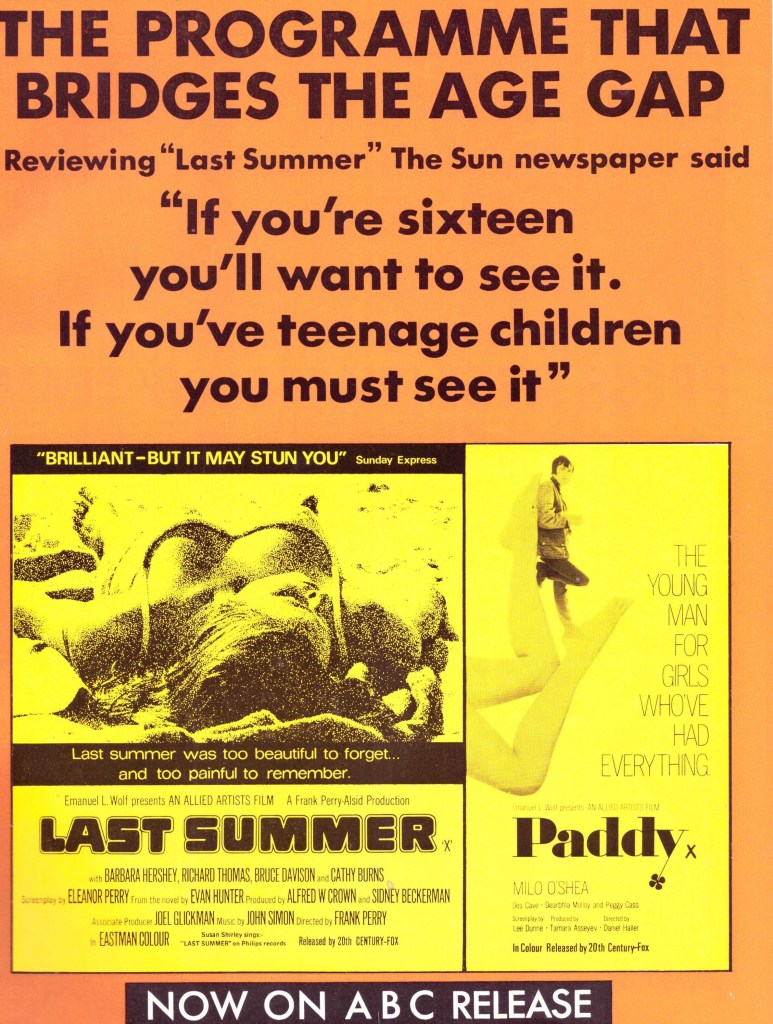
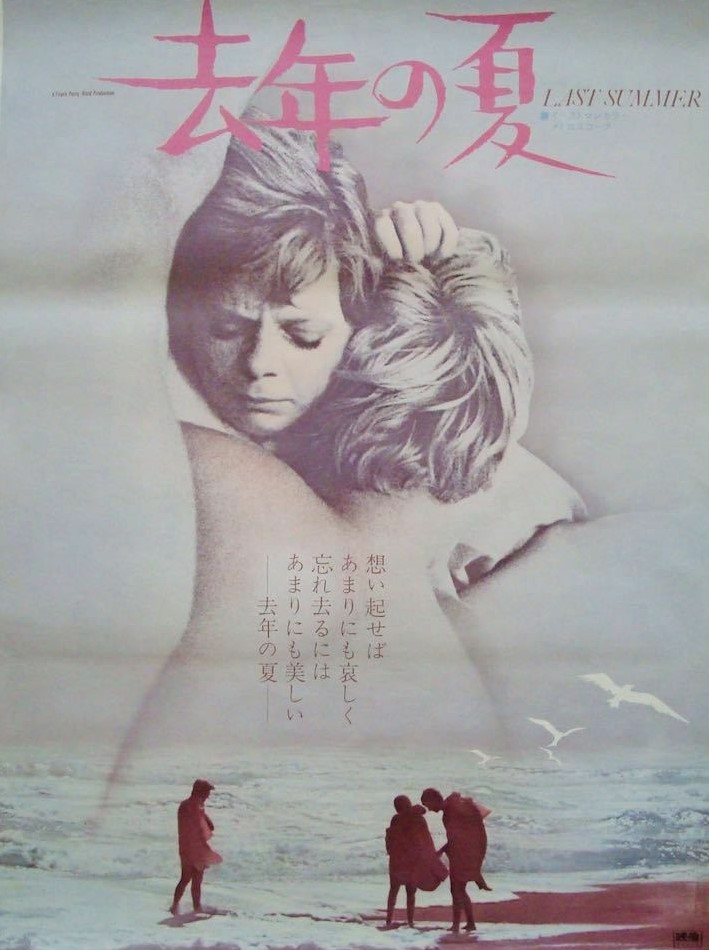
Last Summer (1969) ****

Given the severity of the crime involved, you leave Frank Perry’s coming-of-age-drama wondering what happened to the four principals. Did the aggressive three young demi-gods of a golden age go on to pursue similar acts of cruelty? While one of them might show remorse, or at least suffer from guilt, of the other two I have my doubts. They would find ways to blame the injured party. And what about the victim? Would she have the courage to report the crime, or suffer in shame for decades.

It’s odd how time changes entirely the shape of a movie. In its day this was seen as a bold exposition of frank adventure by teenagers seeking their first experiences of growing up and experimenting with sex and drugs (pilfered from a parental stash). Although there is little focus on dysfunctionality, both Sandy (Barbara Hershey) and Rhoda (Cathy Burns) are missing a parent, the former’s father running off with another woman, the latter’s mother drowned by stupid misadventure. Both have been abused, unable to prevent the wandering hands of males. All are vulnerable, if only by youth.

Of the boys, Dan (Bruce Davison) is the more confident, Peter (Richard Thomas), while easily swayed, the gentler of the two. Dan merely seeks his first taste of sex, Peter the more likely to need love as well. Sandy is sexually precocious, somewhat on the exhibitionist side, peeling off her bikini top with apparently at times no idea of the effect it will have on the boys, at other times clearly uncomfortable with the notion that the guys might have nothing else on their minds but staring at her breasts. But she is the one who wants to continue watching a gay couple cavorting on the beach while Dan is embarrassed. Sometimes the frank sexuality is rite-of-passage stuff, other times it is distinctly creepy. In the cinema both men grope her breasts. She claims to have been excited by the experience, but you can’t help thinking at least one of the men should have shown restraint, not treating her as if she was some kind of sex toy.

The movie begins on a clearer note. The guys come across Sandy nursing a wounded gull and perhaps entranced by her good looks help her remove a hook from the bird’s throat, provide convalescence and eventually help the bird recover the confidence to fly again. It’s a cosy trio, but edgy, too, Sandy allowing them considerable latitude. But, of course, the guys do the same to her. When she bludgeons the bird to death because it bit her (“the ungrateful bastard”), the pair, initially shocked, are not shocked enough to reject her, afflicted by unassailable male logic, the kind that drove film noir, that maintained a beautiful woman could not have a black heart. 

Separated from the other two, Peter displays a gentler side, teaching the shy Rhoda to swim, kissing her in far more considerate fashion than the boys treat Sandy. But, effectively, she is a pet, and it’s only a matter of time before the unsavory aspect of Sandy’s character breaks out. After setting Rhoda up on a date, the trio do everything they can to spoil it, angry at the poor girl for not getting the “joke.”

Worse is to follow. Date-rape we’d call it today. Retreating to the cool forest, Sandy taunts Rhoda by removing her bikini top. When the horrified Rhoda refuses to do the same, Sandy attacks her, holding her down along with Peter while Dan rapes her. That’s where the film ends, no consequences, no repercussion. Back in the day it was a shock ending, an act of violence to mar an otherwise relatively innocent summer. After the deed is done, the camera pulls back into an aerial shot to observe the  guilty trio walking back to the beach, but without drawing conclusion or offering moral judgement. It’s hard to know what to make of the ending. These days, of course, we’d be appalled. But back then it didn’t appear to appall, certainly not drawing the outrage that accompanied similar scenes in The Straw Dogs (1971) or A Clockwork Orange (1971) perhaps because the perpetrators were so attractive and it was, after all, a coming-of-age picture, as if such things could be expected.

Roger Ebert, writing in the Chicago Sun-Times, for example, judged that the conclusion “is not really important to the greatness of the movie.” Andrew Sarris of Village Voice noted that “Perry retreats from the carnal carnage” to end with a shot that “prefers symbolic evocation to psychological exploration.” In other words adolescence is fraught with risk and Rhoda is just collateral damage.

Certainly the acting is uniformly excellent for such inexperienced actors, coping with many changes in dramatic focus, from early exhilaration through growing pains to violence.  Barbara Hershey (Heaven with a Gun, 1969) would go on to become a major star. Amazing to realise that Bruce Davison (Willard, 1971) and Cathy Burns, Oscar-nominated for her role, were making their movie debuts and for Hershey and Richard Thomas (Winning, 1969) their sophomore outings.

Director Frank Perry (The Swimmer, 1968) had a special affinity with the young as he had proved with David and Lisa (1962) and at times the whole affair had an improvised free-wheeling style. Eleanor Perry (David and Lisa) wrote the screenplay based on the novel by Evan Hunter (The Birds, 1963).

This is very hard to find, it turns out, so Ebay might be your best bet.

My thanks to one of my readers, Mike, for digging up this story of the disappearance of Catherine Burns from the movie business.

https://www.hollywoodreporter.com/movies/movie-features/catherine-burns-inside-50-year-disappearance-an-oscar-nominee-1275646/

The Sweet Ride (1968) ***

Unusual drama mainlining on Californian surf, sex, bikers, a mystery of Blow-Up (1966) dimensions and the best entrance since Ursula Andress in Dr No (1962). Displays a 1960s vibe with a 1950s pay-off as the “hitchhiker” of responsibility rears its ugly head.

A woman thrown out of a car narrowly escapes being run over. The cops jack in the investigation after television actress Vickie (Jacqueline Bisset) refuses to explain why she’s been badly beaten up.  And so we enter flashback mode to supposedly find out. She makes a glorious entrance, emerging from the sea, minus bikini top, into the lives of surfer Denny (Michael Sarrazin), jazz pianist Choo-Choo (Bob Denver) and ageing beach bum and tennis hustler Collie (Tony Franciosca). From the off, she’s enigmatic, gives a false address, won’t explain bruises on her arm, has something clandestine going on with television producer Caswell (Warren Stevens) and like Blow-Up we are only privy to snippets of information.

She’s half-in half-out of a relationship with Dennis, with Collie hovering on the periphery hoping to pick up the pieces to his sexual advantage. Contemporary issues clog the background, Choo-Choo tries a camp number complete with pink dog to avoid the draft, a neighbor threatens to shoot Parker for wandering around in shorts and habitually stealing his newspaper, epithets like “degenerates” are tossed around, Choo Choo’s girlfriend Thumper, while appearing in movies with titles like Suburban Lust Queen acts den mother, there’s not much actual exciting surfing, and a biker called Mr. Clean is somehow involved.

The romance plays out well, Vicky unsure, Denny convinced but without a livelihood to offer and unable to get a straight answer out of her. Choo-Choo gets the gig of his dreams in Las Vegas and there’s an rape scene, more unsettling because it’s committed by Denny with the bizarre justification of getting “just for once something on my terms.”  And there’s the equally disquieting sense that the only explanation for Vickie’s behavior is to tab her a nymphomaniac, walking out of an argument with a mysterious man in a beach house to drop her clothes for a bout of sex with Mr Clean.

I must have seen a different picture from everyone else. A good few critics at the time and reviewers since appear to think Vickie was also victim of a gangbang by the bikers, but I can’t see why. When he sees Vickie coming down from the beach house, Mr. Clean shouts “everybody split” and his buddies clear the beach. However, Mr. Clean, ironically, gives the best indication of her state of mind, explaining that Vickie “kept staring back at the house and moaning about how she wanted to die” while he enjoyed the best night of his life sex-wise.

Denny and Collie prove not to be the pussycats they appear, bearding the bikers in their den and beating up Mr. Clean while Denny goes on to deliver a hiding to Caswell. But what this film turns out to be is an examination of vulnerability, how easily those with a new sense of freedom are trapped. An examination of contemporary mores, perhaps, but in not resolving the mystery of Vickie ultimately fails to deliver, especially as it does not, from the outset, carry the kind of artistic credentials of Antonioni in Blow-Up.

Perhaps the mystery needs no resolution, it’s just same old-same old dressed up in the novelty of sexual freedom. There’s no idea of why Vickie was beaten up, and essentially abandoned on the road to become accident fodder, and no hint really of why she fell foul of someone so badly she needed disposed of, no notion that she was a threat to anyone. (Or, for that matter, no explanation of what happened to her bikini top and why, if she was so apparently free with her charms, she was so shy about being seen half-naked.) On the other hand, victim may well have been Vicky’s destiny from the get-go, that kind of innocence only waiting to be defiled.

In any 1960s contemporary picture there’s always the temptation to accept as truthful or reject as phony the lives shown. The idea that sexual freedom bestows actual freedom is usually the issue until consequence (i.e. old-fashioned Hollywood morality) comes into play. This is less heavy-handed than, for example, Easy Rider (1969) or Bob & Carol & Ted & Alice (1969). The characters make decisions to grow up or to stay locked in a world of easy sex, dope and money. There’s no grand finale, just a more realistic drifting apart, and it’s only Vickie who comes apart, although that process had begun long before she met the drifters.  

Jacqueline Bisset (The Detective, 1968), in her divinely posh British accent, comes over well as an attractive screen presence and complex character. In fact, she has a bigger part here than in Bullitt (1968) or The Detective (1968). If you wanted anyone to portray a soulful hippie you need look no further than tousle-haired Michael Sarrazin (In Search of Gregory, 1969) and normally if you required someone on the sly, despicable side, Tony Franciosca (Fathom, 1967) might well be your first port of call, but Franciosca proves the surprise here, classic wind-up merchant and predator who exhibits considerable vulnerability when he realizes he is losing the worship of the idealistic young.

Former British matinee idol Michael Wilding (A Girl Named Tamiko, 1962) and Norma Crane (Penelope, 1966) appear as Vickie’s parents.  Bob Denver (Who’s Minding the Mint, 1967) and Michele Carey (The Spy with My Face, 1965) are solid support. Director Harvey Hart (Fortune and Men’s Eyes, 1970) tries to cover too much ground and could have done with narrowing the focus. Future Bond screenwriter Tom Mankiewicz (son of Joseph L.) made his screenwriting debut adapting the book by William Murray.

The DVD is a bit on the pricey side, but if you just want to check it out, YouTube has a print.

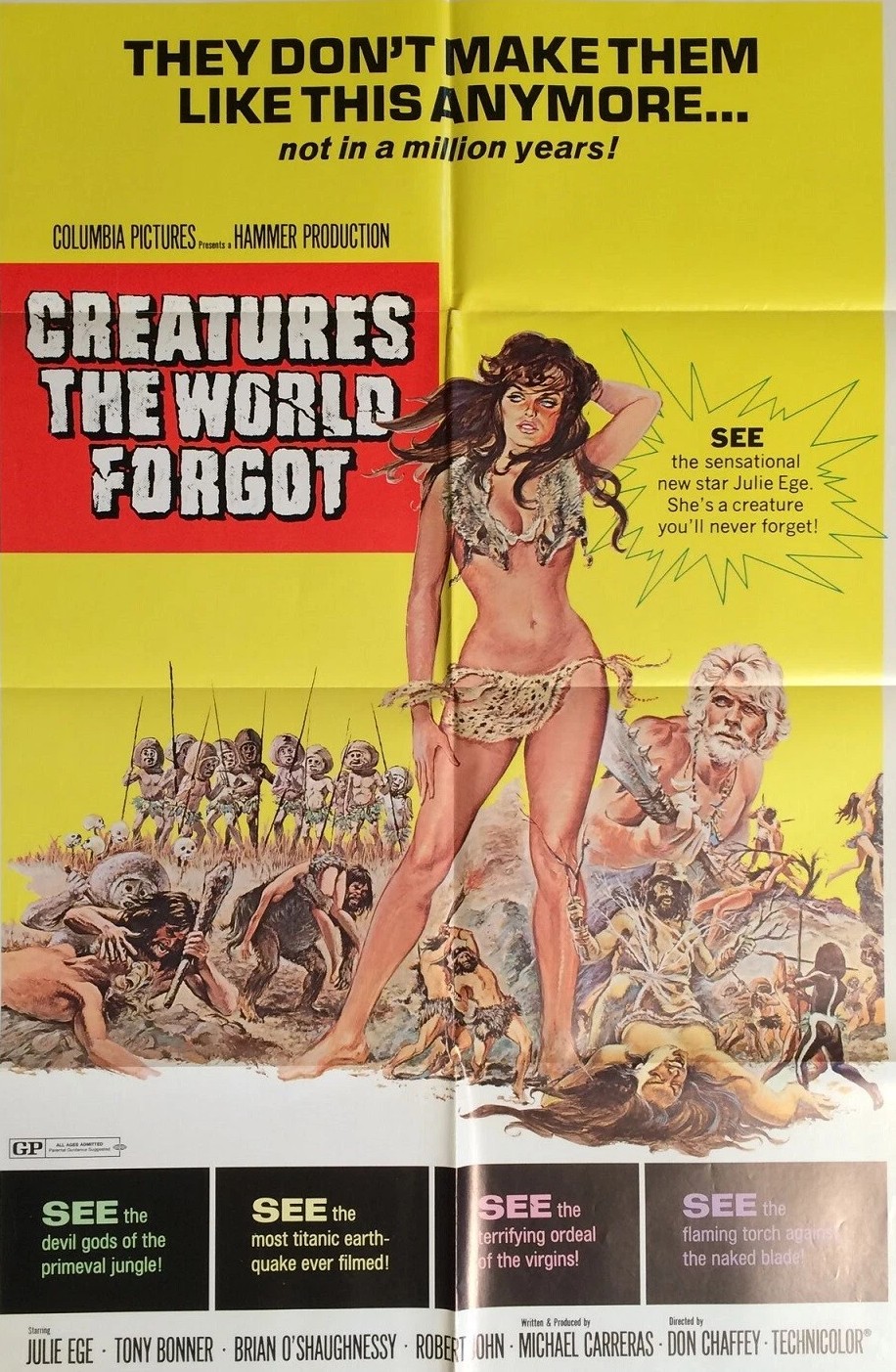
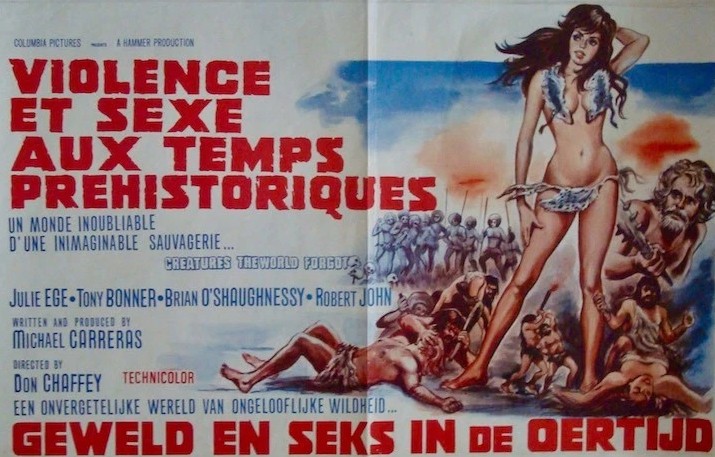
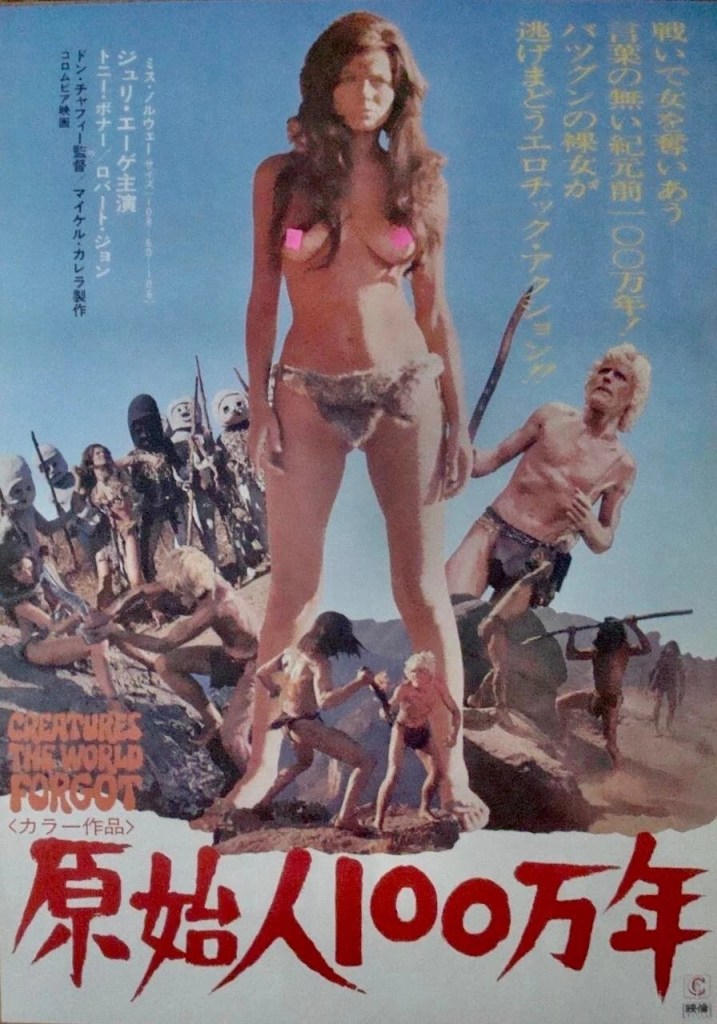
Creatures The World Forgot (1971) ***

Remove the minimal salacious elements (“Violence and Sex in Prehistoric Times” was the come-on for French audiences). Ignore the fact that there are few creatures to speak of (a bear, some warthogs and gazelles aren’t exactly going to terrify the audience). Set aside that denoted star Julie Ege (Every Home Should Have One, 1971) doesn’t appear until about halfway through.

Don’t bother, either, looking for that apparently indispensable item of female prehistoric attire – the fur bikini. Not a T Rex in sight and none of the Ray Harryhausen stop-motion animation that lit up previous forays into this world.  And you’re left with a surprisingly satisfying study of the ethnology of ancient civilizations.

There’s no dialog, nor subtitles for that matter to elucidate what’s going on, communication limited to grunts or, as likely, fists. Fighting – men vs men and women vs women – appears the most common pleasure. Although there’s also some primitive dancing. You’ve got a witch doctor but no idea what makes her so powerful.

The volcanic eruption that kicks off the narrative, forcing one tribe to search for another home, leading to unwelcome incursions into another tribe’s territory, is the least successful element although the subsequent earthquake is well done.

Outside of conflict and travel, what you’re left with is an interesting (if possibly inaccurate) taste of prehistoric life. Fall down a sand dune and you’ll die because you can’t scramble back up. Take on any horned beast and it’s likely their horns will tear you apart. If you can’t kill a gazelle, you’re going to have to make do with scorpions, snakes and rats. You certainly can’t alleviate your diet by growing anything, the land too poor and the notion of farming yet to revolutionize the world. Occasionally, you can protect yourself by dropping weighted spears from trees on your enemy.

The narrative roams around as much as the tribe. We kick off with a battle for power after a leader dies. Someone gives birth to twins, one easily recognizable by a scar on his chest. So then we jump to them as warring teenagers, fighting each other as much as trying to gain their father’s attention. The dark-haired one (Robert John) has more of the sheer physicality required to survive, the blond one (Tony Bonner) has more upstairs, capable of lassoing a porcupine for the sheer pleasure of developing his skills.

Then they’re grown up, and the blond one can trap warthogs using a net while the other, with less accurate spear-throwing, can’t catch anything. Eventually, they are battling over a deaf mute, who would ordinarily be killed at birth but survives due to the timely intervention of lightning, which is taken as a sign. Seduction isn’t on the cards either, and the dark-haired one attempts to rape the deaf mute (Marcia Fox).

She escapes but needs rescued from another tribe. That leads to the major action of the picture, a big battle in caves. The blond kills the enemy chief and takes as his reward the chief’s daughter (Julie Ege). That enrages the dark one who kidnaps the girl, planning to burn her on a pyre. The ending is pretty confusing, involving a python and the dark arts.

But take away the physical distractions of a Raquel Welch bursting out of a fur bikini and various monsters causing chaos and still there’s enough, almost in docu style, to maintain the interest.

Director Don Chaffey (One Million Years B.C., 1966) appears liberated by the focus being on ordinary mortals rather than sex symbols or Harryhausen. There’s a feeling of “what would David Lean do” when confronted with stark landscape or desert and here the composition is particularly good. Putting the focus on day-to-day survival provides all the narrative drive required. Beyond fairly basic characterization, there’s little to distinguish the characters.

You get the impression that if you edited out all the commotion and rivalry you might be left with an even better picture in the vein of those documentaries Hollywood used to churn out about foreign civilizations. This isn’t darkest Africa or darkest anywhere, the sun’s too strong an influence for that.

This was the final film in Hammer’s prehistoric quartet, whose main aim appeared to be to elevate the work of Harryhausen or give a rising female star a push into becoming a sex symbol, posters of whom could alleviate the drab lives of teenagers worldwide. While Harryhausen burnished his credentials, apart from Raquel Welch, neither Martine Beswick (Prehistoric Women/Slave Girls, 1967) nor Victoria Vetri (When Dinosaurs Ruled the Earth, 1970) made the grade on the marquee. Written by producer and Hammer head honcho Michael Carreras (The Lost Continent, 1968).

You might be surprised to find how engrossing a prehistoric movie can be minus the fur bikini or Harryhausen.

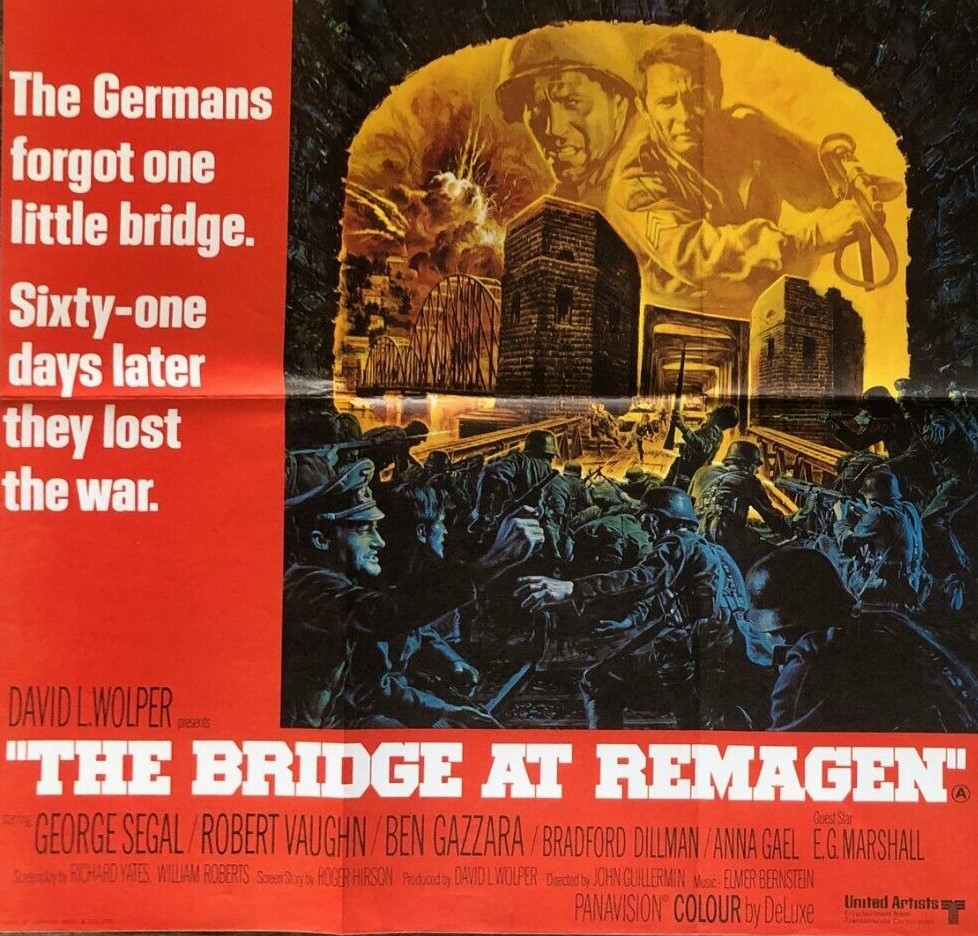
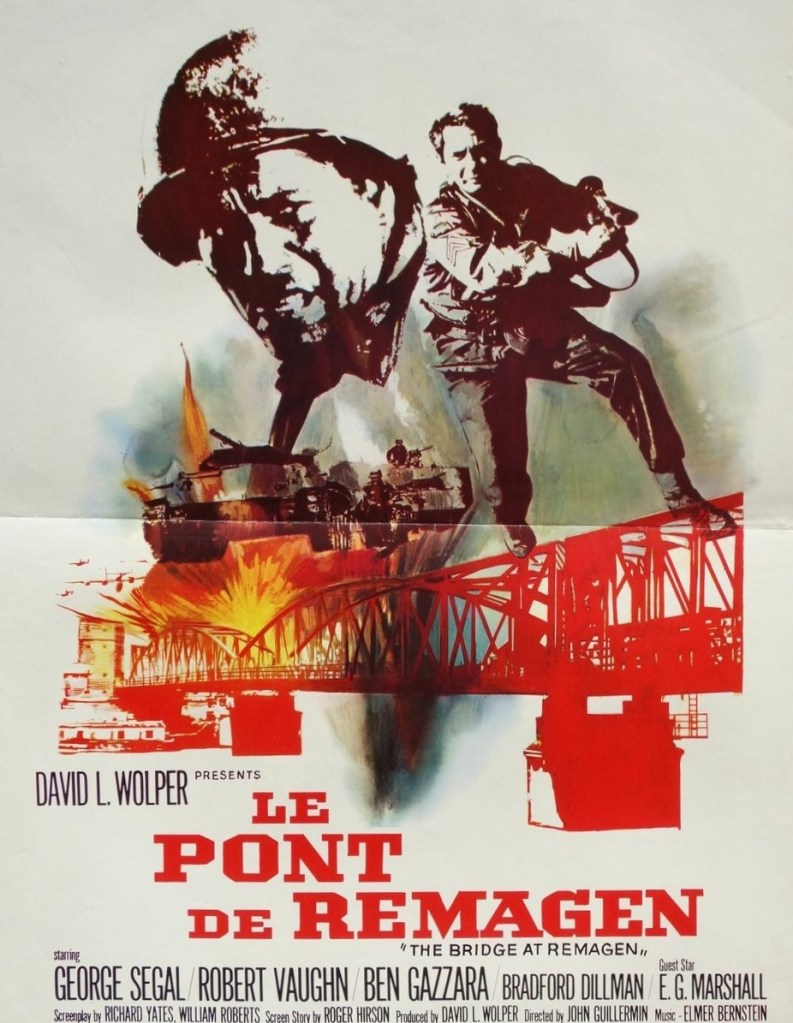
The Bridge at Remagen (1969) ****

Superior war film, somewhat underrated. Not just realistic battle scenes, but realistically weary soldiers and taking an even-handed approach to war in the manner of Battle of the Bulge (1965). The Americans want to destroy the bridge to trap 75,000 German soldiers on the wrong side of the Rhine, the German Major Krueger (Robert Vaughn) overrides his orders to also destroy the bridge and prevent the Allies with a direct route to Berlin. Instead with depleted forces – think Zulu (1963) – and hugely outnumbered he attempts to keep the bridge open so the cornered Germans can escape.

Unlike most war films there’s no time for comedy to lighten the spirits, it’s gruelling non-stop action. Even when the advance company, headed by grizzled Lt. Hartman (George Segal) find an abandoned village where the exhausted squad could rest up for a bit, they are ordered to keep going until they find more enemy to engage. Unlike the humane Krueger, the Allied high command are merciless, gung-ho Major Barnes (Bradford Dillman) and glory-hunter Brigadier Shinner (E.G. Marshall) drive their troops on, the latter not bothered how many of his men die in an attempt to blow up the bridge – “it’s a crap shoot” is the closest he gets to apology, claiming his actions will shorten the war.

When Allied attempts to blow the bridge fail and with the enemy so close Krueger has to proceed with detonating the explosives littering the bridge and that plan is also scuppered, it’s a battle to the death to secure the crossing. And the story itself is accentuated by nods to the grisly cost of war – on both sides. Heartless Sgt Gazzaro (Ben Gazzaro), whose freebooting Hartman despises, is brought up short when he kills a youth commandeered into action by Krueger in a bid to bolster his meagre outfit – barely 200 men when he expected a force of around 1600.  Krueger is sickened to see a German firing squad executing deserters, but has little sympathy for an innkeeper who has lost a son to the fighting when four million Germans are already dead.

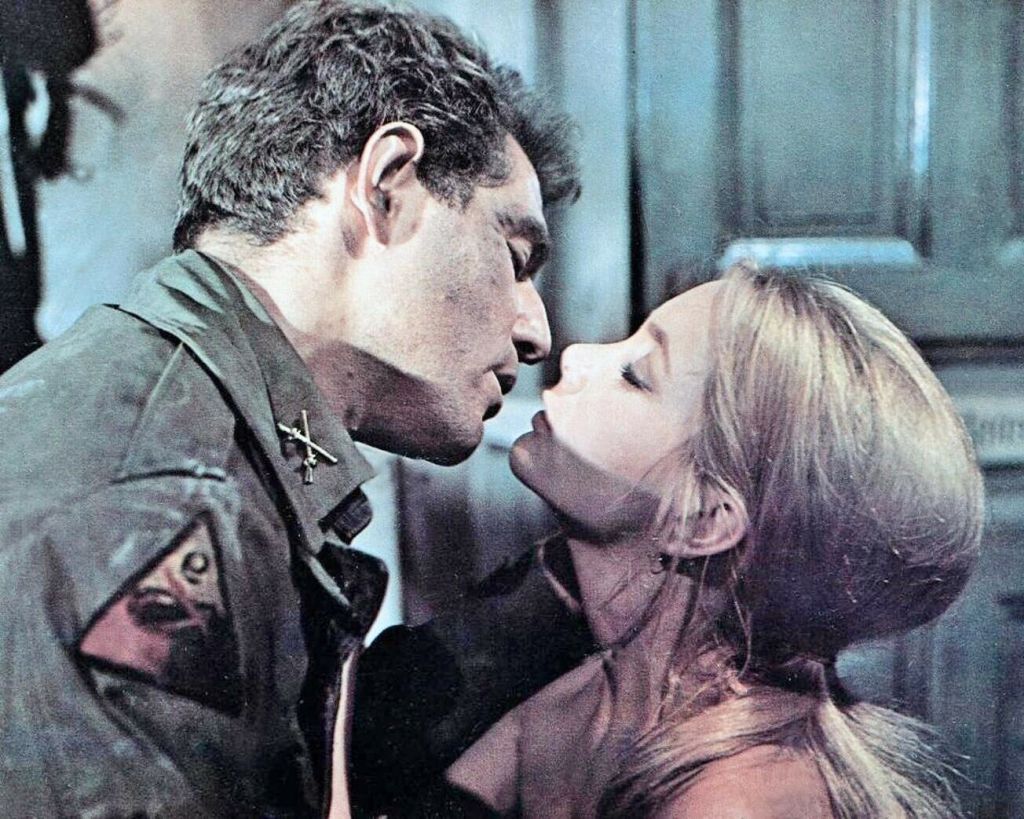
While reining in the worst excesses of Angelo, preventing him taking advantage of a captured woman (Anna Gael) and refusing himself to accept her offer of sex, Hartman does not rail (like Patton, 1970) against those of his men who succumb to pressure. Finding one soldier collapsed, he sympathizes, “sometimes it hits you like that,” and he refuses to put his men in unnecessary line of fire, prompting Barnes into almost killing him. Unlike Battle of the Bulge, however, there is no arrogant German commander (like Robert Shaw) nor complacent Americans.

The action is not only non-stop but hectic and the film begins brilliantly with tracking cameras scarcely able to keep up with American tanks barrelling along the road and aerial shots showing the destruction of another bridge over the Rhine. American tanks and German artillery exchange fire over the river. Buildings are blown out or majestically collapse (turns out these were real buildings, not mock-ups). Bridge stanchions fall in slow motion into the water. Refugees are collateral damage, the camera hardly registering a crying child or an abandoned doll.

As in the best war pictures, strategy and tactics are laid out for the audience, the American blunderbuss approach compares poorly to Krueger’s desperate attempts to utilise every advantage to the point of arming a barge in the river. Hartman and Krueger are well-matched in courage, the former thrown endlessly into action by cynical superiors, the latter, having discharged himself from hospital to fight on, landed with the task of rallying defeatist troops, and leading them into harm’s way in a manner that the American’s immediate superior, Barnes, point-blank refuses to do. Pride drives on the German, the war is almost lost, but surrender would be tantamount to humiliation. All Hartman has to fall back on is an inner core and the chain of command, soldiers obey orders.

Both George Segal (The Quiller Memorandum, 1966) and Robert Vaughn (The Venetian Affair, 1966) are well outside their acting comfort zone. Two stars whose hallmarks are cocky characters and suave charm turn into determined men who barely crack a smile. Segal has done cynical before but not to this degree and what catches the eye more is his sheer physical exhaustion. This is an early career highlight for Vaughn, rarely offered such juicy roles.

Although associated in the general audience mind for playing creepy, not to mention sleazy, characters, Ben Gazzara (Capone, 1975) had not made much impact on 1960s moviegoers, and beyond a handful of supporting roles best known to Americans for a starring role in television series Arrest and Trial (1963-1964). The general untrustworthy screen persona he would come to inhabit is given a good work-out here except for two scenes where his character takes unselfish action. Bradford Dillman, also best known for television (Court Martial, 1965-1966), portrays a largely one-dimension character lifted out of the ordinary in a couple of scenes.

E.G. Marshall (The Defenders, 1961-1965) and Peter Van Eyck (Station Six Sahara, 1963) are the opposing commanders. You can also spot Hans Christian Blech (Battle of the Bulge), Anna Gael (Therese and Isabelle, 1968), Sonja Zieman (The Secret Ways, 1961) and Bo Hopkins (The Wild Bunch, 1969).

John Guillermin (The Blue Max, 1966) directs with aplomb from a screenplay by William Roberts (The Devil’s Brigade, 1968) and novelist Richard Yates (Revolutionary Road, 2008) in his only work for the screen.

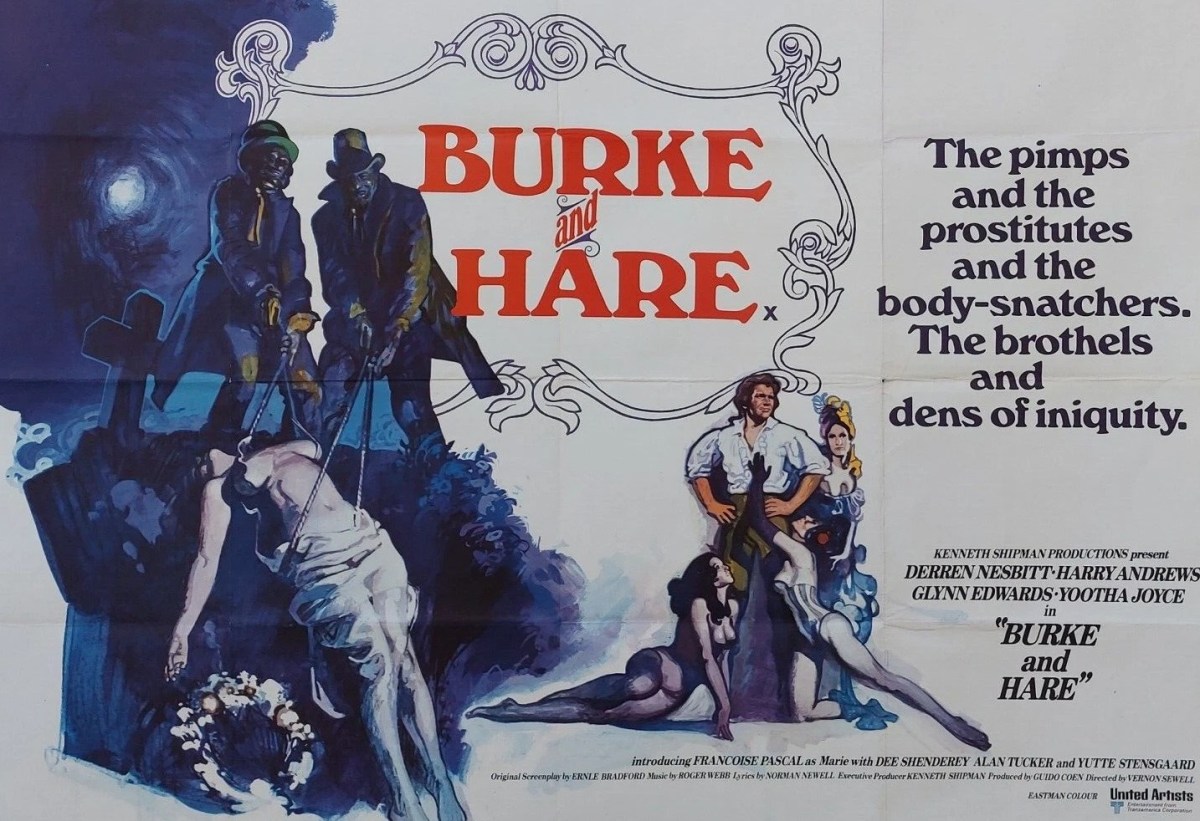
Burke and Hare (1972) **

There’s probably a thesis to be written about how Hammer subverted the traditional horror picture by inserting lashings of nudity. The studio’s female vampire trilogy, beginning with The Vampire Lovers (1970), was presumably made with an eye on attracting bigger box office rather than upending the status quo and taking the exceptionally feminist approach of making females the predators. Although in the first of the series, men were the eye candy, for the second and third it appeared to make more sense for the prey to be disrobed females, a double whammy, if you like, of female nudity.

That formula then appeared to be applied to any movie roughly in the horror genre, sometimes, as here, with just awful results. Young starlets who might previously have been expected to restrict their titillation to cleavage, were now going all-in. It helps if for no apparent narrative function you can set half the tale in a brothel and also ensure part of the attraction of such premises is voyeurism, peep-holes through which the clientele can view a couple having sex.

Two of the damsels on ample display were Francoise Pascal, hitherto one of those trapped into risque roles such as School for Sex (1969), and Yutte Stensgaard, who’s marquee value appeared to have been terminated despite all her nudity in Lust for a Vampire (1971) and now reduced to a supporting role.

Apologies for concentrating on the licentious, but the movie has little more to offer. Burke and Hare preceded Dr Jekyll as Edinburgh’s most famous villains, but it’s hard to get worked up about their activities. Audiences were inured to grave-robbing since without an steady  supply of body parts Frankenstein would have struggled to make his monsters.

The idea of people donating their bodies to medical science was hardly a hidden secret in the 1970s and the idea that you could build a movie exposing the hypocrisy of doctors seeking to use corpses for anatomy lesson seems far-fetched. There was no law against using corpses. As eminent surgeon Dr Knox (Harry Andrews) explains in supercilious tones it was not a crime to cut open a dead body.

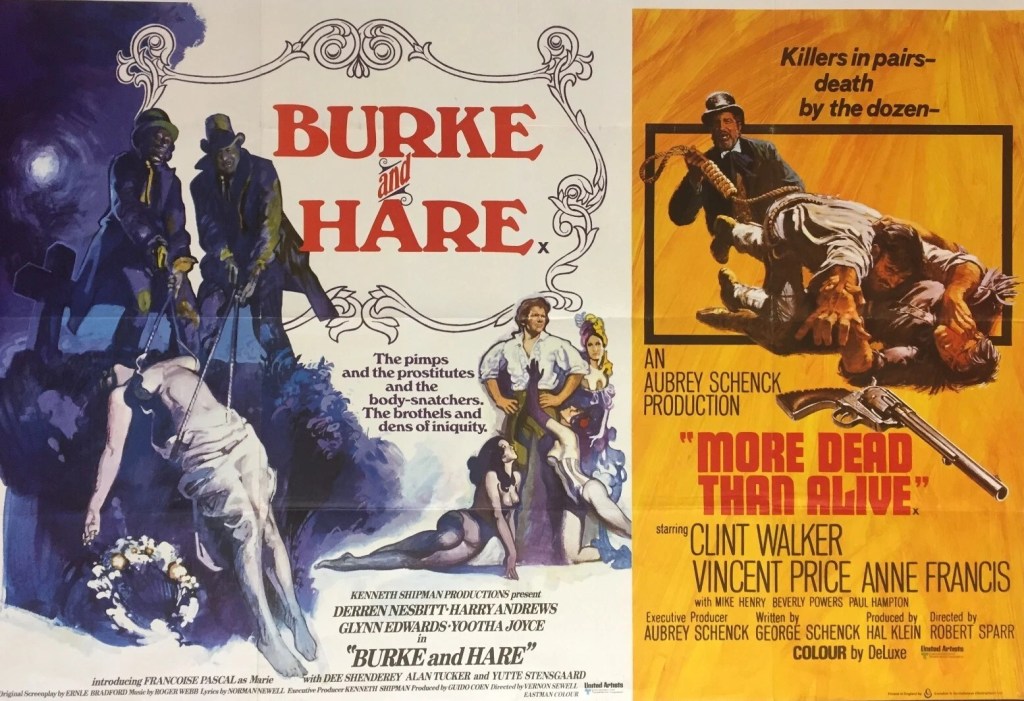
It was more customary to pair one horror film with another but since the producers didn’t have another one to hand they latched onto a western.

So we are left with our graverobbing tag team of Burke (Derren Nesbitt) and Hare (Glynn Edwards) and various other low lifes in Edinburgh in the 1820s whose main preoccupation seems to managing a Scottish accent. There’s little that’s particularly gruesome about the graverobbing and given the victims are all dead a complete lack of gore. Even the one legitimate opportunity to add frisson, the extraction of a  heart by Dr Knox during a class, is ignored.

Graverobbing, however, doesn’t supply all the needs of Dr Knox, so our pair resort to murder. That has the specific advantage of delivering fresher corpses. Suffocation is the murderer’s tool, since already slashed bodies might suggest even to Dr Knox that the corpses had met a different kind of end.

Where does the brothel fit into all this you might wonder? Is Dr Knox a regular? ‘Fraid not. For our entrance to the brothel we have to rely on sketchily-drawn medical students. Sex worker Marie (Francoise Pascal) ends up on Dr Knox’s slab after an unwelcome encounter with Burke. At some point, a little bit of detective work takes over, as Marie’s medical student lover is not satisfied with the post mortem declaring she died of alcohol poisoning.

But since you hardly care about any of these characters, it’s more like a documentary with sex and nudity thrown in.

Derren Nesbitt (Where Eagles Dare, 1968) didn’t enhance his reputation but Glynn Edwards rolled out another of his sneaky characters that provided a lifetime of supporting roles.

Directed by Vernon Sewel; (Curse of the Crimson Altar, 1968) from a script by historian Ernle Bradford making his debut.

A bit better than Orgy of the Dead (1965) but not by much.

Flesh for Frankenstein (1973) ***

What with Jessie Buckley putting on her best Joker-style smile in Maggie Gyllenhaal’s Looney Tunes version of The Bride (2026) and Oscar Isaac going as high-tech as the 19th century would allow in Guillermo del Toro’s excellent Frankenstein (2025), Paul Morrissey’s Flesh for Frankenstein now appears tame in comparison though at the time its sexuality and gore came in for severe criticism. I’m guessing it’s the campiness that finds it rated so highly among the contemporary critics, but, apart from some poor acting, there’s little in this piece that would bring it down in your estimation or provide it with a free pass.

In terms of the thematic, there are connections to David Cronenberg’s Crash (1996), and in terms of trivia (although the version I saw lacked this) it was originally shot in 3D (though without, as was usually the way with such items, tons of things thrown into the viewer’s eyes) and included an early example of the imagination of SFX genius Carlo Rambaldi (Alien, 1979).

While you might recoil at the good doctor’s right-wing tendencies and his determination to bring to life a superior species, the rest of it is surprisingly good. There’s a determined stateliness to the camerawork and the score by Claudio Gizzi (he only did another two) is as far removed from the over-the-top menace that infected Hammer and AIP versions as you can get.

I wasn’t a card-carrying member of the avant-garde back in the day any more than I am now so didn’t rush out to see this on its first appearance and probably wouldn’t have been tempted to watch it at all except that the presence of Dalila di Lazzaro from Three Men to Kill (1980) piqued my interest. In truth, she has a small part as the female of the species in the monster department.

Here, Baron Frankenstein (Udo Kier) is aiming for the double whammy of not just creating male and female monsters but of getting them to procreate and provide him with a new master race. He’s handy with a set of garden shears, lopping off heads to suit his experiment, and stitching, molding cadavers to suit his purpose, and he clearly takes perverse delight in plunging his hands – and shades of David Cronenberg’s Crash (1996) – and other parts of his body into the innards for sexual satisfaction.

If I’ve read this correctly, we’re also in incest territory, his children the offspring of his sister. Or it may well be that she’s employed for her non-existent maternal skills rather than having played a part in their birth.  It’s hard to see why he wants any more creations in his own image since the kids are as creepy as they come, voyeurs to the core, guillotining dolls, making off with any spare body parts, and with a malignancy that sets the tone for a stunning last scene.

His sister Katrin (Monique Van Vooren) has a degree in hypocrisy, taking a moral high tone with villagers she catches having sex while recruiting lusty local stud Nicholas (Joe D’Allesandro) for her own bed. The Baron’s assistant Otto (Arno Jurging) is from the Marty Feldman (Young Frankenstein, 1975) school of eye-popping. The only flaw in Frankenstein’s plan is he hasn’t taken into account sexual preference, since Nicholas’s buddy Sacha (Srdjan Zelenovic),selected to supply a head and brain for his male monster, is more interested in men than women, so despite the best efforts of the female monster (Dalila di Lazzaro) his experiment is doomed to failure.

Most movies in this subgenre exist in a moral vacuum, beyond someone taking vengeance on the horror-meister, but here Sacha not only has no interest in sex but he’s so appalled at what he has become thanks to Frankenstein that he wants to die and is so scandalized by the baroness’s attempts to seduce him that he suffocates her.

For the most part, this is restrained, although over-acting is endemic, and the science as convincing as in the Del Toro version. The gore and sex would scarcely trouble a contemporary audience.

The climax is just superb. With corpses littering the floor, including that of the Baron and his creations, and Nicholas hanging from the ceiling, the kids each pick up a scalpel and begin to lower the captive, leaving the audience to guess the rest.

Any inherent campiness passed me by and I suspect that impact has faded with time. What we’re left with is an intriguing well-directed entry into the canon.

Not sure why Joe Dallesandro (Lonesome Cowboys, 1968) takes top billing,  aside from his beefcake potential and the central role he played in the Andy Warhol Factory, given he has a small part. Like Klaus Kinski, Udo Kier (The Salzburg Connection, 1972) has a cult following, and the freedom to overact as much as he likes.

Beside lending his name to the venture for publicity purposes, Andy Warhol played no part. The direction by Paul Morrissey (Heat, 1972) has, I thought, considerable distinction especially the camera movement and the music. He wrote the screenplay.

Surprisingly good.

Discover WordPress

A daily selection of the best content published on WordPress, collected for you by humans who love to read.

The Atavist Magazine

by Brian Hannan

WordPress.com Blog

News, Tips & Website Tutorials