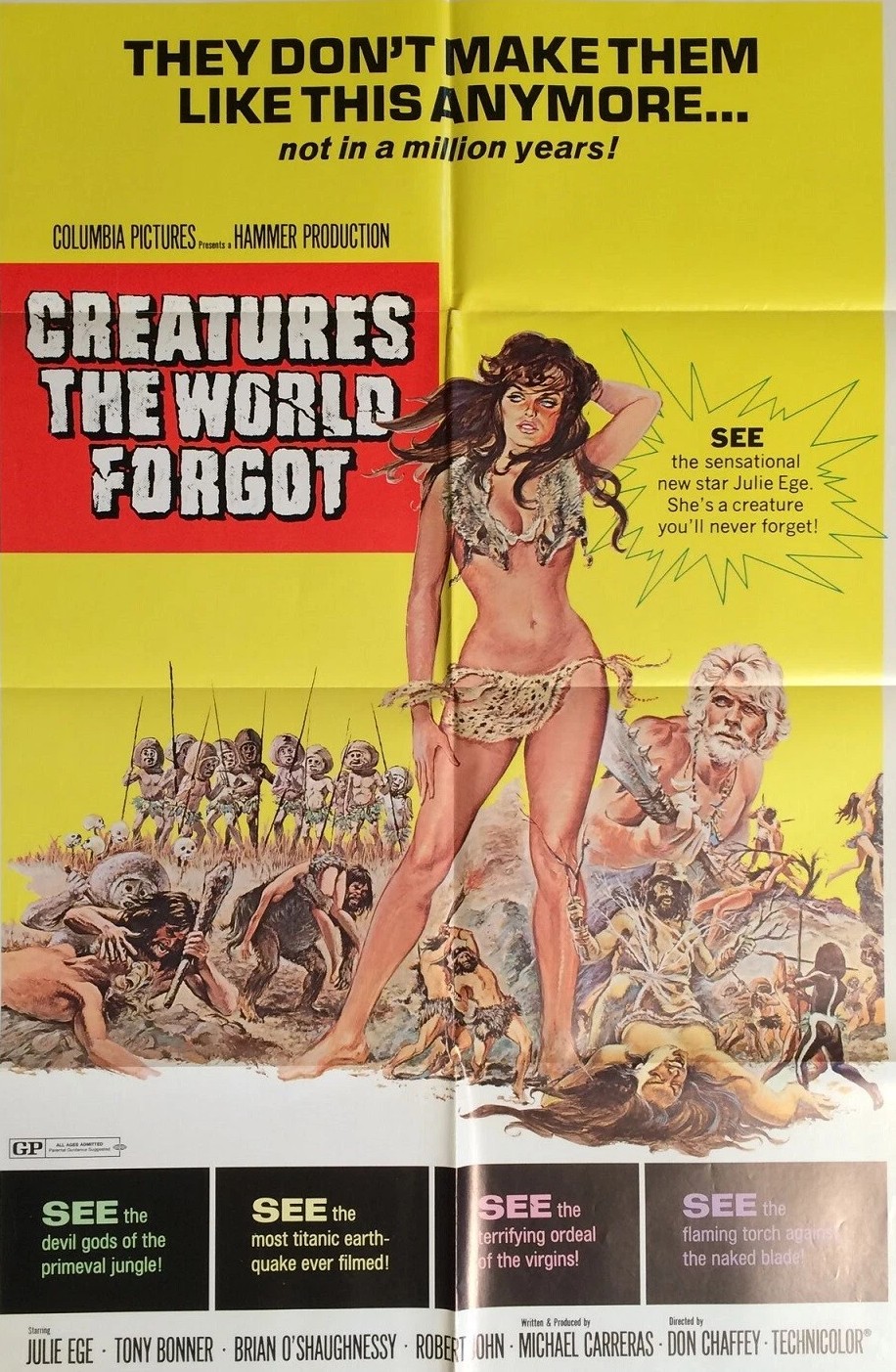
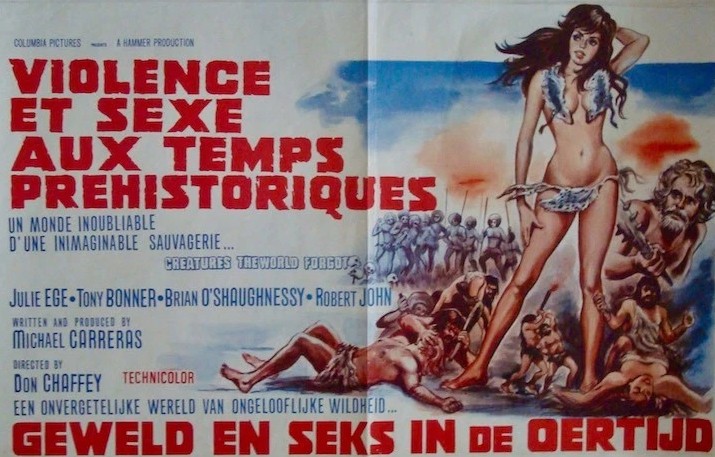
Remove the minimal salacious elements (“Violence and Sex in Prehistoric Times” was the come-on for French audiences). Ignore the fact that there are few creatures to speak of (a bear, some warthogs and gazelles aren’t exactly going to terrify the audience). Set aside that denoted star Julie Ege (Every Home Should Have One, 1971) doesn’t appear until about halfway through.
Don’t bother, either, looking for that apparently indispensable item of female prehistoric attire – the fur bikini. Not a T Rex in sight and none of the Ray Harryhausen stop-motion animation that lit up previous forays into this world. And you’re left with a surprisingly satisfying study of the ethnology of ancient civilizations.
There’s no dialog, nor subtitles for that matter to elucidate what’s going on, communication limited to grunts or, as likely, fists. Fighting – men vs men and women vs women – appears the most common pleasure. Although there’s also some primitive dancing. You’ve got a witch doctor but no idea what makes her so powerful.
The volcanic eruption that kicks off the narrative, forcing one tribe to search for another home, leading to unwelcome incursions into another tribe’s territory, is the least successful element although the subsequent earthquake is well done.
Outside of conflict and travel, what you’re left with is an interesting (if possibly inaccurate) taste of prehistoric life. Fall down a sand dune and you’ll die because you can’t scramble back up. Take on any horned beast and it’s likely their horns will tear you apart. If you can’t kill a gazelle, you’re going to have to make do with scorpions, snakes and rats. You certainly can’t alleviate your diet by growing anything, the land too poor and the notion of farming yet to revolutionize the world. Occasionally, you can protect yourself by dropping weighted spears from trees on your enemy.
The narrative roams around as much as the tribe. We kick off with a battle for power after a leader dies. Someone gives birth to twins, one easily recognizable by a scar on his chest. So then we jump to them as warring teenagers, fighting each other as much as trying to gain their father’s attention. The dark-haired one (Robert John) has more of the sheer physicality required to survive, the blond one (Tony Bonner) has more upstairs, capable of lassoing a porcupine for the sheer pleasure of developing his skills.
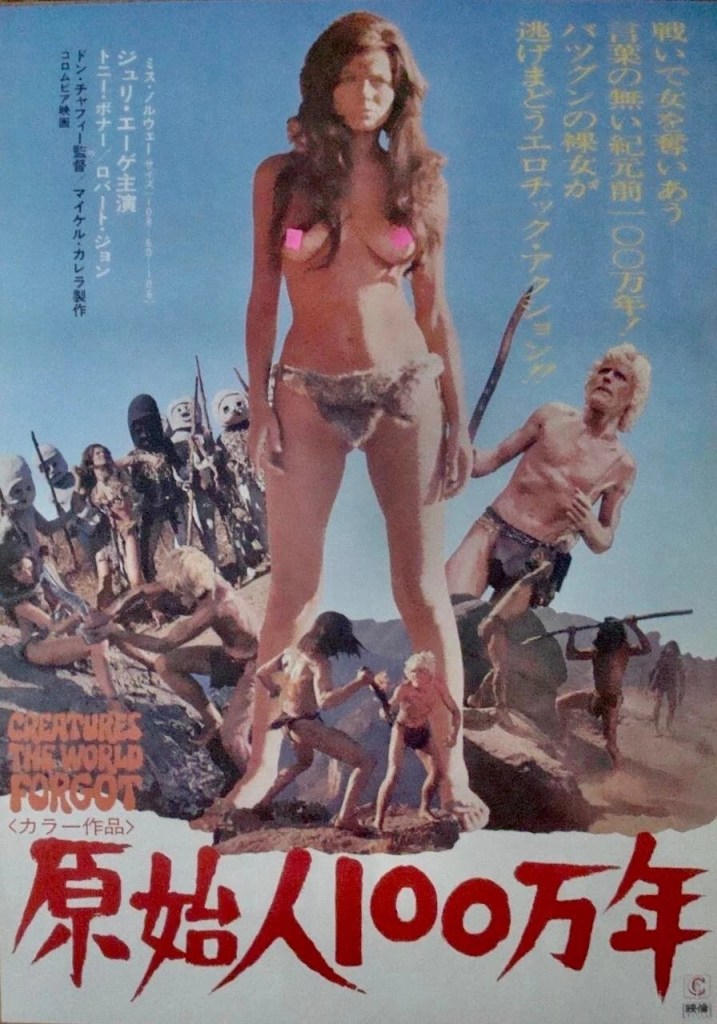
Then they’re grown up, and the blond one can trap warthogs using a net while the other, with less accurate spear-throwing, can’t catch anything. Eventually, they are battling over a deaf mute, who would ordinarily be killed at birth but survives due to the timely intervention of lightning, which is taken as a sign. Seduction isn’t on the cards either, and the dark-haired one attempts to rape the deaf mute (Marcia Fox).
She escapes but needs rescued from another tribe. That leads to the major action of the picture, a big battle in caves. The blond kills the enemy chief and takes as his reward the chief’s daughter (Julie Ege). That enrages the dark one who kidnaps the girl, planning to burn her on a pyre. The ending is pretty confusing, involving a python and the dark arts.
But take away the physical distractions of a Raquel Welch bursting out of a fur bikini and various monsters causing chaos and still there’s enough, almost in docu style, to maintain the interest.
Director Don Chaffey (One Million Years B.C., 1966) appears liberated by the focus being on ordinary mortals rather than sex symbols or Harryhausen. There’s a feeling of “what would David Lean do” when confronted with stark landscape or desert and here the composition is particularly good. Putting the focus on day-to-day survival provides all the narrative drive required. Beyond fairly basic characterization, there’s little to distinguish the characters.
You get the impression that if you edited out all the commotion and rivalry you might be left with an even better picture in the vein of those documentaries Hollywood used to churn out about foreign civilizations. This isn’t darkest Africa or darkest anywhere, the sun’s too strong an influence for that.
This was the final film in Hammer’s prehistoric quartet, whose main aim appeared to be to elevate the work of Harryhausen or give a rising female star a push into becoming a sex symbol, posters of whom could alleviate the drab lives of teenagers worldwide. While Harryhausen burnished his credentials, apart from Raquel Welch, neither Martine Beswick (Prehistoric Women/Slave Girls, 1967) nor Victoria Vetri (When Dinosaurs Ruled the Earth, 1970) made the grade on the marquee. Written by producer and Hammer head honcho Michael Carreras (The Lost Continent, 1968).
You might be surprised to find how engrossing a prehistoric movie can be minus the fur bikini or Harryhausen.

