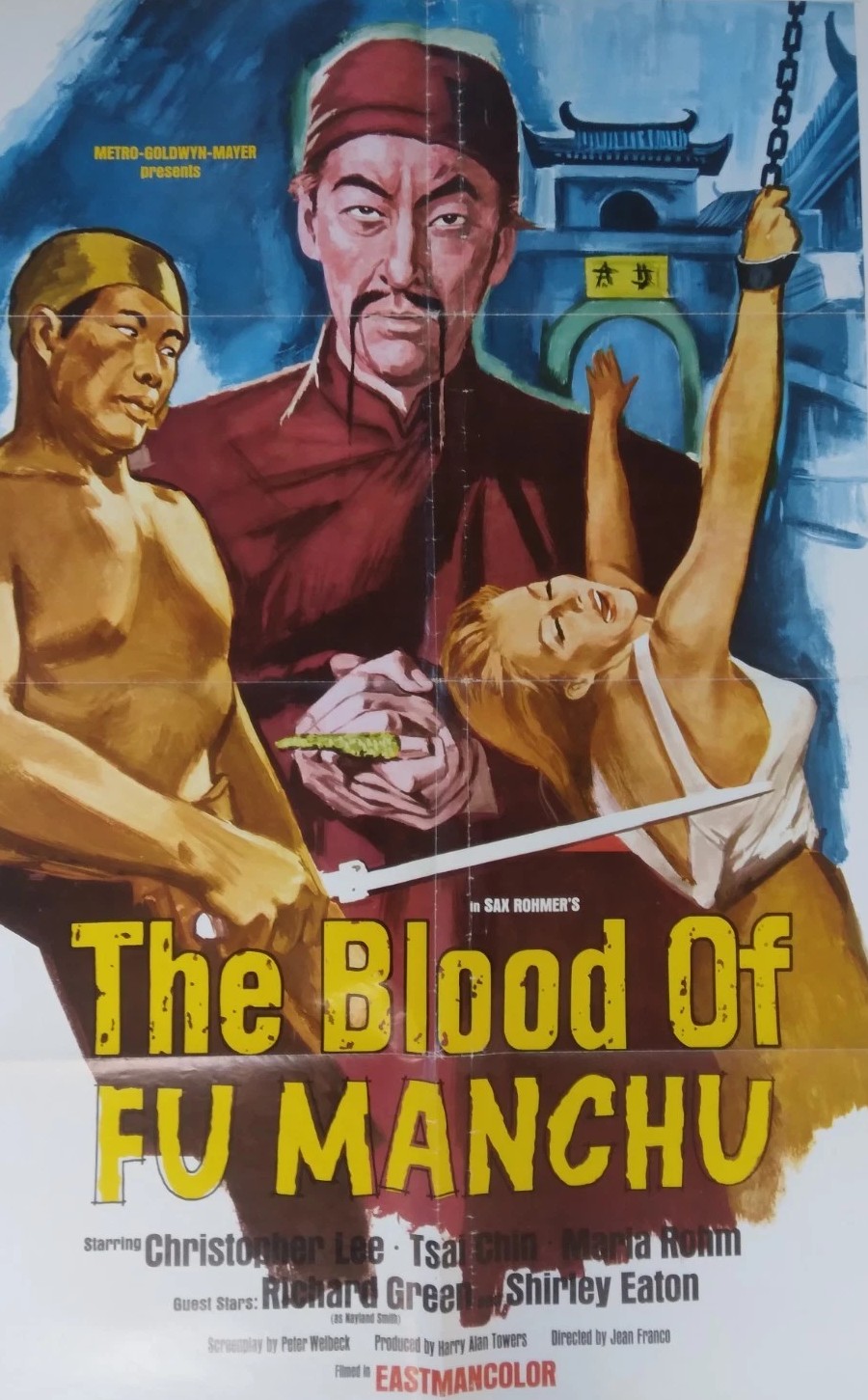
The Blood of Fu Manchu / Kiss & Kill (1968) **

Three stories in one, except only one tale remotely holds our interest. So what compelled producer Harry Alan Towers and director Jess Franco to sideline the titular character and devote more time to a young explorer Carl Janseon (Gotz George) and bandit Sancho Lopez (Ricardo Palacios). You could probably guess that the physical involvement of Fu Manchu (Christopher Lee) would be in any case limited once you grasped the crux of the narrative which saw ten girls sent out into the big wide world to kill his ten most hated enemies. You’ll probably be surprised to learn that he had only ten major enemies, but since one of them is his old nemesis Nayland Smith (Richard Greene), then you can be sure that that aspect is going to suck up a good deal of what time remains after the subplots concerning the explorer and the bandit.

 Which is a shame because neither explorer not bandit employ the kid of evil little grey cells that would allow them to come up with a plot that any of the James Bond villains would be proud of in their bids for global domination. Fu Manchu has located an ancient poison which is transmitted by women in the form of a kiss. It originates in certain snakes and although the women are “kissed” by the snakes, they are apparently impervious to its venom, so the first gender-specific poison in history.
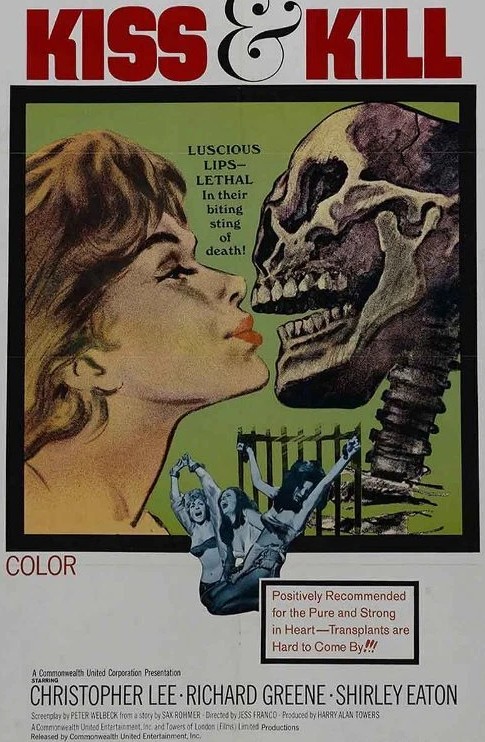
And that’s about it. As usual Towers has rounded up a bevy of young beauties, no doubt sold on the idea that he’s going to turn them into the next big female star, as carriers of the deadly poison. Not all are so keen on the idea, but since he’s got them chained by the neck in a Brazilian cave that passes for his stronghold and with his daughter Lin Tang (Tsai Chin) to threaten them with torture, it’s not surprising they are complicit.

In any case the female assassins are one-trick ponies. The minute they accomplish their deed, they are bumped off. Smith is the first victim (apart from a prisoner selected to demonstrate the efficacy of the poison) but he doesn’t die immediately. Instead he is struck blind, although he is aware he hasn’t got long to live unless an antidote can be found.

Naturally, that puts him on the track of Fu Manchu and, of course, into sudden danger. The Fu Manchu-Nayland Smith had proved a decent cinematic tug-of-war for three previous episodes beginning with  The Face of Fu Manchu (1965), so it was somewhat surprising that tension was diminished by spending so much time playing up explorer and bandit, especially as the latter is determined to play out all the cliches, including laughing like a hyena.

There is some occasional visual humor such as when the bandits go on the rampage and the crew emerge from bandits bearing such prizes as a bishop’s mitre and when a governor, having imprisoned Jansen, suggests they while away their time with a game of chess.
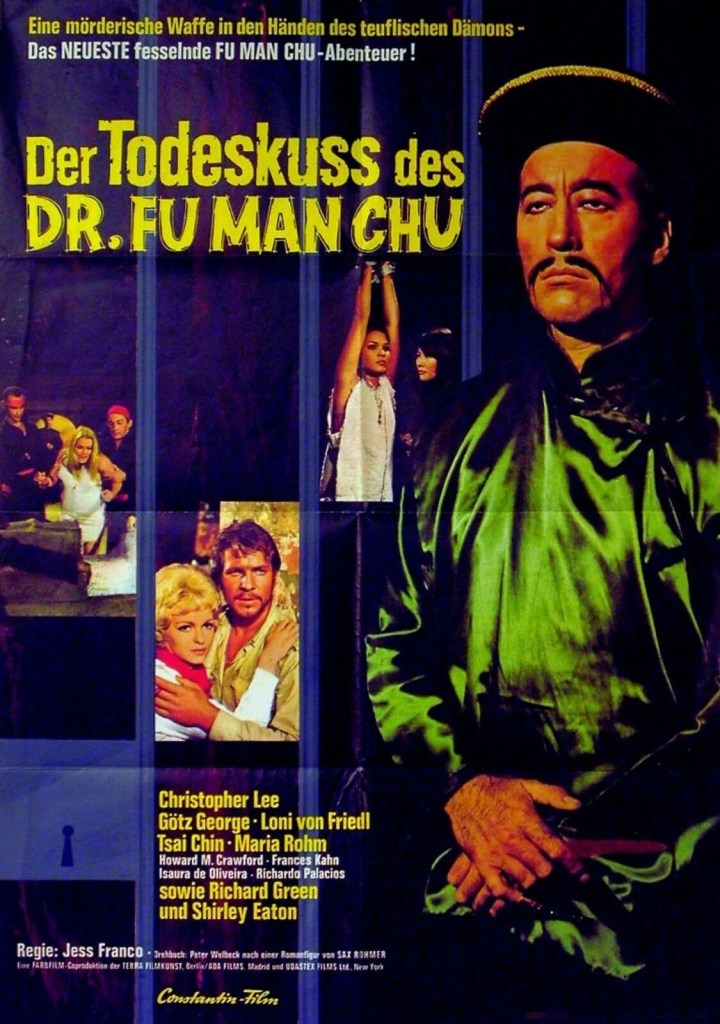
It’s odd that part of the disappointment for certain viewers in this opus is the lack of trademark Jess Franco sleaze. There’s barely any nudity and although the girls are kept in prison (until released to wreak havoc) there’s none of the tawdriness of WIP epics such as his 99 Women (1969) which is replete with brutality and sex.

Despite the cultural appropriation, Christopher Lee (The Devil Rides Out, 1968) is, as ever, solid as Fu Manchu, speaking in clipped tones and towering over everyone else, though his main role appears to be to deliver exposition, explain the foul plot and its consequences and so on. It’s left up to Tsai Chin (You Only Live Twice, 1967) to carry the sadism.

Richard Greene (Sword of Sherwood Forest, 1960) does his best in a role of declining returns. You might spot among the cast Towers’ wife Maria Rohm (Five Golden Dragons, 1967) and Shirley Eaton (The Girl from Rio, 1969).

Of the women expecting a major career break, Loni von Friedl had scores of parts including Doppelganger/Journey to the Far Side of the Sun (1969). But Frances Khan only enjoyed three more roles and or Isaura de Olivera this was the beginning and end of her movie career.

Written as usual by Peter Welbeck (Five Golden Dragons) – aka Harry Alan Towers – and Franco based on the novels of Sax Rohmer.

Promising idea ruined.

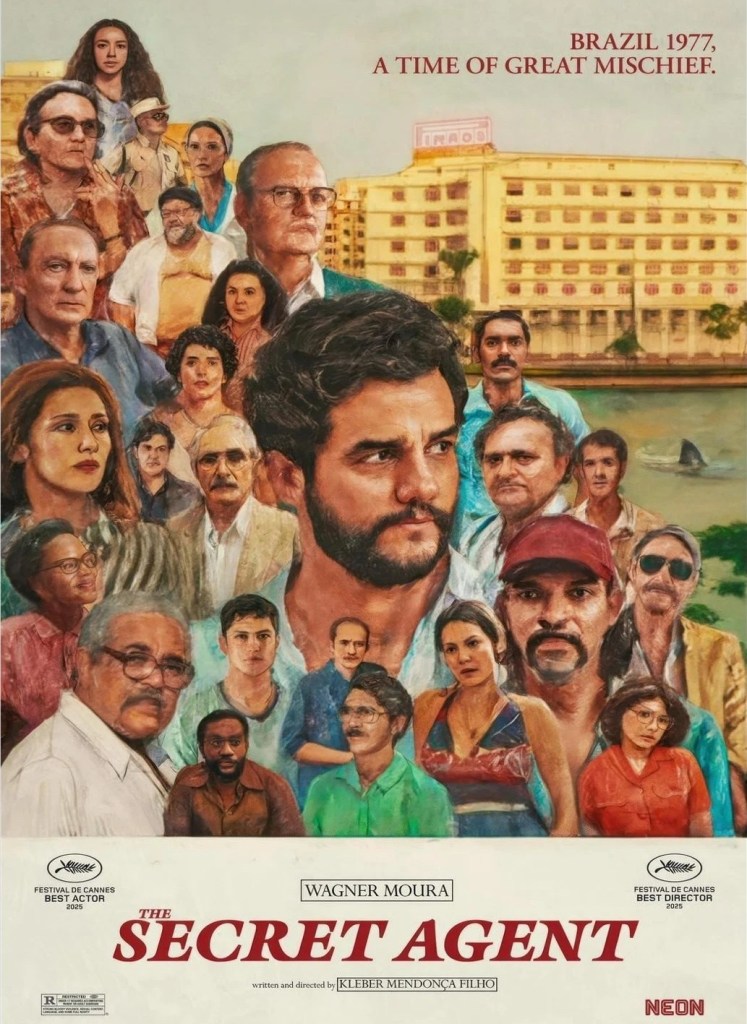
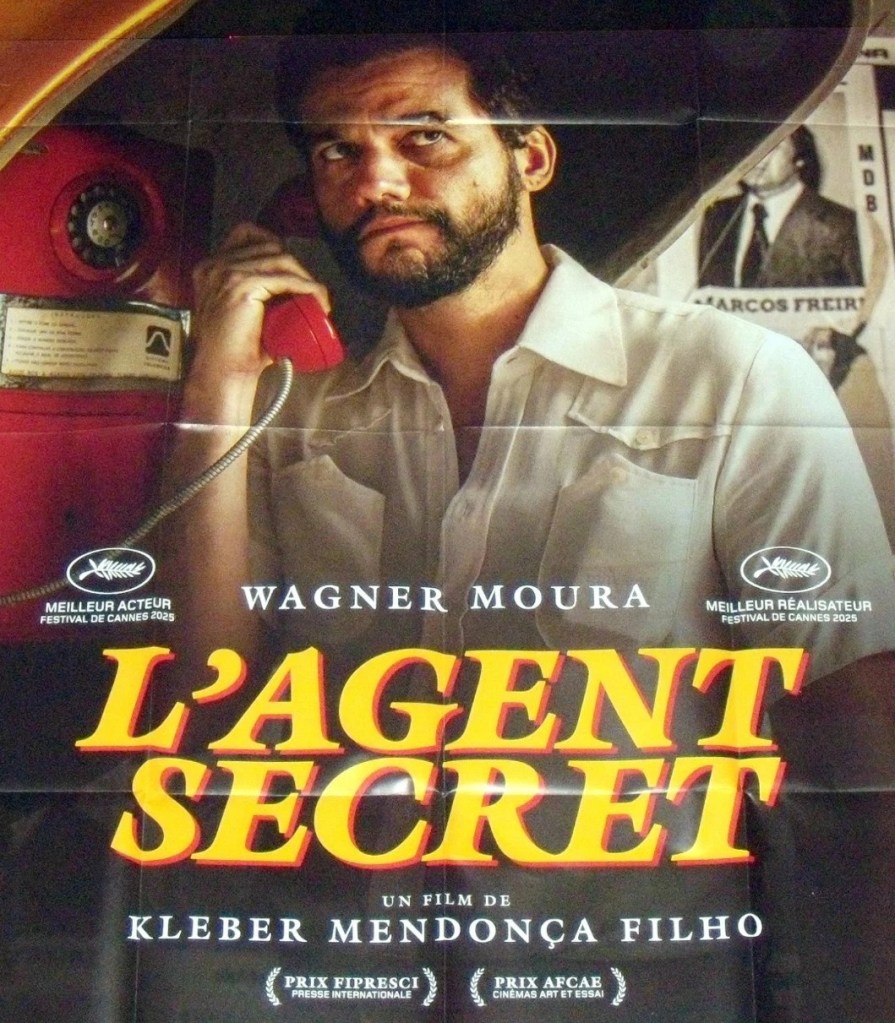
The Secret Agent (2025) ****

Now that publicists have hijacked film festivals in an effort to sell the public an unending stream of over-praised self-indulgent rubbish, it’s refreshing to come across a foreign film that is innovative, interesting and not over-acted. This meshes a thriller-like quality with the kind of surreal diversions that used to indicate movies not following the Hollywood dictat.

And while the storyline concentrates on brutal regimes and people persecuted for no reason except the authorities can get away with it, the potentially somber tone is undercut by homages to La Dolce Vita (1960) and Cinema Paradiso (1988). With time jumps, the movie takes its sweet time coming to a conclusion and when it does so, there’s an unexpectedly emotional twist.

It’s set in Brazil in 1977, but I have to confess I know little about the politics of the period except, judging by what goes on here, corruption is rife and justice is compromised. We begin with our hero, college professor Marcelo (Wagner Mauro) being shaken down at a petrol station by a pair of cops, who eventually are happy with just a packet of cigarettes as their booty. The cops pointedly ignore the corpse rotting in the sunshine.

The widowed Marcelo, on the run and using a pseudonym, is driving to Recife to reunite with his son who is living with his grandfather. Marcelo hides out in a house full of refugees, who are equally in danger. Marcelo has fallen foul, it eventually transpires, of an industrialist who wants to steal his research. Said businessman has despatched two hitmen to deal with this “transgressor” and the hitmen in turn hire a cheaper hit man to carry out the deed.

The surreality emerges when a human leg found in the belly of a shark attracts greater headlines than normal because the country is in the grip of Jaws-fever. The leg takes on a life of its own when it’s stolen from the mortuary and used to terrorize gay men making out in a public park. Attitudes to death are equally morbid, the cops taking bets on how high the death toll will run at the annual carnival.

The grandfather is a projectionist in the local cinema so we are treated to mentions of Jaws (1975), The Omen (1976) and King Kong (1976). Marcelo makes contact with the resistance who are trying to help him get out of the country. But he’s also landed a job in an ID unit where, on the side, he can hunt for information about his mother.

The title is ironic. There’s nothing dangerous about Marcelo and he doesn’t have secrets that can topple a regime, nor is he spying for a foreign power. But he does have to behave like a secret agent just to survive, dodging about, hiding in plain sight, making contact via codes and signals.

You are led to believe also that his every word is being taped and that there are collaborators only too ready to hand him over. But in fact, the story jumps around to the present day and a student doing research on the period.

Marcelo isn’t much of a hero in the normal Hollywood manner. He might be something of a lothario in the James Bond manner but he’s just trying to survive and get on better terms with his young son. His father-in-law, with some justification it appears, accuses Marcelo of hypocrisy – he’s grieving for a wife to whom he was serially unfaithful.

And it’s very honest on the emotional scale. Marcelo discovers that his mother, who was little more than a slave, was impregnated by a landowner when she was 14. When the present-day student confronts Marcelo’s grown-up child with information about his “heroic” father, hounded by a brutal regime, the son doesn’t want to know – he was brought up by his grandfather and that’s more important than a man he rarely saw and to whom he has little emotional connection.

So on the one hand it’s the kind of political thriller that many critics have viewed as holding up a light on brutal regimes around the world, but it’s not that kind of political thriller. It’s at its best when exploring ordinary life, and the way that ordinary people are treated by bad actors.

Wagner Moura (Civil War, 2024) is deservedly up for an Oscar but the movie is people with highly believable characters. Writer-director Kleber Mendonca Filho (Pictures of Ghosts, 2023) makes no sweeping political points but by concentrating on the small scale he more than compensates.

Thoughtful and enjoyable.

Discover WordPress

A daily selection of the best content published on WordPress, collected for you by humans who love to read.

The Atavist Magazine

by Brian Hannan

WordPress.com Blog

News, Tips & Website Tutorials