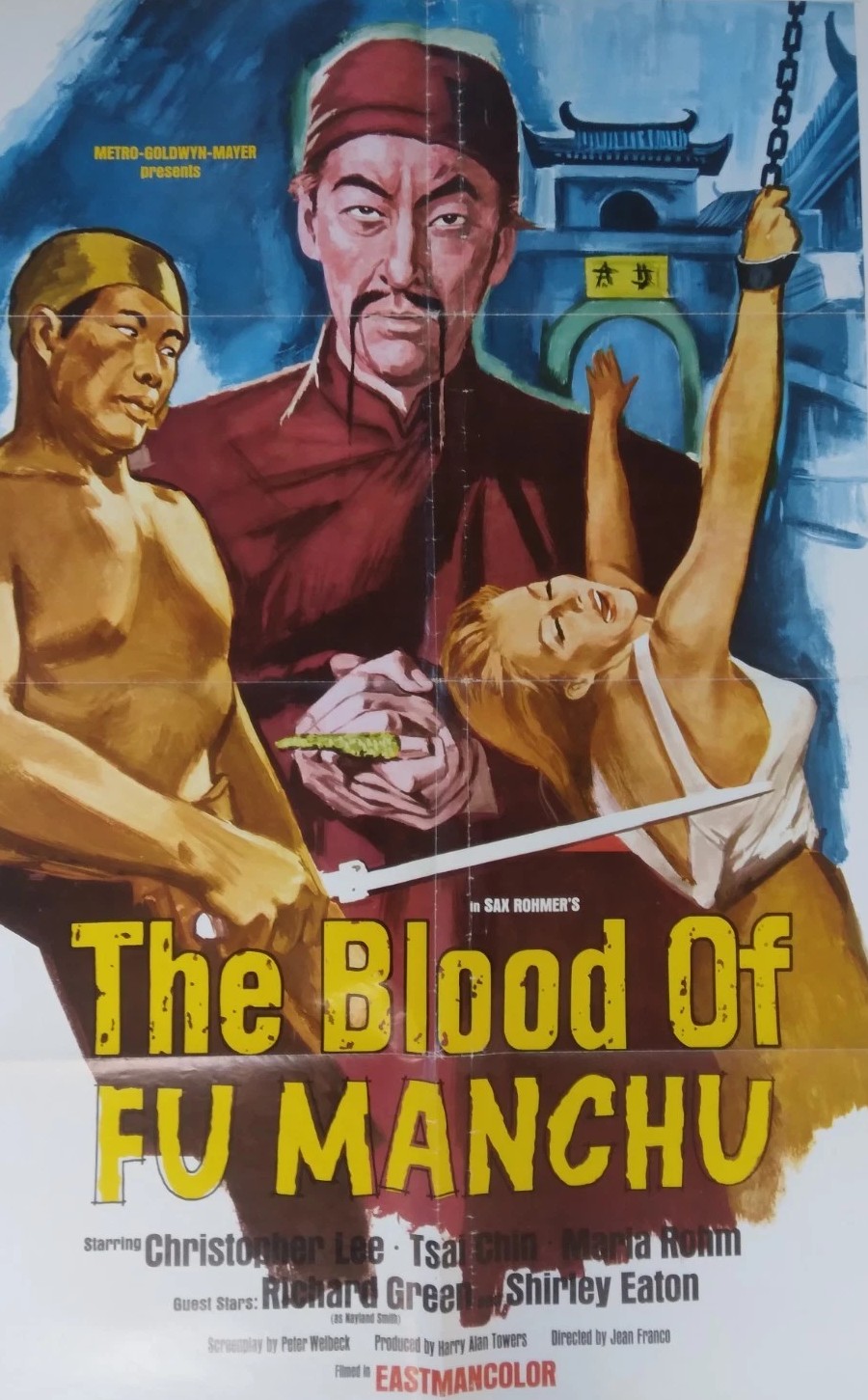
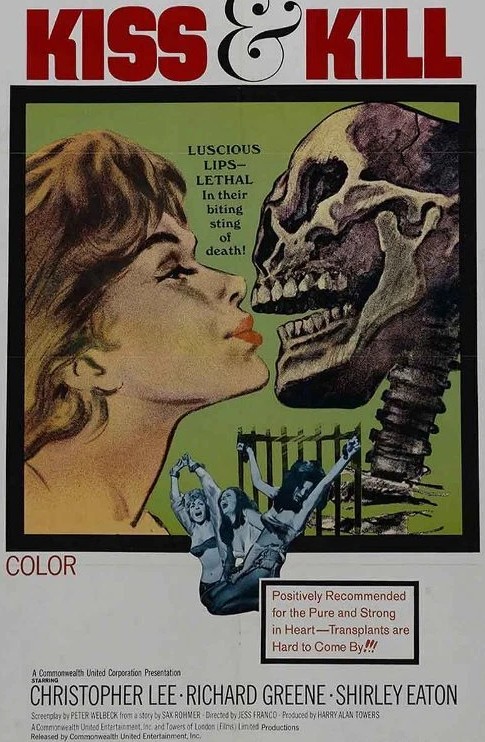
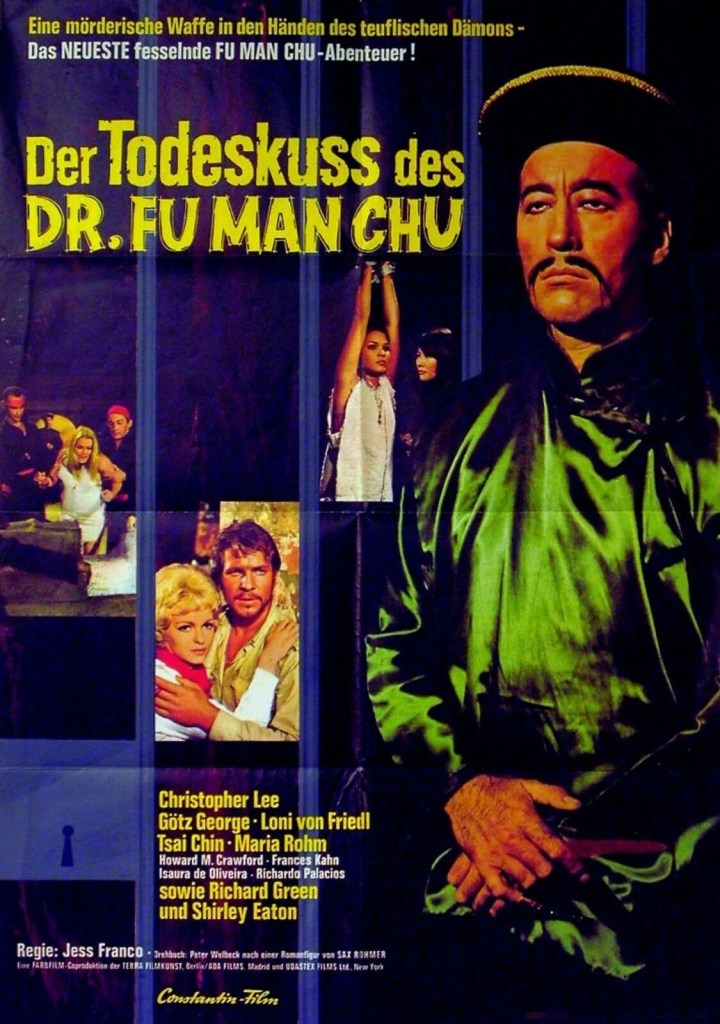
The Blood of Fu Manchu / Kiss & Kill (1968) **

Three stories in one, except only one tale remotely holds our interest. So what compelled producer Harry Alan Towers and director Jess Franco to sideline the titular character and devote more time to a young explorer Carl Janseon (Gotz George) and bandit Sancho Lopez (Ricardo Palacios). You could probably guess that the physical involvement of Fu Manchu (Christopher Lee) would be in any case limited once you grasped the crux of the narrative which saw ten girls sent out into the big wide world to kill his ten most hated enemies. You’ll probably be surprised to learn that he had only ten major enemies, but since one of them is his old nemesis Nayland Smith (Richard Greene), then you can be sure that that aspect is going to suck up a good deal of what time remains after the subplots concerning the explorer and the bandit.

 Which is a shame because neither explorer not bandit employ the kid of evil little grey cells that would allow them to come up with a plot that any of the James Bond villains would be proud of in their bids for global domination. Fu Manchu has located an ancient poison which is transmitted by women in the form of a kiss. It originates in certain snakes and although the women are “kissed” by the snakes, they are apparently impervious to its venom, so the first gender-specific poison in history.
And that’s about it. As usual Towers has rounded up a bevy of young beauties, no doubt sold on the idea that he’s going to turn them into the next big female star, as carriers of the deadly poison. Not all are so keen on the idea, but since he’s got them chained by the neck in a Brazilian cave that passes for his stronghold and with his daughter Lin Tang (Tsai Chin) to threaten them with torture, it’s not surprising they are complicit.

In any case the female assassins are one-trick ponies. The minute they accomplish their deed, they are bumped off. Smith is the first victim (apart from a prisoner selected to demonstrate the efficacy of the poison) but he doesn’t die immediately. Instead he is struck blind, although he is aware he hasn’t got long to live unless an antidote can be found.

Naturally, that puts him on the track of Fu Manchu and, of course, into sudden danger. The Fu Manchu-Nayland Smith had proved a decent cinematic tug-of-war for three previous episodes beginning with  The Face of Fu Manchu (1965), so it was somewhat surprising that tension was diminished by spending so much time playing up explorer and bandit, especially as the latter is determined to play out all the cliches, including laughing like a hyena.

There is some occasional visual humor such as when the bandits go on the rampage and the crew emerge from bandits bearing such prizes as a bishop’s mitre and when a governor, having imprisoned Jansen, suggests they while away their time with a game of chess.
It’s odd that part of the disappointment for certain viewers in this opus is the lack of trademark Jess Franco sleaze. There’s barely any nudity and although the girls are kept in prison (until released to wreak havoc) there’s none of the tawdriness of WIP epics such as his 99 Women (1969) which is replete with brutality and sex.

Despite the cultural appropriation, Christopher Lee (The Devil Rides Out, 1968) is, as ever, solid as Fu Manchu, speaking in clipped tones and towering over everyone else, though his main role appears to be to deliver exposition, explain the foul plot and its consequences and so on. It’s left up to Tsai Chin (You Only Live Twice, 1967) to carry the sadism.

Richard Greene (Sword of Sherwood Forest, 1960) does his best in a role of declining returns. You might spot among the cast Towers’ wife Maria Rohm (Five Golden Dragons, 1967) and Shirley Eaton (The Girl from Rio, 1969).

Of the women expecting a major career break, Loni von Friedl had scores of parts including Doppelganger/Journey to the Far Side of the Sun (1969). But Frances Khan only enjoyed three more roles and or Isaura de Olivera this was the beginning and end of her movie career.

Written as usual by Peter Welbeck (Five Golden Dragons) – aka Harry Alan Towers – and Franco based on the novels of Sax Rohmer.

Promising idea ruined.

Ten Little Indians (1965) ***

This is more like it. Classic Agatha Christie mystery told in classic fashion but devoid of either of her major sleuths, Hercule Poirot or Miss Marple, and set in the grander equivalent of the country house locale that had become something of a trademark. Here it’s the kind of castle perched atop a mountain, accessible only by cable car unless you have mountaineering skills, that you would need the combined services of Clint Eastwood and Richard Burton to affect a rescue, and as with Where Eagles Dare (1968) the conditions are distinctly wintry.

Ten strangers, including the two servants, have been invited to this retreat by the mysterious Mr Owen. They soon learn they are cut off, telephone lines down, cable car out of commission for a couple of days, nearest village a straight drop 15 miles down a perilous cliff.

All they have in common, as they discover via a taped message delivered by their host, is that they all got away with murder or at the very least a dubious death. There is a private eye on hand, former cop Blore (Stanley Holloway), but he’s lacking in the little grey cells that Poirot put to such clever use in such circumstances. So, like a troupe of actors let down by some stage entrepreneur, they have to get the show on the road themselves, a combined effort to solve the problem.

Not so much why they are gathered here, but why they keep on getting bumped off, and rather in the fashion of the titular song. The movie business wasn’t awash with serial killers though this decade would see nascent interest in this sub-genre, witness Psycho (1960) and The Boston Strangler (1968). But Ms Christie mysteries never really seemed to get going until the death toll had reached multiple figures.

The good element of this kind of movie with a large cast is that each character gets a moment in the sun, here that spotlight largely concerned with what crime they committed for which they were never truly punished. Pop singer Mike (played by pop singer Fabian) gets the ball rolling, explaining that his only punishment for killing someone while driving under the influence was a temporary withdrawal of his license.

And so it goes on, everyone wondering who will be next to be despatched and going from the initial conclusion that Owen is responsible and is hidden somewhere in the house to the obvious one that Owen is one of them. I have to confess I’m easily gulled by the murder mystery and I hadn’t reached that conclusion myself.

The movie’s not necessarily filled with that kind of twist – although there certainly are a good few, some people not as guilty as they might appear, not quite who they appear to be –  more you glancing at the cast list and wondering, by dint of billing or box office pull, who will be next for the chop and unless the director has got the Hitchcock vibe it’s not going to be one of the leads.

So it’s a choice of Hugh Lombard (Hugh O’Brian), secretary Ann Clyde (Shirley Eaton), actress Ilona Bergen (Daliah Lavi), General Mandrake (Leo Genn), Judge Cannon (Wilfrid Hyde White), Dr Armstrong (Dennis Price) and the aforementioned Blore plus servants the Grohmanns (Marianne Hoppe and Mario Adorf). And this isn’t your standard serial killer either with a constant modus operandi that will eventually, through standard detection, trap him or her. Instead, variety is the key. Death by fatal injection, knife, poison, slashed rope.

As the numbers whittle down, and you even feel sorry for the actions of some, the actress, for example, whose husband committed suicide when she left him, the tension mounts. You won’t be on the edge of your seat because there are just too many characters involved for you to become overly concerned with their plight but it’s still has you on the hook. You do want to know whodunit and why and you can be sure Ms Christie, as was her wont, will have some clever final twist.

At least, unlike the later variations on the genre, nobody’s been bumped off because they are too fond of sex, and the violence itself is restrained, almost dignified, and there’s no sign of gender favoritism.

All in all, entertaining stuff, though since by now this kind of murder mystery, given we’ve been through various iterations of Poirot – Albert Finney, Peter Ustinov, Kenneth Branagh et al, not to mention numerous Miss Marples – a lot of this feels like cliché (though that’s a bit like a contemporary audience considering John Ford’s Stagecoach old hat, not realizing this was where many of those western tropes were invented or polished to a high level). And I had to say I had a sneaky hankering for some of the out of left field goings-on of The Alphabet Murders (1965).

Sad to see Hollywood not taking advantage of Daliah Lavi’s acting skills, under-estimated in my opinion after her terrific work in The Demon (1963) and The Whip and the Body (1963). But then this wasn’t Hollywood calling but our old friend producer Harry Alan Towers (Five Golden Dragons, 1967) who specialized in dropping a biggish American name into a B-list all-star-cast.

George Pollock, who helmed this decade’s four Miss Marple movies, enjoys keeping the mystery alive without resorting to a central know-it-all. Everyone cast does what they’re expected to do. Towers wrote the screenplay with his usual partner Peter Yeldham.

Worth considering alongside The Alphabet Murders, but stands up well on its own.  

PREVIOUSLY REVIEWED IN THE BLOG: Hugh O’Brian in In Harm’s Way (1965), Texas: Africa Style (1967); Daliah Lavi in The Demon (1963), The Whip and the Body (1964), Lord Jim (1965), The High Commissioner (1968), Some Girls Do (1969).

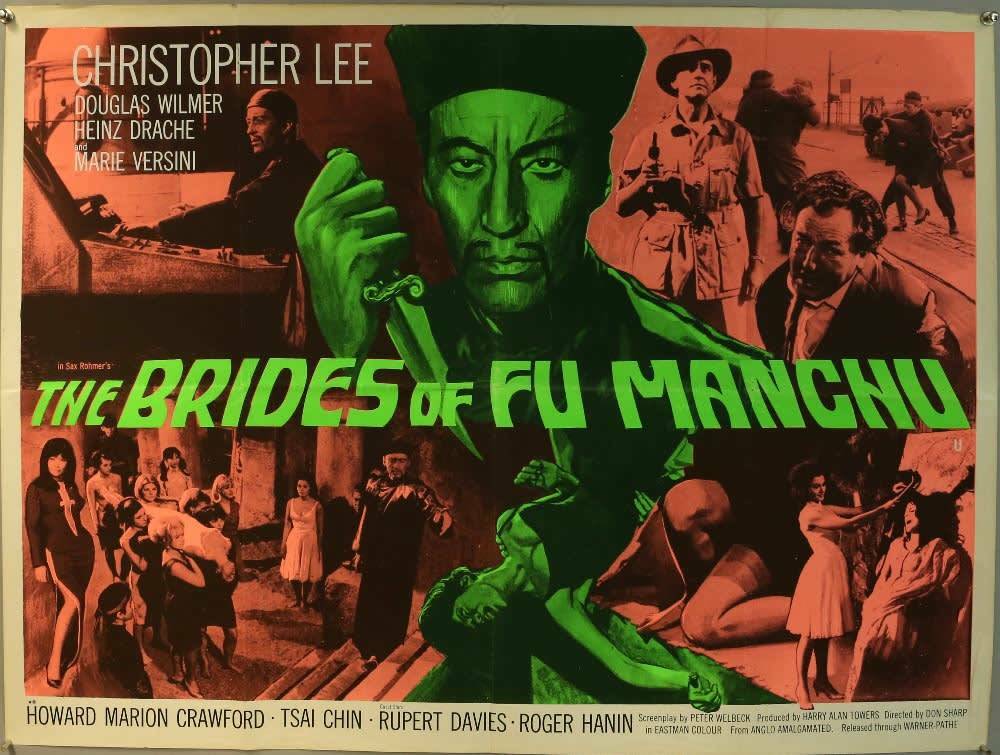
The Brides of Fu Manchu (1966) ****

The 1960s was awash with movie megalomaniacs, most courtesy of the spy vogue. You could also count on secret agents for trailing in their wake bevies of beauties. So no surprise then that criminal mastermind Fu Manchu (Christopher Lee) has his own gang, his “brides,” although they are hardly volunteers, being the kidnapped daughters of top scientists. His plan for global domination this time consists of transmitting energy as sound waves, using miniaturization, a sonic death ray, with enough power to destroy a city.

The result is good hokum, a thriller set in the 1920s with a cracking pace, plenty of action, explosions, burgeoning romance, and  plot that gets more complicated by the minute as a tribe of worthies try out to outwit the evil genius. There is a terrific lair – where the disobedient end up in a snake pit – a passable laboratory, chases, truth serums (“the dust that loosens tongues”), hypnotism, bait-and-switch tricks and decent special effects.  Three stories race along in a parallel pell-mell: Manchu needs one more kidnapping to complete his complement of daughters; the good guys headed by Fu Manchu’s old adversary Nayland Smith (Douglas Wilmer) are trying to locate the bad guy’s secret location while at the same time attempting to find out where he will strike next. 

While Fu Manchu is indestructible – supposed dead after the previous film – his henchmen (and henchwomen) are all too human. It takes three attempts to kidnap Manchu’s next victim. They are easily identifiable by their giveaway cummerbunds and bandannas and their method of assault is not kung fu but brawling so a good solid British punch of the old-school soon sorts them out. Manchu’s daughter Lin Tang (Tsai Chin) is a chip off the old block, delighted at any opportunity to torment the brides.  

The brides wear diaphanous gowns that might have been a job-lot from the set of She, but are far from compliant, even rebelling at one point, and employing vicious fight tactics. Fans of director Don Sharp will find him every bit as inventive as in The Devil-Ship Pirates and Bang, Bang, You’re Dead. It’s another Harry Alan Towers (written under his pseudonym Peter Welbeck) production so that means an international cast. Two television cops, British Rupert Davies (BBC’s Maigret) and German Heinz Drache (cop in a Francis Durbridge series), plus Francois Mitterand’s brother-in-law Roger Hanin, provide solid support. Not forgetting Burt Kwouk as a henchman. Brides of the Year include French Marie Versini (German western Winnetou, 1963) and Rhodesian Carole Gray (Curse of the Fly, 1965). The film did not prove much of a jumping-off point for other brides such as Ulla Berglin, Danielle Defrere and Anje Langstraat, for whom this debut was as far as their careers went.

Christopher Lee, despite the dodgy moustache, is resplendent, exuding evil, and with a gift for rising again (just like Dracula) as he would do for another three films in the series.

Note: The Devil-Ship Pirates and Bang, Bang, You’re Dead are reviewed on this blog.

Discover WordPress

A daily selection of the best content published on WordPress, collected for you by humans who love to read.

The Atavist Magazine

by Brian Hannan

WordPress.com Blog

News, Tips & Website Tutorials